-
Title
-
Walker Evans and Dan Graham
-
Description
-
The exhibition Walker Evans and Dan Graham took place at Witte de With and the Museum Boijmans Van Beuningen in Rotterdam. The two artists were considered simultaneously, yet separately, in order to bring attention to their similarities without hiding their differences.
American artists Walker Evans (1903-1975) and Dan Graham (1942) are separated by several generations as well as by the institutional divisions of art culture. Evans, considered one of the modern masters of photography, created the core of his oeuvre in the thirties. Graham belongs to the generation of conceptual artists which appeared at the end of the sixties. Both utilized photography to document and analyze architecture, urban life, and vernacular culture.
Walker Evans photographed American urban culture. In series such as American Photographs (1938), he systematically documented the archetypes and stereotypes of urban architecture, taking a special interest in the signs of the city and of commerce, and their violent hold on the environment. His work, documentary in style, resists commercial compromise as well as utopian and nationalist Modernism, aiming instead at sober, straightforward registrations.
Evans’s photography is related to the critical work Graham started in the sixties. Graham wished to return Pop Art to its place of origin, the media, and to synchronize artistic activity with its critical reception, and thus to identify the art object with its social production, where formalist doctrine tended to isolate it in a strict autonomy, carefully distanced from the sphere of media. The result was Homes for America, a photo essay published in Arts Magazine in 1966. In this work, the commentary is not a secondary reflection on a separate artwork; the work and the commentary are copresent in a single space of perception, which is that of information.
Graham’s photojournalism is indebted to Evans’s vision of America, with which he, like most artists of his generation, was very familiar. In Evans’s American Photographs, he recognized the paradigms of suburban urbanism: standardized houses, the architecture of commerce and communication in its mechanized form, common to the industrial world, and in its vernacular aspect specific to America. The very nature of the descriptive value of these images allows the assumption that Graham’s critical distance regarding conceptual art is analogous to the distance which Evans took from the documentary photography which was being practiced in his time.
The exhibition at Witte de With presented Dan Graham’s photographic work from 1965-1991, as well as his pavilion Interior Design for Space Showing Videotapes (1986). The exhibition at Museum Boijmans Van Beuningen showed photographs by Walker Evans from 1928-1968.
The exhibition traveled to the Musées de Marseilles, the Westfälischer Landesmuseum für Kunst und Kulturgeschichte in Münster, and the Whitney Museum of American Art in New York.
Participants
Walker Evans, Dan Graham
Curators
Chris Dercon
Network
Museum Boijmans Van Beuningen
<div class="
-
Identifier
-
KIM-EXH-4286
-
92_4
-
Type
-
Exhibition
-
Date
-
1992-08-29/1992-10-11
-
Temporal Coverage
-
1992
-
Publisher
-
Witte de With Center for Contemporary Art
-
Spatial Coverage
-
Rotterdam
-
Language
-
en
-
Is Part Of
-
Exhibition history
-
Rights Holder
-
Kunstinstituut Melly
-
Creator
-
Dan Graham
-
Walker Evans
-
Contributor
-
Chris Dercon
-
Relation
-
Museum Boijmans Van Beuningen
 The Lectures — 30.8.92 on Walker Evans by Craigie Horsfield Craigie Horsfield lectures on the work of Walker Evans
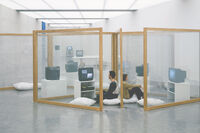 Walker Evans and Dan Graham — image 001 Dan Graham and Walker Evans (dan Graham, Interior Design for Space Showing Videotapes, 1987)