-
Title
-
Cosmoville / Hyde Park
-
Description
-
Both the exhibitions Cosmoville by Eleanor Bond and Hyde Park by Brandt Junceau were literally and figuratively about reconstruction. By creating depictions of fictitious histories, Bond’s paintings and Junceau’s sculptures re-invent the genre of the historical tableau.
Within the framework of Rotterdams celebration of fifty years reconstruction since World War II, Canadian artist Eleanor Bond (1948) was invited to work for a half year in the city on a new series of paintings on Rotterdam and its periphery.
Her project, Cosmoville, was in keeping with the nearly lost tradition of commissioning painters and photographers to visually record the growth and expansion of cities.
By way of fictitious documentation, Bond painted a possible future history of Rotterdam. Her panoramic paintings showed the city of Rotterdam in saturated, unnatural colors and from an unrealistic, aerial perspective. Carrying such narrative titles as Activity in the Inner Harbour Area Is Regenerated by the World Botanical Garden, Constructed with Recycled Materials from the Glass City, her works speculated on the outcome of Rotterdam’s continual reconstruction and transformation. Her urban landscapes lay bare the contradictions of architectonic and urban development solutions, emphasizing ecological and social problems while provoking the consideration of alternatives.
The Cosmoville series was shown in combination with an earlier cycle of paintings about Canada, entitled Social Centers (1989-91).
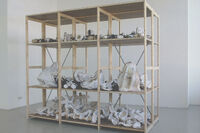
The exhibition Hyde Park by American artist Brandt Junceau (1959) was conceived as a historiographic project. It placed his work within the tradition of two predecessors, the American president Franklin Delano Roosevelt (1882-1945) and the artist Elie Nadelman (1882-1946).
During his presidency, Roosevelt designed a library complex to accommodate his presidential archives. He organized the site, at his birthplace Hyde Park in Dutchess County, New York, so that the total complex would represent an overview of American architectural styles, with the library building itself being an imitation of a seventeenth-century Dutchess County farmhouse.
Nadelman put together the largest collection of folk art and antiquities ever in the United States. After the Depression had forced him to sell his collection, he created a new collection of plaster figurines. The so-called Dolls were loosely modeled after reproductions from archeology books and clippings from newspapers and popular magazines, mingling fragments from different origins in each figure.
Without feeling restricted by historicity, both Nadelman and Roosevelt imitated historical collections through a living evocation of the past. Their subversive mimesis of historical scholarship was duplicated in Junceau’s exhibition by the mimetic character of his work. In Hyde Park, which took the form of a fictive museum, Junceau presented his own casts and their molds next to Roosevelt and Nadelman's imitations, as such confusing the notions of renewal and authorship, on which the traditional concepts of linear history and artistic innovation are based.
Participants
Eleanor Bond, Brandt Junceau
Curators
Chris Dercon
<div class="
-
Identifier
-
KIM-EXH-4161
-
95_5
-
95_6
-
Type
-
Exhibition
-
Date
-
1995-10-28/1995-12-23
-
Temporal Coverage
-
1995
-
Publisher
-
Witte de With Center for Contemporary Art
-
Spatial Coverage
-
Rotterdam
-
Language
-
en
-
Is Part Of
-
Exhibition history
-
Rights Holder
-
Kunstinstituut Melly
-
Contributor
-
Chris Dercon
 Cosmoville / Hyde Park — image 001 Eleanor Bond: Cosmoville/Brandt Junceau: Hyde Park