-
Title
-
Tony Brown — Downtime
-
Description
-
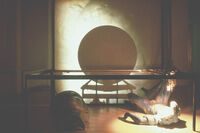
Canadian artist Tony Brown (1952) investigates the technological nature of late-twentieth century society. Keeping close track of the ongoing technological developments, Brown mixes industrial robotics, computer technology, information theory, visual art, cinema and architecture to explore technology’s impact on everyday life.
His installations confront the dream of what technology might bring with insight into how it really functions in society, revealing the relationship between technology and power. They always include an element of danger, a possibility of catastrophe. The title of the exhibition Downtime refers to the period in which computer systems are inactive because of failure.
The exhibition showed a survey of Brown's work, from the emphatically mechanical work Two Machines for Feeling (1984) to Better Living through Remote Access (1996), made especially for the exhibition at Witte de With, which takes on the new digital and communication technologies.
Both works address the involvement of technology in gender issues. Two Machines for Feeling plays male and female cliché images against each other by opposing the figure of a robot with a hologram of a kitsch ballerina. In Better Living through Remote Access, Brown logs into a direct Internet connection, a sex-chatbox, and projects the assumed names of the users as they log in, as well as the accompanying photographs they provide of themselves. While the former work focuses on the imposition of gender stereotypes, the latter shows how the Internet functions as a stage for constructing fictional identities.
Other installations, such as Chute Libre (1992-93) and Living in the Hot House (1993), address the modernistic pursuit of a standardization in living, with its inherent repetition and anonymity. In Living in the Hot House an open architectural model spins at high speed, becoming a screen on which images of the interior spaces in the construction – examples of cliché styles from the fifties to the eighties – and an ergonomic figure are projected. In Chute Libre, the spinning of an architectural structure rises to maximum speed, and is periodically slowed down only to speed up again. The same wind that makes the piece spin also pushes the viewer away, providing him with a metaphorical as well as physical sense of a system driven to the point of collapse or explosion.
Downtime online
At the occasion of the R96 festival, Brown created an Internet project that digitally reconstructed the entire Downtime exhibition at Witte de With. This project was the first interactive, three-dimensional animated exhibition on the Internet. With this virtual exhibition by Tony Brown, Witte de With started its exploration of the significance of the new media for contemporary art. The Internet project was realized in collaboration with Internet Providers Rotterdam and PTT Telecom, Rotterdam. A more technologically advanced and comprehensive rendition of the virtual exhibition Downtime is availabe on CD-Rom.
Participants
Tony Brown
Curators
Bartomeu Marí, Rutger Wolfson
Network
Württembergischer Kunstverein
<div class="
-
Identifier
-
KIM-EXH-4123
-
96_5
-
Type
-
Exhibition
-
Date
-
1996-09-04/1996-11-03
-
Temporal Coverage
-
1996
-
Publisher
-
Witte de With Center for Contemporary Art
-
Spatial Coverage
-
Rotterdam
-
Language
-
en
-
Is Part Of
-
Exhibition history
-
Rights Holder
-
Kunstinstituut Melly
-
Creator
-
Tony Brown
-
Contributor
-
Bartomeu Marí
-
Rutger Wolfson
-
Relation
-
Württembergischer Kunstverein
 Guy Brett on Kinetic art
 Tony Brown — Downtime — image 001 Tony Brown — Downtime (Lucille and Frank, 1995)