-
Title
-
The People’s Art
-
Description
-
The People’s Art is Bartomeu Marí’s farewell exhibition as director of Witte de With. In this exhibition, which includes work by twenty artists born or living in Holland, Marí reveals his perspective on Dutch art. The People’s Art was realized in a different version in Porto during Porto 2001, Cultural Capital of Europe.
The title refers to the notion of the Dutch consensus society where social questions, political decision-making and even the landscape are subjected to minute regulations through the mediation of broad-based consultative bodies and public inquiries. The People’s Art shows how Dutch artists deal with this ‘Dutch identity’. In contrast to the tightly organized environment in which they live, these artists produce images of agitation, social disorder and disturbed landscapes. Artificial rather than natural structures determine the landscape. Unwritten rules and norms rather than etiquette determine the behavior of its inhabitants.
The works on the upper floor are concerned with the artificial landscape. The taut lines of polders, canals and greenhouses in the photos of Gerco de Ruijter display the aesthetics of that landscape. Edwin Zwakman sees in this constructed landscape a reflection of the mentality of its makers – a mentality he then comments on in his work. His photographs of models of interiors and cityscapes are precise reproductions of parts of an already constructed reality. In the work of Frank van der Salm the opposite principle applies – things that look like models really are buildings and cityscapes photographed in detail or bird’s-eye view. Van der Salm does not produce these artificial images through manipulation or by staging them; instead he works with blurring, movement and artificial light.
Florian Göttke’s installations reveal his social commitment to his surroundings. He observes the way nature regains territory in parks and zoos. Real size models highlight a humorist exchange of culture and nature, but they are also the result of the artist’s despairing quest for authenticity.
Göttke’s work forms the transition between the upper and ground floors, where works focus on social structures. Humor and despair are also present in the behavior of the characters in the video’s by Aernout Mik and Anneke de Boer. Yet, while in Mik’s work alienation is embedded in everyday life, in De Boer’s work, this everyday life is deliberately staged. She stresses the artificial character of human behavior, without however offering criticism. The work of Julika Rudelius reaches in this respect further. She refers to problems such as xenophobia that originate in patterns of social intercourse and exposes our prejudices in ambiguous fashion.
Participants
Anneke A. de Boer, Aloysius Donia, Florian Göttke, Hein Hage, Mathilde ter Heijne, Philippine Hoegen, Rob Johannesma, Jeroen Jongeleen, Laurent Malherbe, Aernout Mik, Jeroen Offerman, Vanessa Jane Phaff, Jan Rothuizen, Gerco de Ruijter, Frank van der Salm, Peter Stel, Erik Wesselo
Curators
Bartomeu Marí
Network
Museu Serralves
<div class="
-
Identifier
-
KIM-EXH-3870
-
01_6
-
Type
-
Exhibition
-
Date
-
2001-12-16/2002-02-24
-
Temporal Coverage
-
2001
-
Publisher
-
Witte de With Center for Contemporary Art
-
Spatial Coverage
-
Rotterdam
-
Language
-
en
-
Is Part Of
-
Exhibition history
-
Rights Holder
-
Kunstinstituut Melly
-
Creator
-
Aernout Mik
-
Aloysius Donia
-
Anneke A. de Boer
-
Erik Wesselo
-
Florian Göttke
-
Frank van der Salm
-
Gerco de Ruijter
-
Hein Hage
-
Jan Rothuizen
-
Jeroen Jongeleen
-
Jeroen Offerman
-
Laurent Malherbe
-
Mathilde ter Heijne
-
Peter Stel
-
Philippine Hoegen
-
Rob Johannesma
-
Vanessa Jane Phaff
-
Contributor
-
Bartomeu Marí
-
Relation
-
Museu Serralves
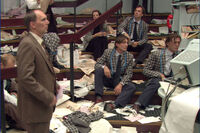 The People’s Art — image 001 Aernout Mik, Middlemen, 2