-
Afra Eisma: Poke Press Squeeze Clasp
Using craft techniques in novel ways, Afra Eisma explores and manifests personal stories through immersive and intimate installations made of textiles, sculptures, ceramics, and sound. Born and based in the Netherlands, inspiring her works are characters or imaginary friends that interweave sensuality with an intended lightheartedness. For 84 STEPS, the artist presents a specially commissioned environment designed to hold a variety of social activities, ranging from large-scale workshops to intimate conversations and educational activities. Responding to an increasing experience of uneasiness, isolation, and uncertainty, towards anything deemed extraneous to our familial environment, Eisma seeks to appease these maladies by fostering mutual understanding and shared experience through art.
Drawing on literature by influential female authors—amongst them, Audre Lorde and Ursula K. Le Guin—the artist interweaves characters drawn from her imagination with ideas provoked by their writing. Seeking to imbue the gallery with a certain liveliness and informality, Eisma creates a convivial gathering amongst alien beings, delighting in pleasures we are not yet able to amidst the pandemic, that of physical proximity, assembly, and embrace. Gathered around a floor tapestry, various environments are invoked; the domestic setting of a lounge or perhaps an outdoor campfire. Interlaced are a series of vessels: those figured within Eisma’s textile pieces, created from terracotta, and inferred by sound. The artist draws on the vessel as both a carrier and agent of imagination, thought, and feeling.
The artist would like to thank Mechteld Jungerius, who assisted in the making of the installation; Marnix van Uum, editor of the audio-work; and Nadie Borggreve, unofficial Head of the Alien Fashion Department.
Participants
Afra Eisma
Curators
Rosa de Graaf, Sofía Hernández Chong Cuy
Series
84 STEPS
<div class="
-
THE ORGAN
THE ORGAN is a playful space on the first floor, where we collect tactile and visual source materials from artworks presented in our exhibitions.
In THE ORGAN, visitors can immerse themselves in the practices of the exhibiting artists, engage with their materials, and learn about their thematic concepts and research frameworks.
Currently, THE ORGAN presents materials and sources connected to our ongoing exhibitions by Hajra Waheed, Basel Abbas and Ruanne Abou-Rahme, Riet Wijnen, AYO, Bani Abidi, Cinthia Marcelle, Felipe Mujica, Misheck Masamvu, Nohemi Perez, and Thierry Oussou
The materials and sources shown in THE ORGAN in 2025 were contributed by the artists exhibiting with us: donna Kukama, Marilyn Nance, Liz Johnson Artur, Madiha Sikander and Zara Julius, Cihad Caner, Jabu Arnell, Luana Vitra, Nolan Oswald Dennis and Sara Sejin Chang (Sara van der Heide), Ola Hassanain, Simnikiwe Buhlungu, and Paulo Nimer Pjota. In addition, materials related to the exhibition 35 Years Minds and Matter were presented.
Alongside source materials, artist-recommended books are displayed and available for purchase in our bookshop on the ground floor.
Participants
Hajra Waheed, Basel Abbas & Ruanne Abou-Rahme, Riet Wijnen, AYO, Bani Abidi, Cinthia Marcelle, Felipe Mujica, Misheck Masamvu, Nohemí Pérez, Thierry Oussou, donna Kukama, Marilyn Nance, Liz Johnson Artur, Madiha Sikander, Zara Julius, Cihad Caner, Jabu Arnell, Luana Vitra, Nolan Oswald Dennis, Sara Sejin Chang (Sara van der Heide), Ola Hassanain, Simnikiwe Buhlungu, Paulo Nimer Pjota
Curators
Gabi Ngcobo
<div class="
-
Guillaume Bijl: Für Garderobe keine Haftung
Guillaume Bijl’s Für Garderobe keine Haftung was Witte de With’s opening exhibition. In light of the newly created exhibition space at Witte de With, Bijl’s show could be seen as a critique of the spectacular and inflationary nature of fine art production as well as an ironical poke at the profusion of exhibitions and exhibition spaces. Guillaume Bijl’s exhibition at Witte de With presented a survey of his installations and objects from the eighties, in the form of a shopping mall.
Belgian artist Guillaume Bijl (1946) has been testing the relationship between art and consumer society since 1979, when he made his Art Liquidation Project. This work took the form of a mock government commissioned report in which he concluded that, in light of the proven uselessness of art, all areas devoted to the arts should be made suitable for more practical purposes. Since then, Bijl has been transforming museums and art galleries into fitness centers, lamp shops, carpet stores, travel agencies, driving schools, and so on. His imitations of spaces not traditionally associated with the arts are caught up in a perplexing interplay between fiction and reality. Even more confusion is caused by Bijl’s imitations of art spaces, such as his fictive exhibition Four American Artists (1987), or his fictive commercial fair installed at the art fair of Lyon in 1986, which also included an art store selling his paintings.
Bijl ironically points out the connection between the display of goods in shop windows and showrooms and the exhibition of objects in museums and galleries. In his installations, consumer items and museum objects seem interchangeable. Bijl’s logic assumes the complete abolition of real differences in the commercial rhetoric of consumer society.
Participants
Guillaume Bijl
Curators
Gosse Oosterhof
<div class="
-
Domenico Mangano & Marieke van Rooy: Dilution Cafeteria
The work of artist duo Mangano van Rooy is characterized by a combination of archival and field research and artistic practice. Micro-stories, and political and architectural constructions of the social, as well as research into the history of the local, forms the basis of their artistic inquiry. Combining archival research with educational projects, their work manifests across numerous mediums, including film, installation, photography, drawing, performance, and publications. Based in Amsterdam, the duo was formed in 2014. Before that, Italian born Domenico Mangano practiced as an artist since the late nineties, and Netherlands-born Marieke van Rooy developed a background in academia, with a focus on the political history of the built environment.
For 84 STEPS, the duo presents a newly commissioned work, the Dilution Cafeteria. The commission marks the latest iteration in their long-term series, The Dilution Project. Begun in 2014, this project centers on the subject of anti-psychiatry and the related democratic movement that unfolded during the 1970s in the Netherlands. The artists investigated what came to be known as the Nieuw Dennendal experiment, developed by psychologist Carel Muller in collaboration with the progressive architect Frank van Klingeren. Underpinning the experiment was the utopian notion of ‘dilution’. At its heart, was Muller’s insistence on the need to re-conceive the spaces and systems of psychiatric care to allow for the intermingling of in-patients with the local communities they were surrounded by. Faced with resistance on numerous counts, the experiment was never realized.
Their latest iteration, Dilution Cafeteria, develops a new facet of research into the concept of the ‘sensory cafeteria’. Developed in the United States in the 1960s, sensory cafeterias were designed as spaces in which to engage all the senses. Sited within care institutions, they were intended as environments in which to research in-patients with an “intellectual” disability. A decade later, the concept of these settings was employed in the Netherlands, adapted to focus on the positive effects of sensorial stimulation as opposed to operating as a site of scientific research. These were referred to as snoezelruimtes, which, to this day, the Netherlands takes a pioneering role internationally. Presented here, Mangano van Rooy seeks to borrow from this concept an emphasis on the way in which knowledge and experience is socialized through the senses. Comprising a cumulative installation of six glazed ceramic sculptures, and a charcoal mural in which a megaphone is incorporated, the installation presents complex inner labyrinths, which the artists’ refer to as “mental architectures.” Varying in color, form, and texture, the sculptures act as intermediaries, marking the occasion upon which the senses are registered. Over the course of the year, the installation will come to be activated in its capacity as a sensorial cafeteria, with special emphasis on sound and touch.
The artists would like to thank Sundaymorning@EKWC, Oisterwijk, where the glazed ceramics were produced in residence and Stichting Stokroos for their financial support.
Participants
Domenico Mangano & Marieke van Rooy
Curators
Rosa de Graaf, Sofía Hernández Chong Cuy
Series
84 STEPS
<div class="
-
Space for Education and Participation
A New Space for Education & Participation
We are proud to announce the brand-new Education & Participation Space at Kunstinstituut Melly: a vibrant and flexible environment dedicated to learning, meeting, creativity, and community exchange. Situated on the ground floor of our building, this space is designed as a visible and active pillar of our institution, ensuring that education, knowledge sharing, and collective learning remain central to our mission. Whether you’re a child, student, artist, educator, or visitor, this is a space for curiosity, care, and connection.
Holiday Passport 2026 - Doing as Drawing
Join us this summer at Kunstinstituut Melly and discover the many possibilities of thinking through drawing. From 18 July to 30 August, children aged 4 to 12 can take part, free of charge, alongside their parents or carers, in an adventurous art programme full of play, imagination and discovery.
Free Saturday Workshops & Collective Learning
Since the opening of our Education & Participation Space, Kunstinstituut Melly has become a lively setting for workshops, talks, and collective learning. Artists, educators, and participants of all ages and backgrounds come together to explore creativity as a shared, evolving practice.
Our Saturday workshops provide a space for experimentation and connection. In January 2026, during Nurdan Ariöz’s workshops, participants engaged with storytelling, visual arts, color, drawing, writing, and movement, contributing to a collective story archive: a living artwork that preserves each person’s presence and voice. In February 2026, during Sabrina Schoop’s workshops in Poetic Diaspora, participants explore language, words, and personal memories, creating poetic fragments that weave together identity, memory, and multilingual expression. In March 2026, the workshop series Tip of the Tongue, led by Veronika Babayan, explores multilingualism, migration, and memory through dried fruit. Participants create fruit chains inspired by expressions from different languages, reflecting on care, loss, humour, and change. Language becomes something you can see, touch, and assemble. Come experience a language that cannot be expressed in words! Nurdan Ariöz led the free Saturday workshops in April 2026. What You Haven’t Said Yet was an open spoken word workshop in which personal stories were made visible through image, text, and voice. The workshop series consisted of three sessions that could be followed independently, in which participants explored different ways of writing: from collage, from a personal object, and through an ode to an unseen talent. During the Saturday workshops in June, led by Thijmen Burgerhout, participants create race numbers, banners, medals and trophies that celebrate non-performance – something of great value, particularly in today’s results-oriented society, where speed, productivity and visibility take centre stage. In a playful, sporty setting, the pressure to perform is turned on its head, creating space for doubt, calm and the rediscovery of one’s own worth and meaning. In July, Conform Cox will host a series of three free Saturday workshops where we’ll draw, imagine, and rethink the world around us, taking inspiration from the exhibition Draw Withdraw Redraw. Each workshop explores a question related to improving our everyday lives. In the first workshop, we’ll reimagine the human form; in the second, we’ll rethink our own living spaces; and in the third, we’ll turn our attention to Rotterdam. The workshops are part of Holiday Passport 2026 – Doing as Drawing. The second Free Saturday Workshop series of Holiday Passport 2026 – Doing as Drawing – will be hosted by Carmen José this August. In Emotional Trees in a Collective Forest, we will explore drawing beyond the academic canons of control and violence over the course of two Saturdays. Together, we will create a vibrant forest on large textiles, culminating in a collective installation hanging from the ceiling. The final free Saturday workshops as part of Holiday Passport 2026 – Doing as Drawing will be led by Elina Charinti. Cultivating Acts of Courage is a series that explores courage as a way to move forward, to refuse to conform and to find new paths. Using felt, drawings and natural materials, participants reflect on memories, values and communities, and create tangible objects that embody courage, resilience, care and hope. Courage becomes something that can be made, seen and touched! During the free Saturday workshop series in September, What comes to mind when I say…?, we’ll be exploring drawing with Jip van der Hek as a way of leaving our mark whilst also making space for others. Drawing together creates a constant interplay between the individual and the collective. How can we develop a visual language that does justice to the complexity of the city, where people and animals, visibility and invisibility, and different perspectives come together?
CLiP #7: The Garage School of Prepping Otherwise
Collective Learning in Practice (CLiP) is the successor to Kunstinstituut Melly’s successful Work-Learn Project (2018) and has run six editions to date. CLiP gives participants the opportunity to study contemporary art issues and work with our team to make the institution more publicly accessible. Each edition supports 10–14 young participants with the tools, skills, and inspiration to grow as individuals, decision-makers, and professionals through a six-month study period. This year, CLiP returns with its seventh edition: The Garage School of Prepping Otherwise. Over six months (October 2025 – March 2026), a group of Rotterdam-based participants aged 17–24 is exploring what it means to survive together in times of global crises, militarisation, and social inequity.
Curators
Emilia Aivazian, Camille de Bruin
Series
Collective Learning, CLIP, Tools for Collective Learning, TRAININGS, Workshops and Collective Learning, Monthly Open CLiP Sessions
<div class="
-
John Knight — Some Works
The exhibition Some Works comprised 15 works by John Knight, made between 1969 and 1990, including Levels and The Journal Series.
Since 1969, American artist John Knight (1945) has concentrated on the relationship between architecture, design and art. He bases his work on the interplay between the material object and its contextual conditions, and comments on the meaning of cultural object and cultural space by employing strategies that invert the conventions of production and reception.
Knight’s early sculptural work, such as Levels (1969), deliberately set itself apart from the innovations of the early sixties of such Minimal artistsas Carl Andre, Dan Flavin and Sol LeWitt. Consisting of carpenter levels arranged on the floor, Levels referred to the basic, reduced shapes of Minimal sculpture, and at the same time engendered an interchange with its physical setting. Employing actual tools of representation as well as of construction, Knight’s works do not merely refer to their site. They incur an overt dialogue with their site, providing a reading of the one in terms of the other.
By the second half of the seventies, Knight extended the concept of location to a consideration of the work’s place within a cultural system. He started investigating representational systems in conjunction with art and non-art support systems. The Journal Series (1978), for example, transformed a non-art object, a magazine, into one that could gain artistic status in a specific artistic context. In this project, Knight mailed 100 gift subscriptions of glossy popular journalsm to friends and acquaintances. The recipient determined whether his subscription was art, interpreting it either as a work by Knight or as an ordinary magazine. With The Journal Series, Knight re-presented existing, non-art representations within the framework of art in order to explore the point at which art and non-art systems overlap, and to investigate the factors that determine an object’s status and worth.
Participants
John Knight
Curators
Chris Dercon
<div class="
-
Feminist Health Care Research Group: A Special Issue in Power
Founded in 2015, the Berlin-based Feminist Health Care Research Group (FHCRG) has focused on collective ways of dealing with crisis and mutual care structures. FHCRG currently consists of the artist, bodyworker, and mother Julia Bonn, and artist, curator, care-assistant, and mother Inga Zimprich. With a strong research-based social practice, they are interested in the political meanings of illness and aim to politicize health care systems.
For 84 STEPS, artist Inga Zimprich of FHCRG presents a newly commissioned work centering around Radical Therapy (RT). Developed in the late 1960s by therapists and activists in the United States, RT was a movement that sought to democratize and de-professionalize therapeutic tools as a means for social empowerment and political change. Their primary node of dissemination was the newspaper The Radical Therapist. By initiating problem-solving groups for women, Marxist feminist Hogie Wyckoff developed a framework that aimed to challenge sexism at the outset of Radical Therapy groups. In 1975 the feminists Gail Pheterson and Lillian Moed facilitated three-week-long training sessions for groups of Dutch feminists in the Netherlands. Pheterson and Moed combined two different methods in these workshops: RT and Re-evaluation Counseling. From these initial trainings, Feministische Oefengroepen Radikale Therapie (FORT) emerged, forming a grassroots movement of feminist RT exercise groups that grew in numbers in the Netherlands.
Zimprich’s display unfolds through a studious environment for contemplation, interweaving historical footage from RT and FORT, including interviews with its early protagonists as well as contemporary practitioners. Tracing the development of FORT, Zimprich invites the public to consider methods of political and intersectional analyses that could revive RT practices today.
This installation was made possible courtesy of Collection IAV-Atria, Institute on Gender Equality and Women’s History.
Participants
The Feminist Health Care Research Group (Inga Zimprich)
Curators
Rosa de Graaf, Sofía Hernández Chong Cuy
Series
84 STEPS
<div class="
-
Riet Wijnen: Suitcase Economy
With Linda van Deursen, Waysatta Fernández with Salvador Núñez from Mono Rojo, Fat Crayon Creative/Jari Nuno, Ima-Abasi Okon, and Jan Wijnen.
Suitcase Economy is the third edition of Tools for Conviviality, a framework in which we continue our work of reimagining our MELLY ground-floor bookstore, café, and event space as a welcoming, free, social area. With evolving artistic interventions, the space invites gathering, listening, meal-sharing, conversing, and creating together.
An experimental canteen, Suitcase Economy, is a year-long project developed by artist Riet Wijnen in collaboration with fellow artists, designers, and family. The project is shaped by the movement of produce carried in suitcases from one place to another, inspiring a bartering of food products whose lifespan is extended through methods of fermentation or preservation. During workshops and study sessions, these processes of transformation will be extrapolated to think about history, territory, and health.
A yellow triangular structure cuts the canteen into sixteen lines. The structure is inspired by Riet’s ongoing series Sixteen Conversations on Abstraction, a project that investigates overlooked and not yet known histories of abstraction. In this series, location is represented by yellow, while time is depicted by green.
The stackable sculptural tableware relates to the practice of the late Lebanese artist Saloua Raouda Choucair (1916-2017). Riet embodies formal aspects and methodologies that Choucair applied in her work. She is interested in how the
omnipresent traditions of fermentation and preservation extend the lifespan of agricultural products, and what this teaches us about the maintenance of histories across time and place.
Rotterdam-based fashion brand Fat Crayon Creative transformed the Boomgaardsstraat window into a ‘backdoor’ of Suitcase Economy, similar to how informal economies avoid super-markets and customs. The canopy welcomes the relations and economies moving into the space. Designed by Linda van Deursen, the labels, recipe cards, and a bag with credits documenting these informal networks as they are developing over time.
Waysatta Fernández created drawings for the canteen’s fermentation pots, thrown by Salvador Núñez from Mono Rojo. The drawings extend Waysatta’s understanding of territory through processes of interdependence, symbiosis, and diversity. Countering a longstanding tradition of transforming territory into property, fermentation, and preservation support self-sustainability and resist the capitalist logics of food production.
Ima-Abasi Okon is interested in the potential of the fermentation process to draw out and make available the healing properties of plants, attending to alternatives to the health industrial complex, which is reputed to be violent. With Riet, she will develop a series of kombucha-based fermented hot sauces as condiments for Suitcase Economy.
On the wall, ceramic clocks by Riet alternate with drawings by her farmer father Jan Wijnen made during his years of suffering from manic depression while turning toward biodynamic farming. Farm-related imagery is alternated with depictions of his own time and the experience of running out of time, as in one of his paintings titled ‘No Time’.
Bring your lunch, enjoy the condiments, and order homemade staples of Suitcase Economy like elderflower, and rhubarb syrup!
Knives and pans are gifted by BARE Cookware. The tableware of Suitcase Economy is supported by Mondriaan Fund, Amsterdam Fund for the Arts, and European Ceramic Work Centre. Suitcase Economy is supported through funds from Droom en Daad Foundation.
Monthly Suitcase Economy Brunch
Monthly Suitcase Economy Brunch is a testing ground for experimenting with relationships, translation, economic models, transformation and time through the preparation and serving of food. In this series, artist Riet Wijnen is developing a method to build connections among different local daily contexts, past and present, by researching local histories of preservation and fermentation.
Participants
Riet Wijnen, Linda van Deursen, Waysatta Fernández, Salvador Núñez, Jari Nuno, Ima-Abasi Okon, Jan Wijnen
Curators
Gabi Ngcobo, Honey Kraiwee
Network
Droom en Daad Foundation
Series
Tools for Conviviality, Monthly Suitcase Economy Brunch , MELLY Bookshop & Café
<div class="
-
Julio Galán en Guillermo Kuitca
The exhibition of Guillermo Kuitca and Julio Galán presented the work of two Latin American artists. Both come from the periphery of the Western art world and yet are connected to its modernist tradition and are essential to its survival. The exhibition sought to investigate the position of non-Western artists in the context of contemporary art.
Through a personal mythology, Argentinean artist Guillermo Kuitca (1961) expresses the common experience of anonymity and isolation. Kuitca first painted apocalyptic theatrical spaces, which were related to his activities as a theater director. In these paintings, diminutive human figures are confronted with enormous spaces as an expression of existential “angst” and light is manipulated for specific purposes: one does not know where the light ends and darkness begins. In later works, he transforms the theater stages into architectural plans. Inspired by the novel The Lost Language of Cranes by David Leavitt, about a middle class family in New York, Kuitca used their apartment as a prototype for his floor plans and used the story of the family’s son, an alter ego, to express the conflicts that arise in the search for personal identity. For Kuitca the floor plan is a symbol for The Place, a physical context to contain and reflect upon memories, emotions, and stories. He further continued his exploration of the self in a series of maps of cities and countries painted on mattresses and benches, which serve as metaphors for vulnerability, sexuality and dreams, as well as the psychoanalyst’s couch.
The paintings by Mexican artist Julio Galán (1959), rooted in the style of ex-votos and colonial retablos, are sophisticated records of personal emotions and memories that are full of complex iconographical references. His Niño Dios (Christ Child) (1986), for example, looks like a devotional icon, but sacredness is replaced by a sublimated feeling of personal identification and vulnerability. Galán, like Kuitca, uses a specific sense of place to represent a psychic state; his images are situated in another world, in an order of pre-birth, post-mortem and dream state. While Kuitca’s desolate apartments seem to remain within the boundaries of the surface of the world and of its unlivable nature, Galán’s oniric images suggest that art can be both a form of suffering and one of healing.
This exhibition, which was the first European presentation for both Galán and Kuitca, comprised about twenty works from 1985-1990 by each painter.
Participants
Guillermo Kuitca, Julio Galán
Curators
Chris Dercon, Gosse Oosterhof
<div class="
-
Lisa Tan: Waiting Room of a Psychologist and a Neurologist
For years, Lisa Tan has researched ways in which images, language, and spaces shape one’s subjectivity. Born in New York and raised in West Texas, she relocated to Stockholm where she works as Professor of Fine Art at Konstfack University College of Arts, Crafts, and Design. Creating work with video, photography, text, installation, and other gestures, she regularly draws from literature, literary theory, and the history of photography. Her own experiences of desire, loss, and otherness, fuel explorations into consciousness, the formation of individual subjectivity, and the role that different representations play in shaping a person’s relationship to the world and to others.
For 84 STEPS, Tan presents an existing installation from 2019, including photographs that document the framed art found in the waiting rooms of two different physicians: a psychologist and a neurologist. The images sourced from these waiting rooms are reproductions of paintings and drawings by artists both notable (Leonardo da Vinci, Paul Klee, Henri Matisse, and Claude Monet) and otherwise (John Wipp and Terence Warren). The artist regards waiting rooms as an interstitial space par excellence, harboring people in sickness and good health. In their unemotional and distanced documentation, the photographs perform a kind of rehabilitation in which the notion of the waiting room becomes more apparent, as do the lives of the images themselves. Each image has run through a sequence of exchanges since their making, circulating in art’s hierarchies and value systems, before ending up in a waiting room. Presented for this iteration is a series of letters the artist received from her former general physician, Dr Bamberger. Together with Tan’s photographs, they speak to feelings, hypotheses, and insecurities, contemplated within such transient spaces of hope and apprehension.
Participants
Lisa Tan
Curators
Rosa de Graaf, Sofía Hernández Chong Cuy
Series
84 STEPS
<div class="
-
Basel Abbas & Ruanne Abou-Rahme: Prisoners of Love: Until the Sun of Freedom
Spring 2026 at Kunstinstituut Melly
This spring, Kunstinstituut Melly presents a new season of exhibitions opening across April and May 2026. On 18 April, two solo exhibitions open as part of the ongoing series Call & Response. A group exhibition, Draw Redraw Withdraw, will follow on 23 May.
Call & Response
Call & Response brings artists into proximity whose practices resonate with one another. The series reflects Kunstinstituut Melly’s commitment to supporting artists whose work engages with geopolitical demands while imagining new possibilities. This season presents exhibitions by Hajra Waheed and by Basel Abbas and Ruanne Abou-Rahme. In both, the artists situate viewers within ongoing conditions that call for sustained attention and attunement, attesting to sound as both a political and liberatory force.
Prisoners of Love: Until the Sun of Freedom
Opening 18 April 2026
Basel Abbas and Ruanne Abou-Rahme create multimedia installations that engage the politics and poetics of anti-colonial resistance while tracing struggles against dispossession and oppression in Palestine. Working together since 2007, their practice combines moving image, sound, and text to explore how histories of resistance are carried across time.
Prisoners of Love: Until the Sun of Freedom draws on a process of study: learning with and from former Palestinian prisoners, poets, revolutionary thinkers, and the many practices of refusal that continue to shape daily life in Palestine. Through this approach, the installation traces connections across generations, approaching resistance as an ongoing practice of study while acknowledging a broader indebtedness to those who have resisted before us.
In this new commission, Basel and Ruanne ask: what does it mean to resist in impossible conditions, to breathe where one should not breathe, and to emerge from sites of exclusion unbound? Writing, storytelling, and song emerge as life-affirming acts that sustain the capacity to continue resisting, even within conditions designed to confine the body and imagination. Through the sampling and layering of moving image and sound, the pair construct what they describe as “new scripts,” forming a poetics of resistance.
Prisoners of Love: Until the Sun of Freedom is co-commissioned by Kunstinstituut Melly in collaboration with The Bell / Brown Arts Institute, Brown University; MACBA Museu d’Art Contemporani de Barcelona; and Nottingham Contemporary.
Participants
Basel Abbas & Ruanne Abou-Rahme
Curators
Gabi Ngcobo, Rosa de Graaf, Aïda Sidhoum
Network
Ammodo
Series
Call & Response
<div class="
-
De Afstand (Distance)
The exhibition De Afstand (Distance) presented “distant,” documentary photography by eight artists. In this exhibition, Witte de With sought to contribute to the discussion about the relationship between photography and the visual arts.
De Afstand investigated the relationship between photography and reality, by way of the concept of distance. The selected works focused on the representation of nature. Historically, the genre of the landscape painting had presupposed a specific viewing distance as well as the display of a changing continuity and unity in a tableau. The camera, however, cannot present such a unifying picture of nature. It cannot keep a distance. It functions rather as an analytical instrument, cutting like a scalpel into the continuity of the visible world. This is why the artists of the twenties, in particular the German photographer Raoul Hausmann, gave priority to the structuring of things over their appearance. To describe was no longer simply to represent things as they present themselves to us, but to reveal their internal structure, thus, to arrive at the law through the example. The photographic landscape became a “piece of nature.”
Participating artists were: Jean-Marc Bustamante (1952), Paul-Armand Gette (1927), Andreas Gursky (1955), Raoul Hausmann (1886 – 1971), Craigie Horsfield (1949), Jean-Luc Moulène (1955), Thomas Struth (1954), and Christopher Williams (1956).
The core of the exhibition consisted of a little known series of landscape photographs by Raoul Hausmann, which were shot between 1927 and 1933 at the coast of the Baltic Sea and the Pommeren region in Germany. These works are pure photographic registrations of nature, that immobilize a momentary state of things. The photographic works by the other artists were grouped around this series. In contrast to Hausmann, however, these contemporary photographers try to produce photographic tableaux. Their landscapes are created in a documentary form that is aimed at keeping a critical distance.
Participants
Jean-Marc Bustamante, Paul-Armand Gette, Andreas Gursky, Raoul Hausmann, Craigie Horsfield, Jean-Luc Moulène, Thomas Struth, Christopher Williams
Curators
Chris Dercon
<div class="
-
Moosje M Goosen and Daily Practice (Suzanne Weenink): On Wards Inwards
On Wards
43 sheets of inkjet on paper
Courtesy Moosje M Goosen
Inwards
Wooden meditation floor, wooden bench
Courtesy Daily Practice
Meditation cushions by Nienke Terpsma
In March 2017, following four years of illness, Rotterdam writer Moosje M Goosen underwent surgery for a life-saving bilateral lung transplant. Only hours earlier, while her close friend Suzanne Weenink happened to be visiting, did the doctor announce news of a donor match. The next day, Goosen was breathing through different lungs and has since gone on to reflect on this formative experience through her writing and meditation practice. Most especially, drawing attention to the deep connectivity with people both familiar and unknown, and with the living and the dead.
In March 2020, Suzanne Weenink invited Goosen to present her writings, however tentative, at Daily Practice. Located in Rotterdam West, Daily Practice was founded by Weenink the year prior, as a space for meditation and exhibitions, and through which to explore notions of hospitality and generosity. Titled On Wards: Dispatches from a hospital bed, the exhibition comprised a text work of 40 pages, accompanied by a series of meditation cushions created by Rotterdam-based artist and researcher Nienke Terpsma. Opening as the Covid-19 pandemic took hold here in the Netherlands, the exhibition remained on view, decidedly open-ended, until it was safe for Goosen herself to attend. Furnished with a specially designed wooden floor fit for meditation, and a new series of meditation cushions created by Terpsma, On Wards Inwards seeks to create the conditions for a state of mind in which acceptance can emerge, however able or fragile a body may be.
Since last year, this space has been activated and complemented by various actions and gestures, both discrete and public, individual and collective. Such activations include bi-weekly meditation sessions, as well as silent meditation retreats marking the arrival of Winter, Spring, Summer, and Fall. These sessions foster attention to turn inward, and to notice reactions and feelings as they arise and cease within and around us over time. Additionally, Weenink regularly comes to the gallery to personally sweep the floor, collecting the dust from the weeks past. She does so as a way to deepen her connection with the space over time—a kind of meditative practice, breathing with the installation. This gesture Weenink also regards as a form of welcoming, preparing the meditation floor for future visitors.
Participants
Moosje M Goosen, Daily Practice (Suzanne Weenink)
Curators
Rosa de Graaf, Sofía Hernández Chong Cuy
Series
84 STEPS
<div class="
-
Draw Withdraw Redraw
Opening 23 May 2026
Draw Withdraw Redraw, a group exhibition featuring work by AYO, Bani Abidi, Cinthia Marcelle, Felipe Mujica, Misheck Masamvu, Nohemi Perez, and Thierry Oussou.
To draw, drawing from, drawing with, drawn to, to being drawn in, a draw–returning to the drawing board as a space to rethink and make new plans for a desired waywardness.
Drawing to leave a mark on paper, on fabric, on the ground […] drawing to create movement [...] drawing to extract [...] drawing in the game of chance [...] drawing to neither lose nor win [...] Departing from the extended sense of drawing, Draw Withdraw Redraw foregrounds recognition, resistance, and reinvention.
To draw withdraw redraw situates us in a state of ongoingness, returning to the same that is not the same. Movement seeks flight without yearning to land. There is constant negotiation, chance-taking and self-preservation, because we never left drawing… because drawing is where we can always pull from…To draw, drawing from, drawing with, drawn to, to being drawn in, a draw.
Participants
Nohemí Pérez, Bani Abidi, Felipe Mujica, AYO, Cinthia Marcelle, Misheck Masamvu, Thierry Oussou
Curators
Gabi Ngcobo, Honey Kraiwee, Alicia Grobholz
<div class="
-
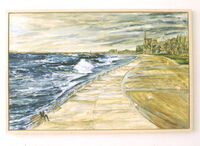 The ten artists which came to my mind at 7 pm on May 3, 1990
Die zehn Künstler an die ich am 3. Mai 1990 um 19.00 Uhr gedacht habe (The ten artists which came to my mind at 7 p.m on May 3, 1990) curated by the first artist invited to curate an exhibition at Witte de With, Jiri Georg Dokoupil, included some of his own works as well as drawings, paintings and photographs by Roberto Cabot, David Deutsch, Robert Greene, Otto Mühl, Joan Nelson, Andres Serrano, Antonin Strizek, Alice Stepanek / Steven Maslin and Victor Pivovarov.
Each year, since its inception in 1990, Witte de With has invited an artist to curate an exhibition. Witte de With encourages each guest curator to develop his project according to his own personal choices so that the resulting exhibition offers the audience another vision, independent of the center’s own program.
The first artist invited to curate an exhibition at Witte de With was Jiri Georg Dokoupil (1954). Dokoupil’s exhibition entitled Die zehn Künstler an die ich am 3. Mai 1990 um 19.00 Uhr gedacht habe (The ten artists which came to my mind at 7 p.m on 3 May 1990) included some of his own works as well as drawings, paintings and photographs by Roberto Cabot (1963), David Deutsch (1943), Robert Greene (1953), Otto Mühl (1925), Joan Nelson (1958), Andres Serrano (1950), Antonin Strizek (1959), Alice Stepanek (1954) / Steven Maslin (1959), and Victor Pivovarov (1937).
In spite of their completely different backgrounds, Dokoupil brought these artists together because of their common use of reality as a point of departure and their reference to the traditional genres of the landscape and interior. In contemporary art, working after nature, according to Dokoupil, is going against the laws, playing with them, exaggerating them and changing them. By presenting contemporary landscapes and interiors, the exhibition explored the status of representation as a subjective processing of “reality.”
Participants
Roberto Cabot, David Deutsch, Jiri Georg Dokoupil, Robert Greene, Steven Maslin, Joan Nelson, Victor Pivovarov, Andres Serrano, Alice Stepanek, Antonin Strizek
Curators
Jiri Georg Dokoupil
<div class="
-
RA Walden: xây ithřa, a pledge
Over the years, Germany and UK-based artist RA Walden has created work that explores the vulnerability of the body. Most recently, they have sought to disturb overly simplistic understandings of the disabled body, looking to bring into conversation with their work an ethics of care. Their practice spans installation, printed matter, performance, video, and coded arduino control systems, all of which they develop through a socially-engaged and research-led methodology.
For 84 STEPS, the artist presents a newly commissioned work, furthering their interest in the generative potential of access. Walden has done so through their creation of a new language—xây ithřa—initiated in response to the ableism and restrictive nature of English language. Formulated by the artist over a period of months in close collaboration with a linguist, xây ithřa exists as a 300+ word lexicon, complete with a basic grammar, confirmed phonology, and an ever growing set of idioms. Drawing on rich histories of queering lexicon—from argots and cants, to anti-languages and the use of constructed language within Sci-Fi and speculative fiction—Walden seeks to bring fluidity, ease, and “access intimacy” to those in sick, disabled, and trans bodies.(1) The artist uses world-building, not as a visionary tool for an imagined future, but as an embodied methodology for the present.
On a material level, presented in this gallery are a series of eleven statements that illustrate the fundamental concepts of the language. Each uses words describing elements and conditions of the earth to describe experiences of the human body. Created in relief, and accompanied by a sound-work, the language exists to be experienced through sight, hearing, and delicate touch. Accompanying the work, is a leaflet to be adopted as a guide through meaning, and a series of publications that offer a more in-depth exploration of xây ithřa and its methods of connection-building. An audio description of the work, as well as large-format text handouts, are available upon request.
1. The artist uses the term “access intimacy,” as one developed by the writer, educator, and community organizer Mia Mingus. Published in 2011 in her blog ‘Leaving Evidence,’ Mingus describes access intimacy as an “elusive, hard to describe feeling when someone else gets your access needs.”
Participants
RA Walden
Curators
Rosa de Graaf, Sofía Hernández Chong Cuy
Series
84 STEPS
<div class="
-
You will find us in the best places: a survey exhibition of Moshekwa Langa
On October 24, Kunstinstituut Melly will open You will find us in the best places, a major survey exhibition of South African artist Moshekwa Langa. Featuring nearly 120 works from the past three decades, the exhibition will occupy the entire building, making it the largest overview of Moshekwa’s work to be presented in the Netherlands, where he has lived for more than 25 years.
Emerging in the early years of post-apartheid South Africa, Moshekwa belongs to a generation of artists who worked with the new enthusiasm sweeping through the country at the time and the curiosity toward a world that was opening up after decades of international solidarity through cultural sanctions and boycotts. His work was widely exhibited at international biennials beginning in 1997 with his participation in the Johannesburg Biennale, the Havana Biennial, and the Istanbul Biennial, and followed by biennials in São Paulo (1998 and 2010), Gwangju (2000), and Venice (2003 and 2009). In 1997, Moshekwa moved to the Netherlands to join the Rijksakademie van Beeldende Kunsten residency, where he sought an international artistic community that would challenge and inform his practice, while allowing his work to remain resistant to easy categorization. His meteoric rise was due in part to his fearless handling of materials from his immediate environment. Using what is considered banal and “everyday” to create complex imagery, his work is characterized by wit and irreverence, while his astute awareness of material is reflected in the layers of meaning that emerge through repeated encounters with unconventional materials such as coffee, nail polish, lipstick, staples, yarn, car varnish, newspaper, coal, refuse bags, and tape.
Having grown up in Bakenberg in the province of Limpopo, Moshekwa later encountered official South African maps that did not feature his hometown. His recurring interest in mapping reflects apartheid South Africa’s selective cartographies and has informed a conceptual concern with the politics of landlessness, mapping, and borders. These concerns take different forms throughout his oeuvre, from lines woven across paper to installations of spools of thread, bodies of water, childhood memories and observations of a landscape shaped by history.
Rather than reaching conclusions, ideas in Moshekwa’s practice return, repeat, and begin again. Works may start and only be finished years later; chronology and linearity are not employed, things begin again, beginnings are continuous, and instead of conclusions there are pauses and ellipses. Time is nebulous and elastic.
Curated by Gabi Ngcobo, director of Kunstinstituut Melly, with curator Kabelo Malatsie, You will find us in the best places offers a pause to reflect on Moshekwa’s practice across three decades. The exhibition is choreographed to reveal recurring themes, questions, and interests, marking time not linearly, but through their continuous unfolding across Moshekwa’s practice.
Publication
A new publication, edited by Gabi Ngcobo and Kabelo Malatsie, and published by Kunstinstituut Melly and Medupi Publishing (Cape Town) will accompany the exhibition. Reflecting the layered and exploratory nature of Moshekwa’s practice, the book will bring together contributions from writers, artists, historians and poets, including Munganyende Hélène Christelle, Nolan Oswald Dennis, Marlene Dumas, Amogelang Maledu, Maneo Mohale, Uhuru Phalafala, Philippe Pirotte, Tracey Rose, Irene V. Small, Gilane Tawadros, and others. Scheduled for release in late March 2027, the book will launch with a dedicated public program during Rotterdam Art Week at Kunstinstituut Melly. The program will feature conversations, performative readings, and listening sessions.
Participants
Moshekwa Langa
Curators
Gabi Ngcobo, Kabelo Malatsie
<div class="
-
Voorwerk 1
Voorwerk 1 was the first exhibition in a yearly recurrent series. Voorwerk, meaning preliminary work, is Witte de With’s annual exhibition of younger artists. As a series, it seeks to provide the first substantial presentation of works by relatively unknown artists. Within the art world’s tendency to formulate relationships, Voorwerk is a peripheral event, captivating because of the heterogeneous character of the work. There are no common denominators or themes in these exhibitions, rather the artists’ works and ideas are left open for comparison.
Voorwerk 1, the first in the Voorwerk series, presented works by Italian artist Doriana Chiarini (1952), Dutch artist Aernout Mik (1962), British artist Fiona Rae (1963), and American artist Kay Rosen.
Doriana Chiarini presented elegant objects that mixed design and art. Miniature chairs cut out of paper and doll furniture were paired with large, abstract sculptures that functioned as pedestals. Chiarini’s combination of materials and historical styles of design and fine art rendered a rather personal breed of minimal sculptures.
Aernout Mik combined sculpture and photography. He showed his Dummies series which consists of cushions from photographic linen, loosely modeled after the human body, that are photographically printed with children’s portraits taken from the history of photography. Each dummy bears a porcelain plate, printed with a photograph of a landscape or city which functions as a personal souvenir, as a commemorative of a special memory. These private images seem to reveal traces of the personal histories of the unknown children, who feature on the photographic skins of the dummies.
Fiona Rae presented abstract paintings, combining primary colors into a range of atmospheres. She loads her paintings with ironical references to the history of abstract painting, quoting from Kandinsky and Mondrian, and commenting on the loss of meaning in painting.
Kay Rosen’s textual paintings reveal visual jokes, taken from sayings, pulp novels, telephone directories, etc. Breaking down grammar and disfiguring words, Rosen aims to encode meaning, then engender reading. Her paintings of language create a fine tension, holding together visual and verbal, sense and nonsense. By playing with syllables, as in “bullet/riddl-/ed ed/shot/back” or “NO/NO/AH AH/NO/AH,” meaning is consciously liberated and altered.
Participants
Doriana Chiarini, Aernout Mik, Fiona Rae, Kay Rosen
Curators
Gosse Oosterhof
<div class="
-
Raja’a Khalid: SS22, FW22/23
Over recent years, Raja’a Khalid has been exploring the colonially derived eco-cultural commodity network that looms large behind the present-day wellness economy. She has done so through art and olfactive (or scented) installations, performance, and collaborations with wellness practitioners. Through her work, Khalid aims to cast a sideways, comical yet critical glance at the present-day commodification of health and wellbeing. Born and raised in Dubai, her practice is especially concerned with the Arabian Gulf region and its narratives of work, consumer culture, and commodity circulation.
For 84 STEPS, the artist presents a newly commissioned environment that is designed to hold a variety of social activities and activations. Comprising painted walls and a newly created olfactive work, titled SS22, FW22/23, SS23, furthers Khalid’s inquiry into trend forecasting within the wellness industry. Her research is informed by trend reports released annually that set out the colors, objects, and imagery determined to be in vogue for the coming year.
Khalid’s analysis of wellness trends is influenced by her observations on the “commodification of the esoteric.” Khalid explores these ideas through the use of scent as a form of the corporate branding that calls upon bodily sensation and ideas of health. The works SS22, FW22/23, and SS23 will unfold in each season of 84 STEPS with a new forecast set of color, scent, and light.
Last year, SS22 saw the gallery painted in ‘Olive Oil’ color, forecasted as a comforting and reassuring tone in times of cautious optimism. With this, the artist paired a scent mimicking a forest full of Cypress trees. Following this the gallery was re-painted with FW22/23, which introduced a ‘Honeycomb’ hue, relating to a forecasted attitude of positivity, desire for luxury, and emphasis on the preservation of agriculture for future generations.
This season, the gallery has been adapted again with SS23, where the gallery is painted in ‘Digital Lavender’. The color was chosen due to its association with the mental health and wellbeing rituals, that many of us have developed throughout the pandemic. The hue is accompanied by a nostalgic seascape scent that drew inspiration from seaside holidays, blue planet campaigns, and the return of the cruise holiday.
This commission was made possible through the artist’s close collaboration with Air Variable, California.
Participants
Raja’a Khalid
Curators
Sofía Hernández Chong Cuy, Rosa de Graaf
Series
84 STEPS
<div class="
-
 Cornerstones
From February 2008 until summer 2009, Witte de With presents monthly lectures by leading art historians under the title Cornerstones. Each lecture focuses on the work of one key artist, whose practice may be understood as a foundation for the development of contemporary art and culture. The speakers of 2009 include Ina Blom, Chantal Pontbriand, Anne Wagner, Helmut Friedel en Mieke Bal.
The series brings together a broad scope of experts, all of whom have made lasting contributions to the contemporary art world and are an authority in their field. The speakers include professors at renowned universities, pioneers of art education, and leading institutional directors. Witte de With asked each speaker to choose as a point of departure an artist who has had an influence on their own academic practice. They will therefore share their fascination with this work, sometimes illustrated by personal anecdotes and experiences. Many of the speakers have worked closely with their chosen artist throughout their careers, enabling them to give a unique twist to existing art historical accounts.
The Cornerstones lectures do not only reflect upon recent art historical developments, but also offer an insight into the contemporary art world by means of art historical analysis. Through this series, Witte de With bridges art’s theory and practice, bringing together both intellectual and intuitive approaches. Cornerstones is aimed at a public with a broad interest in art and culture, as much as at arts students and professionals. Illustrated with striking images, the lectures also provide a point of access for an audience less familiar with recent art history.
The Cornerstones are also designed to complement Witte de With’s 2008 exhibition program, which presents exclusively solo exhibitions. The impulse behind these exhibitions and the theory program is one and the same: to create moments of concentration around a singular practice, by putting the work of an individual artist under the spotlight.
-
Ken Lum
With the exhibition of Canadian artist Ken Lum (1956), Witte de With started an investigation into the depiction of the human figure and the question of mimesis in contemporary art.
Rather than merely portraying people, Ken Lum investigates the conditions which ground the portrait genre, focusing on the interrelations between portrayal and nomenclature. The modern, bourgeois portrait is characterized by either the proper name of the person portrayed, as in Nadar’s Portrait of Goethe, generic identity, as in Vermeer’s Portrait of a Woman in a Red Hat, or anonymity, as in Evans’s Subway Workers. Lum’s portraits mimic these conventions, tracing the contours of anonymity, as in Anonymous (1978); the first named, as in Steve (1986); and the paternal name, as in Ollner Family (1986).
In these works, picture and title are combined in a peculiar way. Ollner Family, for example, consists of a very conventional group portrait of a racially mixed family combined with a sort of commercial sign, which bears the family name as if it were a product. Picture and text are filtered through standardized commercial production systems. Lum’s portrait works don’t show individuals, but the forces which determine how identity is constructed. Any naturalness of expression in the people portrayed is undercut by the explicit presence of the name, which signifies the presence of the law under which the identification process is regulated. Thus, in Ollner Family, the family’s name is that of the father, a white male, whose Chinese wife and daughter are subjected to this name.
Finally, Lum’s work can be seen as a comment on the two migratory movements of modernity: the emigration of formerly colonized peoples to Western centers, which Lum as member of a Chinese immigrant family personally experienced, and the dissemination of capitalist consumer economy across the world.
In addition to showing a selection of Lum’s Portrait-Logos, and Historical, Youth and Attribute Portraits, the exhibition included some Furniture Installations (in which Lum comments on the dream home and the ideal of the family), Language Paintings (which play with the idea of a world language), and Poem Paintings (examples of lyric poetry drawn from many cultures).
In conjunction with the exhibition, Witte de With and Ken Lum realized the billboard-project Melly Shum Hates Her Job on different locations throughout the city of Rotterdam.
The exhibition was realized in collaboration with the Winnipeg Art Gallery in Winnipeg, Manitoba, and the Vancouver Art Gallery in Vancouver, British Colombia.
Participants
Ken Lum
Curators
Chris Dercon, Jon Tupper
<div class="
-
Alma Heikkilä: semipermeable & sensitive
Finnish artist Alma Heikkilä is fascinated by the collective activities of the forest ecosystem, its connection to her body, as well as the creatures that live upon and within the human body. For 84 STEPS, Heikkilä presents a newly commissioned installation comprising two large-scale canvases. Together, they parallel the average volume of a human being’s gut lining: a total of 30 square meters. On the first canvas, the artist approaches the work as a forest bed on the microbial level. On the second canvas, hanging behind the first one, she portrays a close-up of a human forehead. As the light shines through the second canvas, the interrelation between the human body and its environments is highlighted.
In creating this work, Heikkilä invites us to acquaint ourselves with the many symbiotic relationships we participate in—with or without our knowledge—and the essential role they play in constantly making us who we are. Her work encourages us to contemplate how embodied knowledge may challenge our understanding of what it means to be a human, and invites us to consider how our conscious decisions are impacted by biology. The prefrontal cortex, which is the brain region that has been implicated in executive functions, such as planning and decision making, is located behind the forehead. Recent data suggests that the human body is a super-complex ecosystem containing trillions of bacteria and other microorganisms that inhabit all our surfaces, like the skin, and especially the intestines. Microbiota, specifically within the gut, can greatly influence many physiological parameters, including cognitive functions, such as learning, memory and decision making processes.
Heikkilä approaches artmaking as a space to spend time with these ideas, as well as with the minute and invisible processes beyond the realm of human bodily senses. In portraying these invisible biological environments, Heikkilä seeks to foreground the countless interconnections between the human body, its material surroundings, and other species.
Participants
Alma Heikkilä
Curators
Sofía Hernández Chong Cuy, Julija Mockute
Series
84 STEPS
Supported By
Frame Finland
<div class="
-
Rotterdam Dialogues
On three occasions, between the fall of 2008 and the spring of 2009, Witte de With Center for Contemporary Art organized three symposia under the title Rotterdam Dialogues: The Critics, The Curators, The Artists. Each three-day event focused on one agent in the art world, looking at their expectations, positions and the contexts in which they operate.
-
Cézanne
The exhibition Cézanne sought to consider “fine” painting in a critical light and to put its conventions and truisms on line, although not necessarily from a painterly perspective. The oeuvre and ideas of Paul Cézanne were the foundation of the exhibition.
A comparison between film and painting underscored the specificity of the image. The exhibition included works by the Swiss artists Rémy Zaugg (1943) and René Pulfer (1949), the French artist Daniel Walravens (1944) and the French filmmakers Jean-Marie Straub (1933) and Danièle Huillet (1936).
The oeuvre and ideas of Paul Cézanne were the foundation of the exhibition. The participating artists, who had long been fascinated by Cézanne’s work, commented, in various approaches, on his work and ideas. Cézanne was one of the first artists to turn against illusionism. For Cézanne, forms and colors refer to nothing but themselves, and all parts of the painting were equally important.
Zaugg's works in the exhibition included paintings, etchings, books and a video installation, all rela-ted to Cézanne’s La Maison du Pendu (1872-73). Over and over again he tried to register this painting in words, stressing the continuously changing experience of an image that never appears the same. With Pulfer, Zaugg collaborated on a film version of his art of perception, which resulted in the video-film Projection. The film shows the artist working in nature on a large white canvas. The part of the landscape that is cut off from view by the canvas is projected onto it, while the artist copies the projection in white. Projection is a registration of an imitation – or rather an apparent imitation – of nature.
Zaugg’s oeuvre was combined with the film Cézanne by Straub and Huillet. While the film is about painting, it is based on a text: Joachim Gasquet’s recorded conversations with the aging Cézanne. A reconstruction of this dialogue is recited in a metrical rhythm.
Walravens, whose work is an ongoing inquiry into color theory, commented on the use of color in the oeuvre of Cézanne. By making monochrome paintings with colors from an industrial color index, he investigated the interaction between artisanal and artistic uses of color.
Participants
Danièle Huillet, René Pulfer, Jean-Marie Straub, Daniel Walravens, Remy Zaugg
Curators
Chris Dercon
<div class="
-
Maike Hemmers: This Deep Becomes Palpable
Maike Hemmers is a Rotterdam-based artist whose research reflects on intuitive material relations, shaped by her interest in feminist architecture, and what she terms queer and soft resistance; a distancing from and rethinking of dominant norms and oppressive power dynamics. This she explores through pastel drawings, text, and everyday relational art objects, seeking to portray how affects, feelings, and relationships move through a body.
For 84 STEPS, Hemmers invites the viewer to accompany her on a journey through inner landscapes. The work is based on a series of somatic ‘process work’ sessions facilitated by the artist and process-worker Savannah Theis. Related to this, Hemmers invited a group of close friends to attend a special workshop facilitated by Theis, which went on to shape the installation of sculptures on view. Originating in the 1970s within the field of Jungian psychology, process work (otherwise referred to as ‘process-oriented psychology’) is a comprehensive and evolving model that focuses on facilitating awareness at individual, relationship, and collective levels.
The artist draws on inner developments, whether subconscious, bodily, or energetic, to support emergent understanding and orientation. This she does through her creation of both pastel drawings and soft sculptures, creating an environment in which to reflect on the role of queer and soft resistance. In her drawing methodology, the body is scanned, and each part is felt as a color, which comes to constitute the color palette for each of her pastel drawings. Together, Hemmers’ drawings sensorially documents bodily experiences at a given time. The sculptures are produced together with textile designer Karen Huang. They are filled with materials ranging from cherry pits to cedar bark, and can be encountered variously, through scent, sight, and touch; sat or laid upon as a support, or worn and wrapped around the body as a garment.
Participants
Maike Hemmers
Curators
Sofía Hernández Chong Cuy, Julija Mockute
Series
84 STEPS
Supported By
Mondriaan Fund, ifa (Institut für Auslandsbeziehungen)
<div class="