-
Freek Wambacq — Cheval dansant le hula
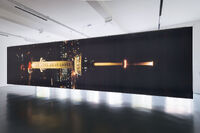
In his presentation Freek Wambacq draws connections between Eadweard Muybridge, Marcel Broodthaers, cinematic sound effects, and the Polynesian hula dance. His point of departure was a work by Marcel Broodthaers, shown at Witte de With as part of Still: A Novel (1996), an exhibition about the origins of cinema and photography and their influence on the visual arts, curated by Chris Dercon. The drawings Cheval au galop, Cheval au galop avant Muybridge, and Cheval au galop après Muybridge (1973-74, see below) make up a triptych in which Broodthaers recognizes and reproduces the impact of Muybridge’s photographic studies of a running horse. These studies brought to light the fact that the human eye only sees the resultant of a series of movements. Thus, his photographs show more than the eye can see and as such enlarge our perception of the world.
Freek Wambacq often alludes to the reality beyond the image. In his assemblages, which occur throughout his oeuvre, he gathers domestic objects or industrial materials based on their use in the production of cinematic sound effects or Foley. Within the controlled Foley sound studio environment a pile of gloves becomes a flock of birds, a battery-driven sex toy becomes an earthquake, moist antelope skins become paintbrushes, celery a breaking bone. Wambacq creates images from which imperceptible matter, radically differing from the material reality, come forth as ideas. When scrunched cellophane wrapping evokes a wood fire, our real life experience of fire is questioned; a paradoxical statement that relativizes our perception.
A galloping horse, represented by coconut shells, has previously been translated by Wambacq into an autonomous sculpture (Galloping horse, 2008), a still life on a table with a pile of gloves and cellophane (Twelve birds, five horses and a small fire, 2009) and an installation where a cardboard box filled with coconuts tested the limits of a bar in Antwerp (Herd of horses, 2013). For In Light Of 25 Years Wambacq connects the coconuts to four drawings he made of a hula dancer, making the horses on the tables dance.
In Light Of 25 Years
Presented as part of In Light Of 25 Years, this project celebrates Witte de With’s 25th anniversary. For In Light Of 25 Years, ten artists and curators each create an image-based work that analyzes certain sediments of contemporary art history, departing from Witte de With’s archive.
Participants
Freek Wambacq
Curators
Samuel Saelemakers
<div class="
-
Wineke Gartz — 000 VA Auroral Blue
Wineke Gartz created two collages combining documents from Witte de With’s archive, images of her own work, and other sourced material. As such she transforms the archive into an image stream rather than an organized system. Auras and dissolves, transparencies and layering all add up to dreamlike and haunting images. Through a process of digitizing print collages spread out on her studio floor, Gartz dealt with the specificities of the digital and its impact on imagery. Her work, much like Witte de With’s own archival history, evolved along the increasing opposition and dynamic between the hard copy and the digital.
The street side of the light box is eclectic and offers an overload of imagery, in line with the busy street it looks out on. Here Gartz uses mostly photographs she took while installing her previous video installations, and which now create portals, doorways or escape routes from the feverish process of creation. The centrally placed video-still is taken from the recording of the performance Red Light, Poses (2009) and shows Gartz’s body by use of a video effect, turn into a surreal animal like object, bathing in red and gold light.
The casino slot machines seen on the upper half of the image illustrate the artist’s fascination with America, its consumer culture and commodified notion of happiness, a fascination she shares with Dan Graham, who is a long time conversation partner of Gartz’s. Graham is also present is this work through a reproduced still from his iconic video essay Rock My Religion (1982–1984), and from his performance Body Press (1972), in which we see him holding a camera.
A softer approach is seen on the other side of the light box, where archival letters and drawings by artist Paul Thek (1933-1988) are presented alongside lists and drawings by Gartz herself. She strongly relates to Thek’s practice, which she sees as a form of exorcism, dealing with the labyrinths of spirituality, sexuality and technological progress. These documents fade over into a collage of images mainly taken from Gartz’s body of work American Pain (2009-ongoing), parts of which are also on view on the monitors in the space.
In Light Of 25 Years
Presented as part of In Light Of 25 Years, this project celebrates Witte de With’s 25th anniversary. For In Light Of 25 Years, ten artists and curators each create an image-based work that analyzes certain sediments of contemporary art history, departing from Witte de With’s archive.
Participants
Wineke Gartz
Curators
Samuel Saelemakers
<div class="
-
 AS LONG AS IT LASTS
In 1993, artist Lawrence Weiner made a work on the 185 meter high Euromast in Rotterdam as part of a group exhibition on painting and architecture. He painted the text AS LONG AS IT LASTS – which also became the title of the exhibition – up the length of the tower, making it one of the largest works Weiner has realized to date. The first issue of Witte de With’s signature Cahier journal extensively documented the exhibition and featured a cover designed by Weiner. The Cahier also includes the two photographs of the work on the Euromast, now shown here on the light box, one taken by day, the other by night.
Conceived of as a recurring work, AS LONG AS IT LASTS reappeared in Rotterdam inside the pedestrian tunnel of the central station, as part of the citywide exhibition Melanchotopia in 2011.
Now, on the occasion of the 25th anniversary of Witte de With, Weiner’s words aptly articulate the ever-changing modus of operation of the institution. Each reiteration of the work prolongs the statement it embodies, resulting in a conceptual short-circuit which is forever finite.
AS LONG AS IT LASTS is a cautious slogan, not quite pessimistic, but rather a firm reminder that one should never make assumptions about the future.
Concept: Paul van Gennip
Photography: Bob Goedewaagen
In Light Of 25 Years
Presented as part of In Light Of 25 Years, this project celebrates Witte de With’s 25th anniversary. For In Light Of 25 Years, ten artists and curators each create an image-based work that analyzes certain sediments of contemporary art history, departing from Witte de With’s archive.
<div class="
-
Art In The Age Of…Planetary Computation
How would you draw a picture of the Internet; through the machines and ‘their’ language that broadcast and store ‘our’ messages, or through the affect and power relations that those messages and their movement produce?
Presented as part of the year-long Art In The Age Of… exhibition series, Art In The Age Of…Planetary Computation investigates how quantification, telecommunications, and our ever-expanding information apparati not only inform contemporary artistic production, but also how contemporary art can hold a mirror up to these processes and formations.
The participating artists explore the fissure between literal infrastructure—code, machines, wires and other like-vocabularies — and the subjective socio-political interactions fostered by using these devices. Guided not only by what can be seen on the computer screen, and the various other black mirrors we stare into day in and day out, this exhibition will also look at what happens behind these screens. Moving from objects to subjects, we ask, how do these positions impact daily life, or said in another way: what does it mean to be ‘screened’?
Aram Bartholl’s Greetings from the Internet repurposes those little scraps of paper on which Wi-Fi passwords are usually handed over into a set of complimentary postcards.
Rossella Biscotti’s monumental textiles show patterns inspired by demographic data from recent Brussels censuses, questioning how statistics and quantitative analysis represent our reality.
Nina Canell meditates upon transmission and resistance through her sculptural constellations comprising found cables originally used for telecommunication and electrical power.
Following his denial of access by Google Inc, John Gerrard hired a helicopter and produced a detailed photographic survey of a Google data server building in Oklahoma, also known as a ‘data farm’, resulting in Farm (Pryor Creek, Oklahoma, 2015), a simulated CGI ‘twin’ of the building.
Femke Herregraven examined countless investment bank brochures to track the names under which more than 60% of all financial securities are now traded via various computer algorithms.
The sculpture Solaris Panel by Antonia Hirsch features shapes cut from black Plexiglas resembling contemporary smartphones and notepads that, in sleep mode, resemble a Claude glass, an artist’s framing aid invented in the 17th century.
Two ‘hyperlinked’ sculptures by David Jablonowski question the impact of contemporary computation in relation to early technological improvements such as manual copying machines.
Navine G. Khan-Dossos creates two new murals under the title My TV Ain’t HD, That’s Too Real. These gouache paintings evolve throughout the exhibition in response to media reports on current events in the Middle East.
John Menick’s Biography of Anish Meta-Bhatt shows pages of a fictional biography of computer scientist Dr. Anish Meta–Bhatt, developer of the first artificially intelligent computer capable of writing novels.
With iknowwhereyourcatlives.com, Owen Mundy visualizes a sample of 1 million public pictures of cats on a world map, locating them by the latitude and longitude coordinates embedded in their metadata.
Trevor Paglen’s Autonomy Cube relays all of Witte de With’s Wi-Fi traffic over Tor, a global network of thousands of volunteer-run servers, relays, and services designed to help anonymize data.
Lucy Raven’s lenticular print Hand moving at a walking pace is made from a video Raven took in a post-production studio in Chennai (India), just one of many outsource centers where Hollywood films are converted from 2D to 3D at highly reduced wages.
Stephan Tillmans creates series of photographs taken at the very moment analog cathode ray televisions are switched off; as the picture raster breaks down, a final flicker abstracts the last image into electromagnetic geometrical waves.
For her work After, About, With, Julia Weist exploited her personal contacts, social media networks, and search engine optimization techniques to attempt to control the search results returned for the artist Haim Steinbach.
Alongside artist presentations, a dedicated research blog has been founded. This blog will track the development of Art in the Age of… exhibitions for 2015 and acts as a visual reader accompanying artists work: http://artintheageof15.tumblr.com.
Art In The Age Of…Planetary Computation is the second iteration of the Art In The Age Of…, a three-part presentation series that investigates future vectors of art production in the 21st century. Art In The Age Of… runs throughout 2015 starting with Art In The Age Of…Energy and Raw Material and continues in September with Art In The Age Of…Asymmetrical Warfare.
Participants
Aram Bartholl, Rossella Biscotti, Nina Canell, John Gerrard, Femke Herregraven, Antonia Hirsch, David Jablonowski, Navine G. Khan-Dossos, John Menick, Owen Mundy, Trevor Paglen, Lucy Raven, Stephan Tillmans
Curators
Defne Ayas, Adam Kleinman, Samuel Saelemakers
Supported By
The work of Antonia Hirsch is presented with the kind support of the Southern Alberta Art Gallery.
<div class="
-
NO HUMANS INVOLVED
Witte de With is pleased to host HOWDOYOUSAYYAMINAFRICAN?, a multi-disciplinary arts collective made up of 45 artists who have lived and worked together, in various iterations, for the past twenty years. The collective consists of visual artists, writers, poets, composers, academics, filmmakers and performers from around the world who collaborate across disciplines and cities. Projects conceived and created by this transnational collective ultimately function as laboratories for investigation, production and discourse.
Members of the collective recided in Rotterdam for two months to produce new work, including video and sculptural installations, printed matter, sonic scapes and film shorts. Many of these installations include algorithmically produced sounds, piezoelectric material interactions and visual material from social media, which are explored in relation to the body. By pushing the notion of technology in conjunction with socio-political questions into the physical, sensorial and hence affective realm the Collective is invested in aesthetically emphasizing what writer Sylvia Wynter called “sociogenic principle”. A concept that can be understood as a result of processes of social conditioning and culturally prescribed “sense of the self”, drawing from the work of the writer and activist Frantz Fanon.
The exhibition was organized around the central question: “What does it mean to be human in a world which is continually contesting ‘certain’ people’s humanity?” and explored different modes of perception as forms of aesthetic conceptual protest and disobedience to normative orders. The ‘new default’ position, which the collective aimed to initiate, opened up a conversation around the multiplicity of our identities. Is it possible to move outside of aesthetic strategies that art, through ideological and institutional framings, has for a long time been complicit with? Can art subvert and truly free the body outside the peripheries of myth and representation to open up a debate that might lead to an understanding of what it “feels to be human”?
Exhibition Readings
Exhibition readings were offered by experts throughout the summer:
5 June, 2015: Teana Boston-Mammah (Researcher, Rotterdam University of Applied Sciences)
3 July, 2015: Samir Bantal (Executive Manager, OMA)
Symposium
The symposium Between Nothingness and Infinity was held on Tuesday 14 July from 6pm.
Participants
HOWDOYOUSAYYAMINAFRICAN, Nana Adusei-Poku
Curators
Defne Ayas, Christa Bell, Natasha Hoare, Sienna Miller, Nana Adusei-Poku
Supported By
Embassy of the United States of America, The Hague.
<div class="
-
Özlem Altın — No story, no
When researching Witte de With’s exhibition history in preparation of her participation in the In Light Of 25 Years project, artist Özlem Altın was instantly drawn to Pas d’histoire, Pas d’histoire (No Story, No History), the first large scale solo exhibition by Belgian artist Joelle Tuerlinckx in 1994. She asks herself how to make Tuerlinckx’ work resonate in her own and whether this personal resonance and reflection could establish a platform that allows new perspectives or readings on how stories and histories are created and displayed?
Altın, whose practice also encompasses painting and photography, often combines images gathered from different sources and re-contextualises them, uprooting them from their origin. She shares with Tuerlinckx a great interest in what she calls suspended objects and gestures. Much like Pas d’histoire, Pas d’histoire (No Story, No History) in 1994, Altın’s work No story, no consists of an open ended constellation of image and text.
Just like the light box itself is suspended in the air, big like a wall yet light like a picture frame, the images on view depict hands, both human and artificial, in various stages of suspended movement, manipulating different objects. The point of these gestures remains unknown.
The notion of the gesture, a movement of the hands, is prominent in this work. French art historian Henri Focillon wrote in his essay “In Praise of Hands“ (1934): “Through his hands man establishes contact with the austerity of thought.” And indeed, Altın is working through her thoughts, drawing from multiple sources to create two enigmatic digital collages, shown in the light box along with a small painting by Altın and a print of an installation shot taken during Tuerlinckx’ exhibition in 1994.
Accompanying the work is a small publication titled Notes on notes, which combines Özlem’s own notes and images with selected notes written by Tuerlinckx and previously published in the Witte de With Cahier #3. This publication is available for sale at Witte de With and Printroom, Rotterdam.
Participants
Özlem Altın
Curators
Samuel Saelemakers
Supported By
SAHA Association
<div class="
-
Rotterdam Cultural Histories #5: Summer Carnival
Rotterdam Cultural Histories #5 features Robert De Hartogh’s photos of the first Rotterdam Zomercarnaval (Summer Carnival) in 1984. The pictures show the birth of a unique explosion of creativity in which the cultural, economic, social, and political ideas about the city come together. The Summer Carnival was held for the first time in 1984 and attracted more than 15,000 visitors. Now, more than thirty years later and with more than 750,000 visitors, the Summer Carnival’s parade is regarded as one of the biggest events in the Netherlands, and it has always remained true to its Caribbean roots. De Hartogh’s photos of the Summer Carnival’s early years show a new and colourful Rotterdam.
Rotterdam Cultural Histories is a collaborative project between TENT and Witte de With Center for Contemporary Art that explores our common roots in Rotterdam and articulates meeting points between both of our programs. Rotterdam Cultural Histories is conceived by Mariette Dölle (Artistic Director, TENT) and Defne Ayas (Director of Witte de With). This fifth edition is curated by Mariette Dölle in collaboration with Robert de Hartogh, in the context of the exhibitions On The Other Side Of Reality at TENT and NO HUMANS INVOLVED at Witte de With.
Network
TENT
Series
Rotterdam Cultural Histories
<div class="
-
Xu Zhen — One of Us Is On the Wrong Side of History!
For One of Us Is On the Wrong Side of History!, Xu Zhen (1977, China) focuses on the visual identity of Witte de With’s past exhibitions as well as its archive of posters. As such, this work brings to light not the artworks shown at Witte de With during the past twenty-five years, but rather the wording and design, which mediated them. The archive is read and revealed as a sprawling visual poem made up of fragments and traces of voices past. In the vein of his Metal Language series, Xu Zhen extracts fonts and layouts from their original contexts and reproduces them using metal chains.
On the floor, these chains sculpturally represent select titles and logos of Witte de With programs. Shimmering like jewels but weighing down on the physical foundation of the institution, the choice of metal shackles reflects the ambiguity of history itself: it is a treasure and a burden. The display, on the other hand, shows images taken from the Metal Language series (2012) and shows select sentences from political caricatures. The “bling” of the chains along with the many exclamation marks evoke the chaos of wall tagging and protest-graffiti, where many individual statements are embedded into one larger image.
In Light Of 25 Years
Presented as part of In Light Of 25 Years, this project celebrates Witte de With’s 25th anniversary. For In Light Of 25 Years, ten artists and curators each create an image-based work that analyzes certain sediments of contemporary art history, departing from Witte de With’s archive.
Participants
Xu Zhen
Curators
Samuel Saelemakers
<div class="
-
Zin Taylor — A Segment of Translation
Zin Taylor’s work A Segment of Translation (F. Kiesler’s Mind Form) stems from extensive research into the work and writing of architect, theoretician, set designer, and sculptor Frederick Kiesler (1890-1965). The first retrospective of this extraordinary artist in the Netherlands was held at Witte de With in 1996, and included original models, drawings, documents, photographs and writings by Kiesler.
Taylor approaches the light box as an architectural element conceived of in a way close to Kiesler’s thinking. Kiesler used the word “organic” to describe his aim for architecture where a form emerges from a creative consciousness and is translated into concrete existence. Taylor himself describes his practice in a similar way, as a process where thoughts about a subject are translated into forms about a subject, where abstraction and phenomenology participate as tools in a narrative development of form.
The two sides of the luminous display together form a permeable wall, a skin which touches both an interior and an exterior space. The wall builds a space for thoughts to exist within. It divides the private thought from the public form. The wall is the membrane that collects these two opposing elements.
The inner space, facing the entrance of the gallery, holds thoughts, and can be seen as a cave for contemplation. One of Kiesler’s most famous works is the Endless House (1950-61), the result of his lifelong scrutiny of the conventions of modern architecture. This house existed as an idea, materialized only into scale models and sketches, making it a house built from thought, rather than stones. The construction principle of the house was that of endless tension, as there was not a single column in the whole structure. As such, the entire house exists as one form, endlessly flowing, or as Kiesler wrote: “like the human body – there is no beginning and no end to it.” This side of Taylor’s work can be seen as a hypothetical rendering of the inside of the Endless House.
Both sides of the work are connected by holes which seemingly pierce the surface. By adding windows to his wall, Taylor opens a portal where dialogue can move through. The inside goes out, and the outside comes in. This dynamic is referenced in the dotted lines which run across both sides, exchanging white circular voids for black locational spots.
The street-side image, facing the Witte de Withstraat, witnesses the ever changing identity of the street through gentrification, a process that filters out difference and mess, replacing this with something approved and clean. This is a corporate idea, to remove the hand-made and the vernacular for the betterment of a select population. Kiesler’s work can be seen as a sort of counterculture architecture, built as the result of protest gestures, of dropping out, of building a personal system.
The structure of the Endless House in many ways resembles that of a yurt, a type of mobile housing unit originating from the Middle East and North Africa that was adopted by American west coast hippies and communes as a home for their ideological activities. This correlation brought Taylor to the idea that alternate ideas take on alternate forms, and alternate forms have the ability to generate alternate ideas. Of the many characters on the front of the wall, one, on the far right, is an illustrated rendition of Mr. Natural, a character by cartoonist Robert Crumb that satirically embodies the hippy movement and its eventual ideological demise.
Also on view is a small stool made by Taylor, carrying copies of poems by Kiesler. Taylor interprets these poems as the document of a hallucinogenic dream-episode Kiesler underwent in 1962, when upon waking he immediately put it to paper. The Endless House was already completed as an idea by then. Taylor then asks: could these poems have formed along with the space created by the organic house? He sees Kiesler’s poetry occurring as the result of the Endless House, that piece of strange architecture presenting a mental opportunity for an extended form of abstraction to take place. In other words, the narrative of the poems occurred within the space made for it by the thought of the Endless House. Thoughts within thoughts.
In Light Of 25 Years
Presented as part of In Light Of 25 Years, this project celebrates Witte de With’s 25th anniversary. For In Light Of 25 Years, ten artists and curators each create an image-based work that analyzes certain sediments of contemporary art history, departing from Witte de With’s archive.
Participants
Zin Taylor
Curators
Samuel Saelemakers
<div class="
-
Art In The Age Of…Asymmetrical Warfare
Just as World War II began with a charge on horseback, and ended with the atomic bomb, the technological escalation of killing machines continues today. Art In The Age Of…Asymmetrical Warfare, the third and final iteration of Witte de With’s year-long exhibition series Art In The Age Of…, considers the irregular, and often uneven nature of the hybrid battlefield. As always, war is ever-present, however, its theater has now extended from the so-called real to the virtual. While hard power is still asserted face-to-face and hand- to-hand, remotely controlled weaponry and other means of telecommunicated violence are broadcast and delivered digitally through cyber attacks, and via social media propaganda platforms. Not surprisingly, these new channels have created their own forms of representation in which morale and information have become equal to, or are greater than, traditional military superiority. Instead of simply producing images of war, a new war of images is being fought and sold. As such, Art In The Age Of…Asymmetrical Warfare asks the question: What role do artists play when they slip into these networks and try to reveal the engines and effects of contemporary conflict?
Valences between presentations develop various leitmotifs including subjects such as diplomacy, media, extra-judicial killing, computation and coding, military and guerrilla tactics, and of course, weaponry. In addition to the artworks, several artifacts will join the exhibition including a real-time global cyber attack monitor as well as an animated map of the international arms trade and nuclear detonations.
As the last iteration in the three part series, this exhibition carries forward three artistic positions from the preceding show, Art In The Age Of…Planetary Computation. Works by Trevor Paglen and Navine G. Khan-Dossos remain on view, whilst artist John Gerrard presents a new duo of simulations. This slippage recontextualises the works to explore the interrelation of computation and conflict.
Abbas Akhavan’s blue shield, cut from one of Witte de With’s gallery walls, marks the art center as a heritage, non-military site unfit for aerial bombardment. Sven Augustijnen charts the history and dispersal of the Belgian made FAL rifle through the gun’s appearance in Paris Match war dispatches from the 1970s. To highlight government censorship, James Bridle uses Fraunhofer lines—light spectrum graphs—to depict information recently withheld by the Dutch government concerning the downing of Malaysia Airlines Flight 17 over the currently embattled Ukraine. The process-based paintings of Navine G. Khan-Dossos are informed by actual reports of Daesh’s (aka Islamic State) executions, accounts of female jihadists, and related ‘War on Terror’ propaganda. John Gerrard’s simulations tackle the logistics and tactics of the United States military troop exercises by rendering an impossible drill set in an overseas Djibouti base through the use of motion capture animation. Like a cipher, the evolution of American embassy design (1967–85) is tracked by Terence Gower so as to decode the country’s developing foreign relations. Glenn Kaino picks up a related theme through a wall-mounted work in which steel panels replicate the façade of the American embassy in Syria, which bears the scars of several street protest assaults. Civil and military weaponry meet in Nida Sinnokrot’s Rubber-Coated Rock, All-Stars 02, which consists of handmade projectiles mimicking the rubber bullets used by the Isreali army. Trevor Paglen and Jacob Appelbaum’s Autonomy Cube creates a working relay within the Tor network, an encrypted online channel that facilitates anonymous communication so as to combat mass Internet surveillance by governments and other institutions. Likewise, Thomson & Craighead consider the spread of Internet-based citizen journalism and other forms of social-media reporting through a film essay which twins Flickr images of war zones spanning the entire globe with the metadata that reveals the origin of each image. The utility of war photo reportage is evoked and critiqued by Broomberg & Chanarin, who, while embedded in Afghanistan, exposed photographic paper on the one day in which no soldier was killed. To measure the physic toll of living under the constant threat of terror, the ominous sound of a General Atomics MQ-1 Predator drone is simulated overhead in Susan Schuppli and Tom Tlalim’s Uneasy Listening. Reflecting on the media coverage of perhaps the preeminent asymmetrical attack, Mohammad Salemy fragments TV broadcasts of 9/11 to demonstrate how a multilayered geopolitical event was channeled into a universal spectacle. Hijacking is also widened to encompass proxy and other acts of disinformation through Thatchergate, a faked conversation between Margret Thatcher and Ronald Reagan disseminated by the anarcho-punk band Crass in the aftermath of the Falklands War. Extending the definition of war further, José Antonio Vega Macotela’s Murmurs brings the viewer to her/his knees in order to decipher codes used by jailed Mexican drug runners to communicate in secret.
Alongside artist presentations, a dedicated research blog has been founded. This blog will track the development of Art in the Age of… exhibitions for 2015 and acts as a visual reader accompanying artists work: http://artintheageof15.tumblr.com.
Art In The Age Of…Asymmetrical Warfare is the third and last iteration of Art In The Age Of…, a three-part presentation series that investigates future vectors of art production in the 21st century. Art In The Age Of… runs throughout 2015; started with Art In The Age Of…Energy and Raw Material in January (23 January – 3 May 2015), and continued with Art In The Age Of…Planetary Computation in (22 May-16 August 2015).
Participants
Abbas Akhavan, Sven Augustijnen, James Bridle, Broomberg & Chanarin, Crass, Claire Evans, John Gerrard, Terence Gower, Glenn Kaino, Navine G. Khan-Dossos, Trevor Paglen, Mohammad Salemy, Susan Schuppli, Nida Sinnokrot, Thomson & Craighead, Tom Tlalim, José Antonio Vega Macotela
Curators
Defne Ayas, Natasha Hoare, Adam Kleinman
Supported By
Art In The Age Of…Asymmetrical Warfare is kindly supported by the vfonds.
<div class="
-
Douglas Coupland — Bit Rot
Witte de With Center for Contemporary Art is proud to present Bit Rot by artist and novelist Douglas Coupland. Bit Rot is Coupland’s very first large-scale solo exhibition in Europe and will be on view from 11 September 2015 until 3 January 2016. The exhibition presents Coupland’s ‘mindscape’, combining his own work with loans from his personal collection, as well as material stemming from his recent residency at the Google Cultural Institute in Paris. An eponymous paperback collection of new and existing short stories and essays written and compiled by the artist will accompany the exhibition.
Throughout the exhibition Coupland shares his thoughts on globalization, terror, the Internet, pop-culture, social media and the resulting accelerated image economy. Taking its title from the phenomenon in which digital data spontaneously and quickly decomposes, Bit Rot creates an associative and visually playful constellation in which memory, loss, fame, violence, destruction, and creation are subjects for contemplation.
For many years Douglas Coupland has been intuitively collecting art works, images and objects, creating a collection perhaps only fully legible to himself. Each of the exhibited strands of work began as impulsive purchases but ultimately led to forms of clarity in regard to deeply rooted needs and wants. Now, for the first time, Coupland exhibits these collected works together with his own.
Following his residency at the Google Cultural Institute, Paris in early 2015, Coupland also presents The Living Internet, a kinetic room-sized sculptural tableau visualizing what the Internet and online searching actually looks like.
Important to the framework of the exhibition is a piece of writing included in the Bit Rot publication, titled An app called: Yoo. This fictional app, conceived by Coupland, creates new and unique visual material based on all of the (meta-)data individuals generate throughout their lives. If the Yoo app, in essence a mind-mapping tool, were to produce an exhibition, Bit Rot is what that might look like.
Yoo brings previously unobserved life patterns to the surface.
Yoo allows you to reinterpret any day of your life in an infinite number of ways.
Yoo finds connections in your life that you didn’t know were happening and makes them for you, before your eyes.
Yoo, poetically, allows you to reincarnate while still living.
Yoo takes images, sounds and text from the course of your day (or week or year) and weaves them together so that they morph, jump-cut and dissolve.
Every new technology allows us new opportunities to explore our humanity. That’s what Yoo is all about.
— Excerpts from An app called: Yoo, published in Bit Rot, Douglas Coupland, 2015
The Cloud Is The New Infinity
With The Cloud Is The New Infinity (2017), renowned author and artist Douglas Coupland has developed for Witte de With an exclusive version of his famous Slogans for the Twenty-First Century series. His solo show Bit Rot was on view at Witte de With from 11 September 2015 – 3 January 2016. Proceeds generated from the sale of this edition partly go to the artist and partly to the institution.
More info
Publication
Published by Witte de With, Bit Rot is a paperback collection of short stories written for the exhibition, which functions as an accompanying work running parallel to the different clusters of art works in the exhibition. Emphasizing the importance of literature as an artistic medium, Coupland readdresses the issues at stake in the exhibition through the medium of writing. Bit Rot will be launched during the opening of the exhibition on 10 September 2015.
“My books have always, to some extent, contained ideas for installations and works […]. Pieces in the exhibition become materializations of words, and some of the words in this book are a dematerialization of objects in the exhibition.”
—Douglas Coupland, introduction to Bit Rot, 2015
The exhibition kicks off Futurosity, a project by Kunstblock that is part of Rotterdam celebrates the city! (check www.rotterdamcelebratesthecity.nl for the complete program) and is supported by The Art of Impact.
Participants
Douglas Coupland
Curators
Samuel Saelemakers
Supported By
Bit Rot is supported by Intracorp, Vancouver and AMMODO, Amsterdam. The work The Living Internet is a Douglas Coupland initiative supported by the Google Cultural Institute.
<div class="
-
Camille Henrot — The Beaver Moon
When faced with the large-scale light box which functions as the ongoing display module for the In Light Of 25 Years series, artist Camille Henrot was reminded of her training in animation. Although the production of animation has by now gone mainly digital, light box based animation remains an essential part of animation studies.
During her research into the exhibition history of Witte de With, Camille Henrot was drawn to the works of Michelangelo Pistoletto, who used mirrors and photography to create trompe l’oeils where the distinction between physical objects and representations is blurred. Also of inspiration were the video works by Ulrike Ottinger, who had a solo exhibition at Witte de With in 2004. In these videos, a universe of strange characters unfolds, inspired by countercultures and questioning norms and morals.
For her new work, titled The Beaver Moon, Henrot drew two human-like characters and staged them as if involved in domestic activities of maintenance and cleaning, reminding us that exhibition spaces are the homes of artworks, and sometimes of artists as well. The creatures are ambiguous, existing somewhere between the realms of male and female, human and bird. They are reminiscent of the Egyptian god Thoth, who has the body of a man and the head of an ibis and who was the god of writing, science and magic. Thoth was believed to be self-begotten, and was considered the care-keeper of the universe.
In Light Of 25 Years
Presented as part of In Light Of 25 Years, this project celebrates Witte de With’s 25th anniversary. For In Light Of 25 Years, ten artists and curators each create an image-based work that analyzes certain sediments of contemporary art history, departing from Witte de With’s archive.
Participants
Camille Henrot
Curators
Samuel Saelemakers
<div class="
-
Rotterdam Cultural Histories #6: Video at the Lijnbaancentrum
Rotterdam Cultural Histories #6 highlights a lesser known aspect of the Lijnbaancentrum, namely its video studio. The Lijnbaancentrum (1970 – 1984), led by head of Exhibitions Felix Valk, was an exhibition space of the Rotterdam Arts Foundation (RKS) in the center of Rotterdam. Here various exhibitions were presented on art, image and mass culture, in order to appeal to a large and diverse audience. Moving image was seen as an indispensable medium to do this; therefore, since its launch the Lijnbaancentrum was equipped with a special studio, with modern video equipment for the recording and editing of both monochrome and recently introduced color video.
The video studio did not just offer quality video equipment and expertise freely to international and Dutch artists such as Vito Acconci, Joan Jonas, Nan Hoover, Wim Gijzen, and Jan van Munster for the production of new video works, but also created recordings of performances, educational videos and produced a number of reports on the exhibitions held at the Lijnbaancentrum. A major exhibition in 1973, Video, brought these different applications of the medium together. Besides an overview of video initiatives in the Netherlands, the exhibition presented various forms of the educational application of video, alongside the work of artists such as Dennis Oppenheim and Henk Tas.
Over the years the core of the Lijnbaancentrum video team was formed by Henk Elenga, Frédéric Kappelhof, Wink van Kempen and Erik van Dieren. Rotterdam Cultural Histories #6 gives an impression of their efforts and experiments with the medium of video, based on archival material, photographs and a selection of five videos, which were created in, and thanks to, the video studio of the Lijnbaancentrum.
Rotterdam Cultural Histories is a collaborative project between TENT and Witte de With Center for Contemporary Art that explores our common roots in Rotterdam and articulates meeting points between both of our programs. Rotterdam Cultural Histories is conceived by Defne Ayas (Director of Witte de With) and Mariette Dölle (Artistic Director, TENT).
Network
TENT
Series
Rotterdam Cultural Histories
<div class="
-
Germaine Kruip – A Room, 4 Minutes
In her work, artist Germaine Kruip brings out tensions between formal abstraction and lyrical spiritualism. With a background in theatre set design, Kruip examines techniques of staging such as light, sound, duration, and isolation. With a predilection for ephemeral objects such as sound or fleeting experiences of time, she decided to use the fixed element of the light box, used throughout the In Light Of 25 Years program, not as a carrier for imagery and representation but to turn it into a performative agent.
Using time and space as her material, Kruip creates a choreography of light and sound which repeats itself endlessly. Outside of the exhibition space is a clock which counts down from four minutes to zero; inside, another clock counts upwards from zero to four. The counting up and down is activated by the sound of hands clapping. This single clap of two hands reminds us of the clapperboard used in cinema. Once the clap is heard, the action begins. The light goes on, then out again.
A Room, 4 Minutes not only hints towards Kruip’s previous work A Room, 24 Hours, but is also a tribute to the work of David Lamelas (Argentina, 1946) who in 1997 had his very first retrospective exhibition in Europe at Witte de With. Kruip’s new work is inspired by Lamelas’ pieces such as Time as Activity (1969) which showed four minutes of recorded city scenery, shot at three different locations but shown in one exhibition space; or Two Modified Spaces (1967) in which the artist modified the exhibition space, creating a stage within a stage by use of light and wooden cubical frames.
With A Room, 4 Minutes, Kruip, much like Lamelas, urges the spectator to become aware of the room they are in, the space they occupy, and the time they spend there.
In Light Of 25 Years
Presented as part of In Light Of 25 Years, this project celebrates Witte de With’s 25th anniversary. For In Light Of 25 Years, ten artists and curators each create an image-based work that analyzes certain sediments of contemporary art history, departing from Witte de With’s archive.
Participants
Germaine Kruip
Curators
Samuel Saelemakers
<div class="
-
Raimundas Malašauskas — What are we looking at tonight?
“All the children will go to sleep, adults will marvel at each other and at an invisible object in the future, asking each other “How do we know if we are still alive?”; the radio will be playing Marvin Gaye (he always sits on one of the shelves upstairs(1)) and a blown up paper toy by Viktorija Rybakova will swirl around Jef Geys’ writings(2); It is 1993(3) and 2016 at once, or perhaps twice, in the same room, in the split gaze; Like that film shot from the perspective of someone whose identity multiplies or changes half way. “How many times you’ve been dead?” one may ask.”
R. Malašauskas
1 On the first floor landing, gracing a window looking into Witte de With’s offices, stands a vinyl record of Marvin Gaye’s hit single What’s Going On (1971). The record has been standing there for over twenty years; the song is the on-hold music for Witte de With’s telephone line.
2 “The words I am writing are mirrored in the red balls on the imaginary Christmas tree which is not in my hotel room in Bredene aan Zee. They assume shapes which even I can barely recognize: “black” is powdered with artificial snow, and “valid” rotates slowly round the tree’s green tip. “Division of labor” is reflected by the stomach of the pink-and-white mannequin onto the pale yellow fake straw before the words fade away between the ox and the ass. Mary’s blue cloak swallows up “working week” and “condensation,” and “demo” glides from one imitation pearl to another.”
Jef Geys, What are we going to read tonight?, Cahier #2, Witte de With Publishers, 1994
3 The 1993 exhibition Wat eten wij vandaag? (What Are We Having for Dinner Tonight?) at Witte de With was associated with the fifth Architecture International Rotterdam manifestation, whose theme was the postwar residential areas built in Rotterdam’s Alexanderpolder neighborhood. Jef Geys’s project commented on the abstract way architects, urban planners and politicians tend to think about the urban environment.
By inviting nine families from Alexanderpolder to contribute to his exhibition, Geys let the residents have their own say about the area they inhabit. The project was realized with the cooperation of the families Bast, Battes and Risse, De Bruin, Diepstraten, Groot and Van Halem, Roodbeen and Boode, Van Schouwen, Sevenhuijsen, and Verkade.
In the exhibition, the families presented photographs of their living area. Each evening, throughout the entire exhibition period, one of the nine participating families was filmed having dinner and broadcasted by the local television station.
Sculpture by Viktorija Rybakova
Photograph by Bob Goedewaagen
In Light Of 25 Years
Presented as part of In Light Of 25 Years, this project celebrates Witte de With’s 25th anniversary. For In Light Of 25 Years, ten artists and curators each create an image-based work that analyzes certain sediments of contemporary art history, departing from Witte de With’s archive.
Participants
Raimundas Malašauskas
Curators
Samuel Saelemakers
<div class="
-
Calla Henkel & Max Pitegoff — Foreword
In Foreword, Berlin-based duo Calla Henkel and Max Pitegoff focus on shared fictions and the abstraction of community within entrepreneurial startups and models of creative labor. An excerpt from a novel-in-progress by New York-based writer Emily Segal (co-founder of the trend forecasting group and art collective K-HOLE and former creative director at Genius) will be released and installed in three parts over the course of the exhibition, framed by a configuration of colored benches and tables pulled from spaces run by Henkel and Pitegoff over the past five years in Berlin. These tables display Henkel and Pitegoff’s short story “Photography and Eating,” which explores the creative classes’ relationship to risk, profit, fantasy, and uselessness, drawing from their interviews and visits to startups in Berlin. The brightly coloured installation recalls both the aesthetics of the start-up offices they visited, and those of early 2000’s relational art practices, offering a non-work space in the ground floor gallery of Witte de With. Hosting two parallel semi-fictional narratives weaving in and out of truth in a nod to internet-era journalism and digitally circulated texts, Foreword sees Henkel and Pitegoff perversely position text as art object.
Para | Fictions
Foreword is presented as part of Para | Fictions, a cycle of sustained investigations taking as its focus the relationship between literature and visual art through the practice of ten artists; Daniel Dewar & Grégory Gicque, Calla Henkel & Max Pitegoff, Mark Geffriaud, Laure Prouvost, Oscar Santillan, Dineo Seshee Bopape, Lucy Skaer and Rayyane Tabet.
Each project on display presents a different artistic methodology, constituting a combination of each artist's visual interests and literary underpinnings, to seek the viability of repositioning ‘reference’ as ‘form’, ‘translation’ as ‘co-authorship’.
Participants
Calla Henkel, Max Pitegoff, Emily Segal
Curators
Defne Ayas, Natasha Hoare
Supported By
AMMODO
<div class="
-
Charlemagne Palestine — GesammttkkunnsttMeshuggahhLaandtttt
GesammttkkunnsttMeshuggahhLaandtttt, a solo exhibition with artist Charlemagne Palestine, who also spent several years living and working in Rotterdam, includes early video works, sculptures, paintings, installations, and sound scores. Charlemagne Palestine works form a highly personal universe of rituals, intoxication, and shamanism. In the last four decades, the artist has created an extensive body of experimental musical compositions, bodily performances, and, in later years, visual art works that are inhabited by stuffed animals. To Palestine, teddy bears figure as powerful shamanic totems, which he fondly calls Divinities.
Born in 1947, Brooklyn, in a Jewish family, Charlemagne Palestine gained recognition in the sixties with his experimental compositions and performances. A flamboyant part of the creative scene of New York, he collaborated with choreographer Simone Forti, artists Tony Conrad and Richard Serra, and performed alongside avant-garde artist La Monte Young and composers Terry Riley, Philip Glass, and Steve Reich. In spite of the art historical consensus about that era and his contemporaries, Palestine has always resisted being labeled a minimalist, opting instead for the term “maximalist”. In his later years he toured through Europe, settling briefly in the Netherlands, where he lived and worked in Rotterdam.
Central to his exhibition are a grand piano, as the sounding heart of the show, and a new large-scale version of the so-called God-Bear Museum Model, a proposal for a new kind of museum where music and performance find a home just as easily as a painting would. Also part of the exhibition are Palestine’s extraordinary music or sound annotations, a vast collection of works on paper, which aim to translate sound into image.
The exhibition kicks off with a performance by Palestine on the opening night, Thursday 28 January 2016, and will be accompanied by a new catalogue, co-published by Witte de With Publishers and Sternberg Press on behalf of Kunsthalle Wien.
Curator: Luca Lo Pinto (Kunsthalle Wien), together with Samuel Saelemakers (Witte de With)
The exhibition is co-commissioned by Kunsthalle Wien and Witte de With Center for Contemporary Art. An earlier iteration of the exhibition was on view from 18 September to 8 November 2015 at Kunsthalle Wien.
On 2-3 April 2016, Charlemagne Palestine and Simone Forti presents a new version of their performance Illuminations at Vleeshal Markt, organized by Vleeshal, Middelburg.
Participants
Charlemagne Palestine
Curators
Luca Lo Pinto
Network
Kunsthalle Wien
<div class="
-
Michael Portnoy — Relational Stalinism – The Musical
“Relational Stalinism”
In opposition to the strangling of museum spaces worldwide by rampant immaterial kudzu, (i.e. Post-French Post-Conceptual Dance, Dance-We-Can’t-Call-Dance, Po-Faced Minimalism, Feel-Good Participatory Glibbery, (a.k.a. Too Many Seagulls), and Performance with no qualities whatsoever aside from its leeching of court-approved historical referents, (a.k.a. Fancy Shoulder Piggybacking)), the breed of Relational Stalinism arose in a Theater Internment Facility in Preoccupied Benelux in the late Twenty-Teens. The primary tenets of Relational Stalinism are: Emboldening Confusion, Logocratic Exuberance, and Antic Behaviorism. Relational Stalinist works use a slippery iron fist to unbutton the viewer’s buggy of self and catapult her into a realm of truths only palpable through higher forms of irrationality.
This advanced breed of world-bending adopts the degree-zero performance palette as a constraint (performers, in a room, that's it), but pushes it out of monochrome and into a pubotany of deviously vibrant offshoots which stretch participants' language and behavior in the service of invention.
--
Running across six spaces at Witte de With, Relational Stalinism – The Musical is an ambitious assemblage of new performances created by artist Michael Portnoy, enacted and developed with a diverse troupe of dancers, actors, singers and improvisers. Many different registers of performance will simultaneously cohabit the institution, mixing inscrutable role-play scenarios, experimental sketch comedy, hyperactive spectatorship, melodramatic operatic interlude, prog-rock micro-dance and teary-eyed theoretical soliloquy. Combining futurology with satire, this exhibition transmutes the seeds of prevalent approaches to visual arts performance as a form of generative critique.
Relational Stalinism – The Musical is the latest branch of Portnoy’s Improvement League, initiated in the Taipei Biennial 2010, which seeks to “improve” existing breeds of art-making by pruning, grafting and hybridizing certain lines of thought in a kind of conceptual horticulture.
Relational Stalinism – The Musical is curated by Defne Ayas (Director, Witte de With) and Natasha Hoare (Curator, Witte de With) and is a co-production of Witte de With and A.P.E (art projects era).
Director: Michael Portnoy
Choreography: Michael Portnoy in collaboration with Mark Bellamy, Thomas Dudkiewicz, Jimmy Guacamole, Margo van de Linde, Keyna Nara, Evelyne Rossie, Loveday Smith, and Gerrie de Vries
Performers: Mark Bellamy, Thomas Dudkiewicz, Jimmy Guacamole, Margo van de Linde, Keyna Nara, Evelyne Rossie, Loveday Smith, and Gerrie de Vries
Curators: Defne Ayas and Natasha Hoare
Dramaturgy: Advisor Maaike Gouwenberg
Lighting: Andre Goos and Jorg Schellenkens
Music: Michael Portnoy
Costume: Nadia van Luijk, Marieke Pruis, Yoeri Guépin
Production Assistant: Sten Saarits
Public Program:
The project is accompanied by several events including Performance Taxonomies, a symposium on March 3, 2016, featuring a series of present and future taxonomies by key thinkers in the field of performance analysing current typologies from which speculative improvements can be structured; The Particiturbation Room, a conceptual nightclub at various locations in Rotterdam; and on a night of short films selected by Portnoy himself to draw out the absurdist streak in artist’s moving image.
Participants
Michael Portnoy, Mark Bellamy, Thomas Dudkiewicz, Margo van de Linde, Keyna Nara, Claudio Ritfeld, Evelyne Rossie, Loveday Smith, Gerrie de Vries
Curators
Defne Ayas, Natasha Hoare
Network
A.P.E (Art Projects Era)
Supported By
Fonds 21, the City of Rotterdam, and the American Embassy in the Netherlands.
<div class="
-
Rotterdam Cultural Histories #7: Perish festival
Rotterdam Cultural Histories #7 revolves around the performance festival Perish, organized on May 24 & 25, 1997, by artists’ initiative Duende in Rotterdam. For 28 years, 1984-2013, Duende offered studio spaces, residencies and exhibitions to Rotterdam-based and (inter)national artists. The Perish festival brought together videos of performances from the 60s and 70s – including works by Dan Graham, Hélio Oiticica, Bas Jan Ader, and Joseph Beuys – and (filmed) performances by contemporary artists such as Bik Van der Pol, Jeroen Eisinga, Alicia Framis, Charlemagne Palestine, Otto Berchem, Yael Davids, and Yvonne Trap. Perish explored the relationship between early performance art and performances from the late ‘90s, reflecting on the role video occupied as a medium and meditator within both contexts.
Rotterdam Cultural Histories is a collaborative project between TENT and Witte de With Center for Contemporary Art that explores our common roots in Rotterdam and articulates meeting points between both of our programs. Rotterdam Cultural Histories is conceived by Defne Ayas (Director of Witte de With) and Mariette Dölle (Artistic Director, TENT).
Concept and Research: Adelheid Smit and Wendy Bos (Witte de With)
Loans: Bik Van der Pol, Kamiel Verschuren and the municipal archive Rotterdam.
Graphic design: Rick Vermeulen, Via Vermeulen
Participants
Bik Van der Pol
Network
TENT
Series
Rotterdam Cultural Histories
<div class="
-
Oscar Santillan — Zaratán
“There is one story that has ranged the whole of geography and all epochs – the tale of mariners who land on an unknown island which then sinks into the sea and drowns them because it is a living creature.”
Jorge Luis Borges, Book of Imaginary Beings, 1957
Zaratán is a new commission by artist Oscar Santillan (1980, Ecuador) presented at Witte de With Center for Contemporary Art as part of Para | Fictions. The commission is fed by converging threads of research and literary reference, including the short stories and life of writer Jorge Luis Borges (1899-1986), travellers’ tales of imaginary islands from the era of colonial exploration, and an unfinished movie titled The Messenger whose filming was tragically cut short.
Titled after the name of a mythical creature recorded in Borges’ Book of Imaginary Beings (1957) – whose gargantuan shell is mistaken by sailors to be an island only to be lost once it submerges – the project traces how we shape the unknown using the forms and tropes at our disposal, and encapsulates Borges’ dizzying referential play between encyclopedic fact and apocryphal tale.
The presentation is the outcome of months of research that started in Russia and ended in the Dominican Republic. Creating parallel realities to Borges’ literary creations, Santillan animates and materializes the imaginary, eschewing empirical definitions of materiality and existence.
Collaborators
Gabriela Aleman (writer, Ecuador), Maritza Alvarez (photographer, Dominican Republic), Netherlands), Matteo Gatti (artist, Italy), Orlando Inoa (historian, Dominican Republic), Ludo Hellemans (biologist, Netherlands), Salomon Kroonenberg (geologist, Netherlands), Frans Snik (astronomer, Netherlands), Ana Pavlisova (translator, Russia), among others.
The Messenger:
Score and Performance - Raul Masu
Cinematography and Editing - Louis Henderson
Para | Fictions
29 January 2016 – 9 April 2017
Zaratán is part of Para | Fictions, a cycle of sustained investigations taking as its focus the relationship between literature and visual art through the practice of ten artists; Daniel Dewar & Grégory Gicque, Calla Henkel & Max Pitegoff, Mark Geffriaud, Laure Prouvost, Oscar Santillan, Dineo Seshee Bopape, Lucy Skaer and Rayyane Tabet.
Each project on display presents a different artistic methodology, constituting a combination of each artist’s visual interests and literary underpinnings, to seek the viability of repositioning ‘reference’ as ‘form’, ‘translation’ as ‘co-authorship’.
Participants
Oscar Santillan, Raul Masu, Louis Henderson
Curators
Natasha Hoare
Supported By
AMMODO
<div class="
-
Ahmed Bouanani — I want to possess in this world that which brings joy to the eyes…
After the collective trauma of the colonial occupation of Morocco, a vanguard of artists forged cultural practices that sought to establish a new vision of the country, appealing to its ancient traditions passed down through oral culture. Filmmaker, poet, and writer Ahmed Bouanani (1938 – 2011) was a towering presence in this landscape, pioneering a cinematic and poetic language that influenced a generation to come.
Bounani’s daughter artist Touda Bouanani and curator Omar Berrada work together to stage presentations drawing from his extensive archive. Here, the platform Witte de With provides is used to enable the translation and subtitling of his short films into English for the first time, providing a stepping stone to the wider distribution of Bouanani’s work and an accompanying recognition of the value and power of avant-garde film making in Morocco and the Maghreb.
Operating between the censoring hand of the monarchy and its organs, and an absence of native filmic tradition, Bouanani was keenly aware of the vital need to use cinema to protect and revive the fragile memories that linked Morocco to its pre-colonial past. In this his training and talent as a film editor were key. The archive is an explicit presence in his films and poetry. Tarfaya was made whilst working at the Moroccan Cinema Center through the permissible format of the regional documentary; Mémoire 14 consists of re-cut films shot by the French during the conquest and so-called pacification of Morocco. Both explicitly make use of archival footage to address the ethnographic distancing typical to the colonial cinematic vision, and to strive towards a more nuanced self-image.
With sad irony his legacy itself is threatened with erasure by a house fire devastating a portion of his collection, and his withdrawal from the public sphere and subsequent neglect as a figure. This presentation acts against erasure, activating networks of distribution through translation, and presenting archival documents to paint a picture of his formidable life long output.
The presentation includes Halakat Nord-Africaines (2014) a video installation by Moroccan artist Ali Essafi based on research around the practice of three radical North African filmmakers, Azzedine Meddour, Ahmed Bennys, and Ahmed Bouanani, each active from the 1960’s onwards, whose films Essafi has restored and resurrected. Halaqat refers to the circle of people gathering around a storyteller in North Africa’s public squares. This traditional oral form inspired the region’s cinema at its origins, as well as other modern narrative genres, and intersects in their work with archival footage assembled to represent contemporary history and engender new cultural forms of post-colonialisation.
Participants
Ahmed Bouanani, Touda Bouanani, Ali Essafi
Curators
Natasha Hoare, Omar Berrada, Touda Bouanani
Series
WDW25+
<div class="
-
Bik Van der Pol — WERE IT AS IF
What is hidden, forgotten, cast away, or overlooked in the day-to-day operations of a cultural institution? How does one make tangible the container of knowledge that envelops the factual succession of exhibitions and publications? Can artists become active and responsible co-creators of institutions, their politics, and representations?
Following Witte de With’s 25th year anniversary, Rotterdam-based artist duo Bik Van der Pol is invited by Witte de With Director Defne Ayas to highlight what might otherwise become lost in both the history of the institution as well as art’s history in the city of Rotterdam. Paying close attention to the socio-economic and political context in which the institution was created, and departing from the belief that cultural institutions and their legacies are as much made up of stories, ephemeral objects, and subtle traces, Bik Van der Pol’s process can be likened to a long term forensic investigation that examines, tests and actively exposes that which lies concealed in the folds of history.
Titled WERE IT AS IF, the collaboration between Bik Van der Pol and Witte de With, which commenced in June 2015, unfolds during the exhibition period, and is carried out in close dialogue with many agents (among them staff members and artists), who plunge into the institute’s rich exhibition history collaboratively, reenergizing the work of artists’ such as John Ahearn, Jef Geys, Ken Lum, Antoni Muntadas, Eugenio Dittborn, Eleanor Bond, John Knight, and Allan Sekula. Equating seemingly-in-the-fringes-material – leftovers, support structures, plans, notes, stories, and witness reports – to the level of artworks, and so exploring the viability of approaching ‘archival document’ as ‘art’, and ‘art’ as ‘source material’, the artists revive histories preserved in the documentation of exhibitions at Witte de With, such as L’oeuvre a-t-elle lieu? (1994), The Rotterdam Project (1998), Hortus Conclusus/Breeze of AIR (2001), Tracer (2004), and Melanchotopia (2011).
This particular search, however, does not stem from a seemingly omnipresent nostalgic desire to revisit the 1990s but is sparked instead by an understanding that much remains active yet unnoticed in the layers of the institute’s past. Stories and (un-)realized artistic and social projects are brought to light as Bik Van der Pol extend the premises of the investigation beyond the white walls of the institute itself, turning to the cities’ forgotten or disappeared crevices which have stood as departure points for artists working at Witte de With, such as the Perron Nul (Platform Zero) (1987 – 1994), a former methadone distribution center and safe haven for drug-users near Rotterdam train station, as well as the closed down ‘tippelzone’ (streetwalking area) at the Keileweg (1994 – 2005), where the divergent worlds of sex workers, protesting citizens, and artist initiatives – including Kaus Australis and Kunst & Complex – clashed repeatedly.
In Bik Van der Pol’s words,
“to resist memory loss and to avoid falling into the trap of repetition, conservatism or even fundamentalism, people’s activities (which after all make and determine history) must first be consumed and digested. In this way, progression and change can truly be generated and made possible.”
To this Director Defne Ayas adds,
“This examination is an attempt on our part to create a mental space for examining the potential of a cultural institution – to (re)perceive itself, to reclaim, reconstitute and recalibrate her connection to the context in which she was created. Our partnership with Bik Van der Pol insists on the rich history of Rotterdam not only as a hub of logistics and trade but also as an intellectual hub, while embracing the urgency to respond to the current momentum that brands Rotterdam as the “destination city” for art and architecture. It is our aim to make available our rich source material for new types of research and visual and textual production as to rewire possibilities through the informed eyes of artists.”
For the duration of the exhibition, Witte de With invites several guests to give readings into the methodologies and choices on display.
Participants
Bik Van der Pol
Curators
Defne Ayas, Samuel Saelemakers
Series
WDW25+
Supported By
Mondriaan Fund
<div class="
-
Marwa Arsanios — What representations?
Witte de With Center for Contemporary Art continues to examine its archive with WDW25+ Commissions running from Summer 2016 until January 2017. This commissioning series invites artists to respond to, and elaborate on, the exhibition history of the institution as a fertile ground for re-assessing and re-imagining contemporary art history.
The first commission sees Marwa Arsanios (artist and co-founder of 98Weeks Research Project) critically engage with Contemporary Arab Representations, a series initiated by former Director Catherine David at Witte de With from 2001 onwards to explore and present the activities of cultural and intellectual actors across the Arab world. Considering the series as one part of an ecology of artist, institution, market, and real estate in post-war Lebanon, Arsanios explores how the canon is formed and written into history; what informed this situation at the time (90s onward), why and how do artists get written out of certain histories? Arsanios excavates this particular period of knowledge production and validation through art historical, spatial, and revisionist feminist discourses, while mapping, re-staging, and inserting new voices in order to open up new readings.
What Representations? critically rethinks the Beirut / Lebanon program. A round-table conversation with academics, artists and writers creates a broader picture of political and social context from which the Beirut show emerged. Furthermore, Arsanios takes a cue from scripts of performances – a pre-eminent medium in the region at the time - found in the archive to create a theatrical set from which to ‘re-script’ the exhibition. This show within a show enacts the self-reflexivity of institutional archives. Lina Majdalanie’s performance “Biokhraphia”, in which she dialogues with herself in a mediation on interiority, is especially influential.
Participants
Marwa Arsanios
Curators
Natasha Hoare
Series
WDW25+
<div class="
-
Rotterdam Cultural Histories #8: Hard Werken
This summer Rotterdam Cultural Histories focuses on the magazine Hard Werken. Between 1979 and 1982, only ten editions of this cultural magazine were published, yet it had a significant influence on a whole generation of graphic designers in the Netherlands and beyond. The presentation is curated by Reyn van der Lugt and Marjolein van de Ven.
Hard Werken
The striking A3 format, its anarchic design contrary to typographic currents, the focus on photography, and its changing group of contributors for each edition – mainly from the visual arts and literature – immediately characterised this new initiative as a brash, elusive, and distinctly Rotterdam phenomenon.
Hard Werken regularly featured Rotterdam writers and poets – it once ran a prepublication of Jules Deelder’s book about the Rotterdam boxer Bep van Klaveren – and provided commentary on Rotterdam’s urban and architectural developments, in particular against the ‘nieuw truttigheid’ (new drabness). Hard Werken became the voice of a dynamic, metropolitan, and international culture. More distinctive than its content was the magazine’s remarkable design; contrasting the mostly black and white pages was an exuberantly coloured cover. Hard Werken featured drawings and collages, dozens of fonts for each issue, skewed texts and photographs; everything was put together in a unique design that evolved into a new ‘style’. The specific attention to photography meant images were often shown across double spreads. Many participating artists became part of what was known in the mid-eighties as the Rotterdam School for (staged) Photography. The magazine’s adverts were designed according to the same unorthodox principles.
At its core were Gerard Hadders, Rick Vermeulen, Tom van den Haspel, Henk Elenga, Kees de Gruiter, and Willem Karswho, who also ran the Rotterdam Art Foundation’s Grafische Werkplaats, which printed the magazine. In 1980, the magazine’s initiators founded the Hard Werken design studio. They mainly worked for cultural institutions in Rotterdam but soon took on clients nationally and internationally. They are renowned for their series of posters for the International Film Festival Rotterdam from 1984 to 1994.
Hard Werken was of great importance to Rotterdam’s cultural self-esteem. The many artists affiliated with the magazine gained national and international recognition. The magazine galvanised Rotterdam’s cultural momentum in the eighties and nineties, liberating the city from its image as a dull and culturally inferior harbour city.
Rotterdam Cultural Histories is a collaborative project between TENT and Witte de With Center for Contemporary Art that explores our common roots in Rotterdam and articulates meeting points between both of our programs. Rotterdam Cultural Histories is conceived by Defne Ayas (Director of Witte de With) and Mariette Dölle (Artistic Director, TENT).
Network
TENT
Series
Rotterdam Cultural Histories
<div class="
-
Maria Barnas — That Slow Nightfall
"The universe (which others call the Library) is composed of an indefinite and perhaps infinite number of hexagonal galleries... Like all men of the Library, I have travelled in my youth; I have wandered in search of a book..."
The Library of Babel, Julio Luis Borges.
During Poetry International, poet and artist Maria Barnas responds to the exhibition Zaratán by artist Oscar Santillan presented at Witte de With Center for Contemporary Art as part of Para | Fictions. Santillan’s project is fed by converging threads of research and literary reference, including the short stories and life of writer Jorge Luis Borges (1899-1986). Maria Barnas is particularly interested in the fact that Borges steadily lost his sight, but continued to visit the cinema until his death in 1986. In response to this, Barnas has written a poem in brail that is presented on a light box at Witte de With.
Borges (in a 1977 lecture): "In my case, that slow nightfall, that slow loss of sight, began when I began to see. It has continued since 1899 without dramatic moments, a slow nightfall that has lasted more than three-quarters of a century. In 1955 the pathetic moment came when I knew I had lost my sight, my readers and writer's sight."
That Slow Nightfall is commissioned by Witte de With Center for Contemporary Art and Poetry International Festival Rotterdam 2016.
Participants
Maria Barnas
Network
Poetry International Festival
<div class="