-
Lucy Skaer — One Remove
"‘Like' and ‘like’ and ‘like’–but what is the thing that lies beneath the semblance of the thing?...The players take the square and place it upon the oblong. They place it very accurately; they make a perfect dwelling-place. Very little is left outside. The structure is now visible; what is inchoate is here stated; we are not so various or so mean; we have made oblongs and stood them upon squares. This is our triumph; this is our consolation."
Virginia Woolf, The Waves, 1931
"I am not concerned with the single life but with lives together. I am trying to find in the folds of the past such fragments as time preserves…..there was a napkin, a flower pot and a book. I am telling the story of the world from the beginning, and in a small room, whose windows are open."
Virginia Woolf – marginalia from an early draft of The Waves
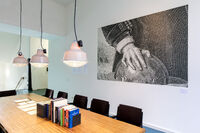
Two lines of oval tables dissect the space. The nearest is recognizably modernist, and shadowed by hanging ceramic lamps. The other, separated from us by the first, is made up of antique mahogany tables with a long curve of Lapis Lazuli making a continuous line down their length. Beneath these lies an elongated and irregular Moroccan rug whose woven shape echoes the carved curvilinear interlocking of the modernist tables. Here, domestic objects behave like sculpture, speaking specific stylistic languages that span different temporalities and geographies yet through insertion and adaption are defamiliarised, dividing the space into non-accessible areas.
Lucy Skaer's One Remove departs from Virginia Woolf's The Waves. The novel follows the self-narrated lives of six friends whose personalities, though defined, co-mingle and overlap much like waves themselves, performing an extraordinary map of human consciousness, each from a singular perspective. Throughout, the text vividly insists on its own materiality, pulling away from the form of the novel towards speech and image.
Can one invert this sentiment to make a small room from the telling of a story? In taking the sensibility of Woolf’s novel, Skaer uses the carte blanche afforded by fiction to make a room that is neither functional nor narrative, but it is specifically crafted to an unreasonable level. Each element has either been manufactured by an artisan or adapted, to fit. In Skaer's undoing of the 'thingness' of these familiar objects one senses in the artworks a dialectical steadying and loosening of the bounds of a grounding in space and time - so many oblongs stood upon squares.
Skaer draws from the novel's irreducibility, approach to pure abstraction, and tension of its relationship to, and status as, 'literature'. The novel itself barely works as such. The experience of the artworks translates, albeit obliquely, these qualities. Frustrating and blocking the viewer from approaching both the textiles and the delicately wrought mahogany, the installation withholds itself whilst emphasizing legibility through material. The tables overlap various moments - the now of the artwork, and contaminous pasts of geological and anthropocentric spans. In the novel a character, when faced with the annihilating abstraction of death, exclaims, "Let me touch the table–so–and thus recover my sense of the moment." No such moment of recovery is provided here.
"What should I describe first – the living half of the room, or the sleeping half? They must be described separately; yet they are always running together."
Virginia Woolf, A Sketch of the Past, 1940
Ceramics made by Gailan Ngan using her own glazes
Rug weaving by Khadija Hadid
Para | Fictions
One Remove is presented as part of Para | Fictions, a cycle of sustained investigations taking as its focus the relationship between literature and visual art through the practice of ten artists; Daniel Dewar & Grégory Gicque, Calla Henkel & Max Pitegoff, Mark Geffriaud, Laure Prouvost, Oscar Santillan, Dineo Seshee Bopape, Lucy Skaer and Rayyane Tabet.
Each project on display presents a different artistic methodology, constituting a combination of each artist's visual interests and literary underpinnings, to seek the viability of repositioning ‘reference’ as ‘form’, ‘translation’ as ‘co-authorship’.
Participants
Lucy Skaer
Curators
Natasha Hoare
Supported By
AMMODO
Peter Freeman, Inc
<div class="
-
In the Belly of the Whale
Drawing from the biblical story of Jonah and the Whale — in which the prophet’s resolve and message is galvanized whilst he meditates within the dark body of the great beast that has swallowed him whole — this group exhibition brings together artworks and objects to trace various transformations of meaning, reception, and use over time. In the Belly of the Whale plays content against its framing to question both how an artifact references a given historical moment and how different modes and moments of display affect signification. Or, to present these questions in another way: do images and artifacts indicate fixed meanings independent of their context, or are they inherently unstable, and tempered by situational and institutional inscription?
Foregrounding their conditions of presentation, ownership, reception, and provenance, artworks, artifacts, and their passage through time and narrative discourses are played off the figure of the cloud chamber — an early twentieth century device that used water vapor to mark the movement of subatomic particles, and which laid the ground for the study of particle physics by photographing the patterns these movements produced. Likewise, the works exhibited are positioned as ‘objects’ caught in motion, images whose trajectories operate to articulate power structures, disrupt official histories, colonial legacies, and other forms of epistemological violence.
Objects are not only molded by reality, they can actively produce new realities as well. A section of the exhibition seeks to address this ability, both through affect and scientific ideals of verifiability. Here the figure of Jean-Martin Charcot, a neuroscientist central to the pathologization of hysteria as a medical category, looms large —particularly through his use of photographic taxonomies as a form of evidence. His findings underpin contemporary facial recognition techniques and research into micro-histories of photography that undermine the medium’s claim to objectivity. Like fragments or links in a larger system, the works collected here offer perspectives with which to bounce aesthetic concerns against the political environment in which they were birthed or later received. Eschewing any neat synthesis, the show instead parallels the sense of investigation from within.
Throughout the Fall of 2016, public tours of In the Belly of the Whale will be given by: Aaron Peck (author, art critic), Nicoline van Harskamp (artist), Mohammad Salemy (critic and curator) and Aaron Schuster (philosopher).
Participants
Advancing American Art (1946-47), Minia Biabiany, Broomberg & Chanarin, Tania Bruguera, Mariana Castillo Deball, Jean-Martin Charcot, Paul Ekman, Hamza Halloubi, International Academy of Art Palestine (IAAP), Emily Jacir, Käthe Kollwitz, Susanne Kriemann, Britta Marakatt-Labba, Pratchaya Phinthong, Jeremy Shaw, Amie Siegel, Charles Thomson Rees Wilson, Van Abbemuseum
Curators
Natasha Hoare, Adam Kleinman
<div class="
-
Kasper Bosmans — Decorations
An intuitive researcher and playful gatherer of material, Kasper Bosmans (1990, BE) collects and transposes into his work formal elements and anthropological principles intrinsic to the studied phenomena, thus opening up a realm of meaning that both surpasses and celebrates them. Each strand of investigation is incorporated into Bosman’s unique visual language and translated into paintings and sculptural ensembles.
With Decorations, Kasper Bosmans reimagines past projects through a series of new works, including an artist publication, painterly interventions in select archival boxes, sculptures and large-scale murals. Bosmans engages with recurrent themes distilled from the archive, including migration, domesticity, sexuality, urban development, and ecology.
Prompted by the absence of folk art in Witte de With’s exhibition history, Decorations also features documents taken from artist Asger Jorn’s photographic archive 10,000 Years of Nordic Folk Art, a project part of his Scandinavian Institute for Comparative Vandalism, founded in 1961 as an interdisciplinary institute aimed at ‘vandalizing’ art history.
As a permanent yet discrete intervention into Witte de With's archive, Bosmans selected a number of archival boxes containing the documentation of projects he closely relates to on a formal, anecdotal, or conceptual level. Using the inside of the lids of these boxes as his canvas, Bosmans paints a visual encryption in which he symbolically translates the content of these archive boxes and the stories surrounding the project it houses. These small paintings are inserted in the very material structure of the archive as a silent presence, only to be revealed to future researchers.
Publication Decorations
Kasper Bosmans began his investigation of Witte de With’s history with a close reading of 20+ Years Witte de With, an anthology published by the institution in 2012 that lists all exhibitions and other projects at Witte de With between 1990 and 2011. Bosmans made numerous annotations and footnotes, scribbles and sketches in the margins across the 357 pages. Adding his own remarks and critical notes, and inserting photographs from Asger Jorn's 10,000 Years of Nordic Folk Art collection, he opens up this well-edited historiography to new interpretations.
Exhibition Reading
Friday 2 December 2016, 7 pm - Hilde de Bruijn (curator, Cobra Museum)
Participants
Kasper Bosmans
Curators
Samuel Saelemakers
Series
WDW25+
Supported By
Flanders State of the Art
<div class="
-
Rotterdam Cultural Histories #9: Manifesta 1 Revisited
Rotterdam Cultural Histories #9 revolves around the first edition of Manifesta, the travelling European biennial that had its very first edition in Rotterdam from June to August 1996. Manifesta 1 was held in 16 different museums and 36 public spaces in Rotterdam, including Witte de With. The biennial was developed by Hedwig Fijen (founding director) and Joop van Caldenborgh (first chair of Manifesta Foundation) and co-curated by Katalyn Neray (Hungary), Rosa Martinez (Spain), Viktor Misiano (Russia), Hans-Ulrich Obrist (Switzerland), and Andrew Renton (United Kingdom). All the works displayed at Manifesta 1 were specially made for this edition and many of the participating artists, now world-renown, were exhibiting outside their own countries for the first time in their career. Through archival and video material that was never shown before, this edition of Rotterdam Cultural Histories aims to shed light on the coming about of the first Manifesta biennial and on the contributions done by artists like Maria Eichhorn (Germany), Ayse Erkmen (Turkey), Vadim Fishkin (Russia), IRWIN (Slovenia), Oleg Kulik (Russia), Roman Ondak (Slovakia), and Huang Yong Ping (France/China).
Rotterdam Cultural Histories is a collaborative project between TENT and Witte de With Center for Contemporary Art that explores our common roots in Rotterdam and articulates meeting points between both of our programs. Rotterdam Cultural Histories is conceived by Defne Ayas (Director of Witte de With) and Mariette Dölle (former Artistic Director of TENT).
This edition is organized in close collaboration with and with support of Manifesta Foundation.
Curators
Adelheid Smit
Series
Rotterdam Cultural Histories
<div class="
-
Mark Geffriaud — two thousand fifteen
A voice comes to one in the dark. Imagine.
Thus starts Company (1977-1979), a novella by Samuel Beckett. With two thousand fifteen, artist Mark Geffriaud (FR, 1977) revisits some of the formal and narrative characteristics of this literary text – an anonymous, detached voice speaking in the second person; the closed-off, almost metaphysical space where the story unfolds – and deploys them to further his own research into the phenomenon of time in cinema. In writing, the author, and with them the reader, is able to seamlessly shift between different times and spaces, however in cinema the montage or cut is always a hard-edged tool which never passes unnoticed. Like the turning of a page, the blink of an eye, or the rotation of a revolving door (as installed here by Geffriaud, altering the entrance to the exhibition space), the cinematic cut is a mechanical gesture which interrupts or redirects the flow of a narrative, a space, or a beam of light.
Geffriaud shows multiple video projections of footage shot during his recent travels in South-America. In the Atacama Desert, Chile, on the top of Mount Armazones, he visited the construction site of what is to be the largest telescope in the world. From here, astrophysicists hope to travel back in time and witness the birth of the first galaxies. On the shores of Lake Titicaca, located between Peru and Bolivia, the artist witnessed the large building stones that were abandoned there for unknown reasons more than a thousand years ago. The various theories about the building for which they were intended are in fact speculations about the past, and construct various projections of a future that will forever remain fictitious.
Between these two sites of investigation lies the land of the Aymara, the only people on earth that have an inverted concept of time: the past lies ahead and the future behind. This unhinging of time is reflected in the exhibition itself. The projected imagery of the film is interrupted by automated shutters, while the voice-over runs independent from these projections allowing for chance correspondences and synchronicities to occur between image and sound.
Along the darkened windows of the exhibition space runs a strategically placed dotted line, a formal nod to the small holes that run along the sides of film strips. The cut-out circles are three millimeters in diameter, referencing the average width of the human pupil, the organ with which we decipher both images and text. Along with the cut-out technical description of the exhibited works placed on the side window, the dotted line allows for daylight to enter the space and for people on the street to look inside.
Para | Fictions
two thousand fifteen is presented as part of Para | Fictions, a cycle of sustained investigations taking as its focus the relationship between literature and visual art through the practice of ten artists; Daniel Dewar & Grégory Gicque, Calla Henkel & Max Pitegoff, Mark Geffriaud, Laure Prouvost, Oscar Santillan, Dineo Seshee Bopape, Lucy Skaer and Rayyane Tabet.
Each project on display presents a different artistic methodology, constituting a combination of each artist's visual interests and literary underpinnings, to seek the viability of repositioning ‘reference’ as ‘form’, ‘translation’ as ‘co-authorship’.
Participants
Mark Geffriaud
Curators
Samuel Saelemakers
Supported By
AMMODO, Institut français des Pays-Bas
<div class="
-
Fabian Bechtle and Adriana Ramić — Rome Was Built For A Day
Rome Was Built For A Day sees the archive through two commissions by Fabian Bechtle and Adriana Ramić. A proposal to bypass chronological investigations into history of art and exhibitions, Witte de With’s in-house materials are activated to yield various contributions on the third floor at the institute and in its digital channels.
Emerging from a relationship with an artificial neural network trained on Witte de With’s digital archive of the past ten years, Adriana Ramić presents a fictitious exhibition. Each piece responds to a text. The texts were composed by a crude version of an autonomous brain — a program which is informed by the institution’s data itself. Seeking to perplex anthropomorphism, Adriana Ramić’s exchange with machine learning employs a certain brutalism of bureaucracy: it is regarding the process of exhibition making as an administrative gesture through documents preserved on the institute’s working server since 2006. This project is part of a long-term research by Adriana Ramić on the question of materializing systems of cognition.
With an interest in the creation of memory Fabian Bechtle has frequently worked on archives. His contribution proposes an observant perspective on the archive of Witte de With. Entering it like a scene both the outward set-up as well as its inner transformations were scanned: in the video, the exhibition space resembles its appearance to date, but also seems to document a different time — in the future or the past. With this proposal of temporality as a possibility, the archive is read as a sculpture in process, a temporary topography or architecture of memory. In order to capture what is yet invisible but present, the camera pans down shelves, boxes and items. The signatures of all directors of the institute are to set into motion an artistic, discursive and administrative evolution of Witte de With. They are shown alongside inhouse materials, while the archival work on the third floor continues. Presented on the third floor, the exhibition also makes use of an earlier set-up. It was initially created by deputy director Paul van Gennip and artist Pierre Bismuth for his solo show in 1997: Special filters on the gallery windows retain transparency but allow for a view outside, while removing just enough light for a clear video projection inside.
Rome Was Built For A Day is the title of a song by Lawrence Weiner. It was released on a record Weiner produced with Ned Sublette in 1997. An mp3 version of this album is part of former curator Juan Gaitán’s research in Witte de With’s digital archive.
Participants
Adriana Ramić, Fabian Bechtle
Curators
Marie Egger
Series
WDW25+
Supported By
the Goethe Institut
<div class="
-
Eric Baudelaire — The Music of Ramón Raquello and his Orchestra
The Music of Ramón Raquello and his Orchestra is the largest monographic presentation of the work of Eric Baudelaire to date, including his latest feature length film Also Known As Jihadi (2017). Baudelaire’s oeuvre has ceaselessly and open-endedly engaged with histories of images, cinema, radical militancy, and violence by or against the state. Spanning over a decade of artistic production across installation, print, photography and film, the exhibition follows his sustained attempts to find a form that accommodates the catastrophic complexity of contemporary life. The exhibition draws on a reoccurring leitmotif in Baudelaire’s work, that of the ‘return’. Here, historical trajectories become looping re-visitations rendered both through the art works themselves and ghosted through their spatial realization.
The new film Also Known As Jihadi follows the progress of a young man’s journey from France to Syria, and back to France where he is currently incarcerated for allegedly joining Daesh. Based on real events, and drawn from thousands of pages of judicial documents, the work employs the so-called landscape theory (fukeiron in Japanese). The theory originated in the film AKA Serial Killer (1969) co-directed by Masao Adachi who was the subject of Baudelaire’s film The Anabasis of May and Fusako Shigenobu, Masao Adachi, and 27 Years without Images (2011), also featured in the exhibition.
Paths to radicalism are rendered purely through a series of landscape shots filmed at the locations traversed by the subject: a biography determined not by what the subject did, but by what the subject saw, questioning how these landscapes reflect the social and political structures that are the backdrop for a journey of alienation. With this starkly expansive approach, Baudelaire affirms the position of trying (not) to understand. Or, in the words of philosopher Pierre Zaoui, to make a film that “aims to understand and not to understand at the same time — to understand up to the point that one no longer understands — and also to show, refusing to understand or explain, so that with a dreadful feeling of confusion we are surprised to find ourselves understanding, discovering a subtle sympathy, telling ourselves that maybe monstrosity is our shared condition.”
Many of the works in the exhibition, titled after the perpetually interrupted fictional band leader in Orson Welles’ The War of the Worlds radio play, pursue Baudelaire’s interest in juxtaposing fictions that have documentary tendencies with documents that open fictional spaces. Research material fragments, chronologies, images and texts that have informed Baudelaire's work process (originating with his training as a social scientist) unfold in the exhibition space as a large scale “source book”. A series of conferences draw out key themes from the exhibition, including ‘fukeiron’ or landscape theory (28 January with International Film Festival Rotterdam), architecture and ‘assembly’ (22 April).
The film Also Known As Jihadi (101 minutes) starts: 11:30 am, 1:30 pm and 3:30 pm.
On Fridays, Witte de With closes at 9 pm. The final screening starts 6:30 pm.
The Music of Ramón Raquello and his Orchestra is co-commissioned by Tabakalera International Centre for Contemporary Culture, San Sebastian. The exhibition runs 23 June – 15 October 2017.
Participants
Eric Baudelaire
Curators
Defne Ayas, Natasha Hoare
Supported By
Institut français and Foundation Collection van Wijngaarden-Boot
<div class="
-
Laure Prouvost — the wet wet wanderer
"When I double speak, laughing and vomiting by the swing-bridge, then my language exits through a trapdoor."
the wet wet wanderer is a new work by Laure Prouvost developed from a sequence selected from the seven part feature-length film The Wanderer (2012). The latter mis-translates fellow artist Rory Macbeth’s mistranslation of a Kafka novella from German with no knowledge of the language or a dictionary. In the ‘wet sequence’ section of the film we follow the progress of Gregor, a tortured writer daubing paper with squid ink; a novel in the making, a mind unraveling, time stalled, distended, and looping.
Prouvost’s installation transforms the ground floor of Witte de With into a sodden sub-aqueous bar, laced with squid ink and dotted with vodka fountains. Plays of projected light cast over objects intensify intoxicatedly as day moves to night. Combining sculpture, video and sound, the form of a mundane high street commercial space is defamiliarized and shot through with a Kafkaesque narrative overlay that metamorphoses literature into space, film into sculpture. Here language is as slippery as a squid, function as deceitful as fiction.
the wet wet wanderer follows previous works in Prouvost’s oeuvre in building an immersive installation with which to frame audio and film works. These set an encompassing mood and wrong-foot interpretation, seducing and provoking the viewer to become an active part of the fictions she concocts. Here, wetness is the central theme in a melancholic and visceral space of rain, water, fish tanks and the body of the squid. In our protagonist Gregor the trope of the tortured alcoholic writer and doomed lover is absurdly magnified to melodramatic proportions. The figure of the squid, a primordial creature that simultaneously embodies both pulpy disgust and aquiline beauty; twin bodily affects engendered by the work. The squid has long been a fascination to Prouvost as a creature whose highly developed consciousness precedes our own by millions of years; here the sea as the birthplace of the mind cues the complexity of the act of creation.
Para | Fictions
the wet wet wanderer is presented as part of Para | Fictions, a cycle of sustained investigations taking as its focus the relationship between literature and visual art through the practice of ten artists; Daniel Dewar & Grégory Gicquel, Calla Henkel & Max Pitegoff, Mark Geffriaud, Laure Prouvost, Oscar Santillan, Dineo Seshee Bopape, Lucy Skaer and Rayyane Tabet.
Each project on display presents a different artistic methodology, constituting a combination of each artist's visual interests and literary underpinnings, to seek the viability of repositioning ‘reference’ as ‘form’, ‘translation’ as ‘co-authorship’.
Participants
Laure Prouvost
Curators
Natasha Hoare
Supported By
AMMODO, Institut français des Pays-Bas
<div class="
-
Rotterdam Cultural Histories #10: Naum Gabo
The untitled sculpture by Russian-American artist Naum Gabo (1890 – 1977) on the Coolsingel in Rotterdam is the largest constructivist artwork ever placed in a public space. At the time, ‘the thing’ or ‘the stylized flower’ as the 26 meter high, 40.000 kg work has come to be known, was a symbol of modernity.
In 2011, the Bijenkorf building and the artwork were declared national monuments of the post-war reconstruction period. In recent years, the sculpture has deteriorated and will be restored in 2017, alongside the long expected redevelopment of the Coolsingel. With the reclamation of public space in this nerve-center of the city it is hoped that Gabo’s sculpture will reclaim its rightful place as a landmark. In anticipation of this restoration, Rotterdam Cultural Histories #10 provides a history of the sculpture through preliminary drafts, film footage of the unveiling and documentation of various restorations that have occurred over the years.
The work was initially commissioned by Van der Wal, director of Bijenkorf department store, aided by Nelly van Doesburg, widow of Theo van Doesburg and an expert in abstract modern art. It was placed in front of Bijenkorf in 1957, itself an iconic building designed by Marcel Breuer.
This edition is organized in close cooperation with Sculpture International Rotterdam, the international program for art and public space of CBK Rotterdam. The Naum Gabo is included in the international sculpture collection of the city, Sculpture International Rotterdam, but is owned by IEF Capital.
Rotterdam Cultural Histories is a collaborative project between TENT and Witte de With that explores our common roots in Rotterdam and articulates meeting points between both of our programs. Rotterdam Cultural Histories is conceived by Defne Ayas (Director Witte de With) and Marielle Dölle (former Artistic Director TENT).
Curators
Wendy van Slagmaat-Bos, Sannetje van Haarst
Network
Sculpture International Rotterdam
Series
Rotterdam Cultural Histories
<div class="
-
Judy Radul — the king, the door, the thief, the window, the stranger, the camera
Media technologies such as CCTV, automation, and screens of all sorts have become the culturally and politically charged frames and filters through which we see reality, oftentimes obscuring or even replacing reality itself.
With the king, the door, the thief, the window, the stranger, the camera, Judy Radul transforms Witte de With’s exhibition spaces into a dynamic set for live image production. Radul sets out to explore the poetic and social agency of doors, windows, entrances, and exits by means of her multi-camera, live-feed “present system” – the backbone of the exhibition. Cameras become agents that steer the visitor’s behavior; architecture is performed through multiple points of view. the king, the door, the thief, the window, the stranger, the camera creates an architecture of the lens where the portals and vistas, the apertures of Witte de With’s exhibition floor, are brought to the fore as reality-producing media.
At the heart of the exhibition lies a publication edited and designed by Radul, in which she compiles visual references and other source material including art historical imagery, architectural sketches, and selected texts from poets and philosophers such as Francis Ponge and Georg Simmel. This book is presented on a custom automated page turner with a camera installed above it, panning and zooming, “reading” through the images and text, while playing back the live footage on screens in separate rooms. As such, both the content of the book and the exhibition as a whole unfold through lens-based representations and spacializations.
Participants
Judy Radul
Curators
Samuel Saelemakers
<div class="
-
Ari Benjamin Meyers — An exposition, not an exhibition
Can we imagine a space for music that exists outside of recordings, headphones and concerts? Taking this question as a departure, An exposition, not an exhibition by American composer and artist Ari Benjamin Meyers presents new works developed from ongoing research into dissolving the delineation between contemporary art and music.
Meyers sculpts elements—compositions, sites, performers and audience members—into a meta-score that challenges conventions around and perceptions of what we think of as music and musical performance. Specifically, and for the first time, the artist takes as his starting point the grey area of what is commonly referred to as “contemporary” or “new” music. As a trained composer who works in the field of contemporary art, Meyers is often confronted by a paradox: although there is a body of “new” music spanning back over one hundred years, it seems to have little or no place in our cultural consciousness, not even in the all-embracing contemporary art discourse of today. How does this music relate to us and what happens when this “contemporary” music is disrupted, deconstructed and unbound from its usual mode of “classical” presentation in the concert hall?
To amplify the spectrum of voices addressing this quandary, Meyers invited six leading Hong Kong composers Shane Aspegren, Steve Hui, Charles Kwong, Lam Lai, Vanissa Law, and GayBird Leung to write a set of intimate musical interventions that comprise Hong Kong Solos. Staff members at six contemporary arts organizations across the city—Asia Art Archive, Hong Kong Arts Centre, M+, Para Site, soundpocket, and Things that can happen—perform the works for visitors by appointment at their desks.
At Spring Workshop, Meyers presents Litany and Rapture, engaging the Hong Kong New Music Ensemble—who are in residence at Spring Workshop throughout 2017—in an arduous durational live performance of their entire repertoire, characterized by conditions set by Meyers and an embrace of contrived imperfection. Finally, there is a single moment at the opening when, under Meyers’ orchestration, the performers from the multiple segments of the exhibition come together with Spring’s staff to sing his composition Anthem, after which the choir disbands.
These new works do away with trappings of how music is consumed and disseminated today, providing live testing grounds where the dynamics of performer and listener are continuously unpacked and overturned. The works can only be experienced live, and so despite traces of exhibition activities recorded as chalkboard entries, what transpires each day is recorded only in the memories of those who were there.
Team: Natasha Hoare, Christina Li, Anja Lindner, Samuel Saelemakers, Rosa de Graaf.
An exposition, not an exhibition was developed during Ari Benjamin Meyers’ two residencies in the summer and fall of 2016 at Spring Workshop, which is in the final year of its five-year run. Stemming from his ongoing work on the essence of live musical performance and the questions surrounding its protocols for audiences, performers and institutions as well as its place within the context of contemporary art, the presentation showcases the first iteration of research and key themes for the Kunsthalle for Music and will be followed at Witte de With Center for Contemporary Art (Rotterdam) by a conference in May 2017 and the inaugural exhibition of the Kunsthalle for Music in January 2018. The Kunsthalle for Music is commissioned by Witte de With Center for Contemporary Art, together with Spring Workshop.
Participants
Ari Benjamin Meyers
Network
Spring Workshop
<div class="
-
Daniel Dewar & Grégory Gicquel — THE NUDE AND THE SAP
Let intelligence and body come together, let them understand one another, by means of the matter of my art! The stones and the powers, the profiles and the masses, the lights and the shadows, the artificial groupings, the illusions of perspective, and the reality of weight, these are the objects of their commerce of which the profit shall finally be this incorruptible richness I call Perfection.
– Eupalinos by word of Phaedrus, Eupalinos, or the Architect, Paul Valéry
The text Eupalinos, or the Architect by French poet Paul Valéry, commissioned as an introduction to the first edition of the review Architectures (1921), runs in parallel to Daniel Dewar and Grégory Gicquel’s THE NUDE AND THE SAP, an exhibition gathering existing and new works by the artist duo. Throughout the works on view runs an interest in the fluids (water, urine, sap, oil) that emerge from the materials used and the bodies that have had a hand in their shaping. Recurrent motifs such as vessels and containers –a vase, a pipe, a dresser– address the notion of negative space as a constructive element to all sculpture and pictorial surfaces.
Valéry’s fictive text plays out a conversation between Socrates and Phaedrus on the potential of immersive architecture and finished form, most especially the idea that through construction the maker and the object being made are indivisible; almost a phantom limb. Phaedrus speaks to Socrates in the afterlife, where the philosopher resides as a mind without a body. In this spiritual realm, they discuss the need for ideas to take on form and thus, potentially, embody beauty. In both architecture and sculpture, issues of sustainability and eternity inevitably arise, thus forcing us to take into consideration the means and processes of production. “There are no details in the execution,” the fictive (?) architect Eupalinos says, meaning that detail is precisely everything when creation is concerned. Mind and body meet in the act of making, defining the work as the “indissoluble knot of the difference between intelligence and body.”
Emphasizing the dialogic in creation and critique – a process inherent to the artist duo’s own sculptural practice – the text could be read as a manifesto of the pair’s sculptural process. Much like the architecture Valéry’s protagonists speak of is mirrored in the architecture of the text itself –a poiesis at work, a building that operates through thinking, speaking, and writing–, Dewar and Gicquel’s sculptures and murals embody their own making, oscillating between perfection and imperfection. The surrealist André Breton is known to have mockingly altered Valéry’s texts by replacing a given word by its opposite, revealing the supposed equivocal nature of the poet’s writing. For THE NUDE AND THE SAP, Dewar and Gicquel have undertaken a similar irreverent approach, replacing the word architecture with sculpture. The artists continuously dissect and reconstruct the medium of sculpture through their iconoclastic practice. With great wit and a bold visual language they traverse the aesthetic registers of sixteenth century pastoral and "brutalist rustic", to create a series of sculptures that explore the tensions and interrelations between nature and culture, material and form, animal and human.
Para | Fictions
THE NUDE AND THE SAP is presented as part of Para | Fictions, a cycle of sustained investigations taking as its focus the relationship between literature and visual art through the practice of ten artists; Daniel Dewar & Grégory Gicquel, Calla Henkel & Max Pitegoff, Mark Geffriaud, Laure Prouvost, Oscar Santillan, Dineo Seshee Bopape, Lucy Skaer and Rayyane Tabet. Each project on display presents a different artistic methodology, constituting a combination of each artist's visual interests and literary underpinnings, to seek the viability of repositioning ‘reference’ as ‘form’, ‘translation’ as ‘co-authorship’.
Participants
Daniel Dewar & Grégory Gicquel
Curators
Samuel Saelemakers
Supported By
AMMODO, Institut français des Pays-Bas
<div class="
-
Rotterdam Cultural Histories #11: Disclaim the street
In Rotterdam Cultural Histories #11: Disclaim the street Navin Thakoer presents an image of the history of hip hop culture in Rotterdam. For 40 years hip hop has been in motion: what it claims to be, what it takes as its domain, and which voices matter, all keep shifting. The same applies for hip hop’s history: there is not one story in which everyone involved would recognise themselves. Hip hop history is itself subject to different claims, and part of an ongoing vigorous debate.
Thakoer makes the discussion concerning hip hop and its legacies visible by appealing to social media and by asking: Who are the legendary Rotterdam hip-hoppers and why?
With his manifest Don’t believe the hype!, he puts hip hop in a historical perspective and in the context of current societal tensions. Time and again, hip hop offers room to create a temporary identity for a new generation of youngsters, and a way to reinvent themselves. Therefore, what hip hop actually means, or is supposed to stand for, in the specific social dynamics of today, is something different than 40 or 20 years ago.
The film Walkmen – The history of Roffadamn hip hop (2002, 70 min.) forms part of Disclaim the street. This documentary was created by the Rotterdam artist, producer and label owner Mike Redman, in cooperation with editor Victor Vroegindeweij. By using rare archive images and interviews with Rotterdam leading figures, Walkmen relates the Rotterdam hip hop scene of 1979-2001.
Navin Thakoer a.k.a. NaferLovesYou is a Rotterdam artist, who, using sample techniques, develops a variety of projects in which ‘glocal’ culture, identity and interaction form central stage. In 2017, he created the NaferLovesYou Supermarket on the Rotterdam Coolsingel, showing exhibitions and activities concerning the changeability of identity. He also formed part of Transformerz, a collective of artists, musicians and DJs that existed fromrom 1994-2003. During ground-breaking club evenings, this collective pioneered in linking together the influences from the various cultures present in the Netherlands, and thus created the basis for urban eclectic and a new Dutch urban discourse.
Disclaim the street has been developed as a counterpart of the exhibition BLUEPRINT in TENT, which has the relationship between street culture and architecture as its theme.
With thanks to Mike Redman and Siebe Thissen.
Rotterdam Cultural Histories is a collaborative project between TENT and Witte de With that explores our common roots in Rotterdam and articulates meeting points between both of our programs.
Network
TENT
Series
Rotterdam Cultural Histories
<div class="
-
Goshka Macuga & Ahmet Öğüt Episode 1
This exhibition is the result of Witte de With director Defne Ayas’ pairing of two critically engaged artists, Goshka Macuga and Ahmet Öğüt. Both artists’ interests are tied to political and historical contexts, distilled through a variety of media and strategies of representation that include performance, participatory event, sculpture, film, and installation. Macuga and Öğüt began a conversation, and through a series of coincidences identified parallel references drawn from their shared social concerns, personal stories, and the ideas driving their respective practices, such as their mutual investment in collaboration and interest in the representation of critical thinkers in the global imaginary. Such references mark the point of departure for a two-part exhibition – the first steered by Ahmet Öğüt (17 June – 20 August), with the second part to follow in Fall with Goshka Macuga (8 September – 31 December). Both artists examine each other’s practices, a process subject to misinformation and misunderstandings along the way, as much as a generosity of ideas, commitment of time, and peer-to-peer play.
Participants
Ahmet Ögüt, Goshka Macuga
Curators
Defne Ayas, Rosa de Graaf, Samuel Saelemakers
Supported By
Mondriaan Fund and SAHA Association
<div class="
-
Wendelien van Oldenborgh — Cinema Olanda: Platform
Witte de With transforms into an adaptable platform for groups and individuals who have informed Cinema Olanda, artist Wendelien van Oldenborgh and curator Lucy Cotter’s presentation in the Dutch pavilion of the 57th Venice Biennale 2017. A series of changing presentations and six weeks of public events will be programmed by Quinsy Gario (Artist, Poet), Charl Landvreugd (Artist, Curator, Writer), Patricia Pisters and Esther Peeren (ASCA, University of Amsterdam), New Urban Collective (Jessica de Abreu, Mitchell Esajas), and First Things First (Katayoun Arian; Curator, Researcher, Writer, Louise Autar; Activist, Organiser, Max de Ploeg, Activist, Cultural & Political Programmer).
Cinema Olanda: Platform is an ever-evolving exhibition incorporating a six-week long dedicated program of live events that extends Wendelien van Oldenborgh and curator Lucy Cotter’s presentation at the 57th Venice Biennale. It forms the most extensive manifestation of their wider collaborative project that ‘brings home’ the exhibition’s questions surrounding the Netherlands’ (inter)national image vis-à-vis current transformations in the Dutch cultural and political landscape. Cinema Olanda: Platform at Witte de With not only brings Van Oldenborgh and Cotter’s presentation in Venice to a full circle, it is also a homecoming for the Rotterdam-based artist.
Artists and activists who appear in Van Oldenborgh’s new films for Venice are among those invited to guest-program a six weeks series of events at Witte de With. Cinema Olanda: Platform includes special live broadcasts of ‘Roet in Het Eten’, Quinsy Gario’s talk show, film screenings and talks curated by the Amsterdam School for Cultural Analysis (ASCA), and an ongoing archive-making endeavor for The Black Archives by New Urban Collective, alongside contributions from Tessa Boerman (Film Director), and Wayne Modest (Head of the Research Center for Material Culture, Nationaal Museum van Wereldculturen). Participating groups and individuals are invited to use the institution as a further site of production for existing projects, which are presented together with film installations by Van Oldenborgh in an exhibition scenography designed to adapt and mutate dependent on the needs of each activity.
Timeline:
Opening Weekend (16th – 18th June)
An opening evening on Friday 16 June will host a performance by the band Addiction. Saturday 17 June, join us for talks, performances, and screenings, including of Wendelien van Oldenborgh’s Prologue: Squat / Anti-Squat (2016) and of archival footage by Cineclub Vrijheidfilms with discussions between van Oldenborgh, Andre Reeder (Film Maker) and Juanita Lalji (Educator, Activist), (in Dutch). Finally, a panel discussion on ‘conditions for criticality’ is moderated and introduced by curator Lucy Cotter, with Amandla Awethu! (writer, community organizer, associated with ‘First Things First’), Charl Landvreugd (Artist, Curator, Writer), David Dibosa (Writer, Curator), and a contribution by Patricia Kaersenhout (Artist). We end the weekend with an architectural bike tour on Sunday 18 June of Pendrecht by OMI and with van Oldenborgh.
The Black Archives on Tour: Hidden Stories of Black Resistance in the Netherlands (19th – 25th June)
A week of talks, screenings and dialogues programmed by New Urban Collective (Jessica de Abreu, Mitchell Esajas) including a sessions on the ‘Zwarte Piet’ issue (20 June), and hidden histories of black resistance and radical black intellectuals (24 June) with a talk by Dr Kehinde Andrews (Associate Professor in Sociology, Birmingham University), and exploration of Surinamese black emancipation movements such as LOSON/SAWO by Andre Reeder (Film Maker) and Ernestine Comvalius (Director, Bijlmerparktheater and Theater Crater). A live archiving of a major new acqui- sition will be included in the exhibition.
Roet in het Eten (26th June – 2nd July)
Through the format of the talkshow, Quinsy Gario (Artist, Poet) aims to provide insights and perspectives with which to enrich the public debate in the Netherlands. Initiated in 2012 as a show on the multicultural Amsterdam-based radio station MART Radio, two years later it became a television talkshow on the Caribbean and South American centered cable channel RTV-7 and YouTube. The talkshow has been recorded at the Hugo Olijfveldhuis, which is owned by the Society Our Suriname. For Cinema Olanda: Platform, Gario will record new episodes of Roet in het Eten on Tuesday 27 June and Saturday 1 July. Previous episodes will be screened in the exhibition.
Black Figures, Black Voices (3rd – 9th July)
Programmed by participants at the Amsterdam School for Cultural Analysis (ASCA), University of Amsterdam, chaired by Patricia Pisters and Esther Peeren. The first session (4 July) focuses on the documentary Zwart Belicht (2008) by Tessa Boerman, which zooms in on black figures in (pre) 17th century Dutch and Flemish paintings. In response to Zwart Belicht, Valika Smeulders (researcher at KITLV/Royal Netherlands Institute of Southeast Asian and Caribbean Studies) will discuss with Boerman issues of representation, colonial history and art historical canons. Performer Naomi Veldwijk will read from Robin Coste Lewis’ collection of poems, Voyage of the Sable Venus (2015). A second session (6 July) will focus on the work of the Surinam-Dutch poet and author Edgar Cairo, with a discussion led by Charl Landvreugd (Artist, Curator, Writer) on the importance of Cairo’s work, alongside the screening of parts of Cindy Kerseborn’s documentary Edgar Cairo: Ik ga dood om jullie hoofd (2011).
Decolonial Options; The futurity of decolonial practice with First Things First (10th – 16th July)
A week-long program by First Things First that aims to critically investigate and discuss the coloniality of Dutch Society and beyond. During this week, we will approach this vast subject through five stages of awareness, as formulated by the artists and writer Grada Kilomba in her book Plantation Memories (2008). Through her art and writing, Kilomba uses the concepts of Denial, Guilt, Shame, Recognition and Reparation as tools to understand and overcome the different, and simultaneously existing, dimensions of colonial power structures. By adopting these stages of awareness in our community-led program, we aspire to bridge the gap between different groups and communities for building solidarity, strength, empowerment and raising consciousness and awareness. Decolonial Options: The Futurity of Decolonial Practice operates as an invitation to consider the ways in which we can break out of the colonial mould of being, knowledge and power. The program will be concluded with the performance ILLUSIONS, by Grada Kilomba herself. First Things First consists of Katayoun Arian (Researcher, Independent Curator, Writer), Louise Autar (Activist, Organizer) and Max de Ploeg (Political and Cultural Programmer).
Holland Mijn Mars (17th – 23rd July)
An audiovisual installation based on four stories from Suriname, Haïti, Quebec and the Netherlands, along with a performance to review migration across the axis of sexuality, by Charl Landvreugd (Artist, Curator, Writer). The first story that makes up the basis for this installation and performance is Kon Hesi Baka (1976) by Henk Barnard, which deals with migra- tion from the perspective of a young girl in Suriname around the time of the country’s independence. The second is Koewatra Djodjo (1979) by Edgar Cairo, which gives an insight into a young man’s arrival in the city. How to make love to a negro without getting tired (1987) by Dany Laferrière speaks about trying to settle in the metropolis. Wan Pipel (1976) by Pim de la Parra delves into disillu- sionment, loyalty and belonging. The com- bined texts create a narrative of migration, and show the timelessness of the subject. The costume design for this performance is by Marga Weimans.
Exhibition
The exhibition also features previous filmic works by Van Oldenborgh, including The Basis for a Song (2005), Maurits Script (2006), Instruction (2009), and Supposing I love you. And you also love me (2011). Each variously explores the clashes, confrontations and histories of legitimated forms of social control such as colonialism and nationalism, and the interpersonal relationships between those grappling with and contesting these edifices.
The Black Archives
Cinema Olanda: Platform will temporarily house part of The Black Archives, sharing its process of archiving of a major new acquisition with a wider public. The Black Archives contains several collections of books, manuscripts and ephemera that collectively document black history and culture in and beyond the Netherlands. This archive formed a source of inspiration for Van Oldenborgh’s two new films for the pavilion: Cinema Olanda (2017), which was shot on location in the Rotterdam district of Pendrecht, and interweaves the story of Suriname-born political activist Otto Huiswoud, regarded as one of the first black members of the American Communist Movement, and Prologue: Squat/Anti-Squat (2016), which centers around a large squatting action in Amsterdam in the 1970s by a Dutch Caribbean group, and features people from various squatting movements ranging from the 1960s until now. Prologue: Squat/Anti-Squat (2016) will have a special screening at Witte de With during the course of the exhibition.
About Cinema Olanda
Cinema Olanda: Platform is conceived and co-organized by artist Wendelien van Oldenborgh and curator Lucy Cotter, together with Witte de With Director Defne Ayas, and Curator Natasha Hoare, as well as the Amsterdam School for Cultural Analysis (ASCA), University of Amsterdam. Cinema Olanda is the Dutch representation at the 57th Venice Biennale, commissioned and financed by the Mondriaan Fund, a publicly financed foundation for visual arts and cultural heritage. Cinema Olanda is partnered by the Amsterdam School for Cultural Analysis (ASCA), University of Amsterdam; Akademie van Kunsten (KNAW); Wilfried Lentz Gallery, Rotterdam; and Nuova Icona, Venice. De Groene Amsterdammer is the media partner for the Cinema Olanda public program. For further information about the Dutch entry please visit: www.venicebiennale.nl.
Participants
Amsterdam School for Cultural Analysis (ASCA), Tessa Boerman, Lucy Cotter, Quinsy Gario, Charl Landvreugd, New Urban Collective, Wendelien van Oldenborgh, First Things First
Curators
Lucy Cotter, Natasha Hoare, Defne Ayas, Wendelien van Oldenborgh
Supported By
Cinema Olanda: Platform is supported by Amsterdam School for Cultural Analysis (ASCA), Gemeente Rotterdam, Goethe Institut and Mondriaan Fund.
<div class="
-
Rayyane Tabet — Ah, my beautiful Venus!
I recall a visit we paid to Baron von Oppenheim in Berlin when he took us to the Museum of his finds. Max and he talked excitedly for (I think) five solid hours. There was nowhere to sit down. My interest, at first acute, flagged, and finally died down completely. With lack-lustre eyes I examined the various extremely ugly statues which had come from Tell Halaf, and which in the Baron's view were contemporary with the extremely interesting pottery. Max was endeavouring to differ politely on this point without contradicting him flatly. To my dazed glance all the statues seemed strangely alike. It was only after a little while that I made the discovery that they were alike, since all but one were plaster reproductions. Baron von Oppenheim stopped in his eager dissertation to say lovingly: "Ah, my beautiful Venus!" and stroke the figure affectionately. Then he plunged back into discussion and I wished sadly that I could, in the old nursery phrase, cut off my feet and turn up the ends!
Agatha Christie, Come, tell me how you live, Williams Collins, 1946
In this latest edition of the Para | Fictions series, and part of his wider project on Max von Oppenheim’s excavation in Syria, Rayyane Tabet draws together narrative threads to piece together an account of the “Tell Halaf Venus”, a commemorative grave figure from the Neo-Hittite period. His literary and associative research is extended in an installation that follows this one sculpture through cycles of unearthing, violence, and display, traced through literary sources of Agatha Christie, Max von Oppenheim and André Malraux. Here, truth is stranger than fiction; indeed the Tell Halaf Venus seems to fictionalise herself across millennia of creation, burial, excavation, destruction, replication and reconstruction.
In Come, tell me how you live (1946), novelist Agatha Christie records her experiences on the site of archaeological digs in Syria and Iraq, of which her husband was a part. In these memoires she notes an encounter with Max von Oppenheim, a German lawyer, diplomat, ancient historian, and rapacious archaeologist, and his ‘Venus’, excavated from the Tell Halaf dig on the border of Turkey and Syria. Christie’s textual account dovetails with Von Oppenheim’s own publication, Tell Halaf: A New Culture in Oldest Mesopotamia (1931), which documents his collection of archaeological finds. His ‘Venus’ is at the heart (and on the cover) of his positioning of the collection. Having made a plaster cast of the figure, he transported the original basalt form to Germany, where it was housed at his own Tell Halaf Museum. The museum was destroyed by a British phosphorus bomb during World War II. The Tell Halaf sculptures survived the initial fire due to the density of the basalt, but exploded into thousands of pieces when rapidly cooled by the firemen's water. It has been a recent decade-long project by the Pergamon Museum, Berlin, now the home of the sculptures, to bring some 27,000 fragments back together again.
Finally, a third publication is drawn in to this tissue of stories through Tabet’s appropriately detective-like investigation of the statue. In André Malraux’s famous Le Musée Imaginaire de la Sculpture Mondiale (The Imaginary Museum of World Sculpture) published in 1952, she appears again by way of a photograph of Oppenheim’s plaster cast, which now resides in the collection of The National Museum of Aleppo. In the Imagined Museum, the Tell Halaf sculpture enters the register of art history - albeit in replica form – as a page in the expansive vision of works from across global geographies and vast temporalities, brought into radical dialogue through the book. The status of the plaster cast in Aleppo is currently unknown, the museum was badly damaged in 2016; again the narrative of conflict determines the sculpture’s fate. The open archeological dig at Tell Halaf has recently been ‘re-covered’ by Kurdish forces for protection, a strange twist of fate for a site uncovered a century ago.
Para | Fictions
Ah, my beautiful Venus! is presented as part of Para | Fictions, a cycle of sustained investigations taking as its focus the relationship between literature and visual art through the practice of ten artists; Daniel Dewar & Grégory Gicquel, Calla Henkel & Max Pitegoff, Mark Geffriaud, Laure Prouvost, Oscar Santillan, Dineo Seshee Bopape, Lucy Skaer and Rayyane Tabet. Each project on display presents a different artistic methodology, constituting a combination of each artist's visual interests and literary underpinnings, to seek the viability of repositioning ‘reference’ as ‘form’, ‘translation’ as ‘co-authorship’.
Participants
Rayyane Tabet
Curators
Natasha Hoare
Supported By
AMMODO
<div class="
-
Goshka Macuga & Ahmet Öğüt Episode 2
To create future it’s often necessary to eradicate the past.
Man is the only living species that has the power to act as his own destroyer—and that is the way he has acted through most of his history.
– Ayn Rand, The Virtue of Selfishness: A New Concept of Egoism, 1964
The lust for aggression and destruction is certainly included; the innumerable cruelties of history and daily life confirm its prevalence and strength. The stimulation of these destructive impulses by appeals to idealism and the erotic instinct naturally facilitates their release. Musing on the atrocities recorded on history’s page, we feel that the ideal motive has often served as a camouflage for the lust of destruction; sometimes, as with the cruelties of the Inquisition, it seems that, while the ideal motives occupied the foreground of consciousness, they drew their strength from the destructive instincts submerged in the unconscious. Both interpretations are feasible.
– Why War? An exchange of letters between Freud and Einstein, 1933
Every man must decide whether he will walk in the light of creative altruism or in the darkness of destructive selfishness. Let us try to teach generosity and altruism, because we are born selfish.
– Martin Luther King
Destruction for social critique but also anarchic, pointless destruction; destruction for the pure pleasure of it.
– Russell Ferguson, ‘The Show is Over’ in Damage Control: Art and Destruction Since 1950, 2013
The passion for destruction is a creative passion, too!
– Mikhail Bakunin
The destructive character is young and cheerful. For destroying rejuvenates in clearing away the traces of our own age; it cheers because everything cleared away means to destroyer a complete reduction, indeed eradication, of his own condition. But what contributes most of all to this Apollonian image of the destroyer is the realization of how immensely the world is simplified when tested for its worthiness of destruction. This is the great bond embracing and unifying all that exists. It is a sight that affords the destructive character a spectacle of deepest harmony.
– Walter Benjamin, Destructive Character, 1931
Each visible fact absolutely expresses its reality.
Certain machine produced forms are the most perfect forms of our period.
In the evenings some of the finest works of art produced now are dumped on the streets of Soho.
Auto creative art is art of change, growth movement.
Auto-destructive art and auto creative art aim at the integration of art with the advances of science and technology. The immediate objective is the creation, with the aid of computers, of works of art whose movements are programmed and include "self-regulation". The spectator, by means of electronic devices can have a direct bearing on the action of these works.
Auto-destructive art is an attack on capitalist values and the drive to nuclear annihilation.
– Gustav Metzger, Auto-Destructive Art Machine Art Auto-Creative Art, 1961
The truth of the matter, as Marx sees it, is that everything that bourgeois society builds is built to be torn down. “All that is solid” – from the clothes on our backs to the looms and mills that weave them, to the men and women who work the machines, to the houses and neighborhoods the workers live in, to the firms and corporations that exploit the workers, to the towns and cities and whole regions and even nations that embrace them all – all these are made to be broken tomorrow, smashed or shredded or pulverized or dissolved, so they can be recycled or replaced next week, and the whole process can go on again and again, hopefully forever, in ever more profitable forms. The pathos of all bourgeois monuments is that their material strength and solidity actually count for nothing and carry no weight at all, that they are blown away like frail reeds by the very forces of capitalist development that they celebrate. Even the most beautiful and impressive bourgeois buildings and public works are disposable, capitalized for fast depreciation and planned to be obsolete, closer in their social functions to tents and encampments than to "Egyptian pyramids, Roman aqueducts, Gothic cathedrals”.
– Marshall Berman, All that is Solid melts into Air, 1982
Have you ever witnessed the anger of the good shopkeeper, James B., when his careless son happened to break a square of glass? If you have been present at such a scene, you will most assuredly bear witness to the fact, that every one of the spectators, were there even thirty of them, by common consent apparently, offered the unfortunate owner this invariable consolation — "It is an ill wind that blows nobody good. Everybody must live, and what would become of the glaziers if panes of glass were never broken?" [...]
– Frédéric Bastiat, The Broken Window, 1850
A changing list of links and thoughts from Goshka Macuga towards Episode 2: The Show is Over*
Öğüt & Macuga
This exhibition is the result of Witte de With director Defne Ayas’ pairing of two critically engaged artists, Goshka Macuga and Ahmet Öğüt. Both artists’ interests are tied to political and historical contexts, distilled through a variety of media and strategies of representation that include performance, participatory event, sculpture, film, and installation.
Macuga and Öğüt began a conversation, and through a series of coincidences identified parallel references drawn from their shared social concerns, personal stories, and the ideas driving their respective practices, such as their mutual investment in collaboration and interest in the representation of critical thinkers in the global imaginary. Such references mark the point of departure for a two-part exhibition – the first steered by Ahmet Öğüt (17 June – 20 August), with the second part to follow in Fall with Goshka Macuga (8 September – 31 December). Both artists examine each other’s practices, a process subject to misinformation and misunderstandings along the way, as much as a generosity of ideas, commitment of time, and peer-to-peer play.
Early on in their exchange, Macuga proposed to take up the notions of destruction and ‘sudden change’ to be played out upon the pair’s work using the exhibition space as test-site, as a means to explore processes of reconstruction. With The Show is Over, Macuga sets out to question how far destruction can work to critique, protest, and confront the present cultural predicament and builds on a rich heritage of artists that have engaged with the gesture of destruction both as subject, concept, and process over the years. In the face of the recent surge of culture wars as well as right-wing agendas that have come to dominate the political landscape, what can be gained by enlisting destruction for social critique but also anarchic, pointless destruction; destruction for the pure pleasure of it? - as posed by Russell Ferguson in his paper The Show is Over (2014), after which the exhibition is named. Further, how far may destruction be invoked to challenge the perceived stability of art and its institutions through transformative processes of shattering, hijacking, and undoing in order to engage in reinvention? In such an exercise, the pair’s work and working relationship is challenged, manifested as, and through, a gesture of drastic change.
Exhibition Concept: Defne Ayas
Team: Defne Ayas, Samuel Saelemakers, Rosa de Graaf
Participants
Goshka Macuga, Ahmet Ögüt
Curators
Defne Ayas, Rosa de Graaf
Supported By
Adam Mickiewicz Institute
<div class="
-
Rana Hamadeh — The Ten Murders of Josephine
The Ten Murders of Josephine is an Opera project by artist Rana Hamadeh structured through several evolving iterations. Preceded by a study group, the exhibition will be followed by a theatrical production premiering at Theater Rotterdam, Schouwburg (14-15 December, 2017), a publication, and a film.
Conceived as both the spatial realization of Hamadeh’s libretto, and the ‘factory’ and ‘assembly line’ for the Opera, the exhibition can be approached as a breathing, morphing sonic encampment at Witte de With. It is constituted of a system of interplaying sonic zones where several characters or events manifest as a dramaturgy across a forty-minute looping score. The spatial realization of the Opera’s initial score is continuously interrupted by the live processing of the audience’s speech; the live interpretations of machines; the daily migrations and displacements of objects across different rooms carried out by Witte de With’s staff-turned-actors; performers’ public rehearsal; and the ongoing production of props and scenographic objects for the consequent theatrical production, turning Witte de With itself into part of the Opera’s materiality.
Drawing broadly on historian Saidiya Hartman and poets NourbeSe Philip and Fred Moten’s writings, Hamadeh approaches the notion of the ‘testimonial’ as a violence not attended to, which materializes – phonically – as a monument to absent speech.
Operatic in both scale and form, the project comes at a pivotal moment in Hamadeh’s diverse and urgent practice, coalescing multiple strands of theoretical research in the largest project of her career to date. Loosely based on Kafka’s mouse songstress Josephine, it genuinely engenders new modalities of readership and spectatorship, and tests performative dynamics of exhibition making.
Team: Defne Ayas, Patrick C. Haas, Rosa de Graaf
Participants
Rana Hamadeh
Curators
Defne Ayas, Natasha Hoare
Supported By
the Arab Fund For Arts and Culture – AFAC, Fonds 21, Gemeente Rotterdam, Mondriaan Fund, Prins Bernhard Cultuurfonds
<div class="
-
 Rotterdam Cultural Histories #12: Witte de With; What’s in a name?
‘As long as the Dutch Imperial past does not form part of the common, general store of knowledge, which coming generations should have at their disposal, as long as general knowledge about the exclusionary processes involved in producing the Dutch nation does not circulate more widely, multiculturalism now cannot be realized...’
— Gloria Wekker, White Innocence
“Cultural memory and discourses on the past do not themselves constitute institutionalized agencies capable of redressing injustices. However, they can create arenas where injustices are recognized and new frameworks are imagined that are necessary, if not sufficient, for their redress.”
— Michael Rothberg, From Gaza to Warsaw: Mapping Multidirectional Memory
Witte de With Center for Contemporary Art was recently challenged, through the process of the Cinema Olanda: Platform project, to reconsider the legacies of its name. The question that was posed by the Platform’s programmers during preparations for the project, and later through an open letter addressed to the institution, was ‘What does it mean for a white institution to do “critical work” under the moniker Witte de With?’
This edition of Rotterdam Cultural Histories is devoted to a part of this question. It attempts to lay bare the activities of Witte Corneliszoon de With, the motivation behind street-naming in the nineteenth century, and the naming of the institution 27 years ago. It also aims to provide a space for public feedback on the question as to whether Witte de With Center for Contemporary Art should change its name.
The project has finite parameters, running from September – December 2017, and once staged it will be archived both within the institution’s public archive, and made permanently available online on our website, as a record and exposition of the colonial history the name Witte de With is a part of. The name has been long untroubled by this institution, a fact that is symptomatic of a wider national issue regarding the denial and sanitization of colonial histories. This is our first step towards recognition and acknowledgment.
This project has been developed through the input of a cross-departmental team of Witte de With staff members.
Rotterdam Cultural Histories is a collaborative project between TENT and Witte de With that explores our common roots in Rotterdam and articulates meeting points between both of our programs. Rotterdam Cultural Histories is conceived by Defne Ayas (Director Witte de With) and Marielle Dölle (former Artistic Director TENT).
Series
Rotterdam Cultural Histories
<div class="
-
Dineo Seshee Bopape — Lerole: footnotes (The struggle of memory against forgetting)
In her work, Southern African artist Dineo Seshee Bopape structures narratives through material and immaterial presences. For the eighth and final iteration of Para | Fictions, Bopape takes cues from author James Baldwin, who is known for his lyrical prose and writings on the complexity of social and psychological pressures of race, sexuality, and acceptance. Bopape presents an installation that meditates on pre-colonial recorded revolts and acts of resistance against European invasions in Africa.
It is commonly believed that the African continent was colonized without much fight or resistance from the people within its various locales, societies, and kingdoms. This is not the case; people fought, refused, rebelled and said ‘no’ – for hours, for days, for decades, and centuries. This work is a meditation on time, memory, spirit, and saying no.
The work is an ephemeral monument, a gesture made in commemoration of those acts and beings. It is comprised of bricks, gold leaf, and a sound composition comprised of collected recordings of a resplendent quetzal bird, mythologically known as the bird that commits suicide when held in captivity. The calls of the quetzal are mixed with sounds of the bodies of water that surround the African continent, as well as those that snake through its mass.
Bopape also draws from a story about Robert Sobukwe (1924-1978), a prominent South African political dissident, who founded the Pan Africanist Congress in opposition to apartheid. Upon the arrival of new prisoners at Robben Island, Subokwe – who was held in solitary confinement – had grabbed a hand full of soil, raised his fist, and saluted the new (political) prisoners. The final element within this work are the clay pieces, molded through a process of grabbing clay in one’s hand, forming it inside one’s fist - releasing it, letting it dry, and firing it till it’s hardened; these are tangible remnants of the exertion of energy, of agency, and the potential to ‘DO’.
Para | Fictions
Lerole: footnotes (The struggle of memory against forgetting) is presented as part of Para | Fictions, a cycle of sustained investigations taking as its focus the relationship between literature and visual art through the practice of ten artists: Daniel Dewar & Grégory Gicquel, Calla Henkel & Max Pitegoff, Mark Geffriaud, Laure Prouvost, Oscar Santillan, Dineo Seshee Bopape, Lucy Skaer and Rayyane Tabet. Each project on display presents a different artistic methodology, constituting a combination of each artist's visual interests and literary underpinnings, to seek the viability of repositioning ‘reference’ as ‘form’, ‘translation’ as ‘co-authorship’.
Participants
Dineo Seshee Bopape
Curators
Defne Ayas, Patrick Constantin Haas
Supported By
AMMODO
<div class="
-
 Kunsthalle for Music
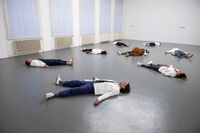
 was a live exhibition composed by Ari Benjamin Meyers that ran from 25 January to 3 March 2018 at Witte de With Center for Contemporary Art. From 5 March until 8 April, traces of the project remain on-site. These traces include audio recordings, musical instruments, experimental scores, and the ensemble’s costumes. Alongside this, a selection of source material underpinning the exhibition is presented: the Kunsthalle for Music Reader, featuring texts that expand on the project’s foundational aims, and, the Kunsthalle for Music Songbook, comprising the scores of the 34 pieces enacted by the ensemble during the period of the exhibition.
At Kunsthalle for Music, an ensemble performed on-site a four-hour musical score of artworks drawn from a “repertoire” or collection, which included existing and newly commissioned solos, duets, and group pieces. While the artworks included in the score are signaled with wall object-labels throughout the galleries, there is no fixed timetable as to when one or the other will be activated. Composed by Ari Benjamin Meyers, the exhibition score is open to variations, and so offers a unique interpretation and experience every day. We encourage you to visit the Kunsthalle for Music more than once.
Even when the ensemble is not present or performing at all times, the Kunsthalle for Music keeps its doors open to the public. If you visit during these times, you may then encounter other kinds of activation of the gallery spaces. For example, ensemble members may be found using the space to rehearse or may have left a recorded trace in their absence. You may also find school groups learning and performing an especially commissioned score by Andre Heuvelman.
Ensemble
The Kunsthalle for Music ensemble forms the heart of the Kunsthalle for Music, consisting of eight musician-performers. An open-call for musicians of all types, backgrounds and skill-levels resulted in the following ensemble: Bergur Thomas Anderson (guitar), Billy Bultheel (piano), Sandhya Daemgen (violin and voice), Sara Hamadeh (violin), Alexander Iezzi (drums and percussion), Nanna Ikonen (saxophone and electronics), Jackson Moore (saxophone), and Pau Marquès i Oleo (cello).
Commissions
The ensemble performs newly commissioned works by Dominique Gonzalez-Foerster, Jonathan Bepler, Libia Castro & Ólafur Ólafsson, and The Residents. Over the course of the exhibition each of the commissioned artists work on-site, activating their scores directly with the ensemble in both rehearsals and performances open to the public. Each commission is incorporated as part of Kunsthalle for Music’s evolving repertoire. For secondary school groups, Andre Heuvelman develops a special education commission.
Repertoire
Kunsthalle for Music repertoire comprises a diverse range of existing and adapted pieces contributed by artists and composers including Bergur Thomas Anderson, Ei Arakawa & Christian Naujoks, Cory Arcangel, John Baldessari, Jonathan Bepler, Wojtek Blecharz, Billy Bultheel, Libia Castro & Ólafur Ólafsson, Sandhya Daemgen, David Michael DiGregorio & Sung Hwan Kim, Marcel Duchamp, Julius Eastman, Tim Etchells, Peter Fengler, Philip Glass, Dominique Gonzalez-Foerster, Andreas Greiner & Tyler Friedman, Sofia Gubaidulina, Charles E. Ives, Hassan Khan, Sora Kim, Lea Letzel, Ranjana Leyendecker, Christian Marclay, Jonathan Monk, Jackson Moore, Pauline Oliveros, Yoko Ono, Laure Prouvost, Steve Reich, The Residents, Terry Riley, Anri Sala with Franz Ferdinand, Erik Satie, Superflex, Andre Vida, Guido van der Werve. The exhibition also includes a number of Ari Benjamin Meyers’ performance-based music works.
Team
Artistic Director: Ari Benjamin Meyers
Co-Founders: Ari Benjamin Meyers and Defne Ayas in partnership with Mimi Brown
Key Production team: Sandhya Daemgen, Rosa de Graaf, Patrick C. Haas, Christina Li, Anja Lindner, Samuel Saelemakers
Founding of the Kunsthalle for Music
The Kunsthalle for Music is commissioned by Witte de With Center for Contemporary Art (Rotterdam) together with Spring Workshop (Hong Kong). An exposition, not an exhibition by Ari Benjamin Meyers unfolded the Kunsthalle’s foundational themes at Spring Workshop (11 March - 1 April 2017), taken up by Music is Not! A Symposium On and Around the Kunsthalle for Music at Witte de With (26-27 May 2017), with contributions by Peter Osborne (Professor of Modern European Philosophy), Armen Avanessian (Philosopher, Literary & Political Theorist), Victoria Ivanova (Writer and Curator), Jörn Schafaff (Art Historian), Marie-France Rafael (Art Historian), Francois Quintin (Director, Lafayette Anticipations), and Lisette Smits (Curator), amongst others, culminating with this inaugural take-over at Witte de With.
Supported By
Goethe-Institut, Institut français, Mondriaan Fund
<div class="
-
Rotterdam Cultural Histories #13: The Temporary Autonomous Bureau
Rotterdam Cultural Histories #13: The Temporary Autonomous Bureau is a space for researching and discussing interpretations of autonomy in cultural or social projects within Rotterdam. We are inhabitants of the Poortgebouw, a historic residential community located next to the Maas River, and students from the Experimental Publishing Master Programme at the Piet Zwart Institute in Rotterdam. We have converted a space at TENT into a temporary office. Following two projects from 2017 - the database 'The Autonomous Archive' and the publication 'A Bed, A Chair and A Table' - we shall use this space to carry on researching the Poortgebouw's history.
The Poortgebouw is a 37-year-old organisation that hosts cultural activities, as well as a community of 30 people. Over the years it has offered space for self-organised events and projects, provided residencies for guests, artists and musicians, and afforded living and work spaces for different generations of people from all over the world. The building was first squatted in 1980 and attained legal status four years later, which was made possible through renovating the building and making it habitable. The commitment of its first residents enabled the founding of the Poortgebouw Association.
During this presentation's three-month timeframe, we shall use this space to organise a series of events that will map the independent strategies of self-organisation in Rotterdam. At the same time, the public has access to the fragmented Poortgebouw archive. The Temporary Autonomous Bureau serves as meeting point where experiences with how to navigate between autonomy and institutionalisation can be shared.
How can independent organisations maintain agency in a city where the institutionalisation of cultural and residential spaces is the norm?
Is it possible to establish sustainable, non- hierarchical, socio-cultural projects through collaborative, bottom-up practices?
Can a degree of openness and autonomy be maintained in the management of a self-organised social and cultural project?
With thanks to past and present Poortgebouw occupants and all the people who have supported it over the years.
Rotterdam Cultural Histories is a collaborative project between TENT and Witte de With that explores our common roots in Rotterdam and articulates meeting points between both of our programmes.
Network
TENT
Series
Rotterdam Cultural Histories
<div class="
-
A new work by Teresa Margolles
Not too long ago, Colombians fled to Venezuela and elsewhere to avoid the escalating violence and insecurity associated to their country’s drug wars and guerillas groups. Today, it is Venezuelans that have been fleeing to Colombia. With an economic hyperinflation and a repressive government policy, Venezuela is facing a food shortage and health crisis, among many other challenges preventing social welfare and safety. On a daily basis, hundreds of Venezuelans cross the border of San Antonio de Táchira in Venezuela to the city of San José de Cúcuta, Colombia. They go there to look for work opportunities or simply to find safety. There, their work typically consists of carrying out odd-jobs or manual labor to purchase basic goods such as food and medicine.
Trayecto — Fase 1. La entrega. Fase 2. A través. Fase 3. Inclusión (Trajectory— Phase 1. The Remittance. Phase 2. Through. Phase 3. Inclusion), a new work by Teresa Margolles, is developed after the artist’s fieldwork in this border region. She has traveled there on three occasions, first, in 2017 at the invitation of Bienal Sur in Colombia. During her time in Cúcuta, Margolles engaged with the sites and subjects of forced migration. In one of several actions there, she hired Venezuelans to carry stones across the river, which geopolitically divides the border; in another action, she hired them to knit their narratives into fabrics stained with the local soil. During these exchanges, their manual labor was remunerated, and was always accompanied by conversations with, and documentation by, the artist.
At Witte de With, the exhibition A new work by Teresa Margolles consists of a simple action: the six large windows of the gallery space are smudged, rather than cleaned, using shirts stained by the soil and sweat of over one-hundred Venezuelan men that Margolles hired in Cúcuta. This performance at the gallery is staged for the first month of the exhibition; during this time period, the shirts used are each progressively encased in a series of cement blocks, made on site. The initials of the names of each hired worker are then engraved into each sculptural element. Together, these elements progressively form an installation in the space alluding to spatial dynamics set forth by the border-crossers in that region. Also included in the galleries is a portrait of one the participants of Margolles’ action in Cúcuta.
A new work by Teresa Margolles comes from the artist’s long-standing and profound engagement with victims of violent crimes in sites where, for the artist, mending a social fabric that is torn invokes attention and involves care. In earlier works by Margolles, such as her installation In the Air (2003) and her exhibition What Else Could We Talk About? (2009), the artist has used materials like cloths and water employed to cleanse the bodies of victims or sites of violence. In other artworks, such as Lote Bravo (2005), she draws soil from the ground where victims of feminicide were found to create her sculpture installations.
The latter is one of a number of works the artist has made in and about Ciudad Juarez in México, a city that borders the United States and that welcomed numerous migrants from the South of the country as the workforce to the new industries based there since the early 1990s. However, the city significantly suffered the effects of the war on drugs in the past decades. As with Lote Bravo, A new work by Teresa Margolles emerges from field-work in a geopolitical border region where social displacement and precarity is latent. These works also share the proposition of sculpture to encounter an occasion “of being” in the presence of absent testimony.
Performers: Pendar Nabipour, Víctor Santamarina
Participants
Teresa Margolles
Curators
Sofía Hernández Chong Cuy, Rosa de Graaf
<div class="
-
An exhibition with art installations by Susana Mejía, Pamela Rosenkranz, and Anicka Yi
This exhibition, bringing together work by Pamela Rosenkranz, Susana Mejia, and Anicka Yi, invites us to engage with a rarely visited part of the world: the Amazon. The largest tropical rainforest in the planet, Amazonia extends over nine different countries in South America, including Brazil and parts of Venezuela, Colombia, and Suriname. Scientists have likened its ecosystem to the lungs of our planet, like a larger-than-human organ taking in, but also producing, oxygen. Similarly, as an organism, art exhibitions operate as entities that make worldviews palpable. For, historically, artists have come to picture, and make visible, unknowns. In so doing, artists probe at what an image of a place, its experience and its mediations, may come to constitute or trigger; they explore the limits of an image, and what its ends could become.
The artworks in this exhibition are uncontained: they are neither solely documents nor finite pictures. Sensually spatializing empirical and intellectual findings, these projects distinguish themselves as aesthetic matter to attest to, and be tested through, senses other than sight and reason alone. The artists created these artworks after artistic and field-research, using a range of technologies drawn from scientific, digital, and indigenous knowledges. What results, are conceptually and materially multi-dimensional art installations.
Taking its name from a substance based on ancient and abundant natural properties found in the Amazon, Pamela Rosenkranz’s work is a light, water, and sound installation. Amazon (Container of the Substance Anemine) draws on the molecular structure of ‘chlorocruorin’, a green blood derived from ringed worms in the rainforest, known to enhance the intensity of human perception. A drip introduces saline water containing “Anemine”, the medical product containing the substance, into the gallery space, creating a reflective liquid on the ground that changes it’s shape over time. Based on her perceptual experience of the Amazon, Rosenkranz conceives the light installation as a translation of the aerial view of the rainforest’s green vegetation and the blue water of the Amazon river’s serpentine-like movements. Permeating throughout the gallery, are sampled sounds of the jungle, emanating from artificial intelligence speakers of the e-commerce company Amazon.
In stark material contrast to this installation, is the hand-made work by Susana Mejía. Together with other artists, anthropologists, botanists, photographers and filmmakers, Mejía has investigated the Colombian Amazon in search of color. Drawing on ancestral knowledge in conversation with Huitoto and Tikuna women, indigenous communities native to the Amazon, eleven botanical species were identified along with the alchemical processes for the use of their pigments on natural fibers such as fique, cotton, and paper. In the artist’s over decade-long project, titled Color Amazonia, of which a large component is showcased in the exhibition, Mejía presents the results of ethno-botanical research.
Anicka Yi’s The Flavor Genome is a techno-sensual journey through the unexplored potentialities of adaptation, mutation, and hybridization of living organisms. Structured as an episodic narrative, this 3D-film stems from the artist’s extensive field-research in the Amazon informed by science fiction, cultural ideas of taste, and the beliefs of indigenous Amazonians. Set in the rainforest and renegade laboratories, its narrative is told through a commercial flavorist who is on the hunt for a mythical orchid, which holds miraculous properties and resides in the jungles of the Amazon. By deploying both 3D video and 3D animation systems, the video takes reality as a matrix of perceived and so-called unique essences, which could enable the potential for bio-diverse intelligence sharing.
The artworks presented in this exhibition are explicitly contemporary: they result from all three women artists’ independent research in the Amazon. Not as a companion, say, to a male researcher, and neither as an emissary of an institution. Their mobility stands as a sign of class, gender, and intellectual emancipation, and the fostering of new imaginaries. Thanks to the histories experienced and the confidence gained through education, the three artists come to foster new imaginaries.
As a central component of this exhibition, a series of public programs will introduce the work by other artists who have also created work in the Amazon. In these programs, special attention is given to documentary practices, including a presentation on the work of Claudia Andujar by curator Agustin Pérez-Rubio, and a project on Thea Segall by the researchers Sagrario Berti and Aixa Sánchez.
Participants
Susana Mejía, Pamela Rosenkranz, Anicka Yi
Curators
Sofía Hernández Chong Cuy, Rosa de Graaf
Supported By
The Mondriaan Fund contributed to the artists fees through the experimental regulations.
<div class="
-
Angie Keefer —
OHRHUT
Angie Keefer’s OHRHUT is a signal-blocking mobile device case conceived by the artist as an antidote to both social media addiction and relentless data surveillance. Any device placed inside of an OHRHUT instantly disappears from the global grid of always-on networked communications, an effect both faster and more reliable than simply powering down, since even dormant phone batteries may be used to gather their owners' geolocation information. Though publicly proposed as a luxury commodity, OHRHUT aims to address systemic problems of political and economic inequity by way of a vertically-integrated, sustainable manufacturing program.
Participants
Angie Keefer
Curators
Sofía Hernández Chong Cuy, Samuel Saelemakers
<div class="