-
Sara Sejin Chang (Sara van der Heide): Dismemberment
Sara Sejin Chang’s (Sara van der Heide) artistic practice is dedicated to spiritual evocations, historical research, decentering eurocentrism, and unraveling colonial narratives to create works that act as historical repair and healing.
In her newly created film installation Dismemberment (2024), she presents a political and shamanistic allegory where a gallerist, embodying Enlightenment ideals, undergoes a ‘dismemberment gut,’ a ritual inspired by the traditional Korean healing practice Ssitgim gut.* The gallerist, the colonial and patriarchal figure of Europa, is portrayed by actress Susanne Sachsse in an all female cast. Through this character, Sara examines the colonial condition of Europe, intertwining ritual objects and artworks to challenge the boundaries imposed by colonial narratives that separate art from spiritual practice.
The installation invites viewers into a space where the film and objects reflect on the deep entanglements of colonialism within Western systems of categorization and racialization. It also reflects on the historical experiences of Asian women, their mothers, and grandmothers in Europe, acknowledging the cycles of violence they have faced and calling for change. Through visions and song-making, Sara reimagines the gallery space as a site of ancestral convergence, situated in the present and honoring the spiritual world, with which the ‘European Enlightenment project’ severed ties.
*During the ssitimgut ritual one is taken apart by the gods, and that which no longer serves the person – whether that be greed, arrogance, abusiveness or sickness, for example – will be removed leading to one's rebirth, assembled anew.
First Double 1 & 2
Sara’s exhibition is part of the series First Double 1 & 2, which takes its title from a collaborative album by South African musicians Madala Kunene, Baba Mokoena, and Sibusiso Mndaweni. The album’s lyrics connect seemingly unrelated activities—such as a mother going to the marketplace, a father attending a racecourse, and anti-colonial resistance chants—to reflect deeper connections between everyday life and broader socio-political themes. Similarly, the five solo exhibitions in First Double 1 & 2 explore diverse yet interconnected topics, including spiritual technologies, mineral extraction, land-related issues, queer cosmologies, and the recollection of historical events. Also included within the series are solo exhibitions by Cihad Caner, Jabu Arnell, Luana Vitra, and Nolan Oswald Dennis.
Participants
Sara Sejin Chang (Sara van der Heide)
Curators
Rosa de Graaf
Series
FIRST DOUBLE 1 & 2
Supported By
MONDRIAAN FUND
<div class="
-
Ola Hassanain: The Watcher
Ola Hassanain is an artist whose work moves through architecture, film, and spatial strategies to reflect on how power becomes visible—and felt—through built environments. Her practice engages with places shaped by climate instability, postcolonial legacies, and displacement, thinking through the politics of inhabiting and how ecological and social systems shape one another across time. As she notes, “observation summons a form of power”.
In The Watcher, her solo exhibition at Kunstinstituut Melly, Ola reflects on the act of watching as a form of responsibility—of bearing witness to both environmental and political catastrophe. Central to the project is the figure of the watcher, drawn from Sudan’s Gezira irrigation scheme: a community caretaker who monitors water levels and signals early signs of floor. Rooted in communities facing environmental precarity, including Ola’s own, the role becomes a lens for considering how people respond to the slow unfolding of catastrophe—whether natural or engineered.
The exhibition’s central film installation moves between two roles inhabited by the same performer. One watches within an agricultural landscape, observing for signs of ecological crisis—mud, storm surges, rising water—alerting others to the slow violence of uninhabitability. In a temporal fold, this same figure inhabits his “historic future” in Waterloopbos, a former hydraulic testing site in the Netherlands where technologies of water control were developed and later exported to colonial contexts such as the Gezira scheme. The second watcher appears in the urban margins, surveilling the displaced—those now framed as “debris” while also acting as a double informant: warning residents ahead of their forced removal, resisting the machinery of state control. As Ola describes, “they watch for the catastrophe of modernity, which brings a continuous cycle of removal and arrival.”
Debris, in Ola’s work, is both material and metaphor. It stands in for the residue of systems, cycles, and histories that displace and erode. Watching becomes a way to read this residue—a mode of resistance, of staying with what remains. “Our bodies are also fragments of modernity,” she notes. “We shore up different spaces but we also shore up different ideas and aspirations for a different political ecology.”
Across the exhibition, Ola reflects on how spatial technologies—retaining walls, thresholds, irrigation networks—are implicated in broader questions of control and erasure. These built forms, designed to manage movement and resources, also manage bodies and histories. Her work asks how we witness what has been lost, and how we remain attentive to what is still unfolding. Watching, in this sense, becomes a mode of resistance: a way to stay with the trouble of living within unstable ground.
The film The Watcher (edition I of III) is commissioned by BAK, basis voor actuele kunst, Utrecht, and presented at Kunstinstituut Melly in its current iteration. The project was made possible with the support of artist Oded Rimon; videography by Juan Arturo Garcia; performance by Hammo Salhein; calligraphy by Tewa Barnosa; and production by Shantell Palmer. Special thanks to Marianne Peijnenburg, Benedetta Pompili, Asbeter, and Orlando Maaike Gouwenberg, Carly Rose Bedford, and Jeanne van Heeswijk.
Participants
Ola Hassanain
Curators
Rosa de Graaf, Gabi Ngcobo
Network
BAK, institute for the contemporary, Ammodo
Series
Call & Response
<div class="
-
Paulo Nimer Pjota: A Lua e Eu (The Moon and I)
Paulo Nimer Pjota is an artist whose large-scale works combine painting on metal sheets and raw canvas. His compositions bring together imagery from archaeology, street culture, comic books, advertising, music, and mythology through a process of visual sampling—a method he likens to that of a hip-hop producer: “If you think of the composition, you can imagine a producer, sampling and repeating to produce the beat. I do it with my pieces: I cut a part of the history and rearrange it, cut another part and rearrange it further.” These visual elements are not simply juxtaposed but held in loose, associative constellations, allowing relationships to emerge between disparate histories, images, and ideas.
Until now, Paulo’s visual language has been one of accumulation and drift. Forms appear suspended or loosely arranged across open surfaces, resisting central focus. Symbols take on a mutable presence: a moon becomes a bowl, a mask becomes a moon, a domestic object turns mythic. “I remix images out of context—images from the old world are layered with the contemporary world,” he notes. Rather than constructing fixed meanings, his works remain open and associative, responding to context and imagination alike.
His solo exhibition A Lua e Eu (The Moon and I) brings together an entirely new series of paintings, shown alongside a selection of recent works that anchor the installation in the artist’s earlier visual language. These are arranged within a large-scale mural painted directly onto the gallery walls. Just as forms in his canvases drift and cluster in loose constellations, here too the works are held in suspension, inhabiting a shared pictorial space without settling into a single narrative or centre.
The exhibition marks a subtle shift in Paulo’s work—from the urban iconography of earlier pieces to a more introspective mode of reflection. Drawing on memories of his childhood in São José do Rio Preto, a small inland city in Brazil, the new paintings explore rural and domestic interiors, plants, animals, and mysterious figures that hover between recollection and imagination. “It takes on a character of dreamlike intoxication,” he says, “where the perspectives of the paintings and their elements, like flowers and beings, blend in the pictorial plane, expressing a fantastical and spiritual thought drawn from fables and myths.”
Some compositions are constructed from earlier studies and sketchbook drawings, tracing a line back to the artist’s earliest experiences of mark-making as a child—when drawing was a way of understanding the world through curiosity and intuition. The exhibition’s title, A Lua e Eu, is borrowed from a song by Brazilian musician Cassiano, a long-standing point of reference for Paulo and a guiding note for the mood of introspection and resonance that infuses this latest body of works.
A Lua e Eu is Paulo Nimer Pjota’s first institutional solo exhibition, and his debut in the Netherlands. This project is supported by Ammodo, and by the artist’s three galleries, Mendes Wood, Maureen Paley, and Francois Ghebaly.
Publication: A Lua e Eu (The Moon and I) — Paulo Nimer Pjota
This new monograph accompanies Paulo Nimer Pjota’s first institutional solo exhibition A Lua e Eu (The Moon and I) at Kunstinstituut Melly, Rotterdam (17 May – 21 September 2025).
Bringing together works from the past five years, the book illustrates Pjota’s distinctive montage practice, in which painting on raw canvas and metal sheets merges with imagery from archaeology, street culture, music, and mythology. His latest works mark a shift from urban iconography toward more introspective explorations of memory, rural life, plants, animals, and dreamlike figures.
The publication includes contributions by writer Mateus Nunes and Gabi Ngcobo, Director of Kunstinstituut Melly, as well as a conversation between Paulo Nimer Pjota and curator Hans Ulrich Obrist. Together, they provide insight into the artist’s evolving visual language and the resonant poetics of his imagery.
Step into Paulo Nimer Pjota’s world of memory, myth, and imagination: buy the book today!
BUY THE BOOK
Participants
Paulo Nimer Pjota
Curators
Gabi Ngcobo, Rosa de Graaf
Network
Ammodo
Series
Call & Response
<div class="
-
Simnikiwe Buhlungu: hygrosummons (iter.02)
Simnikiwe Buhlungu’s exhibition hygrosummons (iter.02) transforms the building of Kunstinstituut Melly into a porous, responsive site. Comprising installation, sculpture, drawing, and sound, Simnikiwe’s new commission unfolds as a sensing hygrometer that conspires with the conditions of the building—summoning water to reveal the ways knowledge, history, and ecology circulate and pool. Puddles are not treated as a minor detail but as a site of accumulation. As Simnikiwe puts it, “The show expands our day-to-day understanding of how water circulates through humidity, moisture, and puddles, by encouraging us to look again at their complexity, and what they might tell us about how knowledge is produced and accessed."
Spanning multiple floors—from basement to rooftop—the installation brings together water samples collected from puddles in Rotterdam, Italy, and South Africa. These are joined by sculptural instruments—zithers—tuned to humidity and materials that shift, leak, or settle over time. Sound, too, is shaped by the moisture in the air—absorbed and altered by the building’s atmosphere. Throughout the exhibition, the artist intervenes in and alongside the architecture: puddles echo the slant of the uneven roof; hand-sculpted clay vents—made using clay sampled from Rotterdam and subterranean puddles from Salse di Nirano, Italy—intervene within the building’s ventilation system; and improvised schematics drawn by the building’s former manager reappear in the form of specially designed merchandise. Simnikiwe, as she says, “thinks with the building,” treating its idiosyncrasies as openings for attunement. Unfolding during a moment of architectural transition at Kunstinstituut Melly, hygrosummons participates in sensing the conditions of the building ahead of the structural renovation of its roof.
Simnikiwe’s practice looks at how knowledge is produced and felt. Through installations that bring together sound, sculpture, and publishing, she traces inquiry or invisible systems—working with water, language, and time as open-ended forms of questioning. “We experience universal phenomena across disparate places and their conditions,” she reflects. “Things that happen in one place might also happen in another, but they look different, mean different, or are encountered differently. What can those shifts tell us?”
This project was co-commissioned with Chisenhale Gallery, London, who presented the first iteration of the exhibition in 2024. The exhibition is accompanied by a new publication, besides Puleng; dontsa-ring and roving preoccupations (2024), co-published with Chisenhale Gallery and Mousse Publishing and available for purchase online and in the ground-floor bookshop.
BESIDES PULENG; DONSTA-RING AND ROVING PREOCCUPATIONS: A PUBLICATION BY SIMNIKIWE BUHLUNGU
With contributions from musicians, artists, curators, and scientists from around the world, the publication draws upon research related to hygrosummons (iter.01) – commissioned by Kunstinstituut Melly, Rotterdam, together with Chisenhale Gallery in London – and gathers an intertextual conversation around the literal and metaphorical possibilities of the water cycle. The artist’s original writing uses the footnote as an editorial style to trace personal anecdotes and literary references that have informed her commission. Situated amongst original drawings, texts, song lyrics, posters and correspondences, a series of research images reveal geographical sites and experimental processes that have shaped the development of a new body of work.
BUY THE BOOK
BESIDES PULENG T-SHIRT: LIMITED EDITION BY SIMNIKIWE BUHLUNGU
Marking the launch of the publication, the artist created a limited edition T-shirt. The design features graphics inspired by Simnikiwe’s research into puddles as poetic and ecological sites, reflecting her interest in how knowledge circulates through everyday life.
BUY THE LIMITED EDITION T-SHIRT
Participants
Simnikiwe Buhlungu
Curators
Rosa de Graaf, Gabi Ngcobo
Network
Chisenhale Gallery, Mousse Magazine Publishing
<div class="
-
TOOLSHED #1 : Pungwe Listening
TOOLSHED is Kunstinstituut Melly’s new residency and research initiative dedicated to exploring the tools we use to build, question, and transform cultural institutions today.
Located on the second floor of Melly, TOOLSHED is a dynamic experimental space for reflection, discussion, experimentation, and action. Building on our programs: Tools for Collective Learning, Tools for Demodernizing, and Tools for Conviviality, TOOLSHED extends our commitment to institutional practices rooted in accessibility, criticality, and care.
At TOOLSHED, tooling is approached as both a practical and symbolic process. It invites artists, cultural practitioners, researchers, and collectives to engage with artistic, theoretical, and material tools that shape how we institute. TOOLSHED is a space to reflect on and challenge conventional institutional frameworks, while exploring interdisciplinary practices that expand the potential of art spaces to engage meaningfully with their surroundings.
For its pilot edition, TOOLSHED welcomes Listening at Pungwe, the collective comprising artist and historian Memory Biwa and music and sound researcher Robert Machiri. Working between Windhoek, Berlin, and Johannesburg, Listening at Pungwe engages with historical and contemporary sound collections and archives to create spaces where people can hear, feel, and activate new knowledge systems that challenge dominant ways of interacting with the world.
Over the course of five months, Memory and Robert approach the TOOLSHED space as a site to cut, play, rewind, splice and dice different materials, whether they were books, sounds or photographs. While the collective slowly reworked these fragments, they also built a radio studio and a record library, enabling them to host The Pungwe Listening Rotations. These open radio sessions draw from the call-and-response tactics of the pungwe: a term used in Zimbabwe to describe all-night social gatherings. Founded in 2017, Listening at Pungwe began as a jam session of ideas centred on sonic memories and the archives of southern African histories. The Rotterdam radio rotations extend this lineage, offering listening as a way of accessing alternative archives: living, communal, and spiritual, beyond material taxonomy.
The residency culminates with a public jam session: a cypher of text cuts, imaginaries, sounds, dance, and other methodologies of living, anchored in Katherine McKittrick’s text Dear Science and Other Stories, and developed in collaboration with Lynnée Denise and Eiliyas.
TOOLSHED is designed as an open, publicly accessible space. Visitors are invited to engage directly with the processes and research unfolding within TOOLSHED, witnessing and participating in new modes of collective learning, institutional questioning, and artistic experimentation.
After the end of Listening at Pungwe’s residency, TOOLSHED remains open to the general public. Visitors were invited to listen to a recording by Princess Constance Magogo, activate the sonic sensors placed on the plants that had lived and breathed alongside the collective and their collaborators for the duration of the program, and browse through a curated selection of LPs. Photographic fragments cut and sequenced by Memory Biwa and drawings on wood by Robert Machiri, also referred to as markings, punctuated the walls.
As a residency initiative, TOOLSHED hosts two collectives per year, each developing their projects over a four-month period. For residents based outside the Netherlands, the program collaborates with Casa Chris, which offers residential studio apartments, supporting immersive research embedded within Rotterdam’s cultural landscape.
Participants
Memory Biwa, Robert Machiri
Network
Listening at Pungwe
Series
TOOLSHED
<div class="
-
35 Years of Minds and Matter: From the Archive of Kunstinstituut Melly
In 2025 Kunstinstituut Melly celebrates its 35 year anniversary, and in the past 10 years, the archive in its current form has come into existence. The archive was created in connection with the exhibition Were it as If of Bik Van de Pol. Their need for archival information on the institute’s relationship with Rotterdam highlighted the necessity of accessible archival resources. 35 Years of Minds and Matter is curated by Melly’s archivist marjolijn kok.
The wealth of material and stories about the artistic practices of over 1400 artists who have come through our doors cannot be grasped in one exhibition, and we should not even attempt to give a complete overview. Instead, a thematic approach is taken.
This exhibition will take as its starting point artists who have exhibited at Kunstinstituut Melly and have engaged with the concept of the archive. Their combined insights will form a thread that shapes the core of the exhibition. Education has always been a strong pillar of Kunstinstituut Melly, and deserves a space where the integral role of our educational programs can be highlighted.We have a large collection of audio tapes, particularly from the events in the early years, capturing discussions that are still relevant today. Events often have a more ephemeral character than exhibitions but have shaped the institute in their own way. Video and film have been important from the start, which is reflected in our collaborations with the International Film Festival Rotterdam and through the many television productions we have made.
We invite the public to participate in the continued development of our archive by scanning our publications, and uploading them directly to our new online archive, where photographs from the first 10 years are already available.
You may also encounter our old name at several locations, which reflects our commitment to preserving documents as they were, rather than how we might wish them to be.
Exhibition Guide: 35 Years of Minds and Matter
To accompany 35 Years of Minds and Matter, we have created an exhibition guide offering further context on the themes, archival materials, and artists featured in the show. Explore the guide to learn more about how our archive came into being, the role of education at Kunstinstituut Melly, and the many voices that have shaped our institution over the past 35 years.
DOWNLOAD THE GUIDE
ONLINE ARCHIVE: MELLY X ARCHIVAL CONSCIOUSNESS
It has always been our goal to make the archive as accessible as possible. While online accessibility is a key objective for Kunstinstituut Melly, it remains a long-term project. In collaboration with Archival Consciousness, we have taken the first step by joining their web archive, Biblio*Graph.
Photographs from our first decade (1990–2000) are now available online, and we are currently digitizing a selection of our publications. On the website, you can explore the archive through three viewing modes:
Timeline: shows scanned publications,
Grid: displays our photographs,
Graph: illustrates the relationships between exhibitions, artists, curators, and years.
All information provided on the website can be used for research and personal enjoyment; commercial use is not permitted.
Click here to discover the online archive.
For more information, please contact our archivist marjolijn kok at [email protected].
Curators
marjolijn kok
<div class="
-
donna Kukama: I Breathe, You Breathe
I Breathe, You Breathe brings together donna Kukama’s sound, videos, paintings, drawings, sculptures, and performance documentation spanning two decades of her artistic practice, along with a newly commissioned mural and performances that will take place throughout the exhibition period. Approaching history as a living and breathing body, donna invites us to breathe in the company of lesser-known stories, reimagine what it means to write a historical text, and to fluidly inhabit spaces of contradiction, plurality, and becoming, reflecting and mirroring the messiness of history.
donna is an interdisciplinary artist and creative researcher whose practice is grounded in breath as a grammar for storytelling and memory work. Known for her performance practice, her continued engagement with the medium, alongside its translations and transmutations into other forms, remains a tool to invent and reimagine the conventions and institutions of art, historical writing, and monument-making.
Aligning with donna’s approach to engaging with history, the exhibition is intentionally unchronological and layered, echoing her multiplicity and non-linear storytelling methods that weave and intertwine histories, rumors, gossip, and poetic ruptures into socio-political contexts. In her drawings and paintings, she rhythmically and repetitively renders written language obsolete, leaning instead toward gestural and invisibilized forms of knowledge-making “go kgapha” from her maternal lineage. Her sculptural works, which document moments in her performances, become miniature monuments drawn from the earth and rendered in clay, copper, and steel. In her sound works, the presence of breath, the human voice, the wind, and oceans transform the exhibition into a living archive of survival, resistance, and reclamation.
I Breathe, You Breathe is donna Kukama’s first solo exhibition in the Netherlands. The exhibition is supported by Ammodo. With thanks to blank projects, Galerie Tschudi, and private collectors across Europe.
Participants
donna Kukama
Curators
Honey Kraiwee, Gabi Ngcobo
Network
Ammodo
<div class="
-
Marilyn Nance: Spirit Faith Grace Rage
Marilyn Nance started making photographs of daily life in New York City at the age of eighteen. At age twenty-three, Marilyn joined the FESTAC ‘77 United States delegation as technical support for the Second World Black and African Festival of Arts and Culture in Lagos, Nigeria, where she created one of the most vibrant visual records of the Pan-African gathering. She continued making images with an equal attention to historical events, family moments, community gatherings, trips abroad, and quiet moments.
While studying and taking care of her photographs, she began using the title Spirit Faith Grace Rage to tie together her work made across different times and geographies. For Marilyn, Spirit is the underlying energy of an event; Faith lies in the belief that everything works towards the greater good; Grace acknowledges the spiral of time and the beauty, love and joy that lives in the everyday; Rage is that built up energy that finds expression and moves us forward.
As Marilyn parses through her images and files with her team, she makes stops along the way to send them to the people she recognizes, or to scholars and artists who can help gather context. From the very beginning of the Internet, Marilyn has set a visionary example for how to disperse archives online to preserve them and put them in relation with others: her website soulsista.com, active since 1995, acts as a partial container, and her social media @marilyn.nance and @festac77archive contemporize her archive.
For this exhibition, the meticulously selected photographs bring together reunions, communions, hugs, dance trains, stages, street or church scenes, demonstrations and living rooms in an interconnected constellation of timeless gestures. Sonic fragments collected by Marilyn over the years and arranged by artist and technologist Ali Santana imbue the space in the social and intimate contexts from which the images emerge.
Across five decades, Marilyn’s works bring forward the importance of seeing oneself historically instead of waiting for history to decide what is worth documenting. The message in her practice remains clear: keep your records, take many photographs, make notes often, back up your files, share them with others. From the multiplication and connection of personal archives, collective memory can be traced and kept safe.
The artist and the Kunstinstituut Melly team would like to thank Ashlyn Diaz (Archive Fellow), Ali Santana (Exhibition Technologist), and RaFia Santana (Exhibition Technologist) for their essential contributions to the making of this exhibition, and to the daily upkeep of the Marilyn Nance Archive.
Photographs ©️ Marilyn Nance c/o Pictoright Amsterdam 2025.
Spirit Faith Grace Rage was made possible thanks to the support of Hartwig Foundation and the Netherlands-America Foundation.
Participants
Marilyn Nance
Curators
Gabi Ngcobo, Aïda Sidhoum
Network
Stichting Hartwig Foundation, The Netherland-America Foundation (NAF)
<div class="
-
TOOLSHED #2 : The Imaginary Stage
Act III
Dear Puppet, sorry to burden you with existence. PS. Please speak for me.
Act III of The Imaginary Stage is a collaborative project by Andrea Celeste La Forgia and Kerem Akar, developed within the TOOLSHED residency at Kunstinstituut Melly. The project understands The Imaginary Stage as the capacity to imagine otherwise: not as fantasy or escape, but as a shared social practice through which new characters, relationships, ideas, and possibilities can be rehearsed collectively through play and experimentation.
Over the course of several months, the artists worked with participants from neighbourhood centres across Rotterdam to explore creativity in relation to labour, migration, social class, collective learning, and making. Through workshops, participants created puppets and developed their characters intuitively through conversation, improvisation, storytelling, and theatre exercises. The puppets became agents of imagination and collective inquiry, redistributing voice and agency while creating space for participants to explore personal and collective stories, memories, desires, and impossible ideas through the voice of another.
The puppets presented in this exhibition were made in collaboration with participants from Dokhuis, Gemaal op Zuid, Het Wijkpaleis, and SOL (Samen Ondernemend Leren). Rather than remaining in the places where they were created, the puppets travelled between neighbourhood centres, becoming vessels for stories, encounters, and the traces of new relationships. This presentation reconnects those journeys and offers a glimpse into the conversations, exchanges, and collective processes that shaped the project.
The Imaginary Stage is part of TOOLSHED, a residency and research initiative at Kunstinstituut Melly. This edition is supported by Amarte Fonds and developed in collaboration with Dokhuis, Het Wijkpaleis, Gemaal op Zuid, SOL (Samen Ondernemend Leren), and Singing Club Rotterdam (Tara Reece).
Exhibition Locations
The puppets created through The Imaginary Stage are presented across five locations in Rotterdam.
Kunstinstituut Melly
20 June – 31 July 2026
Dokhuis
23 June – 25 July 2026
Gemaal op Zuid
23 June – 30 August 2026
Het Wijkpaleis
23 June – 30 August 2026
SOL 't Steiger
23 June – 30 August 2026
TOOLSHED
TOOLSHED is a residency and research initiative by Kunstinstituut Melly that explores the tools we use today to build, question, and transform cultural institutions. The programme invites artists, cultural practitioners, researchers, and collectives to critically reflect on conventional institutional frameworks while developing interdisciplinary practices that expand the capacity of art spaces to engage meaningfully with their surroundings.
Located on the second floor of Melly, TOOLSHED is a dynamic experimental space for reflection, discussion, experimentation, and action. Building on our programs: Tools for Collective Learning, Tools for Demodernizing, and Tools for Conviviality, TOOLSHED extends our commitment to institutional practices rooted in accessibility, criticality, and care. For its pilot edition, TOOLSHED welcomed Listening at Pungwe, the collective comprising artist and historian Memory Biwa and music and sound researcher Robert Machiri.
For its second edition, TOOLSHED welcomes artists Andrea Celeste La Forgia and Kerem Akar, whose joint residency focuses on the relationship between labour, social class, migration, and collective forms of learning and making. Working from distinct yet complementary practices, they approach art and performance as tools to question existing structures and to explore alternative ways of gathering, sharing knowledge, and imagining together.
During their TOOLSHED residency, Andrea Celeste La Forgia and Kerem Akar explore how artistic and pedagogical practices can function as tools for emancipation, solidarity, and institutional imagination. Through performance, collaboration, and research, they develop situations in which labour, knowledge, and creativity are collectively rethought and activated.
Public Performance: Dear Puppet, sorry to burden you with existence. PS. Please speak for me.
On Saturday 20 June, artists and theatre makers Andrea Celeste La Forgia and Kerem Akar invite you to the Public Performance: Dear Puppet, sorry to burden you with existence. PS. Please speak for me. at Kunstinstituut Melly. The performance marks the opening of Act III of their residency project TOOLSHED #2: The Imaginary Stage.
Call for Puppeteers: Join the Puppet Choir!
Artists and theatre makers Andrea Celeste La Forgia and Kerem Akar invite you to join the Puppet Choir at Kunstinstituut Melly, part of the final phase of their residency project TOOLSHED #2: The Imaginary Stage. Over the past months, workshops across Rotterdam have brought a growing community of strange, tender, chaotic, and impossible puppets into being. Now, these travelling characters gather at Kunstinstituut Melly alongside their makers, puppeteers, friends, neighbours, and fellow performers for a collective rehearsal. Led by Tara Reece from the Singing Club Rotterdam, the Puppet Choir temporarily transforms Melly into a shared stage for collective play, rehearsal, and imagination.
Collective Puppetry-Making Workshop
Join artists and theatre makers Andrea Celeste La Forgia and Kerem Akar for a two-session workshop exploring puppetry, storytelling, and collective creation. Using plaster, fabric, and found materials, participants will design and build their own puppets, then bring them to life through simple theatre exercises involving voice, movement, and character development.
Meet the TOOLSHED residents
Andrea Celeste La Forgia
Andrea Celeste La Forgia is an artist based in Rotterdam whose work moves across archival research, painting, prop making, and theatrical performance. Her practice interweaves family experience with broader histories of class struggle and labour, examining how social class is lived, embodied, and reproduced through contemporary forms of work. Central to her practice is an ongoing collaboration with her mother, a lifelong factory worker in Italy, through which lived working class knowledge, tools, and imagination become artistic methods and critical frameworks.
Kerem Akar
Kerem Akar is an artist, theatre maker, educator, and DJ based in Amsterdam. His practice emerges from everyday diasporic migration experiences and is grounded in questioning existing norms. Through collective making processes, often working with children, young people, and non professional performers, he dismantles traditional hierarchies within theatre. Vulnerability, play, and shared learning form the basis for collective and transformative experiences.
This second iteration of TOOLSHED is in collaboration with Amarte.
Participants
Andrea Celeste La Forgia, Kerem Akar
Network
Amarte Fund, Gemaal op Zuid, SOL, Wijkpaleis, Dokhuis
Series
TOOLSHED
<div class="
-
CLiP #7: The end is both near and already here; prepping for collective beginnings
CLiP #7: The Garage School of Prepping Otherwise
Collective Learning in Practice (CLiP) is the successor to Kunstinstituut Melly’s successful Work-Learn Project (2018) and has run six editions to date. CLiP gives participants the opportunity to study contemporary art issues and work with our team to make the institution more publicly accessible. Each edition supports 10–14 young participants with the tools, skills, and inspiration to grow as individuals, decision-makers, and professionals through a six-month study period.
This year, CLiP returns with its seventh edition: The Garage School of Prepping Otherwise. Over six months (October 2025 – March 2026), a group of Rotterdam-based participants aged 17–24 explored what it means to survive together in times of global crises, militarisation, and social inequity.
Monthly Open CLiP Sessions
During CLiP #7, monthly public sessions were held, giving everyone the opportunity to engage with the concepts and practices explored in the program. These sessions took place on the last Friday of each month and were open to the public.
CLiP #7: The end is both near and already here; prepping for collective beginnings
Presented as the exhibition The end is both near and already here: prepping for collective beginnings, CLiP #7 shares the outcomes of this collective learning process. At its core are the participants’ letters to the future(s) we are preparing (for): multimedia reflections on the skills, knowledge, and positions developed over the six-month programme, each responding to the question: What can it mean to survive together?
Taking over the Space for Education and Participation on the ground floor, the exhibition brings together these works alongside a small info market with publications and materials from the CLiP #7 library.
CLiP #7: the Garage School of Prepping Otherwise is curated by the Garage School and is made up of Janey Roana, Nik van der Meulen, Urvee Kulkarni, Pavlos Theodoru, Hooi-Ying Zhang, Aden Mete, Camilla Yakupova, Sol Munoz, August Sturlyte, Sophia Wirth, Leo Rij and Anarcha.
Meet the CLiPers
Discover the young participants shaping CLiP #7 and the ideas emerging from The Garage School of Prepping Otherwise.
Meet the Curators of CLiP #7: The Garage School
For this edition of Collective Learning in Practice (CLiP), Kunstinstituut Melly has invited The Garage School: a nomadic art and education collective led by Santiago Pinyol and Kari Robertson. Together, they reimagine “prepping” as a collective, creative, and hopeful practice.
Curators
The Garage School
Network
Fonds 21, Fonds voor Cultuurparticipatie, Stichting Mostert-Van der Meijden
Series
CLIP, Collective Learning, Monthly Open CLiP Sessions
<div class="
-
Hajra Waheed: There Is a Fountain Even If Pale That Flows Beneath Us All
Spring 2026 at Kunstinstituut Melly
This spring, Kunstinstituut Melly presents a new season of exhibitions opening across April and May 2026. On 18 April, two solo exhibitions open as part of the ongoing series Call & Response. A group exhibition, Draw Redraw Withdraw, will follow on 23 May.
Call & Response
Call & Response brings artists into proximity whose practices resonate with one another. The series reflects Kunstinstituut Melly’s commitment to supporting artists whose work engages with geopolitical demands while imagining new possibilities. This season presents exhibitions by Hajra Waheed and by Basel Abbas and Ruanne Abou-Rahme. In both, the artists situate viewers within ongoing conditions that call for sustained attention and attunement, attesting to sound as both a political and liberatory force.
There Is a Fountain Even If Pale That Flows Beneath Us All
Opening 18 April 2026
Guest curated by Hera Chan
Hajra Waheed is a multidisciplinary artist working across drawing, painting, sound, sculpture, video, and installation. Her practice explores the nature of power, the human impact of displacement and incarceration, and the transformative possibilities of liberation struggles.
There Is a Fountain Even If Pale That Flows Beneath Us All brings together newly commissioned and recent works that approach listening as an embodied, collective, and political practice. The title invokes an undercurrent that persists beneath regimes of repression, where expression defiantly circulates despite attempts to silence it.
At the center is Hum (2020), the first volume in Waheed’s trilogy of multichannel sound installations, which foregrounds political prisoners as leaders of liberation struggles and traces voice under conditions of incarceration. The singers and songwriters featured in the work have all been imprisoned—their work censored, with many forced into exile for mobilizing collective voice. The songs are drawn from a period, as today, marked by state violence and genocide, mass uprisings, and crackdowns. From this shared condition of silencing, the work turns to humming as both a compositional method and a language of resistance.
In parallel to Hum, the exhibition presents a series of sound studies; drawings, paintings, handbound artist books, and leporellos—many shown for the first time. Created over the years alongside sound chamber designs for Hum, these works extend Waheed’s sonic practice across mediums, where line, mark, and landscape become shared fields of attunement.
Participants
Hajra Waheed
Curators
Hera Chan, Rosa de Graaf, Aïda Sidhoum
Network
Ammodo
Series
Call & Response
<div class="
-
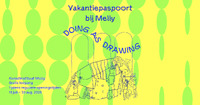 Holiday Passport 2026 - Doing as Drawing
Holiday Passport 2026 runs from 18 July to 30 August inclusive. The programme can be visited during our regular opening hours: Wednesday to Sunday, from 11:00 to 18:00.
Doing as Drawing
Join us this summer at Kunstinstituut Melly and discover the many possibilities of thinking through drawing. From 18 July to 30 August, children aged 4 to 12 can take part, free of charge, alongside their parents or carers, in an adventurous art programme full of play, imagination and discovery.
Be inspired by the exhibition Draw Withdraw Redraw, where drawing is so much more than just a pencil line on paper. Pick a card, follow a trail, build a story or discover how small choices can spark new ideas.
A world full of surprises awaits in the Space for Education and Participation. Help build a giant tent where you can explore, play and withdraw for a while. Create a secret garden for yourself or for someone else. Bring your drawings to life, invent new stories and discover what’s hidden in the many drawers, cupboards and secret nooks of the space. Behind every drawer lies a new task, question or surprise.
There’s no set route and no right or wrong answer. Follow your curiosity, try things out and respond to what others have left behind. Our art mediators will help you get started and invite you to explore the exhibition too.
WORKSHOP SERIES – DISTORTING IMPROVEMENT | JULY 2026
In July, Conform Cox will host a series of three free Saturday workshops where we’ll draw, imagine, and rethink the world around us, taking inspiration from the exhibition Draw Withdraw Redraw. Each workshop explores a question related to improving our everyday lives. In the first workshop, we’ll reimagine the human form; in the second, we’ll rethink our own living spaces; and in the third, we’ll turn our attention to Rotterdam.
The first workshop will be during the Festive Opening: Holiday Passport.
Workshop Programme July 2026
Workshop #1 — Distorting Improvement with Conform Cox: 18 July 2026
In this workshop, participants are invited to imagine how changing the human form could improve the world. Through drawing, posing, and playful experimentation, they will create unique characters that give shape to qualities, traits, and possibilities that are often difficult to see, but easy to imagine.
Workshop #2 — Distorting Improvement with Conform Cox: 25 July 2026
Participants are invited to rethink their living spaces by imagining what would make their room feel better, more exciting, or more inspiring. Through drawing and collage, they will transform familiar interiors into spaces that reflect their wishes, needs, and imagination.
Workshop #3 — Distorting Improvement with Conform Cox: 1 August 2026
How would you change Rotterdam to make it an even more beautiful place? Participants will transform parts of the city through drawing and imagination, creating new perspectives on familiar places and sharing their ideas for the future.
WORKSHOP SERIES – EMOTIONAL TREES IN A COLLECTIVE FOREST | AUGUST 2026
The second Free Saturday Workshop series of Holiday Passport 2026 – Doing as Drawing – will be hosted by Carmen José this August. In Emotional Trees in a Collective Forest, we will explore drawing beyond the academic canons of control and violence over the course of two Saturdays. Together, we will create a vibrant forest on large textiles, culminating in a collective installation hanging from the ceiling.
Workshop Programme August 2026
Workshop #1 — Emotional Trees in a Collective Forest with Carmen José: 8 August 2026
You are invited to draw a large, imaginary tree on textile—inspired by a tree from your window, a childhood memory, or your dreams. What is its name, and how is it feeling today? Together, we will build it from the ground up: starting with deep, entangled roots, moving up to a sturdy trunk, and expanding into branches and leaves that reach out and cross paths with others.
Workshop #2 — Emotional Trees in a Collective Forest with Carmen José: 15 August 2026
Next to the tree, you are invited to draw an imaginary person on textile, rooted in your memories or surroundings. Who are they, and what is their story? We will guide you from the feet up to the body, arms, and head. Are they barefoot or dressed for the cold? How do they move, and what expression do they wear on their face?
WORKSHOP SERIES - CULTIVATING ACTS OF COURAGE | AUGUST
The final free Saturday workshops as part of Holiday Passport 2026 – Doing as Drawing will be led by Elina Charinti. Cultivating Acts of Courage is a series that explores courage as a way to move forward, to refuse to conform and to find new paths. Using felt, drawings and natural materials, participants reflect on memories, values and communities, and create tangible objects that embody courage, resilience, care and hope. Courage becomes something that can be made, seen and touched!
WORKSHOP PROGRAMME AUGUST 2026
Workshop #1 — Cultivating Acts of Courage with Elina Charinti: 22 August 2026
In the first workshop, we will work with felt, natural materials, and drawing to reflect on the people, ideas, values, memories, smells, and flavours that sustain us. We will explore through making what keeps us moving and helps us navigate uncertainty and change, creating tactile pieces that celebrate the things that help us keep going and find our way through challenges.
Workshop #2 — Cultivating Acts of Courage with Elina Charinti: 29 August 2026
What helps us feel trust, safe enough to take a chance, try something new, or face uncertainty? In this workshop, we will create small "safety blankets" using needle-felting techniques. Inspired by the people, places, objects, and memories that offer comfort and support, these pieces will become personal reminders of trust, strength, and resilience.
Curators
Camille de Bruin
Series
Workshops and Collective Learning
<div class="