-
The Humans
From 26 April 2012 to 6 January 2013, Witte de With Center for Contemporary Art hosted the on-site realization of The Humans, a theatrical performance by visual artist and writer Alexandre Singh. Leading up to the final presentation of his play in the Fall of 2013, Singh transformed parts of Witte de With’s second floor into an artist’s studio, a script room and a workshop. This on-site realization of the artwork provided the audience with an insider’s look into the inner dynamics of artistic creation.
Set before the Earth’s beginning in a proto-world populated by spirits, gods, artisans and men of clay and plaster, The Humans — a play with ‘creation’ as its central theme — is modeled after the ancient Greek plays of Aristophanes. Whilst the theatrical references are ancient, the satire is utterly modern: religion, morality and human hubris are all mocked with an irreverent and biting tone. The Humans evolves and changes over an eight-month period and includes a variety of formats, from presentations and rehearsals to discursive events that are informed by the props produced on site. With the intention of inviting the public to actively engage with the artist’s work and the play in specific, collaborations with experts and scholars from different disciplines are forged in order to inform and be informed, inspire and be inspired by the project. As such, the monthly discursive events Causeries – which started in June 2012 and continues until March 2013– are moments and opportunities for different disciplines to collide and engage with theater groups, youth choirs, set designers, prop-makers and costume-designers. They explore an array of subjects from Cosmogony, satire, theatrical costumes, to Aristophanes and scatology.
This project came into being after seven years of correspondence between the artist and Defne Ayas, Witte de With’s director. The Humans Blog Over the course of 2012, on a regular basis, Alexandre Singh posted on a dedicated tumblr page, visual material and other sources that serve as an inspiration in the development of his project The Humans: http://the-humans.tumblr.com/.
The Reader is a selection of texts that provide an insight into different themes the artist explores over the course of his play. It functions as an in-depth source of information and inspiration to The Humans. This booklet, available in limited printed copies for consultation at Witte de With only (and for viewing on Witte de With’s website), is updated on a regular basis parallel to the monthly public events Causeries.
-
Negen (Nine)
In the exhibition Negen (Nine) Witte de With presented work by nine Dutch artists, who, although representing nine independent stances within the panorama of current Dutch art, could be considered as part of one and the same artistic generation. The exhibition travelled with different works by the same artists to other European venues: the Museo d’Arte Contemporanea Luigi Pecci in Prato, the Kunstverein Düsseldorf and the Provincial Museum Hasselt.
The nine artists were: Philip Akkerman (Vaassen, 1957), Rob Birza (Geldrop, 1962), Paul Cox (Rosmalen, 1962), Guido Geelen (Thorn, 1961), Joep van Lieshout (Ravenstein, 1963), Willem Oorebeek (Pernis, 1953), Charly van Rest (Djakarta, 1946), Han Schuil (Voorschoten, 1958) and Roos Theuws (Valkenswaard, 1957).
Witte de With sought out artists who had been working independently of schools and tendencies and who had each formed and expanded a personal position. By presenting different Dutch artists together, at various European locations, Witte de With generated a situation of positive conflict and evoked a discussion about the role Dutch art takes in international developments. The touring exhibition enabled both public and specialists to draw lines, relationships and revisions within the landscape of Dutch contemporary art, forcing them to take a stance.
Participants
Philip Akkerman, Rob Birza, Paul Cox, Guido Geelen, Joep van Lieshout, Willem Oorebeek, Charly van Rest, Han Schuil, Roos Theuws
Curators
Chris Dercon, Gosse Oosterhof
<div class="
-
Anna Witt: Soft Destructions
German artist Anna Witt is interested in the construction of cultural stereotypes and the place of the individual within social systems. Experimental and performative art forms are essential to her art making. She often works collaboratively, and is particularly interested in forms of care work, and the divergence of social connectivity and detachment. Taking the form of performances, public interventions, and video installations, her works seek to playfully enable communal interaction. To this end, she is as interested in non-verbal forms of communication, such as sound, gesture, and movement, as she is in verbal. In her view, it is these more marginalized and sensorial registers that may offer new definitions of our communal existence.
For 84 STEPS, Witt presents a newly commissioned site-specific installation set to become a stage for live ASMR performances. The term ASMR (Autonomous Sensory Meridian Response) refers to a physical reaction comprised of a pleasant tingling sensation which many people find soothing. It became popular in social media, eventually developing into a community phenomenon in 2010, primarily on YouTube. Mutual care and emotional closeness are the cornerstones of this community, as users share and watch videos to help relieve stress, anxiety, or sleeping disorders, most commonly. The live sound-performances will focus on the auditory and sensory effects of gentle, destructive actions towards the objects spread within the gallery, that make up the installation. The physical debris will remain and accumulate within the space, thereby constantly changing it over the course of the exhibition.
Participants
Anna Witt
Curators
Rosa de Graaf, Julija Mockute
Series
84 STEPS
<div class="
-
 Moderation(s)
Do you believe in productive misunderstandings? Does moderation always entail translation? Are you more, or less, defined by geography? A project is a fragment of the future: true or false? If asked, could you explain the difference between moderation and mediation? Without being cynical: aren’t you tired of cynicism? How often, if ever, do you feel manipulated? When you hear “a cross-continental stage for play and production,” does it confound you? Do you believe streams of energy can persist beyond a year’s time? Are you taking pleasure in any of this? Should you?
Moderation(s) is a long-term program, which started in August 2012 and perches on the two international art institutions that initiated it, namely Witte de With Center for Contemporary Art in Rotterdam and Spring Workshop in Hong Kong. Within this framework Heman Chong, a Singaporean artist and writer, was invited to steer the program.
Moderation(s) unfolds over the span of more than a year through different projects including three residencies, a series of performances, a book of short stories, and a conference. Each project installment of Moderation(s) questions or redefines the conditions of creating and producing objects, situations, and stories. The projects are developed independently from one another, yet often naturally inform and shape each other. This open-endedness is also tangible in the absence of a pre-established master plan dictating the course of the Moderation(s) program. Allowing for chance encounters and improvisation to often take the lead, the program reveals itself through its participants more than anything else. Driven by the desire to return to the specific nature of creative processes of production, doing preceded defining.
In speaking about this project, Moderator Heman Chong proposes “to make ‘soft’ the practices of both artist and curator, so that one becomes easily soluble in the other, while retaining their unique forms and patterns of working. The participants will be encouraged to indulge in the pleasures of exchanging knowledge and tools without any pressure to collaborate.”
Initiated by Witte de With’s Director Defne Ayas in collaboration with Spring Workshop Founder and Director Mimi Brown, Moderation(s) is steered by artist and writer Heman Chong.
The project is made possible in part with support by AMMODO. The research part of Moderation(s) in 2012 was supported by a Mondriaan Fund (Research & Development) grant.
-
Hermann Pitz — Panorama MCMXCI
The exhibition Panorama MCMXCI presented the first overview of the work of Hermann Pitz. Rather than a classic retrospective, the exhibition was conceived as an autobiography of the artist, that confronted and compared his heterogeneous work.
German artist Hermann Pitz (1956) has always steered an independent course between the classical genres of the visual arts and art trends. In the early eighties Pitz, one of the initiators of the artists collective “Büro Berlin,” engaged in organizing temporary presentations and events in different locations. Often the sites as well were temporary in nature, being demolished afterwards. Creative production, planning and organization are the essence of Pitz’s notion of artistic activity. Within his artistic concept all of his works function in a permanent cycle of completion. This production process is highly self-referential. Once realized, he photographs his installations and they then become the starting point for new installations. One piece leads to another, although not in a linear way; rather the close ties between the works constitute a family tree, with each branch representing a different development.
Thus Panorama MCMXCI outlined the genealogy of Pitz’s oeuvre, grouping his works into different branches. The catalogue that accompanied the exhibition, took the form of a travel guide, documenting a fictitious journey through his work.
The exhibition traveled to the Westfälischer Kunstverein in Münster and the Kunstverein Braunschweig.
Participants
Hermann Pitz
Curators
Chris Dercon
<div class="
-
Tromarama: Soliloquy
The collective Tromarama is a Bandung-based artist collective founded in 2006 by Febie Babyrose, Herbert Hans, and Ruddy Hatumena. The three met while studying together, and shortly began to create works that combine video, installation, computer programming, and public participation. Underpinning their art making, is their collective interest in the influence of digital media on society’s perception of its surroundings. Channeling language, text, wit, and interaction, Tromarama reflects on the cornerstones of Indonesia’s political and cultural environment, and on forms of perceptive engagement in our hyperreality that applies globally.
For 84 STEPS, Tromarama presents a site-specific iteration of their work Soliloquy (2018/2022). The installation features some ninety second-hand lamps scattered around the space like islands or entities left in solitude. Each time the hashtag “#kinship” is used on Twitter, the tweet is converted into binary code, triggering their switches and creating a symphony of flickers. The flashing bulbs transcribe layers of human desire, as well as individual stories that manifest users’ connections forged across physical and digital realms. The relationship with language, generally but also especially through the realm of social media, has been an important aspect of Tromarama’s practice. This work encourages us to reconsider everyday conditions, relationships, reasoning, and sensibility in our hyperreality.
Participants
Tromarama
Curators
Rosa de Graaf, Julija Mockute
Series
84 STEPS
Supported By
With special thanks to Kadist
<div class="
-
Causeries
Taking its title from the French verb causer – to converse or chat – the Causeries are set up as a series of discussions in which Alexandre Singh expands on his ambitious play The Humans key themes, ranging from cosmology and cosmogony to pictorial satire, dance, drama, and religion. Rather than discursive events in the well-known format of a conference or a symposium, the Causeries are conceived as informal conversations between the artist and an expert in a given field. It is not only the edification of the artist himself that is pivotal in this alternative kind of exchange, also the audience is offered an insight in the underlying themes of The Humans. The monthly Causeries are conceived by Defne Ayas and Alexandre Singh, and are organized in consultation with critic and writer Donatien Grau.
-
Saint Clair Cemin and Jessica Stockholder
The exhibitions of Saint Clair Cemin and Jessica Stockholder confronted and compared two contemporary sculptural visions, that respond differently to our pluralistic culture and consumer society.
Brazilian artist Saint Clair Cemin (1951) uses traditional materials such as stone, iron, wood, bronze, marble and terra-cotta. He investigates the relationships, differences and changes between images not just in art, but in our entire consumer culture. He seeks equality in the appreciation and judgment of all things: art, artifacts and thoughts. As Cemin remarked in his typically aphoristic fashion: “The world of art-objects, and that of common objects, form a continuous field. The value system used to produce and evaluate art-objects, even the most rarefied conceptual work, shares a common ground with the apparatus used to evaluate anything else in the world, such as people, social situations, or the weather.” Inspired by the heterogeneity of this object-world, Cemin’s sculptures are eclectic, fragments of thought which hint of a totality, that has been deliberately left undisclosed.
The exhibition of Saint Clair Cemin presented a selection of works made between 1988 and 1991.
Canadian artist Jessica Stockholder (1959) creates striking assemblages from such materials and objects as wood, sheetrock, concrete, asphalt, carpet, plaster, wallpaper, paint, papier-mâché, tape, electric wire, lights, refrigerators, chairs, sheets, underwear, fruit, toilet paper and garbage bags. Stockholder’s decision to work with debris, waste products and transient substances confronts us, conceptually as well as formally, with the temporality of her installations and, by extension, of our own bodies, and our social and cultural structures which are bound to the consumer society that produces these materials.
This temporality is enhanced by the architectural dimension of Stockholder’s installations; most of her works are in-situ installations that address the architecture of the space they occupy. Her refractory material aggregates allow a multiplicity of possible perspectives, suggesting different ways of seeing. When moving through one of her installations, the viewer perceives the parts as shifting and restructuring constantly and only experiences a unified work after viewing many perspectives. Unity within the continual flux exists only in the memory of each individual viewer.
The exhibition of Jessica Stockholder included a selection of works made between 1988 and 1991, as well as two in-situ installations, made especially for Witte de With, that adapted to the relations of things happening inside and outside the exhibition spaces.
The exhibition of Jessica Stockholder traveled to The Renaissance Society at the University of Chicago.
Participants
Saint Clair Cemin, Jessica Stockholder
Curators
Chris Dercon, Gosse Oosterhof
<div class="
-
Show Me, Don't Tell Me, Brussels Biennale
-
Rotterdam Ontrafeld
Rotterdam Ontrafeld
This Source Book was published on the occasion of Unraveling Rotterdam, The Periphery Complex, a series of discussions with leading figures in the Rotterdam art world, held at Witte de With between Tuesday 27 June and Saturday 1 July 2006.
During daily “talkshows”, members of Witte de With’s staff explored selected themes with one or two guests and with the public, trying to formulate certain answers. The themes from these discussions provided the basis for the textbook. As the book’s aim was also to unravel Rotterdam, the texts included are not direct translations of the “talkshows,” but instead a continuation of them in the form of an article, and interview or a personal text. The result is a challenging, kaleidoscopic book where many ideas are exchanged and critical questions are raised.
-
Facts and Rumours
Each year, since its inception in 1990, Witte de With invited an artist to curate an exhibition. Witte de With encourages each guest curator to develop his project according to his own personal choices so that the resulting exhibition offers the audience another vision, independent of the center’s own program.
The second artist invited to curate an exhibition at Witte de With was Henk Visch from the Netherlands (1950). Other guest curators have been Jiri Georg Dokoupil (in 1990), Haim Steinbach (in 1992), Daniel Buren (in 1994) and Jef Cornelis (in 1995).
Henk Visch selected works by the following colleagues: Diane Arbus (1923), Mike Bidlo (1953), Guillaume Bijl (1946), Meg Cranston (1960), Anke Doberauer (1962), Jan Fabre (1958), Benoit Hermans (1963), John Körmeling (1951), Bernd Lohaus (1940), Reinhard Niedermeier (1959), Manfred Stumpf (1957), Henk Visch (1950), Franz Erhard Walther (1939) and Robin Winters (1950).
With Facts and Rumours Visch asked himself how a collection of heterogeneous objects, like works in an exhibition, can relate to each other. According to Visch, neither exhibitions nor works of art have the specificity or certainty of a fact or statement. With his selection and combination of artworks, Visch sought to start a continuous process of associations, suggestions, and rumours.
His motivation went as follows: “Just beginning something – does one know the beginning of a beginning? – may lead to an unexpected outcome, even to an outcome one does not want (very likely), which makes it necessary to do something – something else – to get away from it. Apparently one thing leads to another. Great forces are involved. By doing one thing, the other, without realizing it, is initiated, set in motion, summoned.”
Participants
Diane Arbus, Mike Bidlo, Guillaume Bijl, Meg Cranston, Anke Doberauer, Jan Fabre, Benoit Hermans, John Körmeling, Bernd Lohaus, Reinhard Niedermeier, Manfred Stumpf, Henk Visch, Franz Erhard Walther, Robin Winters
Curators
Henk Visch
<div class="
-
Jordan Crandall: Under Fire. On the Organization and Representation of Violence
A series of reflections on warfare and representation, Under Fire includes contributions by Akbar Ahmed, John Armitage, Asef Bayat, Ryan Bishop, Benjamin Bratton, Susan Buck-Morss, David Campbell, Hamid Dabashi, Manuel DeLanda, James Der Derian, Madelaine Drohan, Paul N. Edwards, Joy Garnett, Salwa Ghaly, Stephen Graham, Chris Hables Gray, Brian Holmes, Anahid Kassabian, Thomas Keenan, Bracha Lichtenberg Ettinger, Saba Mahmood, Antonio Monegal, Loretta Napoleoni, Amir Parsa, Amit Rai, Harel Shapira, P.W. Singer, Radhika Subramaniam, Ananya Vajpeyi, Ana Valdez, and Eyal Weizman.
Looking at the forms of militarized agencies that are emerging today, Under Fire attempts to understand the nature of emergent power and the forms of resistance to it, situating cycles of violence within the modalities of a global system. It looks at the role that representations play as registers of symbolic meaning and as agents of affective change – exploring the ways that violence materializes as both act and image. It probes into cultural imaginaries of conflict and the deeper truths they may offer about collective identifications and aggressions. It aims to construct a discursive and affective terrain that can offer new insights into symptomatic violence.
The topics covered in these two volumes include the conflux of battle simulation and news programming; democracy and violence; the privatization of the military; the militarization of urban space; architectures and ontologies of targeting; cultures of suspicion; the epistemology of global infrastructures; the exhibition of atrocity; panopticism and disappearance; simulated and imagined constructions of territory; and the corporate use of force.
ISBN Vol. 1: 90-73362-61-X
ISBN Vol. 2: 90-73362-65-2
-
Think Art
Think Art
The publication Think Art sums up the proceedings of the symposium organized by Witte de With Center for Contemporary Art, under the direction of philosopher Jean-Marie Schaeffer. At its basis is the desire for a systematic methodological approach to the distance that separates contemporary art practice from the intellectual instruments that we have for ‘thinking art.’ The status of artworks as means for relating to reality, as tools for obtaining pleasure and knowledge, may situate them in a universe where the specific characteristics of the aesthetic method need to be redefined outside the transcendental models inherited from the seventeenth and eighteenth centuries, which still function as theoretical frameworks for evaluation.
The symposium began with a comparison and contrast between the methodology of the philosopher engaged in aesthetic investigation and the methodologies of the historian, the sociologist and the artist. Three sessions each including two lectures, were offered as public presentations, followed by a closed-door seminar where some fifteen persons were able to discuss and elaborate on the themes introduced in the lectures, as well as others that came up in the course of the discussions. In the first of the sessions, Catherine Ingraham contributed new considerations developed from a critical and historiographical viewpoint for application to architecture. Thus the thinking and making of art were contrasted with architecture where the relations between conception and realization involve quite different levels of complexity. Nathalie Heinich presented her positions from the perspective of a sociology applied to the reception of contemporary art. Finally Tohan Grimonprez spoke of the motivations, choices, and techniques used in his own work. Reactions to the lectures by Andreas Broeckman, Felix lanssens & Ben Laloua, Herma Klijnstra, Henk Oosterling, and Renée Turner initiated a genuinely interesting and original debate, from various professional and intellectual perspectives, while johan Grimonprez contributed with a special project emanating from his ongoing media works.
It is Witte de With’s desire to have contributed, with the symposium, and with this publication, to the broadening and reactivation of the debate on contemporary culture, hoping to have defined and actualized the possibilities and limits of a number of relevant methodological questions. To this end, the publication itself can serve as a stimulus and as a critical framework for a continuing reflection and dialogue in art and about art, which we intend to pursue in the daily activity of this institution.
In the publication Think Art Schaeffer has explored further the subject along with authors representing various disciplines: Catherine Ingraham, Nathalie Heinich, Johan Grimonprez, Henk Oosterling, Yves Michaud, Renée Turner, Herma Klijnstra, Andreas Broeckman, and Felix Janssens & Ben Laloua.
-
Voorwerk 2
Voorwerk 2 was the second exhibition in the yearly recurrent series. Voorwerk, meaning preliminary work, is Witte de With’s annual exhibition of younger artists. As a series, it seeks to provide the first substantial presentation of works by relatively unknown artists.
Voorwerk 2 presented works by German artist Maria Anna Dewes (1955), American artist Brandt Junceau (1959), Dutch artist Rob Kaptein (1961) and Swiss artist Guido Schmidt (1959).
Within the art world’s tendency to formulate relationships, Voorwerk is a peripheral event, captivating because of the heterogeneous character of the work. There are no common denominators or themes in these exhibitions, rather the artists’ works and ideas are left open for comparison. To date, the rest of the series includes Voorwerk 1 (in 1990), Voorwerk 3 (in 1992), Voorwerk 4 (in 1995) and Voorwerk 5 (in 1996).
Jeff Wall’s Destroyed Room (1978) was a point of reference for this exhibition. The work depicts a girl’s bedroom, where life has turned ugly and havoc rules. Furniture and clothes are scattered around. Though the image radiates a fascinating mix of aggression and intimacy, it is its aesthetic pleasure that prevails. The works of the artists in Voorwerk 2also dealt with the home, with people and their objects, with intimacy and aggression, and with order and chaos.
Maria Anna Dewes created life-size plaster casts of people. Her installation included five red casts of sweeping women, portraying typical female labor, while simultaneously evoking in their suggestion of filmic movement Eadweard Muybridge’s cinematographic motion studies.
Brandt Junceau combined his varied works into a single installation. He arranged a narrative presentation that often took autobiographical turns.
The sculptures Rob Kaptein showed referred to living and working environments. He deconstructed cupboards, chairs, desks and cushions, assembling and integrating them into sculptures of great accuracy, refinement and humor.
Guido Schmidt presented monumental sculptures, assembled from such found objects and debris as discarded cigarette boxes or vacuum-cleaner parts. His large robot or targets, made of domestic waste, commented on our consumer society’s endless production of waste. Brandt Junceau’s work was subsequently more extensively explored in the solo exhibition Hyde Park (in 1995).
Participants
Maria Anna Dewes, Brandt Junceau, Rob Kaptein
Curators
Chris Dercon
<div class="
-
Craigie Horsfield: Schuttingproject
Record created from the archive project register (access_project / 2026 projects). No corresponding page exists on the institution’s website.
-
Artists’ Ideals and the Ideal Curator
Artists’ Ideals and the Ideal Curator
Witte de With Colloquy
Friday 12 February 2016, 12 – 4 pm
Location: Auditorium, Witte de With Center for Contemporary Art
Language: English
—Participants
Defne Ayas, Bonaventure Soh Bejeng Ndikung, Grégory Castéra, Rhea Dall, Chris Evans, Satch Hoyt, Kobe Matthys, Wendelien van Oldenborgh, Emily Pethick, Laure Prouvost, Kristine Siegel, Adam Sutherland
—Curators
Defne Ayas, Natasha Hoare, Adam Kleinman
Speakers: Rhea Dall & Kristine Siegel (PRAXES) with Chris Evans (artist), Grégory Castéra (Council) with Kobe Matthys (artist), Adam Sutherland (Grizedale Arts) with Laure Prouvost (artist), Emily Pethick (Showroom, London) with Wendelien van Oldenborgh (artist), and Bonaventure Soh Bejeng Ndikung (Curator at Large Documenta 14, Artistic Director SAVVY Contemporary, Biotechnologist) with Satch Hoyt (artist).
Can curators question their practice alone? Where and how does the voice of the public, the critic, the institution, or more over, the artist fit within curatorial reflection? Where curating is concerned, symposia organized in the field of the visual arts tend to focus on definitions of practice and theoretical approaches. Little attention is given to the actual relationship between artists and curators, and how artists navigate the field. An international roster of speakers is brought together to reflect on shared comparable case-studies and historical correspondences with focus not only on the act of selection and framing but also on the relationship reversals and inversions.
Schedule:
12:00-12:10 – Introduction by Defne Ayas
12:10-12:50 – Adam Sutherland & Laure Prouvost
12:50-13:30 – Bonaventure Soh Bejeng Ndikung & Satch Hoyt
13:30-13:50 – Break for lunch
13:50-14:30 – Gregory Castera & Kobe Matthys
14:30-15:10 – Emily Pethick & Wendelien van Oldenborgh
15:10-15:50 – Rhea Dall, Kristine Siegel & Chris Evans
Organized and hosted by Witte de With on the occasion of Art Rotterdam 2016.
—Supported by
Mondriaan Fund
Art Rotterdam 2016
-
Michael Byron and Julião Sarmento
The simultaneous exhibitions of Michael Byron and Julião Sarmento presented the work of two painters. Byron and Sarmento both draw upon a symbolical literary tradition to create their ponderous imagery. This dual exhibition sought to help decipher the state of painting in the contemporary visual arts.
For American artist Michael Byron (1954), painting is essentially a narrative endeavor. His early works are deliberately theatrical; they consist of a painted backdrop with an object in front of it, sometimes even a burning candle, which grounds the painting in a real-time situation. In later works, the objects are photographed and silk-screened onto the painting’s surface. All works are full of historical quotations, mainly taken from seventeenth and eighteenth-century printed matter. Byron’s paintings are symbolist; they are aimed at a mythic, rather than a realistic, representation of society. Thus, as he has said, his narrative vein is never prescriptive: “Symbolism gives expression to certain ideals and emotions and searches for an intimate contact with the viewer. It has an emotional investment. Symbolism is humanistic …it presents human experience by using the accumulated symbols of history.”
The exhibition at Witte de With focused on Byron’s paintings from 1986-1991. The Museum Boijmans Van Beuningen in Rotterdam also concurrently showed a suite of one hundred drawings from 1989-1990.
The paintings of Portuguese artist Julião Sarmento (1946) contain a diffused plethora of feelings and autobiographical stories. Representing the dance of life and death, his work is rich with undertones of sexuality and occasionally explicit sado masochism. Quoting from art history, the cinema and commercial imagery, Sarmento’s narrative paintings depict the disintegrating bodies of the moribund, the victim and the lover. The human figure is the only subject that Sarmento feels can be endlessly painted: “A bottle is a bottle. In the history of Western art there is an iconography of objects that speaks for itself. It is therefore very difficult to be detached from earlier realities whenever you paint a subject matter that is connected to a never ending chain. The human body is the only subject matter that still can?t be reduced to a simple iconography.”
The exhibition presented Sarmento’s work from 1984-1990
Participants
Michael Byron, Julião Sarmento
Curators
Gosse Oosterhof, Karel Schampers
<div class="
-
00 General
Record created from the archive project register (access_project / 2026 projects). No corresponding page exists on the institution’s website.
-
To Tell The Truth
In 2011, public debate about the cultural sector and the role of art, artists and art institutions has become increasingly vocal and visible, particularly in the Netherlands. However, such discussion is dominated by political rhetoric and point scoring, and seldom allows individual cultural actors to speak at any length about their motivation. In an attempt to create a space for engaged dialogue, the lecture series To Tell The Truth invites members of Witte de With’s programming team to set forth their ideas about cultural politics and the public role of Witte de With, and invites you to come along and respond.
Language: English
Location: Witte de With’s auditorium
Wednesday 19 October, 7 pm
PLEASE
by Anne-Claire Schmitz, junior curator
In her lecture, Anne-Claire Schmitz will discuss the pressure put upon art institutions – and by extension, on artists – to please others, whether it be by following the dictates of funding bodies or by pandering to the demands of an increasingly populistic society. Taking a critical look at how this functions and what impact it has upon culture, she will use selected case studies to examine questions of popularity and accountability.
Wednesday 26 October, 7 pm
UPSTAIRS, DOWNSTAIRS
by Zoë Gray, curator
As part of the debate about public funding for art, there has been an increasing focus on accessibility, with institutions encouraged to attract ever new audiences. Laudable though the intention may be, the discussion about accessibility is too often considered solely in terms of visitor demographics. In her lecture, Zoë Gray will look at the question of accessibility in a broader sense, within and beyond the art institution, relating access to education and class divisions which shape our increasingly service-driven society.
Wednesday 2 November, 7 pm
WHAT IS RIGHT AND WHAT IS LEFT
by Juan A. Gaitán, curator
In this lecture, Juan Gaitán will talk about the way in which the public sphere is being produced into a manageable entity, and the impact that this has on art and on the people currently involved in cultural production. He will also explore how – from the point of view of contemporary art – one can affirm the necessity of having an open space in which to express different and differing positions, be these social, cultural or economic.
To Tell The Truth began this spring, with a lecture on 18 May titled The Danger of Mediocrity by Nicolaus Schafhausen, director of Witte de With, which was followed by a lecture on 25 May titled The Empty Center by Monika Szewczyk, Witte de With’s Head of Publications.
Wednesday 18 May
THE DANGER OF MEDIOCRITY
by Nicolaus Schafhausen, director of Witte de With
In a political atmosphere increasingly dominated by reactionary rhetoric, cultural institutions are under great pressure to be popular, to be liked, to appeal to the mythical ‘‘masses.’’ As his tenure as director of Witte de With draws to a close, Schafhausen’s talk explored alternatives to this dangerously simplistic approach to culture and how they are relevant to institutions of contemporary art.
Wednesday 25 May
THE EMPTY CENTER
by Monika Szewczyk, Witte de With’s Head of Publications
Proposing a politically constructive way to scrutinize contemporary art institutions, Szewczyk’s talk argued for their role in shaping a truly open public sphere. This began with a celebration of ‘‘the empty center’’ – which in part implies an art space that is not void of visitors or of art or of radical ideas, but of a logic that turns people into numbers.
-
 South Bronx Hall of Fame
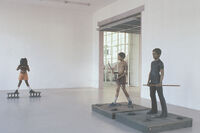
American artist John Ahearn (Binghamton, New York, 1951) and Puerto Rican artist Rigoberto Torres (Aguadilla, 1960) collaborate in portraying everyday people. Their exhibition was part of Witte de With’s investigation into the depiction of the human figure and the question of the relevancy of mimetic impulses.
Ahearn and Torres have lived and worked amidst the Latino-American population in the South Bronx in New York since the end of the seventies, portraying their neighbors in the tradition of the realistic, religious portraits that the Spanish colonists brought to the Americas.
Working about ten miles away from the dense concentration of commercial galleries and highly prized artist’s lofts in Tribeca and Soho, Ahearn and Torres have sought to break from the art establishment by reclaiming a place for art in the fabric of daily life and by renewing the ancient role of the artist in society.
The casting process requires close collaboration with the models and happens in a very public way, usually out on the sidewalk in front of friends, family and neighbors. From the heads, busts, and reliefs, one cast remains in the neighborhood, either in people’s homes or in public places such as waiting rooms or courtyards, while a copy enters the art world. The castings and installations of the busts and reliefs are community events.
The South Bronx Hall of Fame is an alternative to the Hall of Fame of Great Americans, a grand public monument not far from the Bronx, designed by the acclaimed American architect Stanford White, with a procession of classical portraits of distinguished citizens by leading sculptors. In contrast, Ahearn and Torres chose to represent citizens that have rarely been memorialized in art or given pride of place in national monuments and museums. Their art documents the lives in the ghettos, revealing the heroic dimension of everyday people and enabling them to identify with an art that affirms their existence by representing their own reality.
Cool project
The exhibition included a survey of the work Ahearn and Torres have created since 1979. At the occasion of the exhibition, a special project was realized in collaboration with the neighbors of Witte de With: the Cool Project (Cool being the name of the neighborhood). The results, three group portraits of local residents, Ed de Meijer, Nelly Alegria and Koenrjbiharnie Firipersad; Natoucha Verkerk, Patricia Nijhoff and Lisa Kolet; and Mario Boeyen and Antonio Dias, were permanently installed in the neighborhood of Witte de With.
The project emphasized the importance of the processes of creation and collaboration.
Participants
John Ahearn, Rigoberto Torres
Curators
Marilyn Zeitlin
<div class="
-
01 General
Record created from the archive project register (access_project / 2026 projects). No corresponding page exists on the institution’s website.
-
TALK with Nato Thompson: Culture as Weapon
TALK
with Nato Thompson: Culture as Weapon
Tuesday 11 September 2018, 4 - 6 pm (doors open 3:30 pm)
Tickets: sold out
Location: Auditorium, Witte de With Center for Contemporary Art
—Participants
Nato Thompson, Jeanne van Heeswijk, Merlijn Twaalfhoven
—Partners
Master Fine Art Piet Zwart Institute, Rotterdam Arts and Sciences Lab (RASL)
Rotterdam Arts and Sciences Lab (RASL) and Studium Witte de With present Culture as Weapon, a Keynote Lecture by Nato Thompson.
In his lecture, Nato Thompson, curator, writer, and Artistic Director at Philadelphia Contemporary, will discuss his book Culture as Weapon: The Art of Influence in Everyday Life. He will address the growing role of affect in a variety of industries – from charity to counterinsurgency models in the military to contemporary real estate. Throughout the keynote, he will explain how the landscape of strategically deployed human emotion has direct implications to the practice of artists and activism. In response to the keynote, visual artist Jeanne van Heeswijk and composer Merlijn Twaalfhoven will engage in a conversation with Nato Thompson.
This event is organized by RASL Events, Witte de With Center for Contemporary Art, in collaboration with Master Fine Art Piet Zwart Institute, as a kick off for the new academic year for the students of the committed institutions – Erasmus University Rotterdam, Codarts Rotterdam, and Willem de Kooning Academy Rotterdam – but will be accessible to other (non-)students as well. Tickets via the ticketlink.
-
Stephan Balkenhol
The eponymous exhibition of German artist Stephan Balkenhol (1957) provisionally concluded Witte de With’s investigation into the depiction of the human figure and the question of mimesis in contemporary art. This inquiry began with the exhibitions by Ken Lum (in 1990), John Ahearn and Rigoberto Torres (in 1991), and Philip Akkerman (in 1992).
The human and animal figures Balkenhol carves from wood deal with mimesis, in particular with the representation of body and face. The image of the human body is the most immediatly comprehensible of symbols. Accross national traditions and limitations of education and language, recognition of the body’s physiognomy and gestures creates a spontaneous acknowledgment of meaning.
Yet when Balkenhol started to create his sculptures, it was downright taboo to work figuratively: “I have to reinvent the figure, the tradition is interrupted.”
Modernist sculpture had excluded representation, replacing it with the organic creation of plastic symbolic situations, as in the work of Joseph Beuys or Jannis Kounellis, or with nonobjective systems, as in the work of Carl Andre or Donald Judd. Yet at the same time, the figurative tradition was continued by Fascist and Soviet art, which returned to the stereotypes of the nude and the uniformed hero.
Balkenhol’s sculptures simultaneously interfere with the trajectories of radical modernist sculpture and idealized, universal state symbols. His figures are rarely nude and carry no specific attributes. His representations of the human figure are neither models of a universal human ideal nor specific portraits. Presented as solitary figures or as a crowd of individuals, as in 57 Penguins (1991), his sculptures speak about difference, about the differences between what is communal and what is specific.
The exhibition presented a survey of Balkenhol’s work, including reliefs, heads, and figures of different scales, all rapidly carved from single pieces of wood. In conjunction with the exhibition, Balkenhol realized a permanent sculpture for the Witte de With stairwell, Freistehende Relieffigur.
Participants
Stephan Balkenhol
Curators
Chris Dercon, Gosse Oosterhof
<div class="
-
02 General
Record created from the archive project register (access_project / 2026 projects). No corresponding page exists on the institution’s website.
-
National (Re)presentation
National (Re)presentation
Thursday 4 Ocotber 2007 - Sunday 25 November 2007
Language: English
—Participants
Claire Beke, Annie Fletcher, Nick Hackworth, Murina Mirza, Daniel van der Velden, Olav Velthuis
—Partners
BAK, institute for the contemporary, Van Abbemuseum
As part of a collaborative project with BAK, basis voor actuele kunst (Utrecht) and the Van Abbemuseum (Eindhoven) – and as a critical follow-up to the Venice Biennale – Witte de With presents four evening discussions (every Thursday in October) on the topic of the ‘national’ and how it relates to contemporary cultural production and theory today.
In order to expand the dialogue around nation-building, nation-states, and the role of the individual within single country structures – topics that will be also addressed by BAK and the Van Abbemuseum in their debate series this fall – Witte de With has invited Suhail Malik andAndrea Phillips from PoCA (Political Currency of Art Research Group, based in the Department of Visual Arts at Goldsmiths, London, also see website) to collaborate on creating this series of debates. PoCA conducts research on the assimilation of critical and counter-hegemonic contemporary art practices, and how they are situated within the interests of cultural, financial and state institutions. Their involvement with this project will provide the critical approach required to reformulate the problems and politics of what now constitutes the nation(al) in a context of increasingly powerful international forces and their impact on the production, presentation and distribution of contemporary art. The invited guests will explore processes such as global capital, migration, art production and curating under four main headings.
Together with Sophie von Olfers, Suhail Malik and Andrea Phillips will host each evening. Whilst each session will stand independently, audience members are encouraged to attend all four evenings in order to follow and contribute to an ongoing dialogue.
With:
Claire Beke, Annie Fletcher, Nick Hackworth, Nicoline van Harskamp, Munira Mirza, Daniel van der Velden, Olav Velthuis.
Entry is free
Language: English
Reservations are recommended, [email protected].
Thursday 4 October, 7 p.m.
The ‘national’
This introductory session takes the example of the Venice Biennale – the only international biennial with national contributions – as a starting point for this series of debates. It will address notions of national identification in the cultural sector, in particular how the format of the national is used in various ways in order to reach audiences, to gain support, to receive funding, to communicate a country’s cultural agenda, and to present activity that may represent a nation’s image abroad. When does this verge on exploitation? When do cultural producers become cultural ambassadors? At what point does exporting national ‘cultural capital’ become a missionary activity?
Munira Mirza is a writer and researcher on issues related to cultural policy and identity. She has worked for a range of arts and charity organisations and is currently working on a PhD, examining developments in UK cultural policy.
Annie Fletcher is curator at the Van Abbemuseum in Eindhoven and has been involved in developing the museum’s long-term cultural diversity project Be(com)ing Dutch, partner project of this collaborative program.
Download MP3 (32MB)
Thursday 11 October, 7 p.m.
Promotion
This debate will focus on the tools that art institutions and other cultural organizations, governmental bodies and individuals utilize in order to promote themselves within the cultural sector. Recent years have seen a range of high-powered cultural institutions developing hard-hitting marketing strategies and plans for communication. Whether this appears in the form of circulating ones information, or manifests itself through a physical presence elsewhere (i.e. travel, re-location, satellite projects), the pressure to situate and brand oneself clearly and effectively in today’s jungle of activity has become priority on everyone’s agenda. This session will connect with and introduce the following week’s discussion about circulation and exchange.
Daniel van der Velden is a graphic designer and critic, specializing in notions of national branding and visual identity. Shortly after his participation in this debate, he will run a project on the paradox of nation branding with students at Yale University.
Claire Beke works in communication and develops and consults public relations for cultural organizations. She has a wide-ranging experience in the field of marketing, press, branding and image building.
Download MP3 (43MB)
Thursday 18 October, 7 p.m.
Circulation and exchange
Leading on from different modes of promotion in cultural production, the debate on circulation and exchange will delve into the movement and distribution of knowledge, looking in more detail at structures of exchange. Active displacement, which is rapidly growing and has become a normal condition for many cultural practitioners, automatically results in a brisk exchange of cultural capital. Traveling, for instance, means acquiring knowledge and implementing it ‘back home’ – whether deliberately or not. The same goes for taking knowledge and shifting it to another place, as is the case with many commercial galleries and institutions nowadays, who are opening up subdivisions elsewhere. Who really profits from this? The audience or the venturer?
Nick Hackworth is the founding director of the gallery Paradise Row in London. He is also Contemporary Art Critic of the Evening Standard.
Unfortunately Nicoline van Harskamp had to cancel; she will join next week, in Utrecht, October 25th.
Download MP3 (43MB)
Thursday 25 October, 10 p.m.
New capital
(NB: Held at Bak, after the first “Citizens and Subjects: Practices and Debates” discussion, taking place at 8 p.m. at the University of Utrecht. Bus pick-up from WdW at 7 p.m., return bus