-
Home Screen Home
The exhibition Home Screen Home is organized in conjunction with the 27th International Film Festival Rotterdam. Home Screen Home presents video works made for the television screen, ranging from critical tapes of the sixties and seventies to recent music videos and commercials. Makers include Sadie Benning, Kathryn Bigelow, Donigan Cumming, Atom Egoyan, Robert Frank, Nancy Holt, Joan Jonas, Chris Marker, Antoni Muntadas, Mark Romanek, Martha Rosler, Lawrence Weiner and Peter Wollen. The videos will be screened in surroundings which refer to the domestic space. The exhibition is curated by American filmmaker and producer Michael Shamberg.
Made for the television screen
Recent discussions about art and the Internet revolve around the challenge the Net poses to the conventional exhibition system. In the sphere of the Internet, art abandons the physical space of the institution as the site of experience in favor of direct access through the private terminal.
The discussion about the Internet is very similar to the issues raised by the first artists working with video. Their concerns were equally related to finding an alternative space for presenting art. Through television, art was to be brought directly into the home.
Artists’ access to television began around 1969, when the first portable video equipment became available. For many artists, video represented a tool for revolt against mainstream television. Television was perceived as having a tremendous influence on society, and artists examined its effects on a public that had grown to know television as both a home furnishing and a direct source of cultural information. For others, it was a medium through which their art could escape the institutionalized art world.
home theater
In her essay “The Suburban Home Companion” Lynn Spigel analyzes television’s theatricalization of the home. In the forties and fifties, American home magazines advised that “conventional living room groupings need to be slightly altered because televiewers look in the same direction and not at each other” or that “television is a theater; and to succeed, theater requires a comfortably placed audience with clear view of the stage”.
Television puts the viewer in an isolated position, looking at a public spectacle from his own home. It makes the viewer feel as if she is taking part in a public event “from a distance”. At the same time, this distance makes outside spaces part of a safe and predictable experience. People are allowed to travel from their homes while remaining untouched by the actual social contexts to which they have imaginatively ventured.
Television thus contributed to the constitution of the ideal of the suburban family. Television programs also reinforced the family structure. Popular sitcoms pictured romanticized versions of family bonding; even the news was generally presented by a couple. As Dan Graham observed: “Television might be metaphorically visualized as a mirror in which the viewing family sees an idealized, ideologically distorted reflection of themselves”.
democratic television
Artists were among the first to oppose television as an instrument of power. They employed video as a weapon against television’s representational hegemony. In the sixties, underground groups such as Videofreex, People’s Video Theater and Raindance Corporation provided program alternatives to mainstream television and explored the democratic possibilities of mass media. They documented street life in a direct, real-time and unedited style, modeled after the French “cinéma-vérité”. The 1971 manifesto of the alternative movement, “Guerrilla Television”, outlined a plan to decentralize television so that the medium could be made by as well as for the people. Through public-access channels, they covered political conventions from a deliberately subjective position, challenging the objectivity of commercial television journalism.
an alternative place for art
At the same time, other artists, such as Vito Acconci, John Baldessari, Joan Jonas, Nancy Holt and Richard Serra added video to their repertoire of media, not with intentions of changing television and directly affecting social change, but with an interest in changing the standard relationship between artist and viewer. An example is Richard Serra’s video Television Delivers People (1973). The opening statement, “The product of television, commercial television, is the audience”, subverts the common notion that we control the role of television in our lives. These artists were interested in redefining the rigid criteria of the commercial art world. Video's impermanence and reproducibility were seen as a denial of art as precious object. Video thus was part of a more general questioning of the traditional art object through nonmarketable art forms such as performance, conceptual art, land art and body art.
Since the eighties, artists have been less preoccupied with seeking adversarial positions inside the communications industries. Their positions even seem to have been reversed. Many of the early revolutionaries have become official television producers, contributing to popular series as Hill Street Blues, movies and documentaries, supported by public channels such as Channel 4, BRTF, ZDF, PRO and DD. Artists are actually hired as creative directors for MTV clips and commercials. However, through strategies of appropriation, parody or pastiche these works still create a difference, subverting mainstream imagery at a moment when television has become so common it sometimes seems like wallpaper.
Participants
John Baldessari, Sadie Benning, Kathryn Bigelow, Donigan Cumming, Atom Egoyan, Robert Frank, Nancy Holt, Joan Jonas, Chris Marker, Antoni Muntadas, Mark Romanek, Martha Rosler, Lawrence Weiner, Peter Wollen
Curators
Michael Shamberg
<div class="
-
95 General
Record created from the archive project register (access_project / 2026 projects). No corresponding page exists on the institution’s website.
-
Voorwerk 6
The sixth edition of the Voorwerk exhibition series features five young Dutch artists: Raymond Cuijpers, Annemiek de Beer, Madeleine Berkhemer, Philippine Hoegen and Vanessa Jane Phaff.
Raymond Cuijpers
Raymond Cuijpers’s (Geleen, 1973) work is based on various aspects of football and his own experiences as a player. Especially for this exhibition Cuijpers stages a presentation of his work in and around Rita McBride’s Arena, touching on the commercial, mystical, political and economical parameters of the game. Interviewing himself, Cuijpers asks:
RC: Is football art?
RC: No, I don’t think so. I think they are two separate entities which reach similar heights. The only difference is that football is based on a different layer of society from art: football is for the crowd and art for the so-called elite. Football is much more of a mass event; there is a tremendous concentration of energy in the stadium. Take England, where fathers take their sons along to see their club play; it’s a deeply rooted emotion that you’d never find in art. Art is for the mind, football is a gut feeling, football is aggression. Top football is becoming increasingly dominated by political and economical interests, but a top footballer’s purely physical and mental explosions are more violent than an artist’s, I think.
RC: So you think that top footballers are “greater” than great artists?
RC: Top footballers are heroes, idols. What I’m trying to say is that football has a far more direct impact and starts much earlier on in life. Art is much more indirect; its influence is only apparent when you start thinking about it. Art is also very ambiguous, though. Anyone can see that Dennis Bergkamp is a good player, but is Richter a good painter?
football diagrams
Annemiek de Beer
While painting, Annemiek de Beer (Bolsward, 1971) fuses different kinds of subject-matter which she finds in art, in the street or in advertisements. Characteristic of her recent paintings are the different ways in which she combines the flatness of the two-dimensional surface with the suggestion of perspective in one and the same painting. Graphic and painterly elements merge, this results in layered paintings in which lines and areas of color are constantly reversed, seeming to advance and recede alternately and creating an impression of transparency.
Madeleine Berkhemer
Taking fashion and art as her points of departure, Madeleine Berkhemer (Bergen op Zoom, 1973) employs a wide range of media (drawings, collages, wall-sculptures, installations, live presentations and clothes designs) in her investigation of the female body and contemporary culture. The enormous tension in the construction of her large, futuristic and insect-like sculptures made of panty-hose knotted together is illustrative of the powerful charge and ambiguous sexuality of her work. Berkhemer’s provocative, minimal clothes designs emphasize feminine contours and issue an uncompromising commentary on fashion design practice. At the opening of Voorwerk 6 there will be a special presentation called I SPY.
Philippine Hoegen
Philippine Hoegen (Kitzbühel, Austria, 1970) shows how mirrors present us with an image of ourselves in relation to our surroundings. She demonstrates this by photographing herself in a place where that phenomenon is hard to exploit: in the cramped, anonymous space of department-store fitting rooms. In her latest series of works the facial expressions of her subjects are the only clue that these are photographs of mirror images. Intimate (self-)portraits, their gazes expresses both a search for recognition and the image one has of oneself on the basis of one’s reflected image.
Vanessa Jane Phaff
With the techniques she employs (pencil and felt-tip pen drawings and lino-printed paintings reminiscent of coloring pictures) Vanessa Jane Phaff (Tarleton, England, 1965) refers directly to the world of children, the impudent stars of her works. Unlike the image society has of children, these kids are not innocent and vulnerable but proud, brash and at times even malevolent. The details in Phaff’s work speak volumes; they suggest but do not explain the charged context and background of what has just taken place. In her latest series of works the youngsters seem to have deliberately staged the suggestive symbolism of their setting.
Participants
Annemiek de Beer, Madeleine Berkhemer, Raymond Cuijpers, Philippine Hoegen, Vanessa Jane Phaff
Curators
Rutger Wolfson
<div class="
-
96 General
Record created from the archive project register (access_project / 2026 projects). No corresponding page exists on the institution’s website.
-
Voices
Curated by New York-based critic Christopher Phillips, Voices presents works by Vito Acconci, Judith Barry, Geneviève Cadieux, Jochen Gerz, Gary Hill, Pierre Huyghe and Kristin Oppenheim. New works were created for the exhibition by Janet Cardiff & George Bures Miller and Moniek Toebosch.
For centuries the human voice existed outside the proper field of the visual arts, inhabiting a region of experience that lay beyond purely pictorial rendition. In recent decades, however, as artists have come to explore the rich continuum of sounds and sights that now make up the audiovisual environment, the complex relation of voice and visual image has received increasing attention. Against this background, the exhibition Voices sets out to probe the uses of the voice as metaphor and material in contemporary art.
Employing a wide range of mediums – including video, film, photography, and multimedia installation – these pieces pose provocative questions concerning the role of the voice as an instrument of communication and expression in twentieth-century culture.
The works in the exhibition touch upon a variety of themes. These include the “interior voice” as an emblem of the self; the “voice of power” that speaks to us through mass media; the heritage of dada phonetic poetry and post-World War II poésie sonore; the paradoxical pairing of voice and image in cinema; and the experimental combination of vocal and electronically generated sounds. More generally, Voicesencourages us to think in a new way about the subtle transformation of social relations that have been produced by such inventions as the telephone, radio, loudspeaker, tape recorder and computerized voice synthesizer.
Jochen Gerz’s work of the 1960s and early ’70s often reflects his involvement with the international experimental poetry movement of those years. A piece heard through a telephone receiver, Gerz’s Speaking of Her (1972) consists of two short texts recited simultaneously by a pair of Voices – one male and speaking French, the other female and speaking English. Moving in tandem, at every moment both separate and intimately entwined, the two Voices create a startling pattern of sound and meaning in the listener’s mind.
Vito Acconci, in his performances, videotapes, and installations since the late 1960s, has often employed his own low, gravelly voice as an instrument of command, confession, seduction or denunciation. In Three Columns for America (1976), Acconci delivers what he calls a “message from America” Seated before three tall, minimalist panels, we hear the artist speaking in alternate Voices. One is the cliché-filled “interior” voice of an everyday participant in the marathon race of American society; the other is the “exterior” voice of a radio announcer who delivers scandalous headlines concerning the sexual antics of U.S. politicians.
For over two decades, Gary Hill’s videotape works and installations have pioneered new modes of interplay between speech, writing and visual imagery. In a group of short video pieces from 1978-80 – Mouthpiece, Primary, Elements, Mediations, and Around and About – we can follow step by step as Hill moves from formal experiments involving abstract video images and syllabic sound toward combinations of representational images and spoken language. These works prepared the way for Hill’s influential videoworks and installations of the 1980s.
Geneviève Cadieux explores the expressive powers of visual imagery and speech. In two recent diptychs, Elle et lui and Elle et lui (avec main de femme) (1997), Cadieux’s large-scale photographs of a tense-looking man and woman are cropped and paired so that we feel the presence of “off-screen” Voices suggested by the gesturing hands and facial reactions. An archetypal modern tableau is conjured up – a scene of blocked communication and failed dialogue, haunted by hollow words that have fallen short of their goal.
Kristin Oppenheim’s minimalistic installations dispense almost entirely with visual imagery so as to heighten the affective power of her voice. Hey Joe (1996) takes the opening line of a song popularized by Jimi Hendrix during the Vietnam War era: “Hey Joe, where’re you going with that gun in your hand?” As we hear Oppenheim softly singing these words, we see small, electronically guided spotlights moving unpredictably around the otherwise empty room. The result is a mood in which fairytale enchantment becomes increasingly mixed with dread.
In the “fabricated soundscapes” of Janet Cardiff and George Bures Miller, perceptual space and imaginative space become hopelessly entangled. Their new installation, La Tour, pivots on a story of seduction and betrayal and creates a situation that mixes intimacy and voyeurism, reality and fiction, past and present. The piece was inspired by the legendary Marguerite de Bourgogne, a queen of France who was rumored to stage debaucheries in the Tour de Nesle.
The paradoxes of the voice in cinema have figured prominently in Pierre Huyghe’s recent works. His video installation Dubbing (1996) presents us with a group of professional film dubbers who are gathered in a studio and attentively gazing in our direction. In fact they are watching the horror film Poltergeist (which remains invisible to us) and dramatically performing the French dialogue. As we watch the dubbers diligently at work, going in and out of character, another space comes to life – the imaginative space of the story that is being played “before our ears?”.
Employing a range of cinematic devices for presenting the voice – synchronous and nonsynchronous dialogue, off-camera Voices, voice-overs, and so on – Judith Barry dramatizes the way that complex aural and vocal cues have come increasingly to shape our sense of self and our experience of physical space. Barry’s new video-projection work VOICE off explores the ideas of possession and loss, presenting the spectator with two metaphoric narratives that unfold simultaneously on a double-sided screen dividing the gallery space. “Her” side tells the tale of a woman who has lost her voice and is desparately searching for it. “His” side concerns a man who is haunted by Voices whose source he is obsessively trying to track down.
Moniek Toebosch is known not only as an artist but as a performer, a singer and an actress in experimental films. She dedicates her new installation Les douleurs contemporaines V – The Procession to what she calls “the grief of this century”. The Procession is a circuit along one hundred audio speakers, activated by the visitor’s presence, from which groups of lamenting Voices are heard, which Toebosch has gathered from a variety of archival and broadcast sources and for which she made special recordings. They are meant to call to mind the emotional intensity that suffuses the countless scenes of mourning which are played out every day around the planet.
Audio library
In addition to the exhibited works, an audio library of historical and contemporary recordings will be available at a special ‘listening table’. Here the visitor can sample material related to the uses of the voice in sound poetry, avant-garde music, conceptual art and contemporary art.
Catalogue
Voices is accompanied by a fully illustrated catalogue which includes texts by guest curator Christopher Phillips, on the voice as metaphor and material in recent art; art critic Kate Linker, on the use of the voice in video art, taking the work of Vito Acconci as an example; and the text: “The Voice, between body and language” by French psychoanalytic Guy Rosolato, as well as a section of artists’ pages documenting the works in the exhibition and a bibliography and discography.
Voices is a co-production of Witte de With, center for contemporary art, Rotterdam; the Fundació Joan Miró, Barcelona; Le Fresnoy – Studio National des Arts Contemporains, Tourcoing
Voices could be realized thanks to the support of IRCAM, Paris; Kaleidoscope Program of the European Economic Community; CRAAV, Lille; KPN Nederland; Mondriaan Stichting, Amsterdam.
Participants
Vito Acconci, Judith Barry, Geneviève Cadieux, Janet Cardiff, Jochen Gerz, Gary Hill, Pierre Huyghe, Kristin Oppenheim, Moniek Toebosch
Curators
Christopher Phillips
Network
Joan Miró Foundation
<div class="
-
97 General
Record created from the archive project register (access_project / 2026 projects). No corresponding page exists on the institution’s website.
-
The Rotterdam Project
The Rotterdam Projects is a collaboration which developed proposals to think the city in different terms. Through a process of thinking together and dialogue, an image of the city based on the specific and personal experiences of the participants in relation to other people, was created.
Complex social structures such as the city are often described in general terms referring to a limited number of functions. For instance, a city can be defined on the basis of its demographic composition, in figures expressing the economic activities in the port, or the ratio of robberies in relation to the number of residents. People, personal experiences, and specific situations are expressed in suchs ways that fit into these predefined categories. This method, although efficient, is not always an adequate description of the world we live in.
The Rotterdam Projects is a collaboration which developed proposals to think the city in different terms. Through a process of thinking together and dialogue, an image of the city based on the specific and personal experiences of the participants in relation to other people, was created.
The project consisted of a series of conversations in which these personal experiences found a place. Connections and relations gradually came into being: participants shared experiences and recognized themselves in the stories of others.
presentation
The proposals generated by the Rotterdam Project conversations were presented in Witte de With from September 12 to November 8. The presentation was intended to extend the dialogues to new participants. Underlying the presentation was the question “how can the experience of thinking together in conversation, be translated to a public forum”. Some of the connections were set up by the staff of Witte de With; a number of inhabitants of the Hoeksche Waard area near Rotterdam; and Theater Group Hollandia, each of whom reflected in their own way, on the meaning of ‘relation’ and ‘dialogue’. Participants of the project told their stories and started conversations about the city as a place of experience. The audience was invited to participate in the process of dialogue and collaboration.
portraits
For example, a group consisting of Anke Bangma, Hieke Compier, Noortje Hoppe, Craigie Horsfield and Femke Snelting were investigating how an exhibition can function as a place for dialogue instead of spectacle, and how publicity can be more than just information. The presented portraits (made by Craigie Horsfield) were made in collaboration with people from Rotterdam and Hoeksche Waard and made us experience that we exist in relation, that we come into being only in recognition of the other.
dinner
A group consisting of Craigie Horsfield, Rutger Wolfson, and Johan Simons and Jan Zoet of Theater Group Hollandia were thinking through similar questions in relation to theater. For example, Theater Group Hollandia developed a performance as a series of ‘events’ in which stories were not simply represented but passed on, where the audience were participants and not just spectators. In the special setting of a dinner, visitors could listen to recorded conversations of three generations of potato sellers from Hoeksche Waard and others involved in the prject. During the presentation at Witte de With, members of Theater Group Hollandia acted as guides, telling narratives to visitors, who were also invited to tell their own stories, whilst eating potatoes.
participants
The Rotterdam Project was a collaboration between the following people, made possible by Witte de With and Theater Group Hollandia, and related to the AIR-Southbound manifestation and the September in Rotterdam festival: Atty Baardman, Anke Bangma, Ge Beckman, Lijdie Blok, Jacqueline Blom, Manuel Borja-Villel, Hieke Compier, Annemie Devolder, Martin van Dijl, Camille Dings, Terry van Druten, Myriam Eijgenraam, Malou Elshout, Nous Faes, Paul van Gennip, Piet Gootjes, Cootje Gortzak, Eva Hage, Brecht Heemskerk, Rob Hol, Noortje Hoppe, Craigie Horsfield, John Hoornweg, Willemien Ippel, Alleta de Jong, Barbera van Kooij, Line Kramer, Hans Kruythof, Trijntje Kruythof, Dirk Lauwaert, Marcel Langenberg, Michael Lehman, Annet Lekkerkerker, Mariette Maaskant, Bartomeu Mari, Wouter de Nooy, Rachel van Olm, Rob van Olm, Lodewijk Owens, Silvain Perriraz, Sanne van Rijn, Maaike Ritsema, Mark Ritsema, Johan Simons, Rodney Slagtand, Femke Snelting, Ariadne Urlus, Bert Visser, Peter Westenberg, Anne Wolfson, Rutger Wolfson and Jan Zoet.
Participants
Anke Bangma, Rutger Wolfson, Peter Westenberg, Jan Zoet
Curators
Bartomeu Marí, Rutger Wolfson
Network
BOZAR Paleis voor schone Kunsten, Fundació Antoni Tàpies, Museum Dhondt-Dhaenens, September in Rotterdam, Willem de Kooning Academie
<div class="
-
Think Art. Theory and Practice in the Art of Today
Record created from the archive project register (access_project / 2026 projects). No corresponding page exists on the institution’s website.
-
Constant — New Babylon
This exhibition brings Constant Nieuwenhuys New Babylon back to the surface, presenting the complete project for the first time in almost a quarter of a century with the aim to shed light on contemporary architectural and artistic experiments. Much of Constant’s work resonates with current investigations, from the concern with electronic space down to specific model-making techniques. New Babylon acts as a stimulating reference point for our ongoing conversation about the strategic role of space in social life. In the course of twenty years of research and manifestations, Constant relentlessly explored the extreme implications of his project from ectasy to carnage.
In 1956, the Dutch artist Constant Nieuwenhuys (Amsterdam, 1920) started working on a visionary architectural proposal for a future society; he didn’t stop for almost twenty years. Having been a co-founder of the Cobra group of artists in the late forties, he abandoned painting in 1953 to concentrate on the question of “construction”. He became a founding member of the Situationist International in 1957 and played a central role in their experiments until his resignation in 1960. New Babylon, as his project would eventually be called, is a situationist city intended as a polemical provocation.
New Babylon was elaborated in an endless series of models, sketches, etchings, lithographs, collages, architectural drawings, and photocollages, as well as in manifestos, essays, lectures, and films. New Babylon is a form of propaganda that critiques conventional social structures.
New Babylon envisages a society of total automation in which the need to work is replaced with a nomadic life of creative play, in which traditional architecture has disintegrated along with the social institutions that it propped up. A vast network of enormous multilevel interior spaces propagates to eventually cover the planet. These interconnected “sectors” float above the ground on tall columns. While vehicular traffic rushes underneath and air traffic lands on the roof, the inhabitants drift by foot through the huge labyrinthine interiors, endlessly reconstructing the atmospheres of the spaces. Every aspect of the environment can be be controlled and reconfigured spontaneously. Social life becomes architectural play. Architecture becomes a flickering display of interacting desires.
Constant always saw New Babylon as a realizable project, which provoked intense debates at schools of architecture and fine arts about the future role of the architect. Constant Nieuwenhuys insisted that the traditional arts would be displaced by a collective form of creativity. He positioned his project at the threshold of the end of art and architecture. Yet it had a major influence on the work of subsequent generations of architects. It was published widely in the international press in the 1960s and Constant quickly attained a prominent position in the world of experimental architecture. But this influence would eventually be forgotten; the project has not been displayed since Constant Nieuwenhuys stopped working on it in 1974.
This exhibition brings New Babylon back to the surface, presenting the complete project for the first time in almost a quarter of a century with the aim to shed light on contemporary architectural and artistic experiments. Much of Constant’s work resonates with current investigations, from the concern with electronic space down to specific model-making techniques. New Babylon acts as a stimulating reference point for our ongoing conversation about the strategic role of space in social life. In the course of twenty years of research and manifestations, Constant relentlessly explored the extreme implications of his project from ectasy to carnage.
The exhibition is guest-curated by the prominent architectural historian Mark Wigley. It presents the constructions and graphics that anticipate New Babylon and then launches a chronological journey through the multi-media life of the project. The early euphoric images gradually give way to the final series of paintings in which New Babylon, becomes the site of sexual crimes and horrific violence. Along the way, Constant’s own technique of combining huge slide projections with sound and video is reintroduced to create impressions of the spaces of New Babylon. A room with original documents, manuscripts, photographs and ephemera provides further insight into the project.
Mark Wigley is a Professor of Architectural History and Theory at Princeton University. He is the author of Deconstructivist Architecture (1988), The Architecture of Deconstruction: Derrida’s Haunt (1993) and White Walls, Designer Dresses: The Fashioning of Modern Architecture (1995).
In a lecture on 23 May 1980 at the school of architecture at Delft University, Constant summarized his retrospective thoughts about New Babylon as follows:‘… it is possible to form a fairly clear idea of an as yet uninhabited world. It is more difficult to populate this world with people who live so very differently from ourselves: we can neither dictate nor design their playful or inventive behavior in advance. We can only invoke our fantasy and switch from science to art. It was this insight that prompted me to stop work on the models and to attempt in paintings and drawings, however approximately, to create some New Babylonian life. This was as far as I could go. The project exists. It is safely stored away in a museum, waiting for more favorable times when it will once again arouse interest among future urban designers.’
Catalogue
In Constant’s New Babylon: The Hyper-Architecture of Desire, a 256- page monograph published by 010 in collaboration with Witte de With, Mark Wigley provides a detailed analysis of New Babylon alongside the first complete visual record of the project. The book includes a selection of texts by Constant and Guy Debord.
See Publications for more information.
Other interesting websites
ArchiNed, with an abstract (in Dutch) of the symposium on New Babylon that took place in the NAI, entitled “New Babylon and the end of the avant-garde”.
Nothingness.org, an I.S. archive with pre-situ articles and essays from the journal Internationale Situationniste.
The exhibition and the monograph are generously supported by the Stimuleringsfonds voor Architectuur.
Participants
Constant Nieuwenhuys
Curators
Mark Wigley
Network
Kunstmuseum Den Haag, The Drawing Center
<div class="
-
98 General
Record created from the archive project register (access_project / 2026 projects). No corresponding page exists on the institution’s website.
-
From/To
From/To is a cartography in which participants chart out and inscribe a contemporary topos: ‘Palestine’. The project works with fields such as anthropology, cinema, geography, history, and photography, moving through turn-of-the-century postcards to new Palestinian cinema, video, workshop space, computer on-line links, texts, film storyboards, talks, a weekly fax journal, Palestinian university projects, and spatial analysis. Participants from various nationalities based in different countries range from women’s organizations in refugee camps to current independent film and videomakers.
In From/To, space is introduced through an open weave of perspectives, approaches, and locations drawn from narratives of identity. This reflects characteristics of discourse associated with Palestinian issues of post-’48 identity. All of this grounds From/To in a concrete reality that reflects sociologist Stuart Hall’s recent statements on diasporic identity: The history depends on the routes. It’s the replacement of ‘roots’ with ‘routes‘. Routes are the negotiation of exchange. The variety indicates the operation of different economies.
The character of From/To is shaped by new information routes, most just recently made possible. Certain frontiers are bypassed, modifying travel by transmission over electronic routes. As becomes apparent upon entering Witte de With, the project was developed with the logic of a website at the scale of architecture. The whole is based on one stone, the smallest unit of landscape, which links to architecture and, after the decade of the Intifada, to media. This stone is digitized, resulting in a complex set of triangulated lines. One segment is copied and translated to map out the project over two floors of exhibition rooms. What appears as a random pattern of events is in fact an organizational logic. The separate fields are interlinked by one narrative of movement. From/To is a map that unfolds in real time.
From/To spaces included:
Computer
Available over computer, a selection of relevant past and contemporary essays, charts, maps, and links to on-line sites. The role of the computer links has changed the correspondence and information landscape of Palestine. This area also notes the recent symposium Landscape Perspectives on Palestine by the Bir-Zeit University, Ramallah. See From/To for links.
Cinema Production Centre (CPC), Ramallah
The CPC, founded 1996 in Ramallah by Palestinian director Rashid Mashrawi, is the first Palestinian centre concerned with improving the cinema industry. The main goal is to develop cinema in Palestine through producing and distributing films both in Palestine and other countries, and providing Palestinians a chance to watch films at screenings in the West Bank and the Gaza Strip. CPC also aims at introducing Palestinian cinema to people all over the world.
The CPC has two departments: Production and Mobile Cinema. Production is involved in short fiction, feature, and documentary films. Mobile Cinema, established in 1997, arranges screenings in various locations. This project seeks to reach the audience in remote areas, such as villages, refugee camps, and in universities, schools, and cultural centres. A van with equipment for projecting various media formats has already started to show films at universities, schools, and art centres, to give non-city dwellers a chance to view cinema.
Institute for Modern Media, Al-Quds University, Jersualem
Established in 1996, the Institute is part of Al-Quds University College in Al-Bireh, Ramallah. Its aim is to provide broad media education, including directing, editing, reporting, presentation. The Institute includes the Al-Quds Educational TV, organized by journalists and media producers. Starting in 1997, AETV broadcasts programs to Ramallah and North Jerusalem, which focus on education, literacy, social attitudes, environment and consumer awareness. The channel provides free air time to Palestinian non-profit associations and is the first Arab television station to present live broadcasts of the Palestinian Legislative Council. AETV also provides children’s programs, among which the Arab version of Sesame Street.
Cinema Projection
The correspondence between modern cinema and geography by visualization of other lands requires a consideration of its mechanics – the dark room, projection, and the viewer as subject. Here are introduced routes from two key sources: the Lumire Brothers’ first evidence on film of a journey through Palestine (1897), and The Dupes (1972), by Tewfik Saleh, reintroducing that same geography in terms of boundaries and frontiers, to recognize a subject negotiating routes in the space of refugee status. There is an additional daily program.
Video Viewing Area
This provides a large on-request selection of tapes from Palestinian film/videomakers. Decades of fiction and documentaries point to unique narrative intertwinements of place and identity, refracting the focus through global media. The link between memory, media, geography, and representation is evident throughout. The accessibility, mobility, and duration of video is appropriate for interviews and oral histories. The space most lacking or undifferentiated in media representation, the refugee camps, is clearly that site through which many videos thread their narrative, in recognition of its key role in the contemporary issues. Recent works point to new issues of history, orientation of memory, documentary approach, and the role of archival media. They include narrative of the younger generation, as well as the generation who were adults in 1948. The program include videos from, among others, Michel Khleifi, Norma Marcos, Rashid Mashrawi, Mai Masri, Omar al-Quattan, Tewfik Saleh, Eyal Sivan, Sobhi Zobaidi.
Audio
Stephanie Latte Abdallah, Amman. The work isolates oral expressions recorded during interviews carried out in the refugee camps of Jabal Hussein and Jerash in Jordan. The aim is to deliver selected testimonies in raw form, so as to leave the choices of interpretation and evocation up to the listener, who can lose him or herself in the language, seeking meaning from voices that tell stories and dialogues. Through the women’s life stories and the way they put them into words, itineraries and paths emerge to trace the evolving contours of values and family constructions in a situation of uprootedness and long-term temporariness.
Journal
Afaf Al-Jabiri/Jordanian Women’s Union, Amman. Organizer and contributor Afaf Al-Jabiri, Jordanian Women’s Union, develops weekly fax journals from five women living in refugee camps, over the course of the exhibition.
Local photographic archives
Issam Nassar, East-Jerusalem. The collections of two regional photographic archives, the Arab Studies Society in Jerusalem and the Arab Foundation for the Image in Beirut, are the first attempts to archive how local communities represent themselves and their lives. Only a few months after its invention in 1839, photography arrived to Palestine. Since then, a massive body of images was generated which depicted Palestine as a sacred biblical geography, with little concern for how Palestinian landscape was experienced by the natives. The regional photographic archives collect local and anonymous photographs from the nineteenth century to the present. The archives, still in the process of being created, will be accessible over the Internet.
Postcards
Dealing with the Past, Creating a Presence: Picture Postcards of Palestine. Annelies Moors and Steven Wachlin, Utrecht. Around the turn of the century picture postcards functioned as a major mass medium. For the western public, the lifestyle of Palestine’s population was used as a didactic lesson about biblical times; also, its inhabitants were presented as ‘types’ in a loose evolutionary order. Present-day Israeli postcards often employ similar themes of modernity versus traditionalism. Whereas Palestinian postcard production also negotiates time-space displacements, in that case perspectives shift, different connections are explored and fixed meanings are inverted.
Storyboard
Pomegranates and Myrrh, by Najwa Najjar-Kort, Jerusalem. This work visually presents a film project, a fiction based in Palestine after the Oslo accord, from the perspective of a female character.
Neighbourhood
Aemen Salman, Vlaardingen. Salman, a second-generation Dutch-Palestinian, charts out site correspondences to movements in a neighbourhood. His father, like the first generation of Palestinians to arrive in Holland during the 60s, settled in Vlaardingen outside of Rotterdam.
Maps
Charting Palestinian Territories and Power: FROM land control TO flows control. Sylvie Fouet, Jerusalem. The key to power bargaining seems no longer to simply control the land (the size of recovered territory) but rather is moving into the control of the movements of people, goods and information (the viability of such autonomous areas).
Participants
Stéphanie Latte Abdallah, Abu Dagga, Hanan Mikhail Ashrawi, Azza El-Hassan, Sylvie Fouet, Barbara Harlow, Norma Marcos, Rashid Mashrawi, Mai Masri, Annelies Moors, Issam Nassar, Aemen Salman, The Jordanian Women’s Union, Steven Wachlin
Curators
Fareed Armaly
Network
Birzeit University
<div class="
-
Thomas Levin: Celluloid Rembrandtiana
Record created from the archive project register (access_project / 2026 projects). No corresponding page exists on the institution’s website.
-
 space
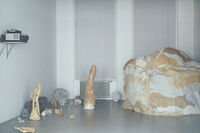
Contemporary art is characterized by great fluidity. Disciplines including architecture, film and the visual arts are slowly merging. What is left is mere space. In space, ten artists and one artists’ collaboration present different views of the concept space, here defined as the place where art is produced and exhibited, as well as the artist’s mental and cultural surroundings.
Some of the exhibited artists explore the small intimate space of individual manoeuvring. Others examine the social space of the built environment. A third group deals with the great atmospheric space of cosmic reality. Each of the artists contribute to the most important space, the intermediary space, in which works of art are linked, associated, enriched and juxtaposed thereby suggesting the outline of contemporary art’s changing practices.
Next to existing works and works in progress, space will contain many new and special contributions by the artists.
Participants
Laura Emsley, Matthew Geller, Holland Harings, Roland Herzog, Jaki Irvine, Master Organisers, Regina Möller, David Noonan, Josephine Pryde, Ursula Rogg, Shimabuku
Curators
Roland Groenenboom
<div class="
-
99 General
Record created from the archive project register (access_project / 2026 projects). No corresponding page exists on the institution’s website.
-
Fortuyn/O Brien — House and Garden
The city. Gondola’s, stepped gables, hot-dog sellers. Subway sounds, a dilapidated porch, the smell of a pretzel. The bakery’s orange awning, the wintry limetrees on the square, the neighbor’s morning song. None of these things matter to the city map which shows street patterns, not traffic, monuments, not history, squares, not seasons. The map merely points the way by capturing the city in a relentless grid. Fortuyn/O’Brien takes this grid as the basis for exploring the city.
The artist seeks all intersecting points on the horizontal and vertical lines on the grid, locates the corresponding real places and makes at each of them a photograph in the four wind directions. The pictures are presented in a slideshow accompanied by citysongs, a mix of sounds recorded at the photographed locations.
Witte de With’s extensive exhibition of Fortuyn/O’Brien’s recent work features four of these cityscapes: London, Paris, Rotterdam, and Valenciennes. The cityscapes illustrate the paradox that extreme realism leads to the unfamiliar. They are composed of common things, streetcorners, houses, traffic, pedestrians, the river. Yet, they are unrecognizable. They lack the story of the viewer, the tourist, flaneur or resident.
The cityscapes are complemented by a series of beautifully crafted interiors. These works originate not from the strict hand of the cartographer, but from the luxurious taste of a designer who explores the boundaries of nature decoration. Dancing threads, bronze trees, and flamboyant flower carpets tempt the eye. Here too, however, the familiar is estranged, turning initial awe into unease. Icy silence envelopes the trees, knots grow rampant above the carpets, ferns form living paintings and a pair of ceramic dogs stares out of the window.
The Rotterdam work made especially for this exhibition crowns the artist’s exploration of the relationships between culture and nature, inside and outside. In this work, an intriguing scape of the harbor city finds its counterpart in airy rooms where reflections of daylight and views of red geraniums on the horizon merge vista and interior. The work makes it seem as if the city were breathing through the spaces of Witte de With. The sum of these exhibited works evoke only vague memories of existing cities and interiors. Their familiar images, smells and sounds form rather new configurations which, each with its characteristic architecture, ecology, and esthetics, lead their own peculiar still lives.
Participants
Fortuyn/O'Brien
Curators
Bartomeu Marí
Network
Kunstverein Hamburg
<div class="
-
Muntadas — On Translation: The Audience
For many years, the artist Antoni Muntadas (Barcelona, 1942) has explored the relations between mass media and art. The exhibition in Witte de With is devoted to three works, a new work titled On Translation: The Audience, a reinterpretation of the installation Between the Frames and a reconstruction of the well-known video installation The Board Room.
The project On Translation: The Audience is a new work by Antoni Muntadas consisting of eleven large photographic triptychs each of which were shown in a cultural institution in Rotterdam for one month and are now brought together for the first time in Witte de With.
Between the Frames (1983-1993) explores the art world. The installation is the outcome of the close collaboration of Muntadas, Witte de With’s staff, and dr. W. De Nooy from the faculty of History and Art Studies, Erasmus University, Rotterdam. It encourages a form of ritual interaction between the audience and the players of the art world. Seven monitors show videos, each of which focuses on one segment of the art market and its players: dealers, museum directors, gallery owners, collectors, critics and the media. In the videos, which constitute a veritable portrait of the art world of the eighties, interviews are larded with metaphors; the ocean tides allude to the critics’ fashion swings, the Tokyo Stock Exchange refers to the collectors’ breathless activity.
Each monitor is in its own sphere. By wandering from sphere to sphere, the visitor traces the movements of the public. Inside each sphere, he can watch the video, whose documentary method promises the visitor authentic insight into the art world. The interviews are in the original languages (translations are provided on paper), whose accents and sounds invoke the rich complexity of the art world.
The Board Room (1987) explores the relations between religion, economy and the media. The installation shows a dark room featuring a burgundy red carpet and a (board room) table with thirteen chairs. Upon entry, the visitor hears a persistent humming sound. Soft light focuses on a series of large, hand-colored photo portraits of famous religious leaders. Among the religious figures are the TV evangelists Billy Graham and Pat Robertson, Islamic leader Ayatollah Khomeini and Pope John Paul II. What seemed a humming sound before appears on closer inspection to be the sound of video excerpts which present a series of speech fragments of the respective leaders. The excerpts stem from small screens which are mounted on the mouths of the religious figures. They illustrate the ways in which organized religion partakes of marketing techniques and media spectacle, thereby blurring the lines between evangelical meeting, rock concert and campaign rally.
Publication
A monograph titled On Translation: the Audience accompanies the exhibition. It includes texts written for this occasion by the French ethnographer Marc Augé and the Catalan anthropologist Octavi Rofes. The publication also contains Barbara Kirshenblatt Gimblett’s Confusing Pleasures and a reprint of Walter Benjamin’s classic text The Task of the Translator.
Participants
Antoni Muntadas
Curators
Bartomeu Marí
Network
MACBA, Museum Boijmans Van Beuningen, Nederlands Genootschap voor Esthetica, V2_, World Wide Film Festival Amsterdam
<div class="
-
Stimuli
Stimuli explores in a number of modern classics and contemporary works the physical experience of visual arts on the basis of this hallucinatory experience.
Contemporary art alters our perception by disrupting reality. Fields of colour, vertiginous lines, and mutating representations make our vision palpable. Traditionally a core theme in aesthetics, art’s ability to stir the mind by targeting the body is hardly recognised today. Jungles of history, context, and theory seem to have banned the body from the realm of vision. Yet it is undeniable that art relies more than ever on direct impulse, on the bodily intake of stimuli. Changing the viewer’s mental make-up, these stimuli prompt an alternative form of perception comparable to hallucination.
Stimuli explores in a number of modern classics and contemporary works the physical experience of visual arts on the basis of this hallucinatory experience. With slowly mutating patterns, repetitious movement and optic distortion the exhibited works give free reign to various levels of consciousness, including hypnosis, ecstasy, trance, and shock.
An important modern classic in the exhibition is Marcel Duchamp’s Rotoreliëfs (1935), which consists of twelve cardboard discs inscribed with round coloured shapes. The discs slowly rotate on record players. A comparable churning movement is palpable in Bruce Naumann’s Clown Torture (1985) which consists of two screens, one featuring a clown telling a circular story, the other a jester uncontrollably laughing. The ‘tree branch video’ (1999) by the Dutch artist Rob Johannesma hypnotises the visitor with an almost unnoticeable zooming in and out of a slowly thinning landscape. Vito Acconci’s intimate monologue in Theme Song (1973) has a similar dazing effect. Matt Mullican’s Hypnosis Tapes (1996), finally, show the artist himself under hypnosis.
Piero Manzoni’s Achroms (1962) have a strong meditative effect as result of the absence of vanishing points. Similarly meditative is Corps Noir (1994 -1999) by Ann Veronica Janssens. Corps Noir is an enormous bowl-shaped panel of black glass which reflects the world upside down. Francis Alÿs’ Narcotourism (1996), the only work in the exhibition that is ostensibly the result of a hallucination, traces the changing perception of a walk made under influence of various drugs.
In addition, Stimuli shows works by Dennis Adams, Justin van Duurling, Peter Fillingham, Runa Islam, Elena Montesinos, Lou Reed, Nasrin Tabatabai, Fiona Tan, Koen Timmermans and Ulay.
The exhibition is initiated by Witte de With and Karel Schampers, (then) Head Curator Modern Art, Museum Boijmans Van Beuningen, Rotterdam.
The exhibition is accompanied by a publication with, among others, Georg Simmel’s classic “The Metropolis and Mental Life,” and Jos ten Berge’s “Droommachines: nieuwe media als nieuwe roesverwekkers”(Dreammachines: The New Media as New Intoxicators).
Participants
Vito Acconci, Dennis Adams, Francis Alÿs, Marcel Duchamp, Justin van Duurling, Peter Fillingham, Keith Collins, Runa Islam, Ann Veronica Janssens, Piero Manzoni, Elena Montesinos, Gregor Schönborn, Matt Mullican, Bruce Nauman, Lou Reed, Pages, Fiona Tan, Koen Timmermans, Ulay
Curators
Bartomeu Marí, Karel Schampers
Network
Museum Boijmans Van Beuningen
<div class="
-
Scripted Spaces
Scripted Spaces explores the recognition, mapping and erasure of our surroundings. Partaking of a long tradition in the visual arts, and yet far away from its beautifying, sentimental, or even apocalyptic features, it charts the modern landscape with nuclear testing sites, entertainment parks, mortal and envisioned spaces, shaped by modern tools of inscription including billboards, bulldozers, and special effects.
The title of the exhibition refers to the installation Scripted Spaces: The Chase and the Labyrinth presented by the critic and novelist Norman Klein, in collaboration with the Künstlerhaus Stuttgart. This installation explores the phenomenon of scripted spaces: carefully designed and controlled spaces that reconcile cultural meaning with the thrill of the unknown. With their prolific use of special effects and virtual topographies, scripted spaces constitute the mainspring of today’s film industry and computer games. Other examples of the genre are theme parks, casinos, and labyrinths. With trompe l’oeil painting, animated cartoons, and web navigators, Klein’s installation presents a collage of images from scripted spaces.
See further the Scripted Spaces website from Künstlerhaus Stuttgart.
It is characteristic of the current pioneers of the landscape genre that they do not all profile themselves primarily as artists. Among them are also academics, critics, and research organizations. The last title applies to The Center for Land Use Interpretation (CLUI), which is “dedicated to the increase and diffusion of information about how the world’s lands are apportioned, utilized and perceived.” Blurring the boundaries between art, research, intelligence and planning, the projects by CLUI render a whole series of politically charged cartographic and landscape views that provide commentary on issues as diverse as modern defense tactics and waste management. In this exhibition, the CLUI will focus on controlled perspectives (‘overlooks’) in a range of places, including, for instance, security forces training towns, state and federal borders, and industrial sites. See further: www.clui.org.
The third part of the exhibition is devoted to the exploration of the Dutch cityscape. Jan Kempenaers (Belgium, 1968) presents the cityscape as a collection of quiet, everyday places. Geert Mul (Netherlands, 1965) shows the city as a series of agitated, fragmented images. More focused on specific viewpoints and aspects of the cityscape are the works by Lara Almarcegui (Spain, 1972), on the phenomenon of the allotment garden, Nasrin Tabatabai (Iran, 1960) on the Rotterdam cityscape viewed through the eyes of a local Turkish shop owner, and Julika Rudelius (Germany, 1968) on the city’s social traffic. Jan Rothuizen (Netherlands, 1968) presents an ethereal urban landscape shaped by the murmur of myriad simultaneously played radio broadcasts.
As part of the exhibition, Norman Klein has given a workshop titled imaginary.nl, in which artists, architects and (media)designers explored the social imaginary of Holland. The participants included Luciano Basauri, Delphine Bedel, Matthijs de Bruijne, Shiuan-Wen Chu, Floris Paalman and Florian Wüst.
Participants
Jan Kempenaers, Geert Mul, Pages, Norman Klein, Jan Rothuizen
Curators
Bartomeu Marí
Network
Berlage Institute, Künstlerhaus Stuttgart, Rijksakademie van Beeldende Kunsten, V2_, Willem de Kooning Academie
<div class="
-
Strangers and Paradise
Strangers & Paradise offers an overview of works by Oladélé Ajiboyé Bamgboyé and features new works by Nasrin Tabatabai and Gediminas Urbonas.
The exhibition of the works by Oladélé Ajiboyé Bamgboyé (Nigeria -UK) presents for the first time a large selection of his photo- and videoworks. The exhibition focuses on Bamgboyé’s exploration of the relation between identity and modern technology, and especially the perception of the black body. With ambivalent erotic poses, Bamgboyé examines ‘blackness’ in the public imagination, in mythology and mass-culture. His body fulfils the double function as object of sexual desire and perversity and as commentary to the commodification of blackness. These themes will also be the subject of a monograph about Bamgboyé’s work that accompanies the exhibition.
In her work The Weaver-bird (2000) Nasrin Tabatabai (Iran – the Netherlands) employs the fragile imagery of the lace collection in Museum Boijmans van Beuningen to explore the phenomenon of data transformation. Symbol for a delicate, veiled world, the lace serves as a basis for digital patterns that the visitor can open, edit and print in an installation masked as a place of production.
Transaction (2000) by Gediminas Urbonas (Lithuania) addresses the changing Lithuanian political regime’s psychological effects on different generations of Lithuanians. Urbonas transforms Witte de With’s exhibition spaces into an archive containing fictional and autobiographic images and sounds.
The work will be made in collaboration with Nomeda Urboniene (camera/editing), Marta Vosyliute (stage design), Darius Ciuta (architecture/sound), Ruta Baciulyte and Raimundas Milasiunas (psychiatrists).
Participants
Oladélé Ajiboyé Bamgboyé, Nasrin Tabatabai, Gediminas Urbonas
Curators
Bartomeu Marí
Network
Künstlerhaus Stuttgart, Museum Boijmans Van Beuningen
<div class="
-
Play-use
The explosive developments on the World Wide Web have generated new fields of design explored by artists as well as architects, (web) designers, game producers and computer programmers. In the exhibition Play-use, they present their findings with interactive models, prototypes, and computer games focusing on the constantly redefined relationship between play and use.
Part of the exhibition was Play-use/The Forum, a website – no longer online – made in collaboration with EINA, Escola de Disseny i Art, Barcelona. Play-use/The Forum expressed part of the projects intention: to ignite a real debate on the possibilities of connecting cultural practices from within and beyond the hierarchies of the fine arts. The question was: which needs can art satisfy? And what programs are designed to fulfill these needs?
A new work by the Dutch architect Kas Oosterhuis presents this relationship between play and use as basis for a new type of design. Employing the lay-out of internet sites such as Active Worlds, he designs buildings as games whose architecture follows the demands of the players. Physical and virtual space merge in the installation by the Japanese computer game producer Hiroshi Masuyama which confronts visitors physically with the virtual world of the new computer game Doshin the Giant. SOMAR (Sophie Krier and Marjolein Fase) presents in collaboration with the Design Academy in Eindhoven the project Fake in which she contrasts the three dimensional materiality of industrial design with the ethereal facade of the cartoon world.
In her series Kiosks, New York artist Donna Nield employs digital means to reconfigure cosmetic booths into ambiguous architectural artifacts. Computer software also plays an important role in the design of the apartment building Resi-Rise Skyscraper by the New York based architecture practice Kolatan/McDonald Studio. This skyscraper’s shape and facade mutate according to computer-steered design changes based on changing residential needs and fluctuating market values. Residential units (“pods”) can be attached or detached when the inhabitant wants a new interior, moves away or with changes in the real estate market.
The American critic and ID Magazine editor Janet Abrams is responsible for installing the exhibition’s nerve center, Medialounge. She has assembled a collection of websites, CD-roms, computer games, video’s en magazines to help the visitors to orient themselves on the hybrid nature of new design. Combining the function of café, salon and library, the space is designed by Melle Smets and Jurriaan van Diggele.
The exhibition was made in collaboration with the Design Academy (Eindhoven), EINA (Barcelona), Interrogative Design Group/ MIT (Massachusetts, U.S.A.), Royal College of Art, Postgraduate Art & Design (London)
Contributors: Janet Abrams, Jop van Bennekom, Kelly Dobson, Peter Friedl, Meschac Gaba, JODI, Kolatan/McDonald Studio, Atelier Van Lieshout & Women on Waves, Hiroshi Masuyama, Donna Nield, Honoré d’O, Kas Oosterhuis, Jean-Arnaud Smadja, Melle Smets/Jurriaan van Diggele, SOMAR, Simon Starling, Krzystof Wodiczko, The Word Company.
Participants
Janet Abrams, Atelier van Lieshout, Jop van Bennekom, Jurriaan van Diggele, Kelly Dobson, Peter Friedl, Meschac Gaba, JODI, Kolatan / MacDonald Studio, Hiroshi Masuyama, Donna Nield, Kas Oosterhuis, Jean-Arnaud Smadja, Melle Smets, SOMAR, The World Company, Krzystof Wodiczko, Women on Waves
Curators
Bartomeu Marí
Network
Design Academy Eindhoven, EINA Barcelona, Interrogative Design Group MIT, Royal College of Art
<div class="
-
Eulàlia Valldosera
Since 1990, Eulàlia Valldosera (Vilafranca del Penedès, Barcelona, 1963) has created an oeuvre of unusual beauty. In her installations, crafted from light, shadow, reflection, and movement, she distils a constellation of dreamlike moments centering on the female body, domestic intimacy, and the everyday objects and specific places that create this intimacy.
Feminine archetypes are a recurring theme in the work of Eulàlia Valldosera: the domestic environment, motherhood, the body and the male gaze. Reacting to the position of the art object as a part of the market economy, she employs her own body as a starting point for her art. Valldosera believes there is a taboo surrounding such corporeality, particularly in Europe: the taboo of flesh, sex, illness and death.
The female body occupies a central position in the presentation on the lower floor of this exhibition. Here the body serves as means of identification, a subject of beauty, of reproduction, contamination and decay. But it is also a fleshy machine that has to be cleaned and fed.
On the upper floor of the exhibition the focus shifts from the body to the objects that surround it. Under the title Appearances the spaces have been arranged like the rooms of a house: a dining room, living rooms, a kitchen and a bathroom. Each space is linked to a particular function of the human body. The works form the total bodily experience of the architectural space. Objects are transformed into ‘social mediators’ in these installations: they say something about the culture, the desire, the emotions and the daily life of the people who acquired them and took them into their environment. The light brings with it a dark side, the hidden meaning of the objects on the surface. In Valldosera’s world, the shadows, as anti-objects, refer to a collective subconscious.
Works 1990 -2000 is a co-production of Witte de With and the Fundació Antoni Tàpies in Barcelona.
Participants
Eulàlia Valldosera
Curators
Bartomeu Marí
Network
Fundació Antoni Tàpies
<div class="
-
Anarrations
The exhibition Anarrations aims at showing cinematographic art not only as a derivative of cinema but as a fully fledged discipline with its own specific qualities. The youngest generation of visual artists shakes off the yoke of film history and focuses on the autonomy of the medium.
Four young Dutch artists, Anneke A. de Boer, Fow Pyng Hu, Gabriel Lester and Pia Wergius, explore the relationships between the moving image, time and narration.
In the multidisciplinary field of the visual arts the cinema is hardly conspicuous anymore. Artworks originating in experimental film or found footage exist alongside productions of (digital) video which in turn are influenced by music culture, commercials and computer games. This changed the nature of cinematographic art once and for all. What remains are the principles which by now have found their place within the visual arts and give no more than a hint of regular cinema. This has in turn also become transformed and incorporated ‘art’ material such as (digital) video in its program.
The exhibition Anarrations aims at showing cinematographic art not only as a derivative of cinema but as a fully fledged discipline with its own specific qualities. The youngest generation of visual artists shakes off the yoke of film history and focuses on the autonomy of the medium. Essentially this consists of time – as is the case with the newer medium of video – but the classic principle of the narrative has become so well-known that ‘gaps’ can effortlessly be filled by the viewer. This principle of film has endless possibilities.
In the works of Anneke de Boer (1969), Fow Pyng Hu (1970), Gabriel Lester (1972) and Pia Wergius (1969) the essence of the narrative is affected by stopping time, pulling it apart into different dimensions or holding it topsy-turvy.
Participants
Anneke A. de Boer, Gabriel Lester, Fow Pyng Hu, Pia Wergius
Curators
Nathalie Zonnenberg
<div class="
-
Manfred Pernice
On the top floor Witte de With presents the first solo exhibition by the German artist Manfred Pernice (1963) in the Netherlands. The exhibition is constructed as a total installation in which existing works are combined with new elements to form a ‘cosmology of the harbor’ – an important theme in Pernice’s work.
In the first place this is characterized by architectural sculptures referring to structures of metropoles with their streams of traffic, transportation of goods and spending patterns. More specifically they refer to the changing character of the city of Berlin where Pernice lives and works.
The sculptures are constructed from simple materials like wood and chipboard and consist of composite forms of boxes and containers. They function as an installation which the viewer can walk through but also serve as pedestals or columns on which posters or photographs, newspaper reports, videos and light flashes find a place. The drawings and models preceding the installations which fill the space are often parts of the whole. Although Pernice takes great pains to integrate his installations with the space, his work can not be called site specific. The installations are composed long before they are shown in a specific space. Yet they do not have a definite character; the strength of the installations is on the contrary to be found in the unfinished state of the works. They contribute to a process in which each work has its own place. Some of the works – the larger ones in particular – can be adapted time and again to fit each space and to evoke a new experience.
The exhibition in Witte de With incorporates three large installations; 1a-Dosenfeld ’00 (2000), which could recently be seen in a solo exhibition of Pernice’s work in the Kunsthalle Zürich, is spread out in the various rooms with its combination of low columns and containers; Bad, bath (1999) which was shown earlier in the Anton Kern Gallery in New York for which it was originally produced, takes on a new appearance in Witte de With’s specific exhibition rooms; 109 (1998) is reconstructed and supplemented with new elements for the exhibition.
In Witte de With the works are presented within the theme of the harbor. The desolate atmosphere characterizing that area is enhanced by the many container-works selected by Pernice, such as Bell II (1998) and Block F (1997). One work in the exhibition forms a beacon in the vast container landscape. O. Dose (2000), realized very recently, was situated on a roundabout in Hamburg until a short while ago. The heavy sculpture which gives out a light flash provided the viewers with a place to return to time and again.
Participants
Manfred Pernice
Curators
Bartomeu Marí
<div class="
-
Meschac Gaba — Museum of Contemporary African Art/The Library
In 1997, Meschac Gaba (Benin, 1961) launched the first sketches of his Museum of Contemporary African Art. The Museum provides an alternative to the colonial context in which western museums display African art. So far, Gaba has installed several museum departments, amongst others a play-room (SMAK, Ghent, Belgium), a museum shop (Traffique, Ghent, Belgium), a restaurant (W139, Amsterdam), the museum architecture (Gate Foundation, Amsterdam) and an audio room (Bonnefantenmuseum, Maastricht).
In Witte de With, Gaba presented the seventh chapter (out of twelve) of his project: the Museum Library. The Library, whose collection of books stems from donations by museums, art institutions and galleries, covered an entire floor at Witte de With, and incorporated a children’s area, a curatorial section, and an interactive space.
The exhibition is accompanied by a monograph, entitled Library of the Museum: Museum of Contemporary African Art, published by Foundation Artimo with essays by, among others, Chris Dercon, Sebastian Lopéz and Anna Tilroe.
“This museum does not exist in reality. It is a concept, an idea that takes shape at some location and disappears again, or travels to another space, altered and is never the same again. Some spaces, like the Museum Restaurant, only existed once and will never be repeated. But who has visited a presentation of this museum, or has taken part of the event that this presentation always is, will never forget its strong physical impact. The body of the visitor is almost at every occasion involved, one way or the other.”
Bert Steevensz
“I believe that, above all, a museum is a place of study, of research. People look at the collection, ask themselves questions, and talk to each other about the pieces… My museum of contemporary African art has no walls. I want to show artists that you can show work everywhere, you can do it on your own. You don’t need four walls to determine your place, to decide who you are. Have the courage to decide for yourself who you are!”
Meschac Gaba
“The Museum for Contemporary African Art is a work of art in which the form, as content, opens itself outward. You ‘enter’ the ten rooms that …refer to aspects of life in Africa while at the same time, because they are located in the context of a museum, they are transformed into metaphors or into art, if you will. But it doesn’t stop there, since art for Gaba is not a goal in itself but a medium, a transparent presence, like a widely-shared idea. So his aim is to return these objects, charged with new significance, to the reality from which they come, as a process of recycling.”
Anna Tilroe
“Libraries are essential to 20th century museums. They are places for safekeeping, concentration, and for the dissemination of knowledge. Whether a sculpture or an installation, the raw material of Gaba’s Library is books on contemporary art: exhibition catalogues, curatorial books, art magazines and children’s books. The exhibition must be seen but its content demands to be read. Witte de With will function during this exhibition not unlike a library where the public will be invited not just to see, but also to use the exhibited books. The central notion of art and visuality will temporarily be transformed into legibility.”
Bartomeu Marí.
All citations are taken from the publication “Library of the Museum – Museum of Contemporary African Art.” (Artimo, 2001)
Participants
Meschac Gaba
Curators
Bartomeu Marí
<div class="
-
Wild Zone
A ‘wild zone’ is a refuge within the organised structure of society. It is not a marginal place, but an experimental area which develops parallel to the controlled and established relations of everyday life. The artists in the exhibition Wild Zone, Carsten Nicolai, L.A. Raeven, Jennifer Tee, and Raimond Wouda, use these areas in their own ways to examine and make visible their personal desires and sources of inspiration. They are interested in the conditioning and manipulation of human behaviour and the effect of aspects of subcultures (fashion, music, sound, media and technology) and they zoom in on specific elements of a reality that seems familiar at first sight.
Carsten Nicolai’s work is based on electronic music compositions and codings. His installations are derived from the contemporary club circuit, but he eliminates every entertainment factor from this popular field, until he is left with only the basis – sound and the movement it produces. His installations combine scientific and artistic research into the kinetic effects of tones and their relation to visual images. By using particular sound waves in his compositions, Nicolai produces geometrical patterns on the surface of a fluid. These motions seem to refer in a highly abstract way to a dancing crowd driven on by the rhythm of the music. The industrial-looking design alludes to the atmosphere in techno culture. Through concepts such as time, rhythm and movement, Nicolai creates a personal, poetic microcosm that subtly questions the vast communication and network systems used in society today. He analyses social patterns by means of cool technology which he makes visual in his installations and thus demystifies.
Jennifer Tee also creates a personal microcosm: ‘The viewers are not in front of but inside the work, and become part of it’ (Martijn van Nieuwenhuyzen, Nieuwsbrief Stedelijk Museum Bureau Amsterdam, 1999, no. 46). Using a wide range of materials, sounds and video images, she produces an Alice-in-Wonderland kind of world, which is based partly on reality and partly (de-)constructed. Because of this blending of the staged and the real, Tee’s installations are more than a fantasy and have a direct relation to the viewer’s perception. For the exhibition at Witte de With Tee drew her inspiration from hiphop and motor race culture. In her installation she turns stereotypical macho signs into colourful objects and rapid images; she employs the rhythm and language of hiphop to tell her own story. The absurdity of the combination of objects and the enlargement of familiar images make Tee’s installations an alienating experience. The wishes and motives behind actions remain unclear; relations are palpable but never elucidated, as if by accident you have ended up in a new culture whose codes are not yet familiar to everyone.
A mixture of the staged and the real is also to be found in Raimond Wouda’s photos. In the small community of Tuindorp Oostzaan he took a series of photos showing the everyday life of the inhabitants. Wouda spent a lot of time in the community so that people did not stiffen up in front of his camera or feel bothered by him going about his work. Thus, he was able to observe and study the relations between people and their environment in an uncomplicated way. Wouda is especially interested in the border area between private and public life. He photographed the people of Tuindorp Oostzaan in everyday situations (walking the dog, having a drink with a neighbour, waiting by the swimming pool) where the intimacy of the familiar setting coincided with the public character of the street. As a result, simple gestures and small acts take on an almost monumental significance. The people in Wouda’s photos are portrayed with self-assurance and pride, but also without shame or flattery. ‘Raimond Wouda succeeds in avoiding the sentimentality that you often find in documentary photos of working-class districts’ (Anne van Driel, de Volkskrant).
The twin sisters L.A. Raeven often feel like oddities in Dutch society because of their extremely thin appearance. In their work they try to lay claim to their personal territory with the aid of media and fashion strategies by creating a subculture in which they are the standard. The fact that they are twins already undermines the uniqueness of L.A. Raeven; this made putting together L.A. Army (a work they initiated earlier with people who met their standard) less threatening.
In subcultures the body is often a ‘performing body’, through which the individual can stand out from the crowd. Through clothes, hairstyle, movement, a logo or music, he can identify with or distance himself from a particular group. L.A. Raeven exploit this by making not the outward appearance of the body but the body itself the medium of their subculture.
In the exhibition at Witte de With L.A. Raeven will focus mainly on body scent. In commerce more and more use is being made of scent as a means of influencing the mood of the consumer. Scents that are generally thought to be pleasing and that encourage people to buy certain products are spread in shops and department stores through the air conditioning. L.A. Raeven oppose the ‘generalisation’ of scents in society. At Witte de With they spread something uniquely human: their own scent. This is not entirely natural because they have artificial eating habits with an excess of synthetic food. By doing this they also ‘show’ the limits of individualism in Western society. L.A. Raeven resist levelling tendencies and trends by making use on a small scale of means also employed by business and the media to give shape to identity.
Participants
Nicolai Carsten, L.A. Raeven, Jennifer Tee, Raimond Wouda
Curators
Tanja Elstgeest
<div class="