-
Manon de Boer
Manon de Boer’s work analyzes the possibilities of film in visual art. She often challenges the conventions and assumptions of the documentary genre. Drawn to individuals with unusual personal histories, she creates intimate portraits that question their own veracity, revealing the inherent instability (perhaps even impossibility) of narrating one’s life as a coherent biography.
In working with the same people (often actors, musicians, intellectuals) over extended periods of time, de Boer explores the disjunctions between lived time and recorded history. Her work captures the post-Modern shift from communal to individual histories. With the repetitions and cuts in her films, she avoids portraying time as either linear or chronological.
Witte de With presents two films by de Boer: Sylvia Kristel – Paris(2003) and Presto, Perfect Sound (2006). The earlier work is constructed around two interviews carried out by de Boer two years apart with the actress who rose to fame as the star of “Emmanuelle”. Kristel’s stories wander fluidly through key points in her life, turning mainly around her many love affairs and the cities in which they took place. The city to which her story returns most frequently is Paris, and while we hear Kristel’s voice, we see images of Paris filmed by a handheld camera. At first, the super-8 images seem to have been recorded in the era of which Kristel speaks, an illusion destroyed by the inclusion of architecture clearly built in recent years. We only see Kristel herself twice, smoking silently and resembling a screen goddess of the Golden Age of Hollywood. These brief appearances punctuate the two interviews, whose emphasis alters considerably, revealing certain inconsistencies in the process of remembering and recounting, her poignant pauses underlining what is left unsaid.
In addition to the sound of Kristel’s voice, we hear the muted sounds of the city intermingled with music by George van Dam, a composer with whom de Boer has also worked on previous films. He becomes the subject of Presto, Perfect Sound, which depicts van Dam playing his violin, his head centered in the frame. The film’s title comes from the piece he plays, the fourth movement of Belà Bartòk’s Sonata for Violin Solo Sz 117 (1944), chosen for its length (5 minutes), speed and plot-like structure. “We found this sequence of different moods or temperatures to be very rich in a narrative sense and particularly suited for a filmed performance”, explains the musician. De Boer then chose the edit together the various takes of this performance in a way that created a perfect sound, ie. that gave priority to the quality and continuity of sound rather than image. This means that when watching the film, we see the cuts but we do not hear them. This is not the first work of de Boer’s in which the central figure is playing music – inRobert, June 1996, for example, the main character played the guitar – but it is not so much the music itself as its repetition that makes it a key motif for de Boer. For her, whether she is working with a musical score or a personal narration, it is the shifts and changes that occur in repetition that are the most telling.
“Rather than suggesting that her subjects are permanently indelible forms or mere reflective surfaces, de Boer lets their identities emerge like photographs in a dark room, developing over the course of their recollections – exposing some areas and hiding others, until their surfaces reveal as much as they conceal” (Christy Lange, Frieze, Jun-Aug 2006, p. 234).
These two films will be screened within the framework of Liam Gillick’s solo exhibition at Witte de With, Three perspectives and a short scenario, which has imposed an architectural meta-structure onto the gallery spaces, designating which rooms are to be used for the presentation of his own work and which are to be seen as “institutional zones”. The director, Nicolaus Schafhausen, has chosen to use these institutional zones to present the work of other artists, beginning with Manon de Boer.
Participants
Manon de Boer
Curators
Nicolaus Schafhausen, Zoë Gray
Network
Frankfurter Kunstverein
Supported By
International Film Festival Rotterdam and the Mondriaan Foundation
<div class="
-
Keren Cytter
Witte de With presents three films by Keren Cytter: Something Happened (2007, 8 min), Der Spiegel (2007, 4 min) and Nightmare (2007, 7min). In addition, Cytter’s feature-length film New Age (2007, 75 min) will be screened during the opening and on Saturday 15 March at 4:30 p.m.
Exhibition opening with an informal introduction by Keren Cytter and Willem Oorebeek prior to a screening of Keren Cytter’s New Age.
Cytter’s films reveal a fascination with human behavior and psychology, often focusing on a couple in a claustrophobic, domestic situation. Although her storylines are highly dramatic, the characters’ facial expressions are often deadpan, creating a jarring disjunction between acerbic language and its passive delivery. “You will never have me. You will never fuck me” murmurs one of her characters, as she caresses the man she is rejecting.
Cytter’s work analyzes the way in which mainstream films are constructed, the narrative devices they employ and the editing tricks that sew a story together. Her characters refer to these, commenting upon their own subtitles or congratulating each other on a smooth edit. Her films also challenge chronological representations of time, with certain actions being repeated or multiple versions of the same event happening at once. The notion of memory is an important aspect in her work, both its emotional impact and its use as a story-telling device. As one character in New Age puts it: “You can’t rebuild your memory, you can only alter it”.
Initially, Cytter’s technological approach appears to be rather low-fi. Several works are filmed with a handheld video camera, she often uses her own apartment as her set, and the same group of friends frequently appear in her films. Yet the construction of her works is extremely layered and complex, including an intricate and evocative use of music, and recurring visual effects such as filming at floor level, or using the opening and closing of a door as a looping moment. Her visual language is as developed as the elaborate verbal language she uses in her scripts.
At Witte de With, Cytter’s films are screened within the framework of Liam Gillick’s solo exhibition Three perspectives and a short scenario, which has imposed an architectural meta-structure onto the gallery spaces. This meta-structure designates which rooms are to be used for the presentation of Gillick’s work and which are to be seen as “institutional zones”, for which he gave back the responsibility to the curatorial team. Witte de With has chosen to use these institutional zones to present the work of other artists, first with Manon de Boer and now with Keren Cytter.
Publication: Witte de With will publish a new book by Keren Cytter in 2008.
Participants
Keren Cytter
Curators
Nicolaus Schafhausen, Zoë Gray
Network
Sternberg Press, STUK Kunstencentrum
<div class="
-
Gareth Moore
Gareth Moore (b. 1975, Matsqui, BC, Canada) is one of these few people, attuned to notice the small details of the world that are usually overlooked. As he puts it, “I like having a very fragmented art practice, of art that exists in a more dissipated or invisible manner”. He instigates projects in which he can learn something and interact with other communities outside the domain of contemporary art. He has been described as an archeologist of the present, and makes work that thrives upon confusion to enable the public to discover his work unexpectantly, often through some element of choreographed quirkiness.
Moore is intrigued by historical figures who stand outside the mainstream. With this project, he focuses our attention on the writings and discoveries of a scientist whose work was never fully accepted by the establishment, but whose ideas find a resonance in ecological thinking today. “They call me deranged”, writes Schauberger, “The hope is that they are right! It is of no greater or lesser import for yet another fool to wander this Earth. But if I am right and science is wrong, then may the Lord God have mercy on mankind!” (1936). Moore’s works center around Schauberger’s belief that water is the source of all life and an active element whose energy must be harnessed rather than destroyed. They include a sculpture of trousers made from fish leather, a meditative 16mm film, and a barrel containing water collected from a small roadside spring in western Canada and shipped to Rotterdam, from which exhibition visitors may drink. Finally, reaching beyond the confines of the gallery walls, Moore’s project extends into the pages of a local paper, where fragments of Schauberger’s writings will be published throughout the exhibition.
Viktor Schauberger was a self-taught philosopher, inventor and naturalist, who developed his theories through the close study of the woods and rivers of his native Austria. “Nature moves everything and creates this movement through various differences in temperature and potential”, writes Schauberger, “Where these intersect, the primordial life-force is born. There are only a very few people who really know how to observe Nature and to notice these small and almost imperceptible differences in motion, temperature, tension and potential” (1936).
At Witte de With, Moore’s works are presented within the framework of Liam Gillick’s solo exhibition, Three perspectives and a short scenario, which has imposed an architectural meta-structure onto the gallery spaces. This re-designates which rooms are to be used for the presentation of Gillick’s work and which are to be seen as “institutional zones”, to be programmed by the curatorial team. Witte de With has chosen to present here the work of other artists, first Manon de Boer, then Keren Cytter and next Gareth Moore.
Participants
Gareth Moore
Curators
Nicolaus Schafhausen, Zoë Gray
<div class="
-
Geoffrey Farmer
Geoffrey Farmer creates complex installations that consist of multiple elements distributed throughout the gallery space. These installations activate narratives, which are drawn from diverse sources including social history, popular culture, art history and literature. The exhibition at Witte de With will be a playful experiment that re-explores an existing work titled Airliner Open Studio (2006). It will feature elements of story-telling, writing, performance and process-based sculpture.
Airliner Open Studio is a work structured around a full-scale aircraft cabin, complete with seats, overhead lockers, emergency lighting and cabin windows. Composed of real and false components, this installation transforms the gallery into a stage-set, revealing the influence of the film industry (ever-present in Vancouver) on Farmer’s work, and his fascination with the theatrical: with staging, improvisation, role-play and self-disguise. The artist will use this interior as a rehearsal space and as a starting point for a number of performances – some scripted, some improvised, alone and with others – performed live in the exhibition space or recorded on video and then presented in the gallery.
Farmer’s preoccupation with the theatrical is also evident in the form adopted by his exhibitions, which enact a real-time staging of change and evolution. Seeking to challenge the apparent timeless neutrality of the gallery and to render the processes of construction visible, he inverts the usual temporality of the exhibition format. Instead of the opening night marking the completion of an installation period, for Farmer it is merely the beginning. He often transforms his installations over the course of an exhibition, working through the night to create changes for visitors to discover each morning, with new elements appearing, others disappearing or being translated into new forms. In this way, his work is “actively worked out in front of the viewer over the duration of the exhibition” (artist’s statement, 2007).
Farmer will be at Witte de With throughout April, making frequent changes to his installation. For this reason, visitors in the first month of the exhibition will be given tickets that allow them to revisit the show, in order to highlight the importance of transformation and process in Farmer’s work.
Publication: Witte de With will publish a Source Book on Farmer’s work, edited by Nicolaus Schafhausen, Monika Szewczyk and Zoë Gray, featuring an introduction by Nicolaus Schafhausen, essays by Diedrich Diederichsen, Thierry Davila and Vanessa Desclaux, and an interview with the artist by Zoë Gray. ISBN: 978-90-73362-79-6. Price: 10 euros. Publication date: Mid June 2008.
Participants
Geoffrey Farmer
Curators
Nicolaus Schafhausen, Zoë Gray
<div class="
-
Claire Fontaine
Taking her name from a brand of French notebooks, Claire Fontaine is an intellectual space whose core is empty since the most important part of her identity is cooperation. Instead, the collaborators who form Claire Fontaine consider themselves to be her assistants. Claire Fontaine was born out of a refusal to accept the division between intellectual and manual work. She chose the art world as the best place to avoid this type of hierarchy, declared herself a “readymade artist”, and began to elaborate a version of neo-conceptual art. She makes artworks that often resemble those of other artists, working in neon, video, sculpture, painting and text. However, she refuses the qualification of “appropriationist”, preferring the one of “expropriationist” that insists on the use value of the borrowed references, and on the political meaning of theft.
At Witte de With, Claire Fontaine’s works will be presented within the remains of Liam Gillick’s retrospective exhibition Three perspectives and a short scenario. Gillick created a meta-structure throughout the galleries of Witte de With. Within this framework, he designated certain spaces as “institutional zones”, which he offered back to Witte de With’s curatorial team. This gesture was a manifestation of his refusal to take sole responsibility for the entire exhibition space and highlighted instead the division of responsibility between artist and institution in the creation of any exhibition.
The curators decided to use this space to propose a program of solo presentations, of which Claire Fontaine’s is the fourth*. Their invitation to Claire Fontaine was motivated by an appreciation of specific similarities between her practice and that of Liam Gillick. Both experiment with collective protocols of production and explore the notion of ‘détournement’, although their conceptual and visual vocabularies differ significantly and provide opposing narrations of our conflicted present. Claire Fontaine’s smoke inscriptions written on the ceiling of Witte de With’s galleries (2007-2008) are extracts from feminist texts that allude to the condition of work and the possibilities of resistance through inaction and refusal: “The worker has the possibility of joining a union, going on strike, the mothers are isolated, locked in their houses, tighten to their children by charitable bonds. Our wildcat strikes manifest themselves as a physical and mental breakdown.”
Both Gillick and Claire Fontaine create work amongst the ruins of authorship. At Witte de With, Claire Fontaine presents the neon text PLEASE COME BACK (K. font) (2008), composed of fluorescent tubes, which are commonly used to illuminate the disciplinary spaces of schools, factories and office buildings. This text – placed within one of the seemingly empty spaces of Gillick’s retrospective – can be seen as a call to Gillick to return and assume the authorship of his work. It can also be read as a plea to the exhibition visitor, who finds themselves in a potentially confusing situation. However, the work is also conceived as a homage to the vanished Dutch artist Bas Jan Ader, whose quasi-mythical status nowadays threatens to overshadow his work.
Participants
Claire Fontaine
Curators
Nicolaus Schafhausen, Zoë Gray
Supported By
Institut Français des Pay-Bas
<div class="
-
Annette Kelm
With intense visual clarity, she portrays objects dislocated from their usual context. Contrary to their apparent simplicity and reduced aesthetic, Kelm’s images contain a wealth of references, from interior design and architecture, to Hollywood films or current day concerns with exoticism and global trade.
Among the works shown at Witte de With are a selection from Kelm’s Big Prints series of 2007, photographs of printed fabrics designed by Dorothy Draper, an American decorator for the rich and famous in the 1940s. Draper’s designs borrowed heavily from Hawaiian and African fabrics, transforming tribal patterns into chic wallpapers and fabrics. Here the fabrics are photographed flat and at close range, highlighting the beauty of the patterns’ compositions, as well as the disjunction between the fabric’s woven texture and the glossy paper of the photographic print.
Also presented at Witte de With is Caps (2008), a series of 20 images of almost identical caps, edged in different colors and taken from various angles. Kelm found these hats in New York’s Chinatown and was attracted by their marriage of the traditional Chinese straw hat with the shape of the classic all-American baseball cap.
For this exhibition, Kelm has produced a new body of work exploring the pre-fabricated houses that emerged in Germany in the post-war years. Intrigued by the high level of ornamentation they display – quite at odds with usual notions of pre-fab architecture – Kelm photographed these houses using a 4×5 large format plate camera, a slow process with only one shot per plate. The resulting images treat each house as an object, but avoid a Becher-like categorization, capturing instead the poetic quality of these “Swiss” chalets and “Swedish” villas.
Revealing her own research-based practice, Kelm’s works spark off a chain reaction of associations and draw upon the rich vocabulary of the history of painting, sculpture and – particularly – photography. Despite the seemingly deadpan presentation of her subject matter, Kelm’s photographs contain a certain natural beauty and reveal a subtle sense of humor. This lyrical quality sets her apart from earlier conceptual photographers (eg. Dan Graham, Christopher Williams), demonstrating her reassessment of contemporary photography and the freshness of her approach.
At Witte de With, Kelm’s photographs are presented within the remains of Liam Gillick’s solo exhibition, which imposed an architectural meta-structure onto the gallery spaces. This framework designated which rooms were to be used for the presentation of Gillick’s work and which were to be seen as “institutional zones”, for which he gave back the responsibility to the curatorial team. Witte de With chose to use these spaces to present the work of other artists, first with Manon de Boer, then Keren Cytter, Gareth Moore, Claire Fontaine and now – as a final installment – Annette Kelm. Gillick’s meta-structure will be dismantled as Kelm’s show closes.
Publication:
Witte de With, KW Institute for Contemporary Art (Berlin) and the Kunsthalle Zurich will co-publish with Walter Koenig Books a new monograph on Annette Kelm’s work. This will feature a dialogue between Susanne Pfeffer (KW), Beatrix Ruf (Kunsthalle Zurich) and Nicolaus Schafhausen (Witte de With), essays by Caoimhin Mac Giollaleith and Zoë Gray, and a text by Dirk von Lowtzow. The book is designed by Hendrik Schwantes and will be published in English, Dutch and German, to appear in late February 2009.
ISBN and price to be announced.
Participants
Annette Kelm
Curators
Nicolaus Schafhausen, Zoë Gray
Network
Kunsthalle Zurich
<div class="
-
Saâdane Afif
Witte de With presents a solo exhibition by Saâdane Afif. The exhibition consists of new sculptures and installations, each of which is an adaptation by Afif of one of his previous works. The exhibition’s title sets the parameters for this transformation: each new work uses as a starting point the technical specifications of the original.
Visitors to Witte de With will also find three radios playing a program of songs inspired by Afif’s sculptures. Their introductions are scripted by Afif and read aloud in the style of a popular radio DJ, citing the technical specifications of the work, the author of the lyrics and the composer of the song. This radio program is recorded live during the opening and broadcast in a loop from the roof of a neighbouring building to the surrounding area for the duration of the exhibition at FM 107.5 Mhz and after the ending of the exhibition streamed online: www.technicalspecifications.net.
Afif’s work vibrates with multiple meanings and reveals a fascination with music and music culture. His sculptures often adopt the forms of microphones, amplifiers, speakers, of musical instruments and their decorative finishes. And many of his works include music as an active ingredient. Another recurring element in Afif’s oeuvre is the passing of time, sometimes represented through a vanitas trope (particularly the image of a skull) or through the use of clocks as part of his formal vocabulary.
Abandoning the position of the isolated artist taking sole responsibility for the outcome of his work, Afif adopts an unusual artistic approach. He practices a form of artistic delegation, creating an extensive network of commissions to artists, writers, designers and musicians. Starting in 2004, Afif began to invite writers to create lyrics based upon his own artworks. These were presented in several exhibitions as wall texts (in place of the usual didactic institutional labels) alongside Afif’s original works. He then gave these lyrics to musicians and commissioned them to write music based upon the words. The resulting songs were then presented in the gallery spaces and released on various CDs.
Afif’s generous and dialogical approach to the creation – and mediation – of art explores the relationship between the original and the reproduction. At Witte de With, in dialogue with the curators, Afif takes this process of translating his work a step further, by reworking for the first time his own sculptures and installations. Additionally, broadcasting the radio show will create an alternative space and time frame in which to experience his works. In this way, the exhibition Technical Specifications represents an implosion and explosion of Afif’s practice, as he simultaneously reduces his own works to the sum of their parts and opens them up to new authors, new readings, new formats and new audiences beyond the institution’s walls.
Publication:
Witte de With is pleased to announce the forthcoming publication of Saâdane Afif’s monograph “Technical Specifications”. Featuring essays by Daniel Baumann and Ina Blom, and an introduction and summary by Zoë Gray and Nicolaus Schafhausen.
ISBN: 978-9-07336-284-0
Price €25.
See the publication page for more information.
Participants
Saâdane Afif, Sam Steverlynck
Curators
Nicolaus Schafhausen, Zoë Gray
<div class="
-
Sung Hwan Kim
Sung Hwan Kim (b. 1975, Seoul) has previously worked and lived in the Netherlands over a period of four years, including the first two years as fellow at the Rijksakademie in 2004/2005. In 2007, he won both the 2nd prize of the prestigious Dutch award the Prix de Rome and the Korean award Hermes Korea Missulsang (Hermes Korea Prize for Contemporary Art).
At Witte de With, Kim will show Summer Days in Keijo– written in 1937 (2007), one of the highlights of the 5th Berlin Biennale earlier this year, as well as works from his In the Room series (2006/07) including installation versions of the videos Dog Video, From the Commanding Heights… and Drawing Video (scary stories).
In his practice, Sung Hwan Kim integrates video and performance art, taking on the role of director, editor, performer, composer, narrator and poet. By approaching his own work from all production angles, his pieces are infused with his own highly subjective vision. His videos and performances seldom tell a linear story. His dream-like films depart from a straight-forward story, the scenes shift almost illogically with strong cuts, whilst maintaining an overall narrative and aesthetic coherence.
The In the Room series was created during Kim’s residence in Amsterdam and was partly produced for his participation in the Prix de Rome. The series offers insight into some of Kim’s working methods. As the title indicates, he mixes scenes and stories taken from his immediate environment. To Kim, every situation offers useful material and he does not search for certain props or characters, but works with what surrounds him. He “collects” his environment through the materials, objects and the people he encounters, combining all these elements in his films.
In the videos Dog Video (2006) and From the Commanding Heights… (2007), Kim creates bizarre stories mixing them with quotidian events, gossip and history, so that the account feels unreal yet entirely believable. For this exhibition, From the Commanding Heights… will be expanded into an installation including Dog Video, along with a wall drawing of chimerical images, provoked by the textual elements of the video. Parts of this drawing are from the live drawings that Kim made during his performance Pushing against the air, performed for Prix de Rome.
Summer Days in Keijo – written in 1937 (2007) is a fictional documentary about the modernisation of Seoul, which was previously called Keijo under Japanese colonial rule. The 1937 travel log “In Korean Wilds and Villages” by the Swedish ethnographer and zoologist Sten Bergman forms the guide to the film. Kim traces Bergman’s footsteps in present-day Seoul, following a Dutch female protagonist through the streets and buildings of the city. She describes an “old-modern” Seoul, which shows the remnants of the colonial period but also the city’s post-war development throughout the 50s to 70s. The film focuses on architecture that has been moved around in the course of time, therefore ironically losing its status as a landmark, and revealing that even supposedly constant constituents of a city can be malleable. Kim created an elaborate soundtrack to the film in collaboration with the Amsterdam- and New York-based musician David Michael DiGregorio also known as dogr. The soundtrack creates a tension between the descriptive narration and a pondering voice that resonates and repeats the assumptions made by the female protagonist.
Publication
Witte de With is pleased to announce the forthcoming publication of Sung Hwan Kim in the series Source Books in May 2009. Featuring essays by Sung Hwan Kim and Luis Cårcamo-Huechanté, a dialogue between Sung Hwan Kim and Joan Jonas, along with notes on the works by Eva Huttenlauch. The book also features documentation by Ann Demeester of the performance “Pushing against the air”, performed for Prix de Rome 2007.
ISBN 978-90-73362-86-4.
The price of the book will be 10 Euro.
Participants
Sung Hwan Kim
Curators
Nicolaus Schafhausen, Zoë Gray
<div class="
-
William Hunt
Hunt’s work can be located within certain art historical traditions of sculpture and performance art, but equally draws its inspiration from popular culture and the entertainment industry. Although his performances are clearly exhausting, asking for substantial endurance and even putting the artist in physical danger, these aspects are not decisive in his work. Reminiscent of artists such as Bas Jan Ader and Stuart Brisley, Hunt creates moments that go beyond the dangerous or controversial, presenting the audience with a dramatic and emotional experience, that merges the comic with the tragic. Within a constructed setting, Hunt creates awkward situations, acting out the role of both hero and underdog, candidly and unashamedly, without any certainty of success. His previous performances have involved a degree of musical showmanship, often under extreme physical conditions, with the artist hanging upside down, spinning on a turntable, or singing under water.
Since his graduation in 2005 from the prestigious Goldsmiths College in London, he has garnered critical attention with his performances in which he combines music with acts of physical duress. For this exhibition, Witte de With invited Hunt to make a new work. In response, he has created an elaborate installation of sculptural objects that form the backdrop to a series of new performances.
In his new work, Hunt continues to pursue this spirit of adventure with a self-deprecating and ironic look at vanity and the ageing process. The work takes the form of a multidisciplinary and multifunctional installation through which Hunt highlights parallels between the transformative processes of making art and the metamorphoses that occur in a beauty salon, striking a chord with the battles that artists and beauticians wage against entropy.
Hunt will use the installation for his performances that explore, scan, dissect, multiply and standardize his own body through different methods. During his performances Hunt dons a wig – made from his own hair – which together with his distinctive black outfit and white training shoes symbolize his “artist” character. These objects are presented next to a three-dimensional bust, a cast of the artist, and refer to the public role of the artist who has to live up to the expectations of his audience.
In the installation, we find a dressing table in front of an oversized mirror. This theatrical stereotype is used for the performance I Forgot Myself Looking At You, in which Hunt replicates his own head. In front of the audience, he covers his face with a plaster cast while using a mouth harmonica as a breathing tube.
In a new performance, I Know I Wanted, created for this exhibition, Hunt has placed himself on a sun bed-like construction that works according to the silk screening process, exposing his body to bright light to make a photographic image. In this structure, Hunt sings a song whose lyrics anticipate the correct duration of exposure needed to transfer his body image onto the silk screen above him. Afterwards, he uses life-size sheets of paper to make prints of this outline.
A tent-shaped object, expanding into a basin, is the seemingly simple set for Tempting Fate By Swimming Alone. Just like the sun bed, this contraption works according to the silkscreen technique, but instead of light it is now water that ‘draws’ the image. Alongside the detritus from each performance, prints, plaster casts, video, sound and photographic documentation will be shown. The exhibition reveals a layered process of production, in which the artist himself plays the leading role: without him there will be no image. With references to Joseph Kosuth’s first conceptual work One and three chairs (1965), Hunt questions the nature of perception, the significance of the image and the definition of the body by differentiating between the body of the artist, the material needed for the production of the body print and the print itself.
Program
Friday 12 September (during the opening)
7.30 p.m. Performance I Forgot Myself Looking At You, location Witte de With
Saturday 13 September
3 p.m. Tour through the exhibition Tempting Fate, Swimming Alone by Belinda Hak
5 p.m. New performance, I Know I Wanted, location vacant shop at Witte de Withstraat 68
Sunday 14 September
5 p.m. Opportunity for the audience of the festival De Wereld van Witte de With to talk with William Hunt about his work, location Witte de With
Saturday 27 September
5 p.m. Performance Tempting Fate By Swimming Alone, location Witte de With
Monday 29 September – Wednesday 1 October
Closed masterclass by William Hunt for fine art students of the Willem de Kooning Academy (Rotterdam), on location at the Rotterdam based artist initiative B.A.D Foundation. The outcome of the masterclass will be presented at Wednesday on the Hogeschool Rotterdam, location: Wijnhaven 61, 12.30 – 1 p.m. Followed by a conversation between William Hunt and students.
Saturday 11 October (during the symposium Rotterdam Dialogues: the Critics)
5 p.m. New performance, I Know I Wanted, location: Witte de With
Masterclass
Tuesday 21 and Wednesday 22 October
Masterclass by William Hunt for young people in the age group 16 – 22. They are welcome to apply until 1 October to Belinda Hak [email protected]. (Participation is free of costs.) On Wednesday night, participants present their work to the audience at 8 p.m. in Witte de With.
Publication
A special artist’s edition accompanies Hunt’s new work. The publication will act as a tangible object that transforms from a book to a poster. It comprises a life-size body print of William Hunt, complemented with ”A Litany of Stoppages”, a selection of manual texts, news clippings, poetry, fiction and prose, selected by critic Sally O’Reilly that describe (in her words) “a circumference within which William Hunt’s performance work can be considered.”
Editors: Belinda Hak and Monika Szewczyk; published by Witte de With; designed by Atelier Bernau Carvalho (The Hague); publication date: September 2008;
ISBN 978-90-73362-83-3.
Curators
Nicolaus Schafhausen
Supported By
De Wereld van Witte de With, Rotterdam; Stanley Thomas Johnson Foundation, Bern, Switserland; Gemeente Rotterdam, dienst Kunst en Cultuur; British Council, London, UK.
<div class="
-
Ian Wallace: A Literature of Images
Witte de With, Center for Contemporary Art is proud to present the first large scale exhibition trilogy of Vancouver-based artist Ian Wallace in Europe, in collaboration with Kunstverein für die Rheinlande und Westfalen (Düsseldorf) and Kunsthalle Zurich. Along with Jeff Wall, Rodney Graham and Ken Lum, Ian Wallace is one of the main contributors to the development of conceptual art in Vancouver, an art scene which has drawn world-wide attention since the early 1970s.
Wallace’s career began in the mid ’60s when he took up a professorship at The University of British Columbia, where Jeff Wall was among his students. He continued to teach until the late ’90s whilst simultaneously working on his art practice. Wallace is an artist with a strong interest in avant-garde strategies and has developed a picture idiom that combines monochrome painting and documentary photography. Even though his work is part of many North American museums and private collections, until now his practice has remained underexposed in Europe.
Instead of adopting the format of a chronological display, each institution takes a constellation of key works as a point of departure. Designed as a trilogy, the three institutions each present a unique exhibition thematically linked to a public program. At the Kunstverein für die Rheinlande und Westfalen, Düsseldorf, the twelve-part panorama Lookout (1979) offers a focus on considerations of the construction of imagery. In Kunsthalle Zurich, Attack on Literature (1975) will focus the inquiry on questioning poetics and the tensions between image and text.
In Witte de With, the photo-murals The Summerscript (1974), The Idea of the University (1990), Clayoquot Protest (1993) will be central next to the installation At Work (2008) in which the combination of video and photographs intensifies the artists’ self-referential research. Together the three seminal works lay bare formal relations between avant-garde painting and photography and test the communicative and ideological limits of art production. For example, The Summerscript is based on an unfinished film, which was originally intended to be a collaboration between Ian Wallace, Rodney Graham and Jeff Wall. In Clayoquot Protest, the focus is on the role of the individual within a collective action. These photo/painting images are set against the background of Canadian wilderness that protestors are trying to protect from exploitation. Finally The Idea of the University links art practice and the intellectual milieu.
Ian Wallace’s interest in the position of the art institution as a place for reflection and production of meaning is visible in the design of this intensive collaboration, initiated by Witte de With. The broadening of the international dialogue and the (art) historical depth that the project entails illustrates and emphasizes crucial aspects of Wallace’s art practice.
Publication:
An extensive monograph will be jointly published by the organizing institutions and Sternberg Press Berlin/New York, edited by the curators and Monika Szewzcyk. The publication includes art historical and theoretical texts, offering key insights into Wallace’s practice as well as a candid interview with the artist. It is richly illustrated with a thorough catalogue of exhibited works and extensive bibliographic notes. Contributors include Renske Janssen, Vanessa Joan Müller, Jacques Rancière, Dieter Roelstraete, Monika Szewczyk and Ian Wallace.
4 – 8 February 2009
Daily at 5:00 p.m.
Parallel to Art Rotterdam Witte de With will host five presentations under the title The Sixties, Seventies, Eighties, Nineties & ´Now-ties´. Several speakers highlight a socio-economic and political background for Ian Wallace’s work.
The programme is a coproduction with Studium Generale of the Erasmus University Rotterdam.
With a.o.:
4 Feb Maarten van Rossem
5 Feb Lex Heerma van Voss
6 Feb Maaike Meijer
7 Feb Markus Müller
8 Feb Ian Wallace
Language: Dutch/English.
Participants
Ian Wallace
Curators
Renske Janssen, Nicolaus Schafhausen, Vanessa Joan Müller, Beatrix Ruf
Network
Kunsthalle Zurich, Kunsthalle Wien, Kunstverein für die Rheinlande und Westphalen
Supported By
Canada Council, Foreign Affairs and International Trade Canada, Hauser & Wirth, London,
Catriona Jeffries Gallery, Vancouver, Yvon Lambert, New York, Paris and London, Galerie Greta Meert, Brussels
<div class="
-
The Sixties, Seventies, Eighties, Nineties and ´Now-ties´
Concluding Ian Wallace’s exhibition A Literature of Images, Witte de With will host five presentations under the title The Sixties, Seventies, Eighties, Nineties and ´Now-ties’.
Daily at 5 p.m.
4 Feb: Maarten van Rossem, Historian
5 Feb: Lex Heerma van Voss, Deputy director and researcher at the International Institute of Social History
6 Feb: Maaike Meijer, Professor at the University of Maastricht
7 Feb: Markus Müller, Writer and freelance curator
8 Feb: Ian Wallace, Artist
The program is a co-production with Studium Generale of the Erasmus University Rotterdam.
Language: Dutch/English. No reservations necessary.
The talks are included in the cost of entry to the exhibition.
The Sixties, Seventies, Eighties, Nineties and ‘Nowties’ will be documented in a magazine produced by ten young people from the Erasmus University and the Piet Zwart Institute in Rotterdam. The students will take Wallace’s work as point of departure for their personal reflections and creative processes. The magazine will include images and texts, and will be produced for a general public.
The production proces will be led by Renske Janssen and Belinda Hak, including collaborations with Niels van Poecke and Willem Scholten, programmers at Studium Generale of the Erasmus University and Vanessa Ohlraun, director of the MFA program at the Piet Zwart Institute in Rotterdam.
Maarten van Rossem
Lecture 4 Feb
The Sixties
Maarten van Rossem will speak about the political climate of the Netherlands during the sixties, a time in which he was a student. The central question around which his talk revolves is: what were the structural causes of excitement during those years?
Maarten van Rossem is a historian and one of the most well known TV-celebrities in the Netherlands. During his academic career, he specialized in the history and politics of the United States of America. His publications include: De Verenigde Staten in de Twintigste Eeuw (2001),Amerika voor en tegen, Heeft geschiedenis nut? (2003) and De Wereld volgens Maarten van Rossem (2005).
Lex Heerma van Voss
Lecture 5 Feb
The early eighties: Working class and popular culture
Lex Heerma Van Voss will focus his attention on the constraints of poverty and the factory and the ‘civilizing offensive’ of the bourgeoisie, looking at the working classes of Britain and the Netherlands and how a distinct culture is developed and unravelled at the same time.
Lex Heerma Van Voss studied history in Utrecht and Paris. He holds a PhD from the University of Utrecht and worked at the University of Leiden and Amsterdam. He is deputy director at the International Institute of Social History, Amsterdam. Recent publications include: Petitions in Social History (Cambridge 2001), Class and Other Identities: Gender, Religion and Ethnicity in the Writing of European Labor History (New York/Oxford 2002).
Maaike Meijer
Lecture 6 Feb
Powerful Melodies: Pop-reconstructions of gender in the seventies
In her lecture Powerful Melodies, Maaike Meijer will take focus on Dutch popular songs from the seventies including those by Corry Brokken, Conny van den Bosch and all the musical songs by the famous writer Annie MG Schmidt. Meijer will speak about the ways in which popular songs justify, affect and redefine the gender system.
Maaike Meijer is a Dutch specialist and theoretician of literature. She published extensively in the field of poetry theory and interpretation, gender studies and ethnographic studies. For over fourteen years Meijer worked at the Faculty of Gender studies in Utrecht and is currently professor and director of The Centre for Gender and Diversity at the University of Maastricht.
Markus Müller
Lecture 7 Feb
1991 The year punk broke / The Nineties – The years art broke
In reference to the well-known documentary focusing on the last happy days of Kurt Cobain (Nirvana) and the beginning of the émminence grise-ness of Sonic Youth, the lecture of Markus Müller will try to recapture the reintroduction of the art school credibility into Pop and how and why the rise of what was the called the “alternative nation” in a recent Sonic Youth biography was flanked by a multiplicity of crossovers, between the subsystems of music and visual art.
Markus Müller is Founder and Executive Director of BUREAU MUELLER, Communication and Consultancy. He studied History, Art History and American Studies at the Ruhr-Universität, Bochum, the Royal Holloway College in London and the American University in Washington DC. He has published extensively on music and contemporary art, for example Make it Funky, Strategies between Avantgarde and Pop in Visual Arts and Music, Cologne, 1999.
Ian Wallace
Lecture 8 Feb
The Nowties
Ian Wallace will give a presentation about his own work, speaking about the potentiality of being an artist in today’s society. Through personal anecdotes and his experiences in art practice, he will give his vision on contemporary society and the place that art holds within it.
Ian Wallace began to make art in 1965, and received his MA in Art History from the University of British Colombia (UBC) in 1968. Wallace taught at UBC from 1967 to 1970, and at the Emily Carr Institute of Art + Design from 1972 to his retirement in 1998. His prestigious exhibition career includes Canadian group and solo exhibitions at the Vancouver Art Gallery, and international group and solo exhibitions in Germany, Switzerland, Spain, Belgium, the Netherlands and the United Kingdom.
Extra events:
5 Feb, 6 p.m.
Following Lex Heerma van Voss’ presentation, Witte de With and TENT. will present Shared Space II, a spatial project on the 1st floor by designer Sebastiaan Straatsma.
8 Feb, 4 p.m.
Prior to his talk, Witte de With will launch Ian Wallace’s monograph A Literature of Images.
Participants
Ian Wallace
<div class="
-
Edith Dekyndt Agnosia
Witte de With presents Agnosia, a solo exhibition by Belgian artist Edith Dekyndt (b. 1960, Ypres, Belgium). The exhibition includes adaptations of previous works as well as recent productions.
Opening Friday, February 27, 5:00 pm.
At 7 p.m. an interview with the artist will be held by Denis Gielen (curator at Grand Hornu, Brussels).
Language: English.
For over two decades, Edith Dekyndt has created a large repertoire of single channel video projections, slide projections, sculptures and sound works, all of which are characterized by a sparse but playful aesthetic. Her video works counterpoise the methodical explorations of experimental video with a skeptical and deliberately erratic approach to minimalism. Often flirting with the limitations of recording technology, she produces seemingly simple, evocative images that, in Dekyndt’s words, “are neither spectacular nor consumable,” and which set out to loosen the relationship between subjectivity and the world of facts.
Since 1999, Dekyndt’s installations have been produced under the umbrella of a Universal Research of Subjectivity, a consciously humorous phrase that functions both as an association – established in 2004 – and as a generative pseudonym that provides a speculative framework for her videos, sculptures and installations. This association/pseudonym establishes a focus on the division between microcosm and macrocosm, a fictional yet naturalized division that destines subjectivity to remain caught at the intersection of these two separated worlds.
A total of twelve installations will be on show at Witte de With, including video, sculpture, and sound pieces, as well as slide projections and one set of photographic images. The works will range from wraithlike sculptural works like Ground Control (2008), a black helium balloon that moves around slowly and freely in one of the gallery spaces, to video works like Dream Machine(2006), in which the three primary colors alternate frame by frame at 24 frames per second, producing a jarring, disorienting effect on the viewer.
Dekyndt’s video-installation One Second of Silence (2008), which will be presented at Witte de With, enables a more directly political reading of Dekyndt’s work. Yet, it is not about a politics of identity; rather it is focused on identifying a space of subjectivity not immediately captured by organized political content – “global positions of people,” as the artist states, and a “focus on the occupation of space, by experiencing the meanings, contents, and particularities of the space (in) itself, as well as its socio-cultural and human context.”
Participants
Edith Dekyndt
Curators
Juan A. Gaitán, Nicolaus Schafhausen
<div class="
-
 I could live in Africa
Opening: March 14, 2009, 7:00 p.m.
What is moral is what you feel good after and what is immoral is what you feel bad after.
(Ernest Hemingway)
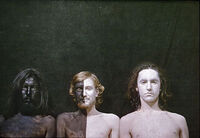
The exhibition I could live in Africa examines the relationship between contemporary art and punk in Poland during the late 1970s and 80s.
The title was taken from the 1983 eponymous documentary film on the Polish punk band Izrael by the Dutch filmmaker and screenwriter Jacques de Koning. In addition to Jacques de Koning’s film, the exhibition will present documentaries and work by Miroslaw Balka, Jozef Robakowski, Darek Skubiel and Michal Tarkowski, among others.
This exhibition was initiated by Nicolaus Schafhausen and is being curated by Lukasz Ronduda and Michal Wolinski. It will be developed in cooperation with Witte de With, Center for Contemporary Art in Rotterdam and is part of a comprehensive exhibition series about moral conceptions and ethics that will be shown in Rotterdam starting september 2009.
For more information please consult the website:
www.ursula-blickle-stiftung.de/en/index.html
Exhibition venue
Ursula Blickle Foundation
Mühlweg 18, D – 76703 Kraichtal -UÖ
Phone +49 7251 60919, Fax +49 7251 68687
Opening hours
Wed. 2 – 5 p.m., Sun. 2 – 6 p.m. and by appointment
Participants
Wiktor Gutt
<div class="
-
PRIXDEROME.NL 2009
Nicoline van Harskamp wins PRIXDEROME.NL 2009
Witte de With and de Appel are pleased to co-host the 2009 PRIXDEROME.NL exhibition, the oldest Dutch state prize for contemporary artists. The exhibition will be held across two different venues.
On view at Witte de With are: Rossella Biscotti, Nicoline van Harskamp, Rob Hornstra, Jasmijn Visser and Helmut Smits.
On view at Westergasfabriek are: Maze de Boer, Heidi Linck, Ólafur Ólafsson i.c.w. Libia Castro, Marc Oosting and Sara Rajaei.
In 2009 the shortlist artists are:
Rossella Biscotti (1978, IT, lives and works in Rotterdam), Nicoline van Harskamp (1975, NL, lives and works in Amsterdam), Ólafur Ólafsson i.c.w. Libia Castro (1973,IS / 1969 ES) both live and work in Rotterdam) and Sara Rajaei (1976, IR, lives and works in Den Haag).
The longlist includes:
Maze de Boer (1976, NL, lives and works in Amsterdam), Rob Hornstra (1975, NL, lives and works in Utrecht), Heidi Linck (1978, NL, lives and works in Wageningen), Marc Oosting, (1976, NL, lives and works in Amsterdam), Helmut Smits (1974, NL, lives and works in Rotterdam), and Jasmijn Visser (1983, NL, lives and works in Utrecht).
The 2009 Prix de Rome exhibition is curated by Sarah Farrar (de Appel) and Juan A. Gaitán (Witte de With). The exhibition will be held across two locations: at Witte de With in Rotterdam and de Appel, as part of a special disembodied programme of activities whilst awaiting its new ‘home’ base, presents an off-site exhibition at the Westergasfabriek (‘Zuiveringshal Oost’)in Amsterdam. Tickets to the exhibition will be valid for both venues.
The winner of the PRIXDEROME.NL 2009 will be announced on 28 May 2009 during an official award ceremony in the Gashouder at the Westergasfabriek in Amsterdam.
The winner is selected from the four shortlist artists by an international jury comprised of Kestutis Kuizinas (LT), chairman, Yael Bartana (IL), Jurgen Bey (NL), Bruce McLean (UK) and Barbara Visser (NL).
A catalogue documenting the work of the ten artists featured in the PRIXDEROME.NL 2009 exhibition, with special attention to the work of the four shortlist artists, will be released on 28 May 2009. It is published by NAi Publishers and will be available from the exhibition venues and selected booksellers.
The PRIXDEROME.NL 2009 is structured as a network organisation by the Rijksakademie van beeldende kunsten, with de Appel and Witte de With as exhibition partners; SNS Reaal Fonds, KPN, MAB Development and INBO, AVRO Kunst as main sponsors; NAi Publishers and Kunstbeeld as media partners; and the Westergasfabriek as a location partner.
It is also made possible by the Dutch Ministry of Culture.
www.prixderome.nl
Practical information:
Date :
9 May – 14 June 2009
Opening :
9 May 2009 at 2 pm – de Appel, ‘Zuiveringshal Oost’, Westergasfabriek, Amsterdam
9 May 2009 at 6 pm – Witte de With, Rotterdam
Award ceremony:
28 May at 4 pm – Gashouder, Westergasfabriek, Amsterdam
The off-site Appel exhibition location:
‘Zuiveringshal Oost’
Westergasfabriek
Pazzanistraat 23
1014 DB Amsterdam
Tel +31 (0)20 6255651
www.deappel.nl
Opening hours: Tuesday – Sunday , 11am – 6pm
(with extended hours during the Holland Festival)
Participants
Rossella Biscotti, Maze de Boer, Libia Castro, Nicoline van Harskamp, Rob Hornstra, Heidi Linck, Ólafur Ólafsson, Marc Oosting, Sara Rajaei, Helmut Smits, Jasmijn Visser
<div class="
-
Billy Apple® A History of the Brand
Witte de With, Center for Contemporary Art, is proud to present the major solo exhibition of Billy Apple®, comprising two parts, A History of the Brand (31 May – 13 September) and Revealed/Concealed (26 June – 13 September). In addition to this major survey, Witte de With will present a new commission in public space by the artist, and a monographic publication titled Billy Apple® as part of Witte de With Publishers’ ongoing Sourcebook series.
A History of the Brand: 1962-2009
Occupying the 3rd floor of Witte de With, this exhibition will present works from Billy Apple®’s inception through to today, tracing a practice that has remained ahead of its time in analysing and incorporating the marketing of art.
Long before the likes of Gilbert & George began their life-long intertwining of art and life, and before Andy Warhol’s self-appointment as the icon of Pop Art, Billy Apple® embarked upon an artistic project that has shaped his practice for five decades. As Christina Barton writes, he has “spent much of his career creating and refining his ‘brand’ as an artistic manoeuvre geared to test the boundaries of art, examine the mechanisms that construct the artist as subject, and expose the value systems in which he and his works are mired”. The culmination of Billy Apple®’s gradual transformation from an individual artist into a brand occurred in 2008, when he succeeded in registering his name as a trademark.
Events
Saturday 30 May 2009
5 – 8 p.m.: Opening A History of the Brand
5 p.m.: Panel discussion “The Artist Has to Live Like Everybody Else” with Billy Apple®, Jan Mot (gallerist, Brussels), Olav Velthuis (writer, Amsterdam), moderated by Nicolaus Schafhausen (curator, director of Witte de With).
Thursday 25 June
5- 8 p.m.: Opening Revealed/Concealed
5 p.m.: Guided tour of the exhibition by Christina Barton (Director of Adam Art Gallery, Wellington) and Wystan Curnow (Professor, University of Auckland)
7 p.m.: Billy Apple® in conversation with David Elliott (artistic director, 17th Sydney Biennial)
Event for and by young people
It’s a new brand world
11-13 September 2009
Publication
The exhibitions will be accompanied by a Source Book, titled Billy Apple®, published by Witte de With Publishers. This English-language monograph will include texts by Christina Barton (Senior Lecturer in Art History, and Director of Adam Art Gallery, Victoria University of Wellington) and Bénédicte Ramade (art critic, L’Oeil, Les Inrocktupibles, Paris), Michelle Menzies (American Field Scholar, PhD candidate at the University of Chicago) and William Wood (Assistant Professor, Art History Faculty, University of British Columbia, Vancouver). Released: September 2009.
Price: 10 euro.
ISBN: 978-90-73362-89-5
Work in public space
The two-part exhibition extends into public space with a billboard commission, created in collaboration with Sculpture International Rotterdam. These two billboards will see Billy Apple®’s designs installed on a large scale, inserting themselves into the visual fabric of the city.
Titles and locations:
The Artist Has To Live Like Everybody Else (c)
Billy Apple®, 1985
location: Opposite Centraal Station Rotterdam, on the corner of Weena and Kruisplein
From the Sculpture International Rotterdam Collection
Billy Apple®, 2009
location: On the corner of Schiedamse Vest and Schilderstraat, on the Herenplaats/MEE Rotterdam building
Click here for map (jpg).
Participants
Billy Apple®
Curators
Zoë Gray, Nicolaus Schafhausen
Supported By
Herenplaats
Laan Irodjojo
Maarsen Groep
Mee Rotterdam
Joost ten Bruggencate and Jeroen Everaert from Mothership
Sculpture International Rotterdam
Creative New Zealand
<div class="
-
 It’s a new brand world
As part of the Rotterdam festival De Wereld van Witte de With 2009 and as the closing event of Billy Apple’s solo-exhibitions A History of the Brand and Revealed/Concealed, Witte de With presents It’s a new brand world – a project by young people for young people. It offers a reflection on the ubiquitous and of-the-moment topic of branding.
Join The Exciting Museum at De Wereld van Witte de With!
Become The Exciting Director of the The Exciting Museum. In order to join the competition: download the job application form, fill in and send it to [email protected] or hand it in on Friday at 5 p.m.
It’s a new brand world presents two alternative spaces on the Witte de Withstraat. Here, they will introduce you to The Exciting Museum, a soon-to-open art institution.
On the agenda are several activities linked to designing the identity of The Exciting Museum. In a photo-booth, you can create a postcard with your self-portrait and choose the ideal location for The Exciting Museum. Additionally, you can act as a curator and decide on The Exciting Collection. The next step is to challenge yourself and participate in the competition to become The Exciting Director. One of the highlights of the program will be the “How to brand yourself” workshop by Neil Taylor, a branding expert from London, who, together with the audience, will explore the art of branding.
With “there are boundaries” as the central topic of the festival, the project aims to question the ‘branded world’ we live in today. The thin line between art and marketing, professional and amateur, fosters a reflection about the new possibilities and challenges for the art world in relation to branding. The direct contact with the festival’s participants and the creation of an interactive and appealing experience will provide the possibility to establish an active dialogue between the audience and the institution, tearing down the boundaries between the visitor and the art world.
It’s a new brand world is: Marijke Appelman, Lola Bezemer, Iwona Lopacinska, Eric Roelen, Coen van de Steen, Weronika Zielinska and Pamela Zúñiga.
The Exciting Museum can be found on both corners of the Witte de Withstraat and Boomgaardstraat. Opening hours are similar to the festival’s: Friday 5 – 11 p.m, Saturday 12 – 11 p.m, Sunday 12 – 6 p.m.
At www.anewbrandworld.blogspot.com the process of exchanging ideas and inspirations can be followed. Become a fan on Facebook.
Corner Witte de Withstraat – Boomgaardstraat, Rotterdam
Participants
Marijke Appelman, Lola Bezemer, Iwona Lopacinska, Eric Roelen, Coen van der Steen, Neil Taylor, Weronika Zielinska, Pamela Zuniga
<div class="
-
Liam Gillick at the German Pavilion at the 53rd Venice Biennale
Liam Gillick will be the artist presented at the German Pavilion during the 53rd Venice Biennale in 2009. The curator of the German Pavilion is Nicolaus Schafhausen, director of Witte de With Center for Contemporary Art in Rotterdam.
Liam Gillick lives and works in New York and London. The artist, who has produced much of his work in Germany, was early to address emergent post-socialist systems and new social models in Europe. His practice represents the ideal projection surface for contemporary art in the twenty-first century. His work operates on several levels of a multi-layered artworld. The theme of his work is the varied phenomena of social utopias that he stages via hypothetical social models, both visual and literary.
Nicolaus Schafhausen: “Through his need to play with the complexity of the contemporary terrain, Gillick has provided models of thought that are not merely binary. He has operated in parallel to known models of work – critic, designer and artist. And this has permitted him to provoke new questions without the necessity to offer simple solutions.”
Liam Gillick: “My work requires a critical terrain that is both sophisticated and skeptical. I view this as a continuation of an ongoing dialogue. The question will be how to produce rather than merely how to present. I operate in the gap between the trajectory of modernity and the modernist self-consciousness. The work is both contingent and specific.”
Liam Gillick and Nicolaus Schafhausen have been involved in a continuous dialogue since the end of the 1980s. Before the Biennale, between November 2008 and May 2009, the artist and curator will collaborate on a number of events that will take place in Germany, Europe and the United States.
In 2008 Liam Gillick has had solo exhibitions in Rotterdam, Zurich and Munich and has forthcoming group exhibitions at the Stedelijk Museum in Amsterdam and The Guggenheim Museum in New York. Next year he will have a solo exhibition at the Museum of Contemporary Art in Chicago.
The exhibition at the German Pavilion is commissioned by the German Foreign Ministry and will be realized together with the Institute of Foreign Affairs (ifa).
Duration of exhibition: 7th June until 22nd November 2009.
www.deutscher-pavillon.org
References
Liam Gillick: Five or Six
Edited by Nicolaus Schafhausen, Frankfurter Kunstverein and Caroline Schneider
2000, English/German, Sternberg Press
ISBN 978-0-9671802-6-7
Also see: Three perspectives and a short scenario, exhibition at Witte de With, 19 January – 24 March 2008.
The German Pavilion
LIAM GILLICK: Artist
NICOLAUS SCHAFHAUSEN: Curator
EVA HUTTENLAUCH: Project Manager
CAROLINE SCHNEIDER: Editorial Advisor
KATHRIN LUZ: Press and Public Relations
NATASA RADOVIC: Venice Assistant
THOMAS HUESMANN, PAUL VAN GENNIP and WITTE DE WITH Center for Contemporary Art: Technical Realisation
Participants
Liam Gillick
Curators
Nicolaus Schafhausen
Network
SpikeMagazine, Volume Magazine
<div class="
-
Billy Apple® Revealed / Concealed
Building upon his exhibition A History of the Brand on the 3rd floor, this reveals a different side to his practice. For this project, Billy Apple® will transform Witte de With’s 2nd floor, as an architectural intervention that continues his ongoing institutional critique.
The second part of Billy Apple®’s exhibition, titled Revealed/Concealed, will open on Thursday 25 June.
5-8 p.m.: Opening
5 p.m.: Guided tour of the exhibition by Christina Barton (Director of Adam Art Gallery, Wellington) and Wystan Curnow (Professor, University of Auckland)
7 p.m.: Billy Apple® in conversation with David Elliott (artistic director, 17th Sydney Biennial)
In 1969, Billy Apple® opened one of the earliest alternative art spaces in New York City, which he called Apple. Created as a showcase for his and others’ work, it developed as an important site for experimental performances and process-based installations, conceptual practices that were not being shown in many institutions or commercial galleries at that time. For example, Billy Apple® began a series of cleaning works that he classed as ‘subtractions’, activities that he documented in photographs.
It was also within this context that Billy Apple® started to make works that highlighted their physical context, site-specific installations that revealed the ‘givens’ of the architectural space. These evolved into a body of works called Censure, in which he marked red those aspects of a gallery that he found unacceptable, just as a proof-reader marks up a text for correction. The artist would then give the owners of these spaces the option of correcting the flaws, leaving his red marks in place, or painting them over and reinstating the status quo.
At Witte de With, Billy Apple® is carrying out a subtraction on a major scale. He has asked the institution to remove the kitchen and storage space from the 2nd floor galleries, functional spaces that had become almost invisible components to those of us working in the building. Revealing the previously hidden spaces inside these two symmetrical units, he is also making other aspects of the floor more symmetrical, by covering the windows on the south side of the building, restoring the ‘white cube’ to its purest form. Finally, he is opening up the covered windows at the east end of the building to create an axis of light along the length of the space.
Having ‘corrected’ the imperfections of Witte de With’s galleries, Billy Apple® will install a selection of related works – dating from 1960 to today – in these newly improved spaces.
Event
It’s a new brand world
Event for and by young people
11-13 September 2009
More information to follow.
Publication
The exhibitions will be accompanied by a Source Book, titled Billy Apple®, published by Witte de With Publishers. This English-language monograph will include texts by Christina Barton (Senior Lecturer in Art History and Director of Adam Art Gallery, Victoria University of Wellington) and Bénédicte Ramade (art critic, L’Oeil, Les Inrocktupibles, Paris), Michelle Menzies (American Field Scholar, PhD candidate at the University of Chicago), and William Wood (Assistant Professor, Art History Faculty, University of British Columbia, Vancouver). Released: September 2009.
Price: 10 euro.
ISBN: 978-90-73362-89-5
Work in public space
The two-part exhibition extends into public space with a billboard commission, created in collaboration with Sculpture International Rotterdam. These two billboards will see Billy Apple®’s designs installed on a large scale, inserting themselves into the visual fabric of the city.
Titles and locations:
*The Artist Has To Live Like Everybody Else (c)
Billy Apple®, 1985
location: Opposite Centraal Station Rotterdam, on the corner of Weena and Kruisplein
*From the Sculpture International Rotterdam Collection
Billy Apple®, 2009
location: On the corner of Schiedamse Vest and Schilderstraat, on the Herenplaats/MEE Rotterdam building
Participants
Billy Apple®, Christina Barton
Curators
Nicolaus Schafhausen, Zoë Gray
Supported By
Herenplaats
Laan Irodjojo
Maarsen Groep
Mee Rotterdam
Joost ten Bruggencate and Jeroen Everaert from Mothership
Sculpture International Rotterdam
Creative New Zealand
<div class="
-
Billy Apple® Work in public space
Through September 13, 2009, Witte de With presents a major solo exhibition by Billy Apple®. Comprising two parts, A History of the Brand and Revealed / Concealed, the exhibition extends into public space with two billboard commissions of Billy Apple®’s works. These large-scale works insert themselves into the visual fabric of the city through September 13.
Billboard installations are not new in the artist’s practise, in which the use of conventional marketing strategies within art has always been of central importance.
The proposition THE ARTIST HAS TO LIVE LIKE EVERYBODY ELSE functions as a statement in public space, claiming both the work’s and the artist’s rights to integrate into the reality of socio-economic structures.
Formulated and displayed for the first time during the economic boom of 1985, this statement has kept its relevance in a variety of different contexts. In 1991 it appeared as a running text on an outdoor electronic signboard, placed on the façade of the Bank of New Zealand’s (BNZ) office in Auckland. It reappeared in 1993 on the back cover of The National Business Review, linking the art of business with the business of art. By 1993 the artist had attached this statement to his Paid series. In this ongoing project, Billy Apple® offers for payment the invoices that he has received for a range of purchases from his day-to-day living. The collector pays the invoice and then receives it framed and mounted on a form titled Paid with the words ‘The artist has to live like everybody else’ written underneath. In these, Billy Apple® shortcuts the usual processes of making art, earning money and spending it. (These works are on show at Witte de With).
The second billboard incorporates aspects of the Billy Apple® brand with those of the collection of Sculpture International Rotterdam. Running down the face of a building on the Witte de Withstraat, this text-based work is presented like a rolling advertisement that has been halted for a moment in time.
FROM THE SCULPTURE INTERNATIONAL ROTTERDAM COLLECTION is drawn from Billy Apple®’s From the Collection series. In this series the tradition of the painter portraying his patron is updated, conceptualized and rendered in strong graphic form, becoming an alternative, knowing, but still respectful portrait of its owner. These works raise questions about the symbolic value of buying art, the self-aggrandizing of owning ‘a collection’, and the artistic motivation behind such a work’s creation.
Related works from the From the Collection series are on view at Witte de With.
Locations
The Artist Has To Live Like Everybody Else (c)
Billy Apple®, 1985
location: Opposite Centraal Station Rotterdam, on the corner of Weena and Kruisplein
From the Sculpture International Rotterdam Collection
Billy Apple®, 2009
location: On the corner of Schiedamse Vest and Schilderstraat, on the Herenplaats/MEE Rotterdam building
Participants
Billy Apple®
Curators
Nicolaus Schafhausen, Zoë Gray
Supported By
Herenplaats
Laan Irodjojo
Maarsen Groep
Mee Rotterdam
Joost ten Bruggencate and Jeroen Everaert from Mothership
Sculpture International Rotterdam
Creative New Zealand
<div class="
-
Act I: Beautiful from Every Point of View
Morality will be inaugurated by two initial acts, proposed as a parallel situation between interrelated statements about our relationship to the world and to images.
Act I: Beautiful from Every Point of View
10 October 2009 – 10 January 2010
Act II: From Love to Legal
10 October 2009 – 7 February 2010
Opening on Friday 9 October, 7 – 9 p.m.
Performance by Spartacus Chetwynd, btwn 7 – 9 p.m.
Act I: Beautiful from Every Point of View explores the gray space that we inhabit between images and power. Act I’s title derives from Horace’s famous aphorism of the first century BCE, “nothing is beautiful from every point of view.” Not so long ago, this statement would have seemed absurd, given the Enlightenment idea that Truth and Beauty arrive together. Today, however, Horace’s sentence is little more than a platitude, increasingly deployed in a rhetoric in which any point of view, and any action, can find its justification merely in its right to exist.
Beautiful from Every Point of View is a group exhibition that brings together a selection of works that refuse to assert an immediate, self-evident point of view on the subjects they represent. The works range from poignant simulations of the capitalist sublime, to humorous commentaries on the relationship between struggle and power.
Featured artists
Philip-Lorca diCorcia, Marko Lulic, Kris Martin, Josephine Meckseper, Sarah Morris, Ron Terada, Tobias Zielony, Artur Zmijewski.
The Triumph of Death and King Midas
Friday 9 October, 7 – 9 p.m.
Performances by Spartacus Chetwynd
Spartacus Chetwynd (London, 1973) gained recognition with her baroque, musical and surreal performances featuring humorous image quotations from art history, literature linked to pop and folktales. The performance or two mimes entitled The Triumph of Death and King Midas are performed by the accompanying band the Princes in the Tower, and together they will perform the narratives from Cautionary Tales.
This is the first project to be developed in the framework of a performance cycle that culminates in 3 days of stage events in the Spring of 2010.
Program curated by Renske Janssen.
Free Guided Tours
(NB not for groups)
Every Wednesday at 3 p.m. by a staff member (in English/Dutch) – FREE (excl. entry price)
Every Sunday at 3 p.m. (in English/Dutch) – FREE (excl. entry price)
For other guided tours
For groups (10 and up)
On other days / times
In other languages (Arabic, English, French, German, Polish, Spanish)
Upon request and payment – 60€.
More information and contact via +31 (0)10 4110144 or by e-mail: [email protected].
Participants
Philip-Lorca DiCorcia, Marko Lulic, Kris Martin, Sarah Morris, Ron Terada, Artur Zmijewski
Curators
Nicolaus Schafhausen, Juan A. Gaitán
Network
MAMbo, MMK Museum für Moderne Kunst
<div class="
-
Act II: From Love to Legal
Morality will be inaugurated by two initial acts, proposed as a parallel situation between interrelated statements about our relationship to the world and to images.
Act I: Beautiful from Every Point of View
10 October 2009 – 10 January 2010
Act II: From Love to Legal
10 October 2009 – 7 February 2010
Opening on Friday 9 October, 6 – 9 p.m.
Performance by Spartacus Chetwynd, btwn 7 – 9 p.m.
Act II: From Love to Legal reveals the different forms that the gray area that we inhabit between images and power may take. Exploring references to biographical, anecdotal, personal and factual histories, with Act II we want to suggest a cyclical trajectory that originates in private life, in a space and a time in which, in Barthes’ words, one “is not an image, an object”. Does this mean that there is a space and a time in which we are able to remain outside the spaces of power, truth, and morality?
From Love to Legal brings together a selection of contemporary artworks that confront such oppositions between anecdotal and factual, personal and historical, making it problematic for us to separate desire from even the most ascetic relationship to the world.
Featured artists
Isa Genzken, Joachim Koester, Christodoulos Panayiotou, Isabelle Pauwels, Mark Raidpere, Tobias Rehberger, Nedko Solakov, Danh Vo, Peter Wächtler, Katarina Zdjelar.
The Triumph of Death and King Midas
Friday 9 October, 7 – 9 p.m.
Performances by Spartacus Chetwynd
Spartacus Chetwynd (London, 1973) gained recognition with her baroque, musical and surreal performances featuring humorous image quotations from art history, literature linked to pop and folktales. The performance or two mimes entitled The Triumph of Death and King Midas are performed by the accompanying band the Princes in the Tower, and together they will perform the narratives from Cautionary Tales.
This is the first project to be developed in the framework of a performance cycle that culminates in 3 days of stage events in the Spring of 2010.
Program curated by Renske Janssen.
Free Guided Tours
(NB not for groups)
Every Wednesday at 3 p.m. by a staff member (in English/Dutch) – FREE (excl. entry price)
Every Sunday at 3 p.m. (in English/Dutch) – FREE (excl. entry price)
For other guided tours
For groups (10 and up)
On other days / times
In other languages (Arabic, English, French, German, Polish, Spanish)
Upon request and payment – 60€.
More information and contact via +31 (0)10 4110144 or by e-mail: [email protected].
Participants
Christodoulos Panayiotou, Nedko Solakov, Danh Vo, Peter Wächtler, Katarina Zdjelar, Isa Genzken, Isabelle Pauwels, Mark Raidpere, Tobias Rehberger
Curators
Nicolaus Schafhausen, Juan A. Gaitán
Supported By
Danish Arts Council
Cypriot Ministry of Culture
<div class="
-
MORALITY
Witte de With is pleased to present Morality.
While there are certain moral principles that are usually unquestioned (the right to life, for instance), morality remains ambivalent and amorphous in terms of the principles it provides for humans acting in the world. It is these amorphous areas, these gray zones, that this project seeks to address, particularly in how they form a difficult aspect of our reality today.
Morality is an invitation to reflect and debate situations in contemporary life that refuse clear distinctions between right and wrong, what is and what ought to be. As a whole, the Morality project has been defined by a desire – inherent to contemporary art – to open spaces for active, engaged forms of spectatorship that are not pre-determined by either moral or ideological imperatives.
Morality is a provocative theme, especially in a world that is now determined by the experiences of war, displacement, political and economic crises, the rise of religious stereotypes, and the radicalization of seemingly old doctrines and ideologies. Morality is also a broad subject that affects everybody in many different ways. From the bathroom to the parliament, there is a total field of social engagement in which morality functions without boundaries, between a set of abstract, intangible and general ideas. Morality is neither a base nor a superstructure, but a smooth network of influences that operates outside the law, governing both regulated and unregulated social spaces, and affecting daily lives in subtle, seductive, unexpected ways. Yet, there is not a unique or purely affirmative sense that one can give to this notion. A number of moral attitudes – often at odds with one another – inform the positions that, as political subjects, we assume vis-a-vis the events that take place in our world.
Seemingly simple, but also disturbingly difficult to grasp, morality is an ideal leitmotiv for a project that seeks to explore critical points of fragmentation in everyday life. Rather than presenting statements that can be perceived as being right or wrong, good or evil, the projectMorality will create a space for showing a wide range of attitudes that problematize a total conception of morality, focusing on the less tangible forces and attitudes that shape common thinking and behavior.
The year-long Morality program at Witte de With is structured as a series of interrelated acts that began in the Fall of 2009 and will run until November 2010. Online visitors may also participate by contributing to the web-platform. The Morality project has included six in-house exhibitions, the exhibition Nether Land at the Dutch Culture Centre for the Shanghai World Expo, a film cycle, a performance program, and facade projects by the Russian collective AES+F, Isa Genzken and Maider López. The current facade project by Ayse Erkmen is titled 15-5519.
Curators
Juan A. Gaitán, Nicolaus Schafhausen, Amira Gad
Supported By
Morality is generously supported by the Mondriaan Foundation and SNS REAAL Fonds.
<div class="
-
ACT IV: I Could Live in Africa
I Could Live in Africa is the fourth act in the year-long project Morality, organised by Witte de With.
It is the first exhibition of Morality that looks at the past and highlights the attitude of artists, choosing to be active as groups rather than individuals, with the aim of resisting an hermetic, authoritarian social and political system. The exhibition presents a variety of practices emblematic of a hidden movement that was driven by the need to open a different space from the moral and aesthetic cultural standards prevailing in Poland under and after martial law (December 13, 1981 to July 22, 1983).
Borrowing its title from Dutch filmmaker Jacques de Koning’s documentary on the Polish post-punk and reggae band Izrael, I Could Live in Africa explores the mood shared by the “new wild” artists and the music subcultures (punk, new wave, reggae) in 1980s communist Poland. Determined by a gloomy political and economic context, this mood translated into an eruption of subcultures that managed to circumvent both the limited means of production and the monopoly the ruling regime over publishing and recording. These subcultures thrived against a background of police brutality, closed borders, empty shops, and frequent power shortages. Their aesthetic weapons included anti-regime stencils and graffiti, safety pins, wildly expressive and primitive forms, assemblages of waste and detritus, collages, concerts that turned into ecstatic group rituals, opening receptions that morphed into improvised happenings and zines. Though the times were hardly “funny”, these cultural manifestations were infused with humour, openly sneering at the system and contemptuous of totalitarian propaganda, the lack of democracy, the naivety of mass media, the Church and cultural hypocrisy in general.
While the punk movement of the West was brandishing it’s slogan, no future, the Polish punk artists were deeply invested in a better future. Far from consuming a trend or criticizing from the premises of capitalism, these artists created not only a resistance to what existed but room to exist differently. Inspired by the Rasta philosophy, which pronounced the fall of Babylon, what drove these artists above all was an impulsive energy and a hunger for freedom.
Participants
Mirosław Bałka, Krzysztof Bednarski, Miroslaw Filonik, Wiktor Gutt, Jacques de Koning, Zbigniew Libera, Luxus, Wlodzimierz Pawlak, Waldemar Raniszewski, Josef Robakowski, Darek Skubiel, Marek Sobczyk, Jerzy Truszkowski, Zdzislaw Zinczuk
Curators
Michal Wolinski, Nicolaus Schafhausen, Anne-Claire Schmitz
Network
BWA Wroclaw, Museum of Modern Art Warsaw
Supported By
The Mondriaan Foundation and SNS REAAL Fonds.
<div class="
-
ACT V: Power Alone
Power Alone is Act V of the year-long program Morality at Witte de With. Like Act IV, I could live in Africa the opening is on Friday 19 February 2010 at 6 p.m. Both exhibitions run until 25 April 2010.
This group exhibition starts from the premise that power operates and is made tangible in the encounter between the general (society, morality, history, gender) and the particular (the individual). Power, as we understand it today, is the moment in which the individual experiences the process of becoming a subject, a member of her or his society through encounters with others and with the law. As power is something that is experienced, it has no aesthetic value in the traditional sense; it is, however, integral to what Jacques Ranciere calls “the distribution of the sensible”. This is one way in which this exhibition engages with the notion of power.
But Power Alone also proposes a more fictive narrative, linked to the myth of Narcissus, a myth that perhaps represents the desire inherent in the discourses on power. Like Narcissus, the Greek hero renowned for his beauty and for his cruelty towards those who love him, the abstract notion we call power would be condemned to become infatuated with itself, perishing by love with its own semblance. Taking Narcissus as the personification of power, this exhibition presents a series of hypothetical scenarios on power’s withdrawal from class, gender, race and its inscription in two opposing forms: the individuated body and the mythological world. The works included engage with the cleft between power as a general force and solitude as a state of mind, between power as the name we give to structures that regulate our everyday lives, and individuated encounters with these structures. The exhibition presents a number of different guises and forms of power, from concrete to abstract, in the socially conditioned world, as in Canan Senol’s Exemplary or Mark Boulos’ All that is Solid Melts into Air. Works such as Goshka Macuga’s On The Nature of the Beast tease power relations out of specific situations; whilst Miki Kratsman’s photographs, Ziad Antar’s videos, or Luc Tuymans’ paintings indicate spaces that can no longer be experienced outside of the structures of power.
Participants
Adel Abidin, Ziad Antar, Mirosław Bałka, Mark Boulos, Piero Golia, Jaebum Kim, Miki Kratsman, Erik van Lieshout, Goshka Macuga, Randa Mirza, Willem de Rooij, Canan Senol, Andreas Slominski, Corin Sworn, Ron Terada, Luc Tuymans
Curators
Juan A. Gaitán, Nicolaus Schafhausen, Amira Gad
<div class="
-
ACT VI: Remember Humanity
Witte de With is pleased to present two upcoming exhibitions in the Morality program begun in the Fall of 2009: Act VI: Remember Humanity, and Act VII: Of Facts and Fables. They open simultaneously on 12 May. Act VI runs until 29 August and Act VII continues until 26 September 2010.
Many of the themes that have dominated contemporary political thought point to the ominous view that ‘humanity’ has become an historical subject, no longer essential to contemporary economic and political considerations. For instance, the notion of ‘bare life’ taken up by Giorgio Agamben, suggests a bankruptcy of the human rights charter in terms of humanity’s capacity to hold to its principles of freedom and equality. The notion of ‘immaterial labor’ most famously developed by Maurizio Lazzarato, indicates a further alienation of the world from its material fabric and concrete foundations. The imperative suggested in the title of this exhibition, to ‘remember humanity,’ is therefore an allusion to a present condition in which humanity has become an historical subject rather than part of our objective reality.
The exhibition Remember Humanity starts from this hypothesis and includes the work of artists who approach ‘our’ present as a field on fragmented existences and isolated interests. Together, these works provide a partial sense of how the construction of the world and the construction of the idea of humanity are mutually conditioned. The works here included do not set out to affirm ‘humanity’ in a nostalgic way or attempt to ‘retrieve’ it from the record of lost ideas. More central to the logic of these works is an examination of how the notion of human is constructed in opposition to the animal, to madness, to the idea of the primitive, in contraposition to War and also in the affirmation of ‘labor’ and ‘consciousness.’
Participants
Julieta Aranda, Mirosław Bałka, Milena Bonilla, Lee Bul, Luke Fowler, Kent Monkman, Christodoulos Panayiotou, Michael Stevenson, Rosemarie Trockel, Julika Rudelius
Curators
Juan A. Gaitán, Nicolaus Schafhausen, Amira Gad
Supported By
Fonds BKVB; Creative New Zealand; and Cyprus Ministry of Culture.
<div class="