-
Afra Eisma: Poke Press Squeeze Clasp
Using craft techniques in novel ways, Afra Eisma explores and manifests personal stories through immersive and intimate installations made of textiles, sculptures, ceramics, and sound. Born and based in the Netherlands, inspiring her works are characters or imaginary friends that interweave sensuality with an intended lightheartedness. For 84 STEPS, the artist presents a specially commissioned environment designed to hold a variety of social activities, ranging from large-scale workshops to intimate conversations and educational activities. Responding to an increasing experience of uneasiness, isolation, and uncertainty, towards anything deemed extraneous to our familial environment, Eisma seeks to appease these maladies by fostering mutual understanding and shared experience through art.
Drawing on literature by influential female authors—amongst them, Audre Lorde and Ursula K. Le Guin—the artist interweaves characters drawn from her imagination with ideas provoked by their writing. Seeking to imbue the gallery with a certain liveliness and informality, Eisma creates a convivial gathering amongst alien beings, delighting in pleasures we are not yet able to amidst the pandemic, that of physical proximity, assembly, and embrace. Gathered around a floor tapestry, various environments are invoked; the domestic setting of a lounge or perhaps an outdoor campfire. Interlaced are a series of vessels: those figured within Eisma’s textile pieces, created from terracotta, and inferred by sound. The artist draws on the vessel as both a carrier and agent of imagination, thought, and feeling.
The artist would like to thank Mechteld Jungerius, who assisted in the making of the installation; Marnix van Uum, editor of the audio-work; and Nadie Borggreve, unofficial Head of the Alien Fashion Department.
Participants
Afra Eisma
Curators
Rosa de Graaf, Sofía Hernández Chong Cuy
Series
84 STEPS
<div class="
-
THE ORGAN
THE ORGAN is a playful space on the first floor, where we collect tactile and visual source materials from artworks presented in our exhibitions.
In THE ORGAN, visitors can immerse themselves in the practices of the exhibiting artists, engage with their materials, and learn about their thematic concepts and research frameworks.
Currently, THE ORGAN presents materials and sources connected to our ongoing exhibitions by Hajra Waheed, Basel Abbas and Ruanne Abou-Rahme, Riet Wijnen, AYO, Bani Abidi, Cinthia Marcelle, Felipe Mujica, Misheck Masamvu, Nohemi Perez, and Thierry Oussou
The materials and sources shown in THE ORGAN in 2025 were contributed by the artists exhibiting with us: donna Kukama, Marilyn Nance, Liz Johnson Artur, Madiha Sikander and Zara Julius, Cihad Caner, Jabu Arnell, Luana Vitra, Nolan Oswald Dennis and Sara Sejin Chang (Sara van der Heide), Ola Hassanain, Simnikiwe Buhlungu, and Paulo Nimer Pjota. In addition, materials related to the exhibition 35 Years Minds and Matter were presented.
Alongside source materials, artist-recommended books are displayed and available for purchase in our bookshop on the ground floor.
Participants
Hajra Waheed, Basel Abbas & Ruanne Abou-Rahme, Riet Wijnen, AYO, Bani Abidi, Cinthia Marcelle, Felipe Mujica, Misheck Masamvu, Nohemí Pérez, Thierry Oussou, donna Kukama, Marilyn Nance, Liz Johnson Artur, Madiha Sikander, Zara Julius, Cihad Caner, Jabu Arnell, Luana Vitra, Nolan Oswald Dennis, Sara Sejin Chang (Sara van der Heide), Ola Hassanain, Simnikiwe Buhlungu, Paulo Nimer Pjota
Curators
Gabi Ngcobo
<div class="
-
Guillaume Bijl: Für Garderobe keine Haftung
Guillaume Bijl’s Für Garderobe keine Haftung was Witte de With’s opening exhibition. In light of the newly created exhibition space at Witte de With, Bijl’s show could be seen as a critique of the spectacular and inflationary nature of fine art production as well as an ironical poke at the profusion of exhibitions and exhibition spaces. Guillaume Bijl’s exhibition at Witte de With presented a survey of his installations and objects from the eighties, in the form of a shopping mall.
Belgian artist Guillaume Bijl (1946) has been testing the relationship between art and consumer society since 1979, when he made his Art Liquidation Project. This work took the form of a mock government commissioned report in which he concluded that, in light of the proven uselessness of art, all areas devoted to the arts should be made suitable for more practical purposes. Since then, Bijl has been transforming museums and art galleries into fitness centers, lamp shops, carpet stores, travel agencies, driving schools, and so on. His imitations of spaces not traditionally associated with the arts are caught up in a perplexing interplay between fiction and reality. Even more confusion is caused by Bijl’s imitations of art spaces, such as his fictive exhibition Four American Artists (1987), or his fictive commercial fair installed at the art fair of Lyon in 1986, which also included an art store selling his paintings.
Bijl ironically points out the connection between the display of goods in shop windows and showrooms and the exhibition of objects in museums and galleries. In his installations, consumer items and museum objects seem interchangeable. Bijl’s logic assumes the complete abolition of real differences in the commercial rhetoric of consumer society.
Participants
Guillaume Bijl
Curators
Gosse Oosterhof
<div class="
-
Domenico Mangano & Marieke van Rooy: Dilution Cafeteria
The work of artist duo Mangano van Rooy is characterized by a combination of archival and field research and artistic practice. Micro-stories, and political and architectural constructions of the social, as well as research into the history of the local, forms the basis of their artistic inquiry. Combining archival research with educational projects, their work manifests across numerous mediums, including film, installation, photography, drawing, performance, and publications. Based in Amsterdam, the duo was formed in 2014. Before that, Italian born Domenico Mangano practiced as an artist since the late nineties, and Netherlands-born Marieke van Rooy developed a background in academia, with a focus on the political history of the built environment.
For 84 STEPS, the duo presents a newly commissioned work, the Dilution Cafeteria. The commission marks the latest iteration in their long-term series, The Dilution Project. Begun in 2014, this project centers on the subject of anti-psychiatry and the related democratic movement that unfolded during the 1970s in the Netherlands. The artists investigated what came to be known as the Nieuw Dennendal experiment, developed by psychologist Carel Muller in collaboration with the progressive architect Frank van Klingeren. Underpinning the experiment was the utopian notion of ‘dilution’. At its heart, was Muller’s insistence on the need to re-conceive the spaces and systems of psychiatric care to allow for the intermingling of in-patients with the local communities they were surrounded by. Faced with resistance on numerous counts, the experiment was never realized.
Their latest iteration, Dilution Cafeteria, develops a new facet of research into the concept of the ‘sensory cafeteria’. Developed in the United States in the 1960s, sensory cafeterias were designed as spaces in which to engage all the senses. Sited within care institutions, they were intended as environments in which to research in-patients with an “intellectual” disability. A decade later, the concept of these settings was employed in the Netherlands, adapted to focus on the positive effects of sensorial stimulation as opposed to operating as a site of scientific research. These were referred to as snoezelruimtes, which, to this day, the Netherlands takes a pioneering role internationally. Presented here, Mangano van Rooy seeks to borrow from this concept an emphasis on the way in which knowledge and experience is socialized through the senses. Comprising a cumulative installation of six glazed ceramic sculptures, and a charcoal mural in which a megaphone is incorporated, the installation presents complex inner labyrinths, which the artists’ refer to as “mental architectures.” Varying in color, form, and texture, the sculptures act as intermediaries, marking the occasion upon which the senses are registered. Over the course of the year, the installation will come to be activated in its capacity as a sensorial cafeteria, with special emphasis on sound and touch.
The artists would like to thank Sundaymorning@EKWC, Oisterwijk, where the glazed ceramics were produced in residence and Stichting Stokroos for their financial support.
Participants
Domenico Mangano & Marieke van Rooy
Curators
Rosa de Graaf, Sofía Hernández Chong Cuy
Series
84 STEPS
<div class="
-
Space for Education and Participation
A New Space for Education & Participation
We are proud to announce the brand-new Education & Participation Space at Kunstinstituut Melly: a vibrant and flexible environment dedicated to learning, meeting, creativity, and community exchange. Situated on the ground floor of our building, this space is designed as a visible and active pillar of our institution, ensuring that education, knowledge sharing, and collective learning remain central to our mission. Whether you’re a child, student, artist, educator, or visitor, this is a space for curiosity, care, and connection.
Holiday Passport 2026 - Doing as Drawing
Join us this summer at Kunstinstituut Melly and discover the many possibilities of thinking through drawing. From 18 July to 30 August, children aged 4 to 12 can take part, free of charge, alongside their parents or carers, in an adventurous art programme full of play, imagination and discovery.
Free Saturday Workshops & Collective Learning
Since the opening of our Education & Participation Space, Kunstinstituut Melly has become a lively setting for workshops, talks, and collective learning. Artists, educators, and participants of all ages and backgrounds come together to explore creativity as a shared, evolving practice.
Our Saturday workshops provide a space for experimentation and connection. In January 2026, during Nurdan Ariöz’s workshops, participants engaged with storytelling, visual arts, color, drawing, writing, and movement, contributing to a collective story archive: a living artwork that preserves each person’s presence and voice. In February 2026, during Sabrina Schoop’s workshops in Poetic Diaspora, participants explore language, words, and personal memories, creating poetic fragments that weave together identity, memory, and multilingual expression. In March 2026, the workshop series Tip of the Tongue, led by Veronika Babayan, explores multilingualism, migration, and memory through dried fruit. Participants create fruit chains inspired by expressions from different languages, reflecting on care, loss, humour, and change. Language becomes something you can see, touch, and assemble. Come experience a language that cannot be expressed in words! Nurdan Ariöz led the free Saturday workshops in April 2026. What You Haven’t Said Yet was an open spoken word workshop in which personal stories were made visible through image, text, and voice. The workshop series consisted of three sessions that could be followed independently, in which participants explored different ways of writing: from collage, from a personal object, and through an ode to an unseen talent. During the Saturday workshops in June, led by Thijmen Burgerhout, participants create race numbers, banners, medals and trophies that celebrate non-performance – something of great value, particularly in today’s results-oriented society, where speed, productivity and visibility take centre stage. In a playful, sporty setting, the pressure to perform is turned on its head, creating space for doubt, calm and the rediscovery of one’s own worth and meaning. In July, Conform Cox will host a series of three free Saturday workshops where we’ll draw, imagine, and rethink the world around us, taking inspiration from the exhibition Draw Withdraw Redraw. Each workshop explores a question related to improving our everyday lives. In the first workshop, we’ll reimagine the human form; in the second, we’ll rethink our own living spaces; and in the third, we’ll turn our attention to Rotterdam. The workshops are part of Holiday Passport 2026 – Doing as Drawing. The second Free Saturday Workshop series of Holiday Passport 2026 – Doing as Drawing – will be hosted by Carmen José this August. In Emotional Trees in a Collective Forest, we will explore drawing beyond the academic canons of control and violence over the course of two Saturdays. Together, we will create a vibrant forest on large textiles, culminating in a collective installation hanging from the ceiling. The final free Saturday workshops as part of Holiday Passport 2026 – Doing as Drawing will be led by Elina Charinti. Cultivating Acts of Courage is a series that explores courage as a way to move forward, to refuse to conform and to find new paths. Using felt, drawings and natural materials, participants reflect on memories, values and communities, and create tangible objects that embody courage, resilience, care and hope. Courage becomes something that can be made, seen and touched! During the free Saturday workshop series in September, What comes to mind when I say…?, we’ll be exploring drawing with Jip van der Hek as a way of leaving our mark whilst also making space for others. Drawing together creates a constant interplay between the individual and the collective. How can we develop a visual language that does justice to the complexity of the city, where people and animals, visibility and invisibility, and different perspectives come together?
CLiP #7: The Garage School of Prepping Otherwise
Collective Learning in Practice (CLiP) is the successor to Kunstinstituut Melly’s successful Work-Learn Project (2018) and has run six editions to date. CLiP gives participants the opportunity to study contemporary art issues and work with our team to make the institution more publicly accessible. Each edition supports 10–14 young participants with the tools, skills, and inspiration to grow as individuals, decision-makers, and professionals through a six-month study period. This year, CLiP returns with its seventh edition: The Garage School of Prepping Otherwise. Over six months (October 2025 – March 2026), a group of Rotterdam-based participants aged 17–24 is exploring what it means to survive together in times of global crises, militarisation, and social inequity.
Curators
Emilia Aivazian, Camille de Bruin
Series
Collective Learning, CLIP, Tools for Collective Learning, TRAININGS, Workshops and Collective Learning, Monthly Open CLiP Sessions
<div class="
-
John Knight — Some Works
The exhibition Some Works comprised 15 works by John Knight, made between 1969 and 1990, including Levels and The Journal Series.
Since 1969, American artist John Knight (1945) has concentrated on the relationship between architecture, design and art. He bases his work on the interplay between the material object and its contextual conditions, and comments on the meaning of cultural object and cultural space by employing strategies that invert the conventions of production and reception.
Knight’s early sculptural work, such as Levels (1969), deliberately set itself apart from the innovations of the early sixties of such Minimal artistsas Carl Andre, Dan Flavin and Sol LeWitt. Consisting of carpenter levels arranged on the floor, Levels referred to the basic, reduced shapes of Minimal sculpture, and at the same time engendered an interchange with its physical setting. Employing actual tools of representation as well as of construction, Knight’s works do not merely refer to their site. They incur an overt dialogue with their site, providing a reading of the one in terms of the other.
By the second half of the seventies, Knight extended the concept of location to a consideration of the work’s place within a cultural system. He started investigating representational systems in conjunction with art and non-art support systems. The Journal Series (1978), for example, transformed a non-art object, a magazine, into one that could gain artistic status in a specific artistic context. In this project, Knight mailed 100 gift subscriptions of glossy popular journalsm to friends and acquaintances. The recipient determined whether his subscription was art, interpreting it either as a work by Knight or as an ordinary magazine. With The Journal Series, Knight re-presented existing, non-art representations within the framework of art in order to explore the point at which art and non-art systems overlap, and to investigate the factors that determine an object’s status and worth.
Participants
John Knight
Curators
Chris Dercon
<div class="
-
Feminist Health Care Research Group: A Special Issue in Power
Founded in 2015, the Berlin-based Feminist Health Care Research Group (FHCRG) has focused on collective ways of dealing with crisis and mutual care structures. FHCRG currently consists of the artist, bodyworker, and mother Julia Bonn, and artist, curator, care-assistant, and mother Inga Zimprich. With a strong research-based social practice, they are interested in the political meanings of illness and aim to politicize health care systems.
For 84 STEPS, artist Inga Zimprich of FHCRG presents a newly commissioned work centering around Radical Therapy (RT). Developed in the late 1960s by therapists and activists in the United States, RT was a movement that sought to democratize and de-professionalize therapeutic tools as a means for social empowerment and political change. Their primary node of dissemination was the newspaper The Radical Therapist. By initiating problem-solving groups for women, Marxist feminist Hogie Wyckoff developed a framework that aimed to challenge sexism at the outset of Radical Therapy groups. In 1975 the feminists Gail Pheterson and Lillian Moed facilitated three-week-long training sessions for groups of Dutch feminists in the Netherlands. Pheterson and Moed combined two different methods in these workshops: RT and Re-evaluation Counseling. From these initial trainings, Feministische Oefengroepen Radikale Therapie (FORT) emerged, forming a grassroots movement of feminist RT exercise groups that grew in numbers in the Netherlands.
Zimprich’s display unfolds through a studious environment for contemplation, interweaving historical footage from RT and FORT, including interviews with its early protagonists as well as contemporary practitioners. Tracing the development of FORT, Zimprich invites the public to consider methods of political and intersectional analyses that could revive RT practices today.
This installation was made possible courtesy of Collection IAV-Atria, Institute on Gender Equality and Women’s History.
Participants
The Feminist Health Care Research Group (Inga Zimprich)
Curators
Rosa de Graaf, Sofía Hernández Chong Cuy
Series
84 STEPS
<div class="
-
Riet Wijnen: Suitcase Economy
With Linda van Deursen, Waysatta Fernández with Salvador Núñez from Mono Rojo, Fat Crayon Creative/Jari Nuno, Ima-Abasi Okon, and Jan Wijnen.
Suitcase Economy is the third edition of Tools for Conviviality, a framework in which we continue our work of reimagining our MELLY ground-floor bookstore, café, and event space as a welcoming, free, social area. With evolving artistic interventions, the space invites gathering, listening, meal-sharing, conversing, and creating together.
An experimental canteen, Suitcase Economy, is a year-long project developed by artist Riet Wijnen in collaboration with fellow artists, designers, and family. The project is shaped by the movement of produce carried in suitcases from one place to another, inspiring a bartering of food products whose lifespan is extended through methods of fermentation or preservation. During workshops and study sessions, these processes of transformation will be extrapolated to think about history, territory, and health.
A yellow triangular structure cuts the canteen into sixteen lines. The structure is inspired by Riet’s ongoing series Sixteen Conversations on Abstraction, a project that investigates overlooked and not yet known histories of abstraction. In this series, location is represented by yellow, while time is depicted by green.
The stackable sculptural tableware relates to the practice of the late Lebanese artist Saloua Raouda Choucair (1916-2017). Riet embodies formal aspects and methodologies that Choucair applied in her work. She is interested in how the
omnipresent traditions of fermentation and preservation extend the lifespan of agricultural products, and what this teaches us about the maintenance of histories across time and place.
Rotterdam-based fashion brand Fat Crayon Creative transformed the Boomgaardsstraat window into a ‘backdoor’ of Suitcase Economy, similar to how informal economies avoid super-markets and customs. The canopy welcomes the relations and economies moving into the space. Designed by Linda van Deursen, the labels, recipe cards, and a bag with credits documenting these informal networks as they are developing over time.
Waysatta Fernández created drawings for the canteen’s fermentation pots, thrown by Salvador Núñez from Mono Rojo. The drawings extend Waysatta’s understanding of territory through processes of interdependence, symbiosis, and diversity. Countering a longstanding tradition of transforming territory into property, fermentation, and preservation support self-sustainability and resist the capitalist logics of food production.
Ima-Abasi Okon is interested in the potential of the fermentation process to draw out and make available the healing properties of plants, attending to alternatives to the health industrial complex, which is reputed to be violent. With Riet, she will develop a series of kombucha-based fermented hot sauces as condiments for Suitcase Economy.
On the wall, ceramic clocks by Riet alternate with drawings by her farmer father Jan Wijnen made during his years of suffering from manic depression while turning toward biodynamic farming. Farm-related imagery is alternated with depictions of his own time and the experience of running out of time, as in one of his paintings titled ‘No Time’.
Bring your lunch, enjoy the condiments, and order homemade staples of Suitcase Economy like elderflower, and rhubarb syrup!
Knives and pans are gifted by BARE Cookware. The tableware of Suitcase Economy is supported by Mondriaan Fund, Amsterdam Fund for the Arts, and European Ceramic Work Centre. Suitcase Economy is supported through funds from Droom en Daad Foundation.
Monthly Suitcase Economy Brunch
Monthly Suitcase Economy Brunch is a testing ground for experimenting with relationships, translation, economic models, transformation and time through the preparation and serving of food. In this series, artist Riet Wijnen is developing a method to build connections among different local daily contexts, past and present, by researching local histories of preservation and fermentation.
Participants
Riet Wijnen, Linda van Deursen, Waysatta Fernández, Salvador Núñez, Jari Nuno, Ima-Abasi Okon, Jan Wijnen
Curators
Gabi Ngcobo, Honey Kraiwee
Network
Droom en Daad Foundation
Series
Tools for Conviviality, Monthly Suitcase Economy Brunch , MELLY Bookshop & Café
<div class="
-
Julio Galán en Guillermo Kuitca
The exhibition of Guillermo Kuitca and Julio Galán presented the work of two Latin American artists. Both come from the periphery of the Western art world and yet are connected to its modernist tradition and are essential to its survival. The exhibition sought to investigate the position of non-Western artists in the context of contemporary art.
Through a personal mythology, Argentinean artist Guillermo Kuitca (1961) expresses the common experience of anonymity and isolation. Kuitca first painted apocalyptic theatrical spaces, which were related to his activities as a theater director. In these paintings, diminutive human figures are confronted with enormous spaces as an expression of existential “angst” and light is manipulated for specific purposes: one does not know where the light ends and darkness begins. In later works, he transforms the theater stages into architectural plans. Inspired by the novel The Lost Language of Cranes by David Leavitt, about a middle class family in New York, Kuitca used their apartment as a prototype for his floor plans and used the story of the family’s son, an alter ego, to express the conflicts that arise in the search for personal identity. For Kuitca the floor plan is a symbol for The Place, a physical context to contain and reflect upon memories, emotions, and stories. He further continued his exploration of the self in a series of maps of cities and countries painted on mattresses and benches, which serve as metaphors for vulnerability, sexuality and dreams, as well as the psychoanalyst’s couch.
The paintings by Mexican artist Julio Galán (1959), rooted in the style of ex-votos and colonial retablos, are sophisticated records of personal emotions and memories that are full of complex iconographical references. His Niño Dios (Christ Child) (1986), for example, looks like a devotional icon, but sacredness is replaced by a sublimated feeling of personal identification and vulnerability. Galán, like Kuitca, uses a specific sense of place to represent a psychic state; his images are situated in another world, in an order of pre-birth, post-mortem and dream state. While Kuitca’s desolate apartments seem to remain within the boundaries of the surface of the world and of its unlivable nature, Galán’s oniric images suggest that art can be both a form of suffering and one of healing.
This exhibition, which was the first European presentation for both Galán and Kuitca, comprised about twenty works from 1985-1990 by each painter.
Participants
Guillermo Kuitca, Julio Galán
Curators
Chris Dercon, Gosse Oosterhof
<div class="
-
Lisa Tan: Waiting Room of a Psychologist and a Neurologist
For years, Lisa Tan has researched ways in which images, language, and spaces shape one’s subjectivity. Born in New York and raised in West Texas, she relocated to Stockholm where she works as Professor of Fine Art at Konstfack University College of Arts, Crafts, and Design. Creating work with video, photography, text, installation, and other gestures, she regularly draws from literature, literary theory, and the history of photography. Her own experiences of desire, loss, and otherness, fuel explorations into consciousness, the formation of individual subjectivity, and the role that different representations play in shaping a person’s relationship to the world and to others.
For 84 STEPS, Tan presents an existing installation from 2019, including photographs that document the framed art found in the waiting rooms of two different physicians: a psychologist and a neurologist. The images sourced from these waiting rooms are reproductions of paintings and drawings by artists both notable (Leonardo da Vinci, Paul Klee, Henri Matisse, and Claude Monet) and otherwise (John Wipp and Terence Warren). The artist regards waiting rooms as an interstitial space par excellence, harboring people in sickness and good health. In their unemotional and distanced documentation, the photographs perform a kind of rehabilitation in which the notion of the waiting room becomes more apparent, as do the lives of the images themselves. Each image has run through a sequence of exchanges since their making, circulating in art’s hierarchies and value systems, before ending up in a waiting room. Presented for this iteration is a series of letters the artist received from her former general physician, Dr Bamberger. Together with Tan’s photographs, they speak to feelings, hypotheses, and insecurities, contemplated within such transient spaces of hope and apprehension.
Participants
Lisa Tan
Curators
Rosa de Graaf, Sofía Hernández Chong Cuy
Series
84 STEPS
<div class="
-
Basel Abbas & Ruanne Abou-Rahme: Prisoners of Love: Until the Sun of Freedom
Spring 2026 at Kunstinstituut Melly
This spring, Kunstinstituut Melly presents a new season of exhibitions opening across April and May 2026. On 18 April, two solo exhibitions open as part of the ongoing series Call & Response. A group exhibition, Draw Redraw Withdraw, will follow on 23 May.
Call & Response
Call & Response brings artists into proximity whose practices resonate with one another. The series reflects Kunstinstituut Melly’s commitment to supporting artists whose work engages with geopolitical demands while imagining new possibilities. This season presents exhibitions by Hajra Waheed and by Basel Abbas and Ruanne Abou-Rahme. In both, the artists situate viewers within ongoing conditions that call for sustained attention and attunement, attesting to sound as both a political and liberatory force.
Prisoners of Love: Until the Sun of Freedom
Opening 18 April 2026
Basel Abbas and Ruanne Abou-Rahme create multimedia installations that engage the politics and poetics of anti-colonial resistance while tracing struggles against dispossession and oppression in Palestine. Working together since 2007, their practice combines moving image, sound, and text to explore how histories of resistance are carried across time.
Prisoners of Love: Until the Sun of Freedom draws on a process of study: learning with and from former Palestinian prisoners, poets, revolutionary thinkers, and the many practices of refusal that continue to shape daily life in Palestine. Through this approach, the installation traces connections across generations, approaching resistance as an ongoing practice of study while acknowledging a broader indebtedness to those who have resisted before us.
In this new commission, Basel and Ruanne ask: what does it mean to resist in impossible conditions, to breathe where one should not breathe, and to emerge from sites of exclusion unbound? Writing, storytelling, and song emerge as life-affirming acts that sustain the capacity to continue resisting, even within conditions designed to confine the body and imagination. Through the sampling and layering of moving image and sound, the pair construct what they describe as “new scripts,” forming a poetics of resistance.
Prisoners of Love: Until the Sun of Freedom is co-commissioned by Kunstinstituut Melly in collaboration with The Bell / Brown Arts Institute, Brown University; MACBA Museu d’Art Contemporani de Barcelona; and Nottingham Contemporary.
Participants
Basel Abbas & Ruanne Abou-Rahme
Curators
Gabi Ngcobo, Rosa de Graaf, Aïda Sidhoum
Network
Ammodo
Series
Call & Response
<div class="
-
De Afstand (Distance)
The exhibition De Afstand (Distance) presented “distant,” documentary photography by eight artists. In this exhibition, Witte de With sought to contribute to the discussion about the relationship between photography and the visual arts.
De Afstand investigated the relationship between photography and reality, by way of the concept of distance. The selected works focused on the representation of nature. Historically, the genre of the landscape painting had presupposed a specific viewing distance as well as the display of a changing continuity and unity in a tableau. The camera, however, cannot present such a unifying picture of nature. It cannot keep a distance. It functions rather as an analytical instrument, cutting like a scalpel into the continuity of the visible world. This is why the artists of the twenties, in particular the German photographer Raoul Hausmann, gave priority to the structuring of things over their appearance. To describe was no longer simply to represent things as they present themselves to us, but to reveal their internal structure, thus, to arrive at the law through the example. The photographic landscape became a “piece of nature.”
Participating artists were: Jean-Marc Bustamante (1952), Paul-Armand Gette (1927), Andreas Gursky (1955), Raoul Hausmann (1886 – 1971), Craigie Horsfield (1949), Jean-Luc Moulène (1955), Thomas Struth (1954), and Christopher Williams (1956).
The core of the exhibition consisted of a little known series of landscape photographs by Raoul Hausmann, which were shot between 1927 and 1933 at the coast of the Baltic Sea and the Pommeren region in Germany. These works are pure photographic registrations of nature, that immobilize a momentary state of things. The photographic works by the other artists were grouped around this series. In contrast to Hausmann, however, these contemporary photographers try to produce photographic tableaux. Their landscapes are created in a documentary form that is aimed at keeping a critical distance.
Participants
Jean-Marc Bustamante, Paul-Armand Gette, Andreas Gursky, Raoul Hausmann, Craigie Horsfield, Jean-Luc Moulène, Thomas Struth, Christopher Williams
Curators
Chris Dercon
<div class="
-
Moosje M Goosen and Daily Practice (Suzanne Weenink): On Wards Inwards
On Wards
43 sheets of inkjet on paper
Courtesy Moosje M Goosen
Inwards
Wooden meditation floor, wooden bench
Courtesy Daily Practice
Meditation cushions by Nienke Terpsma
In March 2017, following four years of illness, Rotterdam writer Moosje M Goosen underwent surgery for a life-saving bilateral lung transplant. Only hours earlier, while her close friend Suzanne Weenink happened to be visiting, did the doctor announce news of a donor match. The next day, Goosen was breathing through different lungs and has since gone on to reflect on this formative experience through her writing and meditation practice. Most especially, drawing attention to the deep connectivity with people both familiar and unknown, and with the living and the dead.
In March 2020, Suzanne Weenink invited Goosen to present her writings, however tentative, at Daily Practice. Located in Rotterdam West, Daily Practice was founded by Weenink the year prior, as a space for meditation and exhibitions, and through which to explore notions of hospitality and generosity. Titled On Wards: Dispatches from a hospital bed, the exhibition comprised a text work of 40 pages, accompanied by a series of meditation cushions created by Rotterdam-based artist and researcher Nienke Terpsma. Opening as the Covid-19 pandemic took hold here in the Netherlands, the exhibition remained on view, decidedly open-ended, until it was safe for Goosen herself to attend. Furnished with a specially designed wooden floor fit for meditation, and a new series of meditation cushions created by Terpsma, On Wards Inwards seeks to create the conditions for a state of mind in which acceptance can emerge, however able or fragile a body may be.
Since last year, this space has been activated and complemented by various actions and gestures, both discrete and public, individual and collective. Such activations include bi-weekly meditation sessions, as well as silent meditation retreats marking the arrival of Winter, Spring, Summer, and Fall. These sessions foster attention to turn inward, and to notice reactions and feelings as they arise and cease within and around us over time. Additionally, Weenink regularly comes to the gallery to personally sweep the floor, collecting the dust from the weeks past. She does so as a way to deepen her connection with the space over time—a kind of meditative practice, breathing with the installation. This gesture Weenink also regards as a form of welcoming, preparing the meditation floor for future visitors.
Participants
Moosje M Goosen, Daily Practice (Suzanne Weenink)
Curators
Rosa de Graaf, Sofía Hernández Chong Cuy
Series
84 STEPS
<div class="
-
Draw Withdraw Redraw
Opening 23 May 2026
Draw Withdraw Redraw, a group exhibition featuring work by AYO, Bani Abidi, Cinthia Marcelle, Felipe Mujica, Misheck Masamvu, Nohemi Perez, and Thierry Oussou.
To draw, drawing from, drawing with, drawn to, to being drawn in, a draw–returning to the drawing board as a space to rethink and make new plans for a desired waywardness.
Drawing to leave a mark on paper, on fabric, on the ground […] drawing to create movement [...] drawing to extract [...] drawing in the game of chance [...] drawing to neither lose nor win [...] Departing from the extended sense of drawing, Draw Withdraw Redraw foregrounds recognition, resistance, and reinvention.
To draw withdraw redraw situates us in a state of ongoingness, returning to the same that is not the same. Movement seeks flight without yearning to land. There is constant negotiation, chance-taking and self-preservation, because we never left drawing… because drawing is where we can always pull from…To draw, drawing from, drawing with, drawn to, to being drawn in, a draw.
Participants
Nohemí Pérez, Bani Abidi, Felipe Mujica, AYO, Cinthia Marcelle, Misheck Masamvu, Thierry Oussou
Curators
Gabi Ngcobo, Honey Kraiwee, Alicia Grobholz
<div class="
-
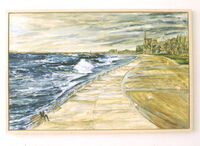 The ten artists which came to my mind at 7 pm on May 3, 1990
Die zehn Künstler an die ich am 3. Mai 1990 um 19.00 Uhr gedacht habe (The ten artists which came to my mind at 7 p.m on May 3, 1990) curated by the first artist invited to curate an exhibition at Witte de With, Jiri Georg Dokoupil, included some of his own works as well as drawings, paintings and photographs by Roberto Cabot, David Deutsch, Robert Greene, Otto Mühl, Joan Nelson, Andres Serrano, Antonin Strizek, Alice Stepanek / Steven Maslin and Victor Pivovarov.
Each year, since its inception in 1990, Witte de With has invited an artist to curate an exhibition. Witte de With encourages each guest curator to develop his project according to his own personal choices so that the resulting exhibition offers the audience another vision, independent of the center’s own program.
The first artist invited to curate an exhibition at Witte de With was Jiri Georg Dokoupil (1954). Dokoupil’s exhibition entitled Die zehn Künstler an die ich am 3. Mai 1990 um 19.00 Uhr gedacht habe (The ten artists which came to my mind at 7 p.m on 3 May 1990) included some of his own works as well as drawings, paintings and photographs by Roberto Cabot (1963), David Deutsch (1943), Robert Greene (1953), Otto Mühl (1925), Joan Nelson (1958), Andres Serrano (1950), Antonin Strizek (1959), Alice Stepanek (1954) / Steven Maslin (1959), and Victor Pivovarov (1937).
In spite of their completely different backgrounds, Dokoupil brought these artists together because of their common use of reality as a point of departure and their reference to the traditional genres of the landscape and interior. In contemporary art, working after nature, according to Dokoupil, is going against the laws, playing with them, exaggerating them and changing them. By presenting contemporary landscapes and interiors, the exhibition explored the status of representation as a subjective processing of “reality.”
Participants
Roberto Cabot, David Deutsch, Jiri Georg Dokoupil, Robert Greene, Steven Maslin, Joan Nelson, Victor Pivovarov, Andres Serrano, Alice Stepanek, Antonin Strizek
Curators
Jiri Georg Dokoupil
<div class="
-
RA Walden: xây ithřa, a pledge
Over the years, Germany and UK-based artist RA Walden has created work that explores the vulnerability of the body. Most recently, they have sought to disturb overly simplistic understandings of the disabled body, looking to bring into conversation with their work an ethics of care. Their practice spans installation, printed matter, performance, video, and coded arduino control systems, all of which they develop through a socially-engaged and research-led methodology.
For 84 STEPS, the artist presents a newly commissioned work, furthering their interest in the generative potential of access. Walden has done so through their creation of a new language—xây ithřa—initiated in response to the ableism and restrictive nature of English language. Formulated by the artist over a period of months in close collaboration with a linguist, xây ithřa exists as a 300+ word lexicon, complete with a basic grammar, confirmed phonology, and an ever growing set of idioms. Drawing on rich histories of queering lexicon—from argots and cants, to anti-languages and the use of constructed language within Sci-Fi and speculative fiction—Walden seeks to bring fluidity, ease, and “access intimacy” to those in sick, disabled, and trans bodies.(1) The artist uses world-building, not as a visionary tool for an imagined future, but as an embodied methodology for the present.
On a material level, presented in this gallery are a series of eleven statements that illustrate the fundamental concepts of the language. Each uses words describing elements and conditions of the earth to describe experiences of the human body. Created in relief, and accompanied by a sound-work, the language exists to be experienced through sight, hearing, and delicate touch. Accompanying the work, is a leaflet to be adopted as a guide through meaning, and a series of publications that offer a more in-depth exploration of xây ithřa and its methods of connection-building. An audio description of the work, as well as large-format text handouts, are available upon request.
1. The artist uses the term “access intimacy,” as one developed by the writer, educator, and community organizer Mia Mingus. Published in 2011 in her blog ‘Leaving Evidence,’ Mingus describes access intimacy as an “elusive, hard to describe feeling when someone else gets your access needs.”
Participants
RA Walden
Curators
Rosa de Graaf, Sofía Hernández Chong Cuy
Series
84 STEPS
<div class="
-
You will find us in the best places: a survey exhibition of Moshekwa Langa
On October 24, Kunstinstituut Melly will open You will find us in the best places, a major survey exhibition of South African artist Moshekwa Langa. Featuring nearly 120 works from the past three decades, the exhibition will occupy the entire building, making it the largest overview of Moshekwa’s work to be presented in the Netherlands, where he has lived for more than 25 years.
Emerging in the early years of post-apartheid South Africa, Moshekwa belongs to a generation of artists who worked with the new enthusiasm sweeping through the country at the time and the curiosity toward a world that was opening up after decades of international solidarity through cultural sanctions and boycotts. His work was widely exhibited at international biennials beginning in 1997 with his participation in the Johannesburg Biennale, the Havana Biennial, and the Istanbul Biennial, and followed by biennials in São Paulo (1998 and 2010), Gwangju (2000), and Venice (2003 and 2009). In 1997, Moshekwa moved to the Netherlands to join the Rijksakademie van Beeldende Kunsten residency, where he sought an international artistic community that would challenge and inform his practice, while allowing his work to remain resistant to easy categorization. His meteoric rise was due in part to his fearless handling of materials from his immediate environment. Using what is considered banal and “everyday” to create complex imagery, his work is characterized by wit and irreverence, while his astute awareness of material is reflected in the layers of meaning that emerge through repeated encounters with unconventional materials such as coffee, nail polish, lipstick, staples, yarn, car varnish, newspaper, coal, refuse bags, and tape.
Having grown up in Bakenberg in the province of Limpopo, Moshekwa later encountered official South African maps that did not feature his hometown. His recurring interest in mapping reflects apartheid South Africa’s selective cartographies and has informed a conceptual concern with the politics of landlessness, mapping, and borders. These concerns take different forms throughout his oeuvre, from lines woven across paper to installations of spools of thread, bodies of water, childhood memories and observations of a landscape shaped by history.
Rather than reaching conclusions, ideas in Moshekwa’s practice return, repeat, and begin again. Works may start and only be finished years later; chronology and linearity are not employed, things begin again, beginnings are continuous, and instead of conclusions there are pauses and ellipses. Time is nebulous and elastic.
Curated by Gabi Ngcobo, director of Kunstinstituut Melly, with curator Kabelo Malatsie, You will find us in the best places offers a pause to reflect on Moshekwa’s practice across three decades. The exhibition is choreographed to reveal recurring themes, questions, and interests, marking time not linearly, but through their continuous unfolding across Moshekwa’s practice.
Publication
A new publication, edited by Gabi Ngcobo and Kabelo Malatsie, and published by Kunstinstituut Melly and Medupi Publishing (Cape Town) will accompany the exhibition. Reflecting the layered and exploratory nature of Moshekwa’s practice, the book will bring together contributions from writers, artists, historians and poets, including Munganyende Hélène Christelle, Nolan Oswald Dennis, Marlene Dumas, Amogelang Maledu, Maneo Mohale, Uhuru Phalafala, Philippe Pirotte, Tracey Rose, Irene V. Small, Gilane Tawadros, and others. Scheduled for release in late March 2027, the book will launch with a dedicated public program during Rotterdam Art Week at Kunstinstituut Melly. The program will feature conversations, performative readings, and listening sessions.
Participants
Moshekwa Langa
Curators
Gabi Ngcobo, Kabelo Malatsie
<div class="
-
Voorwerk 1
Voorwerk 1 was the first exhibition in a yearly recurrent series. Voorwerk, meaning preliminary work, is Witte de With’s annual exhibition of younger artists. As a series, it seeks to provide the first substantial presentation of works by relatively unknown artists. Within the art world’s tendency to formulate relationships, Voorwerk is a peripheral event, captivating because of the heterogeneous character of the work. There are no common denominators or themes in these exhibitions, rather the artists’ works and ideas are left open for comparison.
Voorwerk 1, the first in the Voorwerk series, presented works by Italian artist Doriana Chiarini (1952), Dutch artist Aernout Mik (1962), British artist Fiona Rae (1963), and American artist Kay Rosen.
Doriana Chiarini presented elegant objects that mixed design and art. Miniature chairs cut out of paper and doll furniture were paired with large, abstract sculptures that functioned as pedestals. Chiarini’s combination of materials and historical styles of design and fine art rendered a rather personal breed of minimal sculptures.
Aernout Mik combined sculpture and photography. He showed his Dummies series which consists of cushions from photographic linen, loosely modeled after the human body, that are photographically printed with children’s portraits taken from the history of photography. Each dummy bears a porcelain plate, printed with a photograph of a landscape or city which functions as a personal souvenir, as a commemorative of a special memory. These private images seem to reveal traces of the personal histories of the unknown children, who feature on the photographic skins of the dummies.
Fiona Rae presented abstract paintings, combining primary colors into a range of atmospheres. She loads her paintings with ironical references to the history of abstract painting, quoting from Kandinsky and Mondrian, and commenting on the loss of meaning in painting.
Kay Rosen’s textual paintings reveal visual jokes, taken from sayings, pulp novels, telephone directories, etc. Breaking down grammar and disfiguring words, Rosen aims to encode meaning, then engender reading. Her paintings of language create a fine tension, holding together visual and verbal, sense and nonsense. By playing with syllables, as in “bullet/riddl-/ed ed/shot/back” or “NO/NO/AH AH/NO/AH,” meaning is consciously liberated and altered.
Participants
Doriana Chiarini, Aernout Mik, Fiona Rae, Kay Rosen
Curators
Gosse Oosterhof
<div class="
-
Raja’a Khalid: SS22, FW22/23
Over recent years, Raja’a Khalid has been exploring the colonially derived eco-cultural commodity network that looms large behind the present-day wellness economy. She has done so through art and olfactive (or scented) installations, performance, and collaborations with wellness practitioners. Through her work, Khalid aims to cast a sideways, comical yet critical glance at the present-day commodification of health and wellbeing. Born and raised in Dubai, her practice is especially concerned with the Arabian Gulf region and its narratives of work, consumer culture, and commodity circulation.
For 84 STEPS, the artist presents a newly commissioned environment that is designed to hold a variety of social activities and activations. Comprising painted walls and a newly created olfactive work, titled SS22, FW22/23, SS23, furthers Khalid’s inquiry into trend forecasting within the wellness industry. Her research is informed by trend reports released annually that set out the colors, objects, and imagery determined to be in vogue for the coming year.
Khalid’s analysis of wellness trends is influenced by her observations on the “commodification of the esoteric.” Khalid explores these ideas through the use of scent as a form of the corporate branding that calls upon bodily sensation and ideas of health. The works SS22, FW22/23, and SS23 will unfold in each season of 84 STEPS with a new forecast set of color, scent, and light.
Last year, SS22 saw the gallery painted in ‘Olive Oil’ color, forecasted as a comforting and reassuring tone in times of cautious optimism. With this, the artist paired a scent mimicking a forest full of Cypress trees. Following this the gallery was re-painted with FW22/23, which introduced a ‘Honeycomb’ hue, relating to a forecasted attitude of positivity, desire for luxury, and emphasis on the preservation of agriculture for future generations.
This season, the gallery has been adapted again with SS23, where the gallery is painted in ‘Digital Lavender’. The color was chosen due to its association with the mental health and wellbeing rituals, that many of us have developed throughout the pandemic. The hue is accompanied by a nostalgic seascape scent that drew inspiration from seaside holidays, blue planet campaigns, and the return of the cruise holiday.
This commission was made possible through the artist’s close collaboration with Air Variable, California.
Participants
Raja’a Khalid
Curators
Sofía Hernández Chong Cuy, Rosa de Graaf
Series
84 STEPS
<div class="
-
 Cornerstones
From February 2008 until summer 2009, Witte de With presents monthly lectures by leading art historians under the title Cornerstones. Each lecture focuses on the work of one key artist, whose practice may be understood as a foundation for the development of contemporary art and culture. The speakers of 2009 include Ina Blom, Chantal Pontbriand, Anne Wagner, Helmut Friedel en Mieke Bal.
The series brings together a broad scope of experts, all of whom have made lasting contributions to the contemporary art world and are an authority in their field. The speakers include professors at renowned universities, pioneers of art education, and leading institutional directors. Witte de With asked each speaker to choose as a point of departure an artist who has had an influence on their own academic practice. They will therefore share their fascination with this work, sometimes illustrated by personal anecdotes and experiences. Many of the speakers have worked closely with their chosen artist throughout their careers, enabling them to give a unique twist to existing art historical accounts.
The Cornerstones lectures do not only reflect upon recent art historical developments, but also offer an insight into the contemporary art world by means of art historical analysis. Through this series, Witte de With bridges art’s theory and practice, bringing together both intellectual and intuitive approaches. Cornerstones is aimed at a public with a broad interest in art and culture, as much as at arts students and professionals. Illustrated with striking images, the lectures also provide a point of access for an audience less familiar with recent art history.
The Cornerstones are also designed to complement Witte de With’s 2008 exhibition program, which presents exclusively solo exhibitions. The impulse behind these exhibitions and the theory program is one and the same: to create moments of concentration around a singular practice, by putting the work of an individual artist under the spotlight.
-
Ken Lum
With the exhibition of Canadian artist Ken Lum (1956), Witte de With started an investigation into the depiction of the human figure and the question of mimesis in contemporary art.
Rather than merely portraying people, Ken Lum investigates the conditions which ground the portrait genre, focusing on the interrelations between portrayal and nomenclature. The modern, bourgeois portrait is characterized by either the proper name of the person portrayed, as in Nadar’s Portrait of Goethe, generic identity, as in Vermeer’s Portrait of a Woman in a Red Hat, or anonymity, as in Evans’s Subway Workers. Lum’s portraits mimic these conventions, tracing the contours of anonymity, as in Anonymous (1978); the first named, as in Steve (1986); and the paternal name, as in Ollner Family (1986).
In these works, picture and title are combined in a peculiar way. Ollner Family, for example, consists of a very conventional group portrait of a racially mixed family combined with a sort of commercial sign, which bears the family name as if it were a product. Picture and text are filtered through standardized commercial production systems. Lum’s portrait works don’t show individuals, but the forces which determine how identity is constructed. Any naturalness of expression in the people portrayed is undercut by the explicit presence of the name, which signifies the presence of the law under which the identification process is regulated. Thus, in Ollner Family, the family’s name is that of the father, a white male, whose Chinese wife and daughter are subjected to this name.
Finally, Lum’s work can be seen as a comment on the two migratory movements of modernity: the emigration of formerly colonized peoples to Western centers, which Lum as member of a Chinese immigrant family personally experienced, and the dissemination of capitalist consumer economy across the world.
In addition to showing a selection of Lum’s Portrait-Logos, and Historical, Youth and Attribute Portraits, the exhibition included some Furniture Installations (in which Lum comments on the dream home and the ideal of the family), Language Paintings (which play with the idea of a world language), and Poem Paintings (examples of lyric poetry drawn from many cultures).
In conjunction with the exhibition, Witte de With and Ken Lum realized the billboard-project Melly Shum Hates Her Job on different locations throughout the city of Rotterdam.
The exhibition was realized in collaboration with the Winnipeg Art Gallery in Winnipeg, Manitoba, and the Vancouver Art Gallery in Vancouver, British Colombia.
Participants
Ken Lum
Curators
Chris Dercon, Jon Tupper
<div class="
-
Alma Heikkilä: semipermeable & sensitive
Finnish artist Alma Heikkilä is fascinated by the collective activities of the forest ecosystem, its connection to her body, as well as the creatures that live upon and within the human body. For 84 STEPS, Heikkilä presents a newly commissioned installation comprising two large-scale canvases. Together, they parallel the average volume of a human being’s gut lining: a total of 30 square meters. On the first canvas, the artist approaches the work as a forest bed on the microbial level. On the second canvas, hanging behind the first one, she portrays a close-up of a human forehead. As the light shines through the second canvas, the interrelation between the human body and its environments is highlighted.
In creating this work, Heikkilä invites us to acquaint ourselves with the many symbiotic relationships we participate in—with or without our knowledge—and the essential role they play in constantly making us who we are. Her work encourages us to contemplate how embodied knowledge may challenge our understanding of what it means to be a human, and invites us to consider how our conscious decisions are impacted by biology. The prefrontal cortex, which is the brain region that has been implicated in executive functions, such as planning and decision making, is located behind the forehead. Recent data suggests that the human body is a super-complex ecosystem containing trillions of bacteria and other microorganisms that inhabit all our surfaces, like the skin, and especially the intestines. Microbiota, specifically within the gut, can greatly influence many physiological parameters, including cognitive functions, such as learning, memory and decision making processes.
Heikkilä approaches artmaking as a space to spend time with these ideas, as well as with the minute and invisible processes beyond the realm of human bodily senses. In portraying these invisible biological environments, Heikkilä seeks to foreground the countless interconnections between the human body, its material surroundings, and other species.
Participants
Alma Heikkilä
Curators
Sofía Hernández Chong Cuy, Julija Mockute
Series
84 STEPS
Supported By
Frame Finland
<div class="
-
Rotterdam Dialogues
On three occasions, between the fall of 2008 and the spring of 2009, Witte de With Center for Contemporary Art organized three symposia under the title Rotterdam Dialogues: The Critics, The Curators, The Artists. Each three-day event focused on one agent in the art world, looking at their expectations, positions and the contexts in which they operate.
-
Cézanne
The exhibition Cézanne sought to consider “fine” painting in a critical light and to put its conventions and truisms on line, although not necessarily from a painterly perspective. The oeuvre and ideas of Paul Cézanne were the foundation of the exhibition.
A comparison between film and painting underscored the specificity of the image. The exhibition included works by the Swiss artists Rémy Zaugg (1943) and René Pulfer (1949), the French artist Daniel Walravens (1944) and the French filmmakers Jean-Marie Straub (1933) and Danièle Huillet (1936).
The oeuvre and ideas of Paul Cézanne were the foundation of the exhibition. The participating artists, who had long been fascinated by Cézanne’s work, commented, in various approaches, on his work and ideas. Cézanne was one of the first artists to turn against illusionism. For Cézanne, forms and colors refer to nothing but themselves, and all parts of the painting were equally important.
Zaugg's works in the exhibition included paintings, etchings, books and a video installation, all rela-ted to Cézanne’s La Maison du Pendu (1872-73). Over and over again he tried to register this painting in words, stressing the continuously changing experience of an image that never appears the same. With Pulfer, Zaugg collaborated on a film version of his art of perception, which resulted in the video-film Projection. The film shows the artist working in nature on a large white canvas. The part of the landscape that is cut off from view by the canvas is projected onto it, while the artist copies the projection in white. Projection is a registration of an imitation – or rather an apparent imitation – of nature.
Zaugg’s oeuvre was combined with the film Cézanne by Straub and Huillet. While the film is about painting, it is based on a text: Joachim Gasquet’s recorded conversations with the aging Cézanne. A reconstruction of this dialogue is recited in a metrical rhythm.
Walravens, whose work is an ongoing inquiry into color theory, commented on the use of color in the oeuvre of Cézanne. By making monochrome paintings with colors from an industrial color index, he investigated the interaction between artisanal and artistic uses of color.
Participants
Danièle Huillet, René Pulfer, Jean-Marie Straub, Daniel Walravens, Remy Zaugg
Curators
Chris Dercon
<div class="
-
Maike Hemmers: This Deep Becomes Palpable
Maike Hemmers is a Rotterdam-based artist whose research reflects on intuitive material relations, shaped by her interest in feminist architecture, and what she terms queer and soft resistance; a distancing from and rethinking of dominant norms and oppressive power dynamics. This she explores through pastel drawings, text, and everyday relational art objects, seeking to portray how affects, feelings, and relationships move through a body.
For 84 STEPS, Hemmers invites the viewer to accompany her on a journey through inner landscapes. The work is based on a series of somatic ‘process work’ sessions facilitated by the artist and process-worker Savannah Theis. Related to this, Hemmers invited a group of close friends to attend a special workshop facilitated by Theis, which went on to shape the installation of sculptures on view. Originating in the 1970s within the field of Jungian psychology, process work (otherwise referred to as ‘process-oriented psychology’) is a comprehensive and evolving model that focuses on facilitating awareness at individual, relationship, and collective levels.
The artist draws on inner developments, whether subconscious, bodily, or energetic, to support emergent understanding and orientation. This she does through her creation of both pastel drawings and soft sculptures, creating an environment in which to reflect on the role of queer and soft resistance. In her drawing methodology, the body is scanned, and each part is felt as a color, which comes to constitute the color palette for each of her pastel drawings. Together, Hemmers’ drawings sensorially documents bodily experiences at a given time. The sculptures are produced together with textile designer Karen Huang. They are filled with materials ranging from cherry pits to cedar bark, and can be encountered variously, through scent, sight, and touch; sat or laid upon as a support, or worn and wrapped around the body as a garment.
Participants
Maike Hemmers
Curators
Sofía Hernández Chong Cuy, Julija Mockute
Series
84 STEPS
Supported By
Mondriaan Fund, ifa (Institut für Auslandsbeziehungen)
<div class="
-
The Humans
From 26 April 2012 to 6 January 2013, Witte de With Center for Contemporary Art hosted the on-site realization of The Humans, a theatrical performance by visual artist and writer Alexandre Singh. Leading up to the final presentation of his play in the Fall of 2013, Singh transformed parts of Witte de With’s second floor into an artist’s studio, a script room and a workshop. This on-site realization of the artwork provided the audience with an insider’s look into the inner dynamics of artistic creation.
Set before the Earth’s beginning in a proto-world populated by spirits, gods, artisans and men of clay and plaster, The Humans — a play with ‘creation’ as its central theme — is modeled after the ancient Greek plays of Aristophanes. Whilst the theatrical references are ancient, the satire is utterly modern: religion, morality and human hubris are all mocked with an irreverent and biting tone. The Humans evolves and changes over an eight-month period and includes a variety of formats, from presentations and rehearsals to discursive events that are informed by the props produced on site. With the intention of inviting the public to actively engage with the artist’s work and the play in specific, collaborations with experts and scholars from different disciplines are forged in order to inform and be informed, inspire and be inspired by the project. As such, the monthly discursive events Causeries – which started in June 2012 and continues until March 2013– are moments and opportunities for different disciplines to collide and engage with theater groups, youth choirs, set designers, prop-makers and costume-designers. They explore an array of subjects from Cosmogony, satire, theatrical costumes, to Aristophanes and scatology.
This project came into being after seven years of correspondence between the artist and Defne Ayas, Witte de With’s director. The Humans Blog Over the course of 2012, on a regular basis, Alexandre Singh posted on a dedicated tumblr page, visual material and other sources that serve as an inspiration in the development of his project The Humans: http://the-humans.tumblr.com/.
The Reader is a selection of texts that provide an insight into different themes the artist explores over the course of his play. It functions as an in-depth source of information and inspiration to The Humans. This booklet, available in limited printed copies for consultation at Witte de With only (and for viewing on Witte de With’s website), is updated on a regular basis parallel to the monthly public events Causeries.
-
Negen (Nine)
In the exhibition Negen (Nine) Witte de With presented work by nine Dutch artists, who, although representing nine independent stances within the panorama of current Dutch art, could be considered as part of one and the same artistic generation. The exhibition travelled with different works by the same artists to other European venues: the Museo d’Arte Contemporanea Luigi Pecci in Prato, the Kunstverein Düsseldorf and the Provincial Museum Hasselt.
The nine artists were: Philip Akkerman (Vaassen, 1957), Rob Birza (Geldrop, 1962), Paul Cox (Rosmalen, 1962), Guido Geelen (Thorn, 1961), Joep van Lieshout (Ravenstein, 1963), Willem Oorebeek (Pernis, 1953), Charly van Rest (Djakarta, 1946), Han Schuil (Voorschoten, 1958) and Roos Theuws (Valkenswaard, 1957).
Witte de With sought out artists who had been working independently of schools and tendencies and who had each formed and expanded a personal position. By presenting different Dutch artists together, at various European locations, Witte de With generated a situation of positive conflict and evoked a discussion about the role Dutch art takes in international developments. The touring exhibition enabled both public and specialists to draw lines, relationships and revisions within the landscape of Dutch contemporary art, forcing them to take a stance.
Participants
Philip Akkerman, Rob Birza, Paul Cox, Guido Geelen, Joep van Lieshout, Willem Oorebeek, Charly van Rest, Han Schuil, Roos Theuws
Curators
Chris Dercon, Gosse Oosterhof
<div class="
-
Anna Witt: Soft Destructions
German artist Anna Witt is interested in the construction of cultural stereotypes and the place of the individual within social systems. Experimental and performative art forms are essential to her art making. She often works collaboratively, and is particularly interested in forms of care work, and the divergence of social connectivity and detachment. Taking the form of performances, public interventions, and video installations, her works seek to playfully enable communal interaction. To this end, she is as interested in non-verbal forms of communication, such as sound, gesture, and movement, as she is in verbal. In her view, it is these more marginalized and sensorial registers that may offer new definitions of our communal existence.
For 84 STEPS, Witt presents a newly commissioned site-specific installation set to become a stage for live ASMR performances. The term ASMR (Autonomous Sensory Meridian Response) refers to a physical reaction comprised of a pleasant tingling sensation which many people find soothing. It became popular in social media, eventually developing into a community phenomenon in 2010, primarily on YouTube. Mutual care and emotional closeness are the cornerstones of this community, as users share and watch videos to help relieve stress, anxiety, or sleeping disorders, most commonly. The live sound-performances will focus on the auditory and sensory effects of gentle, destructive actions towards the objects spread within the gallery, that make up the installation. The physical debris will remain and accumulate within the space, thereby constantly changing it over the course of the exhibition.
Participants
Anna Witt
Curators
Rosa de Graaf, Julija Mockute
Series
84 STEPS
<div class="
-
Moderation(s)
Do you believe in productive misunderstandings? Does moderation always entail translation? Are you more, or less, defined by geography? A project is a fragment of the future: true or false? If asked, could you explain the difference between moderation and mediation? Without being cynical: aren’t you tired of cynicism? How often, if ever, do you feel manipulated? When you hear “a cross-continental stage for play and production,” does it confound you? Do you believe streams of energy can persist beyond a year’s time? Are you taking pleasure in any of this? Should you?
Moderation(s) is a long-term program, which started in August 2012 and perches on the two international art institutions that initiated it, namely Witte de With Center for Contemporary Art in Rotterdam and Spring Workshop in Hong Kong. Within this framework Heman Chong, a Singaporean artist and writer, was invited to steer the program.
Moderation(s) unfolds over the span of more than a year through different projects including three residencies, a series of performances, a book of short stories, and a conference. Each project installment of Moderation(s) questions or redefines the conditions of creating and producing objects, situations, and stories. The projects are developed independently from one another, yet often naturally inform and shape each other. This open-endedness is also tangible in the absence of a pre-established master plan dictating the course of the Moderation(s) program. Allowing for chance encounters and improvisation to often take the lead, the program reveals itself through its participants more than anything else. Driven by the desire to return to the specific nature of creative processes of production, doing preceded defining.
In speaking about this project, Moderator Heman Chong proposes “to make ‘soft’ the practices of both artist and curator, so that one becomes easily soluble in the other, while retaining their unique forms and patterns of working. The participants will be encouraged to indulge in the pleasures of exchanging knowledge and tools without any pressure to collaborate.”
Initiated by Witte de With’s Director Defne Ayas in collaboration with Spring Workshop Founder and Director Mimi Brown, Moderation(s) is steered by artist and writer Heman Chong.
The project is made possible in part with support by AMMODO. The research part of Moderation(s) in 2012 was supported by a Mondriaan Fund (Research & Development) grant.
-
Hermann Pitz — Panorama MCMXCI
The exhibition Panorama MCMXCI presented the first overview of the work of Hermann Pitz. Rather than a classic retrospective, the exhibition was conceived as an autobiography of the artist, that confronted and compared his heterogeneous work.
German artist Hermann Pitz (1956) has always steered an independent course between the classical genres of the visual arts and art trends. In the early eighties Pitz, one of the initiators of the artists collective “Büro Berlin,” engaged in organizing temporary presentations and events in different locations. Often the sites as well were temporary in nature, being demolished afterwards. Creative production, planning and organization are the essence of Pitz’s notion of artistic activity. Within his artistic concept all of his works function in a permanent cycle of completion. This production process is highly self-referential. Once realized, he photographs his installations and they then become the starting point for new installations. One piece leads to another, although not in a linear way; rather the close ties between the works constitute a family tree, with each branch representing a different development.
Thus Panorama MCMXCI outlined the genealogy of Pitz’s oeuvre, grouping his works into different branches. The catalogue that accompanied the exhibition, took the form of a travel guide, documenting a fictitious journey through his work.
The exhibition traveled to the Westfälischer Kunstverein in Münster and the Kunstverein Braunschweig.
Participants
Hermann Pitz
Curators
Chris Dercon
<div class="
-
Tromarama: Soliloquy
The collective Tromarama is a Bandung-based artist collective founded in 2006 by Febie Babyrose, Herbert Hans, and Ruddy Hatumena. The three met while studying together, and shortly began to create works that combine video, installation, computer programming, and public participation. Underpinning their art making, is their collective interest in the influence of digital media on society’s perception of its surroundings. Channeling language, text, wit, and interaction, Tromarama reflects on the cornerstones of Indonesia’s political and cultural environment, and on forms of perceptive engagement in our hyperreality that applies globally.
For 84 STEPS, Tromarama presents a site-specific iteration of their work Soliloquy (2018/2022). The installation features some ninety second-hand lamps scattered around the space like islands or entities left in solitude. Each time the hashtag “#kinship” is used on Twitter, the tweet is converted into binary code, triggering their switches and creating a symphony of flickers. The flashing bulbs transcribe layers of human desire, as well as individual stories that manifest users’ connections forged across physical and digital realms. The relationship with language, generally but also especially through the realm of social media, has been an important aspect of Tromarama’s practice. This work encourages us to reconsider everyday conditions, relationships, reasoning, and sensibility in our hyperreality.
Participants
Tromarama
Curators
Rosa de Graaf, Julija Mockute
Series
84 STEPS
Supported By
With special thanks to Kadist
<div class="
-
Causeries
Taking its title from the French verb causer – to converse or chat – the Causeries are set up as a series of discussions in which Alexandre Singh expands on his ambitious play The Humans key themes, ranging from cosmology and cosmogony to pictorial satire, dance, drama, and religion. Rather than discursive events in the well-known format of a conference or a symposium, the Causeries are conceived as informal conversations between the artist and an expert in a given field. It is not only the edification of the artist himself that is pivotal in this alternative kind of exchange, also the audience is offered an insight in the underlying themes of The Humans. The monthly Causeries are conceived by Defne Ayas and Alexandre Singh, and are organized in consultation with critic and writer Donatien Grau.
-
Saint Clair Cemin and Jessica Stockholder
The exhibitions of Saint Clair Cemin and Jessica Stockholder confronted and compared two contemporary sculptural visions, that respond differently to our pluralistic culture and consumer society.
Brazilian artist Saint Clair Cemin (1951) uses traditional materials such as stone, iron, wood, bronze, marble and terra-cotta. He investigates the relationships, differences and changes between images not just in art, but in our entire consumer culture. He seeks equality in the appreciation and judgment of all things: art, artifacts and thoughts. As Cemin remarked in his typically aphoristic fashion: “The world of art-objects, and that of common objects, form a continuous field. The value system used to produce and evaluate art-objects, even the most rarefied conceptual work, shares a common ground with the apparatus used to evaluate anything else in the world, such as people, social situations, or the weather.” Inspired by the heterogeneity of this object-world, Cemin’s sculptures are eclectic, fragments of thought which hint of a totality, that has been deliberately left undisclosed.
The exhibition of Saint Clair Cemin presented a selection of works made between 1988 and 1991.
Canadian artist Jessica Stockholder (1959) creates striking assemblages from such materials and objects as wood, sheetrock, concrete, asphalt, carpet, plaster, wallpaper, paint, papier-mâché, tape, electric wire, lights, refrigerators, chairs, sheets, underwear, fruit, toilet paper and garbage bags. Stockholder’s decision to work with debris, waste products and transient substances confronts us, conceptually as well as formally, with the temporality of her installations and, by extension, of our own bodies, and our social and cultural structures which are bound to the consumer society that produces these materials.
This temporality is enhanced by the architectural dimension of Stockholder’s installations; most of her works are in-situ installations that address the architecture of the space they occupy. Her refractory material aggregates allow a multiplicity of possible perspectives, suggesting different ways of seeing. When moving through one of her installations, the viewer perceives the parts as shifting and restructuring constantly and only experiences a unified work after viewing many perspectives. Unity within the continual flux exists only in the memory of each individual viewer.
The exhibition of Jessica Stockholder included a selection of works made between 1988 and 1991, as well as two in-situ installations, made especially for Witte de With, that adapted to the relations of things happening inside and outside the exhibition spaces.
The exhibition of Jessica Stockholder traveled to The Renaissance Society at the University of Chicago.
Participants
Saint Clair Cemin, Jessica Stockholder
Curators
Chris Dercon, Gosse Oosterhof
<div class="
-
Show Me, Don't Tell Me, Brussels Biennale
-
Rotterdam Ontrafeld
Rotterdam Ontrafeld
This Source Book was published on the occasion of Unraveling Rotterdam, The Periphery Complex, a series of discussions with leading figures in the Rotterdam art world, held at Witte de With between Tuesday 27 June and Saturday 1 July 2006.
During daily “talkshows”, members of Witte de With’s staff explored selected themes with one or two guests and with the public, trying to formulate certain answers. The themes from these discussions provided the basis for the textbook. As the book’s aim was also to unravel Rotterdam, the texts included are not direct translations of the “talkshows,” but instead a continuation of them in the form of an article, and interview or a personal text. The result is a challenging, kaleidoscopic book where many ideas are exchanged and critical questions are raised.
-
Facts and Rumours
Each year, since its inception in 1990, Witte de With invited an artist to curate an exhibition. Witte de With encourages each guest curator to develop his project according to his own personal choices so that the resulting exhibition offers the audience another vision, independent of the center’s own program.
The second artist invited to curate an exhibition at Witte de With was Henk Visch from the Netherlands (1950). Other guest curators have been Jiri Georg Dokoupil (in 1990), Haim Steinbach (in 1992), Daniel Buren (in 1994) and Jef Cornelis (in 1995).
Henk Visch selected works by the following colleagues: Diane Arbus (1923), Mike Bidlo (1953), Guillaume Bijl (1946), Meg Cranston (1960), Anke Doberauer (1962), Jan Fabre (1958), Benoit Hermans (1963), John Körmeling (1951), Bernd Lohaus (1940), Reinhard Niedermeier (1959), Manfred Stumpf (1957), Henk Visch (1950), Franz Erhard Walther (1939) and Robin Winters (1950).
With Facts and Rumours Visch asked himself how a collection of heterogeneous objects, like works in an exhibition, can relate to each other. According to Visch, neither exhibitions nor works of art have the specificity or certainty of a fact or statement. With his selection and combination of artworks, Visch sought to start a continuous process of associations, suggestions, and rumours.
His motivation went as follows: “Just beginning something – does one know the beginning of a beginning? – may lead to an unexpected outcome, even to an outcome one does not want (very likely), which makes it necessary to do something – something else – to get away from it. Apparently one thing leads to another. Great forces are involved. By doing one thing, the other, without realizing it, is initiated, set in motion, summoned.”
Participants
Diane Arbus, Mike Bidlo, Guillaume Bijl, Meg Cranston, Anke Doberauer, Jan Fabre, Benoit Hermans, John Körmeling, Bernd Lohaus, Reinhard Niedermeier, Manfred Stumpf, Henk Visch, Franz Erhard Walther, Robin Winters
Curators
Henk Visch
<div class="
-
Jordan Crandall: Under Fire. On the Organization and Representation of Violence
A series of reflections on warfare and representation, Under Fire includes contributions by Akbar Ahmed, John Armitage, Asef Bayat, Ryan Bishop, Benjamin Bratton, Susan Buck-Morss, David Campbell, Hamid Dabashi, Manuel DeLanda, James Der Derian, Madelaine Drohan, Paul N. Edwards, Joy Garnett, Salwa Ghaly, Stephen Graham, Chris Hables Gray, Brian Holmes, Anahid Kassabian, Thomas Keenan, Bracha Lichtenberg Ettinger, Saba Mahmood, Antonio Monegal, Loretta Napoleoni, Amir Parsa, Amit Rai, Harel Shapira, P.W. Singer, Radhika Subramaniam, Ananya Vajpeyi, Ana Valdez, and Eyal Weizman.
Looking at the forms of militarized agencies that are emerging today, Under Fire attempts to understand the nature of emergent power and the forms of resistance to it, situating cycles of violence within the modalities of a global system. It looks at the role that representations play as registers of symbolic meaning and as agents of affective change – exploring the ways that violence materializes as both act and image. It probes into cultural imaginaries of conflict and the deeper truths they may offer about collective identifications and aggressions. It aims to construct a discursive and affective terrain that can offer new insights into symptomatic violence.
The topics covered in these two volumes include the conflux of battle simulation and news programming; democracy and violence; the privatization of the military; the militarization of urban space; architectures and ontologies of targeting; cultures of suspicion; the epistemology of global infrastructures; the exhibition of atrocity; panopticism and disappearance; simulated and imagined constructions of territory; and the corporate use of force.
ISBN Vol. 1: 90-73362-61-X
ISBN Vol. 2: 90-73362-65-2
-
Think Art
Think Art
The publication Think Art sums up the proceedings of the symposium organized by Witte de With Center for Contemporary Art, under the direction of philosopher Jean-Marie Schaeffer. At its basis is the desire for a systematic methodological approach to the distance that separates contemporary art practice from the intellectual instruments that we have for ‘thinking art.’ The status of artworks as means for relating to reality, as tools for obtaining pleasure and knowledge, may situate them in a universe where the specific characteristics of the aesthetic method need to be redefined outside the transcendental models inherited from the seventeenth and eighteenth centuries, which still function as theoretical frameworks for evaluation.
The symposium began with a comparison and contrast between the methodology of the philosopher engaged in aesthetic investigation and the methodologies of the historian, the sociologist and the artist. Three sessions each including two lectures, were offered as public presentations, followed by a closed-door seminar where some fifteen persons were able to discuss and elaborate on the themes introduced in the lectures, as well as others that came up in the course of the discussions. In the first of the sessions, Catherine Ingraham contributed new considerations developed from a critical and historiographical viewpoint for application to architecture. Thus the thinking and making of art were contrasted with architecture where the relations between conception and realization involve quite different levels of complexity. Nathalie Heinich presented her positions from the perspective of a sociology applied to the reception of contemporary art. Finally Tohan Grimonprez spoke of the motivations, choices, and techniques used in his own work. Reactions to the lectures by Andreas Broeckman, Felix lanssens & Ben Laloua, Herma Klijnstra, Henk Oosterling, and Renée Turner initiated a genuinely interesting and original debate, from various professional and intellectual perspectives, while johan Grimonprez contributed with a special project emanating from his ongoing media works.
It is Witte de With’s desire to have contributed, with the symposium, and with this publication, to the broadening and reactivation of the debate on contemporary culture, hoping to have defined and actualized the possibilities and limits of a number of relevant methodological questions. To this end, the publication itself can serve as a stimulus and as a critical framework for a continuing reflection and dialogue in art and about art, which we intend to pursue in the daily activity of this institution.
In the publication Think Art Schaeffer has explored further the subject along with authors representing various disciplines: Catherine Ingraham, Nathalie Heinich, Johan Grimonprez, Henk Oosterling, Yves Michaud, Renée Turner, Herma Klijnstra, Andreas Broeckman, and Felix Janssens & Ben Laloua.
-
Voorwerk 2
Voorwerk 2 was the second exhibition in the yearly recurrent series. Voorwerk, meaning preliminary work, is Witte de With’s annual exhibition of younger artists. As a series, it seeks to provide the first substantial presentation of works by relatively unknown artists.
Voorwerk 2 presented works by German artist Maria Anna Dewes (1955), American artist Brandt Junceau (1959), Dutch artist Rob Kaptein (1961) and Swiss artist Guido Schmidt (1959).
Within the art world’s tendency to formulate relationships, Voorwerk is a peripheral event, captivating because of the heterogeneous character of the work. There are no common denominators or themes in these exhibitions, rather the artists’ works and ideas are left open for comparison. To date, the rest of the series includes Voorwerk 1 (in 1990), Voorwerk 3 (in 1992), Voorwerk 4 (in 1995) and Voorwerk 5 (in 1996).
Jeff Wall’s Destroyed Room (1978) was a point of reference for this exhibition. The work depicts a girl’s bedroom, where life has turned ugly and havoc rules. Furniture and clothes are scattered around. Though the image radiates a fascinating mix of aggression and intimacy, it is its aesthetic pleasure that prevails. The works of the artists in Voorwerk 2also dealt with the home, with people and their objects, with intimacy and aggression, and with order and chaos.
Maria Anna Dewes created life-size plaster casts of people. Her installation included five red casts of sweeping women, portraying typical female labor, while simultaneously evoking in their suggestion of filmic movement Eadweard Muybridge’s cinematographic motion studies.
Brandt Junceau combined his varied works into a single installation. He arranged a narrative presentation that often took autobiographical turns.
The sculptures Rob Kaptein showed referred to living and working environments. He deconstructed cupboards, chairs, desks and cushions, assembling and integrating them into sculptures of great accuracy, refinement and humor.
Guido Schmidt presented monumental sculptures, assembled from such found objects and debris as discarded cigarette boxes or vacuum-cleaner parts. His large robot or targets, made of domestic waste, commented on our consumer society’s endless production of waste. Brandt Junceau’s work was subsequently more extensively explored in the solo exhibition Hyde Park (in 1995).
Participants
Maria Anna Dewes, Brandt Junceau, Rob Kaptein
Curators
Chris Dercon
<div class="
-
Craigie Horsfield: Schuttingproject
Record created from the archive project register (access_project / 2026 projects). No corresponding page exists on the institution’s website.
-
Artists’ Ideals and the Ideal Curator
Artists’ Ideals and the Ideal Curator
Witte de With Colloquy
Friday 12 February 2016, 12 – 4 pm
Location: Auditorium, Witte de With Center for Contemporary Art
Language: English
—Participants
Defne Ayas, Bonaventure Soh Bejeng Ndikung, Grégory Castéra, Rhea Dall, Chris Evans, Satch Hoyt, Kobe Matthys, Wendelien van Oldenborgh, Emily Pethick, Laure Prouvost, Kristine Siegel, Adam Sutherland
—Curators
Defne Ayas, Natasha Hoare, Adam Kleinman
Speakers: Rhea Dall & Kristine Siegel (PRAXES) with Chris Evans (artist), Grégory Castéra (Council) with Kobe Matthys (artist), Adam Sutherland (Grizedale Arts) with Laure Prouvost (artist), Emily Pethick (Showroom, London) with Wendelien van Oldenborgh (artist), and Bonaventure Soh Bejeng Ndikung (Curator at Large Documenta 14, Artistic Director SAVVY Contemporary, Biotechnologist) with Satch Hoyt (artist).
Can curators question their practice alone? Where and how does the voice of the public, the critic, the institution, or more over, the artist fit within curatorial reflection? Where curating is concerned, symposia organized in the field of the visual arts tend to focus on definitions of practice and theoretical approaches. Little attention is given to the actual relationship between artists and curators, and how artists navigate the field. An international roster of speakers is brought together to reflect on shared comparable case-studies and historical correspondences with focus not only on the act of selection and framing but also on the relationship reversals and inversions.
Schedule:
12:00-12:10 – Introduction by Defne Ayas
12:10-12:50 – Adam Sutherland & Laure Prouvost
12:50-13:30 – Bonaventure Soh Bejeng Ndikung & Satch Hoyt
13:30-13:50 – Break for lunch
13:50-14:30 – Gregory Castera & Kobe Matthys
14:30-15:10 – Emily Pethick & Wendelien van Oldenborgh
15:10-15:50 – Rhea Dall, Kristine Siegel & Chris Evans
Organized and hosted by Witte de With on the occasion of Art Rotterdam 2016.
—Supported by
Mondriaan Fund
Art Rotterdam 2016
-
Michael Byron and Julião Sarmento
The simultaneous exhibitions of Michael Byron and Julião Sarmento presented the work of two painters. Byron and Sarmento both draw upon a symbolical literary tradition to create their ponderous imagery. This dual exhibition sought to help decipher the state of painting in the contemporary visual arts.
For American artist Michael Byron (1954), painting is essentially a narrative endeavor. His early works are deliberately theatrical; they consist of a painted backdrop with an object in front of it, sometimes even a burning candle, which grounds the painting in a real-time situation. In later works, the objects are photographed and silk-screened onto the painting’s surface. All works are full of historical quotations, mainly taken from seventeenth and eighteenth-century printed matter. Byron’s paintings are symbolist; they are aimed at a mythic, rather than a realistic, representation of society. Thus, as he has said, his narrative vein is never prescriptive: “Symbolism gives expression to certain ideals and emotions and searches for an intimate contact with the viewer. It has an emotional investment. Symbolism is humanistic …it presents human experience by using the accumulated symbols of history.”
The exhibition at Witte de With focused on Byron’s paintings from 1986-1991. The Museum Boijmans Van Beuningen in Rotterdam also concurrently showed a suite of one hundred drawings from 1989-1990.
The paintings of Portuguese artist Julião Sarmento (1946) contain a diffused plethora of feelings and autobiographical stories. Representing the dance of life and death, his work is rich with undertones of sexuality and occasionally explicit sado masochism. Quoting from art history, the cinema and commercial imagery, Sarmento’s narrative paintings depict the disintegrating bodies of the moribund, the victim and the lover. The human figure is the only subject that Sarmento feels can be endlessly painted: “A bottle is a bottle. In the history of Western art there is an iconography of objects that speaks for itself. It is therefore very difficult to be detached from earlier realities whenever you paint a subject matter that is connected to a never ending chain. The human body is the only subject matter that still can?t be reduced to a simple iconography.”
The exhibition presented Sarmento’s work from 1984-1990
Participants
Michael Byron, Julião Sarmento
Curators
Gosse Oosterhof, Karel Schampers
<div class="
-
00 General
Record created from the archive project register (access_project / 2026 projects). No corresponding page exists on the institution’s website.
-
To Tell The Truth
In 2011, public debate about the cultural sector and the role of art, artists and art institutions has become increasingly vocal and visible, particularly in the Netherlands. However, such discussion is dominated by political rhetoric and point scoring, and seldom allows individual cultural actors to speak at any length about their motivation. In an attempt to create a space for engaged dialogue, the lecture series To Tell The Truth invites members of Witte de With’s programming team to set forth their ideas about cultural politics and the public role of Witte de With, and invites you to come along and respond.
Language: English
Location: Witte de With’s auditorium
Wednesday 19 October, 7 pm
PLEASE
by Anne-Claire Schmitz, junior curator
In her lecture, Anne-Claire Schmitz will discuss the pressure put upon art institutions – and by extension, on artists – to please others, whether it be by following the dictates of funding bodies or by pandering to the demands of an increasingly populistic society. Taking a critical look at how this functions and what impact it has upon culture, she will use selected case studies to examine questions of popularity and accountability.
Wednesday 26 October, 7 pm
UPSTAIRS, DOWNSTAIRS
by Zoë Gray, curator
As part of the debate about public funding for art, there has been an increasing focus on accessibility, with institutions encouraged to attract ever new audiences. Laudable though the intention may be, the discussion about accessibility is too often considered solely in terms of visitor demographics. In her lecture, Zoë Gray will look at the question of accessibility in a broader sense, within and beyond the art institution, relating access to education and class divisions which shape our increasingly service-driven society.
Wednesday 2 November, 7 pm
WHAT IS RIGHT AND WHAT IS LEFT
by Juan A. Gaitán, curator
In this lecture, Juan Gaitán will talk about the way in which the public sphere is being produced into a manageable entity, and the impact that this has on art and on the people currently involved in cultural production. He will also explore how – from the point of view of contemporary art – one can affirm the necessity of having an open space in which to express different and differing positions, be these social, cultural or economic.
To Tell The Truth began this spring, with a lecture on 18 May titled The Danger of Mediocrity by Nicolaus Schafhausen, director of Witte de With, which was followed by a lecture on 25 May titled The Empty Center by Monika Szewczyk, Witte de With’s Head of Publications.
Wednesday 18 May
THE DANGER OF MEDIOCRITY
by Nicolaus Schafhausen, director of Witte de With
In a political atmosphere increasingly dominated by reactionary rhetoric, cultural institutions are under great pressure to be popular, to be liked, to appeal to the mythical ‘‘masses.’’ As his tenure as director of Witte de With draws to a close, Schafhausen’s talk explored alternatives to this dangerously simplistic approach to culture and how they are relevant to institutions of contemporary art.
Wednesday 25 May
THE EMPTY CENTER
by Monika Szewczyk, Witte de With’s Head of Publications
Proposing a politically constructive way to scrutinize contemporary art institutions, Szewczyk’s talk argued for their role in shaping a truly open public sphere. This began with a celebration of ‘‘the empty center’’ – which in part implies an art space that is not void of visitors or of art or of radical ideas, but of a logic that turns people into numbers.
-
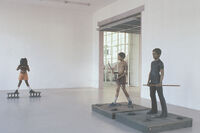 South Bronx Hall of Fame
American artist John Ahearn (Binghamton, New York, 1951) and Puerto Rican artist Rigoberto Torres (Aguadilla, 1960) collaborate in portraying everyday people. Their exhibition was part of Witte de With’s investigation into the depiction of the human figure and the question of the relevancy of mimetic impulses.
Ahearn and Torres have lived and worked amidst the Latino-American population in the South Bronx in New York since the end of the seventies, portraying their neighbors in the tradition of the realistic, religious portraits that the Spanish colonists brought to the Americas.
Working about ten miles away from the dense concentration of commercial galleries and highly prized artist’s lofts in Tribeca and Soho, Ahearn and Torres have sought to break from the art establishment by reclaiming a place for art in the fabric of daily life and by renewing the ancient role of the artist in society.
The casting process requires close collaboration with the models and happens in a very public way, usually out on the sidewalk in front of friends, family and neighbors. From the heads, busts, and reliefs, one cast remains in the neighborhood, either in people’s homes or in public places such as waiting rooms or courtyards, while a copy enters the art world. The castings and installations of the busts and reliefs are community events.
The South Bronx Hall of Fame is an alternative to the Hall of Fame of Great Americans, a grand public monument not far from the Bronx, designed by the acclaimed American architect Stanford White, with a procession of classical portraits of distinguished citizens by leading sculptors. In contrast, Ahearn and Torres chose to represent citizens that have rarely been memorialized in art or given pride of place in national monuments and museums. Their art documents the lives in the ghettos, revealing the heroic dimension of everyday people and enabling them to identify with an art that affirms their existence by representing their own reality.
Cool project
The exhibition included a survey of the work Ahearn and Torres have created since 1979. At the occasion of the exhibition, a special project was realized in collaboration with the neighbors of Witte de With: the Cool Project (Cool being the name of the neighborhood). The results, three group portraits of local residents, Ed de Meijer, Nelly Alegria and Koenrjbiharnie Firipersad; Natoucha Verkerk, Patricia Nijhoff and Lisa Kolet; and Mario Boeyen and Antonio Dias, were permanently installed in the neighborhood of Witte de With.
The project emphasized the importance of the processes of creation and collaboration.
Participants
John Ahearn, Rigoberto Torres
Curators
Marilyn Zeitlin
<div class="
-
01 General
Record created from the archive project register (access_project / 2026 projects). No corresponding page exists on the institution’s website.
-
TALK with Nato Thompson: Culture as Weapon
TALK
with Nato Thompson: Culture as Weapon
Tuesday 11 September 2018, 4 - 6 pm (doors open 3:30 pm)
Tickets: sold out
Location: Auditorium, Witte de With Center for Contemporary Art
—Participants
Nato Thompson, Jeanne van Heeswijk, Merlijn Twaalfhoven
—Partners
Master Fine Art Piet Zwart Institute, Rotterdam Arts and Sciences Lab (RASL)
Rotterdam Arts and Sciences Lab (RASL) and Studium Witte de With present Culture as Weapon, a Keynote Lecture by Nato Thompson.
In his lecture, Nato Thompson, curator, writer, and Artistic Director at Philadelphia Contemporary, will discuss his book Culture as Weapon: The Art of Influence in Everyday Life. He will address the growing role of affect in a variety of industries – from charity to counterinsurgency models in the military to contemporary real estate. Throughout the keynote, he will explain how the landscape of strategically deployed human emotion has direct implications to the practice of artists and activism. In response to the keynote, visual artist Jeanne van Heeswijk and composer Merlijn Twaalfhoven will engage in a conversation with Nato Thompson.
This event is organized by RASL Events, Witte de With Center for Contemporary Art, in collaboration with Master Fine Art Piet Zwart Institute, as a kick off for the new academic year for the students of the committed institutions – Erasmus University Rotterdam, Codarts Rotterdam, and Willem de Kooning Academy Rotterdam – but will be accessible to other (non-)students as well. Tickets via the ticketlink.
-
Stephan Balkenhol
The eponymous exhibition of German artist Stephan Balkenhol (1957) provisionally concluded Witte de With’s investigation into the depiction of the human figure and the question of mimesis in contemporary art. This inquiry began with the exhibitions by Ken Lum (in 1990), John Ahearn and Rigoberto Torres (in 1991), and Philip Akkerman (in 1992).
The human and animal figures Balkenhol carves from wood deal with mimesis, in particular with the representation of body and face. The image of the human body is the most immediatly comprehensible of symbols. Accross national traditions and limitations of education and language, recognition of the body’s physiognomy and gestures creates a spontaneous acknowledgment of meaning.
Yet when Balkenhol started to create his sculptures, it was downright taboo to work figuratively: “I have to reinvent the figure, the tradition is interrupted.”
Modernist sculpture had excluded representation, replacing it with the organic creation of plastic symbolic situations, as in the work of Joseph Beuys or Jannis Kounellis, or with nonobjective systems, as in the work of Carl Andre or Donald Judd. Yet at the same time, the figurative tradition was continued by Fascist and Soviet art, which returned to the stereotypes of the nude and the uniformed hero.
Balkenhol’s sculptures simultaneously interfere with the trajectories of radical modernist sculpture and idealized, universal state symbols. His figures are rarely nude and carry no specific attributes. His representations of the human figure are neither models of a universal human ideal nor specific portraits. Presented as solitary figures or as a crowd of individuals, as in 57 Penguins (1991), his sculptures speak about difference, about the differences between what is communal and what is specific.
The exhibition presented a survey of Balkenhol’s work, including reliefs, heads, and figures of different scales, all rapidly carved from single pieces of wood. In conjunction with the exhibition, Balkenhol realized a permanent sculpture for the Witte de With stairwell, Freistehende Relieffigur.
Participants
Stephan Balkenhol
Curators
Chris Dercon, Gosse Oosterhof
<div class="
-
02 General
Record created from the archive project register (access_project / 2026 projects). No corresponding page exists on the institution’s website.
-
National (Re)presentation
National (Re)presentation
Thursday 4 Ocotber 2007 - Sunday 25 November 2007
Language: English
—Participants
Claire Beke, Annie Fletcher, Nick Hackworth, Murina Mirza, Daniel van der Velden, Olav Velthuis
—Partners
BAK, institute for the contemporary, Van Abbemuseum
As part of a collaborative project with BAK, basis voor actuele kunst (Utrecht) and the Van Abbemuseum (Eindhoven) – and as a critical follow-up to the Venice Biennale – Witte de With presents four evening discussions (every Thursday in October) on the topic of the ‘national’ and how it relates to contemporary cultural production and theory today.
In order to expand the dialogue around nation-building, nation-states, and the role of the individual within single country structures – topics that will be also addressed by BAK and the Van Abbemuseum in their debate series this fall – Witte de With has invited Suhail Malik andAndrea Phillips from PoCA (Political Currency of Art Research Group, based in the Department of Visual Arts at Goldsmiths, London, also see website) to collaborate on creating this series of debates. PoCA conducts research on the assimilation of critical and counter-hegemonic contemporary art practices, and how they are situated within the interests of cultural, financial and state institutions. Their involvement with this project will provide the critical approach required to reformulate the problems and politics of what now constitutes the nation(al) in a context of increasingly powerful international forces and their impact on the production, presentation and distribution of contemporary art. The invited guests will explore processes such as global capital, migration, art production and curating under four main headings.
Together with Sophie von Olfers, Suhail Malik and Andrea Phillips will host each evening. Whilst each session will stand independently, audience members are encouraged to attend all four evenings in order to follow and contribute to an ongoing dialogue.
With:
Claire Beke, Annie Fletcher, Nick Hackworth, Nicoline van Harskamp, Munira Mirza, Daniel van der Velden, Olav Velthuis.
Entry is free
Language: English
Reservations are recommended, [email protected].
Thursday 4 October, 7 p.m.
The ‘national’
This introductory session takes the example of the Venice Biennale – the only international biennial with national contributions – as a starting point for this series of debates. It will address notions of national identification in the cultural sector, in particular how the format of the national is used in various ways in order to reach audiences, to gain support, to receive funding, to communicate a country’s cultural agenda, and to present activity that may represent a nation’s image abroad. When does this verge on exploitation? When do cultural producers become cultural ambassadors? At what point does exporting national ‘cultural capital’ become a missionary activity?
Munira Mirza is a writer and researcher on issues related to cultural policy and identity. She has worked for a range of arts and charity organisations and is currently working on a PhD, examining developments in UK cultural policy.
Annie Fletcher is curator at the Van Abbemuseum in Eindhoven and has been involved in developing the museum’s long-term cultural diversity project Be(com)ing Dutch, partner project of this collaborative program.
Download MP3 (32MB)
Thursday 11 October, 7 p.m.
Promotion
This debate will focus on the tools that art institutions and other cultural organizations, governmental bodies and individuals utilize in order to promote themselves within the cultural sector. Recent years have seen a range of high-powered cultural institutions developing hard-hitting marketing strategies and plans for communication. Whether this appears in the form of circulating ones information, or manifests itself through a physical presence elsewhere (i.e. travel, re-location, satellite projects), the pressure to situate and brand oneself clearly and effectively in today’s jungle of activity has become priority on everyone’s agenda. This session will connect with and introduce the following week’s discussion about circulation and exchange.
Daniel van der Velden is a graphic designer and critic, specializing in notions of national branding and visual identity. Shortly after his participation in this debate, he will run a project on the paradox of nation branding with students at Yale University.
Claire Beke works in communication and develops and consults public relations for cultural organizations. She has a wide-ranging experience in the field of marketing, press, branding and image building.
Download MP3 (43MB)
Thursday 18 October, 7 p.m.
Circulation and exchange
Leading on from different modes of promotion in cultural production, the debate on circulation and exchange will delve into the movement and distribution of knowledge, looking in more detail at structures of exchange. Active displacement, which is rapidly growing and has become a normal condition for many cultural practitioners, automatically results in a brisk exchange of cultural capital. Traveling, for instance, means acquiring knowledge and implementing it ‘back home’ – whether deliberately or not. The same goes for taking knowledge and shifting it to another place, as is the case with many commercial galleries and institutions nowadays, who are opening up subdivisions elsewhere. Who really profits from this? The audience or the venturer?
Nick Hackworth is the founding director of the gallery Paradise Row in London. He is also Contemporary Art Critic of the Evening Standard.
Unfortunately Nicoline van Harskamp had to cancel; she will join next week, in Utrecht, October 25th.
Download MP3 (43MB)
Thursday 25 October, 10 p.m.
New capital
(NB: Held at Bak, after the first “Citizens and Subjects: Practices and Debates” discussion, taking place at 8 p.m. at the University of Utrecht. Bus pick-up from WdW at 7 p.m., return bus
-
Hélio Oiticica
Witte de With presented the first retrospective of Brazilian artist Hélio Oiticica (1937 – 1980), whose work had previously been unfamiliar in Europe and North America. The exhibition and accompanying monograph contributed to a more complete understanding of the history of contemporary art, by showing how an artist who was so very representative of his times has influenced the work of a younger generation of artists.
Inspired by Mondrian’s color theories and the neo-concrete movement in Brazil, Oiticica’s early works explored the basic structural questions of color and painting. He sought to overcome the surface’s passivity and inertia by hanging works freely in space, and by arranging his suspended color-planes so the viewer could walk among them. In a series of innovative experiments, Oiticica transformed the artwork’s support into a live element. He developed the Box Bolides, introducing spatial divisions and plays on opening and closing; the Penetrables, cabins or labyrinths to be physically entered and explored; and the Parangolés, structures resembling clothing, capes, banners, tents for wearing and dancing. With these works, the word ‘support’ lost its meaning; in the Parangolés, the body was not the support for the work, it was its total incorporation. These works aimed to create an environmental world, in which the participation of the spectator was essential.
Oiticica’s work is closely linked to the social and cultural realities of Brazil. His environmental works have a deliberately anti-Beaux Arts, anti-bourgeois aesthetic, which delights in the unpredictable poetry of the streets, such as the architecture of the slums or the samba, both forms of live culture in which everyone participates. Oiticica’s experiments were aimed at finding a true Brazilian art that would transgress stereotypical conceptions of Latin American culture, by aiming not at a new conditioning of the participator, but at overturning every conditioning in quest for individual liberty.
The exhibition, which presented a complete survey of Oiticica’s work, included original works and installations as well as reconstructions and the first presentation of the installation Cosmococa (1973), which had never been exhibited during Oiticica’s lifetime.
The exhibition traveled to the Galerie nationale de Jeu de Paume in Paris, the Fundació Antoni Tàpies in Barcelona, the Centro de Arte Moderna da Fundação Calouste Gulbenkian in Lisbon, and the Walker Art Center in Minneapolis.
This international attention for Oiticica’s work has helped the Projeto Hélio Oiticica, the organization that preserves the artist’s oeuvre, receive support from the Ministry of Culture in Rio de Janeiro for the foundation of the Centro de Arte Hélio Oiticica, which opened in September 1996.
The extensive website Programa Hélio Oiticica is the result of a collaboration between Itaú Cultural and the Projeto Hélio Oticica. This website, with over 5000 images and documents, opens up the complete oeuvre of Hélio Oiticia for the public at large. In Portuguese.
Participants
Luciano Figueiredo, Hélio Oiticica, Lygia Pape
Curators
Guy Brett, Chris Dercon, Catherine David, Lygia Pape
<div class="
-
Work in Transit
Record created from the archive project register (access_project / 2026 projects). No corresponding page exists on the institution’s website.
-
The Lectures 1992
The Lectures 1992
This publication is a compilation of the lectures and debates that were held in conjunction with Witte de With’s exhibition program during 1992. Witte de With – The Lectures -1992 is a documentation of the critical discussion that Witte de With had been conducting on 1992’s state of affairs of contemporary art. These lectures and debates not only addressed the so-called theoretical points of interest which Witte de With considered essential to its exhibition programming, but they also served as a communicative forum for the artists, critics, theoreticians and public involved in Witte de With’s exhibitions.
The exhibition program of Witte de With in 1992 included, the exhibition of the Brazilian artist Hélio Oiticica (22 February – 26 April 1992); the C.E.E.-Project (1989-1992) by the Spanish artist Antoni Muntadas: united Europe; The exhibition of the Dutch artist Philip Akkerman (May 16 -July 12 1992); the exhibition Walker Evans & Dan Graham (29 August – 11 October 1992), co-curated with Jean-François Chevrier; the collaboration with American artist Haim Steinbach, who curated the exhibition No Rocks Allowed., and the exhibition of the German artist Stephan Balkenhol (12 December 1992 – 24 January 1993), that addressed the concept of mimesis.
In the lectures and debates that were programmed with the aforementioned exhibitions, the following themes came up: the importance of the work of Hélio Oiticica for the contemporary art scene, the past and the future of the catalogue as a documentation of art, the significance of Walker Evans for a contemporary comprehension of photography, the status of the exhibition program and of the program as institute, and the sense or the nonsense of the depiction of the human figure in contemporary art.
The contributors were: Stephan Balkenhol, Guy Brett, Jean-François Chevrier, Catherine David, Chris Dercon, Ludger Gerdes, Craigie Horsfield, Martin Kreissig, Rodrigo Naves, Walter Nikkels, Stephen Prina, Sônia Salzstein-Goldberg and Jeff Wall.
In this issue of The Lectures, Bruce Mau’s talk held in the beginning of 1993 is also included. For indeed, his contribution and that of Walter Nikkels provide interesting points of comparison for the future of art publications like this.
-
Muntadas — C.E.E. Project
Simultaneously with the opening of the exhibition Hélio Oiticica, Witte de With presented the C.E.E. project (1989-1992) by the Spanish artist Antoni Muntadas (1942): the united Europe symbolised in the form of a mundane object, a giant carpet with the image of the European flag.
With his C.E.E. project, Muntadas sought to focus attention on the relationship between cultural symbols and the economy as well as to question the objectives and economic prowess of the European Community. The cultural future of a United Europe was presented in the form of a 6 by 4 meter carpet that represented the European flag with a depiction of the member country’s currency in each of the twelve stars. Copies of the carpet were exhibited in other European cities, such as Brussels, Dublin, London, Madrid, Montpellier and Porto. The project was an initiative of the Kanaal Art Foundation in Kortrijk.
Participants
Antoni Muntadas
Curators
Chris Dercon
<div class="
-
03 General
Record created from the archive project register (access_project / 2026 projects). No corresponding page exists on the institution’s website.
-
The Lectures 1990
The Lectures 1990
In an effort to add to the debate on contemporary art, Witte de With organized lectures and debates. In these lectures and debates, the exhibitions, the work of the artist(s), and the underlying concepts or reactions which they produced, were commented upon. The lectures and debates were published every year, in an effort to permit fresh consideration and evaluation of the whole exhibition program.
The publication The Lectures, 1990 was published in 1991, right after Witte de With’s first year of operation, and includes a complete reproduction of the readings organized by Witte de With during that year. The publication is an aid-memoire for all those interested in keeping an eye on the practice of Witte de With, and on developments that Witte de With is keeping an eye on. These developments are celebrated by a continuing discussion that the center both initiates and encourages.
Witte de With is not specifically Dutch, and is only a partial reflection of Rotterdam. The image of art that Witte de With disseminates is a universal and autonomous one. It is a dissemination that should prevent the construction of a framework which can tell us, for example, something about the glamour of art from beyond Europe or North America, or about the terror of current events.
Witte de With is like a shore that the waves of the sea of art lap against, and on that shore, stimulating events take place; not only exhibitions, but also readings and debates; A place for the placement of question marks. The program of Witte de With displays a healthy desire for a more heterogeneous culture of divergence.
-
Philip Akkerman — Self-Portraits
Since 1981, Philip Akkerman has applied himself to painting and drawing exclusively self-portraits. The exhibition Philip Akkerman: Self-Portraits presented 450 self-portraits, dating from 1981 until 1992, along with an archive of 676 drawings and autobiographical notebooks in which Akkerman commented on the creation of his works. The works were presented chronologically, suggesting a reconstruction of the painter’s day-to-day life.
Traditionally, the self-portrait seeks to depict the inner self; it goes beneath that which can be seen, revealing what is essentially, and thus universally, human. Akkerman’s self-portraits, however, are programmatically executed in a continuing series. They have to do with the conditions of depiction itself and with the issue of resemblance, showing how a depiction is structured, how it can be altered, and how the variation in form is related to the likeness. Painted in an endless variety of styles and techniques, his series of portraits encompasses the history of painting and its relationship to reality.
Since he paints nothing but self-portraits, Akkerman’s works lack in a way the depth of the traditional self-portrait. His faces are not distilled, concentrated images of life, but faces like those of any person on any given day. Thus, his portraits are like notes in a diary, bound to commonplace occurrences and the routine of everyday life. However, in the repetition that shows that everything is the same, in showing that each day and each face is followed by another, these banal faces ultimately acquire a universal quality. It is not a heroic quest for one essential work, but an endeavor to save up images that become evident as a work only after one has placed them all together and presented them as a whole. As Akkerman once said: “I paint myself, and so I paint the whole of mankind.”
Participants
Philip Akkerman
Curators
Chris Dercon, Gosse Oosterhof
<div class="
-
04 general
Record created from the archive project register (access_project / 2026 projects). No corresponding page exists on the institution’s website.
-
The Lectures 1991
The Lectures 1991
In an effort to add to the debate on contemporary art, Witte de With organized lectures and debates. In these lectures and debates, the exhibitions, the work of the artist(s), and the underlying concepts or reactions which they produced, were commented upon. The lectures and debates were published every year, in an effort to permit fresh consideration and evaluation of the whole exhibition program. The publication The Lectures, 1991 includes the essays and readings concerning the program of Witte de With during 1991.
For the lectures of 1991, Witte de With invited the French film theorist Raymond Bellour, to lecture on the relationship between cinema and painting, on the occasion of the exhibition Cézanne, in which, amongst other works, the film Cézanne (1989), by the French film makers Jean-Marie Straub and Danielle Huillet was shown.
Further, in a debate that took place in the Rotterdam version of the auditorium installation Creation pendant le troisiéme age (1984), by the German artist Hermann Pitz, the curators Marianne Brouwer and Kasper Kӧnig and the artist Ludger Gerdes discussed the future of public sculptures before an enormous maquette for the new Rotterdam.
In conjunction with the exhibition of Jessica Stockholder and Saint Clair Cemin, the American art critic and artist John Miller conveyed his view on the history of assemblage in a lecture entitled The Avant-Garde, Sublimation and the Patriarchy, a sequel to his essay Formalism and its Other, published by Witte de With in the catalogue of Jessica Stockholder.
During Facts and Rumours, an exhibition curated by the Dutch artist Henk Visch, and Voorwerk 2, the Franco-Italian ethnologist Remo Guidieri presented a philosophical interpretation of the marriage between the creative process of art and the professionalization of the art world entitled Art and Politics, A Political Economy of Happiness II.
With the sixth exhibition of 1991, works by two different artists, the American painter Michael Byron and the Portuguese painter Julião Sarmento, were confronted. Under the title Geographics of Identity the Portuguese sociologist and art critic Alexandre Melo dealt with the relevance and non-relevance of the work outside the so-called ‘art centers’.
In conjunction with the exhibition South Bronx Hall of Fame by the Americans John Ahearn and Rigoberto Torres, which had presented an overview of their portrait-sculptures of neighbours and friends in the South Bronx, New York, the Belgian philosopher Bart Verschaffel presented the lecture On Deathmasks: What truths and lies appear in the countenance of the dead in portrait, print or casting?
-
Walker Evans and Dan Graham
The exhibition Walker Evans and Dan Graham took place at Witte de With and the Museum Boijmans Van Beuningen in Rotterdam. The two artists were considered simultaneously, yet separately, in order to bring attention to their similarities without hiding their differences.
American artists Walker Evans (1903-1975) and Dan Graham (1942) are separated by several generations as well as by the institutional divisions of art culture. Evans, considered one of the modern masters of photography, created the core of his oeuvre in the thirties. Graham belongs to the generation of conceptual artists which appeared at the end of the sixties. Both utilized photography to document and analyze architecture, urban life, and vernacular culture.
Walker Evans photographed American urban culture. In series such as American Photographs (1938), he systematically documented the archetypes and stereotypes of urban architecture, taking a special interest in the signs of the city and of commerce, and their violent hold on the environment. His work, documentary in style, resists commercial compromise as well as utopian and nationalist Modernism, aiming instead at sober, straightforward registrations.
Evans’s photography is related to the critical work Graham started in the sixties. Graham wished to return Pop Art to its place of origin, the media, and to synchronize artistic activity with its critical reception, and thus to identify the art object with its social production, where formalist doctrine tended to isolate it in a strict autonomy, carefully distanced from the sphere of media. The result was Homes for America, a photo essay published in Arts Magazine in 1966. In this work, the commentary is not a secondary reflection on a separate artwork; the work and the commentary are copresent in a single space of perception, which is that of information.
Graham’s photojournalism is indebted to Evans’s vision of America, with which he, like most artists of his generation, was very familiar. In Evans’s American Photographs, he recognized the paradigms of suburban urbanism: standardized houses, the architecture of commerce and communication in its mechanized form, common to the industrial world, and in its vernacular aspect specific to America. The very nature of the descriptive value of these images allows the assumption that Graham’s critical distance regarding conceptual art is analogous to the distance which Evans took from the documentary photography which was being practiced in his time.
The exhibition at Witte de With presented Dan Graham’s photographic work from 1965-1991, as well as his pavilion Interior Design for Space Showing Videotapes (1986). The exhibition at Museum Boijmans Van Beuningen showed photographs by Walker Evans from 1928-1968.
The exhibition traveled to the Musées de Marseilles, the Westfälischer Landesmuseum für Kunst und Kulturgeschichte in Münster, and the Whitney Museum of American Art in New York.
Participants
Walker Evans, Dan Graham
Curators
Chris Dercon
Network
Museum Boijmans Van Beuningen
<div class="
-
06 General
Record created from the archive project register (access_project / 2026 projects). No corresponding page exists on the institution’s website.
-
 CLiP — Collective Learning in Practice
CLiP (Collective Learning in Practice) is an ongoing program at Kunstinstituut Melly. This set holds moving-image material produced within the program.
-
Voorwerk 3
Voorwerk 3 was the third exhibition in the yearly recurrent series ‘Voorwerk’, meaning preliminary work, Witte de With’s annual exhibition of younger artists. As a series, it seeks to provide the first substantial presentation of works by relatively unknown artists. Voorwerk 3, the third in this series, presented works by Dutch artist W.J.M. Kok (1959), Swiss artist Roman Signer (1939), German artist Pia Stadtbäumer (1959), and Belgian artist Koen Theys (1963).
W.J.M. Kok investigates the way meaning is constructed. He presented a series of paintings in which he used a simple yet surprising way of working: he reproduced designs from a children’s coloring book in black acrylic paint on white canvas. The results were a series of extremely stylized and analytical paintings, representing the world in simplified images, reminiscent of childhood.
Roman Signer works with natural elements: earth, water, wind and fire. In numerous actions, video and film performances, and installations he has engaged himself with representing catastrophical natural forces like fire and explosions. In his installation at Witte de With, Signer addressed these themes by ironically referring to the formalist dogma of Minimalist sculpture. He presented a forest of white sticks, through which an iron drum had forcefully cleared a path.
Pia Stadtbäumer investigates the difference between the representation of the human figure and of the human body, concentrating on the depiction of children and adolescents. She brought together bodies made from treated plaster and negative impressions of human figures in domestic architectonic elements such as mantelpieces, creating small configurations that interacted with the architecture of Witte de With.
Koen Theys presented a series of provocative sculptures of such banal or offensive subjects as excrement and raised middle fingers. Cast from classical materials, like bronze and steel, but also from unusual materials like polyurethane and latex rubber, the sculptures were alienating as well as ironical.
Participants
W.J.M Kok, Roman Singer, Pia Stadtbäumer, Koen Theys
Curators
Chris Dercon, Gosse Oosterhof
<div class="
-
Shared Space: general
Record created from the archive project register (access_project / 2026 projects). No corresponding page exists on the institution’s website.
-
Director’s Interviews
Audio recordings of conversations between former directors of the institution and archivist Marjolijn Kok, recorded for the archive. No public web page exists for this series; metadata is taken from the institution’s own sound index.
-
No Rocks Allowed (ijskoude douche.)
The exhibition No Rocks Allowed (ijskoude douche.) at Witte de With was curated by Haim Steinbach (b. 1944).
Each year since its inception in 1990, Witte de With has invited an artist to curate an exhibition. The third artist invited to curate an exhibition at Witte de With was Haim Steinbach. Other guest curators have been Jiri Georg Dokoupil (in 1990), Henk Visch (in 1991), Daniel Buren (in 1994), and Jef Cornelis (in 1995).
The exhibition No Rocks Allowed (ijskoude douche.) included Haim Steinbach's selected texts, films, videotapes and objects by: Bas Jan Ader, Marcel Broodthaers, James Joyce, Joseph Kosuth, Cas Oorthuys, Klaus Rinke, Gerry Schum, Shelly Silver, J.J. Slauerhoff, the Van Toer family, G. Lee Thompson, and Lawrence Weiner.
Haim Steinbach borrowed the title No Rocks Allowed. from an advertisement where the phrase alluded to the outstanding quality of the advertized product. In his work, Steinbach often employs images and wording from consumer society that have been anonymously conceived and created by others. The objects and slogans which Steinbach shows always remain what they originally were; he leaves it up to the viewer to assess whether they will belong to the domain of art or not. In both the exhibition and the accompanying catalogue, which functioned as a complement to the exhibition, the images and texts that were brought together remained primarily autonomous works by others, both artists and non-artists. But something else occurred in Steinbach’s selections and arrangements; he appealed to the full concept of comparison. Images and texts, which at first appeared to have little in common, were placed beside one another, under one and the same nomenclature, and in the name of something that we all allege to know: art. Yet the images and texts actually were connected by one element they all had in common: in one way or another they all referred to or made use of water.
Participants
Bas Jan Ader, Marcel Broodthaers, James Joyce, Joseph Kosuth, Cas Oorthuys, Klaus Rinke, Gerry Schum, Shelly Silver, J.J. Slauerhoff, de familie Van Toer, Lee G. Thompson, Lawrence Weiner
Curators
Haim Steinbach
<div class="
-
JET
Record created from the archive project register (access_project / 2026 projects). No corresponding page exists on the institution’s website.
-
Name Takes (podcast)
Podcast series hosted by Kay Em exploring the history of names and the institution’s renaming from Witte de With Center for Contemporary Art to Kunstinstituut Melly. Metadata is taken from the institution’s own sound index.
-
Huttenlocher, Lasker, Van Merendonk
With Huttenlocher, Lasker, Van Merendonk, Witte de With presented an exhibition about painting. Huttenlocher, Lasker, Van Merendonk examined fine painting in a critical light and put its conventions and truisms on line.
Swiss artist Britta Huttenlocher (1962), American artist Jonathan Lasker (1948) and Dutch artist Jos van Merendonk (1956) are from different generations and ranges of influence. Yet they each seek to develop a way of painting that strikes a balance between the abstract and figurative. Interestingly, in spite of their different aesthetic solutions, the works of all three can be seen as fact-inscribed grids.
Huttenlocher’s work bears witness to nineteenth-century picturesque landscape painting, with its typical theme of glorifying nature. The landscape’s beauty was typically expressed through such painterly techniques as brightening with white and suggesting spontaneity through sketchy outlines and rough brushstrokes. Huttenlocher achieves essentially the same painterly effects through collage: by piecing black-and-white photocopies of postcards into depictions of snow-capped mountains. Yet, like a reversal of the Impressionistic image, her works, when seen from a distance, resemble abstract, monotone paintings.
Lasker’s arrangements call personal expression into question. Images are put together in a way that assumes spontaneity. In his work color fields and patterns are infiltrated by bold abstract forms, that seem to stand out against the background. He juxtaposes linear motifs with patterns of thick, tangible brushstrokes in shimmering colors. According to Lasker, paintings should above all be specific: unique while confronting the viewer with their immediate presence.
According to Van Merendonk, his endless partitions in green are the results of an accumulation of cliché characteristics from abstract painting. By putting these elements through a process of painting, scraping, carving and repainting, he evokes an entire range of colors and spatial effects in his monotone surfaces.
Participants
Britta Huttenlocher, Jonathan Lasker, Jos van Merendonk
Curators
Chris Dercon, Roland Groenenboom, Gosse Oosterhof
<div class="
-
ArtVIPS
Record created from the archive project register (access_project / 2026 projects). No corresponding page exists on the institution’s website.
-
IFFR — International Film Festival Rotterdam collaborations
Recordings of lectures and discussions presented in collaboration with International Film Festival Rotterdam. Metadata is taken from the institution’s own sound index.
-
Michelangelo Pistoletto — e la fotografia
The exhibition Michelangelo Pistoletto e la fotografia contributed to Witte de With’s investigation into the relationship between photography and the visual arts. The exhibition presented the first survey of Italian artist Michelangelo Pistoletto’s (1933) photographic work. Pistoletto is generally associated with Arte Povera, a movement not usually connected to the implications of photography. Witte de With presented Pistoletto’s photographic works as a concentrated group, stressing the role of photography throughout his oeuvre.
These works were motivated by Pistoletto’s interest in the mediation between the internal logic of the image and the external effect of that same image on the viewer. For Pistoletto, this could only be achieved through the means of photography. He replaced the background of his figurative paintings by a sheet of highly polished stainless steel that acted as a mirror and turned the painted figure into a photographic one. By using a mirror as surface, the photographic figure is detached from the pictorial background. Thus, the logic of perspective is both fulfilled and reversed: the viewer penetrates the background of the picture by drawing away, or enters the picture – and sees himself entering it – to the extent that he draws near. What was the background becomes the space between objects in which the viewer can move, just as his reflection moves within the time of the mirror painting. As Pistoletto has said: “I’m interested in the passage between objects more than in the objects themselves.”
The mirror paintings enabled Pistoletto to escape all problems of change in pictorial art. They refer to both present and past; the present being affirmed through the mobility of the beholder’s reflection, while the photographic image refers to a past experience. Two related but asynchronous experiences are thus made to figure in the same picture. These dialectics were taken even further in a later series of mirror paintings in which Pistoletto reproduced his own objects, installations and sculptures.
The exhibition traveled to the Fundação de Serralves in Porto.
Participants
Michelangelo Pistoletto
Curators
Chris Dercon, Camiel van Winkel
<div class="
-
Prix de Rome.nl 2007
Record created from the archive project register (access_project / 2026 projects). No corresponding page exists on the institution’s website.
-
Uncataloged archive recordings
Audio recordings held in the archive that are not attributed to a specific exhibition or program in the institution’s sound index.
-
AS LONG AS IT LASTS
For the exhibition AS LONG AS IT LASTS Witte de With invited nine artists to realize installations in relation to the architecture of its exhibition spaces, taking painting as a starting point. In the confrontation between painting and the architectural space, possibilities for a further development in painting were sought after and questioned.
The artists shown in AS LONG AS IT LASTS were: Rob Birza (1962), Raoul De Keyser (1930), Ludger Gerdes (1954), Fons Haagmans (1948), Henri Jacobs (1957), Marien Schouten (1956), Philippe Van Snick (1946), Jessica Stockholder (1959), and Lawrence Weiner (1942).
With AS LONG AS IT LASTS Witte de With wanted to test painting’s autonomy by making it address the two- and three-dimensional divisions of architectural space. The artists approached this challenge with sometimes far-reaching measures: Stockholder literally broke down parts of walls, while Birza added objects like mattresses and chairs to his wall paintings.
As a result, the exhibition could be seen as contending the further development of painting in a contemporary context that simultaneously preaches both its crisis and revival, but where, in most cases, only the “object value” of painting is emphasized. In contrast to these consecrated objects, the paintings in AS LONG AS IT LASTS were not meant to last; after the exhibition ended, the walls were painted over.
As part of the exhibition AS LONG AS IT LASTS, Lawrence Weiner realized a special work for the Euromast in Rotterdam. His text AS LONG AS IT LASTS painted on the Euromast was one of the largest works Weiner has ever realized. With this project, Witte de With wanted to further contribute to the discussion on the role of art in public spaces.
The film El sol del membrillo (1992), by the Spanish filmmaker Victor Erice (1940), about the making of a painting of a quince tree, was shown in conjunction with the exhibition.
Participants
Rob Birza, Raoul De Keyser, Ludger Gerdes, Fons Haagmans, Henri Jacobs, Marien Schouten, Philippe van Snick, Jessica Stockholder, Lawrence Weiner
Curators
Chris Dercon, Gosse Oosterhof
<div class="
-
Shared Space 1: Frank Bruggeman, Bertjan Pot
Record created from the archive project register (access_project / 2026 projects). No corresponding page exists on the institution’s website.
-
Yvan Salomone — Pour Gouverner Ailleurs (Off Her Course)
French artist Yvan Salomone (1957) makes drawings and watercolors of port views, based on an archive of photographs he has taken of ports along the French coast. Since 1991, he executes a watercolor each week.
Eevry week, from October 1993 through July 1994, Salomone sent a watercolor to Witte de With, where it was shown as a special project in the stairwell. Each week brought a new harbor view, including some of the port of Rotterdam.
Pour gouverner ailleurs/Off her course functioned as a prelude to Fish Story (in 1995), the photographic project by American artist Allan Sekula. Both Sekula and Salomone are interested in the representation of maritime space. Their projects pick up the rich but nearly lost tradition of depicting harbors, ships and coastlines, that few contemporary artists are continuing.
Participants
Yvan Salomone
Curators
Chris Dercon
<div class="
-
07 Genereal
Record created from the archive project register (access_project / 2026 projects). No corresponding page exists on the institution’s website.
-
Jef Geys — What Are We Having for Dinner Tonight?
Belgian artist Jef Geys (1934) investigates the institutional function of the museum, often by assuming the role of the saboteur and infiltrator. His controversial proposal at the occasion of his exhibition at Antwerp’s Museum of Fine Arts in 1970, to blow up the museum, is exemplary of his approach.
For the Bruges Triennial in 1968, Geys proposed to rent out the exhibition space granted him to people who were not invited by the organizers. Such undermining projects are, of course, not permitted by museum authorities; Geys either exhibits the repressive reactions his proposals provoke or presents them in his newspaper the Kempens Informatieblad, which he publishes with each new project.
The exhibition What Are We Having for Dinner Tonight? was associated with the fifth Architecture International Rotterdam manifestation, whose theme was the postwar residential areas built in Rotterdam’s Alexanderpolder neighborhood to replace housing bombed during World War II. Geys’s project reacted on this manifestation by commenting on the abstract way architects, urban planners and politicians tend to think about the urban environment.
By inviting nine families from Alexanderpolder to contribute to his exhibition, Geys let the residents have their own say about the area they inhabit. The project was realized with the cooperation of the families Bast, Battes and Risse, De Bruin, Diepstraten, Groot and Van Halem, Roodbeen and Boode, Van Schouwen, Sevenhuijsen, and Verkade.
In the exhibition, the families presented photographs of their living area. They reported on their daily experiences in three “Alexanderpolder special editions” of the Kempens Informatieblad, which was distributed in Rotterdam and Capelle aan den IJssel as a supplement to the door-to-door magazine De Havenloods. Each evening, throughout the entire exhibition period, one of the nine participating families was broadcast at dinner by the local television station.
Participants
Jef Geys
Curators
Jef Geys
<div class="
-
08_general
Record created from the archive project register (access_project / 2026 projects). No corresponding page exists on the institution’s website.
-
Eugenio Dittborn — MAPA
Since 1984, Chilean artist Eugenio Dittborn (1943) has been making works that he calls Airmail Paintings. He begins with a large sheet of synthetic, white fabric and then prints, paints, sews, embroiders and patches his painting on this material. He then folds the painting, placing it in a specifically designed envelope, and sends it airmail to the place where it is to be exhibited. The envelope also provides information about all of the painting’s previous “journeys.”
Many of the Airmail Paintings are collaborative works. In Airmail Painting no.91: The 11th History of the Human Face (500 years) (1991), for example, Dittborn combined faces drawn by the patients of a psychiatric hospital in Santiago de Chili with police records of criminals, children’s drawings and images from newspapers or found graffiti. Culling images from a wide variety of sources, Dittborn’s work achieves a powerful humanity that is both existential and political.
The exhibition at Witte de With, Dittborn’s first large retrospective, showed 80 Airmail Paintings as well as publications and videotapes.
In the context of the exhibition, Dittborn realized a special project, La casa de Erasmo de Rotterdam (The house of Erasmus from Rotterdam), in collaboration with drug addicts who frequent the “De Maasvlakte” aid center in Rotterdam. The project was carried out with the help of Jack van Mildert, who runs a drawing workshop for the drug addicts. It focused on the definition of “house,” the house being understood as a destination, shelter, asylum and stopping place. From Santiago de Chili, Dittborn asked the drug addicts to draw their dream house and to describe the house in which they lived when they were ten years old. The drawings and texts by Jeroen, Guy Fierens, Pieter “Penn” de Jager, Alford G.M. Marsdin and Jeffrey Sulter were then mailed to Santiago de Chili, where Dittborn incorporated the material into Airmail Painting no. 105: La casa de Erasmo de Rotterdam.
With this special project, Dittborn visualized the basic problems of drug addicts, especially the physical exposure to which they are subjected, without a fixed and stable place to live. Their situation turns them into ambulant “nomads,” into travelers without a home, just like the artist’s own Airmail Paintings.
Participants
Eugenio Dittborn
Curators
Chris Dercon, Barbera van Kooij, Jack van Mildert
<div class="
-
09 General
Record created from the archive project register (access_project / 2026 projects). No corresponding page exists on the institution’s website.
-
WATT
WATT presented work by 29 young artists at two locations, in Witte de With and the Kunsthal Rotterdam. Similar to Witte de With’s Voorwerk series, this group exhibition presented and juxtaposed works by relativily young, unknown artists, without the intention of defining positions.
The participating artists were: David Bade (1969), Vered Ben-Kiki (1960), Pierre Bismuth (1963), Christine Borland (1965), Rita McBride (1960), Dinos Chapman (1962), Jake Chapman (1966), Tacita Dean (1965), Olga Chernysheva (1962), Arturo Duclos (1959), Nicole Eisenman (1963), Chohrez Feyzdjou (1955-96), Peter Fillingham (1964), Claudia Di Gallo (1959) (visit her site at www.digallo.net), Yannick Gonzalez (1965), Douglas Gordon (1966), Erik van Lieshout (1968), Guy Limone (1958), Sarah Lucas (1962), Gabriel Orozco (1962), Hervé Paraponaris (1966), Wouter van Riessen (1967), Maria Roosen (1957), Yvan Salomone (1957), Yvonne Trapp (1964), Joëlle Tuerlinckx (1958), Marijke van Warmerdam (1959), Pae White (1963), and Maja Zomer (1961).
Samuel Beckett’s novel WATT inspired the title of this exhibition: “And sometimes Watt understood all, and sometimes he understood much, and sometimes he understood little, and sometimes he understood nothing, as now…” With the exhibition WATT, Witte de With responded to the current interest for group shows. The importance of group shows may lie in the creation of a new context for individual works of art, in which new meanings can be generated. In the confrontation with other works and environments, the work of art is forced to redefine itself over and over again. The decision to show works by the same artists at two different locations, and give the artworks more than one chance to react with one another and the architecture of the exhibitions space, made WATT an experimental group show. In this way, WATT showed the heterogeneity of contemporary art, permitting the works of the artists to intertwine, without any prearranged agreements or real common denominators.
Some of the artists included in WATT, were also presented in other exhibitions organized by Witte de With: Maria Roosen and Marijke van Warmerdam in the XLVI Biennale di Venezia (in 1995), Joëlle Tuerlinckx in the solo exhibition Pas d’histoire, Pas d’histoire (in 1994).
Participants
David Bade, Vered Ben-Kiki, Pierre Bismuth, Christine Borland, Rita McBride, Jake & Dinos Chapman, Tacita Dean, Olga Chernysheva, Arturo Duclos, Nicole Eisenman, Chohrez Feyzdjou, Peter Fillingham, Claudia Di Gallo, Yannick Gonzalez, Douglas Gordon, Erik van Lieshout, Guy Limone, Sarah Lucas, Gabriel Orozco, Hervé Paraponaris, Wouter van Riessen, Maria Roosen, Yvan Salomone, Yvonne Trapp, Joëlle Tuerlinckx, Marijke van Warmerdam, Pae White, Maja Zomer
Curators
Chris Dercon, Gosse Oosterhof
<div class="
-
Morality Act III: And The Moral Of The Story Is…
Record created from the archive project register (access_project / 2026 projects). No corresponding page exists on the institution’s website.
-
L’oeuvre a-t-elle lieu? (Does the work take place?)
Each year, since its inception in 1990, Witte de With has invited an artist to curate an exhibition. Witte de With encourages each guest curator to develop his project according to his own personal choices so that the resulting exhibition offers the audience another vision, independent of the center’s own program. This year L’oeuvre a-t-elle lieu? was curated by Daniel Buren (1938, Paris).
Daniel Buren invited the following artists to participate in his project: Giovanni Anselmo (1934), Michael Asher (1943), Stanley Brouwn (1935), Patrick Corillon (1959), Jacqueline Dauriac (1945), Krijn de Koning (1963), Thierry Kuntzel (1948), and Chen Zhen (1945).
Since the late sixties Buren has been concerned with the question of site. His work seeks to reveal the place of exhibition (museum or gallery) in its defects, contradictions, and particularities. Each proposition is elaborated in accordance with a defined space (in situ) and accompanied by a description, explanatory notes, and plans. For his exhibition at Witte de With, Buren proposed inviting eight artists to carry out pieces in concordance with his own approach.
In L’oeuvre a-t-elle lieu? the question of site was decisive for the elaboration of the individual pieces.
In his letter of invitation, Buren asked the above-mentioned artists to participate according to specific rules in an exhibition that would take place in an “abstract” space. By concealing the actual name and location of the exhibition space, Buren cut his artists off from any context that could directly refer to the representational systems of the international art scene and major art events and gave them the opportunity to freely create their own specific space for exhibiting their work.
Participants
Giovanni Anselmo, Michael Asher, Stanley Brouwn, Patrick Corillon, Jacqueline Dauriac, Krijn de Koning, Thierry Kuntzel, Chen Zhen
Curators
Daniel Buren
<div class="
-
Shared Space3. Chris Kabel
Record created from the archive project register (access_project / 2026 projects). No corresponding page exists on the institution’s website.
-
Willem Oorebeek — MONOLITH, lettered rock
Dutch artist Willem Oorebeek’s (1953) work is grounded in techniques from the graphic arts. He utilizes different printing processes in a special manner, fully employing the printing procedure’s inherent principles of juxtaposition and stratification in order to explore the themes of repetition, multiplication, seriality and order. Oorebeek is especially interested in how image and language can combine and lead to a unique cross of visibility and legibility. Pictograms often recur in his work.
In his use of graphic art techniques Oorebeek refers to the history of reproduction techniques, from the invention of book printing to Robert Rauschenberg’s flatbed method. At the same time, the content of his works is inspired by the tradition of representation, from landscape painting to advertisement. In this double pursuit, Oorebeek constantly seeks to redefine and revitalize the image.
MONOLITH, lettered rock was Oorebeek’s first large solo-exhibition. For the exhibition Oorebeek created a new series of works in the form of a book and a project in the exhibition spaces of Witte de With.
Both exhibition and book implied a replication of the structural characteristics of Oorebeek’s work. His duplication methods were no longer applied to just individual works; instead, their principles governed the overall presentation of pictures in the exhibition and the book. The pages of the book were generated by pages from Oorebeek’s previous publications, which were reprinted and overlaid to form new images. The book’s temporal structures were spatially expanded in the exhibition. The prints presented on the walls of Witte de With interrelated through the same method of juxtaposition and stratification. Thus, the advertisement images which Oorebeek copied and pasted on the walls highlighted the potential of re-production and re-presentation.
Participants
Willem Oorebeek
Curators
Chris Dercon, Willem Oorebeek
Network
Winnipeg Art Gallery
<div class="
-
Motto Boekwinkel
Record created from the archive project register (access_project / 2026 projects). No corresponding page exists on the institution’s website.
-
Stan Douglas and Diana Thater
The eponymous exhibition of Stan Douglas and Diana Thater investigated the similarities and the differences between film and video. The installation, which transformed Witte de With into a megacinema, thus became an artwork in itself, playing off interior against exterior, opacity against transparency, black-and-white against color, image against sound, and screen against off-screen.
Canadian artist Stan Douglas (1960) represents and analyzes the history of television and cinema. His works investigate technologies of image and sound as producers of culture, and comment on the notion of the spectacle and the status of the viewer. Hors-champs (Off Screen) (1992), for example, questions the mechanisms of television in the form of its music broadcasts. The work presents the performance of four American musicians living and working in France in the late sixties during the revival of Free Jazz. In Europe, Free Jazz was associated with the civil rights movement, especially in France around 1968 where it was even sponsored by the French communist party. In the style of French television productions from the sixties, the work was shot with two camera’s; the takes are simultaneously presented on the front and back sides of a suspended screen. One side of the screen shows a ‘program’ montage, while the other side shows a counter-narrative of the footage that was edited out. The work thus simultaneously shows what is on and what is off screen. Reflecting on the conditions that govern the presentation of image and sound and the techniques of montage, Douglas’ works analyze the relationship of the video or film image to what takes place off the screen.
Douglas presented five installations including Hors-champ which acted as the exhibition’s keynote piece, transforming his exhibition spaces into a cinema theater.
American artist Diana Thater (1962) creates spatial videographic works that explore the relationship between film, video and architecture. Inspired by the tradition of landscape painting and the representation of landscape in westerns and experimental films, Thater shows videotaped images of the landscape, broken down into the component colors of video: red, blue and green. In The Holy Mountain (1994), for example, the three component colors of a single shot of an image of Mount Wilson in Attadena, California, are separated onto tapes and rolled at different speeds. When the three colors come together, everything which is stationary, the mountain and the trees, remains in black-and-white throughout; while the clouds, which move, reveal all of the colors of the video spectrum. Movement and time seem to separate themselves. With this procedure of deconstruction, Thater investigates and tests the architecture of cinema as described by the French philosopher Gilles Deleuze, using the notions of “image and movement” and “image and time” so that spatial time enters, both literally and figuratively, into a relationship with filmic time. Thater’s greater than life-size video images are projected directly onto the architecture of the exhibition spaces. By entering the space, the viewer changes the image of both the space and the projection.
Thater presented six video works, transforming her rooms at Witte de With into a Deleuzian “smooth space,” into a rhythmic space without size or border.
Participants
Douglas Gordon, Diana Thater
Curators
Chris Dercon
<div class="
-
10 General
Record created from the archive project register (access_project / 2026 projects). No corresponding page exists on the institution’s website.
-
Joëlle Tuerlinckx — Pas d’histoire, Pas d’histoire
Pas d’histoire, Pas d’histoire (No Story, No History) was the first large solo exhibition of Joëlle Tuerlinckx.
In her works, Belgian artist Joëlle Tuerlinckx (1958) experiments with pieces of paper, paper snippets, paper balls, confetti and colored plasticine, placing them on her studio floor and observing how they react to light, crumble, disintegrate, expand, and shrink. Tuerlinckx describes the result of these experiments as suppositions of form or tangible thought.
In Pas d’histoire, Pas d’histoire, Tuerlinckx presented works created for the spaces of Witte de With. Her work, typically based on a combination rather than organization of forms, emphasizes the inherent potential of elementary substances. Tuerlinckx prefers to work on the floor as one might use a piece of paper to make a drawing: “When I draw a line on a piece of paper I can not delay the moment in order to make each point the result of a well-defined choice. Using materials like plasticine or pieces of confetti placed next to one another halts the evolution of a form because it crystallizes within a decelerated time frame, like film where choice occurs twenty-four times a second.”
In her work at Witte de With the perception of space was inextricably bound to the perception of time, which was inherent in her choice and manner of presenting poor or found artificial and organic materials. Some of her objects, scraps and bits of everyday materials, were wrapped or locked up in showcases or jars, while others were literally left open and bare, shredded in the space. In some cases her works were merely projected or described, existing only as vague contours or as an inventory of ideas. No matter their presentation, Tuerlinckx’s installations and objects confirmed the principles of abstraction and proved themselves a pure form of beauty.
Participants
Joëlle Tuerlinckx
Curators
Chris Dercon
<div class="
-
12 General
Record created from the archive project register (access_project / 2026 projects). No corresponding page exists on the institution’s website.
-
Allan Sekula — Fish Story
With the exhibition Fish Story, American artist Allan Sekula (1951) reconstructed a realist model of photographic representation, while taking a critical stance towards traditional documentary photography.
Though there is a long artistic tradition of depicting harbors, ships and coastlines, few contemporary artists are continuing it. In Fish Story Sekula picked up this tradition, demonstrating the history and future of maritime space not only as a visual space but also as a socio-economic one. Fish Story was his third project in a related cycle of works that deal with the imaginary and actual geography of the advanced capitalistic world. A key issue in Fish Story is the connection between containerized cargo movement and the growing internationalization of the world industrial economy, with its effects on the actual social space of ports.
Since its conception, Sekula sought to build the project cumulatively, exhibiting and publishing Fish Story as a work in progress. For the project Sekula photographed and described the harbors and cities of Barcelona, Gdansk, Glasgow, Hong Kong, London, Los Angeles, Newcastle-upon-Tyne, New York, Pusan, Rotterdam, San Diego, Seoul, Ulsan, Veracruz, Vigo and Warsaw, between 1988 and 1994, as well as his passage across the North Atlantic on a Sea-Land container vessel from Port Elisabeth, New Jersey, to the ECT/Sea-Land Terminal in Rotterdam.
The exhibition in Witte de With consisted of 7 sequences or chapters, incorporating 105 framed color photographs: Fish Story, Loaves and Fishes, Middlepassage, Seventy in Seven, Message in a Bottle, True Cross and Dictatorship of the Seven Seas. Fish Story also included two slide sequences of 80 projected slides each: Dismal Science and Walking on Water. Overall, the sequences formed a circular movement. Departing from Los Angeles and San Diego, the artist traveled from the east coast of the United States to the shores of Europe and Asia, moving via Spain and Mexico to the Pacific Coast of the United States. In doing this, a number of contemporary and historic routes were traced and questioned. The photographs and slide installations were combined with text panels, which commented on the project. Sekula’s sequences defied the cult of the single image so notoriously present in contemporary photography.
The exhibition traveled to the Fotografiska Museet in Moderna Museet in Stockholm; Tramway in Glasgow; and Le Channel, Scène nationale and Musée des Beaux Arts et de la Dentelle in Calais.
Participants
Allan Sekula
Curators
Chris Dercon
Network
Fotografiska Museet Stockholm, Moderna Museet Stockholm, Nederlands Fotomuseum, Tramway Glasgow
<div class="
-
13 general
Record created from the archive project register (access_project / 2026 projects). No corresponding page exists on the institution’s website.
-
Call it Sleep
Each year, since its inception in 1990, Witte de With has invited an artist to curate an exhibition. To mark the 100th anniversary of cinema, Witte de With invited a guest curator from the world of film and television: Jef Cornelis, director for Flemish television (BRTN) since 1964.
Call It Sleep was part of Witte de With’s exploration of the complex correlation between cinema and the visual arts. Jef Cornelis (1941, lives in Antwerp) has directed some of the most talked about documentaries on art, architecture and literature. The major art events he has filmed include documenta 4 and documenta 5, Sonsbeek buiten de perken and Münster Skulpturenprojekte.
For Call it Sleep, Jef Cornelis choose works by the following artists: Lothar Baumgarten (1944), Rita McBride (1960), Thierry De Cordier (1954), Eugenio Dittborn (1943), James Ensor (1860-1949), Patrick Vanden Eynde (1964), Dianne Hagen (1964), Craigie Horsfield (1949), Henri Jacobs (1957), On Kawara (193-3), René Magritte (1898-1967), Reinhard Mucha (1950), Bruce Nauman (1941), Panamarenko (194-0), Michelangelo Pistoletto (1933), Hermann Pitz (1956), Julião Sarmento (19-48), Cindy Sherman (1954), Philippe Van Snick (1946), Tunga (1952), Jan Vercruysse (1948) and Stephen Wilks (1964).
The title of the exhibition, borrowed from the novel Call it Sleep by Henry Roth, referred to the moment between sleep and awakening. Cornelis is convinced that artists circle around language, yet avoid its truth, because truth would render all art forms superfluous. Artists safeguard the area preceding language, pursuing an empty space that is similar to the peace and quiet between awakening and dreaming. For Jef Cornelis, this state is a metaphor for the autonomy of art.
The themes of death and the erotic were present in all the works Cornelis selected. Pursuing Georges Bataille’s observation that “what designates passion is a halo of death”, Cornelis considers passion the thing for which people put their very existence at risk. Yet Hypnos, the god of sleep and dreams, is the true master of both Eros and Thanatos. With sleep, anguish and pain disappear. As an exhibition, Call it Sleep expressed the hope that art can provide an acquiescence similar to sleep and triumph over the violent passions that rule life.
Participants
Lothar Baumgarten, Rita McBride, Thierry De Cordier, Eugenio Dittborn, James Ensor, Patrick van den Eynde, Dianne Hagen, Craigie Horsfield, Henri Jacobs, On Kawara, René Magritte, Reinhard Mucha, Bruce Nauman, Panamarenko, Michelangelo Pistoletto, Hermann Pitz, Julião Sarmento, Cindy Sherman, Philippe van Snick, Tunga, Jan Vercruysse, Stephen Wilks
Curators
Jef Cornelis
<div class="
-
14 General
Record created from the archive project register (access_project / 2026 projects). No corresponding page exists on the institution’s website.
-
Voorwerk 4
Voorwerk 4 was the fourth exhibition in the yearly recurrent series. Voorwerk, meaning preliminary work, is Witte de With’s annual exhibition of younger artists. As a series, it seeks to provide the first substantial presentation of works by relatively unknown artists. Voorwerk 4 included works by Dutch artists Robert Zandvliet (1970) and Martin Hiddink (1965).
René Magritte wrote in 1963: “An image [text, painting, music, etc.] is not an expression of a thought. It is the thought itself, it identifies itself with that which is already thought”. These words aptly describe the work of the young Dutch artists Martin Hiddink and Robert Zandvliet.
Hiddink’s visual puzzles, in the form of objects and prints, and the monumental paintings by Zandvliet, which some-times literally refer to a film-screen, are dominated by the tension between “seeing and knowing”.
For the series Finestra sul mondo (Window on the World) (1992), Hiddink described real and fictional works of art and exhibitions to an illustrator of a popular Italian magazine, Club enigmistico. Following the free interpretation of the anonymous artist, Hiddink created his own images by means of reproduction techniques. La nascita del dolore (The Birth of Pain) (1992), one of the works depicted in Finestra sul mondo, was subsequently realized three-dimensionally by Hiddink. Wine, oil and water flowed out of vases shaped like stylized faces, coloring and scenting the surrounding exhibition space. Just like the sudaria named after St. Veronica that Hiddink also presented in Witte de With, the grotesque vases functioned as indexes.
Robert Zandvliet is not interested in a true resemblance, his paintings are reincarnations of objects. At Witte de With his depictions of simple, everyday things like a railway carriage, a shelter, a street lamp, a windowpane, and a car mirror affected the viewer as if they were symptoms of the way people look. Zandvliet tries to identify the process of seeing by making the act of viewing lead to recognition and knowledge. How he applies paint to his canvases also contributes to this process. Sometimes the results remind us of skin, sometimes of a mirror; opacity and transparency take turns. Zandvliet’s paintings evoke memories of images we thought not important, or which we forgot.
Participants
Martin Hiddink, Robert Zandvliet
Curators
Chris Dercon, Rutger Wolfson
<div class="
-
Art in the Age Of... GENERAL
Record created from the archive project register (access_project / 2026 projects). No corresponding page exists on the institution’s website.
-
Paul Thek — The Wonderful World That Almost Was
The retrospective exhibition of American artist Paul Thek (1933-1988), and the accompanying monograph, functioned as a sequel to Witte de With’s Hélio Oiticica retrospective held in 1992. As the oeuvres of Thek and Oiticica had long been underestimated or generalized, both retrospectives significantly contributed to a more complete understanding of contemporary art history. The work of both artists was not only representative of the art of their times; their influence can be traced in the environments and process-oriented work of artists today.
In the early sixties, Thek pioneered a representation of human identity trapped in the labyrinths of spirituality, sexuality and technologi-cal progress. His Technological Reliquaries – realistic lumps of flesh and body parts, modeled in wax and cased in plexiglas boxes – were painful modern images of vanity. In the late sixties and early seventies, while traveling through Europe, Thek started creating temporary environments. He called them “processions”, referring to the ritual character of creating and experiencing them. Thek made the environments in collaboration with a group of artists, known as the Artists’ Co-op. The environments were not so much finished works of art as “stills” from a working process, which had to stop simply because the exhibition had to open. The “processions” were centered on the themes of birth, death and rebirth, and were full of references to Christian symbolism as well as mythology, local folklore, literature and everyday life. Ideally, they took place around the principal Christian festivals of Easter and Christmas. The public was invited to file in ritual fashion past the various tableaus in the environments, and to take part in the highly individual alternative to everyday reality which Thek presented. The paintings and drawings Thek made in the seventies and eighties were a more personal means of expression than his work with the Artists’ Co-op, charged with the same individual symbolism.
The exhibition, which presented the first complete survey of Thek’s work, included a selection of the Technological Reliquaries (1964-67), reconstructions of the environment The Procession/The Artist’s Co-op (1969) and of the installation Small Paintings (1980), bronzes from the series The Personal Effects of the Pied Piper (1973-76), a vast selection of paintings and drawings on newspaper, as well as documents, such as the artist’s notebooks, photographs, films and videotapes.
The exhibition traveled to the Neue Nationalgalerie in Berlin, the Fundació Antoni Tàpies in Barcelona, the Kunsthalle Zürich and the Museum für Gegenwartskunst in Zurich, and the MAC, galeries contemporaines des Musées de Marseille in Marseilles.
Participants
Paul Thek
Curators
Chris Dercon, Roland Groenenboom
Network
Fundació Antoni Tàpies, Kunsthalle Zurich, MAC/VAL, Migros Museum of Contemporary Art, Neue Nationalgalerie Berlin
<div class="
-
15 General
Record created from the archive project register (access_project / 2026 projects). No corresponding page exists on the institution’s website.
-
Dumas Roosen Van Warmerdam
As of 1995, the Ministry of Education, Culture and Science has placed the organization of the Dutch contribution to the Venice Biennial under the auspices of the Mondriaan Foundation. The Mondriaan Foundation appointed Chris Dercon, then director of Witte de With, as curator of the Dutch contribution for the 46th Venice Biennale. At the Venice Biennale in 1995, the Dutch pavilion housed a joint, thematic presentation of paintings, sculptures and films by Marlene Dumas, Maria Roosen and Marijke van Warmerdam. They showed recent and new work made especially for Venice.
After studying at Ateliers ’63 in Haarlem, Marlene Dumas (Cape Town, 1953) has exhibited with great success in the Netherlands and abroad since the early 1980’s. In Venice she enjoyed the unusual distinction of being doubly represented at the Biennale: the other exhibition was Identità e Alterità, in the Palazzo Grassi and the Italian pavilion in the Giardini. On 6 June 1995, moreover, The Particularity Of Being Human, a major Dumas retrospective combined with work by Francis Bacon, opened at the Castello di Rivoli, near Turin.
Maria Roosen (Oisterwijk, 1957), graduated from the Academie voor Beeldende Kunsten in Arnhem in 1983, and Marijke van Warmerdam (Nieuwer Amstel, 1959) from the Rijksacademie in Amsterdam in 1990. Both are Marlene Dumas’s juniors, a factor which was all the more important now that the directorship in Venice has scrapped Aperto.
Dumas, Roosen and Van Warmerdam, despite their different approaches, complemented one another in the theme that interested us: the image of the “intermediate body.” By that token the presentation fell into line with the central theme chosen by the directors of the 46th Venice Biennale: Image versus Icon, a combination of a variety of exhibitions which examined the fast-changing representation of human identity.
The exhibition was conceived around Rietveld’s arrangement of the pavilion into three more or less separate rooms: a gallery opposite the entrance, occupying the entire width of the building, and two smaller rooms, each filling approximately a quarter of the space. The choice and arrangement of the works fully preserved the relationship to the basic square shape of the pavilion.
Participants
Marlene Dumas, Maria Roosen, Marijke van Warmerdam
Curators
Chris Dercon
<div class="
-
HEINEKEN_LEZING
Record created from the archive project register (access_project / 2026 projects). No corresponding page exists on the institution’s website.
-
Cosmoville / Hyde Park
Both the exhibitions Cosmoville by Eleanor Bond and Hyde Park by Brandt Junceau were literally and figuratively about reconstruction. By creating depictions of fictitious histories, Bond’s paintings and Junceau’s sculptures re-invent the genre of the historical tableau.
Within the framework of Rotterdams celebration of fifty years reconstruction since World War II, Canadian artist Eleanor Bond (1948) was invited to work for a half year in the city on a new series of paintings on Rotterdam and its periphery.
Her project, Cosmoville, was in keeping with the nearly lost tradition of commissioning painters and photographers to visually record the growth and expansion of cities.
By way of fictitious documentation, Bond painted a possible future history of Rotterdam. Her panoramic paintings showed the city of Rotterdam in saturated, unnatural colors and from an unrealistic, aerial perspective. Carrying such narrative titles as Activity in the Inner Harbour Area Is Regenerated by the World Botanical Garden, Constructed with Recycled Materials from the Glass City, her works speculated on the outcome of Rotterdam’s continual reconstruction and transformation. Her urban landscapes lay bare the contradictions of architectonic and urban development solutions, emphasizing ecological and social problems while provoking the consideration of alternatives.
The Cosmoville series was shown in combination with an earlier cycle of paintings about Canada, entitled Social Centers (1989-91).
The exhibition Hyde Park by American artist Brandt Junceau (1959) was conceived as a historiographic project. It placed his work within the tradition of two predecessors, the American president Franklin Delano Roosevelt (1882-1945) and the artist Elie Nadelman (1882-1946).
During his presidency, Roosevelt designed a library complex to accommodate his presidential archives. He organized the site, at his birthplace Hyde Park in Dutchess County, New York, so that the total complex would represent an overview of American architectural styles, with the library building itself being an imitation of a seventeenth-century Dutchess County farmhouse.
Nadelman put together the largest collection of folk art and antiquities ever in the United States. After the Depression had forced him to sell his collection, he created a new collection of plaster figurines. The so-called Dolls were loosely modeled after reproductions from archeology books and clippings from newspapers and popular magazines, mingling fragments from different origins in each figure.
Without feeling restricted by historicity, both Nadelman and Roosevelt imitated historical collections through a living evocation of the past. Their subversive mimesis of historical scholarship was duplicated in Junceau’s exhibition by the mimetic character of his work. In Hyde Park, which took the form of a fictive museum, Junceau presented his own casts and their molds next to Roosevelt and Nadelman's imitations, as such confusing the notions of renewal and authorship, on which the traditional concepts of linear history and artistic innovation are based.
Participants
Eleanor Bond, Brandt Junceau
Curators
Chris Dercon
<div class="
-
Archive Project
Record created from the archive project register (access_project / 2026 projects). No corresponding page exists on the institution’s website.
-
Still/ A Novel
Still/A Novel was a two part-project that paid homage to the 100th anniversary of cinema. Tracing the origins and influences of cinema and photography in art, it was director Chris Dercon’s last exhibition at Witte de With as well as a documentary on the future of the cinema that he directed for Dutch television (VPRO).
The exhibition presented works by Eadweard Muybridge (1830-1904) and Jan Dibbets (1941) as well as homage’s to Muybridge by Carl Andre (1935) and Marcel Broodthaers (1924-1976).
The exhibition’s point of departure was the interest that artists such as Mel Bochner, Jan Dibbets, Hollis Frampton, Dan Graham and Sol Lewitt had in Muybridge’s Animal Locomotion. In the late sixties, these artists renewed interest in Muybridge by making works inspired by his motion studies and publishing articles about his work. The serial structure of Muybridge’s photographic project was essential to these artists.
At Witte de With the exhibition confronted 100 collotypes from Animal Locomotion with 400 contact sheets made by Dibbets between 1967 and 1995 as the basis of his photographic work. In terms of philosopher Gilles Deleuze’s concepts of image and movement and image and time, used to analyze the structure of cinema, the photographic sequences of these two artists employ the basic elements of film. The exhibition also included STILL/ A NOVEL, a set of 98 poems by Carl Andre, which imitates the sequential structure of Muybridge’s Animal Locomotion in a series of phrases from Muybridge's biography. The viewer had to reconstruct the narrative from the cryptic phrases, just as he had to reconstruct time and movement from the stills in Muybridge’sAnimal Locomotion or Dibbets’s contact sheets. The exhibition also included humorous drawings by Broodthaers that referred to the cartoons provoked by the original publication of Animal Locomotion.
The documentary dealt with questions about the future of cinema, the increasing use of film by artists, and the current tendency of presenting film in the context of the art museum. It featured, among others: Chantal Ackerman, Matthew Barney, Raymond Bellour, Kerry Brougher, Hartmut Bitomsky, Catherine David, Craigie Horsfield, Rem Koolhaas, James Lingwood. Bruce Mau, Susan Meseilas, Marco Müller, Bruce Nauman, Stephen Prina, Charles Ray, Harald Szeeman, Jeff Wall and Christopher Williams.
Participants
Marcel Broodthaers, Jan Dibbets, Eadweard Muybridge, Stephen Prina
Curators
Chris Dercon
Network
Lantaren Venster
<div class="
-
In-between
Dutch artist Zeger Reyers (1966) realized the project Onder-tussen (In-between) at the occasion of the exhibition Voorwerk 5. In reaction to the state of the building where Witte de With is housed, Reyers made an installation with oyster mushrooms for the second-floor toilets.
Reyers’s installation was part of a series of in-situ projects for Witte de With’s stairwell that has included works by artists such as Philip Akkerman and Willem Oorebeek.
Yet Onder-tussen is by nature less permanent than the other installations. The mushroom's development has always been and remains unpredictable; even if the installation were to be removed, its traces would be left behind in Witte de With’s building for eternity.
Participants
Zeger Reyers
Curators
Roland Groenenboom, Rutger Wolfson
<div class="
-
16 General
Record created from the archive project register (access_project / 2026 projects). No corresponding page exists on the institution’s website.
-
Voorwerk 5
Voorwerk 5 was new director Bartomeu Mari’s first exhibition at Witte de With. The exhibition included works by Dutch artist Yvonne Dröge-Wendel (1991), Belgian artist Christoph Fink (1963), Israeli artist Sigalit Landau (1969), and Spanish artist Ana Prada (1965).
Voorwerk 5 was the fifth exhibition in the recurrent series. Voorwerk, meaning preliminary work, is Witte de With’s annual exhibition of younger artists. As a series, it seeks to provide the first substantial presentation of works by relatively unknown artists. Within the art world’s tendency to formulate relationships, Voorwerk is a peripheral event, captivating because of the heterogeneous character of the work. There are no common denominators or themes in these exhibitions, rather the artists’ works and ideas are left open for comparison.
Yvonne Dröge-Wendel investigates the relationship between people and things. She considers objects indispensable extensions of the human body; without them man cannot exist. Dröge affirmed this relationship by marrying a piece of furniture and assuming its brand name, Wendel, next to her own. For Witte de With, Dröge-Wendel created the installation Wooden Sticks. It presented a heterogeneous collection of pictures of people holding sticks, made either during her trips to various countries or reproduced from magazines and art history books. These pictures all had one thing in common: they focused on the contact point between man and stick, revealing the object as an extension of the hand.
Trips by plane, train, bicycle and walks through such cities as New York, Brussels, Venice and Rotterdam form the starting point for the works of Christoph Fink. He designs ingenious systems to document his traversed routes, supplementing the usual place markers with less stable data, such as chance meetings, variable weather conditions, temporal traces of smell or sound and personal musings. All notes are accompanied by precise time indications, resulting in what the artist calls a “cartography of the moment”. Fink’s drawings deny the aims of official cartography; his calculations don’t provide a factual and orderly registration of the landscape, but delight in the complexity of personal experience.
The work of Sigalit Landau comments on the social and political implications of the notion of territory. She builds installations from household goods and building construction materials. Her tents and shelters offer no protection, but bear the marks of destruction and conflict, as seen among communities which cannot achieve social integration and are left adrift, as in Landau’s native country, Israel. In Sandblasting Lighthouse, for example, which Landau created especially for Voorwerk 5, the lighthouse has lost its lantern and looks like a stranded bark; it is no longer a landmark but a shelter wrenched open, “exposed”.
Ana Prada extracts inconspicuous consumer articles, such as panties, paper bags and plastic knives, from their familiar household environment. Each object is pulled apart, examined and cut to reveal its hidden visual possibilities. She then pastes or tapes a multitude directly onto the exhibition space walls, incorporating them into a sculptural configuration. Through these performative interventions, Prada imparts everyday objects with an unexpected yet subtle poetry.
Participants
Ana Prada, Sigalit Landau, Christoph Fink, Yvonne Dröge Wendel
Curators
Bartomeu Marí
<div class="
-
WdW Name Change
Record created from the archive project register (access_project / 2026 projects). No corresponding page exists on the institution’s website.
-
Manifesta I
Manifesta is a new international art manifestation, which takes place every two years in a different European city. The first edition of Manifesta took place in Rotterdam, at local art institutions. The curators of Manifesta 1 were Rosa Martinez (Barcelona), Viktor Misiano (Moscow), Katalin Néray (Budapest), Hans Ulrich Obrist (Paris/Vienna) and Andrew Renton (London). They conceived the manifestation around a series of themes, such as Declining and Becoming, Two Breeding Flowers Will Never Breed the Same, and Laboratory for Comparative Studies.
The tradition of large exhibitions on contemporary art has mainly been defined by documenta in Kassel and the Venice Biennial. These two manifestations represent the conventional models for group exhibitions: either the expression of the vision of one curator, or an unconnected assembly of national presentations.
Manifesta 1 intended to develop an alternative model for exhibitions of contemporary art.
The Manifesta curators, who chose the theme of migrations for the exhibition at Witte de With, selected the following eight artists for the exhibition at Witte de With: Róza El-Hassan (1966, Budapest), Carl Michael von Hausswolff (1964, Stockholm), Eva Marisaldi (1966, Bologna), Jenny Marketou (1951, Athens/New York), Hale Tenger (1960, Istanbul), Henrik Plenge Jacobsen (1967, Copenhagen/Paris), Uri Tzaig (1965, Tel Aviv) and Susann Walder (1959, Zurich).
It was intended that the theme do justice to the cultural diversity in Europe as well as be an exhibition model for interaction and collaboration. Migrations also referred to Manifesta’s aim to go beyond the dominant art-world conventions and boundaries, by being a biennial without a fixed location or identity. The exhibition at Witte de With could therefore be considered a model for the entire manifestation.
To reflect on this guest exhibition, Witte de With further organized a discussion about the implications of the exhibition model Manifesta 1 put forward. It was striking that Manifesta had presented itself, almost in opposition to its theme, as a strictly European biennial. Rasheed Araeen, founding editor of the art magazine Third Text (Third World Perspectives on Contemporary Art and Culture), questioned the curators and artists about the meaning and potential of such terms as migration, hybridity and flux within these boundaries.
Participants
Rasheed Araeen, Róza El-Hassan, Carl Michael von Hausswolff, Eva Marisaldi, Jenny Marketou, Katalin Néray, Henrik Plenge Jakobsen, Hale Tenger, Uri Tzaig, Susann Walder
Curators
Rosa Martinez, Viktor Misiano, Katalin Néray, Hans Ulrich Obrist, Andrew Renton
Network
Centrum Beeldende Kunst Rotterdam, Chabot Museum, Kunsthal Rotterdam, Museum Boijmans Van Beuningen, NAi Rotterdam, Natuurhistorisch Museum Rotterdam, Nederlands Fotomuseum, V2_
<div class="
-
Tony Brown — Downtime
Canadian artist Tony Brown (1952) investigates the technological nature of late-twentieth century society. Keeping close track of the ongoing technological developments, Brown mixes industrial robotics, computer technology, information theory, visual art, cinema and architecture to explore technology’s impact on everyday life.
His installations confront the dream of what technology might bring with insight into how it really functions in society, revealing the relationship between technology and power. They always include an element of danger, a possibility of catastrophe. The title of the exhibition Downtime refers to the period in which computer systems are inactive because of failure.
The exhibition showed a survey of Brown's work, from the emphatically mechanical work Two Machines for Feeling (1984) to Better Living through Remote Access (1996), made especially for the exhibition at Witte de With, which takes on the new digital and communication technologies.
Both works address the involvement of technology in gender issues. Two Machines for Feeling plays male and female cliché images against each other by opposing the figure of a robot with a hologram of a kitsch ballerina. In Better Living through Remote Access, Brown logs into a direct Internet connection, a sex-chatbox, and projects the assumed names of the users as they log in, as well as the accompanying photographs they provide of themselves. While the former work focuses on the imposition of gender stereotypes, the latter shows how the Internet functions as a stage for constructing fictional identities.
Other installations, such as Chute Libre (1992-93) and Living in the Hot House (1993), address the modernistic pursuit of a standardization in living, with its inherent repetition and anonymity. In Living in the Hot House an open architectural model spins at high speed, becoming a screen on which images of the interior spaces in the construction – examples of cliché styles from the fifties to the eighties – and an ergonomic figure are projected. In Chute Libre, the spinning of an architectural structure rises to maximum speed, and is periodically slowed down only to speed up again. The same wind that makes the piece spin also pushes the viewer away, providing him with a metaphorical as well as physical sense of a system driven to the point of collapse or explosion.
Downtime online
At the occasion of the R96 festival, Brown created an Internet project that digitally reconstructed the entire Downtime exhibition at Witte de With. This project was the first interactive, three-dimensional animated exhibition on the Internet. With this virtual exhibition by Tony Brown, Witte de With started its exploration of the significance of the new media for contemporary art. The Internet project was realized in collaboration with Internet Providers Rotterdam and PTT Telecom, Rotterdam. A more technologically advanced and comprehensive rendition of the virtual exhibition Downtime is availabe on CD-Rom.
Participants
Tony Brown
Curators
Bartomeu Marí, Rutger Wolfson
Network
Württembergischer Kunstverein
<div class="
-
Frederick Kiesler 1890 – 1965
Frederick Kiesler 1890 – 1965 was the first retrospective in The Netherlands of the oeuvre of Romanian-American artist Frederick Kiesler (1890-1965). The exhibition presented original models, drawings, documents, photographs and writings by Kiesler. The exhibition focused in particular on his designs for cinemas and theaters (1923-61); his exhibition designs (1924-47); and his lifelong scrutiny of the conventions of modern architecture, which culminated in the Endless House (1950-61).
Kiesler was a revolutionary artist, who combined architecture with industrial design, set design, film, painting and sculpture. His radically inventive work was often well in advance of what his contemporaries were doing. For example, Kiesler experimented with optical mechanisms to manipulate vision for his set designs for Carel Capek’s R.U.R. (1923) by incorporating the new technological possibilities of film. He developed ideas about the use of biotechnology in architecture and industrial design, investigating the interaction between the human body and its architectural environment. In Space House (1933), for example, Kiesler sought to mobilize the inhabitant’s sensuality by means of automatic closing and opening systems, and through the use of materials such as rubber, sponge and oiled silk; the house thus functions as an object of contemplation and experiment, a space that echoes the body and responds in its turn.
Kieslers works are invariably concerned with the realization of the “endless”. In contrast with the dogma of modernist architecture, the “endless” is essentially anti-functionalist, inspired by the cyclical rhythms of life itself. As Kiesler commented in 1961: “Variability is one of the most important aspects of architecture, but most of our colleagues know nothing about it, because they freeze every building in specific functions. Their offices are frigidaires of inertia … Functionalism is determination and therefore stillborn”. Few of Kiesler’s designs were ever realized; most of his projects could be considered visionary concepts, in a sense unrealizable by definition.
Kiesler’s work has been underestimated and insufficiently explored, even though his revolutionary ideas were esteemed by such avant-garde artists as Theo van Doesburg, Marcel Duchamp and Fernand Leger; and his influence can even be seen in the development of subsequent generations of artists and architects, such as Dan Graham and Rem Koolhaas en Bernard Tschumi. Today, Kiesler’s pioneering ideas are more current than ever. Due to new technical possibilities in design (computer) and construction (new building materials and techniques), the curved lines and fluent forms of Kiesler’s architectural proposals now play an important role in the work of contemporary architects.
The exhibition presented original models, drawings, documents, photographs and writings by Kiesler. It focused in particular on his designs for cinemas and theaters (1923-61); his exhibition designs (1924-47); and his lifelong scrutiny of the conventions of modern architecture, which culminated in the Endless House(1950-61).
Frederick Kiesler 1890 – 1965 is a co-production of Witte de With and IVAM Centre Julio González in Valencia. The exhibition was produced in collaboration with the Musée nationale d’art moderne, Centre Georges Pompidou in Paris and the IVAM, Centre Julio González in Valencia.
Participants
Frederick Kiesler
Curators
Bartomeu Marí
Network
NAi Rotterdam, Centre Pompidou
<div class="
-
Curatorial fellowship
Record created from the archive project register (access_project / 2026 projects). No corresponding page exists on the institution’s website.
-
Tacita Dean and Gerco de Ruijter
The exhibitions of Tacita Dean and Gerco de Ruijter showed two unique experiments with the camera and the medium of film. The exhibitions were associated with the 27th International Film Festival Rotterdam, which also showed a selection of Dean's films.
Gerco de Ruijter
Dutch artist Gerco de Ruijter (1961) experiments with the eye of the camera in an unusual way. He photographs landscapes through a camera attached to a kite. The bird's eye perspective and absence of a horizon line, our eye’s normal orientation point, create a peculiar and enigmatic abstraction of the Dutch landscape, making De Ruijter’s photographs closer to painting than to documentary photography. De Ruijter’s inventive and experimental working method permits us to go beyond the physical restrictions of our human vision. His work reminds us of our desire to see and our will to be able to realize an impossible experience.
In films shot from his kite, it becomes apparent how little control De Ruijter has over the images his camera records. Go and have a look at two of these films, shot from a kite (Quicktime): mov1 and mov1.
The viewer gets caught up in De Ruijter’s amazement with the beauty of what is for the human eye practically imperceptible –even unattainable– but which can be made visible with the help of the camera’s mechanical eye.
Tacita Dean
The work of British artist Tacita Dean (1965) revolves around the narrative character of cinema and the processes used to make films. Often inspired by chance discovery, she weaves her tales through films, photographs, drawings and objects. A picture or sentence in a book, a name or an incident, can lead to further investigation into the found subject. Her stories –which mostly recount mysterious incidents– shift between fact and fiction. Thus the viewer is able to draw his own interpretation from the complex web of associations evoked by the works.
Dean untangles the medium of film in a variety of ways. Her exhibition appeared as a layered structure of projected and ‘real’ images, sound and stories. It presented film as the verbal and visual representation of sequential movement (storyboards drawn on blackboards); as sound (dubbing sheets and the work Foley Artist); as projected images and as stories (in the films); and as investigations and working processes (framed materials and documents).
In 1994, Witte de With presented the first phase of Dean’s project Girl Stowaway in the group exhibition WATT.
Participants
Tacita Dean, Gerco de Ruijter
Curators
Roland Groenenboom, Rutger Wolfson
<div class="
-
17 General
Record created from the archive project register (access_project / 2026 projects). No corresponding page exists on the institution’s website.
-
David Lamelas — A New Refutation of Time
The exhibition A New Refutation of Time is Argentinean artist David Lamelas’s (Buenos Aires, 1946) first retrospective in Europe. At Witte de With Lamelas is presenting an overview of his photographic series, films and media installations. Three early installations, including Situación de tiempo, have been specially reconstructed for this exhibition.
David Lamelas is one of the pioneers of the innovations in the sixties and seventies that redefined the status of art. Lamelas’s work from this period analyzes art as a means of communication, relating it to how information is conveyed by such media as the newspaper, radio and television. In light of the current discussion on the relationship between art and the entertainment industry, his critique of the passive role imposed on the public by the mass media is in particular once again topical.
Lamelas’s work is unfettered. His search for new ways of making and presenting art brought him from Argentina to Europe, where he has maintained close ties with such artists and Marcel Broodthaers and Daniel Buren, and finally to the United States, where he has made the film and television industry the theme and context of his work. In retrospect, one can see that it was Lamelas’s decision to work beyond the institutional system of the visual arts that primarily caused his work to disappear from the public eye.
With the exception of being included in the important retrospective Reconsidering the Object of Art 1965 – 1976 held by the Museum of Contemporary Art in Los Angeles in 1995, Lamelas’s work has hardly been shown since the seventies. A New Refutation of Time calls attention to Lamelas’s film and media installations at a moment in which they can again be meaningful. This work contrasts significantly with recent art, which frequently takes the mass media as a starting point. In the work of the younger generation of artists, which grew up with film and television, the critical distance with which Lamelas provided insight into the effects of the various media has given way to full acceptance of the media and their influence. The alienating effect that Lamelas realizes through his use of media is replaced in their work by a self-evident appropriation of television’s visual language. His work challenges us to again take distance and to question the role of such media as television and the new media.
About the work
Lamelas’s first works were paintings and “shaped canvasses” inspired by popular culture. He subsequently made “site-specific” sculptural installations that shattered the convention of the autonomous work of art. In these installations, rather than concentrating on the isolated art object, he stressed the artwork’s relationship with conventional exhibition architecture, thus bringing the supposed neutrality of the institutional framework into discussion. Lamelas further developed his critical practice of art by using the mass media and means of communication tools. For example, the installation Situación de tiempo (1967) consists of 17 television sets in a darkened space. The televisions are turned on but tuned to a non-existent channel; rather than conveying information as usual, they only transmit a bright light, thus becoming manifest as the carriers of information.
During the highly talked about Venice Biennial of 1968 Lamelas turned the Argentinean pavilion into a center for information on the most important news of the day: the Vietnam War. The latest news was received by telex and read aloud in several languages through a microphone. Office of Information about the Vietnam War at Three Levels: The Visual Image, Text and Audio confronted the art public with political rather than aesthetic information. The installation thus recalled the original political function of the national pavilions at the Venice Biennial. In such works as Cumulative Script (1971) and Film Script (Manipulation of Meaning) (1972), Lamelas transferred his analysis of information to the realm of fiction. Through photographic series and film installations he investigated how meaning is constructed and manipulated by the sequential structure of film. In The Desert People (1974) Lamelas first film intended for the cinema rather than museum he combined genres of documentary and road movie. Reportage fiction meet as well in video films which imitated such stereotypical t.v. talk show evening news, made these works Los Angeles an ironic commentary on American commercial television where difference between news entertainment blurs.
Realized in collaboration with the Kunstverein München, the Fundació Antoni Tàpies in Barcelona and the Fundação de Serralves in Porto, the exhibition has been generously supported by the Argentinean embassy in The Hague.
Participants
David Lamelas
Curators
Bartomeu Marí
Network
Fundació Antoni Tàpies, Gemeente Bibliotheek Rotterdam, Instituto Cervantes, Kunstverein München, Lantaren Venster, Museu Serralves
<div class="
-
Michel François — Manure, Nettles and Dandelions
Since June 1996, François has been working on a permanent work commissioned by the Mondriaan Stichting’s Praktijkbureau Beeldende Kunstopdrachten for the De Kijvelanden detention clinic in Rotterdam. In a strikingly close collaboration between the artist and the inmates, François designed a display case in which they exhibit either something they made specially for the case or something of themselves. In response to his work for such an inaccessible institution, François will realize a specific project for public-orientated spaces of Witte de With. With a so-called “documentary” section of his exhibition consisting of objects and images, François will refer to the experiences he acquired through his contact with the detention clinic’s inmates.
The personal perception of reality forms the main starting point for Michel François’ work. He inventories the world around us by way of antitheses: formal opposites such as the sculptural extremes of concave-convex and empty-full; and such opposites as freedom and imprisonment, poor and rich. Work versus free time is one of the contrasts that determines our day to day life. François attached wires with casts of neon lights throughout the entire exhibition space, referring to the industrial lightsource that determines the sphere of so many work places. Facing the lights was a large carpet on which the visitor could stretch before a scramble of televisions and watch François’ video works. Prison versus images of laughing and playing children (survival versus playing). Dark area versus light (night versus day).
The exhibition incites a redefinition of the instances in which the structure of our society lies closed off: the public space of the museum against the inaccessible institution of the prison; school against house; playground against work space; social life against private life. François is interested in both the parts and the whole: the city as a geographic area in which individual worlds are simultaneously born side by side, where independent realities form at once one reality. By visualizing these opposites, François makes an appeal to our sensory perceptions and our capacity for interpretation as a means of raising individual and social consciousness.
Michel François has never wanted to limit himself to one discipline. He uses all sorts of materials and a range of methods, combining industrial and natural objects, photographs and installations into a result that appeals to all of our senses. François analyzes and refers to everyday customs and habits in an associative manner without detracting from their general validity. According to François, we can become poetically acquainted with the world around us through our aesthetic experience. He shares the arte povera artist’s preference for materials devoid of artistic meaning, revealing their inherent sculptural and aesthetic qualities without negating their original identity. This honest attitude towards materials marks as well François’ project at Witte de With.
The exhibition is made in collaboration of the Centre Cultural Tecla Sala, L’Hospitalet, in Barcelona.
Participants
Michel François
Curators
Bartomeu Marí
Network
Tecla Sala
<div class="
-
Fetishimage
Is realistic representation still possible today? Fetishimage suggests that our understanding of the world is based not only on rational thought but also on a mental process comparable to figures of speech in poetry: metaphor, metonymy and synecdoche. The essence of poetry, the thing that distinguishes it from other functions of language, is image. Imagery does not describe or explain but shows; its effect is not based on deductive comprehension but on shock. It is this function of the image that is the focal point of an exhibition confronting art and poetry with each other.
Western thinking is shaped by a notion of knowledge from which poetic language is excluded. Fetishimage presents the aesthetic experience as man’s relationship to the world in which knowledge and pleasure go hand in hand. The exhibition concept reflects recent attempts, as in documenta x, to broaden and intensify the territory of sensibility and to free aesthetics.
Fetishimage reflects the interest of artists and poets in investigating the possibilities of representation.
Glen Rubsamen (Los Angeles, 1957) deploys contradictory perspectives in seemingly hyper-realistic paintings of familiar cityscapes; he tests painting’s ability to represent reality through scientific perspective and to blend its ideal of verisimilitude with fiction.
Edwin Zwakman (The Hague, 1969) uses photography’s ostensible objectivity for a realistic reproduction of the urban landscape; the landscapes and interiors are really models, though, photographed in Zwakman’s studio. The reality content of the photographs turns out to be a reconstruction, a metaphor for the way our urban planners construct the landscape.
Carla Klein (The Hague, 1970) paints empty aquariums, display cases and light boxes, omitting their usual protagonists. She employs an unusual combination of figuration and abstraction which simultaneously evokes images and hides them from view. Empty figuration enables her to visualize a metaphorical void.
Angel Vergara (Mières, 1958) endeavors to do justice to the transient, changeable side of reality. His schematic paintings of the Belgian economy or the life of Rubens walk the tightrope of order and chaos; instead of selecting and isolating similar data, he displays the entanglement of fact and fiction and of actuality and memory that characterizes our experience of reality.
William Engelen (Weert, 1964) develops personal notation systems which visualize non-visual experiences such as music and space, in which time and motion play a central role. His contribution to the exhibition is a series of hypothetical architectonic depictions, which will unfold in time for the duration of the exhibition and actually move through the exhibition space. Every four days a new fragment is drawn in a different place in the exhibition. The old fragment is removed. In addition to the twelve sequential fragments, two works are present during the entire exhibiton period, as a point of reference for the twelve fragments.
A version of the project tracing its successive stages can be seen on the Witte de With website, see Twelve Movements.
Participants
William Engelen, Carla Klein, Glen Rubsamen, Angel Vergara
Curators
Bartomeu Marí
<div class="
-
20_general
Record created from the archive project register (access_project / 2026 projects). No corresponding page exists on the institution’s website.
-
Pierre Bismuth
Central to the work of French artist Pierre Bismuth (1963) are perception and how perception relates to our choices and commitments.
Memory and interpretations – and hence subjectivity – play a major role here. The compressed, mediated and channeled information we use in order to communicate is the basic material of Bismuths intricate installations. He compels the beholder to concentrate on the various components of a work simultaneously. He does so by, for instance, deliberately dissociating the installations image (video projection) and sound (headphones).
An example is Thinking about me watching them (1997), consisting of a video projection with soundtrack of a street scene with a bar. Through the window of the bar we see two people talking. Headphones enable us to overhear what they are saying, but at the same time block out the street noises. It is up to the visitor to mentally join image and sound.
Bismuth utilizes characteristics and structures of media like video, digital images and sound to activate the flow of thoughts and capture the spectators moment of consciousness. Whether we witness an apparently simple action in which the artist requires himself or someone else to make revelations about our verbal and non-verbal communication, or watch a series of projected digital photographs, the moment we realize that we are involved in simply ascertaining a primary events existence the work evokes our ability to take in and transform what we experienced.
Participants
Pierre Bismuth
Curators
Bartomeu Marí
Supported By
AFAA – Association Française d’Action Artistique, Ministère des Affaires Etrangères, Paris.
<div class="
-
Twelve Movements
Twelve Movements by William Engelen is a project conceived for the exhibition Fetishimage. In the course of seven weeks, twelve movements took place in the exhibition spaces, following a rhythmical pattern. This internet version of Twelve Movements relates to the exhibition, documenting the twelve movements in cumalative succession.
The movements concern fragments of changing hypothetical architectonic depictions drawn directly on the walls. They are configurations of fictitious spatial structures and patterns of movement, language, graphic musical notations and choreographic patterns. These elements mutually influence one another in a non hierarchical system. Every four days a new movement is actuated. A new fragment is drawn in a different place in the exhibition. The old fragment is removed.
The Internet version of Twelve Movements relates to the exhibition, documenting the twelve movements in cumalative succession. Every four days a new fragment is added to the site. The old fragments remain on the net. The successive movements through the exhibition space can be followed by clicking the buttons, numbers 1 to 12 on the floor plan.
In addition to the twelve sequential fragments, two works are present during the entire exhibition period. First, Composition no. 3, (B in the floor plan) a composition for snapping fingers and voice, in the form of a graphic notation on the windows of the front facade.
Second, Exploded view no. 1, (A in the floor plan) an architectonic complex in which elements such as floor plans and language provide a connection to the twelve changing fragments.
Timetable movements
1: 6 September – 10 September
2: 11 September – 16 september
3: 17 September – 20 September
4: 21 September – 24 September
5: 25 September – 28 September
6: 29 September – 2 October
7: 3 October – 6 October
8: 7 October – 10 October
9: 11 October – 14 October
10: 15 October – 18 October
11: 19 October – 22 October
12: 23 October – 26 October
Participants
William Engelen
Curators
Bartomeu Marí
<div class="
-
Rita McBride
From 22 November 1997 through 11 January 1998, Witte de With presented Arena and National Chain, two new installations by the American artist Rita McBride.
McBride’s work exists in the perimeters of art, design and architecture. In recent years, sometimes in collaboration with other artists, she has made site-specific works and objects in a wide range of materials (such as glass, bronze, rattan). Inspired by the environs of Witte de With, the two new installations literally transformed the exhibition space and provided a new structure for Witte de With.
Arena is an oval grandstand which intersects and connects all the second-floor rooms at Witte de With. It is a large temporary, lightweight structure made of plywood covered on both sides with Twaron (an extremely tough aramide weave) and epoxy resin. Arena posesses a strong theatrical dimension. Upon entering Witte de With, the visitor immediately becomes part of the spectacle; alternating between actor and spectator. National Chain occupies the entire third floor at Witte de With. It is formed by a grid of metal strips used in the sectional ceilings so characteristic of modern architecture. This universal standard system is found in spaces with widely differing functions, such as residential or office buildings and airports. McBride mounted the grid upside down and at shoulder height, so that it acts as a lowered ceiling for Arena.In order to enter National Chain, the visitor will bend and rise repeatedly throughout the space, utilizing the open grid to accommodate this movement. Once inside the grid, one’s sense of inclusion is exaggerated further by the diagonally articulated grid juxtaposed with the wholly symmetrical architecture of Witte de With.
The exhibition is accompanied by a publication in the form of a magazine devised by Rita McBride. Bartomeu Mari’s introduction is followed by Dominic van den Boogerd’s interview with Rita McBride, an essay by the German art historian Christian Rattemeyer and an article on Roman arenas by the American archeologist Paloma Schulz.
After the presentation at Witte de With, Arena will be shown at the Kunstverein München.
Participants
Rita McBride
Curators
Bartomeu Marí
Network
Lantaren Venster, Moderna Museet Stockholm, NAi Rotterdam, Staatliche Kunsthalle Baden-Baden
Supported By
Arena
Mondriaan Stichting / Praktijkbureau Beeldende Kunstopdrachten, Amsterdam; Stichting VSB Fonds, Utrecht; Akzo Nobel, Arnhem; Stichting Bevordering van Volkskracht, Rotterdam; and Stichting Verzameling Van Wijngaarden – Boot, Rotterdam.
National Chain
BOAG Bouwadviesgroep; C. Schol Schildersbedrijf; Hoek en Donker Bouwbedrijf B.V.; and BOVERO; all Rotterdam based.
<div class="
-
93 General
Record created from the archive project register (access_project / 2026 projects). No corresponding page exists on the institution’s website.
-
4 RMS W VU: wallpaper, lamps and plants. NEW.
American artist John Baldessari realized a special project, which functioned as a framework for Home Screen Home. The walls of the exhibition spaces of Witte de With were covered with wallpaper designed by Baldessari, in combination with photographs of lamps and plants. With its reference to the home as the setting for watching television, junkfood and TV dinners, the wallpaper installation was an ironic comment on television culture.
In relation to the exhibition Home Screen Home, John Baldessari realizes a special project: 4 RMS W VU: wallpaper, flowerpots, lamps, NEW. The project is a collage of wallpaper designed by Baldessari in combination with black-and-white photographs of lamps and flowerpots. The installation refers to domestic space as the setting for watching television.
American artist John Baldessari (1931) has been very conscious of the effects of mass media on the spectator. In his photo work, he comments on the imagery of Hollywood movies, television, advertisements and photojournalism. His major tool is the principle of montage.
Montage, as it was used by the avant-garde’s of the early twentieth century, for example in the films of Sergey Eisenstein or the photomontages of John Heartfield, strove for a clash of images. The aim of montage was to break the naturalism of the continuous filmstrip by replacing it with a disconnected assemblage of images.
Mass media, however, would recuperate the very techniques of the avant-garde. By now the clash of images has become a common, everyday experience. As American critic John Miller observed in his essay on Baldessari, if the umbrella and the sewing machine once met by chance on Lautréamont’s surrealistic dissecting table, in advertisement that encounter has now become routine. The newspaper and television present ads, natural disasters and political events all on the same footing; because they have to compete with one another for attention, these otherwise dissociated items become comparably trivial. Both media have an effect of leveling and transvaluation that is characteristic of capitalist society.
At a time when reading through a series of images has become so normal to mass media spectators that it seems to be a reflex response, Baldessari makes us stand still before the mechanisms of montage. In order to do this, he subjects the technique of montage to an ironic reversal. Instead of consciously arranging images according to a meaningful juxtaposition, he uses a kind of non-signifying montage, for example by shooting television movies at random with an intervalometer. By using the camera as an analytical tool that stops action, Baldessari reveals the latent, not manifest, meaning of mass media imagery.
The project was realized in collaboration with the Museum für Gegenwartskunst, Zurich and the Museu d’ Art Contemporani MACB, Barcelona.
Participants
John Baldessari
Curators
Bartomeu Marí
Network
M.A.R.T, MACBA, Migros Museum of Contemporary Art, Staatliche Kunstsammlungen Dresden
<div class="
-
94 General
Record created from the archive project register (access_project / 2026 projects). No corresponding page exists on the institution’s website.
-
Home Screen Home
The exhibition Home Screen Home is organized in conjunction with the 27th International Film Festival Rotterdam. Home Screen Home presents video works made for the television screen, ranging from critical tapes of the sixties and seventies to recent music videos and commercials. Makers include Sadie Benning, Kathryn Bigelow, Donigan Cumming, Atom Egoyan, Robert Frank, Nancy Holt, Joan Jonas, Chris Marker, Antoni Muntadas, Mark Romanek, Martha Rosler, Lawrence Weiner and Peter Wollen. The videos will be screened in surroundings which refer to the domestic space. The exhibition is curated by American filmmaker and producer Michael Shamberg.
Made for the television screen
Recent discussions about art and the Internet revolve around the challenge the Net poses to the conventional exhibition system. In the sphere of the Internet, art abandons the physical space of the institution as the site of experience in favor of direct access through the private terminal.
The discussion about the Internet is very similar to the issues raised by the first artists working with video. Their concerns were equally related to finding an alternative space for presenting art. Through television, art was to be brought directly into the home.
Artists’ access to television began around 1969, when the first portable video equipment became available. For many artists, video represented a tool for revolt against mainstream television. Television was perceived as having a tremendous influence on society, and artists examined its effects on a public that had grown to know television as both a home furnishing and a direct source of cultural information. For others, it was a medium through which their art could escape the institutionalized art world.
home theater
In her essay “The Suburban Home Companion” Lynn Spigel analyzes television’s theatricalization of the home. In the forties and fifties, American home magazines advised that “conventional living room groupings need to be slightly altered because televiewers look in the same direction and not at each other” or that “television is a theater; and to succeed, theater requires a comfortably placed audience with clear view of the stage”.
Television puts the viewer in an isolated position, looking at a public spectacle from his own home. It makes the viewer feel as if she is taking part in a public event “from a distance”. At the same time, this distance makes outside spaces part of a safe and predictable experience. People are allowed to travel from their homes while remaining untouched by the actual social contexts to which they have imaginatively ventured.
Television thus contributed to the constitution of the ideal of the suburban family. Television programs also reinforced the family structure. Popular sitcoms pictured romanticized versions of family bonding; even the news was generally presented by a couple. As Dan Graham observed: “Television might be metaphorically visualized as a mirror in which the viewing family sees an idealized, ideologically distorted reflection of themselves”.
democratic television
Artists were among the first to oppose television as an instrument of power. They employed video as a weapon against television’s representational hegemony. In the sixties, underground groups such as Videofreex, People’s Video Theater and Raindance Corporation provided program alternatives to mainstream television and explored the democratic possibilities of mass media. They documented street life in a direct, real-time and unedited style, modeled after the French “cinéma-vérité”. The 1971 manifesto of the alternative movement, “Guerrilla Television”, outlined a plan to decentralize television so that the medium could be made by as well as for the people. Through public-access channels, they covered political conventions from a deliberately subjective position, challenging the objectivity of commercial television journalism.
an alternative place for art
At the same time, other artists, such as Vito Acconci, John Baldessari, Joan Jonas, Nancy Holt and Richard Serra added video to their repertoire of media, not with intentions of changing television and directly affecting social change, but with an interest in changing the standard relationship between artist and viewer. An example is Richard Serra’s video Television Delivers People (1973). The opening statement, “The product of television, commercial television, is the audience”, subverts the common notion that we control the role of television in our lives. These artists were interested in redefining the rigid criteria of the commercial art world. Video's impermanence and reproducibility were seen as a denial of art as precious object. Video thus was part of a more general questioning of the traditional art object through nonmarketable art forms such as performance, conceptual art, land art and body art.
Since the eighties, artists have been less preoccupied with seeking adversarial positions inside the communications industries. Their positions even seem to have been reversed. Many of the early revolutionaries have become official television producers, contributing to popular series as Hill Street Blues, movies and documentaries, supported by public channels such as Channel 4, BRTF, ZDF, PRO and DD. Artists are actually hired as creative directors for MTV clips and commercials. However, through strategies of appropriation, parody or pastiche these works still create a difference, subverting mainstream imagery at a moment when television has become so common it sometimes seems like wallpaper.
Participants
John Baldessari, Sadie Benning, Kathryn Bigelow, Donigan Cumming, Atom Egoyan, Robert Frank, Nancy Holt, Joan Jonas, Chris Marker, Antoni Muntadas, Mark Romanek, Martha Rosler, Lawrence Weiner, Peter Wollen
Curators
Michael Shamberg
<div class="
-
95 General
Record created from the archive project register (access_project / 2026 projects). No corresponding page exists on the institution’s website.
-
Voorwerk 6
The sixth edition of the Voorwerk exhibition series features five young Dutch artists: Raymond Cuijpers, Annemiek de Beer, Madeleine Berkhemer, Philippine Hoegen and Vanessa Jane Phaff.
Raymond Cuijpers
Raymond Cuijpers’s (Geleen, 1973) work is based on various aspects of football and his own experiences as a player. Especially for this exhibition Cuijpers stages a presentation of his work in and around Rita McBride’s Arena, touching on the commercial, mystical, political and economical parameters of the game. Interviewing himself, Cuijpers asks:
RC: Is football art?
RC: No, I don’t think so. I think they are two separate entities which reach similar heights. The only difference is that football is based on a different layer of society from art: football is for the crowd and art for the so-called elite. Football is much more of a mass event; there is a tremendous concentration of energy in the stadium. Take England, where fathers take their sons along to see their club play; it’s a deeply rooted emotion that you’d never find in art. Art is for the mind, football is a gut feeling, football is aggression. Top football is becoming increasingly dominated by political and economical interests, but a top footballer’s purely physical and mental explosions are more violent than an artist’s, I think.
RC: So you think that top footballers are “greater” than great artists?
RC: Top footballers are heroes, idols. What I’m trying to say is that football has a far more direct impact and starts much earlier on in life. Art is much more indirect; its influence is only apparent when you start thinking about it. Art is also very ambiguous, though. Anyone can see that Dennis Bergkamp is a good player, but is Richter a good painter?
football diagrams
Annemiek de Beer
While painting, Annemiek de Beer (Bolsward, 1971) fuses different kinds of subject-matter which she finds in art, in the street or in advertisements. Characteristic of her recent paintings are the different ways in which she combines the flatness of the two-dimensional surface with the suggestion of perspective in one and the same painting. Graphic and painterly elements merge, this results in layered paintings in which lines and areas of color are constantly reversed, seeming to advance and recede alternately and creating an impression of transparency.
Madeleine Berkhemer
Taking fashion and art as her points of departure, Madeleine Berkhemer (Bergen op Zoom, 1973) employs a wide range of media (drawings, collages, wall-sculptures, installations, live presentations and clothes designs) in her investigation of the female body and contemporary culture. The enormous tension in the construction of her large, futuristic and insect-like sculptures made of panty-hose knotted together is illustrative of the powerful charge and ambiguous sexuality of her work. Berkhemer’s provocative, minimal clothes designs emphasize feminine contours and issue an uncompromising commentary on fashion design practice. At the opening of Voorwerk 6 there will be a special presentation called I SPY.
Philippine Hoegen
Philippine Hoegen (Kitzbühel, Austria, 1970) shows how mirrors present us with an image of ourselves in relation to our surroundings. She demonstrates this by photographing herself in a place where that phenomenon is hard to exploit: in the cramped, anonymous space of department-store fitting rooms. In her latest series of works the facial expressions of her subjects are the only clue that these are photographs of mirror images. Intimate (self-)portraits, their gazes expresses both a search for recognition and the image one has of oneself on the basis of one’s reflected image.
Vanessa Jane Phaff
With the techniques she employs (pencil and felt-tip pen drawings and lino-printed paintings reminiscent of coloring pictures) Vanessa Jane Phaff (Tarleton, England, 1965) refers directly to the world of children, the impudent stars of her works. Unlike the image society has of children, these kids are not innocent and vulnerable but proud, brash and at times even malevolent. The details in Phaff’s work speak volumes; they suggest but do not explain the charged context and background of what has just taken place. In her latest series of works the youngsters seem to have deliberately staged the suggestive symbolism of their setting.
Participants
Annemiek de Beer, Madeleine Berkhemer, Raymond Cuijpers, Philippine Hoegen, Vanessa Jane Phaff
Curators
Rutger Wolfson
<div class="
-
96 General
Record created from the archive project register (access_project / 2026 projects). No corresponding page exists on the institution’s website.
-
Voices
Curated by New York-based critic Christopher Phillips, Voices presents works by Vito Acconci, Judith Barry, Geneviève Cadieux, Jochen Gerz, Gary Hill, Pierre Huyghe and Kristin Oppenheim. New works were created for the exhibition by Janet Cardiff & George Bures Miller and Moniek Toebosch.
For centuries the human voice existed outside the proper field of the visual arts, inhabiting a region of experience that lay beyond purely pictorial rendition. In recent decades, however, as artists have come to explore the rich continuum of sounds and sights that now make up the audiovisual environment, the complex relation of voice and visual image has received increasing attention. Against this background, the exhibition Voices sets out to probe the uses of the voice as metaphor and material in contemporary art.
Employing a wide range of mediums – including video, film, photography, and multimedia installation – these pieces pose provocative questions concerning the role of the voice as an instrument of communication and expression in twentieth-century culture.
The works in the exhibition touch upon a variety of themes. These include the “interior voice” as an emblem of the self; the “voice of power” that speaks to us through mass media; the heritage of dada phonetic poetry and post-World War II poésie sonore; the paradoxical pairing of voice and image in cinema; and the experimental combination of vocal and electronically generated sounds. More generally, Voicesencourages us to think in a new way about the subtle transformation of social relations that have been produced by such inventions as the telephone, radio, loudspeaker, tape recorder and computerized voice synthesizer.
Jochen Gerz’s work of the 1960s and early ’70s often reflects his involvement with the international experimental poetry movement of those years. A piece heard through a telephone receiver, Gerz’s Speaking of Her (1972) consists of two short texts recited simultaneously by a pair of Voices – one male and speaking French, the other female and speaking English. Moving in tandem, at every moment both separate and intimately entwined, the two Voices create a startling pattern of sound and meaning in the listener’s mind.
Vito Acconci, in his performances, videotapes, and installations since the late 1960s, has often employed his own low, gravelly voice as an instrument of command, confession, seduction or denunciation. In Three Columns for America (1976), Acconci delivers what he calls a “message from America” Seated before three tall, minimalist panels, we hear the artist speaking in alternate Voices. One is the cliché-filled “interior” voice of an everyday participant in the marathon race of American society; the other is the “exterior” voice of a radio announcer who delivers scandalous headlines concerning the sexual antics of U.S. politicians.
For over two decades, Gary Hill’s videotape works and installations have pioneered new modes of interplay between speech, writing and visual imagery. In a group of short video pieces from 1978-80 – Mouthpiece, Primary, Elements, Mediations, and Around and About – we can follow step by step as Hill moves from formal experiments involving abstract video images and syllabic sound toward combinations of representational images and spoken language. These works prepared the way for Hill’s influential videoworks and installations of the 1980s.
Geneviève Cadieux explores the expressive powers of visual imagery and speech. In two recent diptychs, Elle et lui and Elle et lui (avec main de femme) (1997), Cadieux’s large-scale photographs of a tense-looking man and woman are cropped and paired so that we feel the presence of “off-screen” Voices suggested by the gesturing hands and facial reactions. An archetypal modern tableau is conjured up – a scene of blocked communication and failed dialogue, haunted by hollow words that have fallen short of their goal.
Kristin Oppenheim’s minimalistic installations dispense almost entirely with visual imagery so as to heighten the affective power of her voice. Hey Joe (1996) takes the opening line of a song popularized by Jimi Hendrix during the Vietnam War era: “Hey Joe, where’re you going with that gun in your hand?” As we hear Oppenheim softly singing these words, we see small, electronically guided spotlights moving unpredictably around the otherwise empty room. The result is a mood in which fairytale enchantment becomes increasingly mixed with dread.
In the “fabricated soundscapes” of Janet Cardiff and George Bures Miller, perceptual space and imaginative space become hopelessly entangled. Their new installation, La Tour, pivots on a story of seduction and betrayal and creates a situation that mixes intimacy and voyeurism, reality and fiction, past and present. The piece was inspired by the legendary Marguerite de Bourgogne, a queen of France who was rumored to stage debaucheries in the Tour de Nesle.
The paradoxes of the voice in cinema have figured prominently in Pierre Huyghe’s recent works. His video installation Dubbing (1996) presents us with a group of professional film dubbers who are gathered in a studio and attentively gazing in our direction. In fact they are watching the horror film Poltergeist (which remains invisible to us) and dramatically performing the French dialogue. As we watch the dubbers diligently at work, going in and out of character, another space comes to life – the imaginative space of the story that is being played “before our ears?”.
Employing a range of cinematic devices for presenting the voice – synchronous and nonsynchronous dialogue, off-camera Voices, voice-overs, and so on – Judith Barry dramatizes the way that complex aural and vocal cues have come increasingly to shape our sense of self and our experience of physical space. Barry’s new video-projection work VOICE off explores the ideas of possession and loss, presenting the spectator with two metaphoric narratives that unfold simultaneously on a double-sided screen dividing the gallery space. “Her” side tells the tale of a woman who has lost her voice and is desparately searching for it. “His” side concerns a man who is haunted by Voices whose source he is obsessively trying to track down.
Moniek Toebosch is known not only as an artist but as a performer, a singer and an actress in experimental films. She dedicates her new installation Les douleurs contemporaines V – The Procession to what she calls “the grief of this century”. The Procession is a circuit along one hundred audio speakers, activated by the visitor’s presence, from which groups of lamenting Voices are heard, which Toebosch has gathered from a variety of archival and broadcast sources and for which she made special recordings. They are meant to call to mind the emotional intensity that suffuses the countless scenes of mourning which are played out every day around the planet.
Audio library
In addition to the exhibited works, an audio library of historical and contemporary recordings will be available at a special ‘listening table’. Here the visitor can sample material related to the uses of the voice in sound poetry, avant-garde music, conceptual art and contemporary art.
Catalogue
Voices is accompanied by a fully illustrated catalogue which includes texts by guest curator Christopher Phillips, on the voice as metaphor and material in recent art; art critic Kate Linker, on the use of the voice in video art, taking the work of Vito Acconci as an example; and the text: “The Voice, between body and language” by French psychoanalytic Guy Rosolato, as well as a section of artists’ pages documenting the works in the exhibition and a bibliography and discography.
Voices is a co-production of Witte de With, center for contemporary art, Rotterdam; the Fundació Joan Miró, Barcelona; Le Fresnoy – Studio National des Arts Contemporains, Tourcoing
Voices could be realized thanks to the support of IRCAM, Paris; Kaleidoscope Program of the European Economic Community; CRAAV, Lille; KPN Nederland; Mondriaan Stichting, Amsterdam.
Participants
Vito Acconci, Judith Barry, Geneviève Cadieux, Janet Cardiff, Jochen Gerz, Gary Hill, Pierre Huyghe, Kristin Oppenheim, Moniek Toebosch
Curators
Christopher Phillips
Network
Joan Miró Foundation
<div class="
-
97 General
Record created from the archive project register (access_project / 2026 projects). No corresponding page exists on the institution’s website.
-
The Rotterdam Project
The Rotterdam Projects is a collaboration which developed proposals to think the city in different terms. Through a process of thinking together and dialogue, an image of the city based on the specific and personal experiences of the participants in relation to other people, was created.
Complex social structures such as the city are often described in general terms referring to a limited number of functions. For instance, a city can be defined on the basis of its demographic composition, in figures expressing the economic activities in the port, or the ratio of robberies in relation to the number of residents. People, personal experiences, and specific situations are expressed in suchs ways that fit into these predefined categories. This method, although efficient, is not always an adequate description of the world we live in.
The Rotterdam Projects is a collaboration which developed proposals to think the city in different terms. Through a process of thinking together and dialogue, an image of the city based on the specific and personal experiences of the participants in relation to other people, was created.
The project consisted of a series of conversations in which these personal experiences found a place. Connections and relations gradually came into being: participants shared experiences and recognized themselves in the stories of others.
presentation
The proposals generated by the Rotterdam Project conversations were presented in Witte de With from September 12 to November 8. The presentation was intended to extend the dialogues to new participants. Underlying the presentation was the question “how can the experience of thinking together in conversation, be translated to a public forum”. Some of the connections were set up by the staff of Witte de With; a number of inhabitants of the Hoeksche Waard area near Rotterdam; and Theater Group Hollandia, each of whom reflected in their own way, on the meaning of ‘relation’ and ‘dialogue’. Participants of the project told their stories and started conversations about the city as a place of experience. The audience was invited to participate in the process of dialogue and collaboration.
portraits
For example, a group consisting of Anke Bangma, Hieke Compier, Noortje Hoppe, Craigie Horsfield and Femke Snelting were investigating how an exhibition can function as a place for dialogue instead of spectacle, and how publicity can be more than just information. The presented portraits (made by Craigie Horsfield) were made in collaboration with people from Rotterdam and Hoeksche Waard and made us experience that we exist in relation, that we come into being only in recognition of the other.
dinner
A group consisting of Craigie Horsfield, Rutger Wolfson, and Johan Simons and Jan Zoet of Theater Group Hollandia were thinking through similar questions in relation to theater. For example, Theater Group Hollandia developed a performance as a series of ‘events’ in which stories were not simply represented but passed on, where the audience were participants and not just spectators. In the special setting of a dinner, visitors could listen to recorded conversations of three generations of potato sellers from Hoeksche Waard and others involved in the prject. During the presentation at Witte de With, members of Theater Group Hollandia acted as guides, telling narratives to visitors, who were also invited to tell their own stories, whilst eating potatoes.
participants
The Rotterdam Project was a collaboration between the following people, made possible by Witte de With and Theater Group Hollandia, and related to the AIR-Southbound manifestation and the September in Rotterdam festival: Atty Baardman, Anke Bangma, Ge Beckman, Lijdie Blok, Jacqueline Blom, Manuel Borja-Villel, Hieke Compier, Annemie Devolder, Martin van Dijl, Camille Dings, Terry van Druten, Myriam Eijgenraam, Malou Elshout, Nous Faes, Paul van Gennip, Piet Gootjes, Cootje Gortzak, Eva Hage, Brecht Heemskerk, Rob Hol, Noortje Hoppe, Craigie Horsfield, John Hoornweg, Willemien Ippel, Alleta de Jong, Barbera van Kooij, Line Kramer, Hans Kruythof, Trijntje Kruythof, Dirk Lauwaert, Marcel Langenberg, Michael Lehman, Annet Lekkerkerker, Mariette Maaskant, Bartomeu Mari, Wouter de Nooy, Rachel van Olm, Rob van Olm, Lodewijk Owens, Silvain Perriraz, Sanne van Rijn, Maaike Ritsema, Mark Ritsema, Johan Simons, Rodney Slagtand, Femke Snelting, Ariadne Urlus, Bert Visser, Peter Westenberg, Anne Wolfson, Rutger Wolfson and Jan Zoet.
Participants
Anke Bangma, Rutger Wolfson, Peter Westenberg, Jan Zoet
Curators
Bartomeu Marí, Rutger Wolfson
Network
BOZAR Paleis voor schone Kunsten, Fundació Antoni Tàpies, Museum Dhondt-Dhaenens, September in Rotterdam, Willem de Kooning Academie
<div class="
-
Think Art. Theory and Practice in the Art of Today
Record created from the archive project register (access_project / 2026 projects). No corresponding page exists on the institution’s website.
-
Constant — New Babylon
This exhibition brings Constant Nieuwenhuys New Babylon back to the surface, presenting the complete project for the first time in almost a quarter of a century with the aim to shed light on contemporary architectural and artistic experiments. Much of Constant’s work resonates with current investigations, from the concern with electronic space down to specific model-making techniques. New Babylon acts as a stimulating reference point for our ongoing conversation about the strategic role of space in social life. In the course of twenty years of research and manifestations, Constant relentlessly explored the extreme implications of his project from ectasy to carnage.
In 1956, the Dutch artist Constant Nieuwenhuys (Amsterdam, 1920) started working on a visionary architectural proposal for a future society; he didn’t stop for almost twenty years. Having been a co-founder of the Cobra group of artists in the late forties, he abandoned painting in 1953 to concentrate on the question of “construction”. He became a founding member of the Situationist International in 1957 and played a central role in their experiments until his resignation in 1960. New Babylon, as his project would eventually be called, is a situationist city intended as a polemical provocation.
New Babylon was elaborated in an endless series of models, sketches, etchings, lithographs, collages, architectural drawings, and photocollages, as well as in manifestos, essays, lectures, and films. New Babylon is a form of propaganda that critiques conventional social structures.
New Babylon envisages a society of total automation in which the need to work is replaced with a nomadic life of creative play, in which traditional architecture has disintegrated along with the social institutions that it propped up. A vast network of enormous multilevel interior spaces propagates to eventually cover the planet. These interconnected “sectors” float above the ground on tall columns. While vehicular traffic rushes underneath and air traffic lands on the roof, the inhabitants drift by foot through the huge labyrinthine interiors, endlessly reconstructing the atmospheres of the spaces. Every aspect of the environment can be be controlled and reconfigured spontaneously. Social life becomes architectural play. Architecture becomes a flickering display of interacting desires.
Constant always saw New Babylon as a realizable project, which provoked intense debates at schools of architecture and fine arts about the future role of the architect. Constant Nieuwenhuys insisted that the traditional arts would be displaced by a collective form of creativity. He positioned his project at the threshold of the end of art and architecture. Yet it had a major influence on the work of subsequent generations of architects. It was published widely in the international press in the 1960s and Constant quickly attained a prominent position in the world of experimental architecture. But this influence would eventually be forgotten; the project has not been displayed since Constant Nieuwenhuys stopped working on it in 1974.
This exhibition brings New Babylon back to the surface, presenting the complete project for the first time in almost a quarter of a century with the aim to shed light on contemporary architectural and artistic experiments. Much of Constant’s work resonates with current investigations, from the concern with electronic space down to specific model-making techniques. New Babylon acts as a stimulating reference point for our ongoing conversation about the strategic role of space in social life. In the course of twenty years of research and manifestations, Constant relentlessly explored the extreme implications of his project from ectasy to carnage.
The exhibition is guest-curated by the prominent architectural historian Mark Wigley. It presents the constructions and graphics that anticipate New Babylon and then launches a chronological journey through the multi-media life of the project. The early euphoric images gradually give way to the final series of paintings in which New Babylon, becomes the site of sexual crimes and horrific violence. Along the way, Constant’s own technique of combining huge slide projections with sound and video is reintroduced to create impressions of the spaces of New Babylon. A room with original documents, manuscripts, photographs and ephemera provides further insight into the project.
Mark Wigley is a Professor of Architectural History and Theory at Princeton University. He is the author of Deconstructivist Architecture (1988), The Architecture of Deconstruction: Derrida’s Haunt (1993) and White Walls, Designer Dresses: The Fashioning of Modern Architecture (1995).
In a lecture on 23 May 1980 at the school of architecture at Delft University, Constant summarized his retrospective thoughts about New Babylon as follows:‘… it is possible to form a fairly clear idea of an as yet uninhabited world. It is more difficult to populate this world with people who live so very differently from ourselves: we can neither dictate nor design their playful or inventive behavior in advance. We can only invoke our fantasy and switch from science to art. It was this insight that prompted me to stop work on the models and to attempt in paintings and drawings, however approximately, to create some New Babylonian life. This was as far as I could go. The project exists. It is safely stored away in a museum, waiting for more favorable times when it will once again arouse interest among future urban designers.’
Catalogue
In Constant’s New Babylon: The Hyper-Architecture of Desire, a 256- page monograph published by 010 in collaboration with Witte de With, Mark Wigley provides a detailed analysis of New Babylon alongside the first complete visual record of the project. The book includes a selection of texts by Constant and Guy Debord.
See Publications for more information.
Other interesting websites
ArchiNed, with an abstract (in Dutch) of the symposium on New Babylon that took place in the NAI, entitled “New Babylon and the end of the avant-garde”.
Nothingness.org, an I.S. archive with pre-situ articles and essays from the journal Internationale Situationniste.
The exhibition and the monograph are generously supported by the Stimuleringsfonds voor Architectuur.
Participants
Constant Nieuwenhuys
Curators
Mark Wigley
Network
Kunstmuseum Den Haag, The Drawing Center
<div class="
-
98 General
Record created from the archive project register (access_project / 2026 projects). No corresponding page exists on the institution’s website.
-
From/To
From/To is a cartography in which participants chart out and inscribe a contemporary topos: ‘Palestine’. The project works with fields such as anthropology, cinema, geography, history, and photography, moving through turn-of-the-century postcards to new Palestinian cinema, video, workshop space, computer on-line links, texts, film storyboards, talks, a weekly fax journal, Palestinian university projects, and spatial analysis. Participants from various nationalities based in different countries range from women’s organizations in refugee camps to current independent film and videomakers.
In From/To, space is introduced through an open weave of perspectives, approaches, and locations drawn from narratives of identity. This reflects characteristics of discourse associated with Palestinian issues of post-’48 identity. All of this grounds From/To in a concrete reality that reflects sociologist Stuart Hall’s recent statements on diasporic identity: The history depends on the routes. It’s the replacement of ‘roots’ with ‘routes‘. Routes are the negotiation of exchange. The variety indicates the operation of different economies.
The character of From/To is shaped by new information routes, most just recently made possible. Certain frontiers are bypassed, modifying travel by transmission over electronic routes. As becomes apparent upon entering Witte de With, the project was developed with the logic of a website at the scale of architecture. The whole is based on one stone, the smallest unit of landscape, which links to architecture and, after the decade of the Intifada, to media. This stone is digitized, resulting in a complex set of triangulated lines. One segment is copied and translated to map out the project over two floors of exhibition rooms. What appears as a random pattern of events is in fact an organizational logic. The separate fields are interlinked by one narrative of movement. From/To is a map that unfolds in real time.
From/To spaces included:
Computer
Available over computer, a selection of relevant past and contemporary essays, charts, maps, and links to on-line sites. The role of the computer links has changed the correspondence and information landscape of Palestine. This area also notes the recent symposium Landscape Perspectives on Palestine by the Bir-Zeit University, Ramallah. See From/To for links.
Cinema Production Centre (CPC), Ramallah
The CPC, founded 1996 in Ramallah by Palestinian director Rashid Mashrawi, is the first Palestinian centre concerned with improving the cinema industry. The main goal is to develop cinema in Palestine through producing and distributing films both in Palestine and other countries, and providing Palestinians a chance to watch films at screenings in the West Bank and the Gaza Strip. CPC also aims at introducing Palestinian cinema to people all over the world.
The CPC has two departments: Production and Mobile Cinema. Production is involved in short fiction, feature, and documentary films. Mobile Cinema, established in 1997, arranges screenings in various locations. This project seeks to reach the audience in remote areas, such as villages, refugee camps, and in universities, schools, and cultural centres. A van with equipment for projecting various media formats has already started to show films at universities, schools, and art centres, to give non-city dwellers a chance to view cinema.
Institute for Modern Media, Al-Quds University, Jersualem
Established in 1996, the Institute is part of Al-Quds University College in Al-Bireh, Ramallah. Its aim is to provide broad media education, including directing, editing, reporting, presentation. The Institute includes the Al-Quds Educational TV, organized by journalists and media producers. Starting in 1997, AETV broadcasts programs to Ramallah and North Jerusalem, which focus on education, literacy, social attitudes, environment and consumer awareness. The channel provides free air time to Palestinian non-profit associations and is the first Arab television station to present live broadcasts of the Palestinian Legislative Council. AETV also provides children’s programs, among which the Arab version of Sesame Street.
Cinema Projection
The correspondence between modern cinema and geography by visualization of other lands requires a consideration of its mechanics – the dark room, projection, and the viewer as subject. Here are introduced routes from two key sources: the Lumire Brothers’ first evidence on film of a journey through Palestine (1897), and The Dupes (1972), by Tewfik Saleh, reintroducing that same geography in terms of boundaries and frontiers, to recognize a subject negotiating routes in the space of refugee status. There is an additional daily program.
Video Viewing Area
This provides a large on-request selection of tapes from Palestinian film/videomakers. Decades of fiction and documentaries point to unique narrative intertwinements of place and identity, refracting the focus through global media. The link between memory, media, geography, and representation is evident throughout. The accessibility, mobility, and duration of video is appropriate for interviews and oral histories. The space most lacking or undifferentiated in media representation, the refugee camps, is clearly that site through which many videos thread their narrative, in recognition of its key role in the contemporary issues. Recent works point to new issues of history, orientation of memory, documentary approach, and the role of archival media. They include narrative of the younger generation, as well as the generation who were adults in 1948. The program include videos from, among others, Michel Khleifi, Norma Marcos, Rashid Mashrawi, Mai Masri, Omar al-Quattan, Tewfik Saleh, Eyal Sivan, Sobhi Zobaidi.
Audio
Stephanie Latte Abdallah, Amman. The work isolates oral expressions recorded during interviews carried out in the refugee camps of Jabal Hussein and Jerash in Jordan. The aim is to deliver selected testimonies in raw form, so as to leave the choices of interpretation and evocation up to the listener, who can lose him or herself in the language, seeking meaning from voices that tell stories and dialogues. Through the women’s life stories and the way they put them into words, itineraries and paths emerge to trace the evolving contours of values and family constructions in a situation of uprootedness and long-term temporariness.
Journal
Afaf Al-Jabiri/Jordanian Women’s Union, Amman. Organizer and contributor Afaf Al-Jabiri, Jordanian Women’s Union, develops weekly fax journals from five women living in refugee camps, over the course of the exhibition.
Local photographic archives
Issam Nassar, East-Jerusalem. The collections of two regional photographic archives, the Arab Studies Society in Jerusalem and the Arab Foundation for the Image in Beirut, are the first attempts to archive how local communities represent themselves and their lives. Only a few months after its invention in 1839, photography arrived to Palestine. Since then, a massive body of images was generated which depicted Palestine as a sacred biblical geography, with little concern for how Palestinian landscape was experienced by the natives. The regional photographic archives collect local and anonymous photographs from the nineteenth century to the present. The archives, still in the process of being created, will be accessible over the Internet.
Postcards
Dealing with the Past, Creating a Presence: Picture Postcards of Palestine. Annelies Moors and Steven Wachlin, Utrecht. Around the turn of the century picture postcards functioned as a major mass medium. For the western public, the lifestyle of Palestine’s population was used as a didactic lesson about biblical times; also, its inhabitants were presented as ‘types’ in a loose evolutionary order. Present-day Israeli postcards often employ similar themes of modernity versus traditionalism. Whereas Palestinian postcard production also negotiates time-space displacements, in that case perspectives shift, different connections are explored and fixed meanings are inverted.
Storyboard
Pomegranates and Myrrh, by Najwa Najjar-Kort, Jerusalem. This work visually presents a film project, a fiction based in Palestine after the Oslo accord, from the perspective of a female character.
Neighbourhood
Aemen Salman, Vlaardingen. Salman, a second-generation Dutch-Palestinian, charts out site correspondences to movements in a neighbourhood. His father, like the first generation of Palestinians to arrive in Holland during the 60s, settled in Vlaardingen outside of Rotterdam.
Maps
Charting Palestinian Territories and Power: FROM land control TO flows control. Sylvie Fouet, Jerusalem. The key to power bargaining seems no longer to simply control the land (the size of recovered territory) but rather is moving into the control of the movements of people, goods and information (the viability of such autonomous areas).
Participants
Stéphanie Latte Abdallah, Abu Dagga, Hanan Mikhail Ashrawi, Azza El-Hassan, Sylvie Fouet, Barbara Harlow, Norma Marcos, Rashid Mashrawi, Mai Masri, Annelies Moors, Issam Nassar, Aemen Salman, The Jordanian Women’s Union, Steven Wachlin
Curators
Fareed Armaly
Network
Birzeit University
<div class="
-
Thomas Levin: Celluloid Rembrandtiana
Record created from the archive project register (access_project / 2026 projects). No corresponding page exists on the institution’s website.
-
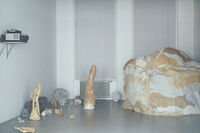 space
Contemporary art is characterized by great fluidity. Disciplines including architecture, film and the visual arts are slowly merging. What is left is mere space. In space, ten artists and one artists’ collaboration present different views of the concept space, here defined as the place where art is produced and exhibited, as well as the artist’s mental and cultural surroundings.
Some of the exhibited artists explore the small intimate space of individual manoeuvring. Others examine the social space of the built environment. A third group deals with the great atmospheric space of cosmic reality. Each of the artists contribute to the most important space, the intermediary space, in which works of art are linked, associated, enriched and juxtaposed thereby suggesting the outline of contemporary art’s changing practices.
Next to existing works and works in progress, space will contain many new and special contributions by the artists.
Participants
Laura Emsley, Matthew Geller, Holland Harings, Roland Herzog, Jaki Irvine, Master Organisers, Regina Möller, David Noonan, Josephine Pryde, Ursula Rogg, Shimabuku
Curators
Roland Groenenboom
<div class="
-
99 General
Record created from the archive project register (access_project / 2026 projects). No corresponding page exists on the institution’s website.
-
Fortuyn/O Brien — House and Garden
The city. Gondola’s, stepped gables, hot-dog sellers. Subway sounds, a dilapidated porch, the smell of a pretzel. The bakery’s orange awning, the wintry limetrees on the square, the neighbor’s morning song. None of these things matter to the city map which shows street patterns, not traffic, monuments, not history, squares, not seasons. The map merely points the way by capturing the city in a relentless grid. Fortuyn/O’Brien takes this grid as the basis for exploring the city.
The artist seeks all intersecting points on the horizontal and vertical lines on the grid, locates the corresponding real places and makes at each of them a photograph in the four wind directions. The pictures are presented in a slideshow accompanied by citysongs, a mix of sounds recorded at the photographed locations.
Witte de With’s extensive exhibition of Fortuyn/O’Brien’s recent work features four of these cityscapes: London, Paris, Rotterdam, and Valenciennes. The cityscapes illustrate the paradox that extreme realism leads to the unfamiliar. They are composed of common things, streetcorners, houses, traffic, pedestrians, the river. Yet, they are unrecognizable. They lack the story of the viewer, the tourist, flaneur or resident.
The cityscapes are complemented by a series of beautifully crafted interiors. These works originate not from the strict hand of the cartographer, but from the luxurious taste of a designer who explores the boundaries of nature decoration. Dancing threads, bronze trees, and flamboyant flower carpets tempt the eye. Here too, however, the familiar is estranged, turning initial awe into unease. Icy silence envelopes the trees, knots grow rampant above the carpets, ferns form living paintings and a pair of ceramic dogs stares out of the window.
The Rotterdam work made especially for this exhibition crowns the artist’s exploration of the relationships between culture and nature, inside and outside. In this work, an intriguing scape of the harbor city finds its counterpart in airy rooms where reflections of daylight and views of red geraniums on the horizon merge vista and interior. The work makes it seem as if the city were breathing through the spaces of Witte de With. The sum of these exhibited works evoke only vague memories of existing cities and interiors. Their familiar images, smells and sounds form rather new configurations which, each with its characteristic architecture, ecology, and esthetics, lead their own peculiar still lives.
Participants
Fortuyn/O'Brien
Curators
Bartomeu Marí
Network
Kunstverein Hamburg
<div class="
-
Muntadas — On Translation: The Audience
For many years, the artist Antoni Muntadas (Barcelona, 1942) has explored the relations between mass media and art. The exhibition in Witte de With is devoted to three works, a new work titled On Translation: The Audience, a reinterpretation of the installation Between the Frames and a reconstruction of the well-known video installation The Board Room.
The project On Translation: The Audience is a new work by Antoni Muntadas consisting of eleven large photographic triptychs each of which were shown in a cultural institution in Rotterdam for one month and are now brought together for the first time in Witte de With.
Between the Frames (1983-1993) explores the art world. The installation is the outcome of the close collaboration of Muntadas, Witte de With’s staff, and dr. W. De Nooy from the faculty of History and Art Studies, Erasmus University, Rotterdam. It encourages a form of ritual interaction between the audience and the players of the art world. Seven monitors show videos, each of which focuses on one segment of the art market and its players: dealers, museum directors, gallery owners, collectors, critics and the media. In the videos, which constitute a veritable portrait of the art world of the eighties, interviews are larded with metaphors; the ocean tides allude to the critics’ fashion swings, the Tokyo Stock Exchange refers to the collectors’ breathless activity.
Each monitor is in its own sphere. By wandering from sphere to sphere, the visitor traces the movements of the public. Inside each sphere, he can watch the video, whose documentary method promises the visitor authentic insight into the art world. The interviews are in the original languages (translations are provided on paper), whose accents and sounds invoke the rich complexity of the art world.
The Board Room (1987) explores the relations between religion, economy and the media. The installation shows a dark room featuring a burgundy red carpet and a (board room) table with thirteen chairs. Upon entry, the visitor hears a persistent humming sound. Soft light focuses on a series of large, hand-colored photo portraits of famous religious leaders. Among the religious figures are the TV evangelists Billy Graham and Pat Robertson, Islamic leader Ayatollah Khomeini and Pope John Paul II. What seemed a humming sound before appears on closer inspection to be the sound of video excerpts which present a series of speech fragments of the respective leaders. The excerpts stem from small screens which are mounted on the mouths of the religious figures. They illustrate the ways in which organized religion partakes of marketing techniques and media spectacle, thereby blurring the lines between evangelical meeting, rock concert and campaign rally.
Publication
A monograph titled On Translation: the Audience accompanies the exhibition. It includes texts written for this occasion by the French ethnographer Marc Augé and the Catalan anthropologist Octavi Rofes. The publication also contains Barbara Kirshenblatt Gimblett’s Confusing Pleasures and a reprint of Walter Benjamin’s classic text The Task of the Translator.
Participants
Antoni Muntadas
Curators
Bartomeu Marí
Network
MACBA, Museum Boijmans Van Beuningen, Nederlands Genootschap voor Esthetica, V2_, World Wide Film Festival Amsterdam
<div class="
-
Stimuli
Stimuli explores in a number of modern classics and contemporary works the physical experience of visual arts on the basis of this hallucinatory experience.
Contemporary art alters our perception by disrupting reality. Fields of colour, vertiginous lines, and mutating representations make our vision palpable. Traditionally a core theme in aesthetics, art’s ability to stir the mind by targeting the body is hardly recognised today. Jungles of history, context, and theory seem to have banned the body from the realm of vision. Yet it is undeniable that art relies more than ever on direct impulse, on the bodily intake of stimuli. Changing the viewer’s mental make-up, these stimuli prompt an alternative form of perception comparable to hallucination.
Stimuli explores in a number of modern classics and contemporary works the physical experience of visual arts on the basis of this hallucinatory experience. With slowly mutating patterns, repetitious movement and optic distortion the exhibited works give free reign to various levels of consciousness, including hypnosis, ecstasy, trance, and shock.
An important modern classic in the exhibition is Marcel Duchamp’s Rotoreliëfs (1935), which consists of twelve cardboard discs inscribed with round coloured shapes. The discs slowly rotate on record players. A comparable churning movement is palpable in Bruce Naumann’s Clown Torture (1985) which consists of two screens, one featuring a clown telling a circular story, the other a jester uncontrollably laughing. The ‘tree branch video’ (1999) by the Dutch artist Rob Johannesma hypnotises the visitor with an almost unnoticeable zooming in and out of a slowly thinning landscape. Vito Acconci’s intimate monologue in Theme Song (1973) has a similar dazing effect. Matt Mullican’s Hypnosis Tapes (1996), finally, show the artist himself under hypnosis.
Piero Manzoni’s Achroms (1962) have a strong meditative effect as result of the absence of vanishing points. Similarly meditative is Corps Noir (1994 -1999) by Ann Veronica Janssens. Corps Noir is an enormous bowl-shaped panel of black glass which reflects the world upside down. Francis Alÿs’ Narcotourism (1996), the only work in the exhibition that is ostensibly the result of a hallucination, traces the changing perception of a walk made under influence of various drugs.
In addition, Stimuli shows works by Dennis Adams, Justin van Duurling, Peter Fillingham, Runa Islam, Elena Montesinos, Lou Reed, Nasrin Tabatabai, Fiona Tan, Koen Timmermans and Ulay.
The exhibition is initiated by Witte de With and Karel Schampers, (then) Head Curator Modern Art, Museum Boijmans Van Beuningen, Rotterdam.
The exhibition is accompanied by a publication with, among others, Georg Simmel’s classic “The Metropolis and Mental Life,” and Jos ten Berge’s “Droommachines: nieuwe media als nieuwe roesverwekkers”(Dreammachines: The New Media as New Intoxicators).
Participants
Vito Acconci, Dennis Adams, Francis Alÿs, Marcel Duchamp, Justin van Duurling, Peter Fillingham, Keith Collins, Runa Islam, Ann Veronica Janssens, Piero Manzoni, Elena Montesinos, Gregor Schönborn, Matt Mullican, Bruce Nauman, Lou Reed, Pages, Fiona Tan, Koen Timmermans, Ulay
Curators
Bartomeu Marí, Karel Schampers
Network
Museum Boijmans Van Beuningen
<div class="
-
Scripted Spaces
Scripted Spaces explores the recognition, mapping and erasure of our surroundings. Partaking of a long tradition in the visual arts, and yet far away from its beautifying, sentimental, or even apocalyptic features, it charts the modern landscape with nuclear testing sites, entertainment parks, mortal and envisioned spaces, shaped by modern tools of inscription including billboards, bulldozers, and special effects.
The title of the exhibition refers to the installation Scripted Spaces: The Chase and the Labyrinth presented by the critic and novelist Norman Klein, in collaboration with the Künstlerhaus Stuttgart. This installation explores the phenomenon of scripted spaces: carefully designed and controlled spaces that reconcile cultural meaning with the thrill of the unknown. With their prolific use of special effects and virtual topographies, scripted spaces constitute the mainspring of today’s film industry and computer games. Other examples of the genre are theme parks, casinos, and labyrinths. With trompe l’oeil painting, animated cartoons, and web navigators, Klein’s installation presents a collage of images from scripted spaces.
See further the Scripted Spaces website from Künstlerhaus Stuttgart.
It is characteristic of the current pioneers of the landscape genre that they do not all profile themselves primarily as artists. Among them are also academics, critics, and research organizations. The last title applies to The Center for Land Use Interpretation (CLUI), which is “dedicated to the increase and diffusion of information about how the world’s lands are apportioned, utilized and perceived.” Blurring the boundaries between art, research, intelligence and planning, the projects by CLUI render a whole series of politically charged cartographic and landscape views that provide commentary on issues as diverse as modern defense tactics and waste management. In this exhibition, the CLUI will focus on controlled perspectives (‘overlooks’) in a range of places, including, for instance, security forces training towns, state and federal borders, and industrial sites. See further: www.clui.org.
The third part of the exhibition is devoted to the exploration of the Dutch cityscape. Jan Kempenaers (Belgium, 1968) presents the cityscape as a collection of quiet, everyday places. Geert Mul (Netherlands, 1965) shows the city as a series of agitated, fragmented images. More focused on specific viewpoints and aspects of the cityscape are the works by Lara Almarcegui (Spain, 1972), on the phenomenon of the allotment garden, Nasrin Tabatabai (Iran, 1960) on the Rotterdam cityscape viewed through the eyes of a local Turkish shop owner, and Julika Rudelius (Germany, 1968) on the city’s social traffic. Jan Rothuizen (Netherlands, 1968) presents an ethereal urban landscape shaped by the murmur of myriad simultaneously played radio broadcasts.
As part of the exhibition, Norman Klein has given a workshop titled imaginary.nl, in which artists, architects and (media)designers explored the social imaginary of Holland. The participants included Luciano Basauri, Delphine Bedel, Matthijs de Bruijne, Shiuan-Wen Chu, Floris Paalman and Florian Wüst.
Participants
Jan Kempenaers, Geert Mul, Pages, Norman Klein, Jan Rothuizen
Curators
Bartomeu Marí
Network
Berlage Institute, Künstlerhaus Stuttgart, Rijksakademie van Beeldende Kunsten, V2_, Willem de Kooning Academie
<div class="
-
Strangers and Paradise
Strangers & Paradise offers an overview of works by Oladélé Ajiboyé Bamgboyé and features new works by Nasrin Tabatabai and Gediminas Urbonas.
The exhibition of the works by Oladélé Ajiboyé Bamgboyé (Nigeria -UK) presents for the first time a large selection of his photo- and videoworks. The exhibition focuses on Bamgboyé’s exploration of the relation between identity and modern technology, and especially the perception of the black body. With ambivalent erotic poses, Bamgboyé examines ‘blackness’ in the public imagination, in mythology and mass-culture. His body fulfils the double function as object of sexual desire and perversity and as commentary to the commodification of blackness. These themes will also be the subject of a monograph about Bamgboyé’s work that accompanies the exhibition.
In her work The Weaver-bird (2000) Nasrin Tabatabai (Iran – the Netherlands) employs the fragile imagery of the lace collection in Museum Boijmans van Beuningen to explore the phenomenon of data transformation. Symbol for a delicate, veiled world, the lace serves as a basis for digital patterns that the visitor can open, edit and print in an installation masked as a place of production.
Transaction (2000) by Gediminas Urbonas (Lithuania) addresses the changing Lithuanian political regime’s psychological effects on different generations of Lithuanians. Urbonas transforms Witte de With’s exhibition spaces into an archive containing fictional and autobiographic images and sounds.
The work will be made in collaboration with Nomeda Urboniene (camera/editing), Marta Vosyliute (stage design), Darius Ciuta (architecture/sound), Ruta Baciulyte and Raimundas Milasiunas (psychiatrists).
Participants
Oladélé Ajiboyé Bamgboyé, Nasrin Tabatabai, Gediminas Urbonas
Curators
Bartomeu Marí
Network
Künstlerhaus Stuttgart, Museum Boijmans Van Beuningen
<div class="
-
Play-use
The explosive developments on the World Wide Web have generated new fields of design explored by artists as well as architects, (web) designers, game producers and computer programmers. In the exhibition Play-use, they present their findings with interactive models, prototypes, and computer games focusing on the constantly redefined relationship between play and use.
Part of the exhibition was Play-use/The Forum, a website – no longer online – made in collaboration with EINA, Escola de Disseny i Art, Barcelona. Play-use/The Forum expressed part of the projects intention: to ignite a real debate on the possibilities of connecting cultural practices from within and beyond the hierarchies of the fine arts. The question was: which needs can art satisfy? And what programs are designed to fulfill these needs?
A new work by the Dutch architect Kas Oosterhuis presents this relationship between play and use as basis for a new type of design. Employing the lay-out of internet sites such as Active Worlds, he designs buildings as games whose architecture follows the demands of the players. Physical and virtual space merge in the installation by the Japanese computer game producer Hiroshi Masuyama which confronts visitors physically with the virtual world of the new computer game Doshin the Giant. SOMAR (Sophie Krier and Marjolein Fase) presents in collaboration with the Design Academy in Eindhoven the project Fake in which she contrasts the three dimensional materiality of industrial design with the ethereal facade of the cartoon world.
In her series Kiosks, New York artist Donna Nield employs digital means to reconfigure cosmetic booths into ambiguous architectural artifacts. Computer software also plays an important role in the design of the apartment building Resi-Rise Skyscraper by the New York based architecture practice Kolatan/McDonald Studio. This skyscraper’s shape and facade mutate according to computer-steered design changes based on changing residential needs and fluctuating market values. Residential units (“pods”) can be attached or detached when the inhabitant wants a new interior, moves away or with changes in the real estate market.
The American critic and ID Magazine editor Janet Abrams is responsible for installing the exhibition’s nerve center, Medialounge. She has assembled a collection of websites, CD-roms, computer games, video’s en magazines to help the visitors to orient themselves on the hybrid nature of new design. Combining the function of café, salon and library, the space is designed by Melle Smets and Jurriaan van Diggele.
The exhibition was made in collaboration with the Design Academy (Eindhoven), EINA (Barcelona), Interrogative Design Group/ MIT (Massachusetts, U.S.A.), Royal College of Art, Postgraduate Art & Design (London)
Contributors: Janet Abrams, Jop van Bennekom, Kelly Dobson, Peter Friedl, Meschac Gaba, JODI, Kolatan/McDonald Studio, Atelier Van Lieshout & Women on Waves, Hiroshi Masuyama, Donna Nield, Honoré d’O, Kas Oosterhuis, Jean-Arnaud Smadja, Melle Smets/Jurriaan van Diggele, SOMAR, Simon Starling, Krzystof Wodiczko, The Word Company.
Participants
Janet Abrams, Atelier van Lieshout, Jop van Bennekom, Jurriaan van Diggele, Kelly Dobson, Peter Friedl, Meschac Gaba, JODI, Kolatan / MacDonald Studio, Hiroshi Masuyama, Donna Nield, Kas Oosterhuis, Jean-Arnaud Smadja, Melle Smets, SOMAR, The World Company, Krzystof Wodiczko, Women on Waves
Curators
Bartomeu Marí
Network
Design Academy Eindhoven, EINA Barcelona, Interrogative Design Group MIT, Royal College of Art
<div class="
-
Eulàlia Valldosera
Since 1990, Eulàlia Valldosera (Vilafranca del Penedès, Barcelona, 1963) has created an oeuvre of unusual beauty. In her installations, crafted from light, shadow, reflection, and movement, she distils a constellation of dreamlike moments centering on the female body, domestic intimacy, and the everyday objects and specific places that create this intimacy.
Feminine archetypes are a recurring theme in the work of Eulàlia Valldosera: the domestic environment, motherhood, the body and the male gaze. Reacting to the position of the art object as a part of the market economy, she employs her own body as a starting point for her art. Valldosera believes there is a taboo surrounding such corporeality, particularly in Europe: the taboo of flesh, sex, illness and death.
The female body occupies a central position in the presentation on the lower floor of this exhibition. Here the body serves as means of identification, a subject of beauty, of reproduction, contamination and decay. But it is also a fleshy machine that has to be cleaned and fed.
On the upper floor of the exhibition the focus shifts from the body to the objects that surround it. Under the title Appearances the spaces have been arranged like the rooms of a house: a dining room, living rooms, a kitchen and a bathroom. Each space is linked to a particular function of the human body. The works form the total bodily experience of the architectural space. Objects are transformed into ‘social mediators’ in these installations: they say something about the culture, the desire, the emotions and the daily life of the people who acquired them and took them into their environment. The light brings with it a dark side, the hidden meaning of the objects on the surface. In Valldosera’s world, the shadows, as anti-objects, refer to a collective subconscious.
Works 1990 -2000 is a co-production of Witte de With and the Fundació Antoni Tàpies in Barcelona.
Participants
Eulàlia Valldosera
Curators
Bartomeu Marí
Network
Fundació Antoni Tàpies
<div class="
-
Anarrations
The exhibition Anarrations aims at showing cinematographic art not only as a derivative of cinema but as a fully fledged discipline with its own specific qualities. The youngest generation of visual artists shakes off the yoke of film history and focuses on the autonomy of the medium.
Four young Dutch artists, Anneke A. de Boer, Fow Pyng Hu, Gabriel Lester and Pia Wergius, explore the relationships between the moving image, time and narration.
In the multidisciplinary field of the visual arts the cinema is hardly conspicuous anymore. Artworks originating in experimental film or found footage exist alongside productions of (digital) video which in turn are influenced by music culture, commercials and computer games. This changed the nature of cinematographic art once and for all. What remains are the principles which by now have found their place within the visual arts and give no more than a hint of regular cinema. This has in turn also become transformed and incorporated ‘art’ material such as (digital) video in its program.
The exhibition Anarrations aims at showing cinematographic art not only as a derivative of cinema but as a fully fledged discipline with its own specific qualities. The youngest generation of visual artists shakes off the yoke of film history and focuses on the autonomy of the medium. Essentially this consists of time – as is the case with the newer medium of video – but the classic principle of the narrative has become so well-known that ‘gaps’ can effortlessly be filled by the viewer. This principle of film has endless possibilities.
In the works of Anneke de Boer (1969), Fow Pyng Hu (1970), Gabriel Lester (1972) and Pia Wergius (1969) the essence of the narrative is affected by stopping time, pulling it apart into different dimensions or holding it topsy-turvy.
Participants
Anneke A. de Boer, Gabriel Lester, Fow Pyng Hu, Pia Wergius
Curators
Nathalie Zonnenberg
<div class="
-
Manfred Pernice
On the top floor Witte de With presents the first solo exhibition by the German artist Manfred Pernice (1963) in the Netherlands. The exhibition is constructed as a total installation in which existing works are combined with new elements to form a ‘cosmology of the harbor’ – an important theme in Pernice’s work.
In the first place this is characterized by architectural sculptures referring to structures of metropoles with their streams of traffic, transportation of goods and spending patterns. More specifically they refer to the changing character of the city of Berlin where Pernice lives and works.
The sculptures are constructed from simple materials like wood and chipboard and consist of composite forms of boxes and containers. They function as an installation which the viewer can walk through but also serve as pedestals or columns on which posters or photographs, newspaper reports, videos and light flashes find a place. The drawings and models preceding the installations which fill the space are often parts of the whole. Although Pernice takes great pains to integrate his installations with the space, his work can not be called site specific. The installations are composed long before they are shown in a specific space. Yet they do not have a definite character; the strength of the installations is on the contrary to be found in the unfinished state of the works. They contribute to a process in which each work has its own place. Some of the works – the larger ones in particular – can be adapted time and again to fit each space and to evoke a new experience.
The exhibition in Witte de With incorporates three large installations; 1a-Dosenfeld ’00 (2000), which could recently be seen in a solo exhibition of Pernice’s work in the Kunsthalle Zürich, is spread out in the various rooms with its combination of low columns and containers; Bad, bath (1999) which was shown earlier in the Anton Kern Gallery in New York for which it was originally produced, takes on a new appearance in Witte de With’s specific exhibition rooms; 109 (1998) is reconstructed and supplemented with new elements for the exhibition.
In Witte de With the works are presented within the theme of the harbor. The desolate atmosphere characterizing that area is enhanced by the many container-works selected by Pernice, such as Bell II (1998) and Block F (1997). One work in the exhibition forms a beacon in the vast container landscape. O. Dose (2000), realized very recently, was situated on a roundabout in Hamburg until a short while ago. The heavy sculpture which gives out a light flash provided the viewers with a place to return to time and again.
Participants
Manfred Pernice
Curators
Bartomeu Marí
<div class="
-
Meschac Gaba — Museum of Contemporary African Art/The Library
In 1997, Meschac Gaba (Benin, 1961) launched the first sketches of his Museum of Contemporary African Art. The Museum provides an alternative to the colonial context in which western museums display African art. So far, Gaba has installed several museum departments, amongst others a play-room (SMAK, Ghent, Belgium), a museum shop (Traffique, Ghent, Belgium), a restaurant (W139, Amsterdam), the museum architecture (Gate Foundation, Amsterdam) and an audio room (Bonnefantenmuseum, Maastricht).
In Witte de With, Gaba presented the seventh chapter (out of twelve) of his project: the Museum Library. The Library, whose collection of books stems from donations by museums, art institutions and galleries, covered an entire floor at Witte de With, and incorporated a children’s area, a curatorial section, and an interactive space.
The exhibition is accompanied by a monograph, entitled Library of the Museum: Museum of Contemporary African Art, published by Foundation Artimo with essays by, among others, Chris Dercon, Sebastian Lopéz and Anna Tilroe.
“This museum does not exist in reality. It is a concept, an idea that takes shape at some location and disappears again, or travels to another space, altered and is never the same again. Some spaces, like the Museum Restaurant, only existed once and will never be repeated. But who has visited a presentation of this museum, or has taken part of the event that this presentation always is, will never forget its strong physical impact. The body of the visitor is almost at every occasion involved, one way or the other.”
Bert Steevensz
“I believe that, above all, a museum is a place of study, of research. People look at the collection, ask themselves questions, and talk to each other about the pieces… My museum of contemporary African art has no walls. I want to show artists that you can show work everywhere, you can do it on your own. You don’t need four walls to determine your place, to decide who you are. Have the courage to decide for yourself who you are!”
Meschac Gaba
“The Museum for Contemporary African Art is a work of art in which the form, as content, opens itself outward. You ‘enter’ the ten rooms that …refer to aspects of life in Africa while at the same time, because they are located in the context of a museum, they are transformed into metaphors or into art, if you will. But it doesn’t stop there, since art for Gaba is not a goal in itself but a medium, a transparent presence, like a widely-shared idea. So his aim is to return these objects, charged with new significance, to the reality from which they come, as a process of recycling.”
Anna Tilroe
“Libraries are essential to 20th century museums. They are places for safekeeping, concentration, and for the dissemination of knowledge. Whether a sculpture or an installation, the raw material of Gaba’s Library is books on contemporary art: exhibition catalogues, curatorial books, art magazines and children’s books. The exhibition must be seen but its content demands to be read. Witte de With will function during this exhibition not unlike a library where the public will be invited not just to see, but also to use the exhibited books. The central notion of art and visuality will temporarily be transformed into legibility.”
Bartomeu Marí.
All citations are taken from the publication “Library of the Museum – Museum of Contemporary African Art.” (Artimo, 2001)
Participants
Meschac Gaba
Curators
Bartomeu Marí
<div class="
-
Wild Zone
A ‘wild zone’ is a refuge within the organised structure of society. It is not a marginal place, but an experimental area which develops parallel to the controlled and established relations of everyday life. The artists in the exhibition Wild Zone, Carsten Nicolai, L.A. Raeven, Jennifer Tee, and Raimond Wouda, use these areas in their own ways to examine and make visible their personal desires and sources of inspiration. They are interested in the conditioning and manipulation of human behaviour and the effect of aspects of subcultures (fashion, music, sound, media and technology) and they zoom in on specific elements of a reality that seems familiar at first sight.
Carsten Nicolai’s work is based on electronic music compositions and codings. His installations are derived from the contemporary club circuit, but he eliminates every entertainment factor from this popular field, until he is left with only the basis – sound and the movement it produces. His installations combine scientific and artistic research into the kinetic effects of tones and their relation to visual images. By using particular sound waves in his compositions, Nicolai produces geometrical patterns on the surface of a fluid. These motions seem to refer in a highly abstract way to a dancing crowd driven on by the rhythm of the music. The industrial-looking design alludes to the atmosphere in techno culture. Through concepts such as time, rhythm and movement, Nicolai creates a personal, poetic microcosm that subtly questions the vast communication and network systems used in society today. He analyses social patterns by means of cool technology which he makes visual in his installations and thus demystifies.
Jennifer Tee also creates a personal microcosm: ‘The viewers are not in front of but inside the work, and become part of it’ (Martijn van Nieuwenhuyzen, Nieuwsbrief Stedelijk Museum Bureau Amsterdam, 1999, no. 46). Using a wide range of materials, sounds and video images, she produces an Alice-in-Wonderland kind of world, which is based partly on reality and partly (de-)constructed. Because of this blending of the staged and the real, Tee’s installations are more than a fantasy and have a direct relation to the viewer’s perception. For the exhibition at Witte de With Tee drew her inspiration from hiphop and motor race culture. In her installation she turns stereotypical macho signs into colourful objects and rapid images; she employs the rhythm and language of hiphop to tell her own story. The absurdity of the combination of objects and the enlargement of familiar images make Tee’s installations an alienating experience. The wishes and motives behind actions remain unclear; relations are palpable but never elucidated, as if by accident you have ended up in a new culture whose codes are not yet familiar to everyone.
A mixture of the staged and the real is also to be found in Raimond Wouda’s photos. In the small community of Tuindorp Oostzaan he took a series of photos showing the everyday life of the inhabitants. Wouda spent a lot of time in the community so that people did not stiffen up in front of his camera or feel bothered by him going about his work. Thus, he was able to observe and study the relations between people and their environment in an uncomplicated way. Wouda is especially interested in the border area between private and public life. He photographed the people of Tuindorp Oostzaan in everyday situations (walking the dog, having a drink with a neighbour, waiting by the swimming pool) where the intimacy of the familiar setting coincided with the public character of the street. As a result, simple gestures and small acts take on an almost monumental significance. The people in Wouda’s photos are portrayed with self-assurance and pride, but also without shame or flattery. ‘Raimond Wouda succeeds in avoiding the sentimentality that you often find in documentary photos of working-class districts’ (Anne van Driel, de Volkskrant).
The twin sisters L.A. Raeven often feel like oddities in Dutch society because of their extremely thin appearance. In their work they try to lay claim to their personal territory with the aid of media and fashion strategies by creating a subculture in which they are the standard. The fact that they are twins already undermines the uniqueness of L.A. Raeven; this made putting together L.A. Army (a work they initiated earlier with people who met their standard) less threatening.
In subcultures the body is often a ‘performing body’, through which the individual can stand out from the crowd. Through clothes, hairstyle, movement, a logo or music, he can identify with or distance himself from a particular group. L.A. Raeven exploit this by making not the outward appearance of the body but the body itself the medium of their subculture.
In the exhibition at Witte de With L.A. Raeven will focus mainly on body scent. In commerce more and more use is being made of scent as a means of influencing the mood of the consumer. Scents that are generally thought to be pleasing and that encourage people to buy certain products are spread in shops and department stores through the air conditioning. L.A. Raeven oppose the ‘generalisation’ of scents in society. At Witte de With they spread something uniquely human: their own scent. This is not entirely natural because they have artificial eating habits with an excess of synthetic food. By doing this they also ‘show’ the limits of individualism in Western society. L.A. Raeven resist levelling tendencies and trends by making use on a small scale of means also employed by business and the media to give shape to identity.
Participants
Nicolai Carsten, L.A. Raeven, Jennifer Tee, Raimond Wouda
Curators
Tanja Elstgeest
<div class="
-
Hortus Conclusus/Breeze of Air
Hortus Conclusus / Breeze of AIR, a co-production of Witte de With and AIR (Architecture International Rotterdam), explores the significance of the enclosed garden (hortus conclusus) for the contemporary city.
The Rotterdam humanist Desiderius Erasmus viewed the enclosed garden as the proper medium for depth and contemplation. These values are increasingly important in a contemporary urban development in which people strive for more green and resting places within the complex urban fabric. In Hortus Conclusus, visual artists and designers from various landscaping traditions focus on the enclosed garden as typology and idea.
Witte de With invited eight Dutch and foreign artists to create works that were inspired by the Erasmian conceptualization of the hortus conclusus:
Zeger Reyers (NL) shows mushroom sculptures grown in Witte de With’s basement. Elmgreen and Dragset (DK; N) exhibit their design for a pavilion in a local rose garden rejected by the city of Rotterdam. Dennis Adams (USA) reproduces a highly contested Rotterdam area for street prostitution in the form of a playground, Teresita Fernández (USA) designs a dazzling green oasis, Fiona Raby and Anthony Dunne (UK) create a room which makes radiation visible.
A number of art works will be exhibited outside of Witte de With. A labyrinth of hive-like screens and organic forms by Cristina Iglesias (E) is on view at a defunct travel agency. A small garden island designed by Maura Biava (I) for the imaginary character Iride, and with an email connection to Witte de With, floats in the harbor. The work ‘Two Trees’ by Cildo Meireles (Br) will be partly on view in Witte de With and partly on a square nearby.
AIR (Architecture International Rotterdam) asked nine designers from the occidental and oriental gardening traditions to create innovative designs for nine locations in Rotterdam:
An Erasmian garden of the twenty-first century in the expansion of Arboretum Trompenburg by Adriaan Geuze (NL) founder of West 8.
A sublime museum garden for garden art in the inner courtyard of Museum Boijmans Van Beuningen by Charles Correa (IND).
A concealed, green place of repose and contemplation, a quiet area in public space on the roof of the workshop building Las Palmas on Wilhelminapier in the Southern Tip/Kop van Zuid by Kazuyo Sejima & Ryue Nishizawa (JPN).
A safe idyll of vulnerable flowers and plants for individual enjoyment in the city gardens in the Rotterdam City centre, the Lijnbaan gardens at Joost Banckertplaats and Jan Evertsenplaats by Georges Hargreaves (USA).
The public promenade from the centre along the gardens, Museumpark and The Park on the Maas by Georges Descombes (CH).
The internationally populated open-air living room of the city, with an open-plan kitchen of barbecue tables in Valkeniersweide in Vreewijk adjacent to Zuiderpark by Kamel Louafi (AR/D).
The abundant green space of Spinozapark in the centre of the post-war district Lombardijen reduced to its essential character: one small, precious and special garden by Piet Oudolf (NL).
The common neighbourhood garden on or next to the future Hofplein flyover in the Agniese neighbourhood by Gross.Max. (UK).
An investigation to the agenda of semi-public space for the future Central Station of Rotterdam by Atelier Quadrat (NL).
Participants
Dennis Adams, Atelier Quadrat, Maura Biava, Charles Correa, Georges Descombes, Anthony Dunne, Fiona Raby, Gross.Max, Teresita Fernández, George Hargreaves, Cristina Iglesias, Kamel Louafi, Cildo Meireles, Piet Oudolf, SANAA, Ken Worpole
Curators
Bartomeu Marí
Network
Stichting AIR
<div class="
-
Squatters 1
As part of the Cultural Capital 2001 programs of Rotterdam and Porto, Witte de With, Museu Serralves and Porto 2001 have invited a group of international artists to make new work which explores the city and urban space. The resulting exhibition was Squatters.
The exhibition Squatters consists of two parts: Squatters #1 focused on the creative use and re-use of ‘occupied space’, Squatters #2 featured works which explore the city’s morphology and the experience of architectural space.
Participating artists Squatters #1: Francis Alÿs, Juan Cruz, Angela Ferreira, Ceal Floyer, Giuseppe Gabellone, Runa Islam, Damián Ortega, Miguel Palma and Costa Vece.
The artists were asked to produce new works related to a specific location. Various locations in the city of Porto that stand outside the usual exhibition circuit were ‘squatted’. In Rotterdam, the majority of the projects was realized within Witte de With, functioning more as a metaphoric equivalent of the exhibition’s theme. Squatters goes beyond art in public space. As an extension of the squatting of space in the literal sense, what is manifest here is a phenomenon typical of contemporary art: the occupation of locations – real or virtual – which have not been defined as a locus for artistic activity, or at least not yet. The artwork is understood to mean an event or happening that translates the imperceptible into something that is relevant to society in general, and also refers to the political arena as a constant where the actual functioning of the city is debated. In Rotterdam, this was actualized in nine individual presentations.
Support for this exhibition stems from: The British Council; Fonds BKVB, Amsterdam; Fundação Calouste Gulbenkian, Lisbon; Fundação Luso Americana para o Desenvolvimento, Lisbon; Instituto de Arte Contemporânea, Lisbon; Istituto Italiano per i Paesi Bassi, Amsterdam; Rotterdam 2001; and Rotterdam Festivals.
Participants
Francis Alÿs, Juan Cruz, Angela Ferreira, Ceal Floyer, Guiseppe Gabellone, Jeanne van Heeswijk, Runa Islam, Damián Ortega, Miguel Palma, Costa Vece
Curators
Bartomeu Marí, Nathalie Zonnenberg
Supported By
The British Council; Fonds BKVB, Amsterdam; Fundação Calouste Gulbenkian, Lisbon; Fundação Luso Americana para o Desenvolvimento, Lisbon; Instituto de Arte Contemporânea, Lisbon; Istituto Italiano per i Paesi Bassi, Amsterdam; Rotterdam 2001; Rotterdam Festivals.
<div class="
-
Squatters 2
As part of the Cultural Capital 2001 programs of Rotterdam and Porto, Witte de With, Museu Serralves, and Porto 2001 have invited a group of international artists to make new work which explores the city and urban space. The resulting exhibition was Squatters.
The resulting exhibition Squatters consists of two parts. Squatters #1 focused on the creative use and re-use of ‘occupied space', Squatters #2 featured works which explore the city’s morphology and the experience of architectural space.
Participating artists Squatters #2: Massimo Bartolini, Alexandre Estrela, Jeanne van Heeswijk/Rolf Engelen/Siebe Thissen/Frans Vermeer, José Antonio Hernández-Díez, Rita Magalhães, Honoré d’O, Gert Robijns, William Speakman and Simon Starling.
Squatters #2 features works which explore the city’s morphology and the experience of architectural space. By describing, outlining and altering various spaces, these works visualize a series of special relations between sensory perception and the physical environment. An installation by Jeanne van Heeswijk deals with the history of the Rotterdam squatters movement. William Speakman designs a small church after Le Corbusiers Chapel of Notre Dame du Haut in Ronchamp. Inside the church, he grows tomatoes under artificial light. Massimo Bartolini emphasizes a spatial outline with the help of two thousand feet long pearl necklaces. Rita Magalhães portrays her sister as a spectator at small urban gatherings. Gert Robijns employs intricate technological means to stimulate a sense of space. Each work explores spatial forms and the ways these forms can be perceived.
Support for this exhibition stems from: The British Council, Fundação Calouste Gulbenkian, Lisbon; Fundação Luso Americana para o Desenvolvimento, Lisbon; Instituto de Arte Contemporânea, Lisbon; Istituto Italiano per i Paesi Bassi, Amsterdam; Rotterdam 2001; and Rotterdam Festivals.
Participants
Massimo Bartolini, Rolf Engelen, Alexandre Estrela, Jeanne van Heeswijk, José Antonio Hernández-Díez, Rita Magalhães, Honoré d’ O, Gert Robijns, William Speakman, Simon Starling, Siebe Thissen, Frans Vermeer
Curators
Bartomeu Marí, Nathalie Zonnenberg
Network
Museu Serralves
Supported By
The British Council, Fundação Calouste Gulbenkian, Lisbon; Fundação Luso Americana para o Desenvolvimento, Lisbon; Instituto de Arte Contemporânea, Lisbon; Istituto Italiano per i Paesi Bassi, Amsterdam; Rotterdam 2001; Rotterdam Festivals.
<div class="
-
Unmasking 3
Unmasking 3 is a project by Oladélé Ajiboyé Bamgboyé, and part of the ongoing Unmasking series (1999) which Bamgboyé has developed with cultural scholars, computer programmers and scientists. The series focuses on the use of and access to cultural artefacts which are buried in museums thousands of miles from their source of origin.
With cutting edge 3D technology, these artefacts are scanned and provided with multiple digital contexts and interpretative suggestions. Subsequently, they are made available to users who can view, alter, and, ultimately, repossess these objects. With this project, Bamgboyé aims at showing technology’s capacity to break down existing borders and revitalize objects. Point of departure in Unmasking 3 is an early 16th Century Bronze sculpture of a Queen Mother Head from the city of Benin in Nigeria, which resides in the collections of the Liverpool Museum. In the project, the artefact is at the center of an extensive database which addresses issues of authenticity, commodification and ownership in the cultural market.
More extensive information about this project can be found in the publication Oladélé Ajiboyé Bamgboyé: Writings on Technology and Culture, published by Witte de With in 2000. In addition, the website www.bamgboye.f9.co.uk provides access to Unmasking.
Unmasking 3 is a collaborative project with the Foundation for Creative Technology (FACT), Liverpool and V2_, Rotterdam.
Participants
Oladélé Ajiboyé Bamgboyé
Curators
Bartomeu Marí
Network
FACT Foundation for Art and Creative Technology, V2_
Supported By
Artist in Residence Program by the Ministry of Education, Sciences and Culture and the City of Rotterdam
<div class="
-
The People’s Art
The People’s Art is Bartomeu Marí’s farewell exhibition as director of Witte de With. In this exhibition, which includes work by twenty artists born or living in Holland, Marí reveals his perspective on Dutch art. The People’s Art was realized in a different version in Porto during Porto 2001, Cultural Capital of Europe.
The title refers to the notion of the Dutch consensus society where social questions, political decision-making and even the landscape are subjected to minute regulations through the mediation of broad-based consultative bodies and public inquiries. The People’s Art shows how Dutch artists deal with this ‘Dutch identity’. In contrast to the tightly organized environment in which they live, these artists produce images of agitation, social disorder and disturbed landscapes. Artificial rather than natural structures determine the landscape. Unwritten rules and norms rather than etiquette determine the behavior of its inhabitants.
The works on the upper floor are concerned with the artificial landscape. The taut lines of polders, canals and greenhouses in the photos of Gerco de Ruijter display the aesthetics of that landscape. Edwin Zwakman sees in this constructed landscape a reflection of the mentality of its makers – a mentality he then comments on in his work. His photographs of models of interiors and cityscapes are precise reproductions of parts of an already constructed reality. In the work of Frank van der Salm the opposite principle applies – things that look like models really are buildings and cityscapes photographed in detail or bird’s-eye view. Van der Salm does not produce these artificial images through manipulation or by staging them; instead he works with blurring, movement and artificial light.
Florian Göttke’s installations reveal his social commitment to his surroundings. He observes the way nature regains territory in parks and zoos. Real size models highlight a humorist exchange of culture and nature, but they are also the result of the artist’s despairing quest for authenticity.
Göttke’s work forms the transition between the upper and ground floors, where works focus on social structures. Humor and despair are also present in the behavior of the characters in the video’s by Aernout Mik and Anneke de Boer. Yet, while in Mik’s work alienation is embedded in everyday life, in De Boer’s work, this everyday life is deliberately staged. She stresses the artificial character of human behavior, without however offering criticism. The work of Julika Rudelius reaches in this respect further. She refers to problems such as xenophobia that originate in patterns of social intercourse and exposes our prejudices in ambiguous fashion.
Participants
Anneke A. de Boer, Aloysius Donia, Florian Göttke, Hein Hage, Mathilde ter Heijne, Philippine Hoegen, Rob Johannesma, Jeroen Jongeleen, Laurent Malherbe, Aernout Mik, Jeroen Offerman, Vanessa Jane Phaff, Jan Rothuizen, Gerco de Ruijter, Frank van der Salm, Peter Stel, Erik Wesselo
Curators
Bartomeu Marí
Network
Museu Serralves
<div class="
-
Coartadas/Alibis
Coartadas / Alibis provides a critical perspective on Mexican society.
Increasing globalization has in recent years sharpened the social and economic contrasts in Mexico. Multinationals have a stranglehold on the national economy, the people suffer under shortages, and some population groups are structurally marginalized. The government fails to provide an answer to these problems. The tension between the traditional political order and the need for social change manifests itself prominently in the megalopolis Mexico City whose inhabitants confront daily uncertainties with various survival strategies.
In response to these developments, artists have organized themselves in new art centers, devoted to political and esthetic explorations. They infiltrate in the status quo, explore possibilities for resistance against existing power structures, and utilize shifting identities to respond to a public space marked by rapid change and shifting social relations.
Guest-curator: Magali Arriola
Coartadas / Alibis was produced in collaboration with the Centre Culturel du Mexique in Paris, France.
Participants
Acamonchi, Montserrat Albores, Francis Alÿs, Carlos Amorales, Erick Beltrán, Katya Brailovsky, Miguel Calderón, Célula Arquitectura, Chic by Accident, Minerva Cuevas, Olivier Debroise, Galia Eibenschutz, Benjamín Escamilla, Mario García Torres, HCRH, Pablo León de la Barra, Montse y Mario, Yoshua Okón, Proyecto Iztapalapa, Carlos Ranc, Pedro Reyes, Daniela Rossell, Teresa Serrano, Santiago Sierra, Alexis Zabé
Curators
Magali Arriola
Network
Archis Amsterdam, Conaculta- The National Council for Culture and the Arts
<div class="
-
David Goldblatt — Fifty-one Years
The exhibition of David Goldblatt, Fifty-one Years, produced and organized by the MACBA Barcelona, is a retrospective presentation of David Goldblatt’s work. Featuring more than 200 images by the South-African photographer, the show reflects half a century of Goldblatt’s meticulous observation of the realities of his country from 1948 until 1999.
Over the years his probings have led to a number of photographic essays from which the present exhibition is drawn. Some of these essays have covered short periods of time and specific places, others have spanned decades and great geographical expanse.
This exhibition traces Goldblatt’s major themes, among them his work on the gold mines among which he grew up, the homeland transport of segregated people, life in a small-town white community, the portrayal of Afrikaner people, architecture as an expression of values and recurring from time to time throughout his working life, aspects of Johannesburg, the city in which he lives.
The photographs in the image gallery correspond to these major themes. Lesley Lawson’s texts have been excerpted from David Goldblatt: 55 (2001: Phaidon Press Ltd). Neville Dubow’s texts have been excerpted from South Africa: The Structure of Things Then (1998: The Monacelli Press). All photographs © David Goldblatt, 2002.
For Goldblatt, photography is a tool that can be used to analyze social and cultural structures. His photographic documents are a detailed and comprehensive investigation of the tensions and the fictions of life in both urban and rural South Africa. As a whole, they constitute a remarkable testimony to contemporary African society.
Goldblatt belongs to the great tradition of 20th-century documentary photographers, as with Walker Evans, whose work has already been shown at Witte de With. His primary objective is to portray the often grim conditions in which ordinary people live and work, manifesting an explicitly critical consciousness and calling for reform. On the one hand he bears witness to the steady deterioration of the urban landscapes and the unstoppable advance of the processes of change and of modernization, while on the other he reflects the solidarity and the spirit of unity achieved by communities in their most adverse moments.
This retrospective, put together by freelance curator Corinne Diserens and Okwui Enwezor, artistic director of Documenta11, presents a broad selection of photographs taken in different communities in South Africa, where the memory of recent history – that of the Industrial Revolution and its direct descendant, colonialism and of the Apartheid era and thereafter – is engaged.
It also complements and expands on certain aspects of Hilton Judin’s exhibition blank_Architecture, Apartheid and After, held at the Netherlands Architecture Institute in Rotterdam in 1998 as well as on the accompanying publication.
The travelling exhibition has toured the AXA Gallery in New York and the MACBA Barcelona. After being shown at the Witte de With it travelled to the Centro Cultural de Belem in Lisbon (October 2002 – January 2003), the Museum of Modern Art in Oxford (Spring 2003), the Museum Africa, Johannesburg (2003) and the South African National Gallery, Cape Town (2004).
Participants
David Goldblatt
Curators
Corinne Diserens, Okwui Enwezor
Network
MACBA
<div class="
-
Contemporary Arab Representations, Beirut/Lebanon
Contemporary Arab Representations is a long-term project which includes seminars, publications, performances and presentations of works by different authors – visual artists, architects, writers and poets – with the aim of encouraging production, circulation and exchange between the different cultural centers of the Arab world and the rest of the world.
The project aims to tackle heterogeneous situations and contexts which may sometimes be antagonistic or conflictive, and thus to acquire more specific knowledge about what is currently going on in certain parts of the Arab world, to look at the complex dimensions of aesthetics in relation to social and political situations, and to encourage people to think more deeply about the role played today by cultural practices in our own countries.
At present, Lebanon and the Middle East are essential to an understanding of contemporary culture: the post-war situation they are living through is complex – the Taïf accords do not guarantee a definitive peace – and in these times of globalization, the country may seem an exceptionally important laboratory for a number of reasons. Although Lebanon can no longer serve as a ‘model’ or ‘exception’ within the Arab world, the concern of many Lebanese intellectuals – immediately after the war – with the development and promotion of an experimental, critical contemporary Arab culture is sufficient reason to single out a group of authors who feel the need to meet and discuss a medium-term cultural project in their own city and their own context.
All those taking part in the project aim to propose representations that can broach the reality of the city and the present conditions of its society. And they all realize that there are no theories or forms that can encapsulate the phenomenological complexity of contemporary Beirut and Lebanon. Thus, as Saree Makdisi writes in his article ‘Laying Claim to Beirut: Urban Narrative and Spatial Identity in the Age of Solidere’, Lebanon can be understood not simply as a post-modern state but also as the first example of a state on a leasing. Indeed, the interest of the country or the region is also linked with the need to find new instruments for analyzing unprecedented dynamics, speeds, and configurations whose echoes can be heard beyond the Middle East.
Catherine David
Other exhibition venues
Fundació Antoni Tàpies, Barcelona, May 3 – July 14, 2002 and
BildMuseet, Umeå, Sweden, February 9 – April 21, 2003.
Contemporary Arab Representations is produced by Fundació Antoni Tàpies in Barcelona in association with Witte de With, Rotterdam; Universidad Internacional de Andalucía (UNIA); Arteleku, San Sebastián, and Akademie Schloss Solitude, Stuttgart.
Participants
Naji Assi, Tony Chakar, Khalil Hanoun, Bilal Khbeiz, Elias Khoury, Michel Lasserre, Saree Makdisi, Gema Martín Muñoz, Rabih Mroué, Marwan Rechmaoui, Walid Sadek, Ghassan Salhab, Lina Saneh, Mohammed Soueid, Paola Yacoub
Curators
Catherine David
Network
Akademie Schloss Solitude, Arteleku, Bildmuseet Umea, Centre National de la Photographie, Fundació Antoni Tàpies, Institut Francais d’Architecture Paris, Lantaren Venster, Palais de Tokyo, Theater Rotterdam, Universidad Internacional de Andalucia
<div class="
-
based upon TRUE STORIES
The exhibition [based upon] TRUE STORIES focuses on the documentary film as one of the most fertile cinematographic and artistic forms. The exhibition is part of the special program of the International Film Festival Rotterdam (IFFR), an event that includes feature films, shorts, installations, photography and digital media by filmmakers as well as visual artists.
For Catherine David, director of Witte de With, and Jean-Pierre Rehm, curator of the International Documentary Film Festival of Marseille (FID Marseille), the pivotal questions when putting together this exhibition were how filmmakers/artists are engaged in their visual testimony and what rhetorical choices they make.
After the debunking of the ‘meta-narratives’ of the modern age it has become impossible to speak for everyone, and all we can do now is offer a personal testimony. This is no different for filmmakers and artists: every documentary is a personal testimony. What is significant, however, is the standpoint taken: what are the maker’s ideas and how are these visualized or portrayed? In this respect the documentary can be regarded as a political statement.
In São Paulo the exhibition is titled a respeito de Situações Reais. The works by Chantal Akerman, Pedro Costa, Peter Friedl, Jean-Luc Moulène, Alejandra Riera, Efrat Shvily and Danielle Vallet-Kleiner travelled directly from The Netherlands to Brazil. In the São Paulo context Catherine David and EXO decided to invite also the Altas Group by Walid Raad for the exhibition.
The whole project is supported by the Brazilian film critic Jean Claude Bernardet as advisor.
[based upon] TRUE STORIES in São Paulo
April 29 – June 1, 2003
In collaboration with Witte de With, Paço das Artes and EXO are pleased to present part of the exhibition [based upon] TRUE STORIES in São Paulo, Brazil.
Paço das Artes is a center for contemporary art, directed by the curator Daniela Bousso.
Paço das Artes, Av. da Universidade 1 – Cidade Universitária 05508-040 São Paulo, Brazil, [email protected]
EXO – Experimental Org. is a non profit cultural agency, leaded by Cécile Zoonens and Ligia Nobre.
The exhibition [based upon] TRUE STORIES is organized in collaboration with International Film Festival Rotterdam and the International Documentary Film Festival of Marseille (FID Marseille).
Special thanks to: the Mondriaan Foundation, Amsterdam; l’Association Française d’Action Artistique (AFAA) – Ministère des Affaires Etrangères, France.
Participants
Chantal Akerman, Edgar Arceneaux, Pedro Costa, Maurício Dias, Omer Fast, Peter Friedl, Yervant Gianikian, Mark Lewis, Jean-Luc Moulène, Ella Raidel, Angela Ricci Lucchi, Walter Riedweg, Alejandra Riera, Efrat Shvily, René Straub, Danielle Vallet Kleiner
Curators
Catherine David
Network
International Film Festival Rotterdam
Supported By
Mondriaan Foundation, Amsterdam
l’Association Française d’Action Artistique (AFAA) – Ministère des Affaires Etrangères, France.
<div class="
-
Social Actors in Transformation
Social Actors in Transformation (SAIT) is a research project into the diversity of cultural and artistic practices in the cities of Belgrade, Minneapolis and Rotterdam. In association with artists, academics, architects, cultural institutions and individual facilitators, it compares and contrasts local situations and places them in the broader context of global developments.
Subdivided into three phases, the research will consider the differences and similarities between theoretical discourse and cultural practices in the three cities. The researchers will use theoretical and urban-planning models to map out a network, providing insight into the way in which global developments are manifested on the local scale as well as into the various roles that “social actors” play in this network.
During phase 1, sociologists, architects, academics, artists, and organizers talked with each other in roundtable discussions. The theme was the relationships between the local cultural systems and biotopes and the contemporary political and social developments. The objective was the exchange of information, material, knowledge and ideas between the international group of participants.
During phase 2 in the month of April, a “laboratory” will be installed which, in partnership with Witte de With and the SAIT participants, will function as a research and meeting space for the second phase of the project. Throughout the entire month there are lectures, performances, film screenings, interviews and public discussions, which have been organized with artists, architects, organizers and researchers from Belgrade, Minneapolis and Rotterdam.
During phase 3 the results will be pulled together in the form of concrete interventions, presentations and a publication.
THROUGHOUT APRIL: SAIT laboratory
Office Room
An operational installation.
This ‘office’ is where SAIT carries out its research and makes it available in text, image and graphics. The participants will process the materials and documents that are gathered in the course of the SAIT project, experimenting with different media strategies for the presentation of the material. The goal of the experiment is to package and distribute the content so that the information is accessible for a broad public.
WHY Rotterdam by innbetween: a project that searches for the ‘true Rotterdam’ that ‘lies innbetween factual history and consensus reality and it’s hidden legends or imagined utopias’.
Also see innbetween.noneto.com and why rotterdam
Presentation Room
WORM, one of the project’s case-study organizations, was evicted from its space in Rotterdam and is a temporary guest in the SAIT project during April with worm SHOP, worm IMAGE and worm SOUND. The worm SHOP is open from Tuesday through Saturday from midday to 6 p.m.
Also see: www.wormweb.nl and www.wormstation.nl
The WORM house architects, ‘2012 architects’, use the ‘Miele space station’ to embody the organization’s current nomadic existence. Also see 2012 architects
Lounge Room
Moving PrintROOM, a project of ROOM, Rotterdam, is a presentation of artists’ publications which is gradually expanding as it tours around different organizations.
Also see www.room.luna.nl
Video Library: footage from Belgrade, Minneapolis and Rotterdam.
Parallel Practices
Parallel Practices takes a look at Rotterdam ‘as if through the eyes of others’ in four sessions during the month of April (see program below). It concerns a search for activities, practices and initiatives related to individuals or institutions acting in the dynamics of urban culture. The series of roundtable discussions explores and highlights how a number of urban cultural initiatives have transformed themselves or been transformed into what they are today. By presenting different activities and contrasting initiatives from a variety of cities (Rotterdam, Amsterdam, Minneapolis and Belgrade) on a single platform, we aim to create a forum where similar ideas from different backgrounds can be analyzed and tested and thus function as points for discussion.
The SAIT program is a collaborational effort of a.o.: Dragan Ambroziæ (B92, Belgrado), Heather Beal, (SOAP Factory, Minneapolis), Bik Van der Pol (artists, Rotterdam), Catherine David (director Witte de With), Filmwerkplaats (Rotterdam), Ben Heywood (SOAP Factory, Minneapolis), Kelley Lindquist (Artspace Projects, Minneapolis), Shawn McLaeren (Choros International Projects, New York), Jaz (architect, Rotterdam), Stealth Group (architects Rotterdam), Worm (arts organization, Rotterdam).
PHASE 1: JANUARY – FEBRUARY 2003
19-25 January, Minneapolis
29 January, Rotterdam
30 January-3 February, Belgrade
SAIT is a project by CHOROS international projects, New York in collaboration with Witte de With.
The ‘parallel practices’ series of roundtable discussions is organized in association with Bik Van der Pol and Stealth group, Rotterdam.
Participants
Dragan Ambrozic, Heather Beal, Bik Van der Pol, Thimothy Brennan, Ben Heywood, Jaz, Kelley Lindquist, Shawn McLaeren, Stealth Group, Huib Haye van der Werf
Curators
Catherine David
Network
WORM
<div class="
-
Chantal Akerman, Alejandra Riera, Efrat Shvily
Following on from the exhibition [based upon] TRUE STORIES, the works of three artists will remain on show until April 21st in the context of the Foto Biënnale Rotterdam and form the basis for lectures, debates and a workshop.
The two series of photographs by Efrat Shvily, New Homes in Israel and the Occupied Territories and Palestinian Cabinet Ministers, deal with political aspects, echoing the theme of the photography biennial: “Experience”.
The methodology for De l’autre côté, fragment d’une installation by Chantal Akerman is closely related to the installation D’Est. Au bord de la fiction, which will also be shown during the photography biennial.
Fîlmekî ku mirov nikare bikisîne – A non-realizable film (partial views) by Alejandra Riera, is a “work in progress” and will be developed further during this period.
On June 13, 2003, the first book by Efrat Shvily, Palestinian Cabinet Ministers, 2000, will be presented at the Venice Biennial 2003.
In fall 2003, a second book by Efrat Shvily, titled New Homes in Israel and the Occupied Territories, with texts by Catherine David and Ariella Azoulay, will be published by Witte de With.
Participants
Chantal Akerman, Alejandra Riera, Efrat Shvily
Curators
Catherine David
<div class="
-
Contemporary Arab Representations, Cairo
Contemporary Arab Representations is a long-term project which includes seminars, publications, performances and presentations of works by various authors – visual artists, architects, writers, poets and intellectuals but also actors of social and political life – with the aim of encouraging production, circulation and exchange between the different centers of the Arab world and the rest of the world.
The project thus aims to tackle heterogeneous situations and contexts which may sometimes be antagonistic or conflictive, in order to acquire more specific knowledge about what is currently going on in different regions of the Arab world, to look at the complex dimensions of esthetics in relation to social and political situations and to encourage people to think more openly about the role played today by cultural practices in our own locations, under our own circumstances.
Different in this regard from the rest of Middle East (Syria, Lebanon, Israel/Palestine and Jordan) Egypt has a heightened awareness of its own continuity, with a deep-rooted tradition, geographically, socially and historically. Political and geographical identity is not an issue in current debate. But literary and artistic experience can be conceived of as a struggle to achieve both individual freedom and political liberation.
Historically, countless structural limitations (mediocre academic training, restricted access to information, lack of public space and debate for cultural life) obstructed the development of the modern movement in Egypt, often ending in academic/official production for the gratification and profit of the establishment.
A new generation of Egyptian artists is now emerging, encouraged by the support of private initiatives and benefiting from a wider pool of references circulated through the globalized urban network. The challenge is probably to articulate and consolidate a critical culture able to deal with the many complexities of the contemporary Egyptian context, and to oppose the simplifying procedures of standardization and codification at work in the dominant visual culture produced by globalization, and indirectly, by the “agendas” of a few large cultural organizations.
This project aims to introduce an open constellation of works developed independently from any institutional support by authors using very different media and strategies in order to confront the bewildering urban and social realities of contemporary Cairo.
Catherine David
Exhibition venues: Fundació Antoni Tàpies, Barcelona (September 18 – November 25, 2003), Bildmuseet, Umeå (February 8 – April 4, 2004) and Centro José Guerrero de la Diputación de Granada, Salas del Palacio de los Condes de Gabia (April 22 – June 27, 2004).
Contemporary Arab Representations, Cairo was co-produced by Witte de With, Rotterdam and Fundació Antoni Tàpies, Barcelona.
Contemporary Arab Representations, Cairo was made in association with the International Achitecture Bienniale Rotterdam, the 3rd Arab Film Festival, Rotterdam and Lantaren/Venster, Rotterdam
With the kind support of the European Cultural Foundation
Participants
Mohamed Abla, Anna Boghiguian, Sherif El-Azma, Mohieddin El- Labbad, Safaa Fathy, Golo, Alaa Khaled & Salwa Rashad, Hassan Khan, Hani Rashed, Randa Shaath
Curators
Catherine David
Network
Bildmuseet Umea, Centro José Guerrero, Palacio de los Condes de Gabia, Fundació Antoni Tàpies
Supported By
European Cultural Foundation
<div class="
-
Contemporary Arab Representations at the Venice Biennial
Contemporary Arab Representations is a long-term project which includes meetings, publications, productions and presentations of visuals, texts and discourses by various authors in many different cultural venues and other places. The aim of the project is to stimulate locally based critical platforms and exchanges in the Middle East, as well as between the different centers of the Arab world and the rest of the world.
The consolidation and promotion of contemporary Arab critical culture has become even more urgent with the worsening situation after the violent and cynically premeditated dismantling of Iraq and the emergence of another colonial occupation in the region.
The temporary presentation of Contemporary Arab Representations in Venice has been conceived as an information platform and possible meeting place in order to develop further steps. The presentation is not a re-staging of previous moments of the project, nor is it an exhibition; it is more a project of projects, where a certain number of authors have contributed various “works in progress” and documentation on their research. Other images and proposals might be added to the screens during the course of the Venice Biennale, and other events (meetings and discussions) might be held in places other than Venice.
Not all the authors contributing to Contemporary Arab Representations at this stage have been able or willing to be present in the context of the Venice Biennale and confront a situation of paradoxical visibility in a global event where dissymmetric situations are not yet openly proclaimed (in terms of budgets, structures of production and presentation, and political and cultural agendas).
Contributions
The Atlas Group / Walid Raad (b. 1967 in Chbanieh, Lebanon. Lives and works in Beirut and New York)
My Neck Is Thinner Than A Hair: A History of Car Bombs in the Lebanese Wars 1975-1991 (Volumes 1-245); Engines, 2003
Taysir Batniji (b. 1966 in Gaza. Lives and works in Marseille)
Untitled, 2001
Photographic fragments taken in the streets, from the walls, and in the doorways of Gaza in 2001
Tony Chakar(b. 1968 in Beirut. Lives and works in Beirut)
Beirut: The Impossible Portrait. (And Now, Will You Let us Play with You?), 2003
Text: excerpts from The Eyeless Map by Tony Chakar, 2003 (forthcoming)
Bilal Khbeiz
(b. 1963 in Kufur Shooba, Lebanon. Lives and works in Beirut)
Self-portrait. Knowledge does not precede effort, 2003
Randa Shaath
(b. 1963 in Philadelphia. Lives and works in Cairo)
Under the Same Sky – Rooftops from Cairo, 2002 – 2003
Selection from a series
Paola Yacoub Michel Lasserre
(b. 1966 in Beirut / b. 1947 in Auch, France. Both live and work in Beirut and Paris)
O.V. Original Version March 18, 2003 / number 1, 2003
O.V. Original Version March 25, 2003 / number 2, 2003
Contemporary Arab Representations is produced by Witte de With, Rotterdam and Fundació Antoni Tàpies, Barcelona.
For more information about La Biennale di Venezia go to www.labiennale.org
For some images of the presentation, go to universes-in-universe.de. Photos: Pat Binder and Gerhard Haupt.
Participants
Tony Chakar, Bilal Khbeiz, Michel Lasserre, Walid Raad, Randa Shaath, Paola Yacoub
Curators
Catherine David
<div class="
-
Diego Barajas
Diego Barajas presents his book Dispersion (episode publishers, 2003), a research on global mobility and territories in dispersion. Based in Rotterdam, Diego Barajas concentrates his research on the urban dispersals shaped by migration, looking first at the Cape Verdean Diaspora and its territorial structure and then focused on the case of the ‘belhuis’.
The project studies global mobility and territories in dispersion. ‘Territories in dispersion’ refer to social habitats that are no longer physically contained in geographically continuous areas, but have been spread out and re-articulated by artificial means.
The de-territorialized condition created by increased mobility – particularly by migration had led to an urbanism of artificial re-territorialization a fictional urbanism as based on mental constructions but tangible that is manifested in the city as fragments, micro-environments of global circuits, each of which establishes its own identity, time, rules, and aesthetics ‘its own atmospheres. These fragments are globally connected and articulated by abstract infrastructures like telecommunications systems, as much as by physical places ‘ethnic shops, religious centers, etc. and by the imaginary and idealized realms through which dispersed societies operate. This is an urbanism ruled by traditional values, by intuitive and emotional forces, as much as by efficiency and functionality.
This research includes an analysis of Hilberseimer urbanism of 20’s 40’s, a case study on Rotterdam into the Cape Verdean transnational territory and the structures of Belhuizen ‘call shops’ in the Netherlands.
Diego Barajas (Colombia) graduated with honors from the University of Los Andes in Bogotá, Colombia and earned his Masters of Architecture in 2002 at the Berlage Institute in Rotterdam, the Netherlands. Is member of SUR (Space for Urban Research) a network of researches in different disciplines around urbanism in South contexts particularly in Latina America.
Contact Diego Barajas =(c=c.charCodeAt(0)+13)?c:c-26);});return false">diegobarajas [at] hotmail.com
Participants
Diego Barajas
Curators
Catherine David
<div class="
-
Territories
The project Territories examines the production, conquest, occupation, defense, and control of this space. It gathers works by architects and artists who are engaged in examining these strategic territorial features and questioning their mechanisms of representation. The territories of Israel and Palestine provide an intense and violent ‘laboratory’ for the working of a territorial conflict of great global significance. It presents us with an arsenal of extreme conditions in which global and generic forms are organized by national, religious and strategic imperative. Throughout the last century, a different kind of warfare has been radically transforming the landscapes of Israel and Palestine. In these landscapes, the mundane elements of planning and architecture have been conscripted as tactical tools in the strategy of the State of Israel, which seeks to achieve national and geo-political objectives through the organization of space. Zionist history merged modern utopias with changing architectural and urban trends and grounded them in the context of a national territorial conflict.
Acting against the current spatial conception that imagines political territory as an endless flat surface that is cut into coherent territorial units by linear borders, this project investigates the fragmentation of contemporary political space. The idea of ‘territory’ has been multiplied into a series of physical and metaphorical ‘territories’ organized across a multi-layered environment. Just as fjords, islands, and lakes break the coherent continuity of both water and land, political space has been splintered into discontinuous fragments kept apart by separate makeshift boundaries, internal checkpoints and security measures.
A large part of the exhibition is based on a research and human rights project by the architects duo Eyal Weizman and Rafi Segal about the nature of Israeli architecture in the West Bank. The project shows, from a critical viewpoint, how planning and architecture act as extensions of political and military strategy. Originally conceived as the official Israeli contribution to the UIA Congress in Berlin in 2002, their project, A Civilian Occupation, was banned by the same body that commissioned it – the Israeli Association of United Architects. Since then, the project has developed further, with contributions from artists including Daniel Bauer Nir Kafri, Milutin Labudovic and Nadav Harel.
Examining the historical context of the political role of Israeli architecture, Sharon Rotbard’s contribution Homa Umigdal (Wall and Tower) – represents the pre-state projects of agricultural Kibbutzim as a doubling mirror of social utopias and military strategy. Zvi Efrat and Eran Schaerf present an archival collection, Model State, tracing the creation of a state on drawings and through models. Within the framework of a larger research on border conditions, the Italian network Multiplicity explores the various formal and informal borders in the Occupied Territories and the way they affect the everyday life of both Palestinians and Israelis. Their contribution, Road Map, highlights the ‘theft of time’ that complements the spatial colonization of the territories. This work is echoed in a film of Armin Linke on the effects of a roadblock near Gaza City.
A series of specially commissioned works supplements the territorial investigation of Israel/Palestine. The Berlin-based group An Architektur explores the juridical and spatial dimensions of the ‘War on Terrorism’. Their investigation of detention camps such as Guantanamo Bay in Cuba and Diego Garcia in the Indian Ocean points to the state of emergency as a paradigmatic condition of political space today. Together with contributions by Sean Snyder on military bases and Joachim Koester on the Free City of Christiania, the exhibition offers a reading of space in the proliferation of a multiplicity of strategic and extraterritorial islands – between utopian isolation, spatial exclusion and strategic location.
Territories was produced by Kunstwerke, Berlin in collaboration with Witte de With, Rotterdam. Territories was on view at Kunstwerke from June 1 – August 24, 2003.
TERRITORIES was produced by Kunst-Werke, Berlin in collaboration with Witte de With, Rotterdam. Curated by Anselm Franke, in collaboration with Eyal Weizman, Rafi Segal and Stefano Boeri.
With special thanks to: Mondriaan Foundation, Amsterdam and Hauptstadtkulturfonds, Berlin.
Participants
An Architektur, Ariella Azoulay, Amir Balaban, Sharon Balaban, Daniel Bauer, Zvi Efrat, Nadav Harel, Nir Kafri, Joachim Koester, Milutin Labudovic, Armin Linke, Multiplicity, Sharon Rotbard, Eran Schaerf, Sean Snyder
Curators
Anselm Franke, Stefano Boeri, Rafi Segal, Eyal Weizman
Network
Kunst-Werke Berlin
Supported By
Mondriaan Foundation, Amsterdam
Hauptstadtkulturfonds, Berlin
<div class="
-
KIASMA Institution 2
Institution 2 is an exhibition and a seminar that posit an inquiry into the work of ten contemporary art institutions in Europe. The program is part of The Process, a sequence of exhibitions, performances, workshops and lectures, which together form the program of KIASMA from September 2003 till January 2004.
In the exhibition artists and institutions, together, have collaborated in producing a presentation of the particular institutional models. This has produced a great variety of works. The objective of Institution 2 is to presents different examples of institutional work from various cultural and geographic contexts that manifest a flexible and progressive approach to a critical engagement with art and the exchange with the public.
The program will examine the different institutional models in order to formulate an outlook of the diverse landscape of art institutions and their different strategies.
The participating institutions
BAK basis voor actuele kunst, Utrecht
Contemporary Art Center, Vilnius
Foksal Gallery Foundation, Warsaw
Index, Stockholm
Kunstverein Frankfurt, Frankfurt
Oslo Kunsthall, Oslo
Palais de Tokyo, Paris
Platform Garanti Contemporary Art Center, Istanbul
Rooseum, Malmö
Witte de With, Rotterdam
In addition the organizing institutions, KIASMA and NIFCA will take part in the program and present their specific models in the exhibition as well as the seminar. Institution 2 is curated by Jens Hoffmann and organized by NIFCA, Nordic Institute for Contemporary Art in collaboration with KIASMA - Museum of Contemporary Art.
For the compete program see www.kiasma.fi.
For more information please contact Jens Hoffmann, tel: +49 173 295 0556 or =(c=c.charCodeAt(0)+13)?c:c-26);});return false">Jens [at] jenshoffmann.org.
Curators
Jens Hoffmann
Network
BAK, institute for the contemporary, Frankfurter Kunstverein, Palais de Tokyo
<div class="
-
Ulrike Ottinger, Bild Archive
The exhibition Bild Archive in Witte de With is a retrospective of Ulrike Ottinger’s photography and highlights its relationship with three of her films: Superbia 'The Pride (1986), Usinimage (1987) and the more recent Southeast Passage (2002). (Website sources: www.ulrikeottinger.com and www.suedostpassage.com).
Ulrike Ottinger came to filmmaking in the early seventies via a career in the visual arts. But she took her first photograph at the age of nine, on a canal boat in Amsterdam (two Indian gentlemen, one in a trench coat, the other one wearing a turban with a well-tailored suit, smile for the camera). Afterwards would come thousands of images (photographs of course, but also collections of postcards, cut-outs, illustrations and various iconographic documents), constituting the open archive of a life and an oeuvre based on a principle of the “collage” of images and events. Each image “refers to something beyond itself: to the reality that precedes it; to countless images from the repositories of the arts, of everyday culture and of myth; and to the visual cosmos of her own increasingly dense oeuvre. These photographs are encounters between things found and things invented. They are arenas in which reality and fiction, past and future, wish and fulfillment, transform each other”.(1)
The exhibition at Witte de With invites you on an accompanied stroll among a selection of images introducing the complex relations that the work of Ulrike Ottinger maintains with the world, with history and culture. A long, beautiful voyage, at once grave and enchanted, which from nearest to furthest, from the urban landscapes of Berlin to the steppes of Mongolia, from yesterday’s tales to today’s decors, has nothing exotic or egotist about it. Rather it involves a concern for the other and an “aesthetics of diversity”, (2) worthy of another age.
Catherine David
(1) Katharina Sykora, Stills and Sessions, in Ulrike Ottinger (Berlin: Contemporary Fine Arts, 2001).
(2) Victor Segalen, Essay on Exoticism: An Aesthetics of Diversity, transl. Yaël Rachel Schlick (Durham, NC: Duke University Press, 2002).
Participants
Ulrike Ottinger
Network
EACC Espai d’Art contempoarani de Castello, Master Fine Art Piet Zwart Institute
<div class="
-
News from Tehran 1
News from Tehran 1 is a project by Nasrin Tabatabai, in collaboration with Babak Afrassiabi. With the participation of: Saeideh Akbari, Kiarash Anvari, Arta group, Javad Emami, Kambiz Ghavamzadeh, Farzaneh Khademian, Pirooz Kalantari, Bahman Kiarostami, Akram Mahmoudian, Maani Petgar and Nahid Rezaei.
News From Tehran 1 is based on current artistic and cultural practices in Iran, developed through communications and exchanges with Iranian artists working in different disciplines. The project attempts to work with different topics of social, political and cultural representations already implicitly addressed in the work of the artists involved. Therefore, the project is neither developed on the basis of a predefined concept, nor is it seeking to fit individual works into preconceptions of cultural locality and representations. The result may be one of a multiplicity of concepts introduced by the works presented.
The project takes a horizontal approach, trying to work explicitly with differentiations in artistic activity and production. It can be seen as part of the broader concern with investigating how artistic practices in Iran are both constituted by and seek to address social, political and cultural conditions in their particular methods of representation. The narratives these practices communicate are often themselves marked by difference and dissonance. And as such they not only resist subjectivization but also tend to escape becoming mere examples of cultural difference.
News from Tehran is a rather allusive reference to these differentiations and dissonances. “News” does not refer to the presented works as news or means of mediating news from Tehran, but rather to events and conditions circulating between artistic activities and their sociopolitical context, beyond locality. In this presentation, the project introduces already existing works alongside works in progress, narratives circulating in the space of the presentation as processes of research and formation of representations.
Together with the presentation of News from Tehran 1 the first issue of the bilingual (Farsi/English) periodical Pages will be presented. Pages is a collaborative project of Nasrin Tabatabai and Babak Afrassiabi.
Participants
Babak Afrassiabi, Saeideh Akbari, Kiarash Anvari, Arta Group, Javad Emami, Kambiz Ghavamzadeh, Pirooz Kalantari, Farzaneh Khademian, Bahman Kiarostami, Akram Mahmoudian, Maani Petgar, Nahid Rezaei
<div class="
-
Alison and Peter Smithson
Striving to adapt the progressive ideas of the pre-war modern movement to the specific human needs of post-war reconstruction, Alison and Peter Smithson were among the most influential and controversial architects of the latter half of the twentieth century.
Witte de With is thus continuing its tradition of holding presentations based on thorough historical research into key figures in the visual arts and architecture. The exhibitions about Paul Thek (1995), Frederick Kiesler (1996), and Constant Nieuwenhuys (1999) are previous examples of this.
The exhibition about Alison and Peter Smithson was organized by Dirk van den Heuvel and Max Risselada of the Faculty of Architecture at Delft University of Technology (TU Delft), who were granted full access to the archives of the Smithsons for a number of years to conduct their research.
Alison (1928-1993) and Peter (1923-2003) Smithson were at the heart of the debate about the future course of modern architecture. They were among the younger members of CIAM and were founding members of Team 10. Their polemics and designs ‘ in which they focused on the burgeoning consumer society and the role of urban planning laid the foundations for New Brutalism and the Pop Art movement of the 1960s.
An important theme for the Smithsons was the dwelling. The new concepts of ‘place’ and ‘territory’ were a counterbalance to Le Corbusier’s ‘machine for living’. To the Smithsons, a house was a special place which had to meet the ordinary requirements of everyday life while remaining in harmony with its surroundings.
This exhibition shows the evolution in the Smithsons’ approach to the ‘art of inhabitation’. It extensively documents almost all their designs for individual dwellings, especially their optimistic House of the Future of 1955-1956 and the series of alterations and additions to the fairy-tale ‘Hexenhaus’ (‘Witch House’) in Germany from the mid-1980s on.
The exhibition was previously shown at the Design Museum in London. The exhibition has been redesigned for Witte de With and supplemented with a section in which the work of the Smithsons is set alongside work by other famous architect duos: Charles and Ray Eames, Pierre Jeanneret and Charlotte Perriand, Jean Prouvé and Charlotte Perriand, and Gerrit Rietveld and Truus Schröder.
The exhibition will travel – after the presentation in Witte de With – to the Lighthouse, Glasgow and the Hatton Gallery in Newcastle-upon-Tyne.
Participants
Alison & Peter Smithson
Network
Design Museum London, Hatton Gallery, Lighthouse Glasgow, NAi Rotterdam, SKVR Cultuurtraject Rotterdam
<div class="
-
Making Things Public
In his project Making Things Public, Lieven De Boeck is carrying out research into ‘housing': the physical and emotional experience of inhabiting and organizing a space for private use.
De Boeck approaches ‘dwelling’ from a whole range of viewpoints and invited a number of fellow artists and authors to make a personal contribution based on the project’s theme (see the program for details).
The installation Making Things Public is based on two parallel books by Lieven De Boeck, Wonen and Housing, which were recently published by the Jan van Eyck Academie in Maastricht. In these publications, Lieven De Boeck presents his research into alternative concepts of the time, place and space which frame our living environments, our domiciles, with contributions from fellow authors and artists. The book comprises a series of drawings, designs, texts, and stories, deconstructing traditional habitats into fragments and using these fragments to devise systems and ideas to “re-inhabit”.
The installation being shown in Witte de With is a three-dimensional translation of one of the typologies that Lieven De Boeck examines in his books. The design of this typology is based on an ideal storage system. The basis of the installation is a cube measuring 3 x 3 x 3 metres. This cube is constructed from a number of apparently standardized cupboards and storage systems which can be reassembled in order to create a new space.
The installation was designed and produced in association with Ann Clicteur specially for Witte de With. The cube with storage systems was made as a prototype and will be presented as such. In order to be able to place the thinking behind the installation in a broader context, Lieven De Boeck has developed a diverse program of performances and lectures as part of his installation. In addition, a number of earlier works by Lieven De Boeck will be presented.
Making Things Public Program:
Saturday, April 3, 6:15 p.m. (opening)
performance in the installation by Lieven De Boeck, Jannah Loontjes, Johnny Golding, and Suchan Kinoshita
Sunday, April 4, 3 p.m.
It’s a wonderful life, lecture by Johnny Golding based on her contribution to the book Housing
Saturday, April 10, 3 p.m.
Interior, lecture by Kersten Geers on relations between the work of Lieven De Boeck and the work of Alison and Peter Smithson concerning the theme of “inhabitation”.
Saturday, April 17, 5 p.m.
Home Call, lecture by Wouter Davidts about the work of Lieven De Boeck in the context of the visual arts
Sunday, April 18, 3 p.m.
performance by Suchan Kinoshita
Saturday, April 24, 3 p.m.
Line of Desertion, performance by Lieven De Boeck
Sunday, April 25, 3 p.m.
Traces of Memories, book presentation by Lieven De Boeck and John Murphy
Sunday, May 16, 3 p.m.
Housing, book presentation and lecture by Lieven De Boeck
Publication: Housing (Wonen)
Lieven De Boeck (editor)
Jan van Eyck Academy, Maastricht, 2003
ISBN 90-72076-22-2
Euro 19,-
More information: www.janvaneyck.nl
Participants
Lieven de Boeck
<div class="
-
Indonesia under Construction
An Encounter
The Netherlands and Indonesia are inextricably connected because of their history. Many Dutch people and Indonesians still have personal memories of the direct links with the colonial society that the Netherlands imposed on Indonesia.
Karel Doing and Lulu Ratna met each other in Jakarta while Doing was carrying out research for his film Een ontdekkingreis naar Tarakan (A journey to Tarakan). Lulu Ratna, who supports independent film in Indonesia with her organization Boemboe, introduced Doing to the relatively new independent group of filmmakers and video artists who are active in Indonesia.
A period of intensive collaboration and exchange of materials and ideas between Lulu Ratna and Karel Doing ensued. In 2003 they organized a film festival in Amsterdam and Rotterdam called “Indonesia Calling!”, with films and videos by independent Indonesian directors.
Connections
Karel Doing and Lulu Ratna worked together on a video installation, titled Connections, for Witte de With. Using video fragments and e-mail, they have corresponded about their day-to-day activities and work over recent months. What linked them was their shared interest in movement and traveling by public transport, and the coincidental encounters that take place there. Karel Doing found old footage of the Nederlandse Indische Spoorwegen (Dutch Railways) in Indonesia in the Filmmuseum, and integrated it in the installation. The video installation Connections is about the visible and hidden relations between the two countries, the personal and more universal similarities and differences. Pierre Bastien made the sound installation.
Video library
Besides the installation Connections there is a library of videos in Witte de With, mostly by Indonesian makers, for the public to browse. From his first encounters with Indonesian independent film- and videomakers, Doing was impressed by the high quality of their work, often realized with a minimum of means. Despite the immense social and economic problems that the country has to deal with, the makers strive to create a personal space with their work and to build up a network. Artists? initiatives such as Ruangrupa and more activism-orientated collectives such as Off Stream work alongside each other. Lulu Ratna made a selection of work for the video archive: an initial sketch to chart the diverse methodologies of Indonesian film- and videomakers.
With works by: Ariani Darmawan, Dimas Jayasrana, Forum Lenteng, Lulu Ratna, Wisnumurti, Tintin Wulia, Yufik, Andibachtiar Yusuf, Oliver Zwink.
Participants
Andibachtiar, Pierre Bastien, Ade Darmawan, Ariani Darmawan, Karel Doing, Forum Lenteng, Dimas Jayasrana, Pablo Pijnappel, Steve Pilar, Lulu Ratna, Wisnumurti, Tintin Wulia, Yufik, Oliver Zwink
<div class="
-
Yto Barrada, A Life Full of Holes
Even a life full of holes, a life of nothing but waiting, is better than no life at all.
A Life Full of Holes, Driss Ben Hamed Charhadi, 1964
Even in its collapse, the colonial dream has left us the heritage of an iniquitous regime of managing and perceiving the mobility between the North and the South of the Mediterranean. In this bottleneck known as the Strait of Gibraltar, visiting rights are now unilateral.
This territory of the in-between has the astonishing particularity of being marked by the coincidence between a physical space, a symbolic space, an historical space, and finally, an intimate space.
In Arabic as in English, strait conjugates narrowness (dayq) and distress (mutadayeq). In clear weather, the horizon of the Moroccan coasts is Spanish; but the Strait has become a huge Moroccan cemetery. This immigration differs from the preceding ones. It has its vocabulary, its legends, its songs and rituals. People no longer say “he emigrated”, but h’reg: “he burnt”, he burnt his papers, his past. The exploits of the burnt crop up everywhere, their stories stoke the desire for elsewhere. An enclave long forgotten by national investments, Tangier is now the city where thousands of hopes come up short. Rather than any nostalgia for an international ghetto, what I want to show in this city is the inscription of this stubborn urge for departure which marks a people, first of all.
I have sought to suggest the metonymical character of the Strait in this series, by insisting in my images on the tension between allegory and snapshot. Strait is another word for the temptation of departure, and a commonplace (which has become a common bond), ceaselessly agitating the streets of Tangier. This slippage gives the streets the form of an imaginary space, into which all the obstinate dreams of leaving the country are engulfed. The would-be immigrant forges a collective identity here, by dint of being legally obstructed from crossing the Strait. This obstacle is not without consequences on the state of dispossession that emerges, and on the indignity attached to his position. This new immigration (a temporary, individual movement) is perceived in Europe as being closer to a migration (a massive shift of population). We are in the era of suspicion.
Our Moroccan cities are shaped by urban migrations, but also by and for tourism; these two great mass movements which are directly connected to the machinery of globalization. This transformation requires a reconfiguration of the geography of differences, while new trajectories imply new identities (the rural exodus, the return of emigrant Moroccan workers on their summer visits), identities which themselves are forged in resistance to the domestication of space.
When I take photographs in Tangier, I can hardly ignore the fact that I am in my father’s native city, where my mother came to lose her way. I do not seek to dedramatize the tension and dangers of departure. Yet I’ve never quite known where I am myself when I walk through this city, in what history. I can photograph all the inhabitants who want to leave it, but myself, I always come back, and I live there in the comfort of the maternal home. In my images I no doubt exorcise the violence of departure (the others’ departure), but I give myself up to the violence of return (to home). The estrangement is that of a false familiarity. I photograph temptations, and not veritable attempts, in a reportage-like style. As soon as I am back in Tangier, I am once again in a state of absence, I become absent. Perhaps there is a relation between my highly personal experience and the situation of a population seeking to leave the country, having not found its place there. I began to photograph my mother’s house, the violence of domestic relations; and of course, what I find nearby, much closer, are the people dreaming of absence.
Yto Barrada
Participants
Yto Barrada
Curators
Catherine David
Network
The Mead Gallery
<div class="
-
TRACER
TRACER is a collaborative project by TENT. and Witte de With on the occasion of the fifth anniversary of TENT.
Based on observations and reflections on art in Rotterdam, TRACER is composed of a variety of specific sub-exhibitions, projects, and a program of activities. TRACER draws together various visions for the future of art in Rotterdam and for the role played by art institutions.
In recent months, six curators have ‘traced’ contemporary art in the city. Their exploration of Rotterdam’s urban centre, the Port of Rotterdam and the Maasvlakte area for port-related industrial activities resulted in six thought-provoking visualizations.
Six curators from various countries have been invited to study the prevailing cultural climate in Rotterdam and to share their thoughts and reactions to it. The central concerns are artistic production, the municipal arts policy, and also the local and (inter)national position of TENT. and Witte de With.
Andreas Broeckmann, Ritsaert ten Cate, Annie Fletcher / Sarah Pierce, Thomas Michelon, Pelin Tan, and waanja present their personal responses in various subsections of the exhibition, in a series of debates, and in music, film and video programs, to be held throughout the building and beyond.
Andreas Broeckmann (Germany, 1964) fixes attention on the massive strategic oil reserve in the Port of Rotterdam, intended for international crises. For his exhibition Neuralgic, 90 Days to Shake the World, Broeckmann uses this oil reserve as a metaphorical starting point.
Artists: Marnix de Nijs, Joe Cillen, Ursula Biemann, Joost Conijn, Heidrun Holzfeind, Dick el Demasiado, Knowbotic Research and AGF aka antye greie.
Ritsaert ten Cate (The Netherlands, 1938) opted for a highly personal approach. An inventory of his direct contacts with, among others, policy-makers, ‘officials’ and directors in the Rotterdam art world forms the core of a ‘family tree’. The works of art selected by these people constitute the newest branches of this tree. It gives a personal face to Rotterdam’s art policy over recent decades. Ten Cate’s own selection is De Verwoeste Stad (‘The Destroyed City’) by Ossip Zadkine. In his motivation, Ten Cate concisely explains the present-day relevance of this monument.
Artists: Anna (Verweij – Verschuure), Cathrin Boer, Axel van der Kraan, Daan van Golden, bram van Waardenburg, Jeanne van Heeswijk/ Marten Winters, Erik van Lieshout, Joep van Lieshout, Willem Oorebeek and Ben Zegers.
Annie Fletcher (Ireland, 1971) and Sarah Pierce (U.S.A., 1968) have established the semi-permanent Paraeducation Department, which is inserted between the Witte de With and TENT. organizations. The Paraeducation Department is situated on the first floor of the building, where the administrative offices of both organizations are to be found. Analogous to the regular education activities, The Paraeducation Department creates a physical and organizational structure where informal groups, personal encounters and impulsive gatherings facilitate a learning process. As a model of practice, the department might serve an exemplary function.
Thomas Michelon (France, 1971) invited the artists Bojan ‘arcevic', Matti Braun and Melvin Moti, as well as anthropologists and sociologists, to contribute to Cultural Transfers: Histories and Sharings, analyzing both the contradictory interpretations of collective symbolic spaces and the condition of the system of a (political) community.
Pelin Tan (Turkey, 1974), as a ‘foreigner’ in Rotterdam, carries her Turkish background with her like baggage. For her project Luggage from Another Climate she researched the artistic climate, the artists’ initiatives and the formal infrastructure from the perspective of the situation in Istanbul.
Artists: The Buggers, Libia Perez/ Olafur Olafsson and Jan Konings.
Her interviews resulted in a documentary film and two debates. In the first of these, on Rhizomatic Cities (Friday, September 10), Siebe Thissen, Esra Ersen, Hou Hanru and Jochen Becker discuss urban space and identity.
waanja (Czech Republic, 1966) has drawn together a presentation of subsidized and tolerated public art in Rotterdam. His particular interest is the non-representative and engaged art that occupies the border zone between private and public space.
Artists: ZEDZ, MVM, Nafer, Bibo, Nicoline van Harskamp, Hieke Pars, Robin van 't Haar, presentation model: Artists’ initiatives and projects in Charlois Rotterdam 2001-2003.
TRACER is coordinated by Arno van Roosmalen (TENT.), Catherine David (Witte de With) and Renske Janssen (Witte de With).
Network
TENT
<div class="
-
Peter Friedl — Out of the Shadows
Out of the Shadows is the result of an aesthetic research by Peter Friedl focussing on the political and socio-historical situation in Cyprus. Out of the shadows is part of the visual art program Who if not we?? of Thinking Forward, the cultural program for the Dutch presidency of the European Union in 2004.
Out of the Shadows
The EU border has run through Cyprus for half a year now. What was a cease-fire line monitored by UN peace-keeping troops’a negative fairy-tale scenario that could not be changed’has mutated to the EU border after the more prosperous South entered unilaterally into the European Union. And what is commonly referred to as the “Cyprus Problem” the founding and destruction of the first undivided republic (1960 - 1974) and the ethnically defined, de-facto division of the Mediterranean island, which is positioned ambiguously between three continents, into a Greek Cypriot and a Turkish Cypriot part has thereby experienced a further development. The ‘State of Exception’ (Giorgio Agamben), which has today reached its greatest global distribution and normal status as a side-effect and remnant of modernity, also determines Cyprus’ inner borders and socio-historical identity. It defines the forms of rule and reaction. As a dramatic model with pictorial qualities, it presents itself for the aesthetic investigation of conflicts that would otherwise remain at the margins of narratives or somewhere in between, and become buried in the media's speechlessness.
Out of the Shadows is based on the idea that the exhibition is the media. ‘Cyprus’ is a projection screen an object of desire for all types of geopolitical interests in the course of a mutating history equipped with all ingredients necessary for an epic tale (anti-colonial struggle, civil war, partition, modernization, and offshore business).
The exhibition material comes in part from public workshops held in Rotterdam. Various authors have been invited to write short, informative contributions based on a fragmentary list of themes, such as would be necessary for a hitherto non-existent dictionary of the history of Cyprus’which would thus be a critical history. The perished world of the Greek and Turkish shadow theater is the arena for dualistic obsessions. The slide series Playgrounds (Cyprus) documents; from below; the state of affairs after decades of social amnesia.
Otto Preminger’s Hollywood saga Exodus, a belated film on the founding of a state (Israel), was produced at the same time as Cyprus gained independence. The story begins in the British colony of Cyprus shortly after World War II and recalls the illegal Jewish immigrants to Palestine interned in detention camps located there. In Pier Paolo Pasolini’s short film 'Che cosa sono le nuvole' (1967), the Cypriot story of Othello is radically and melancholically rescued from the oblivion of bourgeois tragedy. After a revolutionary dismantling of the intrigue, it is tossed onto the garbage heap as perfectly happy trash.
The topography of division and displacement delivers the open structure for an exhibition project about the construction of history and concepts based on the example of Cyprus.
Peter Friedl
Who if not we?? episode 4: Out of the Shadows, a series of projects on (ex)changing Europe.
Out of the shadows is part of the visual art program Who if not we?? of Thinking Forward, the cultural program for the Dutch presidency of the European Union in 2004. Thinking Forward consists of a variety of activities in the Netherlands and in the ten new member states of the EU.
Thinking Forward is an initiative of the Dutch Ministry of Foreign Affairs and the Dutch Ministry of Education, Culture and Science and is commissioned by the Fund for Amateur Art and Performing Arts and the Mondriaan Foundation.
Who if not we?? consists of seven exhibitions and a number of additional projects throughout Europe. The main motivation of this program is to discuss how art can participate in current social and political change.
Participants
Peter Friedl
Curators
Peter Friedl
Supported By
Mondriaan Fonds
thinkingforward
EU2004
<div class="
-
Time Suspended
In November 2002, three artists and critics from Brussels journeyed to Palestine for a ten-day visit. The knowledge they possessed about the unresolved conflict between Israel and Palestine was about as much as any westerner who watches news on TV and reads newspapers. On arrival though, they witnessed first-hand the complexities of daily life in the region, a reality that does not fit into slick media sound bites. Two years later, they have published a book on that journey, with photos and texts: Time Suspended. The time they needed to comprehend the situation was long, particularly at a time when images and reports on the conflict zones across the globe compete on an almost daily basis.
The trio have put together an exhibition for Work In Transit, using the same title. New individual works engage in a dialogue with works created in the last few decades of the twentieth century. The clash between the past and the present enables the clarification of a personal perspective from engaged outsiders. The distance between here and there seems to be constantly shifting, what seems far away becomes a close-up and vice versa. The works on show diametrically oppose the familiar media hype and sketch the ‘timeless’ nature of the Israeli/Palestinian conflict.
To date, at the end of 2004, everything but nothing seems to have changed in the ongoing crisis. 1948, 1967, 1987, 1993, 2000: a never-ending parade of dramatized moments with devastating consequences for Israeli and Palestinian citizens. The images from the past are the images of today. Military prowess, armed resistance, check points, road blocks, houses destroyed, bloody murderous attacks, fatherless sons, motherless daughters, Sharon and Arafat. They may be the same images but they hit harder, are more harrowing and heinous.
Pressure is rising and at the same time everyone is on hold in the waiting game. Waiting for a passport; waiting at the border; waiting in the transit zone; waiting at the check point; waiting for the next curfew. Waiting for the next attack. For the next reprisal. The reprisal in return for the reprisal. Waiting for a political solution to resolve this side, the other side, no side, all sides. And finally, waiting for it all to pass. As if time were suspended.
Time Suspended [Uitgestelde Tijd]
Concept: Herman Asselberghs, Els Opsomer, Pieter Van Bogaert
Photos: Els Opsomer
Text: Herman Asselberghs, Pieter Van Bogaert
English/Dutch, colour/black-and-white, 256 pages, 25 euro
A publication by: SQUARE vzw (www.squarevzw.be)
ISBN 90 8088 391 3
Exhibition design: Ann Clicteur
Time Suspended and Transit are on view at the Bergen KunstHall, www.kunsthall.no, from 21 January to 20 February 2005.
Opening Friday 21 January, 8 p.m.
A project by Herman Asselberghs, Els Opsomer, Pieter Van Bogaert, in collaboration with Ann Clicteur.
Participants
Herman Asselberghs, Pieter van Bogaert, Els Opsomer
Curators
Herman Asselberghs, Pieter van Bogaert, Ann Clicteur, Els Opsomer
Network
Kunsthall Bergen
<div class="
-
Transit
Transit, 6.18 min., Egypt/Palestine, 2004
In 2004 Taysir Batniji photographed his journey to the Gaza Strip. The work Transit presents these images and reflects on the extremely difficult conditions under which Palestinians must travel.
For the last few years, most especially since the second Intifada broke out in 2001, the Rafah border has been the only way for people from the Gaza Strip to leave or enter the region. People travel via Cairo airport, men traveling alone separated from the other travelers, and under heightened Egyptian guard. All the travelers encounter each other in an open-air transit zone in Rafah, waiting for the moment when the Israelis will permit them transit to Gaza. This wait can last from a day to several weeks.
Time Suspended and Transit are on view at the Bergen KunstHall, www.kunsthall.no, from 21 January to 20 February 2005.
Opening Friday 21 January, 8 p.m.
Participants
Taysir Batniji
Curators
Catherine David
Network
Kunsthall Bergen
<div class="
-
Untitled [Tower and Square]
In a curious counterpoint to the accumulation of comfort and anxiety on the ground, Rotterdam finds liberation in its phantasmagoric skyline. From a distance, it is a promise of urban intensity, but once the city is entered, on the ground level, the intensity is gone.
In essence, the project by Untitled is positive: to (unabashedly) embrace Rotterdam’s dream of creating a city of towers and to redirect this power to reshape the public domain. In this project of ‘towers and squares’, the main question becomes how the tower volumes relate to the (public) surface level.
Untitled is founded in an intention to make architecture, to try and tackle (any given) topic with architectural project. At odds with the contemporary architectural discourse, Untitled tests whether architectural design can still be poignant when put in parallel with urban scale enquiries. It formulates methods for composing (architectonic) spaces and for doing research by making projects. It practices architecture as a discipline of space and phenomenology and tries to investigate the consequences of these ideas.
Fear of the City
Rotterdam’s public ground reveals a pattern which is to a large extent build to the comfort of its inhabitant. Ticket machines, ATM booths, pavement protection, video cameras, paid parking places, fences, poles and signs, the ‘neighborhood watch’, the rubber-tile playground, are the city’s sedimentation of certainty.
The Untitled project is developed in the context of Groepsportretten 04 [group portraits 04]. For more information on Groepsportretten and the program of the whole day, check www.gp04.nl.
Group portraits of young architects 2004 (GP04) is a project from the Architecture Fund and the Netherlands Foundation for Visual Arts, Design and Architecture organized by Urban Affairs.
A project by UNTITLED: Milica Topalovic, Bas Princen, Office Kersten Geers David van Severen.
Participants
Kersten Geers, Bas Princen, Milica Topalovic
Curators
Catherine David
<div class="
-
Life, Once More
These days, the term “reenactment” usually refers to live reconstructions of historic events, often of a military nature, performed by hobbyists. In the U.S., there are many enthusiasts (primarily men) who take part in Civil War reenactments, while in Europe the Napoleonic era is the most popular.
In the world of visual art, there have in recent years been many reenactments of historic performances from the 1960s and 1970s – works which otherwise only exist in the form of photos, videos and descriptions. But what exactly is being reenacted, and what is the effect of the representation? Jackson Pollock already had the feeling that his existential “act” for the painting session filmed by Hans Namuth degenerated into “acting” in the sense of theatrical performance – something he found insufferable. Is it not the fate of reenactment to eventually become an image, a representation in the form of film, photo or video? And are such representations just part of a spectacle that breeds passivity or can they in some sense be performative, active?
Mainstream historical reenactment struggles with some of the same issues: reenactors are critical of Hollywood’s depictions of history and of media representations in general; however, not only do reenactors make photos and videos during their staged battles, their quest for a “period rush” is also influenced by watching films and over the last decade, reenactors have frequently been used as extras in historical feature films (for example Saving Private Ryan).
Against this backdrop, it is hardly strange that some artists make work which is based on ”aspects of” this culture of reenactment. Their work becomes a doubling and – in some cases – a critical questioning of mainstream reenactment. The exhibition Life, Once More couples examples of artistic reflection on historical reenactment with (registrations of) reenactments of performances, in an attempt to fight repetition with repetition, to break open and activate the past.
The exhibition includes work by Mike Bidlo, Bik Van der Pol, Rod Dickinson, Omer Fast, Andrea Fraser, Robert Longo, Eran Schaerf, Catherine Sullivan and Barbara Visser.
It is accompanied by a publication with text contributions by Jennifer Allen, Andrea Fraser, Peggy Phelan, Sven Lütticken, Barbara Visser and others.
The project Life, Once More is part of Exploding Cinema, the side program of the International Filmfestival Rotterdam which takes place from January 26 – February 6, 2005.
Participants
Mike Bidlo, Bik Van der Pol, Rod Dickinson, Omer Fast, Andrea Fraser, Robert Longo, Sven Lütticken, Eran Schaerf, Catherine Sullivan, Barbara Visser
Curators
Sven Lütticken
Network
International Film Festival Rotterdam
Supported By
International Film Festival Rotterdam
Mondriaan Stichting
<div class="
-
Lukas Einsele — One Step Beyond
In his project One Step Beyond (OSB), www.one-step-beyond.de, Lukas Einsele has been researching the worldwide phenomenon of the landmine, its victims and its relation with the social and physical environment.
Einsele traveled together with photographer Andreas Zierhut to minefields and other areas in the world’s four most heavily mined countries: Angola, Afghanistan, Bosnia-Herzegovina, and Cambodia. Einsele’s work explores the interrelationships between landmines and their victims against the backdrop of global politics, revealing his findings in the form of photos, graphics, texts and interviews.
OSB is based on memory and stories: People injured by a mine recount the events leading up to the accident in an interview with the artist. Some make a rough sketch of the incident’s location. With a field camera Einsele makes a photographic portrait of each participant, and leaves a Polaroid copy behind. Finally, in a public forum, the victims’ stories, drawings and portraits are set alongside the documentation of the landmine and the photos of the area.
With the specific cohesion of the various visual elements and project components (website, presentations, publications and installations) Einsele strives to articulate a new esthetic and political space, in which a wide range of information and visual materials can be communicated and presented to the public in a distinctive manner.
OSB is based on collaborations, relationships are a central component of the project. The core group of collaborators includes: Jessica Beebone (project coordination), David Promies (Internet representation and programing), Carolyn Steinbeck (design concept) and Andreas Zierhut (photography).
OSB is a project connected with international contexts and spaces. Further solo presentations in 2005 include: Museum Haus Esters, Krefeld (February 20 – May 8), United Nations and Goethe Institut, New York (November 2005). In addition to these presentations, from July 2005 OSB will be presented in the countries that inspired it and where its material was gathered.
A publication, a collaboration between Lukas Einsele and Carolyn Steinbeck, is planned for release in April 2005 and includes texts by Sherko Fatah, Fabrizio Gallanti, Jonathan Kaplan, Thomas Küchenmeister, Frank Masche, Pedro Rosa Mendes, Bertrand Ogilvie and Ralf Syring.
Participants
Jessica Beebone, Lukas Einsele, David Promies, Haim Steinbach, Carolyn Steinbeck
Curators
Catherine David
Network
Goethe Institut
Supported By
Kulturstiftung des Bundes
Mondriaan Foundation
Hessische Kulturstiftung
medico international
Kulturstiftung NRW
Akademie Schloss Solitude
ifa
<div class="
-
Printing Matters
With the Printing Matters event, Witte de With will be focusing on independent publishing for just over two weeks. The inspiration was the traveling exhibition KIOSK, an exceptional collection of independent publishing projects (artists’ books, periodicals, fanzines, record labels, and video and audio projects) assembled by Christoph Keller of Revolver publishers (Frankfurt).
With this collection, Keller aims to present an overview of various models of multiplication and distribution for artistic publications or projects, focusing on the activities ‘behind the scenes’ (publishers, editors, multiplicators, distributors) and their driving forces, strategies and motivations. At each place it is presented, KIOSK takes on a new form.
At Witte de With, KIOSK is the point of reference for an event about independent work in printed form with L.A.T. (Amsterdam), PrintROOM (Rotterdam), Piet Zwart Institute (Rotterdam), and others. L.A.T. (Kees Maas, Kasper Andreasen, Tine Melzer) and PrintROOM (Karin de Jong and editorial team) have been invited to respond to KIOSK in a presentation in the spaces of Witte de With. A series of panel discussions, book presentations, and interventions has also been organized.
What is the reason for the proliferation of books and magazines in recent years? How does this relate to the production of other visual strategies, such as installations, performances, film/video, and the globally accessible Internet? And what do designers, artists, and publishers think about the future of printing and distribution? These are the questions that will be addressed during Printing Matters.
Kiosk Update
Right now (November 2005) the Kiosk is being deinstalled at the Istanbul Biennial and will travel on to the ICA London, where Liam Gillick has designed a display for the forthcoming presentation of the archive on independent publishing, which will open on the 16th of December.
After the exhibition at the ICA, the Kiosk will travel on: In spring and summer 2006 Revolver will present the archive in New zealand (Artspace, Auckland) and Australia, in September 2006 the Emily Carr Institute in Vancouver, Canada will host the presentation, from where it will travel on in Canada and the US.
Network
Master Fine Art Piet Zwart Institute, PrintRoom
<div class="
-
Be what you want but stay where you are
Witte de With presents from April 29 till June 19 the exhibition Be what you want but stay where you are by guest curators Ruth Noack and Roger M. Buergel, in cooperation with assistent curator Sophia Prinz and Witte de With.
Let us start with a Dutch group portrait from the so-called Golden Age as a very particular ‘i.e. egalitarian‘ model of community. And let us ask, addressing that image, what went so fatally wrong with the liberal ideal of tolerance and equality among free individuals? There is of course no answer readily available. Although the cost of excluding people from the image has been excessively high (the free individual still has its price), it would be utterly vulgar to blame that seventeenth century vision of community, performed by the male citizens themselves, for the recent clash between Western and Islamist ideologies that shook (not only) the Netherlands.
However, while slowly taking in the painting, one cannot help speculating about possible connections between a vision of society which proposes to be indefinitely expandable and those forms of life which remain excluded from that vision. The murder of Theo van Gogh as well as the arson attacks on mosques have been traumatic events. At least in part, these events belong to a realm where symbols and meanings are mute or simply absent. (In a media world it might be worth remembering that an image of a burning mosque or a dead body on the street is not necessarily an act of symbolization, as this requires that events are worked through consciously as well as collectively.)
Be what you want but stay where you are is a another group portrait, albeit a purely aesthetic one. It is a group portrait as exhibition, bringing together a variety of artworks from different geopolitical areas that share a concern with “government”. But while the Dutch group portrait disseminates government among free individuals, forming a social body of immobilized identities, the exhibition envisions government in more abstract terms. It looks for an agency that makes that social body appear in the first place. Government, in other words, is not associated with political agents conceived of more inclusively as an action or a set of actions that acts upon other actions (the action of others).
The exhibition as a dynamic group portrait might help us to contemplate those forms of connectedness that usually cannot be perceived because we are taking part in the image. Put differently, the exhibition gives us access not to a realm beyond power but to a realm beyond immobile designs the realm of aesthetics.
With works by
Sonja Abián & Carlos Piegari, Ibon Aranberri, Archivo Tucumán Arde (Graciela Carnevale), Maja Bajevic, Ricardo Basbaum, Matthijs de Bruijne & Javier Martínez, James Coleman, Jan Daemen Cool, Alice Creischer & Andreas Siekmann, Danica Dakic, Ines Doujak, Peter Friedl, Andrea Geyer, Sanja Ivekovic, Joris Ivens, Wendelien van Oldenborgh, Rainer Oldendorf, Alejandra Riera, Dierk Schmidt, Allan Sekula, Imogen Stidworthy, Lidwien van de Ven, Simon Wachsmuth, Francesca Woodman and others.
Special program
Special program for students May 25, 2005, 7.30-10 p.m., Witte de With, auditorium.
(Reservation necessary: [email protected] or 010-4110144)
Be what you want but stay where you are is the fifth and last exhibition of the series ‘Die Regierung / El Gobierno / The Government’. Different versions of the exhibition have been presented at the Kunstraum der Universität Lueneburg (November 6, 2003 – May 20, 2004), at MACBA in Barcelona (September 22 – November 7, 2004), at the MAC in Miami (November 30, 2004 – January 30, 2005) and at Secession in Vienna (February 24 – April 24, 2005).
For general information about the exhibition series ‘Die Regierung’ see:dieregierung.uni-lueneburg.de.
Related links:
www.miamiartcentral.org
www.secession.at
www.macba.es
Participants
Sonia Abian, Ibon Aranberri, Archivo Tucumán Arde (Graciela Carnevale), Maja Bajevic, Ricardo Basbaum, Matthijs de Bruijne, James Coleman, Jan Daemen Cool, Alice Creischer, Danica Dakic, Maya Deren, Ines Doujak, Patrick Faigenbaum, Harun Farocki, Peter Friedl, Andrea Geyer, Jean-Luc Godard, Dmitry Gutov, Sanja Ivekovic, Joris Ivens, Jocelyne Lemaire-Darnaud, Lorenzetti Ambrogio, Javier Martinez, Wendelien van Oldenborgh, Rainer Oldendorf, Carlos Piegari, Lisl Ponger, Florian Pumhösl, Alejandra Riera, Dierk Schmidt, Allan Sekula, Andreas Siekmann, Imogen Stidworthy, Lidwien Van de Ven, Simon Wachsmuth
Curators
Roger M. Buergel, Ruth Noack
Supported By
Kulturstiftung des Bundes
Mondriaan Foundation
<div class="
-
Lagos Wide and Close
On the occasion of the launching of the DVD Lagos Wide & Close by Bregtje van der Haak, there will be a special video installation in Witte de With during the International Architecture Biennale Rotterdam(IABR). The installation, in which the different video and audio tracks of the DVD can be ‘simultaneously’ seen and heard, is part of the City Program of the IABR and will be on view until 19 June.
Opening: Friday, May 27, 19:30 hours.
Rem Koolhaas in conversation with Bregtje van der Haak: Wednesday, June 1, 20:00 hours.
In 2002, Bregtje van der Haak, in cooperation with architect Rem Koolhaas and The Harvard Project on the City made Lagos/Koolhaas, a documentary on self-organization and urbanization in Nigeria. As a sequel, together with designer Silke Wawro, she developed a new project: Lagos Wide & Close, an Interactive Journey into an Exploding City. This innovative DVD contains an interactive video documentary (60), edited from 55 hours of unused material that brings the viewer closer to the explosively growing megalopolis Lagos. With bus driver Olawole Busayo, the viewer moves through the city and has a choice of a distant (‘wide’) or an involved (‘close’) perspective, at any random moment in the documentary.
Director: Bregtje van der Haak
Designer: Silke Wawro
Camera: Alexander Oey
Sound: Rik Meier
Submarine, 2005
Rem Koolhaas in conversation with Bregtje van der Haak
On the occasion of the publication of the DVD, Rem Koolhaas will join Bregtje van der Haak in a discussion led by Hans Maarten van den Brink on Wednesday June 1, at 20:00 in Witte de With (Auditorium). There are only a limited number of seats; therefore it is necessary to make a reservation. This can be done by sending an e-mail to [email protected] by calling: 010 4110144. Tickets cost EUR 5,00.
In addition to the installation in Witte de With, the documentary will also be interactively viewable on VPRO from 28 May to 5 June, at 21.00 through a special cooperation between digital channels Holland Doc and /Geschiedenis (/History).
produced by Submarine in co-production with VPRO
Participants
Bregtje van der Haak, Rem Koolhaas, Submarine
Supported By
Amsterdam Foundation for Visual Arts
Dutch Cultural Broadcasting Fund
<div class="
-
Occupying Space
Three Rotterdam institutions show a unique collection of visual art
This summer Witte de With, TENT. and the Nederlands fotomuseum are showing a selection from the art collection of the Austrian Generali Foundation. Since the late 1980s Generali has been building a collection of international visual art, in which the emphasis lies on conceptual art, social involvement and the use of electronic media. For the first time a survey exhibition of the collection has been assembled, which will only be seen in Munich, Rotterdam and Zagreb. The exhibition includes work by Harun Farocki, Bruno Gironcoli, Dan Graham, Hans Haacke, Martha Rosler, Allan Sekula, Heimo Zobernig and many others.
The Generali collection: history, scope, topicality
The Generali Foundation was established in 1988 by the Generali Vienna Group, with the goal of promoting contemporary art. With a collection of Austrian sculpture as its point of departure, the emphasis later shifted to the thematization of art as a social space. Installation works, film, photography, video and media in general that allow the production of art as a process have therefore defined this unique collection for many years. The collection comprises about 1,500 works by about 160 artists. What is especially remarkable about the Generali Foundation is that it involves a ‘corporate’ collection which nevertheless has been assembled, expanded, maintained and made accessible as a true public collection. The Generali Foundation has always exhibited and collected art which is still considered ‘difficult’ or ‘problematic’ due to the media involved or the topics addressed, and which is therefore rarely collected. Photography, film, video and installations are amply represented in it; the Generali Foundation has indeed played a pioneering role in collecting policy with regard to these media. It holds the largest collection of artist’s videos in Europe (more than 350 works). The works of many female artists who are still not adequately represented in museums are also a strong focal point of the collection. In that way too the Generali Foundation distinguishes itself from other institutions.
Artists showing in Occupying Space in Rotterdam
Azra Aksamija – Fareed Armaly – Gottfried Bechtold – Norbert Brunner – Ernst Caramelle – Maria Eichhorn – valie export – Harun Farocki – Andrea Fraser – Rainer Ganahl – Isa Genzken – Bruno Gironcoli – Dan Graham – Hans Haacke – Hans Hollein – Sanja Ivekovic – Mary Kelly – Richard Kriesche – Elke Krystufek – Friedl Kubelka – Dorit Margreiter – Gordon Matta-Clark – Walter Pichler – Adrian Piper – Mathias Poledna – Marjetica Potrc – Florian Pumhösl – Martha Rosler – Gerhard Rühm – Michael Schuster – Allan Sekula – Peter Weibel – Franz West – Heimo Zobernig – and many others in the video program.
Occupying Space in Rotterdam
In this exhibition it is intended to make various connections between different art works as well as between different artists. The concept of this private collection is reflected through the exhibition?s dialogue-like presentation. Works from the 1960/70s are linked to works of a younger generation. Pivotal works of Austrian pioneers in the visual arts build the core of the collection. These often radical positions in Austrian art are juxtaposed with those of international artists. For each of the three institutions in Rotterdam, individual topics have been developed, which will be reflected in the presentation and selection of the art works from the Generali Foundation Collection.
Occupying Space in TENT.
body / media / narratives
Works by Fareed Armaly, Gottfried Bechtold, Ernst Caramelle, VALIE EXPORT, Harun Farocki, Dan Graham, Sanja Ivekovic, Richard Kriesche, Elke Krystufek, Friedl Kubelka, Dorit Margreiter, Adrian Piper, Peter Weibel, Heimo Zobernig and videos by many other artists presented in the New Design for Showing Videos by Dan Graham.
Occupying Space in Witte de With
architecture / space / intervention (2nd floor)
Works by Azra Aksamija, VALIE EXPORT, Isa Genzken, Dan Graham, Hans Haacke, Hans Hollein, Gordon Matta-Clark, Walter Pichler, Marjetica Potrc, Florian Pumhösl, Martha Rosler, Allan Sekula.
sculpture / body / space / performance (3rd floor)
Maria Eichhorn, VALIE EXPORT/Peter Weibel, Andrea Fraser, Isa Genzken, Bruno Gironcoli, Hans Haacke, Adrian Piper, Mathias Poledna, Gerhard Rühm, Allan Sekula, Franz West, Heimo Zobernig.
Occupying Space in the Nederlands fotomuseum
image / text / research
This part of the exhibition will put the emphasis on the artist as researcher in relation to certain topics such as art as a media documenting or questioning reality. Works by Norbert Brunner/Michael Schuster, VALIE EXPORT, Harun Farocki, Rainer Ganahl, Dan Graham, Sanja Ivekovic, Mary Kelly, Elke Krystufek, Friedl Kubelka, Martha Rosler, Gerhard Rühm. Works that seem only loosely connected to photography in this context are also exhibited at the fotomuseum thereby emphasizing their thorough relevance for a better understanding of the artistic and social significance of the medium. This thematic aspect of the collection policy of the Generali Foundation offers interesting starting points for reflection on the fotomuseum’s own collection policy thereby raising questions like: What is the significance of photography in general for the work of artists employing it? What does it mean to collect works that reflect theoretically on, or pose critical questions about the qualities or use of the medium itself?
The exhibition
With this collaboration TENT., Witte de With and the Nederlands fotomuseum have seized a unique chance to devote attention to the relation between photography and visual art from the special perspectives that the collection involved supplies (conceptual and performance art, cross-overs between disciplines and media, etc.).
Organised by Generali Foundation in cooperation with Witte de With, TENT. and Nederlands fotomuseum. Curated by Sabine Breitwieser (Director Generali Foundation) in collaboration with Rein Wolfs (Head of presentation at the Boijmans Van Beuningen Museum), Thomas Meyer zu Schlochtern (Director TENT. Centre for Visual Art), and Frits Gierstberg (Head of Exhibitions at the Nederlands fotomuseum).
Other venues: Haus der Kunst, Munich (March 9 – May 15, 2005),Museum of Contemporary Art Zagreb, Croatia (end of September 2005).
Locations
Nederlands fotomuseum | TENT. | Witte de With
Witte de Withstraat 63 / Witte de Withstraat 50
www.occupyingspace.nl
Participants
Azra Aksamija, Fareed Armaly, Gottfried Bechtold, Maze de Boer, Sabine Breitwieser, Norbert Brunner, Caramelle Ernst, Maria Eichhorn, Valie Export, Harun Farocki, Andrea Fraser, Rainer Ganahl, Isa Genzken, Bruno Gironcoli, Dan Graham, Hans Haacke, Hans Hollein, Sanja Ivekovic, Mary Reid Kelly, Richard Kriesche, Elke Krystufek, Friedl Kubelka, Dorit Margreiter, Walter Pichler, Adrian Piper, Mathias Poledna, Marjetica Potrc, Florian Pumhösl, Martha Rosler, Gerhard Rühm, Michael Schuster, Allan Sekula, Peter Weibel, Heimo Zobernig
Curators
Sabine Breitwieser
Network
TENT, Nederlands Fotomuseum
<div class="
-
Monopolis — Antwerp
Witte de With presents Monopolis – Antwerp, an exhibition organised in collaboration with three contemporary art centers in Antwerp: MuHKA, Extra City and objectif_exhibitions.
Antwerp and Rotterdam are both port cities, in a manner of speaking within walking distance of each other, sharing the same language and a social and political context that displays close similarities. That context imposes increasingly exacting demands on the production and presentation of culture. Should culture pay due attention to the multiethnicity and multiformity of society, or should it primarily affirm the historic and the local? What place might artistic offerings have in a society that with regard to essential points continues to be a unitary whole, even though we always perceive it as having crumbled, as existing in fragments, and this also being how we usually think about it.
The exhibition Monopolis – Antwerp strives first and foremost to demonstrate artistic engagement. Works of art have a right to be ambiguous and to remain open to a diversity of interpretations. Dissension deserves a place alongside consensus. An even greater number of seats for the popular Vlaams Belang party (‘Flemish Interest’, which strives for Flemish independence and campaigns on an anti-immigration platform) at the next municipal elections might not mean an immediate bombshell, but it could signal the final curtain for that shared, communal space in Antwerp.
Monopolis – Antwerp is the work of three organizations – Extra City, MuHKA en objectif_exhibitions – which, in collaboration with Witte de With, want to show how dialogue and exchange are the fountainhead of an artistic project that is simultaneously socially engaged. The exhibition is a case study about art and the ways in which it embeds itself in the social fabric of Antwerp, not only as a city but also as a metropolis. Though the exhibition presents work by many of the city’s prominent artists, it is not the intention to provide a representative overview of all the developments in Antwerp, and nor is it the intention to provide direct commentary on the political situation. The exhibition’s curators were intent on presenting a broad spectrum of work and the varying alliances within it, which sometimes highlights new possibilities and at other times lays bare limitations.
100 posters
The exhibition is complemented by hundred posters in the city, which sketch a profile of the city by means of moments from the twentieth century. This dynamic picture of Antwerp is the initial impetus for the exhibition.
A free magazine is being published to accompany the exhibition, with texts by Geert Buelens, Vivian Liska, Ramsey Nasr, and Jeroen Olyslaegers.
Debate: September 9, 3.00 pm
On the day of the opening, from 3.00 p.m. to 5.00 p.m., speakers from both cities will take part in a debate about what art can do for the socio-political climate in the two cities.
Opening: 5.30 pm
Performance by Building Transmissions: 7:0) pm
The opening of Monopolis – Antwerp on Friday September 9 will be held within the framework of ‘The World of Witte de With’.
Venue for both events: auditorium, TENT./Witte de With.
Participants
Michael van den Abeele, Francis Alÿs, Carla Arocha, Bart de Baere, Charif Benhelima, Fred Bervoets, Guillaume Bijl, Building Transmissions, David Claerbout, Club Moral, Vaast Colson, Jef Cornelis, Cel Crabeels, Jan Kempenaers, Anne Daems, Marie Denkens, Els Dietvorst, Niels Donckers, Bruna Hautman, Jozef Legrand, Corey McCorkle, Guy Mees, Vanessa van Obberghen, Ria Pacquée, Wim Peeters, Gert Robijns, Narcisse Tordoir, Luc Tuymans, Jörgen Voordeckers
Network
MuHKA - Museum for Contemporary Art Antwerp, Extra City, Objectif Exhibitions
<div class="
-
Bernadette Corporation
From 19 November, 2005, to 8 January, 2006, Witte de With will present Bernadette Corporation’s first solo exhibition in the Netherlands.
Opening November 18, 2005, 5.30 p.m.
Since 1994 the anonymous international group of artists that use the Bernadette Corporation logo have worked in various combinations at the boundaries of fashion, art and activism. The mainspring of their varied artistic output appears to be avoidance of a specific identity. Bernadette Corporation has successively stood for an underground fashion label (1995-1997), a privately published art magazine called Made in USA (1999-2001), a collective novel called Reena Spaulings (Semiotext(e), 2005) and various videos and installations. Although the media used are extremely varied, what these products have in common is their playful, intelligent rendering of the concept and their deliberately limited duration.
Witte de With has invited Bernadette Corporation to make a presentation documenting the last ten years of their work. The first materials of their new film production Pedestrian Cinema will also be shown for the very first time.
Pedestrian Cinema is a Berlin-based independent film production company which explores the margins of the film medium. The company will be working for a year on a digital film in which the mise-en-scène operates within an open-ended scenario. The first materials will be displayed on four different screens in Witte de With.
See for further information the website www.bernadettecorporation.com.
To accompany this exhibition, a magazine will be published on the Witte de With website as an impulse for more wide-ranging research into artistic practices in the 1990s. It includes contributions from Shumon Basar (Sexy Machinery, London), Claire Bishop (Royal College, London), Payam Shafiry (artist/writer, London/Paris), Daniël van der Velden (designer/writer, Amsterdam) and others.
Participants
Bernadette Corporation
<div class="
-
Peter Piller Archives
German artist Peter Piller gives photographs from newspapers and archives a second lease of life. What is perceived as boring or monotonous at first glance proves to be a treasure trove that contains undiscovered relationships and exciting meanings. Piller, whose work is being shown in the Netherlands for the first time, exposes the absurdity of normality.
Opening: November 18, 2005, 4.30 - 5.30 p.m., with a lecture by Peter Piller
Peter Piller collects images that are familiar to everyone. He finds them in the filing cabinets of regional newspapers or in the archives of a company that sells aerial photos of houses. Freed of their original purpose they initially seem to be devoid of meaning. When the artist rearranges them and classifies them in series they at first reveal the clichés of commercial photography, but then also bring new meanings and unusual relationships to light. What appeared to be a detail, somewhere on the edge of a photo, could be the start of a narrative. A caption like ‘bone of contention’ or ‘the house of the culprit’ draws together dozens of shots in a mysterious way.
Participants
Peter Piller
<div class="
-
Satellite of Love
During the festival (January 25 – February 5, 2006), Satellite of Love will be the nerve center for the Exploding Television section of the IFFR’s program. As in previous years, this section of the festival, organized by Edwin Carels, focuses on recent developments in digital technology that influence or perhaps even result in radical shifts within visual and audiovisual culture. Satellite of Love will become the headquarters of a veritable TV commune, a utopian project. Furthermore, in association with the VPRO, Exploding Television will be manifesting itself online via www.explodingtelevision.net.
The rapidly changing media landscape and especially that of the medium of television lie at the basis of the Satellite of Love exhibition. Over recent months, not a day has gone by without the media reporting technological, financial or political maneuvers in the world of television. The number of digital broadcasters is skyrocketing. The convergence of television, the Internet and mobile telephony is bringing about a radical change in the way programs are being presented to the public.
The means of distributing image and sound may be increasing by the day, but this 'openness' also masks a new form of restriction. While at first a communal forum was developed for a broad public, it now appears that segmentation is striking due to market influences, with profit as the ultimate objective. In other words, the public space is disappearing while private space is gaining ground. Making television using a camera and a laptop hardly presents a problem, but a satellite link continues to be a privilege for the happy few.
In response to these trends, the organizers chose to provide a platform for the independent voice. In Satellite of Love, visual artists, media activists and television-makers rediscover something that is being torn apart from the top down. The aim is to establish a space (for reflection) where the production of live television is combined with installations. In addition, in the afternoon and evening there is a program of public discussions, masterclasses, and TV dinners organized in association with the Stimuleringsfonds Culturele Omroepproducties (Fund for Cultural Broadcasting Productions) and V2_, Institute for the Unstable Media. Satellite of Love and Exploding Television will also be broadcast online via VPRO Digitaal and local television, thus providing a lively context for interaction and reflection.
Participants in Satellite of Love include Franz Ackermann, AL+AL, Francis Alÿs, Mark Bain, John Logie Baird, Pierre Bismuth & Michel Gondry, Angela Bulloch, Edith Dekyndt, Dias & Riedweg, Michel François, Laurent Grasso, Erik van Lieshout, Yves Netzhammer, Melik Ohanian, Daniel Sauter & Osman Khan, Monika Sosnowska, Maurice van Tellingen, Rirkrit Tiravanija and Francesco Vezzoli.
During the ten days of the IFFR, the following units will be producing live television: Ambient TV.NET from London, CAC TV from Vilnius, Orfeo TV-Telestreet from Bologna, De Taalpolitie from Rotterdam/Brussels and tv-tv from Copenhagen.
A special program will be presented during the Museum Night on March 4, 2006, see www.rotterdamsemuseumnacht.nl/startEN.html.
Also see the Exploding Television website. From January 23 onward at www.explodingtelevision.net.
Participants
Franz Ackermann, Al and Al, Ambient TV.net, Mark Bain, Pierre Bismuth, Angela Bulloch, CAC TV, Edith Dekyndt, Michel François, Michel Gondry, Laurent Grasso, Osman Khan, Lektrolab, Erik van Lieshout, John Logie Baird, Bjørn Melhus, Yves Netzhammer, Melik Ohanian, Orfeo TV Telestreet, Walter Riedweg, Daniel Sauter, Monika Sosnowska, Maurice van Tellingen, Rirkrit Tiravanija, tv-tv, Francesco Vezzoli, Peter Westenberg
Network
V2_, TENT, International Film Festival Rotterdam
<div class="
-
Don Quijote
Witte de With opens its first season under the direction of Nicolaus Schafhausen with two exhibitions: the first solo exhibition in the Netherlands of Mathias Poledna and the thematic group exhibition Don Quijote. Featuring twenty-two international artists, the exhibition presents artworks across a range of media, all of which put idealism and irrationality to the test.
Four hundred years after it was written, Miguel de Cervantes’ masterpiece Don Quijote de la Mancha continues to exert a strong influence on our imagination, whether we have read the book or not. Its wandering “knight” and his faithful servant Sancho Panza are ingrained in our collective cultural memory, and their idealistic quest has been used as a metaphor for many journeys since, both physical and imaginary.
Just like the story that inspired it, this exhibition contains a vast array of intense human relationships, passionate anecdotes, personal struggles, tragicomic failures and devastating self-destruction. The exhibition takes a renewed look at Cervantes’ tale, retelling it in a contemporary voice. The figure of Don Quijote reminds us that idealism will eventually be grounded by practicality and that the realisation of insane visions will always be restricted by the pragmatic world in which we live.
Don Quijote presents works ranging from surreal musical performances to humble wooden sculptures, from contemporary figurative painting to the mapping of vanished routes through Rotterdam, from mini manufactured bio-systems to life-size puppets. Michael Beutler constructs a topography in the gallery space that acts as a stage set for the exhibition, emphasising its theatricality and bringing together the many works in a weird and wonderful landscape.
A prelude to future group shows, Don Quijote refers on a deeper level to Witte de With’s current phase of self-assessment and the re-examination of the institution’s role. For, if we see Don Quijote‘s idealistic battles as an analogy for the struggles faced by contemporary art institutions, we may spot a new set of windmills on today’s cultural horizon.
Participating artists: Michael Beutler, Johanna Billing, Manon de Boer, Gerard Byrne, Ryan Gander, Tue Greenfort, William Hunt, Sven Johne, Jesper Just, Annette Kelm, David Lieske, Damian Moppett, Chris Moukarbel, Ivan Navarro, Christopher Orr, Pablo Pijnappel, Mark Raidpere, Hannah Rickards, Markus Schinwald, Anj Smith, Kostis Velonis, Richard T. Walker.
The exhibition Don Quijote is curated by Nicolaus Schafhausen and Sophie von Olfers.
Events
Friday 28 April
3 p.m. Press conference followed by drinks with the artists and curators
6 p.m. Opening night featuring a performance by William Hunt
11 p.m. After-party with DJs Roeland 303 & David Lieske at De Unie, Mauritsweg 52, Rotterdam
Film screenings at Lantaren/Venster
Films start at 7:30 p.m.
11 May Lost in La Mancha, Keith Fulton and Louis Pepe (2002)
25 May Resonating Surfaces, Manon de Boer(2005) and Homme à Femmes (Michel Debrane), Gerard Byrne (2004)
1 June President Mir Qanbar, Mohammad Shirvani (2005)
Location: Gouvernestraat 133, Rotterdam. www.lantaren-venster.nl.
Wednesday 31 May, 8 p.m.
Can small battles change the world?, event for students at Witte de With. For more information, call or mail Belinda Hak, 010 4110144, [email protected].
Saturday, 5 August, 10 p.m.
Going quixotic!, an open-ended, summer-night concoction of films (featuring Kenneth Anger) at Witte de With to mark the end of the exhibition.
Participants
Michael Beutler, Johanna Billing, Manon de Boer, Gerard Byrne, Ryan Gander, Tue Greenfort, Sven Johne, Jesper Just, Annette Kelm, David Lieske, Damian Moppett, Chris Moukarbel, Ivan Navarro, Christopher Orr, Pablo Pijnappel, Mathias Poledna, Mark Raidpere, Hannah Rickards, Markus Schinwald, Anj Smith, Kostis Velonis, Richard T. Walker
Curators
Nicolaus Schafhausen, Sophie von Olfers
<div class="
-
Mathias Poledna
Witte de With opens its new season under the direction of Nicolaus Schafhausen with two exhibitions: the thematic group exhibition Don Quijote and the first solo exhibition in the Netherlands of Mathias Poledna.
The exhibition will present two of his recent film installations ”Western Recording (2003) and Version (2004)” in dialogue with works in other media, giving viewers a concentrated and unique insight into his practice.
Poledna’s art is informed by historical research, by archives and collections. In his work, he shares and develops his interest in the histories of avant-garde cinema, of modernism in architecture and design, of the crossovers between popular culture and art and of the post-conceptualist critique of institutions. In recent years, his projects have taken the form of highly reduced filmic reconstructions that suggest ephemeral moments from 20th century culture, often popular culture, yet in a much broader sense, of modernity.
“Poledna’s methodical and formal aesthetic research at the intersections of archive and subjectivity make the latter objects of a highly formalized art, without ever suppressing the tensions that are created between timelessness and historicity. Through an extreme reduction of the narrative moments to the structure of the loop and the systematic dashing of expectations of a realistic representation of history, he subjects himself to the accusation of dissolving the historical in the aesthetic. However, instead, Poledna’s installations react to a crisis of the concept of history and the precarious status of historical events, they emanate from this crisis.” (Tom Holert)
This exhibition is curated by Renske Janssen and is accompanied by a cinema screening conceived by Poledna as an integral part of the exhibition. The publication Western Recording has been produced for this occasion by WdW Publishers and Museum of Modern Art Foundation Ludwig Vienna (MUMOK), featuring an introduction by Matthias Michalka and Nicolaus Schafhausen, with essays by Alexander Alberro and Nora M. Alter, and Tom Holert (in Dutch, English and German).
ISBN 90-73362-67-9 (25 euro).
Events
Friday 28 April
3 p.m. Press conference followed by drinks with the artist and curator.
5 p.m. Artist’s talk and publication launch: Mathias Poledna in conversation with Willem de Rooij, chaired by Nicolaus Schafhausen.
6 p.m. Opening night.
11 p.m. After-party with DJs Roeland 303 & David Lieske at Zaal De Unie, Mauritsweg 52, Rotterdam.
Thursday 18 May
7:30 p.m. Film screening organised by Mathias Poledna.
Films with Music from Central Africa China Haiti Jamaica North America: Adebar, Peter Kubelka (1956, 69 sec.)
Meditation on Violence, Maya Derens (1948, 12 mins)
Sufferers’ Version Mathias Poledna (2003, 6 mins, 30 sec.)
Introduced by Nicolaus Schafhausen.
Location: Lantaren/Venster, Gouvernestraat 133, Rotterdam, www.lantaren-venster.nl.
Participants
Mathias Poledna
Curators
Renske Janssen
<div class="
-
Tue Greenfort
Tue Greenfort (b. Holbäk, Denmark, 1973) seeks out hidden corners, non-places where the boundary between “nature” and “culture” are blurred. This summer Tue Greenfort will present several existing works at Witte de With, alongside two new pieces.
Witte de With presents the first major solo exhibition of the Danish artist Tue Greenfort. Adopting a cross disciplinary ‘at times quasi-scientific‘ approach, Greenfort works with diverse materials to explore ideas about the environment and recycling. He situates his work on the blurry boundary between “nature” and “culture” and investigates the ways in which the natural world manifests itself in today’s highly urbanized cities.
Greenfort’s practice bears comparison to both environmental and post-conceptual art, focusing on the flow of ideas and materials in the world. He often works on a small scale, whilst keeping sight of the larger repercussions of all our actions. He uses seemingly simple objects and interventions to reveal the many structures shaping our environment. On previous occasions, he has included animals in his work ‘a pathway for ants leading to a specially prepared meal (Social Organism, 2001), or a camera triggered by foxes (Daimlerstr. 38, 2001)‘ displaying their ability to act as a metaphor for human society.
His exhibition here at Witte de With is neither a retrospective nor a presentation of solely new commissions, but a new configuration of his work. Interested in exploring the idea of the exhibition as a metaphorical ecosystem, he has installed his work in a way that reveals the inter-relatedness of his diverse projects.
In the run up to this exhibition, Greenfort spent considerable time exploring the local environment. Herbarium of Origins (2006) brings together the stickers found on fruit that inform us of the country in which it was grown, with pressed foreign plants found in Rotterdam’s harbour (belonging to the collection of the city’s Natural History Museum). This work links the products knowingly imported into Holland with the less visible side-effects of this global trade, which has evolved over several hundred years, inadvertently bringing many new species to this country.
Incorporating regional influences into his ongoing interest in the way that man shapes and understands nature, Greenfort has created a large installation consisting of an inverted greenhouse from which we can watch bumblebees in action. The bees ‘used for pollination in commercial flower and fruit production‘ are ordered by the box from specialised biological companies. In Public flower pollination (2006), they are brought together with a flower arrangement typical to road junctions in Rotterdam. Here Greenfort plays with ideas of inside/outtside and natural/artificial, creating a tightly controlled environment.
His fascination with the cultivated Dutch landscape and with the aesthetics of agricultural production can also be seen in the series of photographs created during his research for this exhibition (all 2006).
Several of Greenfort’s recent projects have explored how supposedly public natural resources are commodified and sold. Here, his focus is upon the commercialization of drinking water and our increasing use of branded water. His Chaudfontaine Condensation Cube (2006), after a work by Hans Haacke, employs bottled water sold by the Coca Cola company in place of the distilled water used in Haacke’s original, a clear example of the way in which Greenfort combines ecological concerns with conceptual art.
Designer water – solid, liquid, gas (2006) is a piece which embodies processes presented in an earlier collage with the same subtitle. This way of reworking existing projects and adapting his own projects to fit a new context illustrates Greenfort’s interest in recycling ideas. Also a reconfiguration of an earlier work is Water cooler (2006). This uses frozen fruit juice to cool water brought up from the point in Witte de With's cellar where it enters the building. The intervention into the functional architecture of the institution takes Greenfort’s exhibition beyond the gallery space, integrating his work into the building’s infrastructure.
Greenfort asked Witte de With to switch its power supply to ennvironmentally friendly sources for the duration of his exhibition. Subsequent conversations with energy supplier ENECO ‘presented by Greenfort in the exhibition’ reveal the red tape that surrounds such an alteration. His project explores corporate social responsibility and aspects of value in energy production: “green” energy is not technically worth more than “gray” energy, but its extra costs are due to the fact that energy is now a “product” on the free market. The electricity used by Witte de With would remain, in fact, unchanged, but ENECO would buy more energy from sustainable sources. After much discussion, it proved to be impossible to switch the institution to green energy for the six weeks of the exhibition, but instead ENECO offered to make the switch for 2007 and to reimburse Witte de With for some of the extra cost. However discussions are still underway. If this suceeds, Greenfort’s work From gray to green (2006) will remain invisible but present for an entire year, altering almost imperceptibly both the day-to-day running of the institution and visitors’ experience of its exhibitions.
The exhibition is curated by Florian Waldvogel and Zoë Gray and will occupy the entire second floor of Witte de With.
It is accompanied by the book Tue Greenfort co-published by WdW Publishers and Lukas & Sternberg, featuring essays (in German and English) by Maria Mühle, Jesper Hoffmeyer and an interview with the artist by Zoë Gray.
ISBN: 0-9745688-0-5.
Greenfort (b. 1973, Holbäk, Denmark) lives and works in Berlin. Recent solo exhibitions include Kunstverein Arnsberg, Palais für Aktuelle Kunst in Glückstadt and Johann König gallery in Berlin (all 2005). This year his work is presented in the group show Don Quijote at Witte de With, in Apocalypse Focus Group at ALP galleri Peter Bergman (Stockholm), in 4 at Anna Helwing Gallery (L.A.) and in the forthcoming Momentum, Nordic Festival of contemporary art (Norway). He recently completed an ISP residency in Oslo and will soon carry out a commission with London's RSA Art & Ecology program.
Friday 23 June 2006
3 p.m. Press preview of exhibition.
5 p.m. Panel discussion: crossovers between art and ecology, with Tue Greenfort, Raimar Stange (art critic, Berlin) and Remko Andeweg (City Ecology Bureau, Rotterdam). Chaired by Florian Waldvogel (curator of the exhibition). English spoken. Free entry.
6 p.m. Opening of the exhibition to the public. Reception with drinks, all welcome.
7 p.m. Introductory speech by Nicolaus Schafhausen (director).
Participants
Tue Greenfort
Curators
Zoë Gray, Florian Waldvogel
Supported By
Tema Celeste
<div class="
-
Street: behind the cliché
Witte de With is pleased to present the thematic group exhibition Street: behind the cliché. Open from 9 September until 19 November 2006, it features work in a range of media by 28 international artists.
In a city, the street can serve many purposes: it can be a sidewalk where a mass of people meet and pass each other on a daily basis; an infrastructure through which people move from A to B; an ideal space for consumerism to reach a broad audience. Today’s city streets can be thought of as post-public spaces, intimately interwoven with market mechanisms and forcefully, politically designed. ‘The street’ that used to be a synonym for ‘public space’ has now become highly regulated, ordered and controlled.
Not so long ago, Johan Remkes (Dutch State Secretary) pointed out in a governmental memorandum titled A Design Strategy for the Netherlands that we all need to strive for a ‘clean’, ‘safe’ and ‘intact’ public space. To think of the street as the ideal location on which the many-faceted, cultural life of the metropolis is shown now seems outdated, but still phrases such as street art and street culture are forever being used by numerous art institutions, generally funded with public money. The time is ripe for a reconsideration of how public space operates, especially in the Netherlands, where the notion is a perennially popular topic of discussion.
Nowadays it is rare to encounter critical reflections on aesthetic representation that do not involve the concept of space, whether its a social, emotional, institutional or economic space. Street: behind the cliché considers the particular section of public space called the street as a local theater, a stage on which the complex stratification of cultural codes is acted out and identity is formed. The exhibition therefore functions as an analysis of the interrelated phenomena that we encounter in our immediate surroundings, such as the fraught relationship between popular culture and sub-cultural identity, how ‘underground’ is now big business.
In the works included in the exhibition, twenty-eight artists express a varied fascination with city planning, failing modernity and its utopias, social and economic pressure, and the anonymity of everyday life and its worn-out routine. They dissect, analyze and redefine these phenomena to invite us to rethink contemporary society’s existing symbols of iconoclasm and idolatry, causing us to look behind the clichés that we encounter in the stream of life.
Artists: Joachim Baan (NL), David Blandy (UK), Henning Bohl (DE), Martin Boyce (UK), Tobias Buche (DE), Jason Dodge (US), Marius Engh (NO), Gardar Eide Einarsson (NO), Iain Forsyth & Jane Pollard (UK), Isa Genzken (DE), Pieterjan Ginckels (BE), Sascha Hahn (DE), Laura Horelli (FIN), Pieter Hugo (ZA), Ian Kiaer (UK), Germaine Kruip (NL), Klara Liden (SE), Gareth Moore (CA), Alex Morrison (CA), Chloe Piene (US), Robin Rhode (ZA), Ugo Rondinone (CH), Matt Stokes (UK), Aram Tanis (NL), An Te Liu (CA), Luc Tuymans (BE), Silke Wagner (DE), and Tobias Zielony (DE).
Participants
Joachim Baan, David Blandy, Henning Bohl, Martin Boyce, Tobias Buche, Jason Dodge, Gardar Eide Einarsson, Marius Engh, Iain Forsyth, Isa Genzken, Pieterjan Ginckels, Sascha Hahn, Laura Horelli, Pieter Hugo, Ian Kiaer, Germaine Kruip, Klara Liden, Gareth Moore, Alex Morrison, Chloe Piene, Jane Pollard, Robin Rhode, Ugo Rondinone, Matt Stokes, Aram Tanis, An Te Liu, Luc Tuymans, Silke Wagner, Tobias Zielony
Curators
Nicolaus Schafhausen, Renske Janssen
Supported By
The British Council.
<div class="
-
Brian Jungen
Witte de With is delighted to present Canadian artist Brian Jungen’s solo exhibition this winter, his first on such a large scale in Europe.
Building upon his major survey exhibition organized by the Vancouver Art Gallery, Witte de With will invigorate the exhibition with new commissions and a new publication.
Brian Jungen (b. British Columbia, Canada, 1970) is part of a generation of Vancouver-based artists currently bursting onto the international stage. Born to a Swiss-Canadian father and First Nations mother and raised in the Dane-zaa nation, his drawings, sculptures and installations explore elements of his own hybrid cultural identity. Yet, his approach transcends questions of ethnicity to explore the complex exchanges of goods and ideas in our globalized world.
Jungen first came to public attention with his Prototypes for New Understanding (1998-2005), a selection of Nike Air Jordan trainers that he dissected and reassembled to resemble Northwest Coast Indian masks. Conflating the transformative power of ceremonial masks with Nike consumers’ desire to emulate or become sport stars by wearing a particular brand of trainers, Jungen plays with economic and cultural values, revealing the power of contemporary “idols” and linking colonial history with today’s Third World sweatshop labor. Works such as Talking Sticks (2005) – baseball bats carved with the words “collective unconscious” and “First Nation Second Nature” that formally resemble totem poles – embody the way in which First Nations’ myths have been co-opted by contemporary North American sport culture: think of teams such as the Chicago Blackhawks or the Atlanta Braves.
Jungen’s reputation was secured by his magnificent whale “skeletons” (such as Cetology, 2002), large suspended sculptures made from cheap plastic deckchairs. His rendering of rare and endangered whale species in non-biodegradable mass-produced objects also refers to current debates about whaling practices in Canada. Representing the postmodern, postcolonial world with a wry sense of humor, Jungen collapses stereotypes and embraces change, flux and instability. Offering new ways of thinking about multiculturalism at a time when the famous model of Dutch “tolerance” is under close scrutiny, his practice approaches cultural difference as an unstable, reciprocal notion, using it as a starting point for creativity and critical reflection.
Brian Jungen at Witte de With is curated by Daina Augaitis, Nicolaus Schafhausen and Zoë Gray. The original show was organized by the Vancouver Art Gallery with the support of the Audain Foundation and the Andy Warhol Foundation.
The publication Brian Jungen produced by WdW Publishers features essays by critic Clint Burnham, Tate curator Jessica Morgan, and artist/writer Edgar Schmitz, plus an introduction by Nicolaus Schafhausen and an interview with professor Homi K. Bhabha by Solange de Boer and Zoë Gray (ISBN: 978-90-73362-69-7, 10 euro).
Participants
Brian Jungen
Curators
Nicolaus Schafhausen, Zoë Gray, Daina Augaitis
Supported By
Parachute, Canada, Kunstbeeld & de Groene Amsterdammer.
<div class="
-
Chloe Piene
Witte de With presents the first solo exhibition in the Netherlands of Chloe Piene (Stamford, USA, 1972).
Chloe Piene is known for her intense and powerful work. Since the late 1990s, she has been making charcoal drawings, executed on delicate paper, showing the ambiguous physical boundaries between men and women, people and animals.
In her videos, Piene twists the cinematic power of sound, voice and narrative. Through the use of simple techniques like the slowing down of the sound and the image, she forces the viewer to engage at a subversive and dark level. Extreme states such as isolation and fear are enhanced by strong chiaroscuro images, intense soundtracks and solitary performances.
Chloe Piene is part of a generation of young artists investigating new representations of radical otherness. Instead of emphasizing a familiar loss of the self, Piene provokes the viewer to cut loose from any possible illusionary state of mind. In this way, she succeeds in a subtle engagement in the plight of both victim and hero, viewer and protagonist.
Publication
Due to unforeseen events the publication accompanying Chloe Piene’s exhibition has been cancelled.
Participants
Chloe Piene
Curators
Nicolaus Schafhausen, Renske Janssen
<div class="
-
Jesper Just
Witte de With is pleased to present Jesper Just’s first solo exhibition in the Netherlands, comprising of two major new films and a selection of his previous work.
The exhibition will be running simultaneously at Witte de With and the Ursula Blickle Foundation in Kraichtal, Germany. A selection of Just’s films will also be screened in the ursula blickle videolounge at the Kunsthalle Wien, Vienna, during the month of April. And Just’s works will be on show at S.M.A.K in Ghent, Belgium, from April through June.
Jesper Just, who works mainly in film, represents one of the most interesting and pressing artistic positions in moving image production today. His works are extremely multi-faceted, in fact so layered and complex that the more one tries to understand or analyse them, the more obscure they become. The harder one tries to read the behaviour of Just’s protagonists and the relationships between them, the deeper one stumbles into psychological traps, graciously and generously positioned by the artist to manoeuvre the viewer into an isolated state of seduction. Nothing is quite like watching one of Just’s films for the first time. The viewer is caught in a moment that the brain is not programmed to protect, where reason is not ‘loaded’ to fight off attacks of love, longing, hurt, and deep existential fear. One is suddenly swamped by one’s own raw, emotional, and sub-conscious reactions.
Works such as Invitation to Love (2003), A Fine Romance (2004) or The Lonely Villa (2004) are often referred to as being ‘homoerotic’ or addressing eroticised father-son relationships. This may indeed spring to mind, considering that the majority of his casts are male and that the men do interact with one another in a highly charged fashion. However, Just has stated that he does not seek to create narratives that must be ‘read’ or ‘understood’ in any particular way, suggesting that there is not solely one way of interpreting the dynamics between the characters. Rather, the works should be regarded as incessantly shifting parts in Just’s larger socio-political enquiry into the nature of human interaction and relationships: their pitfalls, failures and perversions, but also their dignity and beauty.
New Production
In view of Just’s rapidly growing international acclaim, Witte de With is delighted that Just is using this exhibition as an opportunity to produce a new work, entitled A Vicious Undertow (2007). This was initiated by the artist, Witte de With and the Ursula Blickle Foundation and is supported by S.M.A.K.
Supported by Danish Arts Council.
Publication
In conjunction with this exhibition project, WdW Publishers, the Ursula Blickle Foundation and S.M.A.K. are co-publishing the first major publication of Just’s work to date. The book will be in three languages (English, German and Dutch), and will feature a foreword by Philippe Van Cauteren and Nicolaus Schafhausen, a preface by Sophie von Olfers, an introduction by Nina Folkersma, texts by Ilsa Colsell and Andrew Renton on different aspects of Just’s practice and a piece by Jacob Lillemose, who followed the production of Just’s new work. The publication will include a large range of images, including shots documenting the recent shoot in Copenhagen and a selection of musical scores by composer and conductor Petri Sirviö, who Just collaborated with for his trilogy It Will All End In Tears (2006).
The exhibition at Witte de With is curated by Sophie von Olfers and Nicolaus Schafhausen.
www.jesperjust.com
Exhibition partners
The exhibition will be running simultaneously at Witte de With and the Ursula Blickle Foundation in Kraichtal, Germany
3 March 2007: Opening at Ursula Blickle Foundation
4 March - 15 April 2007
www.ursula-blickle-stiftung.de
1 April – 30 April 2007: Screening at ursula blickle videolouge at Kunsthalle Wien, Vienna, Austria
26 April, 1 pm: Jesper Just in conversation with Nicolaus Schafhausen
www.kunsthallewien.at
20 April 2007: Opening at SMAK, Ghent, Belgium
21 April – 24 June 2007
www.smak.be
Participants
Jesper Just, Chris Keulemans
Curators
Nicolaus Schafhausen, Sophie von Olfers
Network
Ursula Blickle Stiftung
<div class="
-
Margaret Salmon
Witte de With presents the first solo exhibition in the Netherlands of Margaret Salmon.
Margaret Salmon (b. 1975, New York, USA) creates filmic portraits that weave together poetry and documentary. Focusing on individuals in their everyday habitats, her slow-moving films capture the minutiae of daily life and infuse them with gentle grandeur to touch upon universal human themes. As she puts it “it is the ghost narrative in mundane tasks that I find interesting.”
Inspired by Soviet and US propaganda films from the 1940s onwards, Salmon portrays the common struggle of ordinary people. Music often plays a central role in her work and technically she draws on practices pioneered by cinematic movements such as Italian neorealism and Cinema Vérité.
Salmon’s recent film Ninna Nanna (2006) is a study of motherhood, featuring three young Italian mothers. It reveals the discrepancies between the reality of their role and its idealization in art, politics and religion. Peggy (2003) is an elegant portrait of an elderly woman moving through her home whilst singing Amazing Grace. Her frail voice is at odds with her purposeful movements as she goes about her chores. The work evokes a sense of accepted loneliness also present in Salmon's film Ramapo Central (2003). This follows the day-to-day life of an “average” middle-aged American woman: at work as a telephone receptionist, taking an aerobics class or basking in the sun on her front porch. At times, the film verges on the tragicomic, but Salmon’s position is neither aggressive nor intrusive. Balancing intimacy with respectful distance, she creates laconic yet moving works that are at once sober and lyrical.
The exhibition is curated by Zoë Gray and Nicolaus Schafhausen.
The exhibition is accompanied by a publication titled Margaret Salmon, featuring texts by André Bazin, Raymond Carver, Zoë Gray, Nicolaus Schafhausen, Bina von Stauffenberg.
Price: 10 euro. ISBN:978-90-73362-75-8
EVENTS
Saturday May 19, 3:00 p.m.
Artist’s Talk: Margaret Salmon in conversation with Polly Staple (Frieze)
Wednesday 4 July, 8:00 p.m.
Readings from American Realist fiction.
Wednesday 25 July, 7:00 p.m.
Italian films on motherhood: Una giornata particolare (1977), by Ettore Scola; Roma Città Aperta (1946), by Roberto Rossellini.
Sunday 19 August, 5:00 p.m.
Finissage with the Soviet film: Soy Cuba (1964), by Mikhail Kalatozov.
Participants
Margaret Salmon, Mikhail Kalatozov, Polly Staple
Curators
Nicolaus Schafhausen, Zoë Gray
Supported By
With support from The British Council
<div class="
-
Tris Vonna-Michell
Witte de With presents the first solo exhibition in the Netherlands of Tris Vonna-Michell.
With his energetic performances, Tris Vonna-Michell (b. 1982, Rochford, UK) adds a whole new chapter to the age-old tradition of storytelling.
His performances function as chapters within an over-arching, non-linear story. They develop in parallel to one another, occasionally intertwining. He tells his stories inside installations that he has created, interweaving projections, texts and objects as theatrical props. During the performances, he takes his audience with him on a mental and physical journey, through which the objects in the gallery space acquire additional layers of meaning or briefly refer to each other. With his tales, he tries to unravel various fictional and non-fictional histories.
The incredible rapidity with which he speaks changes the words and sentences in to a baffling rhythmic and abstract composition. His use of sound reveals how the complex relationship between speech and language balances between order and chaos, illusion and disillusion. His practice is at once structured and spontaneous. Working with a premeditated scenario, Vonna-Michell's performance is influenced by the situation in which he finds himself and new stories, images and associations come into being.
His young but rich artistic practice shows traces of vocal experiments from the early 1920s, such as Kurt Schwitters’ well-known sound poemUrsonata. The post-war forms of Spoken Word by Allen Ginsberg or William S. Burroughs are also clearly recognizable in Vonna-Michell’s work. He ingeniously combines personal facts and fiction in a style reminiscent of an MC’s verbal freedom.
At Witte de With, Vonna-Michell presents a new work that uses aspects of earlier performance series such as hahn/huhn (2004), a wartime conspiracy story about mysterious disappearances in the tunnels beneath Berlin’s Anhalter Bahnhof and Down the Rabbit Hole (2006), where he feigns amnesia and travels to Paris to offer quail’s eggs in exchange for information about his own identity, to avant-garde poet and musician Henri Chopin (b. 1922, Paris). The latter story also exists in another version, entitled Finding Chopin: In Search of Holy Quail. For this exhibition, Vonna-Michell returns to the place where this work began: England's Lake District, where both Schwitters and Chopin once lived and worked. In Witte de With, Vonna-Michell renders this research visible and adds the reconstruction of this quest to his body of work.
Accompanying the exhibition, Witte de With releases a limited edition 7 vinyl entitled Tall Tales and Short Stories, with excerpts from the performance Finding Chopin: In Search of Holy Quail and an original recording by Erik Vonna-Michell from 1982. The idea for the recording was born after the theft of several performance objects from an exhibition in late 2006. The recordings are conceived as a means to reconstruct the original piece.
Graphic concept: Tine Melzer. Price: euro 10.
Tris Vonna-Michell will be present at Witte de With to perform his work on the following dates:
May 19, 20 and 22
June 1, 2 and 3
June 16, 17 and 19 (coinciding with the Poetry International Festival)
7 and 8 July and 4 and 5 August
Curated by Renske Janssen & Nicolaus Schafhausen.
Interview broadcasted by Radio Rijnmond on May 21 2007 with Tris Vonna-Michell, Renske Janssen and Rob Hamelijnck.
Participants
Tris Vonna-Michell
Curators
Nicolaus Schafhausen, Renske Janssen
Supported By
IFA, British Council
<div class="
-
 ArtVIPs exhibition
Witte de With invites you to attend the opening of the ArtVIPs exhibition! After the series of masterclasses, the ArtVIPs will show the results at Witte de With, from 26 May through June 3, 2007.
The opening is on Friday May 25, from 4.00 to 6.30 p.m.
What is art? Who says so? What makes art interesting, boring, beautiful or not? Why and how does art come into existence? Who is involved? What does an art institution do? How does one assemble an exhibition? Who defines art? How does an artist work?
Twelve ArtVIPs tried to find the answers to these and other questions. In collaboration with the ArtVIPs, Witte de With proudly presents their experiences in an exhibition.
What is ArtVIPs?
A series of ten masterclasses about contemporary art. Over the past three months, the ArtVIPs worked with artists, photographers and writers, met with curators, and had a look behind the scenes in several museums and art galleries. Meanwhile, they documented and reflected upon their experiences in the form of photographs, video recordings and texts. The ArtVIPs now present a selection of this material in the exhibition.
Who are ArtVIPs?
Lotte van Breugel, Andrea Fitskie, Katinka van Gorkum, Winny de Jong, Mik Jung, Louise Kleijweg, Judith Leijdekkers, Ottilie Meijer, Sammie Oostrum, Vincent Peters, Evert Ruiten and Esra Yalciner.
What did the ArtVIPs do?
Introduction to Witte de With;
Masterclass on digital photography by photographer Pieter Kers;
Masterclass on creative writing by writer Bianca Boer;
Studio visits to the Piet Zwart Institute and Duende Studios, Rotterdam;
Visit and talk at Wonderkamers at Gemeentemuseum, The Hague;
Tour [art = life] at Muhka, Antwerp;
Masterclass on street art by Urban Arts, Rotterdam;
Masterclass on video art at Montevideo/Time Based Arts, Amsterdam;
Masterclass by artist Jesper Just and curator Sophie von Olfers at S.M.A.K, Ghent;
Masterclass on performance art by artist William Hunt;
ArtVIPs exhibition at Witte de With.
Want to have a peek?
artvips.hyves.nl and picasaweb.google.com/artvips.
Want to know more?
Mail/phone Belinda Hak =(c=c.charCodeAt(0)+13)?c:c-26);});return false">belinda [at] wdw.nl or 010 4110144.
Participants
Andrea Fitskie, Katinka van Gorkum, Winny de Jong, Mik Jung, Pieter Kers, Louise Kleijweg, Evert Ruiten, Esra Yalciner
Supported By
Dienst Kunst en Cultuur, Rotterdam and the VSBfonds.
<div class="
-
Isa Genzken
Witte de With’s director Nicolaus Schafhausen is appointed as curator for the German contribution to the 52nd Venice Biennale, he chose to show Isa Genzken (b. 1948, Bad Oldesloe, Germany) to represent Germany.
Schafhausen explained this choice by stating that Genzken is one of the most uncompromising artists of today, pinpointing current times like almost no other contemporary artist. Furthermore, he said that for Genzken, life and existence are just as complex as art itself. Her creative work stands in contradiction to a one-trick-pony society and culture, which searches for happiness in simple answers. For more than thirty years, Genzken has created a diverse oeuvre that spans sculpture, installation, photography, collage and film, a practice that continues to move and develop while meeting new challenges. This is why she remains such an important influence to so many international artists of subsequent generations.
The team of the German Pavilion includes:
Nicolaus Schafhausen, Witte de With, Rotterdam – commissioner
Sophie von Olfers, Witte de With, Rotterdam – project coordination
Roger Bundschuh, Bundschuh Architekten, Berlin – architecture
Sven Bergmann, Bonn – press and public relations
Markus Weisbeck, Surface, Frankfurt am Main – design
Paul van Gennip, Witte de With, Rotterdam – technical realisation
Natasa Radovic, Julia Moritz, Laura Preston – assistance
Contact:
Deutscher Pavillon
Sophie von Olfers
p/a Witte de With
Center for Contemporary Art
Witte de Withstraat 50
3012 BR Rotterdam
The Netherlands
Tel. 0031 (0)104110144
=(c=c.charCodeAt(0)+13)?c:c-26);});return false">vonolfers [at] deutscher-pavillon.org
Press Contact:
Deutscher Pavillon
Sven Bergmann
Meckenheimer Allee 125
53115 Bonn
Germany
Tel. 0049 (0)228.2665275
=(c=c.charCodeAt(0)+13)?c:c-26);});return false">bergmann [at] deutscher-pavillon.org
www.deutscher-pavillon.org
On March 24, 2007, Witte de With hosted the Isa Genzken Special, an occasion to discuss and explore Genzken' work in depth. With Alex Farquharson, Kasper König, Vanessa Joan Müller, Juliane Rebentisch and Karel Schampers.
You can download the lectures and discussions as MP3’s from theevents’ page.
The German Pavilion at the 52nd International Art Exhibition La Biennale die Venezia 2007 is commissioned and sponsored by the Foreign Office of the Federal Republic of Germany and co-organised by the Institute for Foreign Cultural Relations (ifa).
The main sponsor of the pavilion is Deutsche Bank.
Media partner is DW-TV Deutsche Welle. The pavilion is supported by AXA Art Kunstversicherung
and technically realised by the production team of Witte de With, Center for Contemporary Art.
The catalogue for the German Pavilion is published and supported by DuMont Literatur and Kunst Verlag.
Participants
Isa Genzken
Curators
Nicolaus Schafhausen
Network
52nd Venice Biennale
Supported By
Deutsche Bank
<div class="
-
BODYPOLITICX
Why does pornography have such a bad reputation? BODYPOLITCX is an international group exhibition – with extensive sideprogramme of debates, performances and workshops – seeing sex through the eyes of over 70 artists, film-makers, activists, photo-journalists, musicians and magazine editors.
‘A censor is someone who knows more than he thinks you ought to’ (Lawrence Peter)
Why does pornography have such a bad reputation? Everybody has an opinion about porn. Most profess not to like it and many claim to have never even seen any. But can pornography be avoided in a world of increasingly sexualized magazines, films, commercials and websites? Additionally, whilst the question ‘what is porn?’ may seem straight-forward, beyond a technical or dictionary definition, it remains almost impossible to answer.
This group exhibition does not seek to provide one simple response. Nor does it take sides in the for-or-against debate about pornography. Instead, in a specially conceived setting that combines artworks with artifacts, BODYPOLITICX poses further questions: does porn symbolize patriarchal structures and the oppression of women? Are porn films a reflection of existing social and sexual relationships? What is taboo when everything around us is sexualized and yet sexual practices remain un-discussable? Is pornography to blame for the destruction of sexuality?
In Europe during the Middle Ages, sexuality was an unknown concept. Sexual intercourse and masturbation were taken for granted and were not stigmatized with shame. Irrespective of gender, satisfying one’s desires was seen as a way to remain healthy. Not until the 16th century – with the beginnings of industrialization, the division of labor and hence a greater emphasis on social- and self-control – was a lack of sexual discipline declared taboo, and sexuality banished to the private domain. The concept of ‘modern pornography’ arose with the expansion of printing during the 18th century. Initially it was used by free-thinkers as a tool to criticize the religious and political authorities, and was not primarily intended as a means of sexual stimulation. Only with advancing industrialization and the invention of photography did pornography become a category in its own right.
With a focus upon the 20th and 21st centuries, this exhibition takes a contemporary look at an age-old fascination, seeing sex through the eyes of over 70 artists, film-makers, activists, photo-journalists, musicians and magazine editors. By means of visual juxtaposition, the exhibition sets out to examine the demarcation of the sex industry, subculture, pop, performance and art. BODYPOLITCX asks: If we have learnt from Shakespeare what love is, what can we learn from the cultural practice of pornography?
Note: Entrance allowed only to visitors above 18 y.o.
Program Friday 7 Sep 2007
From 3:00 p.m. press preview
6:00 p.m. Exhibition opens
7:30 p.m. Welcome by Nicolaus Schafhausen and a short introduction by the curators
8:00 p.m. Roundtable discussion with Jürgen Brüning, Olaf Metzel, Thomas Bayrle, Panik Qulture, Eon McKai.
10:00 pm Workshop with Jürgen Brüning:
The Porn Ensemble presents The Porn Dialogue
11:30 pm Party with DJ Fritz Ostermayer at De Unie, Mauritsweg, Rotterdam.
BODYPOLITCX is curated by Florian Waldvogel and Thomas Edlinger.
The opening takes place during the Festival De Wereld van Witte de With to celebrate the opening of the cultural season. Additional events for the opening weekend to be announced.
Participants
Louisa Achille, Nic Andrews, Joanna Angel, Kenneth Anger, Fernando Arias, Martin Arnold, James Avalon, Fiona Banner, Willem van Batenburg, Michelle Anne (Belladonna) Sinclair, Andrew Blake, Angela Bulloch, Tom Burr, Butt Magazine, Marilyn Chambers, Larry Clark, Gerard Damiano, Nathalie Djurberg, Snoop Dogg, Rinse Dream, Andrea Fraser, Jean Genet, Girls Like Us, Garry Gross, Guerrilla Girls, Sachiko Hanai, Roswitha Hecke, Hustler Magazine, Dorothy Iannone, Robert Indiana, Jenna Jameson, William E. Jones, Richard Kern, Edward Kienholz, Nancy Kienholz, Bernd Krauß, Yayoi Kusama, Michael Laub, Tracy Lords, Robert Mapplethorpe, Dorit Margreiter, Dona Ann McAdams, Malcolm McLaren, Olaf Metzel, John Miller, Artie Mitchell, Jim Mitchell, Otto Mühl, Bruce Nauman, Henrik Olesen, Fritz Ostermayer, Panik Qulture, Haris Pellapaisiotis, Richard Prince, Dean Proctor, Iwata Roku, Martha Rosler, Doug Sakmann, Brooke Shields, Valerie Solanas, Annie Sprinkle, SUPERM, Paul Thomas, Erik Visser, Lawrence Weiner, Vivienne Westwood, Octavio Winkytiki, Johannes Wohnseifer, Nick Zedd, Jack the Zipper
Curators
Florian Waldvogel, Thomas Edlinger
Supported By
Mondriaan Foundation & September.
<div class="
-
Liam Gillick: Three perspectives and a short scenario
Witte de With is delighted to present Liam Gillick’s first solo exhibition in the Netherlands.
Liam Gillick’s exhibition at Witte de With is the starting point of a year-long, mid-career retrospective which is also a collaboration between four international art institutions. It comprises a solo exhibition by Gillick at Kunsthalle Zürich, running parallel to his show here at Witte de With; a “scenario” to be held in June 2008 at Kunstverein München; and a retrospective at the Museum of Contemporary Art, Chicago in Autumn 2009. Three perspectives and a short scenario will be a continuous investigation into Gillick’s practice and an in-depth study of his work to date, adopting a different form at each “station”.
The first station of the project will take place at Witte de With and will consist of three inter-related levels:
an architectural intervention
Gillick’s exhibition at Witte de With will feature an architectural structure, constructed from various screens that create corridors and semi-permeable galleries, while closing off other spaces. This will alter the visitor’s sensation of space, direction and perspective, leading them along a labyrinthine route to a screening room at the heart of the exhibition. On the way, the visitor will also encounter a vitrine designed by Gillick, featuring his posters, books and texts.
a documentary film
Gillick’s first documentary film will act as a “reframing” of all his previous work, derived from documentation of projects dating from 1988 to the present, and encompassing projects that range in scope from various lectures to architectural designs and exhibition projects. Accompanied by a voiceover, the film will guide the viewer through a collection of images, creating new narratives via the movement of the camera. Rather than employing the “usual” format of a retrospective exhibition at Witte de With, the film itself will act as Gillick’s mid-career retrospective.
the “institutional space”
The remaining space within the galleries is categorized by Gillick as the “institutional space”. These zones have been offered by Gillick back to Witte de With’s curatorial team, in a gesture designed to highlight the division of responsibility between artist and institution in the creation of any exhibition. This gesture can be seen as either one of generosity or provocation, depending on how it is interpreted by the receiver (in this case, by Witte de With). Considering his spatial intervention as a given, the curatorial team has decided to use this space to launch its series of solo presentations planned for 2008 (artists to be announced soon), presenting the work of other artists during Gillick’s solo exhibition.
Gillick’s practice – which asks who decides what is included in (or excluded from) an exhibition, and explores how an artistic practice can be represented – questions existing conventions of exhibition design and modes of display. It is a curatorial choice to continue this line of investigation and to very deliberately confront Witte de With (and its viewers) with what can be considered as the essential role of the prototypical contemporary art institution: the presentation of contemporary art. Any ambiguities or misunderstandings that result from this artistic and curatorial choice will raise questions about the functions of art institutions and the assumptions or expectations of artists and visitors.
Publication:
Meaning Liam Gillick, a critical reader co-published by the survey organizers and MIT Press.
ISBN 978-0-262-51351-7
Participants
Liam Gillick
Curators
Nicolaus Schafhausen, Zoë Gray
Network
Kunsthalle Zurich, Kunstverein München, Museum of Contemporary Art Chicago, SpikeMagazine, Volume Magazine
Supported By
The Henry Moore Foundation. London; International Film Festival Rotterdam
<div class="
-
Manon de Boer
Manon de Boer’s work analyzes the possibilities of film in visual art. She often challenges the conventions and assumptions of the documentary genre. Drawn to individuals with unusual personal histories, she creates intimate portraits that question their own veracity, revealing the inherent instability (perhaps even impossibility) of narrating one’s life as a coherent biography.
In working with the same people (often actors, musicians, intellectuals) over extended periods of time, de Boer explores the disjunctions between lived time and recorded history. Her work captures the post-Modern shift from communal to individual histories. With the repetitions and cuts in her films, she avoids portraying time as either linear or chronological.
Witte de With presents two films by de Boer: Sylvia Kristel – Paris(2003) and Presto, Perfect Sound (2006). The earlier work is constructed around two interviews carried out by de Boer two years apart with the actress who rose to fame as the star of “Emmanuelle”. Kristel’s stories wander fluidly through key points in her life, turning mainly around her many love affairs and the cities in which they took place. The city to which her story returns most frequently is Paris, and while we hear Kristel’s voice, we see images of Paris filmed by a handheld camera. At first, the super-8 images seem to have been recorded in the era of which Kristel speaks, an illusion destroyed by the inclusion of architecture clearly built in recent years. We only see Kristel herself twice, smoking silently and resembling a screen goddess of the Golden Age of Hollywood. These brief appearances punctuate the two interviews, whose emphasis alters considerably, revealing certain inconsistencies in the process of remembering and recounting, her poignant pauses underlining what is left unsaid.
In addition to the sound of Kristel’s voice, we hear the muted sounds of the city intermingled with music by George van Dam, a composer with whom de Boer has also worked on previous films. He becomes the subject of Presto, Perfect Sound, which depicts van Dam playing his violin, his head centered in the frame. The film’s title comes from the piece he plays, the fourth movement of Belà Bartòk’s Sonata for Violin Solo Sz 117 (1944), chosen for its length (5 minutes), speed and plot-like structure. “We found this sequence of different moods or temperatures to be very rich in a narrative sense and particularly suited for a filmed performance”, explains the musician. De Boer then chose the edit together the various takes of this performance in a way that created a perfect sound, ie. that gave priority to the quality and continuity of sound rather than image. This means that when watching the film, we see the cuts but we do not hear them. This is not the first work of de Boer’s in which the central figure is playing music – inRobert, June 1996, for example, the main character played the guitar – but it is not so much the music itself as its repetition that makes it a key motif for de Boer. For her, whether she is working with a musical score or a personal narration, it is the shifts and changes that occur in repetition that are the most telling.
“Rather than suggesting that her subjects are permanently indelible forms or mere reflective surfaces, de Boer lets their identities emerge like photographs in a dark room, developing over the course of their recollections – exposing some areas and hiding others, until their surfaces reveal as much as they conceal” (Christy Lange, Frieze, Jun-Aug 2006, p. 234).
These two films will be screened within the framework of Liam Gillick’s solo exhibition at Witte de With, Three perspectives and a short scenario, which has imposed an architectural meta-structure onto the gallery spaces, designating which rooms are to be used for the presentation of his own work and which are to be seen as “institutional zones”. The director, Nicolaus Schafhausen, has chosen to use these institutional zones to present the work of other artists, beginning with Manon de Boer.
Participants
Manon de Boer
Curators
Nicolaus Schafhausen, Zoë Gray
Network
Frankfurter Kunstverein
Supported By
International Film Festival Rotterdam and the Mondriaan Foundation
<div class="
-
Keren Cytter
Witte de With presents three films by Keren Cytter: Something Happened (2007, 8 min), Der Spiegel (2007, 4 min) and Nightmare (2007, 7min). In addition, Cytter’s feature-length film New Age (2007, 75 min) will be screened during the opening and on Saturday 15 March at 4:30 p.m.
Exhibition opening with an informal introduction by Keren Cytter and Willem Oorebeek prior to a screening of Keren Cytter’s New Age.
Cytter’s films reveal a fascination with human behavior and psychology, often focusing on a couple in a claustrophobic, domestic situation. Although her storylines are highly dramatic, the characters’ facial expressions are often deadpan, creating a jarring disjunction between acerbic language and its passive delivery. “You will never have me. You will never fuck me” murmurs one of her characters, as she caresses the man she is rejecting.
Cytter’s work analyzes the way in which mainstream films are constructed, the narrative devices they employ and the editing tricks that sew a story together. Her characters refer to these, commenting upon their own subtitles or congratulating each other on a smooth edit. Her films also challenge chronological representations of time, with certain actions being repeated or multiple versions of the same event happening at once. The notion of memory is an important aspect in her work, both its emotional impact and its use as a story-telling device. As one character in New Age puts it: “You can’t rebuild your memory, you can only alter it”.
Initially, Cytter’s technological approach appears to be rather low-fi. Several works are filmed with a handheld video camera, she often uses her own apartment as her set, and the same group of friends frequently appear in her films. Yet the construction of her works is extremely layered and complex, including an intricate and evocative use of music, and recurring visual effects such as filming at floor level, or using the opening and closing of a door as a looping moment. Her visual language is as developed as the elaborate verbal language she uses in her scripts.
At Witte de With, Cytter’s films are screened within the framework of Liam Gillick’s solo exhibition Three perspectives and a short scenario, which has imposed an architectural meta-structure onto the gallery spaces. This meta-structure designates which rooms are to be used for the presentation of Gillick’s work and which are to be seen as “institutional zones”, for which he gave back the responsibility to the curatorial team. Witte de With has chosen to use these institutional zones to present the work of other artists, first with Manon de Boer and now with Keren Cytter.
Publication: Witte de With will publish a new book by Keren Cytter in 2008.
Participants
Keren Cytter
Curators
Nicolaus Schafhausen, Zoë Gray
Network
Sternberg Press, STUK Kunstencentrum
<div class="
-
Gareth Moore
Gareth Moore (b. 1975, Matsqui, BC, Canada) is one of these few people, attuned to notice the small details of the world that are usually overlooked. As he puts it, “I like having a very fragmented art practice, of art that exists in a more dissipated or invisible manner”. He instigates projects in which he can learn something and interact with other communities outside the domain of contemporary art. He has been described as an archeologist of the present, and makes work that thrives upon confusion to enable the public to discover his work unexpectantly, often through some element of choreographed quirkiness.
Moore is intrigued by historical figures who stand outside the mainstream. With this project, he focuses our attention on the writings and discoveries of a scientist whose work was never fully accepted by the establishment, but whose ideas find a resonance in ecological thinking today. “They call me deranged”, writes Schauberger, “The hope is that they are right! It is of no greater or lesser import for yet another fool to wander this Earth. But if I am right and science is wrong, then may the Lord God have mercy on mankind!” (1936). Moore’s works center around Schauberger’s belief that water is the source of all life and an active element whose energy must be harnessed rather than destroyed. They include a sculpture of trousers made from fish leather, a meditative 16mm film, and a barrel containing water collected from a small roadside spring in western Canada and shipped to Rotterdam, from which exhibition visitors may drink. Finally, reaching beyond the confines of the gallery walls, Moore’s project extends into the pages of a local paper, where fragments of Schauberger’s writings will be published throughout the exhibition.
Viktor Schauberger was a self-taught philosopher, inventor and naturalist, who developed his theories through the close study of the woods and rivers of his native Austria. “Nature moves everything and creates this movement through various differences in temperature and potential”, writes Schauberger, “Where these intersect, the primordial life-force is born. There are only a very few people who really know how to observe Nature and to notice these small and almost imperceptible differences in motion, temperature, tension and potential” (1936).
At Witte de With, Moore’s works are presented within the framework of Liam Gillick’s solo exhibition, Three perspectives and a short scenario, which has imposed an architectural meta-structure onto the gallery spaces. This re-designates which rooms are to be used for the presentation of Gillick’s work and which are to be seen as “institutional zones”, to be programmed by the curatorial team. Witte de With has chosen to present here the work of other artists, first Manon de Boer, then Keren Cytter and next Gareth Moore.
Participants
Gareth Moore
Curators
Nicolaus Schafhausen, Zoë Gray
<div class="
-
Geoffrey Farmer
Geoffrey Farmer creates complex installations that consist of multiple elements distributed throughout the gallery space. These installations activate narratives, which are drawn from diverse sources including social history, popular culture, art history and literature. The exhibition at Witte de With will be a playful experiment that re-explores an existing work titled Airliner Open Studio (2006). It will feature elements of story-telling, writing, performance and process-based sculpture.
Airliner Open Studio is a work structured around a full-scale aircraft cabin, complete with seats, overhead lockers, emergency lighting and cabin windows. Composed of real and false components, this installation transforms the gallery into a stage-set, revealing the influence of the film industry (ever-present in Vancouver) on Farmer’s work, and his fascination with the theatrical: with staging, improvisation, role-play and self-disguise. The artist will use this interior as a rehearsal space and as a starting point for a number of performances – some scripted, some improvised, alone and with others – performed live in the exhibition space or recorded on video and then presented in the gallery.
Farmer’s preoccupation with the theatrical is also evident in the form adopted by his exhibitions, which enact a real-time staging of change and evolution. Seeking to challenge the apparent timeless neutrality of the gallery and to render the processes of construction visible, he inverts the usual temporality of the exhibition format. Instead of the opening night marking the completion of an installation period, for Farmer it is merely the beginning. He often transforms his installations over the course of an exhibition, working through the night to create changes for visitors to discover each morning, with new elements appearing, others disappearing or being translated into new forms. In this way, his work is “actively worked out in front of the viewer over the duration of the exhibition” (artist’s statement, 2007).
Farmer will be at Witte de With throughout April, making frequent changes to his installation. For this reason, visitors in the first month of the exhibition will be given tickets that allow them to revisit the show, in order to highlight the importance of transformation and process in Farmer’s work.
Publication: Witte de With will publish a Source Book on Farmer’s work, edited by Nicolaus Schafhausen, Monika Szewczyk and Zoë Gray, featuring an introduction by Nicolaus Schafhausen, essays by Diedrich Diederichsen, Thierry Davila and Vanessa Desclaux, and an interview with the artist by Zoë Gray. ISBN: 978-90-73362-79-6. Price: 10 euros. Publication date: Mid June 2008.
Participants
Geoffrey Farmer
Curators
Nicolaus Schafhausen, Zoë Gray
<div class="
-
Claire Fontaine
Taking her name from a brand of French notebooks, Claire Fontaine is an intellectual space whose core is empty since the most important part of her identity is cooperation. Instead, the collaborators who form Claire Fontaine consider themselves to be her assistants. Claire Fontaine was born out of a refusal to accept the division between intellectual and manual work. She chose the art world as the best place to avoid this type of hierarchy, declared herself a “readymade artist”, and began to elaborate a version of neo-conceptual art. She makes artworks that often resemble those of other artists, working in neon, video, sculpture, painting and text. However, she refuses the qualification of “appropriationist”, preferring the one of “expropriationist” that insists on the use value of the borrowed references, and on the political meaning of theft.
At Witte de With, Claire Fontaine’s works will be presented within the remains of Liam Gillick’s retrospective exhibition Three perspectives and a short scenario. Gillick created a meta-structure throughout the galleries of Witte de With. Within this framework, he designated certain spaces as “institutional zones”, which he offered back to Witte de With’s curatorial team. This gesture was a manifestation of his refusal to take sole responsibility for the entire exhibition space and highlighted instead the division of responsibility between artist and institution in the creation of any exhibition.
The curators decided to use this space to propose a program of solo presentations, of which Claire Fontaine’s is the fourth*. Their invitation to Claire Fontaine was motivated by an appreciation of specific similarities between her practice and that of Liam Gillick. Both experiment with collective protocols of production and explore the notion of ‘détournement’, although their conceptual and visual vocabularies differ significantly and provide opposing narrations of our conflicted present. Claire Fontaine’s smoke inscriptions written on the ceiling of Witte de With’s galleries (2007-2008) are extracts from feminist texts that allude to the condition of work and the possibilities of resistance through inaction and refusal: “The worker has the possibility of joining a union, going on strike, the mothers are isolated, locked in their houses, tighten to their children by charitable bonds. Our wildcat strikes manifest themselves as a physical and mental breakdown.”
Both Gillick and Claire Fontaine create work amongst the ruins of authorship. At Witte de With, Claire Fontaine presents the neon text PLEASE COME BACK (K. font) (2008), composed of fluorescent tubes, which are commonly used to illuminate the disciplinary spaces of schools, factories and office buildings. This text – placed within one of the seemingly empty spaces of Gillick’s retrospective – can be seen as a call to Gillick to return and assume the authorship of his work. It can also be read as a plea to the exhibition visitor, who finds themselves in a potentially confusing situation. However, the work is also conceived as a homage to the vanished Dutch artist Bas Jan Ader, whose quasi-mythical status nowadays threatens to overshadow his work.
Participants
Claire Fontaine
Curators
Nicolaus Schafhausen, Zoë Gray
Supported By
Institut Français des Pay-Bas
<div class="
-
Annette Kelm
With intense visual clarity, she portrays objects dislocated from their usual context. Contrary to their apparent simplicity and reduced aesthetic, Kelm’s images contain a wealth of references, from interior design and architecture, to Hollywood films or current day concerns with exoticism and global trade.
Among the works shown at Witte de With are a selection from Kelm’s Big Prints series of 2007, photographs of printed fabrics designed by Dorothy Draper, an American decorator for the rich and famous in the 1940s. Draper’s designs borrowed heavily from Hawaiian and African fabrics, transforming tribal patterns into chic wallpapers and fabrics. Here the fabrics are photographed flat and at close range, highlighting the beauty of the patterns’ compositions, as well as the disjunction between the fabric’s woven texture and the glossy paper of the photographic print.
Also presented at Witte de With is Caps (2008), a series of 20 images of almost identical caps, edged in different colors and taken from various angles. Kelm found these hats in New York’s Chinatown and was attracted by their marriage of the traditional Chinese straw hat with the shape of the classic all-American baseball cap.
For this exhibition, Kelm has produced a new body of work exploring the pre-fabricated houses that emerged in Germany in the post-war years. Intrigued by the high level of ornamentation they display – quite at odds with usual notions of pre-fab architecture – Kelm photographed these houses using a 4×5 large format plate camera, a slow process with only one shot per plate. The resulting images treat each house as an object, but avoid a Becher-like categorization, capturing instead the poetic quality of these “Swiss” chalets and “Swedish” villas.
Revealing her own research-based practice, Kelm’s works spark off a chain reaction of associations and draw upon the rich vocabulary of the history of painting, sculpture and – particularly – photography. Despite the seemingly deadpan presentation of her subject matter, Kelm’s photographs contain a certain natural beauty and reveal a subtle sense of humor. This lyrical quality sets her apart from earlier conceptual photographers (eg. Dan Graham, Christopher Williams), demonstrating her reassessment of contemporary photography and the freshness of her approach.
At Witte de With, Kelm’s photographs are presented within the remains of Liam Gillick’s solo exhibition, which imposed an architectural meta-structure onto the gallery spaces. This framework designated which rooms were to be used for the presentation of Gillick’s work and which were to be seen as “institutional zones”, for which he gave back the responsibility to the curatorial team. Witte de With chose to use these spaces to present the work of other artists, first with Manon de Boer, then Keren Cytter, Gareth Moore, Claire Fontaine and now – as a final installment – Annette Kelm. Gillick’s meta-structure will be dismantled as Kelm’s show closes.
Publication:
Witte de With, KW Institute for Contemporary Art (Berlin) and the Kunsthalle Zurich will co-publish with Walter Koenig Books a new monograph on Annette Kelm’s work. This will feature a dialogue between Susanne Pfeffer (KW), Beatrix Ruf (Kunsthalle Zurich) and Nicolaus Schafhausen (Witte de With), essays by Caoimhin Mac Giollaleith and Zoë Gray, and a text by Dirk von Lowtzow. The book is designed by Hendrik Schwantes and will be published in English, Dutch and German, to appear in late February 2009.
ISBN and price to be announced.
Participants
Annette Kelm
Curators
Nicolaus Schafhausen, Zoë Gray
Network
Kunsthalle Zurich
<div class="
-
Saâdane Afif
Witte de With presents a solo exhibition by Saâdane Afif. The exhibition consists of new sculptures and installations, each of which is an adaptation by Afif of one of his previous works. The exhibition’s title sets the parameters for this transformation: each new work uses as a starting point the technical specifications of the original.
Visitors to Witte de With will also find three radios playing a program of songs inspired by Afif’s sculptures. Their introductions are scripted by Afif and read aloud in the style of a popular radio DJ, citing the technical specifications of the work, the author of the lyrics and the composer of the song. This radio program is recorded live during the opening and broadcast in a loop from the roof of a neighbouring building to the surrounding area for the duration of the exhibition at FM 107.5 Mhz and after the ending of the exhibition streamed online: www.technicalspecifications.net.
Afif’s work vibrates with multiple meanings and reveals a fascination with music and music culture. His sculptures often adopt the forms of microphones, amplifiers, speakers, of musical instruments and their decorative finishes. And many of his works include music as an active ingredient. Another recurring element in Afif’s oeuvre is the passing of time, sometimes represented through a vanitas trope (particularly the image of a skull) or through the use of clocks as part of his formal vocabulary.
Abandoning the position of the isolated artist taking sole responsibility for the outcome of his work, Afif adopts an unusual artistic approach. He practices a form of artistic delegation, creating an extensive network of commissions to artists, writers, designers and musicians. Starting in 2004, Afif began to invite writers to create lyrics based upon his own artworks. These were presented in several exhibitions as wall texts (in place of the usual didactic institutional labels) alongside Afif’s original works. He then gave these lyrics to musicians and commissioned them to write music based upon the words. The resulting songs were then presented in the gallery spaces and released on various CDs.
Afif’s generous and dialogical approach to the creation – and mediation – of art explores the relationship between the original and the reproduction. At Witte de With, in dialogue with the curators, Afif takes this process of translating his work a step further, by reworking for the first time his own sculptures and installations. Additionally, broadcasting the radio show will create an alternative space and time frame in which to experience his works. In this way, the exhibition Technical Specifications represents an implosion and explosion of Afif’s practice, as he simultaneously reduces his own works to the sum of their parts and opens them up to new authors, new readings, new formats and new audiences beyond the institution’s walls.
Publication:
Witte de With is pleased to announce the forthcoming publication of Saâdane Afif’s monograph “Technical Specifications”. Featuring essays by Daniel Baumann and Ina Blom, and an introduction and summary by Zoë Gray and Nicolaus Schafhausen.
ISBN: 978-9-07336-284-0
Price €25.
See the publication page for more information.
Participants
Saâdane Afif, Sam Steverlynck
Curators
Nicolaus Schafhausen, Zoë Gray
<div class="
-
Sung Hwan Kim
Sung Hwan Kim (b. 1975, Seoul) has previously worked and lived in the Netherlands over a period of four years, including the first two years as fellow at the Rijksakademie in 2004/2005. In 2007, he won both the 2nd prize of the prestigious Dutch award the Prix de Rome and the Korean award Hermes Korea Missulsang (Hermes Korea Prize for Contemporary Art).
At Witte de With, Kim will show Summer Days in Keijo– written in 1937 (2007), one of the highlights of the 5th Berlin Biennale earlier this year, as well as works from his In the Room series (2006/07) including installation versions of the videos Dog Video, From the Commanding Heights… and Drawing Video (scary stories).
In his practice, Sung Hwan Kim integrates video and performance art, taking on the role of director, editor, performer, composer, narrator and poet. By approaching his own work from all production angles, his pieces are infused with his own highly subjective vision. His videos and performances seldom tell a linear story. His dream-like films depart from a straight-forward story, the scenes shift almost illogically with strong cuts, whilst maintaining an overall narrative and aesthetic coherence.
The In the Room series was created during Kim’s residence in Amsterdam and was partly produced for his participation in the Prix de Rome. The series offers insight into some of Kim’s working methods. As the title indicates, he mixes scenes and stories taken from his immediate environment. To Kim, every situation offers useful material and he does not search for certain props or characters, but works with what surrounds him. He “collects” his environment through the materials, objects and the people he encounters, combining all these elements in his films.
In the videos Dog Video (2006) and From the Commanding Heights… (2007), Kim creates bizarre stories mixing them with quotidian events, gossip and history, so that the account feels unreal yet entirely believable. For this exhibition, From the Commanding Heights… will be expanded into an installation including Dog Video, along with a wall drawing of chimerical images, provoked by the textual elements of the video. Parts of this drawing are from the live drawings that Kim made during his performance Pushing against the air, performed for Prix de Rome.
Summer Days in Keijo – written in 1937 (2007) is a fictional documentary about the modernisation of Seoul, which was previously called Keijo under Japanese colonial rule. The 1937 travel log “In Korean Wilds and Villages” by the Swedish ethnographer and zoologist Sten Bergman forms the guide to the film. Kim traces Bergman’s footsteps in present-day Seoul, following a Dutch female protagonist through the streets and buildings of the city. She describes an “old-modern” Seoul, which shows the remnants of the colonial period but also the city’s post-war development throughout the 50s to 70s. The film focuses on architecture that has been moved around in the course of time, therefore ironically losing its status as a landmark, and revealing that even supposedly constant constituents of a city can be malleable. Kim created an elaborate soundtrack to the film in collaboration with the Amsterdam- and New York-based musician David Michael DiGregorio also known as dogr. The soundtrack creates a tension between the descriptive narration and a pondering voice that resonates and repeats the assumptions made by the female protagonist.
Publication
Witte de With is pleased to announce the forthcoming publication of Sung Hwan Kim in the series Source Books in May 2009. Featuring essays by Sung Hwan Kim and Luis Cårcamo-Huechanté, a dialogue between Sung Hwan Kim and Joan Jonas, along with notes on the works by Eva Huttenlauch. The book also features documentation by Ann Demeester of the performance “Pushing against the air”, performed for Prix de Rome 2007.
ISBN 978-90-73362-86-4.
The price of the book will be 10 Euro.
Participants
Sung Hwan Kim
Curators
Nicolaus Schafhausen, Zoë Gray
<div class="
-
William Hunt
Hunt’s work can be located within certain art historical traditions of sculpture and performance art, but equally draws its inspiration from popular culture and the entertainment industry. Although his performances are clearly exhausting, asking for substantial endurance and even putting the artist in physical danger, these aspects are not decisive in his work. Reminiscent of artists such as Bas Jan Ader and Stuart Brisley, Hunt creates moments that go beyond the dangerous or controversial, presenting the audience with a dramatic and emotional experience, that merges the comic with the tragic. Within a constructed setting, Hunt creates awkward situations, acting out the role of both hero and underdog, candidly and unashamedly, without any certainty of success. His previous performances have involved a degree of musical showmanship, often under extreme physical conditions, with the artist hanging upside down, spinning on a turntable, or singing under water.
Since his graduation in 2005 from the prestigious Goldsmiths College in London, he has garnered critical attention with his performances in which he combines music with acts of physical duress. For this exhibition, Witte de With invited Hunt to make a new work. In response, he has created an elaborate installation of sculptural objects that form the backdrop to a series of new performances.
In his new work, Hunt continues to pursue this spirit of adventure with a self-deprecating and ironic look at vanity and the ageing process. The work takes the form of a multidisciplinary and multifunctional installation through which Hunt highlights parallels between the transformative processes of making art and the metamorphoses that occur in a beauty salon, striking a chord with the battles that artists and beauticians wage against entropy.
Hunt will use the installation for his performances that explore, scan, dissect, multiply and standardize his own body through different methods. During his performances Hunt dons a wig – made from his own hair – which together with his distinctive black outfit and white training shoes symbolize his “artist” character. These objects are presented next to a three-dimensional bust, a cast of the artist, and refer to the public role of the artist who has to live up to the expectations of his audience.
In the installation, we find a dressing table in front of an oversized mirror. This theatrical stereotype is used for the performance I Forgot Myself Looking At You, in which Hunt replicates his own head. In front of the audience, he covers his face with a plaster cast while using a mouth harmonica as a breathing tube.
In a new performance, I Know I Wanted, created for this exhibition, Hunt has placed himself on a sun bed-like construction that works according to the silk screening process, exposing his body to bright light to make a photographic image. In this structure, Hunt sings a song whose lyrics anticipate the correct duration of exposure needed to transfer his body image onto the silk screen above him. Afterwards, he uses life-size sheets of paper to make prints of this outline.
A tent-shaped object, expanding into a basin, is the seemingly simple set for Tempting Fate By Swimming Alone. Just like the sun bed, this contraption works according to the silkscreen technique, but instead of light it is now water that ‘draws’ the image. Alongside the detritus from each performance, prints, plaster casts, video, sound and photographic documentation will be shown. The exhibition reveals a layered process of production, in which the artist himself plays the leading role: without him there will be no image. With references to Joseph Kosuth’s first conceptual work One and three chairs (1965), Hunt questions the nature of perception, the significance of the image and the definition of the body by differentiating between the body of the artist, the material needed for the production of the body print and the print itself.
Program
Friday 12 September (during the opening)
7.30 p.m. Performance I Forgot Myself Looking At You, location Witte de With
Saturday 13 September
3 p.m. Tour through the exhibition Tempting Fate, Swimming Alone by Belinda Hak
5 p.m. New performance, I Know I Wanted, location vacant shop at Witte de Withstraat 68
Sunday 14 September
5 p.m. Opportunity for the audience of the festival De Wereld van Witte de With to talk with William Hunt about his work, location Witte de With
Saturday 27 September
5 p.m. Performance Tempting Fate By Swimming Alone, location Witte de With
Monday 29 September – Wednesday 1 October
Closed masterclass by William Hunt for fine art students of the Willem de Kooning Academy (Rotterdam), on location at the Rotterdam based artist initiative B.A.D Foundation. The outcome of the masterclass will be presented at Wednesday on the Hogeschool Rotterdam, location: Wijnhaven 61, 12.30 – 1 p.m. Followed by a conversation between William Hunt and students.
Saturday 11 October (during the symposium Rotterdam Dialogues: the Critics)
5 p.m. New performance, I Know I Wanted, location: Witte de With
Masterclass
Tuesday 21 and Wednesday 22 October
Masterclass by William Hunt for young people in the age group 16 – 22. They are welcome to apply until 1 October to Belinda Hak [email protected]. (Participation is free of costs.) On Wednesday night, participants present their work to the audience at 8 p.m. in Witte de With.
Publication
A special artist’s edition accompanies Hunt’s new work. The publication will act as a tangible object that transforms from a book to a poster. It comprises a life-size body print of William Hunt, complemented with ”A Litany of Stoppages”, a selection of manual texts, news clippings, poetry, fiction and prose, selected by critic Sally O’Reilly that describe (in her words) “a circumference within which William Hunt’s performance work can be considered.”
Editors: Belinda Hak and Monika Szewczyk; published by Witte de With; designed by Atelier Bernau Carvalho (The Hague); publication date: September 2008;
ISBN 978-90-73362-83-3.
Curators
Nicolaus Schafhausen
Supported By
De Wereld van Witte de With, Rotterdam; Stanley Thomas Johnson Foundation, Bern, Switserland; Gemeente Rotterdam, dienst Kunst en Cultuur; British Council, London, UK.
<div class="
-
Ian Wallace: A Literature of Images
Witte de With, Center for Contemporary Art is proud to present the first large scale exhibition trilogy of Vancouver-based artist Ian Wallace in Europe, in collaboration with Kunstverein für die Rheinlande und Westfalen (Düsseldorf) and Kunsthalle Zurich. Along with Jeff Wall, Rodney Graham and Ken Lum, Ian Wallace is one of the main contributors to the development of conceptual art in Vancouver, an art scene which has drawn world-wide attention since the early 1970s.
Wallace’s career began in the mid ’60s when he took up a professorship at The University of British Columbia, where Jeff Wall was among his students. He continued to teach until the late ’90s whilst simultaneously working on his art practice. Wallace is an artist with a strong interest in avant-garde strategies and has developed a picture idiom that combines monochrome painting and documentary photography. Even though his work is part of many North American museums and private collections, until now his practice has remained underexposed in Europe.
Instead of adopting the format of a chronological display, each institution takes a constellation of key works as a point of departure. Designed as a trilogy, the three institutions each present a unique exhibition thematically linked to a public program. At the Kunstverein für die Rheinlande und Westfalen, Düsseldorf, the twelve-part panorama Lookout (1979) offers a focus on considerations of the construction of imagery. In Kunsthalle Zurich, Attack on Literature (1975) will focus the inquiry on questioning poetics and the tensions between image and text.
In Witte de With, the photo-murals The Summerscript (1974), The Idea of the University (1990), Clayoquot Protest (1993) will be central next to the installation At Work (2008) in which the combination of video and photographs intensifies the artists’ self-referential research. Together the three seminal works lay bare formal relations between avant-garde painting and photography and test the communicative and ideological limits of art production. For example, The Summerscript is based on an unfinished film, which was originally intended to be a collaboration between Ian Wallace, Rodney Graham and Jeff Wall. In Clayoquot Protest, the focus is on the role of the individual within a collective action. These photo/painting images are set against the background of Canadian wilderness that protestors are trying to protect from exploitation. Finally The Idea of the University links art practice and the intellectual milieu.
Ian Wallace’s interest in the position of the art institution as a place for reflection and production of meaning is visible in the design of this intensive collaboration, initiated by Witte de With. The broadening of the international dialogue and the (art) historical depth that the project entails illustrates and emphasizes crucial aspects of Wallace’s art practice.
Publication:
An extensive monograph will be jointly published by the organizing institutions and Sternberg Press Berlin/New York, edited by the curators and Monika Szewzcyk. The publication includes art historical and theoretical texts, offering key insights into Wallace’s practice as well as a candid interview with the artist. It is richly illustrated with a thorough catalogue of exhibited works and extensive bibliographic notes. Contributors include Renske Janssen, Vanessa Joan Müller, Jacques Rancière, Dieter Roelstraete, Monika Szewczyk and Ian Wallace.
4 – 8 February 2009
Daily at 5:00 p.m.
Parallel to Art Rotterdam Witte de With will host five presentations under the title The Sixties, Seventies, Eighties, Nineties & ´Now-ties´. Several speakers highlight a socio-economic and political background for Ian Wallace’s work.
The programme is a coproduction with Studium Generale of the Erasmus University Rotterdam.
With a.o.:
4 Feb Maarten van Rossem
5 Feb Lex Heerma van Voss
6 Feb Maaike Meijer
7 Feb Markus Müller
8 Feb Ian Wallace
Language: Dutch/English.
Participants
Ian Wallace
Curators
Renske Janssen, Nicolaus Schafhausen, Vanessa Joan Müller, Beatrix Ruf
Network
Kunsthalle Zurich, Kunsthalle Wien, Kunstverein für die Rheinlande und Westphalen
Supported By
Canada Council, Foreign Affairs and International Trade Canada, Hauser & Wirth, London,
Catriona Jeffries Gallery, Vancouver, Yvon Lambert, New York, Paris and London, Galerie Greta Meert, Brussels
<div class="
-
The Sixties, Seventies, Eighties, Nineties and ´Now-ties´
Concluding Ian Wallace’s exhibition A Literature of Images, Witte de With will host five presentations under the title The Sixties, Seventies, Eighties, Nineties and ´Now-ties’.
Daily at 5 p.m.
4 Feb: Maarten van Rossem, Historian
5 Feb: Lex Heerma van Voss, Deputy director and researcher at the International Institute of Social History
6 Feb: Maaike Meijer, Professor at the University of Maastricht
7 Feb: Markus Müller, Writer and freelance curator
8 Feb: Ian Wallace, Artist
The program is a co-production with Studium Generale of the Erasmus University Rotterdam.
Language: Dutch/English. No reservations necessary.
The talks are included in the cost of entry to the exhibition.
The Sixties, Seventies, Eighties, Nineties and ‘Nowties’ will be documented in a magazine produced by ten young people from the Erasmus University and the Piet Zwart Institute in Rotterdam. The students will take Wallace’s work as point of departure for their personal reflections and creative processes. The magazine will include images and texts, and will be produced for a general public.
The production proces will be led by Renske Janssen and Belinda Hak, including collaborations with Niels van Poecke and Willem Scholten, programmers at Studium Generale of the Erasmus University and Vanessa Ohlraun, director of the MFA program at the Piet Zwart Institute in Rotterdam.
Maarten van Rossem
Lecture 4 Feb
The Sixties
Maarten van Rossem will speak about the political climate of the Netherlands during the sixties, a time in which he was a student. The central question around which his talk revolves is: what were the structural causes of excitement during those years?
Maarten van Rossem is a historian and one of the most well known TV-celebrities in the Netherlands. During his academic career, he specialized in the history and politics of the United States of America. His publications include: De Verenigde Staten in de Twintigste Eeuw (2001),Amerika voor en tegen, Heeft geschiedenis nut? (2003) and De Wereld volgens Maarten van Rossem (2005).
Lex Heerma van Voss
Lecture 5 Feb
The early eighties: Working class and popular culture
Lex Heerma Van Voss will focus his attention on the constraints of poverty and the factory and the ‘civilizing offensive’ of the bourgeoisie, looking at the working classes of Britain and the Netherlands and how a distinct culture is developed and unravelled at the same time.
Lex Heerma Van Voss studied history in Utrecht and Paris. He holds a PhD from the University of Utrecht and worked at the University of Leiden and Amsterdam. He is deputy director at the International Institute of Social History, Amsterdam. Recent publications include: Petitions in Social History (Cambridge 2001), Class and Other Identities: Gender, Religion and Ethnicity in the Writing of European Labor History (New York/Oxford 2002).
Maaike Meijer
Lecture 6 Feb
Powerful Melodies: Pop-reconstructions of gender in the seventies
In her lecture Powerful Melodies, Maaike Meijer will take focus on Dutch popular songs from the seventies including those by Corry Brokken, Conny van den Bosch and all the musical songs by the famous writer Annie MG Schmidt. Meijer will speak about the ways in which popular songs justify, affect and redefine the gender system.
Maaike Meijer is a Dutch specialist and theoretician of literature. She published extensively in the field of poetry theory and interpretation, gender studies and ethnographic studies. For over fourteen years Meijer worked at the Faculty of Gender studies in Utrecht and is currently professor and director of The Centre for Gender and Diversity at the University of Maastricht.
Markus Müller
Lecture 7 Feb
1991 The year punk broke / The Nineties – The years art broke
In reference to the well-known documentary focusing on the last happy days of Kurt Cobain (Nirvana) and the beginning of the émminence grise-ness of Sonic Youth, the lecture of Markus Müller will try to recapture the reintroduction of the art school credibility into Pop and how and why the rise of what was the called the “alternative nation” in a recent Sonic Youth biography was flanked by a multiplicity of crossovers, between the subsystems of music and visual art.
Markus Müller is Founder and Executive Director of BUREAU MUELLER, Communication and Consultancy. He studied History, Art History and American Studies at the Ruhr-Universität, Bochum, the Royal Holloway College in London and the American University in Washington DC. He has published extensively on music and contemporary art, for example Make it Funky, Strategies between Avantgarde and Pop in Visual Arts and Music, Cologne, 1999.
Ian Wallace
Lecture 8 Feb
The Nowties
Ian Wallace will give a presentation about his own work, speaking about the potentiality of being an artist in today’s society. Through personal anecdotes and his experiences in art practice, he will give his vision on contemporary society and the place that art holds within it.
Ian Wallace began to make art in 1965, and received his MA in Art History from the University of British Colombia (UBC) in 1968. Wallace taught at UBC from 1967 to 1970, and at the Emily Carr Institute of Art + Design from 1972 to his retirement in 1998. His prestigious exhibition career includes Canadian group and solo exhibitions at the Vancouver Art Gallery, and international group and solo exhibitions in Germany, Switzerland, Spain, Belgium, the Netherlands and the United Kingdom.
Extra events:
5 Feb, 6 p.m.
Following Lex Heerma van Voss’ presentation, Witte de With and TENT. will present Shared Space II, a spatial project on the 1st floor by designer Sebastiaan Straatsma.
8 Feb, 4 p.m.
Prior to his talk, Witte de With will launch Ian Wallace’s monograph A Literature of Images.
Participants
Ian Wallace
<div class="
-
Edith Dekyndt Agnosia
Witte de With presents Agnosia, a solo exhibition by Belgian artist Edith Dekyndt (b. 1960, Ypres, Belgium). The exhibition includes adaptations of previous works as well as recent productions.
Opening Friday, February 27, 5:00 pm.
At 7 p.m. an interview with the artist will be held by Denis Gielen (curator at Grand Hornu, Brussels).
Language: English.
For over two decades, Edith Dekyndt has created a large repertoire of single channel video projections, slide projections, sculptures and sound works, all of which are characterized by a sparse but playful aesthetic. Her video works counterpoise the methodical explorations of experimental video with a skeptical and deliberately erratic approach to minimalism. Often flirting with the limitations of recording technology, she produces seemingly simple, evocative images that, in Dekyndt’s words, “are neither spectacular nor consumable,” and which set out to loosen the relationship between subjectivity and the world of facts.
Since 1999, Dekyndt’s installations have been produced under the umbrella of a Universal Research of Subjectivity, a consciously humorous phrase that functions both as an association – established in 2004 – and as a generative pseudonym that provides a speculative framework for her videos, sculptures and installations. This association/pseudonym establishes a focus on the division between microcosm and macrocosm, a fictional yet naturalized division that destines subjectivity to remain caught at the intersection of these two separated worlds.
A total of twelve installations will be on show at Witte de With, including video, sculpture, and sound pieces, as well as slide projections and one set of photographic images. The works will range from wraithlike sculptural works like Ground Control (2008), a black helium balloon that moves around slowly and freely in one of the gallery spaces, to video works like Dream Machine(2006), in which the three primary colors alternate frame by frame at 24 frames per second, producing a jarring, disorienting effect on the viewer.
Dekyndt’s video-installation One Second of Silence (2008), which will be presented at Witte de With, enables a more directly political reading of Dekyndt’s work. Yet, it is not about a politics of identity; rather it is focused on identifying a space of subjectivity not immediately captured by organized political content – “global positions of people,” as the artist states, and a “focus on the occupation of space, by experiencing the meanings, contents, and particularities of the space (in) itself, as well as its socio-cultural and human context.”
Participants
Edith Dekyndt
Curators
Juan A. Gaitán, Nicolaus Schafhausen
<div class="
-
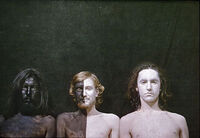 I could live in Africa
Opening: March 14, 2009, 7:00 p.m.
What is moral is what you feel good after and what is immoral is what you feel bad after.
(Ernest Hemingway)
The exhibition I could live in Africa examines the relationship between contemporary art and punk in Poland during the late 1970s and 80s.
The title was taken from the 1983 eponymous documentary film on the Polish punk band Izrael by the Dutch filmmaker and screenwriter Jacques de Koning. In addition to Jacques de Koning’s film, the exhibition will present documentaries and work by Miroslaw Balka, Jozef Robakowski, Darek Skubiel and Michal Tarkowski, among others.
This exhibition was initiated by Nicolaus Schafhausen and is being curated by Lukasz Ronduda and Michal Wolinski. It will be developed in cooperation with Witte de With, Center for Contemporary Art in Rotterdam and is part of a comprehensive exhibition series about moral conceptions and ethics that will be shown in Rotterdam starting september 2009.
For more information please consult the website:
www.ursula-blickle-stiftung.de/en/index.html
Exhibition venue
Ursula Blickle Foundation
Mühlweg 18, D – 76703 Kraichtal -UÖ
Phone +49 7251 60919, Fax +49 7251 68687
Opening hours
Wed. 2 – 5 p.m., Sun. 2 – 6 p.m. and by appointment
Participants
Wiktor Gutt
<div class="
-
PRIXDEROME.NL 2009
Nicoline van Harskamp wins PRIXDEROME.NL 2009
Witte de With and de Appel are pleased to co-host the 2009 PRIXDEROME.NL exhibition, the oldest Dutch state prize for contemporary artists. The exhibition will be held across two different venues.
On view at Witte de With are: Rossella Biscotti, Nicoline van Harskamp, Rob Hornstra, Jasmijn Visser and Helmut Smits.
On view at Westergasfabriek are: Maze de Boer, Heidi Linck, Ólafur Ólafsson i.c.w. Libia Castro, Marc Oosting and Sara Rajaei.
In 2009 the shortlist artists are:
Rossella Biscotti (1978, IT, lives and works in Rotterdam), Nicoline van Harskamp (1975, NL, lives and works in Amsterdam), Ólafur Ólafsson i.c.w. Libia Castro (1973,IS / 1969 ES) both live and work in Rotterdam) and Sara Rajaei (1976, IR, lives and works in Den Haag).
The longlist includes:
Maze de Boer (1976, NL, lives and works in Amsterdam), Rob Hornstra (1975, NL, lives and works in Utrecht), Heidi Linck (1978, NL, lives and works in Wageningen), Marc Oosting, (1976, NL, lives and works in Amsterdam), Helmut Smits (1974, NL, lives and works in Rotterdam), and Jasmijn Visser (1983, NL, lives and works in Utrecht).
The 2009 Prix de Rome exhibition is curated by Sarah Farrar (de Appel) and Juan A. Gaitán (Witte de With). The exhibition will be held across two locations: at Witte de With in Rotterdam and de Appel, as part of a special disembodied programme of activities whilst awaiting its new ‘home’ base, presents an off-site exhibition at the Westergasfabriek (‘Zuiveringshal Oost’)in Amsterdam. Tickets to the exhibition will be valid for both venues.
The winner of the PRIXDEROME.NL 2009 will be announced on 28 May 2009 during an official award ceremony in the Gashouder at the Westergasfabriek in Amsterdam.
The winner is selected from the four shortlist artists by an international jury comprised of Kestutis Kuizinas (LT), chairman, Yael Bartana (IL), Jurgen Bey (NL), Bruce McLean (UK) and Barbara Visser (NL).
A catalogue documenting the work of the ten artists featured in the PRIXDEROME.NL 2009 exhibition, with special attention to the work of the four shortlist artists, will be released on 28 May 2009. It is published by NAi Publishers and will be available from the exhibition venues and selected booksellers.
The PRIXDEROME.NL 2009 is structured as a network organisation by the Rijksakademie van beeldende kunsten, with de Appel and Witte de With as exhibition partners; SNS Reaal Fonds, KPN, MAB Development and INBO, AVRO Kunst as main sponsors; NAi Publishers and Kunstbeeld as media partners; and the Westergasfabriek as a location partner.
It is also made possible by the Dutch Ministry of Culture.
www.prixderome.nl
Practical information:
Date :
9 May – 14 June 2009
Opening :
9 May 2009 at 2 pm – de Appel, ‘Zuiveringshal Oost’, Westergasfabriek, Amsterdam
9 May 2009 at 6 pm – Witte de With, Rotterdam
Award ceremony:
28 May at 4 pm – Gashouder, Westergasfabriek, Amsterdam
The off-site Appel exhibition location:
‘Zuiveringshal Oost’
Westergasfabriek
Pazzanistraat 23
1014 DB Amsterdam
Tel +31 (0)20 6255651
www.deappel.nl
Opening hours: Tuesday – Sunday , 11am – 6pm
(with extended hours during the Holland Festival)
Participants
Rossella Biscotti, Maze de Boer, Libia Castro, Nicoline van Harskamp, Rob Hornstra, Heidi Linck, Ólafur Ólafsson, Marc Oosting, Sara Rajaei, Helmut Smits, Jasmijn Visser
<div class="
-
Billy Apple® A History of the Brand
Witte de With, Center for Contemporary Art, is proud to present the major solo exhibition of Billy Apple®, comprising two parts, A History of the Brand (31 May – 13 September) and Revealed/Concealed (26 June – 13 September). In addition to this major survey, Witte de With will present a new commission in public space by the artist, and a monographic publication titled Billy Apple® as part of Witte de With Publishers’ ongoing Sourcebook series.
A History of the Brand: 1962-2009
Occupying the 3rd floor of Witte de With, this exhibition will present works from Billy Apple®’s inception through to today, tracing a practice that has remained ahead of its time in analysing and incorporating the marketing of art.
Long before the likes of Gilbert & George began their life-long intertwining of art and life, and before Andy Warhol’s self-appointment as the icon of Pop Art, Billy Apple® embarked upon an artistic project that has shaped his practice for five decades. As Christina Barton writes, he has “spent much of his career creating and refining his ‘brand’ as an artistic manoeuvre geared to test the boundaries of art, examine the mechanisms that construct the artist as subject, and expose the value systems in which he and his works are mired”. The culmination of Billy Apple®’s gradual transformation from an individual artist into a brand occurred in 2008, when he succeeded in registering his name as a trademark.
Events
Saturday 30 May 2009
5 – 8 p.m.: Opening A History of the Brand
5 p.m.: Panel discussion “The Artist Has to Live Like Everybody Else” with Billy Apple®, Jan Mot (gallerist, Brussels), Olav Velthuis (writer, Amsterdam), moderated by Nicolaus Schafhausen (curator, director of Witte de With).
Thursday 25 June
5- 8 p.m.: Opening Revealed/Concealed
5 p.m.: Guided tour of the exhibition by Christina Barton (Director of Adam Art Gallery, Wellington) and Wystan Curnow (Professor, University of Auckland)
7 p.m.: Billy Apple® in conversation with David Elliott (artistic director, 17th Sydney Biennial)
Event for and by young people
It’s a new brand world
11-13 September 2009
Publication
The exhibitions will be accompanied by a Source Book, titled Billy Apple®, published by Witte de With Publishers. This English-language monograph will include texts by Christina Barton (Senior Lecturer in Art History, and Director of Adam Art Gallery, Victoria University of Wellington) and Bénédicte Ramade (art critic, L’Oeil, Les Inrocktupibles, Paris), Michelle Menzies (American Field Scholar, PhD candidate at the University of Chicago) and William Wood (Assistant Professor, Art History Faculty, University of British Columbia, Vancouver). Released: September 2009.
Price: 10 euro.
ISBN: 978-90-73362-89-5
Work in public space
The two-part exhibition extends into public space with a billboard commission, created in collaboration with Sculpture International Rotterdam. These two billboards will see Billy Apple®’s designs installed on a large scale, inserting themselves into the visual fabric of the city.
Titles and locations:
The Artist Has To Live Like Everybody Else (c)
Billy Apple®, 1985
location: Opposite Centraal Station Rotterdam, on the corner of Weena and Kruisplein
From the Sculpture International Rotterdam Collection
Billy Apple®, 2009
location: On the corner of Schiedamse Vest and Schilderstraat, on the Herenplaats/MEE Rotterdam building
Click here for map (jpg).
Participants
Billy Apple®
Curators
Zoë Gray, Nicolaus Schafhausen
Supported By
Herenplaats
Laan Irodjojo
Maarsen Groep
Mee Rotterdam
Joost ten Bruggencate and Jeroen Everaert from Mothership
Sculpture International Rotterdam
Creative New Zealand
<div class="
-
 It’s a new brand world
As part of the Rotterdam festival De Wereld van Witte de With 2009 and as the closing event of Billy Apple’s solo-exhibitions A History of the Brand and Revealed/Concealed, Witte de With presents It’s a new brand world – a project by young people for young people. It offers a reflection on the ubiquitous and of-the-moment topic of branding.
Join The Exciting Museum at De Wereld van Witte de With!
Become The Exciting Director of the The Exciting Museum. In order to join the competition: download the job application form, fill in and send it to [email protected] or hand it in on Friday at 5 p.m.
It’s a new brand world presents two alternative spaces on the Witte de Withstraat. Here, they will introduce you to The Exciting Museum, a soon-to-open art institution.
On the agenda are several activities linked to designing the identity of The Exciting Museum. In a photo-booth, you can create a postcard with your self-portrait and choose the ideal location for The Exciting Museum. Additionally, you can act as a curator and decide on The Exciting Collection. The next step is to challenge yourself and participate in the competition to become The Exciting Director. One of the highlights of the program will be the “How to brand yourself” workshop by Neil Taylor, a branding expert from London, who, together with the audience, will explore the art of branding.
With “there are boundaries” as the central topic of the festival, the project aims to question the ‘branded world’ we live in today. The thin line between art and marketing, professional and amateur, fosters a reflection about the new possibilities and challenges for the art world in relation to branding. The direct contact with the festival’s participants and the creation of an interactive and appealing experience will provide the possibility to establish an active dialogue between the audience and the institution, tearing down the boundaries between the visitor and the art world.
It’s a new brand world is: Marijke Appelman, Lola Bezemer, Iwona Lopacinska, Eric Roelen, Coen van de Steen, Weronika Zielinska and Pamela Zúñiga.
The Exciting Museum can be found on both corners of the Witte de Withstraat and Boomgaardstraat. Opening hours are similar to the festival’s: Friday 5 – 11 p.m, Saturday 12 – 11 p.m, Sunday 12 – 6 p.m.
At www.anewbrandworld.blogspot.com the process of exchanging ideas and inspirations can be followed. Become a fan on Facebook.
Corner Witte de Withstraat – Boomgaardstraat, Rotterdam
Participants
Marijke Appelman, Lola Bezemer, Iwona Lopacinska, Eric Roelen, Coen van der Steen, Neil Taylor, Weronika Zielinska, Pamela Zuniga
<div class="
-
Liam Gillick at the German Pavilion at the 53rd Venice Biennale
Liam Gillick will be the artist presented at the German Pavilion during the 53rd Venice Biennale in 2009. The curator of the German Pavilion is Nicolaus Schafhausen, director of Witte de With Center for Contemporary Art in Rotterdam.
Liam Gillick lives and works in New York and London. The artist, who has produced much of his work in Germany, was early to address emergent post-socialist systems and new social models in Europe. His practice represents the ideal projection surface for contemporary art in the twenty-first century. His work operates on several levels of a multi-layered artworld. The theme of his work is the varied phenomena of social utopias that he stages via hypothetical social models, both visual and literary.
Nicolaus Schafhausen: “Through his need to play with the complexity of the contemporary terrain, Gillick has provided models of thought that are not merely binary. He has operated in parallel to known models of work – critic, designer and artist. And this has permitted him to provoke new questions without the necessity to offer simple solutions.”
Liam Gillick: “My work requires a critical terrain that is both sophisticated and skeptical. I view this as a continuation of an ongoing dialogue. The question will be how to produce rather than merely how to present. I operate in the gap between the trajectory of modernity and the modernist self-consciousness. The work is both contingent and specific.”
Liam Gillick and Nicolaus Schafhausen have been involved in a continuous dialogue since the end of the 1980s. Before the Biennale, between November 2008 and May 2009, the artist and curator will collaborate on a number of events that will take place in Germany, Europe and the United States.
In 2008 Liam Gillick has had solo exhibitions in Rotterdam, Zurich and Munich and has forthcoming group exhibitions at the Stedelijk Museum in Amsterdam and The Guggenheim Museum in New York. Next year he will have a solo exhibition at the Museum of Contemporary Art in Chicago.
The exhibition at the German Pavilion is commissioned by the German Foreign Ministry and will be realized together with the Institute of Foreign Affairs (ifa).
Duration of exhibition: 7th June until 22nd November 2009.
www.deutscher-pavillon.org
References
Liam Gillick: Five or Six
Edited by Nicolaus Schafhausen, Frankfurter Kunstverein and Caroline Schneider
2000, English/German, Sternberg Press
ISBN 978-0-9671802-6-7
Also see: Three perspectives and a short scenario, exhibition at Witte de With, 19 January – 24 March 2008.
The German Pavilion
LIAM GILLICK: Artist
NICOLAUS SCHAFHAUSEN: Curator
EVA HUTTENLAUCH: Project Manager
CAROLINE SCHNEIDER: Editorial Advisor
KATHRIN LUZ: Press and Public Relations
NATASA RADOVIC: Venice Assistant
THOMAS HUESMANN, PAUL VAN GENNIP and WITTE DE WITH Center for Contemporary Art: Technical Realisation
Participants
Liam Gillick
Curators
Nicolaus Schafhausen
Network
SpikeMagazine, Volume Magazine
<div class="
-
Billy Apple® Revealed / Concealed
Building upon his exhibition A History of the Brand on the 3rd floor, this reveals a different side to his practice. For this project, Billy Apple® will transform Witte de With’s 2nd floor, as an architectural intervention that continues his ongoing institutional critique.
The second part of Billy Apple®’s exhibition, titled Revealed/Concealed, will open on Thursday 25 June.
5-8 p.m.: Opening
5 p.m.: Guided tour of the exhibition by Christina Barton (Director of Adam Art Gallery, Wellington) and Wystan Curnow (Professor, University of Auckland)
7 p.m.: Billy Apple® in conversation with David Elliott (artistic director, 17th Sydney Biennial)
In 1969, Billy Apple® opened one of the earliest alternative art spaces in New York City, which he called Apple. Created as a showcase for his and others’ work, it developed as an important site for experimental performances and process-based installations, conceptual practices that were not being shown in many institutions or commercial galleries at that time. For example, Billy Apple® began a series of cleaning works that he classed as ‘subtractions’, activities that he documented in photographs.
It was also within this context that Billy Apple® started to make works that highlighted their physical context, site-specific installations that revealed the ‘givens’ of the architectural space. These evolved into a body of works called Censure, in which he marked red those aspects of a gallery that he found unacceptable, just as a proof-reader marks up a text for correction. The artist would then give the owners of these spaces the option of correcting the flaws, leaving his red marks in place, or painting them over and reinstating the status quo.
At Witte de With, Billy Apple® is carrying out a subtraction on a major scale. He has asked the institution to remove the kitchen and storage space from the 2nd floor galleries, functional spaces that had become almost invisible components to those of us working in the building. Revealing the previously hidden spaces inside these two symmetrical units, he is also making other aspects of the floor more symmetrical, by covering the windows on the south side of the building, restoring the ‘white cube’ to its purest form. Finally, he is opening up the covered windows at the east end of the building to create an axis of light along the length of the space.
Having ‘corrected’ the imperfections of Witte de With’s galleries, Billy Apple® will install a selection of related works – dating from 1960 to today – in these newly improved spaces.
Event
It’s a new brand world
Event for and by young people
11-13 September 2009
More information to follow.
Publication
The exhibitions will be accompanied by a Source Book, titled Billy Apple®, published by Witte de With Publishers. This English-language monograph will include texts by Christina Barton (Senior Lecturer in Art History and Director of Adam Art Gallery, Victoria University of Wellington) and Bénédicte Ramade (art critic, L’Oeil, Les Inrocktupibles, Paris), Michelle Menzies (American Field Scholar, PhD candidate at the University of Chicago), and William Wood (Assistant Professor, Art History Faculty, University of British Columbia, Vancouver). Released: September 2009.
Price: 10 euro.
ISBN: 978-90-73362-89-5
Work in public space
The two-part exhibition extends into public space with a billboard commission, created in collaboration with Sculpture International Rotterdam. These two billboards will see Billy Apple®’s designs installed on a large scale, inserting themselves into the visual fabric of the city.
Titles and locations:
*The Artist Has To Live Like Everybody Else (c)
Billy Apple®, 1985
location: Opposite Centraal Station Rotterdam, on the corner of Weena and Kruisplein
*From the Sculpture International Rotterdam Collection
Billy Apple®, 2009
location: On the corner of Schiedamse Vest and Schilderstraat, on the Herenplaats/MEE Rotterdam building
Participants
Billy Apple®, Christina Barton
Curators
Nicolaus Schafhausen, Zoë Gray
Supported By
Herenplaats
Laan Irodjojo
Maarsen Groep
Mee Rotterdam
Joost ten Bruggencate and Jeroen Everaert from Mothership
Sculpture International Rotterdam
Creative New Zealand
<div class="
-
Billy Apple® Work in public space
Through September 13, 2009, Witte de With presents a major solo exhibition by Billy Apple®. Comprising two parts, A History of the Brand and Revealed / Concealed, the exhibition extends into public space with two billboard commissions of Billy Apple®’s works. These large-scale works insert themselves into the visual fabric of the city through September 13.
Billboard installations are not new in the artist’s practise, in which the use of conventional marketing strategies within art has always been of central importance.
The proposition THE ARTIST HAS TO LIVE LIKE EVERYBODY ELSE functions as a statement in public space, claiming both the work’s and the artist’s rights to integrate into the reality of socio-economic structures.
Formulated and displayed for the first time during the economic boom of 1985, this statement has kept its relevance in a variety of different contexts. In 1991 it appeared as a running text on an outdoor electronic signboard, placed on the façade of the Bank of New Zealand’s (BNZ) office in Auckland. It reappeared in 1993 on the back cover of The National Business Review, linking the art of business with the business of art. By 1993 the artist had attached this statement to his Paid series. In this ongoing project, Billy Apple® offers for payment the invoices that he has received for a range of purchases from his day-to-day living. The collector pays the invoice and then receives it framed and mounted on a form titled Paid with the words ‘The artist has to live like everybody else’ written underneath. In these, Billy Apple® shortcuts the usual processes of making art, earning money and spending it. (These works are on show at Witte de With).
The second billboard incorporates aspects of the Billy Apple® brand with those of the collection of Sculpture International Rotterdam. Running down the face of a building on the Witte de Withstraat, this text-based work is presented like a rolling advertisement that has been halted for a moment in time.
FROM THE SCULPTURE INTERNATIONAL ROTTERDAM COLLECTION is drawn from Billy Apple®’s From the Collection series. In this series the tradition of the painter portraying his patron is updated, conceptualized and rendered in strong graphic form, becoming an alternative, knowing, but still respectful portrait of its owner. These works raise questions about the symbolic value of buying art, the self-aggrandizing of owning ‘a collection’, and the artistic motivation behind such a work’s creation.
Related works from the From the Collection series are on view at Witte de With.
Locations
The Artist Has To Live Like Everybody Else (c)
Billy Apple®, 1985
location: Opposite Centraal Station Rotterdam, on the corner of Weena and Kruisplein
From the Sculpture International Rotterdam Collection
Billy Apple®, 2009
location: On the corner of Schiedamse Vest and Schilderstraat, on the Herenplaats/MEE Rotterdam building
Participants
Billy Apple®
Curators
Nicolaus Schafhausen, Zoë Gray
Supported By
Herenplaats
Laan Irodjojo
Maarsen Groep
Mee Rotterdam
Joost ten Bruggencate and Jeroen Everaert from Mothership
Sculpture International Rotterdam
Creative New Zealand
<div class="
-
Act I: Beautiful from Every Point of View
Morality will be inaugurated by two initial acts, proposed as a parallel situation between interrelated statements about our relationship to the world and to images.
Act I: Beautiful from Every Point of View
10 October 2009 – 10 January 2010
Act II: From Love to Legal
10 October 2009 – 7 February 2010
Opening on Friday 9 October, 7 – 9 p.m.
Performance by Spartacus Chetwynd, btwn 7 – 9 p.m.
Act I: Beautiful from Every Point of View explores the gray space that we inhabit between images and power. Act I’s title derives from Horace’s famous aphorism of the first century BCE, “nothing is beautiful from every point of view.” Not so long ago, this statement would have seemed absurd, given the Enlightenment idea that Truth and Beauty arrive together. Today, however, Horace’s sentence is little more than a platitude, increasingly deployed in a rhetoric in which any point of view, and any action, can find its justification merely in its right to exist.
Beautiful from Every Point of View is a group exhibition that brings together a selection of works that refuse to assert an immediate, self-evident point of view on the subjects they represent. The works range from poignant simulations of the capitalist sublime, to humorous commentaries on the relationship between struggle and power.
Featured artists
Philip-Lorca diCorcia, Marko Lulic, Kris Martin, Josephine Meckseper, Sarah Morris, Ron Terada, Tobias Zielony, Artur Zmijewski.
The Triumph of Death and King Midas
Friday 9 October, 7 – 9 p.m.
Performances by Spartacus Chetwynd
Spartacus Chetwynd (London, 1973) gained recognition with her baroque, musical and surreal performances featuring humorous image quotations from art history, literature linked to pop and folktales. The performance or two mimes entitled The Triumph of Death and King Midas are performed by the accompanying band the Princes in the Tower, and together they will perform the narratives from Cautionary Tales.
This is the first project to be developed in the framework of a performance cycle that culminates in 3 days of stage events in the Spring of 2010.
Program curated by Renske Janssen.
Free Guided Tours
(NB not for groups)
Every Wednesday at 3 p.m. by a staff member (in English/Dutch) – FREE (excl. entry price)
Every Sunday at 3 p.m. (in English/Dutch) – FREE (excl. entry price)
For other guided tours
For groups (10 and up)
On other days / times
In other languages (Arabic, English, French, German, Polish, Spanish)
Upon request and payment – 60€.
More information and contact via +31 (0)10 4110144 or by e-mail: [email protected].
Participants
Philip-Lorca DiCorcia, Marko Lulic, Kris Martin, Sarah Morris, Ron Terada, Artur Zmijewski
Curators
Nicolaus Schafhausen, Juan A. Gaitán
Network
MAMbo, MMK Museum für Moderne Kunst
<div class="
-
Act II: From Love to Legal
Morality will be inaugurated by two initial acts, proposed as a parallel situation between interrelated statements about our relationship to the world and to images.
Act I: Beautiful from Every Point of View
10 October 2009 – 10 January 2010
Act II: From Love to Legal
10 October 2009 – 7 February 2010
Opening on Friday 9 October, 6 – 9 p.m.
Performance by Spartacus Chetwynd, btwn 7 – 9 p.m.
Act II: From Love to Legal reveals the different forms that the gray area that we inhabit between images and power may take. Exploring references to biographical, anecdotal, personal and factual histories, with Act II we want to suggest a cyclical trajectory that originates in private life, in a space and a time in which, in Barthes’ words, one “is not an image, an object”. Does this mean that there is a space and a time in which we are able to remain outside the spaces of power, truth, and morality?
From Love to Legal brings together a selection of contemporary artworks that confront such oppositions between anecdotal and factual, personal and historical, making it problematic for us to separate desire from even the most ascetic relationship to the world.
Featured artists
Isa Genzken, Joachim Koester, Christodoulos Panayiotou, Isabelle Pauwels, Mark Raidpere, Tobias Rehberger, Nedko Solakov, Danh Vo, Peter Wächtler, Katarina Zdjelar.
The Triumph of Death and King Midas
Friday 9 October, 7 – 9 p.m.
Performances by Spartacus Chetwynd
Spartacus Chetwynd (London, 1973) gained recognition with her baroque, musical and surreal performances featuring humorous image quotations from art history, literature linked to pop and folktales. The performance or two mimes entitled The Triumph of Death and King Midas are performed by the accompanying band the Princes in the Tower, and together they will perform the narratives from Cautionary Tales.
This is the first project to be developed in the framework of a performance cycle that culminates in 3 days of stage events in the Spring of 2010.
Program curated by Renske Janssen.
Free Guided Tours
(NB not for groups)
Every Wednesday at 3 p.m. by a staff member (in English/Dutch) – FREE (excl. entry price)
Every Sunday at 3 p.m. (in English/Dutch) – FREE (excl. entry price)
For other guided tours
For groups (10 and up)
On other days / times
In other languages (Arabic, English, French, German, Polish, Spanish)
Upon request and payment – 60€.
More information and contact via +31 (0)10 4110144 or by e-mail: [email protected].
Participants
Christodoulos Panayiotou, Nedko Solakov, Danh Vo, Peter Wächtler, Katarina Zdjelar, Isa Genzken, Isabelle Pauwels, Mark Raidpere, Tobias Rehberger
Curators
Nicolaus Schafhausen, Juan A. Gaitán
Supported By
Danish Arts Council
Cypriot Ministry of Culture
<div class="
-
MORALITY
Witte de With is pleased to present Morality.
While there are certain moral principles that are usually unquestioned (the right to life, for instance), morality remains ambivalent and amorphous in terms of the principles it provides for humans acting in the world. It is these amorphous areas, these gray zones, that this project seeks to address, particularly in how they form a difficult aspect of our reality today.
Morality is an invitation to reflect and debate situations in contemporary life that refuse clear distinctions between right and wrong, what is and what ought to be. As a whole, the Morality project has been defined by a desire – inherent to contemporary art – to open spaces for active, engaged forms of spectatorship that are not pre-determined by either moral or ideological imperatives.
Morality is a provocative theme, especially in a world that is now determined by the experiences of war, displacement, political and economic crises, the rise of religious stereotypes, and the radicalization of seemingly old doctrines and ideologies. Morality is also a broad subject that affects everybody in many different ways. From the bathroom to the parliament, there is a total field of social engagement in which morality functions without boundaries, between a set of abstract, intangible and general ideas. Morality is neither a base nor a superstructure, but a smooth network of influences that operates outside the law, governing both regulated and unregulated social spaces, and affecting daily lives in subtle, seductive, unexpected ways. Yet, there is not a unique or purely affirmative sense that one can give to this notion. A number of moral attitudes – often at odds with one another – inform the positions that, as political subjects, we assume vis-a-vis the events that take place in our world.
Seemingly simple, but also disturbingly difficult to grasp, morality is an ideal leitmotiv for a project that seeks to explore critical points of fragmentation in everyday life. Rather than presenting statements that can be perceived as being right or wrong, good or evil, the projectMorality will create a space for showing a wide range of attitudes that problematize a total conception of morality, focusing on the less tangible forces and attitudes that shape common thinking and behavior.
The year-long Morality program at Witte de With is structured as a series of interrelated acts that began in the Fall of 2009 and will run until November 2010. Online visitors may also participate by contributing to the web-platform. The Morality project has included six in-house exhibitions, the exhibition Nether Land at the Dutch Culture Centre for the Shanghai World Expo, a film cycle, a performance program, and facade projects by the Russian collective AES+F, Isa Genzken and Maider López. The current facade project by Ayse Erkmen is titled 15-5519.
Curators
Juan A. Gaitán, Nicolaus Schafhausen, Amira Gad
Supported By
Morality is generously supported by the Mondriaan Foundation and SNS REAAL Fonds.
<div class="
-
ACT IV: I Could Live in Africa
I Could Live in Africa is the fourth act in the year-long project Morality, organised by Witte de With.
It is the first exhibition of Morality that looks at the past and highlights the attitude of artists, choosing to be active as groups rather than individuals, with the aim of resisting an hermetic, authoritarian social and political system. The exhibition presents a variety of practices emblematic of a hidden movement that was driven by the need to open a different space from the moral and aesthetic cultural standards prevailing in Poland under and after martial law (December 13, 1981 to July 22, 1983).
Borrowing its title from Dutch filmmaker Jacques de Koning’s documentary on the Polish post-punk and reggae band Izrael, I Could Live in Africa explores the mood shared by the “new wild” artists and the music subcultures (punk, new wave, reggae) in 1980s communist Poland. Determined by a gloomy political and economic context, this mood translated into an eruption of subcultures that managed to circumvent both the limited means of production and the monopoly the ruling regime over publishing and recording. These subcultures thrived against a background of police brutality, closed borders, empty shops, and frequent power shortages. Their aesthetic weapons included anti-regime stencils and graffiti, safety pins, wildly expressive and primitive forms, assemblages of waste and detritus, collages, concerts that turned into ecstatic group rituals, opening receptions that morphed into improvised happenings and zines. Though the times were hardly “funny”, these cultural manifestations were infused with humour, openly sneering at the system and contemptuous of totalitarian propaganda, the lack of democracy, the naivety of mass media, the Church and cultural hypocrisy in general.
While the punk movement of the West was brandishing it’s slogan, no future, the Polish punk artists were deeply invested in a better future. Far from consuming a trend or criticizing from the premises of capitalism, these artists created not only a resistance to what existed but room to exist differently. Inspired by the Rasta philosophy, which pronounced the fall of Babylon, what drove these artists above all was an impulsive energy and a hunger for freedom.
Participants
Mirosław Bałka, Krzysztof Bednarski, Miroslaw Filonik, Wiktor Gutt, Jacques de Koning, Zbigniew Libera, Luxus, Wlodzimierz Pawlak, Waldemar Raniszewski, Josef Robakowski, Darek Skubiel, Marek Sobczyk, Jerzy Truszkowski, Zdzislaw Zinczuk
Curators
Michal Wolinski, Nicolaus Schafhausen, Anne-Claire Schmitz
Network
BWA Wroclaw, Museum of Modern Art Warsaw
Supported By
The Mondriaan Foundation and SNS REAAL Fonds.
<div class="
-
ACT V: Power Alone
Power Alone is Act V of the year-long program Morality at Witte de With. Like Act IV, I could live in Africa the opening is on Friday 19 February 2010 at 6 p.m. Both exhibitions run until 25 April 2010.
This group exhibition starts from the premise that power operates and is made tangible in the encounter between the general (society, morality, history, gender) and the particular (the individual). Power, as we understand it today, is the moment in which the individual experiences the process of becoming a subject, a member of her or his society through encounters with others and with the law. As power is something that is experienced, it has no aesthetic value in the traditional sense; it is, however, integral to what Jacques Ranciere calls “the distribution of the sensible”. This is one way in which this exhibition engages with the notion of power.
But Power Alone also proposes a more fictive narrative, linked to the myth of Narcissus, a myth that perhaps represents the desire inherent in the discourses on power. Like Narcissus, the Greek hero renowned for his beauty and for his cruelty towards those who love him, the abstract notion we call power would be condemned to become infatuated with itself, perishing by love with its own semblance. Taking Narcissus as the personification of power, this exhibition presents a series of hypothetical scenarios on power’s withdrawal from class, gender, race and its inscription in two opposing forms: the individuated body and the mythological world. The works included engage with the cleft between power as a general force and solitude as a state of mind, between power as the name we give to structures that regulate our everyday lives, and individuated encounters with these structures. The exhibition presents a number of different guises and forms of power, from concrete to abstract, in the socially conditioned world, as in Canan Senol’s Exemplary or Mark Boulos’ All that is Solid Melts into Air. Works such as Goshka Macuga’s On The Nature of the Beast tease power relations out of specific situations; whilst Miki Kratsman’s photographs, Ziad Antar’s videos, or Luc Tuymans’ paintings indicate spaces that can no longer be experienced outside of the structures of power.
Participants
Adel Abidin, Ziad Antar, Mirosław Bałka, Mark Boulos, Piero Golia, Jaebum Kim, Miki Kratsman, Erik van Lieshout, Goshka Macuga, Randa Mirza, Willem de Rooij, Canan Senol, Andreas Slominski, Corin Sworn, Ron Terada, Luc Tuymans
Curators
Juan A. Gaitán, Nicolaus Schafhausen, Amira Gad
<div class="
-
ACT VI: Remember Humanity
Witte de With is pleased to present two upcoming exhibitions in the Morality program begun in the Fall of 2009: Act VI: Remember Humanity, and Act VII: Of Facts and Fables. They open simultaneously on 12 May. Act VI runs until 29 August and Act VII continues until 26 September 2010.
Many of the themes that have dominated contemporary political thought point to the ominous view that ‘humanity’ has become an historical subject, no longer essential to contemporary economic and political considerations. For instance, the notion of ‘bare life’ taken up by Giorgio Agamben, suggests a bankruptcy of the human rights charter in terms of humanity’s capacity to hold to its principles of freedom and equality. The notion of ‘immaterial labor’ most famously developed by Maurizio Lazzarato, indicates a further alienation of the world from its material fabric and concrete foundations. The imperative suggested in the title of this exhibition, to ‘remember humanity,’ is therefore an allusion to a present condition in which humanity has become an historical subject rather than part of our objective reality.
The exhibition Remember Humanity starts from this hypothesis and includes the work of artists who approach ‘our’ present as a field on fragmented existences and isolated interests. Together, these works provide a partial sense of how the construction of the world and the construction of the idea of humanity are mutually conditioned. The works here included do not set out to affirm ‘humanity’ in a nostalgic way or attempt to ‘retrieve’ it from the record of lost ideas. More central to the logic of these works is an examination of how the notion of human is constructed in opposition to the animal, to madness, to the idea of the primitive, in contraposition to War and also in the affirmation of ‘labor’ and ‘consciousness.’
Participants
Julieta Aranda, Mirosław Bałka, Milena Bonilla, Lee Bul, Luke Fowler, Kent Monkman, Christodoulos Panayiotou, Michael Stevenson, Rosemarie Trockel, Julika Rudelius
Curators
Juan A. Gaitán, Nicolaus Schafhausen, Amira Gad
Supported By
Fonds BKVB; Creative New Zealand; and Cyprus Ministry of Culture.
<div class="
-
ACT VII: Of Facts and Fables
Witte de With is pleased to present two upcoming exhibitions in theMorality program begun in the Fall of 2009: Act VI: Remember Humanity, and Act VII: Of Facts and Fables. They open simultaneously on 12 May. Act VI runs until 29 August and Act VII continues until 26 September 2010.
There is a traditional distinction between the earth as the space of nature, and the world as the space of humanity. Fictions and abstractions belong to the world, as do thought and action. The fable, however, invariably returns to nature in search of motifs that are excluded from the principles and imperatives of morality: animals, plants, inanimate objects. Children are the fable’s ideal audience and are also exempt from the sphere of morality and moral imperatives, even if only temporarily – that is, for as long as they are children or remain ‘child-like.’ In this sense, that which is excepted from morality is susceptible to becoming an example – a negative example – of the seemingly chaotic and ‘anarchic’ state of nature. Animal behavior, for instance, is often mobilized by moralistic discourses in order to prove that the true nature of humanity is one of uninhibited impulses that morality is designed to set right.
Of Facts and Fables brings together a selection of works that mobilize this realm of exception, presenting a critical image of the world and its fictions, operating in a space of representation that relies on fabulous motifs. History, mysticism, fiction, and scientific discourse come together in this exhibition as both outmoded forms of thought, and as potential for new kinds of speculative critique.
Participants
Mirosław Bałka, Keren Cytter, Stan Douglas, Agnes Geoffray, Marko Lulic, Philippe Parreno, Yvette Supraski, Luc Tuymans, Ola Vasiljeva, Danh Vo, Tris Vonna-Michell
Curators
Juan A. Gaitán, Nicolaus Schafhausen, Amira Gad
Supported By
Maison Descartes and CulturesFrance.
<div class="
-
ACT IX: Let Us Compare Mythologies
What if all myths were true… – Liu Kang
Act IX of Witte de With’s year long Morality program, Let Us Compare Mythologies, is a three-day cycle of staged events presenting international artists exploring the nature of the performance.
Based on a wide variety of topics, like man’s intrinsic relationship to objects, the program is centered around the continued existence of myths in today’s society and their creative force. We are most grateful to all participants who are willing to show their works, (re)stage their performances and compare their mythologies…
What happens when two myths meet, will they dissolve or will they reinforce each other?
Participants
Danai Anesiadou, Baktrüppen, Geneviève Belleveau, Dineo Seshee Bopape, Keren Cytter, D.O.R., Oskar Dawicki, Simon Denny, Yngve Holen, Andrew Kerton, Gergely László, Mark Leckey, Leeroy the Duck, Patrizio di Massimo, Eliza Newman-Saul, Nishiko, Rory Pilgrim, Lili Reynaud-Dewar, Jeremy Shaw, Tris Vonna-Michell
Curators
Renske Janssen, Dorothea Jendricke
Supported By
The Mondriaan Foundation, SNS Reaal Fonds, Office for Contemporary Art Norway and Dienst Kunst & Cultuur Rotterdam. With special thanks to all artists, all venues and the Goethe Institut.
<div class="
-
ACT VIII: Nether Land
ACT VIII of MORALITY, developed by Witte de With Center for Contemporary Art, Rotterdam, for the Dutch Culture Centre, Shanghai, as part of the World Expo 2010.
As the eighth act of Morality, realized specifically for the ‘world stage’ of Shanghai’s Expo, Nether Land highlights diverse international artistic practices that engage with the paradoxes of cross-cultural perception and fantasies of foreign and alternative production.
Resonating with the name of the exhibition venue, the Dutch Culture Centre, the exhibition title Nether Land is a more exact and deadpan English iteration of the Dutch word for its nation, ‘Nederland’. The isolation of the word ‘nether’ points to its double meaning, as both low (hence the ‘Low Countries’) and remote (as in ‘the nether reaches of the universe’). The echo in Nether Land of the idealized ‘Neverland’ of Peter Pan is not lost, and many of the works in the show explore the idea of a better life elsewhere. More important still is the Chinese translation of the title, He Guo, which emphasizes the questioning tone of the exhibition: He Guo sounds like the beginning of He Lan [Chinese for ‘Holland’], it actually means ‘What Country?’ – a question that destabilizes our sense of place and creates something of a parallax effect, where shifting locations and shifting viewpoints contribute to deeper perspective.
Each of the exhibited works in the exhibition projects a different relationship with a far away land – Asia, Africa, Europe and the Middle East – or estranges the here and now, making it impossible for a cumulative portrait of a country or culture to emerge. Nevertheless, the immense impact of such viewing from a distance and across borders on the shaping of aesthetic and political values that underpin contemporary artistic practice in a global arena comes into sharper relief.
Participants
Meschac Gaba, Guogu Zheng, Jacques de Koning, Erik van Lieshout, Ken Lum, Sarah Morris, Allan Sekula, Jennifer Tee, Lidwien Van de Ven, J.Q. Whitcomb, Xu Zhen
Curators
Amira Gad, Monika Szewczyk
Network
SICA Dutch Culture Center Shanghai
Supported By
This exhibition is generously supported by the City of Rotterdam, the Mondriaan Foundation and the Dutch Culture Centre / Netherlands China Arts Foundation. With thanks to the Fonds BKVB.
<div class="
-
Cosima von Bonin’s Far Niente for Witte de With’s Sloth Section, Loop # 01 of the Lazy Susan Series, a Rotating Exhibition
At Witte de With, Center for Contemporary Art, Cosima von Bonin presents an exhibition around the notion of sloth and fatigue. With her typical laconic humor, Cosima von Bonin creates a constellation of new and existing works. From oversized stuffed animals to sewn fabrics, from pastiches of minimalist sculptures to recreations of shop display systems, her work blends formalism and pop, oscillating between seriousness and fun, weighed down with melancholy or fizzing with critical wit.
The expression dolce far niente evokes the sweetness of doing nothing. Here the expression takes on a certain irony, as this is the first show in a sequence of major institutional exhibitions, which means that the artist is doing quite the opposite of nothing.
The sequence is subtitled: THE LAZY SUSAN SERIES, A ROTATING EXHIBITION, referring to the rotating disks that appear in many restaurants and are used to present an array of dishes. The idea of a rotating exhibition differs from a traditional traveling show in that, with each rotation or loop, visitors are served a slightly different dish.
Education
During this exhibition several educational activities, like art confrontations and workshops, are being organized for high schools and academic students. In an art confrontation, the students take a close look at the works of Cosima von Bonin. The Witte de With educator takes the specific knowledge and experience of the students as a starting point. By creating an open atmosphere, students can explore their own responses to art works and increase their understanding of art. Discussion and debate are used to share ideas. We aim to engage students with the artworks and encourage critical thinking about the works of Cosima von Bonin and about contemporary art in general.
Workshops Wolfert Tweetalig
Four groups of students from Rotterdam high school Wolfert Tweetalig visit Witte de With during Cosima von Bonin’s exhibition. Their visit consists of two parts: an art confrontation and a workshop. Following the theme of the exhibition the workshop evolves around sloth. Artist Karin Schipper guides the students in creating their own universe out of movable and stackable goods. During the workshop the class gets divided into smaller groups who each have their own task in making this new universe come to life. The process of growth is captured in images, which together form a stop-motion film. The four stop-motion films will be screened on Sunday the 7th of November at 4 P.M. in the Goethe-Institut as one of the Slothful Sunday.
Art Now: Cosima von Bonin
Witte de With Education hosts a month-long series of workshops for over 400 high school students.
Participants
Cosima von Bonin
Curators
Nicolaus Schafhausen, Zoë Gray
Network
MAMCO, Museum Ludwig, The Arnolfini
Supported By
The Indofin group, Cees and Inge de Bruin-Heijn
Goethe-Institut Niederlande
Galerie Daniel Buchholz (Berlin/Cologne)
Galerie Neu (Berlin)
<div class="
-
Making is Thinking
Making is Thinking explores distinct artistic practices engaged with notions of conceptual craft and intuitive industry. It seeks to collapse the persistent dichotomy between the practical and the intellectual, and presents a range of works that refuse the binary of concept and form.
Among the artworks included in Making is Thinking, several recurring or overlapping areas of interest are discernible: There is a fascination with the role of the amateur, occupied with absurdly time-consuming activities that verge on meditation (Wilfrid Almendra, Dewar & Gicquel, Teppei Kaneuji, Hans Schabus). There is an analysis of the process of creation, and a transformation of this analysis into a new moment of creation (Hedwig Houben, Ane Hjort Guttu, Edgar Leciejewski). There is an exploration of sculpture and the applied arts, a struggle between functionalism and formalism that avoids any hint of nostalgia (Julia Dault, Rita McBride, Eva Rothschild). There is a flourishing of decoration and beauty in the reassessment of certain Modernist tropes (Eva Berendes, Alexandre Da Cunha). There is the avoidance of conscious thinking and the emphasis on intuitive knowledge (William J. O’Brien, Koki Tanaka). And in many of the works, there is a knowing humor or irony that deflates the pious earnestness that can accompany discussions of craft.
Context:
European society has been marked by an increasing division between making and thinking that dates back to the industrial revolution. With the decline of urban guilds and rural cottage industries in the nineteenth century, and the subsequent mechanization of labor, workers were separated into blue- and white-collar jobs. Today, our education system privileges the creation of flexible “knowledge workers” over those with practical skills or manual know-how.
It is possible to trace a similar division in art since the beginning of the twentieth century. With Duchamp’s introduction of the readymade in 1913, the focus of avant-garde artistic practice shifted away from technique and the process of making to the transformative power of the artist’s vision. This saw the flourishing of conceptual art and the movement that Lucy Lippard famously labeled the dematerialization of the art object, culminating in Lawrence Weiner’s 1968 Declaration of Intent in which he announced that an artwork “need not be built.” For Weiner, thinking is making. Nevertheless, today artists are still making physical artworks and engaging with tangible materials. In our increasingly dematerialized world, how are we to engage with materiality? How might thoughtful forms of this insistence on making relate to our supposedly post-industrial society?
In recent years, craft has been held up to epitomize an alternative set of social values in the face of industrial production, global capitalism and mass consumerism. Yet this idea of craft is broader than that defended by John Ruskin or William Morris at the start of the previous century. Incorporating many elements of Modernism and informed by postmodernism, it offers a radical way for rethinking questions of work, both within and beyond the artistic field. Many artists are turning to this expanded notion of craft as a paradigm for making that seems to fuse previously oppositional positions – such as the trace of the artist’s hand and conceptual reflection – and are exploring its potential for reconsidering broader questions of production.
Accompanying program:
25 January 2011: Master class by Julia Dault and William J. O’Brien.
2 February 2011, 7pm: Lecture by Rita McBride
27 February 2011, 3pm: Crafternoon, a discussion afternoon combined with making.
26-28 April: Workshop by Hedwig Houben for students of the Willem de Kooning Academy, Rotterdam, at Witte de With.
As Rita McBride once said: “Art doesn’t matter, it is the doing, the learning, the scrambling, the growing, the discoveries along the way that matter.” Continuing Witte de With Education’s successful series of “art confrontations,” interactive tours of the exhibition will be available throughout its duration, structured to explore the “discoveries along the way.”
Publication:
To highlight the importance placed on process, the accompanying publication was produced over the course of the show, and made available to the public in online installments.
The publication features an introduction by curator/editor Zoë Gray followed by four essays. The contributors include Gavin Delahunty, Head of Exhibitions & Displays, Tate Liverpool; Alice Motard, Deputy Director & Exhibitions Organiser, Raven Row, London; Solveig Øvstebø, director of Bergen Kunsthall; Yoshiko Nagai, curator/writer, Tokyo.
Participants
Wilfrid Almendra, Eva Berendes, Alexandre da Cunha, Julia Dault, Ane Hjort Guttu, Hedwig Houben, Teppei Kaneuji, Edgar Leciejewski, Rita McBride, William J. O'Brien, Eva Rothschild, Hans Schabus, Koki Tanaka, Daniel Dewar & Grégory Gicquel
Curators
Zoë Gray, Amira Gad
Supported By
Goethe-Institut Niederlande, OCA, CulturesFrance, Institut Français des Pays-Bas (Maison Descartes), Austrian Embassy in The Hague.
<div class="
-
The End of Money
The End of Money is a group exhibition about time and value. Bringing together works by a host of international artists, this exhibition and its parallel publication reflect upon the fears, hopes, and expectations associated with the end of money and its ominous consequence: the dissolution of an absolute standard of value.
What limits does the economy impose on our collective imagination, and how is the collective imagination responsible for the current economy? The End of Money focuses on the multiple relationships that could and those that should exist between culture and economy. Informing this curatorial project is the utopian notion that, in a world where money has been factored out of the collective memory, other suppressed forms of value may emerge leading to another social bond and a different relationship to time.
Time, Benjamin Franklin famously said, is money. In Marshall McLuhan’s formulation of this statement, money is “stored time”. With this variation, McLuhan meant to suggest that with the clocking of labor, a practice whose origins lie with the Industrial Revolution, time becomes the meta-commodity, that which is ultimately and essentially being traded in money. The time of work; but not necessarily – as Franklin would have it – the time of the worker.
The works included in The End of Money range from reflections on the arbitrary ways in which value is ascribed to things, as in Zachary Formwalt’s video At Face Value (2008), in which a stamp collection is taken as an occasion to explore the historical valuation of stamps as currency; to explorations of the absolute loss of representative value, as in Christodoulos Panayiotou’s 2008 (2008), a monumental pile of shredded Greek Cypriot Pounds, the totality of which the artist was able to acquire when Greek Cyprus adopted the Euro. Other works highlight time, which is a persistent corollary of money in our efficiency-obsessed culture: Maha Maamoun’s short video 2026 (2010), explores the limits of the temporal imagination, revealing how the image of the future is foreclosed by the mind’s over-identification with the present; or Toril Johannessen’s graphs, which quantify the relationship between time and history and as such attempt to de-naturalize our conceptions of it. There is also Fischli & Weiss’ Sichtbare Welt (1987-2000), a series of photographs taken by the artists all over the world, critically evoking a parallel between systems of valuation and modes of representation.
Publication
The accompanying digital publication, edited by Juan A. Gaitán, includes contributions by Dessislava Dimova, Donatien Grau, Dieter Roelstraete and Carolina Sanín. They have been approached with the request to speculate on this theme in their own medium – be this fiction, art history, philosophy or criticism – and to form their own areas of expertise, be these “scientific” or “unfounded”. Documentation of the exhibition will also be included.
Language: English
ISBN: 978-90-73362-98-7
Side-Programming
Film Screening: A selection of historical and contemporary films whose subject is money and time will be screened at Witte de With on Sunday 26 June 2011 (12 to 6 pm). This event is organized by Juan A. Gaitán and Mariska Oosterloo.
Time/Bank: For the duration of The End of Money exhibition Witte de With will accept Time/Bank’s hour-notes designed by Lawrence Weiner.
Time/Bank is a project by e-flux: www.e-flux.com/timebank.
Participants
Alexander Apóstol, Pierre Bismuth, Fischli & Weiss, Zachary Formwalt, Goldin + Senneby, Hadley + Maxwell, Toril Johannessen, Vishal Jugdeo, Agnieszka Kurant, Matts Leiderstam, Maha Maamoun, Lili Reynaud-Dewar, Tomás Saraceno, Tonel, Vangelis Vlahos, Lawrence Weiner
Curators
Juan A. Gaitán, Amira Gad
Network
Time/Bank
Supported By
Office for Contemporary Art Norway; Cypriot Ministry of Education & Culture; and Pro Helvetia: Swiss Arts Council. With thanks to the Fonds BKVB; The Canada Council for the Arts; and Nationalgalerie im Hamburger Bahnhof – Museum für Gegenwart – Berlin.
<div class="
-
Melanchotopia
Witte de With’s Melanchotopia is an exhibition that invites more than forty international artists to work with different venues in the city-center of Rotterdam – places where people live and work – and to activate their potential as spaces for ideas, discourse and invention.
From large-scale interventions to very simple gestures, Melanchotopia supports a range of artistic practices that go beyond the classical approach to displaying art in public space. Working with the existing dynamics of the city, Witte de With’s intention is to bring forward the diverse layers of daily life in Rotterdam, creating a rich framework for subjective encounters. It is an exhibition about the reality of Rotterdam.
Today, Rotterdam seems to be on hold between its past and its future: filled with nostalgia for the pre-WWII city and in wait for the utopian future, which is perpetually stalled in unfinished developments and reconstructions. Projections about yesterday and tomorrow drive the image of the city, that seems to lack a present. Melanchotopia performs the present of the city through the specific practice of each artist.
Over the course of the exhibition (and remaining active until 31 December 2011) Witte de With’s galleries is reconfigured to become the epicenter of Melanchotopia. The projects, which spread throughout Rotterdam’s center, are brought together via a graphic mapping. Several art works and installations are also on show inside the epicenter and it is the site for numerous events.
Besides its new function as an information center, Witte de With is equipped with a designed Pro qm bookshop and an auditorium dedicated to a side program of lectures and artist talks. Here is available the exhibition guide with Melanchotopia map. The comprehensive educational program provides guided tours, art encounters and a special audio tour.
All images published in the Melanchotopia catalogue were specifically commissioned to Steffen Jagenburg by Witte de With.
Side program
On an almost daily basis throughout the exhibition, the Melanchotopia epicenter hosts a variety of events. These include talks, lectures, book launches, film screenings and performances, all exploring different aspects of Melanchotopia’s themes. During these events, the Pro qm bookshop is open.
Education
Workshops & master classes
The Melanchotopia epicenter also hosts several workshops and master classes, by artists from the exhibition and by invited professionals, including
– Stefan Kalmár & Richard Birkett (Artists Space, New York)
– Nicolaus Schafhausen, director, Witte de With
– Zoë Gray, curator, & Belinda Hak, business coordinator, Witte de With
Art Confrontations
Groups of (young) adults, students and secondary school students have the possibility to take part in an art confrontation as part of Melanchotopia. During an art confrontation, the group will view and discuss the exhibition together with an educator of Witte de With, who will encourage the group to look carefully at the works on display and form their own opinions of them. Art confrontations are designed to be accessible to all levels of education. An art confrontation takes 1 hour and costs € 2.50 per person (cash or cultuurkaart). A maximum of 30 persons can take part of an ‘art confrontation’ session.
Grand Opening
Friday 2 September 2011, starting from 1 p.m. till late
1 – 5 p.m.: Guided tours of the exhibitions, starting at Witte de With.
(Each tour lasts 45 min. They start at 1 pm; 1:30 pm; 2 pm; 2:30 pm; 3 pm; 3:30 pm; 4 pm; and 4:30 pm)
6 p.m.: Opening speech & drinks at Witte de With.
7 p.m.: Premiere of ‘Music for Melanchotopia’ for soprano and string ensemble by George Van Dam, live at the Rotterdamse Schouwburg.
9 p.m.: ‘It’s all downhill from here on,’ an event by Filip Gilissen, from sunset till sunrise, at the corner of the Karel Doormanstraat and Crispijnstraat.
10 p.m. till late: Party at Witte de With, DJ sets by Guillaume Bijl, Tobias Donat, Filip Gilissen, Kate Newby, Tobias Spichtig and Zin Taylor.
Locations
Witte de With – Center for Contemporary Art, SPAR Corandewal, Pathé Schouwburgplein, Weenink Bedrijfskleding, ROTTERDAM.INFO, Museum Rotterdam, Robeco, Bar Mon Cheri, Shop Erotica, Avondwinkel Alexia, Galerie VIVID, Willibrordschool, Rotterdamse centrum markt, Grotekerkplein, Beurs-World Trade Center, Stadswinkel Centrum Stadhuis, GRAND HOTEL CENTRAL, Q-Park Weena, Het Schieblock, The Manhattan Hotel, Nationale-Nederlanden, Rotterdam Centraal, Groot Handelsgebouw & Engels Grandcafé Restaurant Zalen, Rotterdamse Schouwburg, Mauritsplaats, Pauluskerk, Van Urk Piano’s & Vleugels, Jan Segeren herenmode, De Karel Doorman, Queens of Rings, Bilderberg Parkhotel, Buro Rietveld / Dutch Style Company, Stiltecentrum Erasmus MC, Hartman Binnenhuisadviseurs, De Havenloods.
Participants
Michael van den Abeele, Saâdane Afif, Babak Afrassiabi, Harold Ancart, Danai Anesiadou, Sven Augustijnen, Dirk Bell, Michael Beutler, Guillaume Bijl, Pierre Bismuth, Monica Bonvicini, George van Dam, Thea Djordjadze, Jean-Pascal Flavien, Olivier Foulon, Murray Gaylard, Filip Gilissen, Adam Gillam, Harald Thys & Jos De Gruyter, Arnoud Holleman, Adrià Julià, Leon Kahane, Kate Newby, Erik van Lieshout, Minouk Lim, Sarah Morris, Alex Morrison, Ricardo Okaranza, Pages, Henrik Plenge Jakobsen, Nina Pohl, Tomo Savić-Gecan, Markus Schinwald, Slavs and Tatars, Andrew Smart, Mårten Spångberg, Tobias Spichtig, Zin Taylor, Octavian Trauttmansdorff, Kostis Velonis, Lidwien Van de Ven, Peter Wächtler, Lawrence Weiner, Markus Weisbeck
Curators
Nicolaus Schafhausen, Amira Gad
Network
Berlage Institute
Supported By
VSB Fonds; SNS Reaal Fonds; Gobierno de Espana AC/E; Institut Francais; Creative New Zealand; Danish Arts Council; Canada Council for the Arts; Swiss Arts Council Pro Helvetia.
Rotterdam Tourist Map hijacked by Studio Matthias Görlich; Image Compositing: Felix Scheu; Printer: Druckerei Henrich, Frankfurt, Germany; Thank you to ROTTERDAM.INFO for permission to use their map.
<div class="
-
Polder Cup
Polder Cup was part of the Morality project’s Between You and I, a joint project by SKOR and Witte de With which took place between the Fall of 2009 and the Fall of 2010.
Polder Cup was a site-specific project by Spanish artist Maider López. The façade of Witte de With functioned as an open call to participate in a one-day football championship, which took place on September 4, 2010 in the polders of Ottoland (Municipality of Graafstroom).
Unlike a typical football game, López’s displaced football field intersected by water channels, challenged the rules of football and encouraged players to seek and invent new strategies. Not only does the location create an unusual situation, it reflects on the long Dutch history of fighting against water and the consensus society. With this project, López hopes to transform the function of the polders, going beyond its historical and agricultural uses, to host a public event held within the framework of a common sporting match. Through the participation of football players and audience from all walks of life, the polder will undergo a transformation in which its use can be opened up for new interpretations, challenging the way in which we perceive our spatial surroundings.
Maider López’s projects focus on the intriguingly humorous or the extraordinary behind the obvious and ordinary. López creates various events and situations for individuals to gather through a common language, in this case, football. Polder Cup becomes a moment where diverse groups of the society are brought together through play, sports and social exchange.
Polder Cup was part of Morality‘s Between You and I, a joint project by SKOR and Witte de With which took place between the Fall of 2009 and the Fall of 2010. For this project, four international artists were commissioned to intervene on Witte de With’s façade in order to create a critical interface dealing directly with Rotterdam’s urban fabric. Between You and I strived to open a space to reflect about morality today, inviting an active response by the public concerning the presence of contemporary art in public spaces.
Curated by SKOR (Stichting Kunst en Openbare Ruimte) & Witte de With (Center for Contemporary Art)
Featured artists: AES+F, Isa Genzken, Maider López and Ayse Erkmen.
Participants
Maider López
<div class="
-
Angela Bulloch — SHORT BIG DRAMA
There is more than meets the eye to Angela Bulloch’s work. Her solo exhibition SHORT BIG DRAMA at Witte de With, Center for Contemporary Art plays with this red herring – the illusion of simplicity – and highlights the theatricality of Bulloch’s practice. Focusing on three types of works – namely her monumental wall paintings, colorful pixel installations and interactive drawing machines – SHORT BIG DRAMA presents a selection of existing works together with specially commissioned new pieces.
In this exhibition, contradiction takes center-stage and reveals the inherent beauty of Bulloch’s complex artworks. Playing with the nature of drama, whether epic or mundane, big or short, the project adapts the form of a play to structure a sequence of commissions and a new suite of works by the artist. For Witte de With, Bulloch interprets and manipulates earlier potentially clashing installations into a seemingly harmonious whole.
Bulloch adopts an interdisciplinary approach, incorporating references from a wide array of sources, be it history, film or music. In her wall paintings, specific references to artistic, political or social groups are deconstructed and graphically assembled. Through this process of détournement, the artist questions the informational status of an artwork, as well as the possibility of narrating history. Bulloch’s drawing machines are interactive pieces, triggered or altered by the engagement of visitors. In this way, her drawing machines explore the dialectic between technology and labor, making us conscious of our place, and that of others, within the gallery space. With her Pixel works, Bulloch ‘programs’ our experience of art by encoding specific references in the technical programming of her modular light and sound installations. Though the complexity of the workings behind these installations is invisible, a predefined experience of the work is imposed upon the viewer, thus challenging the viewer’s subjective input.
A common thread in Bulloch’s artistic practice is thus the manipulation of codes and a sense of control. Whether that code is music or text-based, the artist plays with and orchestrates our perception and experience of art. She proposes that this experience can be ‘subliminally programmed’ and her work stages that which is beyond our grasp.
Curated by Amira Gad & Nicolaus Schafhausen.
Click here to download the exhibition guide (English, PDF).
Participants
Angela Bulloch
Curators
Nicolaus Schafhausen, Amira Gad
<div class="
-
Meriç Algün Ringborg — Line No. 2 (Holy Bible)
Meriç Algün Ringborg (b. 1983, Istanbul, lives and works in Stockholm) presents a seemingly simple horizontal line, consisting of scriptures from the Holy Bible, that courses through Witte de With’s exhibition space. Perhaps the most unexpected point of departure for Line No.2 (Holy Bible) is Alexander Selkirk who is known as the original Robinson Crusoe, the central protagonist in Daniel Defoe’s fictional yet biographical novel first published in 1719. Algün Ringborg’s work presents the Holy Bible as a symbol for self-control as it appeared in Selkirk and Crusoe’s stories, further stipulating on the role of religion throughout history.
Line No. 2 (Holy Bible) part of Prompts & Triggers
Meriç Algün Ringborg
Participants
Meriç Algün Ringborg
Curators
Defne Ayas
<div class="
-
Qiu Zhijie — Blueprints
Artist Qiu Zhijie (邱志杰; b. 1969, Fujian Province, China) draws from major political and historical narratives to produce large-scale ink-based maps and diagrams. From Confucianism to Enlightenment, Qiu Zhijie charts new paths, centers, nodes and relationships, scrutinizing the mutable boundaries that outline histories of world thought. Qiu Zhijie developed these series of mappings of the contemporary world based on several concepts that are summarized in the following maps: Map of 21st century; Map of Utopia; Map of Total Art; Map of Chinese History; Map of Nanjing Yangzi River and Map of Spirit Renew.
Blueprints (2012) part of Prompts & Triggers
Qiu Zhijie
View the artist at work: 26 – 28 June 2012, from 12 to 6:00 p.m.
Shanghai Biennale Curatorial Presentation: Thursday 28 June 2012, at 6:00 p.m.
Participants
Qiu Zhijie
Curators
Defne Ayas
Network
Shanghai Biennale
<div class="
-
Surplus Authors
Outside of personal romance, collaboration is perhaps the most elemental form of politics—just consider how the term plays a hand in ideas as basic as “two heads are better than one” as well as in issues as large as international alliances. To crack open this power relation Surplus Authors looks at a group of artists whose work traces and delineates several fault lines inherent in the act of collaboration from (art) historical and social indebtedness, to trust, generosity, incentives, antagonism and even cooption. Without laying claim to any illustrative narratives, Surplus Authors presents itself at a time of a growing call for institutions to work together as a promised means to alleviate the reasons for austerity.
As a possible retort, Surplus Authors begs another question: is collaboration an end in and of itself, or is it a tenuous and unfolding process in which psychological, intellectual, and political dynamics are contested and reconstituted?
Participating artists: Michael Blum & Damir Nikšić, AA Bronson & Ryan Brewer, Club Moral, Maya Deren, Song Dong & Yin Xiuzhen, Haris Epaminonda & Daniel Gustav Cramer, Chris Evans, Luis Jacob & Chris Curreri, Dora Garcia, Alicja Kwade, MadeIn Company, Karen Mirza & Brad Butler, Annaïk Lou Pitteloud & Steve Van den Bosch, Ana Roldán & Falke Pisano, Wu Shanzhuan & Inga S. Thorsdottir, Hito Steyerl, Jalal Toufic, Oscar Tuazon and Tzu Nyen Ho.
Surplus Authors is curated by Defne Ayas together with Philippe Pirotte.
The opening will be jointly hosted with TENT, who is opening the show Between The Map and The Territory on the same day, from 8 pm to 11 pm. From 11pm onwards, after party in WORM, opposite Witte de With Center for Contemporary Art and TENT.
Participants
AA Bronson, Hector Aristizábal, Michael Blum, Ryan Brewer, Brad Butler, Club Moral, Daniel Gustav Cramer, Maya Deren, Chris Evans, Haris Epaminonda, Tzu Nyen Ho, Luis Jacob, Alicja Kwade, Karen Mirza, Damir Nikšić, Pablo Pijnappel, Falke Pisano, Annaïk Lou Pitteloud, Ana Roldan, Wu Shanzhuan, Song Dong, Hito Steyerl, Inga Svala Thorsdottir, Jalal Toufic, Oscar Tuazon, Steve Van den Bosch, Yin Xiuzhen, Xu Zhen
Curators
Defne Ayas, Amira Gad, Philippe Pirotte
Supported By
Kunstenisrael
<div class="
-
Paola Pivi — Tulkus 1880 to 2018
Opening talk by Defne Ayas, Director of Witte de With
Additional talk by Christa Meindersma, Director Prince Claus Fund
Witte de With is excited to unfurl her 2013 program with Tulkus 1880 to 2018, a mastodontic artwork and work in progress by Paola Pivi, based on an extensive international research.
Aimed at creating a complete collection of portraits and basic information on all the tulkus of the world – who in Tibetan Buddhism are the recognized reincarnations of previous Buddhist masters* – from the beginning of photography until today, from all the schools of Tibetan Buddhism and Bon, and from all the areas of the world where this religion is practiced, this growing survey has until now collected over 1100 photographic portraits.
Manifesting in a stunning array of forms, from high production color prints to inexpensive photocopied reproductions, and in scales ranging from pocket-size to large format, these images are the same ones commonly treasured in monasteries, hung in private households or shops, or collected by the faithful. These photographs are considered holy by the believers.
Executed in collaboration with hundreds of tulkus, individuals and institutions around the world, Pivi’s research will continue to grow and be displayed through 2018 in various venues, up to a total of 10 exhibitions, after which it will be donated to the Tibetan people. The direction of the research itself has been delegated to Tibetan individuals, under the supervision of Tibetan historian Tashi Tsering, Director of Amnye Institute, Tibetan Centre for Advanced Studies, Dharamshala, India. The entire project/artwork Tulkus 1880 to 2018 is non profit.
Tulkus 1880 to 2018 uncharacteristically lays bare these objects of specific veneration within the confines of a religiously plural, and often secular art institution–an institution that conversely is not known for presenting nominally sacred objects to its audience, and is itself enshrined within a long history of aesthetic discourses that attempt to establish a ‘visual neutrality’.
Witte de With Director Defne Ayas calls the exhibition “a major undertaking of key historical value” and adds: “As Witte de With, we are tremendously proud to be a partner to this important project, for which Paola Pivi went beyond and above, and collaborated with spiritual leaders, scholars, researchers, and photographers, as well as with special archives. It is indeed a treat to experience it.”
In Tibetan Buddhism, a tulku is the recognized reincarnation of a previous Buddhist master (a highly realized teacher or lama, e.g. H.H. the Dalai Lama or H.H. Karmapa) who is able to choose the manner of their rebirth and can often reveal the place of their next birth by means of cryptic clues. Tulkus are collectively revered for holding the lineages of oral transmission of all of the Buddha’s teachings, which have been handed down through many generations. Most often they are referred to as Rinpoche or ‘precious one’.
With photographs by:
Daniel Kuma Bärlocher, Sue Byrne, Das Brothers, Alexandra David-Néel, Don Farber, James Giabrone, Marion Griebenow, Thomas L. Kelly, Kinsey Bros, Vijay Kranti, Mr. M. Linden, Heather Lindquist, Marvin Moore, Melina Mulas, Tashi Nangchen, Sarah Orbanic, Tashi Paljor, Tenzing Paljor, Matthew Pistono, Claire Pullinger, Raghu Rai, Matthieu Ricard, Joseph Francis Charles Rock, Tim Roodenrys, Ritu Sarin and Tenzing Sonam, David Sassoon, Sandra Scales, Jurek Schreiner, Albert Shelton, Tseten Tashi, Gursed Tserenpil, Neal Watkins, John Claude White, David Zimmerman, and many more.
Tulkus 1880 to 2018 is curated by Davide Trapezi and co-commissioned by Castello di Rivoli Museum of Contemporary Art and Defne Ayas on behalf of Witte de With Center for Contemporary Art. Special thanks go to all the sponsors who have supported this project from its inception onwards: Artissima, Turin; Galleria Massimo De Carlo, Milan and London, Galerie Perrotin, Hong Kong /Paris, Photographic Laboratory Grieger, Düsseldorf, and generous contributions of anonymous donors.
The project Tulkus 1880 to 2018 and its progress is documented on the following website: www.tulkus1880to2018.net.
Public Programs
In a fashion more prismatic than mirroring, Witte de With will organize a symposium in two parts in which mental visualization, projection, and modeling will be put to task to unravel the question of how the grasping of the world as a fixed image–pictorial and/or descriptive–can hold one belief over another.
21 November 2012
New Beginnings
Film screening of The Reincarnation of Khensur Rinpoche by Ritu Sarin and Tenzing Sonam.
2 February 2013
Lacing Buddhist Threads in Contemporary Art
This transversal event joins together a set of thinkers so as to draw out just a few rich strands from the art and culture, which bind Buddhist history. Curator Davide Quadrio will lead the audience through the visual narrative depicted in the 17th century Tibetan thangka (painting) portraying Tsuglag Gyatso, the Third Pawo Rinpoche (c 1567–1630), which references to the origin of the tulku photographic portrait tradition and hangs in the Witte de With galleries as a loadstone for the general exhibition. Expanding on the contemporary history of Buddhism in the West, artist Louwrien Wijers will in conversation with art historian Arnisa Zeqo trace early parallels between pre-Christian iconography, and the Buddha’s image, punctuated by personal reflections on Wijers’ introduction of the 14th Dalai Lama to Joseph Beuys and the European art scene in the 1980s.
30 March 2013
Between Seeing and Believing
This symposium will tackle a novel course and explore the faculty of imaging, both pictorially and descriptively, by focusing on how belief can be constructed through the process of envisioning. To this end, several scholars including Andrei Pop, Minou Schraven and Pascal Rousseau present a short iconographic reading of a single image of their own choice respectively—collectively though, each of these images revolve around the idea of visions, be they found in dreams, hypnosis, hallucinations, representations of the afterlife, or other related themes.
Participants
Paola Pivi
Curators
Defne Ayas
Supported By
Tulkus 1880 to 2018 is made possible in part by support from AMMODO.
<div class="
-
The World Turned Inside Out
Could secularized narratives and the impasse of modern rationalism be producing a world devoid of wonder? But consider that knowledge never draws straight lines…
Drafting from unexpected maps and courses of knowledge, and reactivating pre-modern anchors, Witte de With enables the development of artistic practices in collaboration with a set of international protagonists who, by linking and delinking across fields, seek to debunk historical narratives guided by traditional educational models. These investigations set in motion new paths of inquiry respectively, replete with desire, curiosity and speculation.
On 25 May 2013 The World Turned Inside Out begins with a dynamic series of seven events taking place at Witte de With throughout the summer and orchestrated by the program’s protagonists and their guests from the fields of the arts, academia and science. Continuing into the Fall of 2013, lines of inquiry extend into the curatorial, educational and online publishing activities of Witte de With and culminate with the establishment of a collaborative network of partner organizations, both in Rotterdam and throughout the world.
Julieta Aranda tries to understand the nature of ‘exotic matter’, by way of transhistorical apples – objects that both define us as beings capable of acquiring knowledge and that represent our material state: bound to the world… Ho Tzu Nyen follows the millenary cosmo-ecological path of the mythical Malayan Tiger, which continues to haunt South East Asia colonial and communist histories. Also stretching times and geographies, Landings (curators Natasha Ginwala and Vivian Ziherl) survey the mangrove as an ‘in-between’ place that becomes a motif to conceive modes of unauthentic belonging and extra-territoriality, extending its recent launch event at Witte de With: Imperial Pastoral: On Constructions of Rurality. Landings will initiate a conversation with Rana Hamadeh and present works by Roberto Chabet (courtesy of the Asia Art Archive), Bonita Ely, Rana Hamadeh, Irene Kopelman, Tejal Shah, Lawrence Weiner and Terue Yamauchi, along with photographic materials from the Tropenmuseum (Amsterdam) and the North Stradbroke Island Historical Museum (Dunwich). Jennifer Wen Ma contemplates the various occurrences of the Garden of Eden, from Western medieval paintings to Chinese and Middle-Eastern mythologies, inviting a Kunqu opera singer to voice the utopian projections of lost paradises. Kader Attia observes the construction of evil through the unfolding of the colonial gaze in the pages of early twentieth-century printed matter. Riffing on science-fiction and anthropological concepts of indigenousness, non-linear time, and the politics of language, Shezad Dawood embarks on fictional journeys towards a ´possible film´that stages encounters with the mystical. Aslı Çavuşoğlu drifts into the depths of lapis lazuli’s ancient blue, linking the mountains of Afghanistan and Pakistan with Witte de With, in her search for delirium, absentness and the intangibility of the sky.
Studio Miessen provides The World Turned Inside Out with a spatial framework that proposes a space of assembly to generate an ongoing reinterpretation of the material on display, including readings, rehearsals, screenings as well as archival installations. The spatial set-up draws inspiration from ancient archeological sites, where images, symbols, icons, artworks and other objects of curiosity offer insights into the protagonists’ inquiries.
Working in parallel with the on-site activities of Witte de With, an ancient site in the Danish forest of Lilla Hareskov will become a stage for the launch of new lines of inquiry by Deirdre M. Donoghue. The artist reflects on the maternal figure as a thinker and a producer of knowledge, rather than as a subject of representation and as a domestic figure inseparable from human emotions.
In the company of these protagonists, Witte de With continues to be a mediating agent for artists and thinkers with the aim to upset linear narratives of knowledge with the ambition that art will turn the world inside out. As The World Turned Inside Out continues throughout the Fall of 2013, a growing network of interlocutors from the arts, humanities and politics will shift away from familiar twentieth century references to instigate another mindset -one that reflects on the diversity of materials, cultures, religions and histories, and puts them into work through public talks, live events, film premieres and performances.
Participants
Julieta Aranda, Kader Attia, Virginie Bobin, Aslı Çavuşoğlu, Roberto Chabet, Shezad Dawood, Deirdre Donoghue, Bonita Ely, Amira Gad, Natasha Ginwala, Rana Hamadeh, Tzu Nyen Ho, Bauke Knottnerus, Irene Kopelman, Claartje Lindhout, Jennifer Wen Ma, Tejal Shah, Lawrence Weiner, Terue Yamauchi, Vivian Ziherl
Curators
Defne Ayas, Amira Gad, Virginie Bobin
<div class="
-
The Temptation of AA Bronson
Opening: Thursday 5 September 2013, 5 – 8 p.m.
Performance by AA Bronson at 0:01 a.m.
Performance by Michael Bühler-Rose at 7 a.m.
Performance by Chrysanne Stathacos from 2 to 6 p.m.
Performances by Nils Bech, Michael Dudeck, Bradford Kessler, Sands Murray-Wassink and Sébastien Lambeaux from 5 to 8 p.m.
Queer Zines panel discussion with Philip Aarons (zine collector), AA Bronson, Raymond Cha (editor of Queer Zines), Jessica Gysel (editor and publisher of GIRLS LIKE US) and Scott Treleaven (artist) from 6 to 7 p.m.
AA Bronson (b. 1946, Vancouver) is both artist and curator, subject and object, in this hybrid project that includes his recent solo work, his collaborations with younger artists, and works by friends, both queer and not. Also included are two of his curatorial projects: Queer Zines, incorporating more than 100 queer zines from the punk era until today; and Ancestors, a personal archive of books, editions, and ephemera that form a fragmentary and incoherent historical underpinning to the overall project.
Themes of body, spirit, sex, religion, community, death, ritual, and magic collide throughout The Temptation of AA Bronson in sigils, crystals, mirrors, nudity, and bodily fluids. Moving up through the old school rooms of Witte de With, the style of exhibition moves back in time: the white cube gives way to the immersive environment of the surrealist exhibition, and to the cabinet of curiosities, to finally arrive at the threshold of magic: the phantasm of images, smells, sounds, and action that contains the potential for healing.
The exhibition features a new commission by AA Bronson and Michael Bühler-Rose, The City of Nine Gates, consisting of two large cubes, each containing the remains of a performance. Bronson’s Invocation of the Queer Spirits (Rotterdam) will be enacted privately by a small group of invited participants at midnight prior to the opening. Bühler-Rose’s ritual, Invocation by Fire, is open to the public a few hours later at dawn.
A new iteration of Marina Abramović’s major installation Transitory Objects: Beds for Human and Spirit Use invites visitors to don white laboratory coats and earphones, and to lie down on wooden tables to experience the healing energy of crystals, which she calls “the most simplified computers of the planet”. Abramović says: “If you put in any impulse—that’s how you get digital watches—the impulse never leaves the crystal. […] They’re regenerators.”
During the opening, The Temptation of AA Bronson will be baptized with a confusion of simultaneous and continuous performances by Chrysanne Stathacos, Michael Dudeck, Nils Bech, Sands Murray-Wassink and Sébastien Lambeaux.
The Temptation
The title The Temptation of AA Bronson alludes to Gustave Flaubert’s The Temptation of Saint Anthony, the many references Flaubert’s tightly-knit text brings together and its subsequent reverberations in art, literature and theory. Flaubert began writing The Temptation of Saint Anthony in his twenties in the 1840s and published three versions over his lifetime, the last in 1874. It was his Gesamtkunstwerk, his life’s work and remained incomplete and inchoate. Michel Foucault describes it as the first modern text, the text that activates modern literature, that sets the library on fire: we look over Saint Anthony’s shoulder and witness a kind of movie within a movie enacted on the Egyptian desert and indexing the temptations which form our physical, moral, intellectual and emotional life, sourced from the paintings and books of Flaubert’s world and founded in The Bible, “The Book” itself. Like Freud, Flaubert could not escape sexuality, he spent his life immersed in cataloguing the perversions of humanity.
Saint Anthony was a very particular figure, the father of the desert fathers, the hermits who prefigure monks. He lived in North Africa at the end of that mostly undocumented period when Christianity centered in Africa, and Christians were primarily black. He died in 356, two decades after the center of Christianity was moved from Alexandria to Constantinople (Istanbul today) in Asia Minor. Only 1000 years later did the center of Christian power move to Rome, that is, to Europe.
Flaubert freely wrote of his own sexual encounters with prostitutes, mostly in Egypt and Turkey, both male and female, even with boys. He shared a history with Saint Anthony, not only of life in Egypt and Asia Minor, but also a life lived in continuous dialogue with temptation.
Salvador Dalí created his seminal painting The Temptation of Saint Anthony in 1946, using classicism, eroticism, and Surrealism to invoke the intermediaries between heaven and earth. It was his first painting on a religious theme and has become one of his most ubiquitous images. It is included in the exhibition in the form of a jigsaw puzzle.
Saint Anthony, Flaubert, and Salvador Dalí share a particular skill in representing a practice through personae. Their life work is not constructed as a sequence of cultural products or even achievements; rather, each represents a practice encapsulated in lifelong dedication to being present in the world.
Blessing
The collaboration between AA Bronson and Witte de With started with ‘AA Bronson Blessing’ on 14 March 2012 at the time of the waning half moon, when Bronson led a ritual blessing, with no audience, to inaugurate the program of Witte de With’s Director, Defne Ayas, who invited AA Bronson to create an exhibition for Witte de With.
Participants
AA Bronson, Marina Abramović, Nils Bech, Ryan Brewer, David Buchan, Michael Bühler-Rose, Elijah Burgher, Oisin Byrne, Nicolaus Chaffin, TM Davy, Tom de Pékin, Michael Dudeck, Robert Flack, General Idea, Matthias Herrmann, Reima Hirvonen, Derek Jarman, K8 Hardy, Mike Kelley, Bradford Kessler, Terence Koh, Sébastien Lambeaux, Gareth Long, Mr and Mrs Keith Murray, Sands Murray-Wassink, Chrysanne Stathacos, Scott Treleaven, Jeffrey Vallance, Louwrien Wijers
Curators
AA Bronson
Supported By
Support for participating artists in The Temptation of AA Bronson has been provided by the Alberta Foundation, The Canada Council for the Arts, Office for Contemporary Art (Norway) and the Austrian Ministry of Culture. For the presentation of K8 Hardy’s work Witte de With thanks Hans Boodt for their kind support. A ritual of queer rituals is co-sponsored by The Institute for Art, Religion, and Social Justice, Union Theological Seminary and the city of Rotterdam. Flag of Ecstasy is presented in collaboration with WORM and Peter Taylor. Special thanks to Philip Aarons and Shelley Fox Aarons, Nature Morte (Berlin), and Esther Schipper (Berlin) for their generous contributions.
<div class="
-
The Crime Was Almost Perfect
The Crime Was Almost Perfect is an exhibition that brings together over forty artists who cross the bridges linking art and the aesthetics of crime.
Like any good detective story, art history is filled with enigmas, myths, and riddles waiting to be unraveled. Solving these intellectual puzzles is a common pleasure and few are immune to such a cultural temptation.
Although the link between art and crime can be traced back to ancient times, Thomas De Quincey explicitly theorized this connection in his notorious essay “On Murder Considered As One Of The Fine Arts” (1827). The nineteenth century also saw the growing importance of photography both in the development of criminology and in the new sensationalism of the tabloid press—two phenomena that popularized the genre of the detective story. Cinema soon became the perfect medium for capturing the dubious charm of violence and transforming it into pleasurable images.
Following De Quincey’s ironic proposal to analyze murder from an aesthetic point of view, The Crime Was Almost Perfect is an exhibition that invokes the spirits of visual art, architecture, cinema, criminology, and the modern crime genre, transforming the rooms of Witte de With and the streets of Rotterdam into multiple ‘crime scenes’.
Beyond crime, there is Evil. Thus The Crime Was Almost Perfect necessarily examines the relationship between ethics and aesthetics. Questioning the role of authorship, authenticity, trickery, and fraud, the exhibition blurs the dichotomy between ‘good’ and ‘bad’ taste, while also highlighting the double bind of ‘crime as art’ and ‘art as crime’.
The exhibition brings together over forty local and international artists who cross the bridges linking art and the aesthetics of crime, including challenging works encompassing a multitude of artistic strategies. New and already existing projects as well as a collection of unexpected objects are immersed in unorthodox ways within an environment specially designed by Fabian Marti, that guides the viewer through routes containing different chapters.
Some of the works in the exhibition reflect the detective’s obsessive curiosity and interpretation, the narcissistic identification with the criminal, as well as the spectator’s fetishistic pleasure. A few projects deal with authenticity and frauds that could be considered as ‘art crimes’; some play with the artist’s role as subversive and marginal; others with law, order, and transgression; certain projects tend to represent crime as macabre and sublime as in the cinematic; while a few proposals provide evidence of public historical events—social, political crimes. A few projects could be said to combine selections of these main tendencies.
Eva Grubinger puts up a flag and a brass plaque on the facade of Witte de With, turning it into the Embassy of Eitopomar, a utopian kingdom ruled by the evil master villain Dr. Mabuse. Close to the entrance desk, a wall painted by Jean-Luc Blanc resembles the cover of a pulp magazine signed with the show’s title. Monica Bonvicini presents a large hanging sculpture resembling something like a macabre carousel of harnesses casted in black fluid rubber. The ductility of the harnesses seems to combine sexual desire with the exploitative force of labour where protection turns into torment. “Why is desire always linked to crime?”, a quote from Karl Holmqvist’s film, will be constantly on the spectators’ mind, whereas Rupert Norfolk’s Guillotine represents the ultimate symbol of capital punishment, a disquieting presence that remains emblematic. In the film Murder in Three Acts, Aslı Çavuşoğlu mimics the television crime genre (exemplified by the series Crime Scene Investigation) showcasing exhibitions as crime scenes and art works as weapons, while Fabian Marti leaves imprints of his hands throughout the gallery spaces. Gabriel Lester creates a cinematographic loop of crime scenes in a park and projects it onto the surrounding walls and on the visitor, fetishizing violent images. The cinematic is also present through uncanny paintings by Dan Attoe, Richard Hawkins, and Dawn Mellor as well as with Brice Dellsperger’s and Aïda Ruilova’s films. Lili Reynaud-Dewar stages an elaborate installation addressing Jean Genet’s life and work as a writer, an activist, and a thief, while Dora Garcia invites the audience to steal a book. A monumental installation by Kader Attia evokes an oppressive labyrinth where images from his own private collection of newspapers and comic strips repeatedly depict the non-Western person as a beast or monster—like in the manipulations undertaken by colonialist propaganda. Jim Shaw ironically portrays businessmen as zombies through a set of paintings and a film, while Saâdane Afif presents the Centre Pompidou as a coffin softly killing the museum. These are just a few examples of the types of works that will be offered to the audience to be discovered during their visit to The Crime Was Almost Perfect.
Exhibition Architecture by Fabian Marti in collaboration with Charlotte Truwant & Dries Rodet
Participants
Saâdane Afif, Kader Attia, Dan Attoe, Dirk Bell, Bik Van der Pol, Jean-Luc Blanc, Monica Bonvicini, Ulla von Brandenburg, Aslı Çavuşoğlu, Claire Fontaine, Mike Cooter, François Curlet, Brice Dellsperger, Jason Dodge, Gardar Eide Einarsson, Matias Faldbakken, Keith Farquhar, Douglas Gordon, Eva Grubinger, Richard Hawkins, Karl Holmqvist, Pierre Huyghe, Joachim Koester, Gabriel Lester, Erik van Lieshout, Jonas Lund, Teresa Margolles, Han van Meegeren, Bod Mellor, Fabian Marti, Rupert Norfolk, Raymond Pettibon, Emilie Pitoiset, Olivia Plender, Julien Prévieux, Rodolphe Archibald Reiss, Lili Reynaud-Dewar, Aïda Ruilova, Allen Ruppersberg, Markus Schinwald, Jeremy Shaw, Noam Toran, Herwig Weiser
Curators
Cristina Ricupero
Supported By
Support for the artists in The Crime Was Almost Perfect is generously provided by: Bundesministerium für Unterricht und Kunst (Vienna), Institut Français, Galerie Krinzinger (Vienna), Office for Contemporary Art Norway (OCA), Outset Netherlands, Pro Helvetia, SAHA, Galerie Peter Kilchmann (Zurich), Yvon Lambert Gallery (Paris), Nagel-Draxler Gallery (Berlin-Koln), Galerie Georges-Philippe & Nathalie Vallois (Paris). Additional support is provided by Museum Boijmans Van Beuningen and Sjarel Ex.
<div class="
-
Rotterdam Cultural Histories #1: R.A.N.
Contemporary art has a history too. Under the header Rotterdam Cultural Histories, Witte de With and TENT present a series of small presentations to highlight the treasures that hide in libraries and archives to give glimpses of the lively contemporary art of the past in Rotterdam. These vignettes are presented in a vitrine that was originally made for Museum Boijmans van Beuningen and that today can be found in several Rotterdam art institutes.
“With Rotterdam Art News a part – a living part – of Dutch culture looks for contact with foreign countries. The network through which communication takes place within the global village thus acquires another link” wrote then Director of the Rotterdamse Kunst Stichting (RKS) Adriaan van der Staay in 1972 in English in the introduction of the first edition of Rotterdam Art News (R.A.N.).
Initiated by writer and critic Jan Donia and edited in collaboration with curators Gosse Oosterhof and Johannes van der Wolk, the publication R.A.N. sought to bring the new art in Rotterdam way beyond the borders of the city to find like-minded pioneers abroad. Part elaborate newsletter of the city’s art scene, part mail art project in itself, R.A.N. gives a beautiful cross section of the scene of the early 1970s. Twelve issues of R.A.N. were published in total, between 1972 and 1974, a time when both the International Film Festival Rotterdam and Poetry International just realized their first editions, galerie ‘t Venster was showing the new developments in contemporary art, and the art space of the RKS, the Lijnbaancentrum (1970-1982), was rising to international fame because of its highly advanced video colour studio. In these years the Rotterdam art scene was small (some say maximum 70 artists and organizers in total) and tightly knit, with many collaborations and crossovers. In those years fertile seeds were sown for the flourishing and diverse scene of today. The thematic setup of R.A.N. reflects these developments, and its pages present an image of an art scene that is bold, energetic and ready to venture out in to the world.
R.A.N. was the follow up of the semimonthly artist’s book series Atlas voor een Nieuwe Metropool, that Jan Donia edited for the Lijnbaancentrum in 1971/1972. Just like R.A.N., these publications were sent (for free) by mail to several hundred addresses. Unlike R.A.N., this series was not designed to inform about art, but contained art projects in its envelopes, pushing the boundaries of what an artwork could be and how it could be (re)presented. With both projects the RKS proved to be a governmental pioneer in recognizing the possibilities of printed matter for the distribution and production of new forms of art and the discourse surrounding it.
Rotterdam Cultural Histories is a collaborative project between TENT and Witte de With that explores our common roots in Rotterdam and articulates meeting points between both of our programs. Rotterdam Cultural Histories #1: R.A.N. will be followed by a second vignette in 2014.
Rotterdam Cultural Histories #1 was researched and compiled by Annick Kleizen. Advisor for Rotterdam Cultural Histories is Hans Walgenbach. Artist Wim Gijzen collected the full edition of R.A.N. and Atlas voor een nieuwe metropool – in both of which he is represented – and we are grateful that we can show his copies. Many thanks to Jan Donia, Gosse Oosterhof, Johannes van der Wolk, Adriaan van der Staay, and all artists and organizers who shook up the art in Rotterdam and made it evolve into the lively and many-faceted scene that we know today.
Network
TENT
Series
Rotterdam Cultural Histories
<div class="
-
The Part In The Story Where A Part Becomes A Part Of Something Else
The Part In The Story Where A Part Becomes A Part Of Something Else is a group exhibition with works by over forty artists. Playing with variation and repetition, resemblance and difference, synchronicities and slippages, this exhibition marks the end of Moderation(s), a long-term program (August 2012 – August 2014) initiated by Witte de With Center for Contemporary Art in Rotterdam and Spring Workshop in Hong Kong.
But if everything is potentially everything else, complained the translator, what am I doing here? From “Afterword: The Death Of The Translator” by George Szirtes
Works by artists from across the globe – including a strong contingent of Hong Kong-based artists, many of whom have never shown at Witte de With before– are gathered around key concepts such as time, duration and space (Douglas Gordon, Felix Gonzalez-Torres, On Kawara), memory and inscription (Ang Song Ming, John Cage, Sharon Hayes), transformation (Bik Van der Pol, Nicolás Lamas), pleasure (Ivan Argote, Chu Yun, Willem de Rooij, Haegue Yang), and encounters (Lee Kit, Narcisse Tordoir). The relations and transferences between the presented artworks are guided by notions such as tension, repetition, variation, and momentum, reminiscent of Contact Improvisation, a dance method developed by choreographer Steve Paxton.
How can one work of art moderate another one? Can an audience become a moderator of the works on view? How much translation is needed to bring out meaningful relations between works created by different artists? If everything is connected, what is the shared connective language? The Part In The Story deals with the transmissive qualities of objects, situations, and storytelling, where one can dissolve into the others.
Guilty Pleasures, Incidents of Travel, A Thing At A Time, A Fictional Residency, Stories and Situations, and The Social Contract, each project installment of Moderation(s) questioned or redefined the conditions which impact the creation and production of objects, situations, and stories. As such, the dynamic triangulation between these three axis is the central topic of The Part In The Story, which can be seen as an epilogue and a reprise of the manifold motifs at play in the Moderation(s) program.
An epilogue is the final chapter at the end of a story. It can occur a significant period of time after the main plot has ended, and may offer scenes only tangentially related to the subject of the story. An epilogue can continue in the same narrative style and perspective as the preceding story, although occasionally the form can be drastically different from the overall story.
Participants
A Constructed World, Nadim Abbas, Allora & Calzadilla, Song Ming Ang, Ivan Argote, Bik Van der Pol, Pierre Bismuth, John Cage, Leung Chi Wo, Yun Chu, Cevdet Erek, Tim Etchells, Ceal Floyer, Aurélien Froment, Felix Gonzalez-Torres, Douglas Gordon, Minja Gu, Ho Rui An, Vlatka Horvat, João Vasco Paiva, On Kawara, Patrick Killoran, Lee Kit, Sheung Chi Kwan, Nicolás Lamas, Michael Lee, Lucas Lenglet, Gabriel Lester, Katarina Löfström, MAP Office, Anthony Marcellini, Ahmet Ögüt, Pages, Babak Afrassiabi, Patricia Reed, Willem de Rooij, Mor Shani, Ho Sin Tung, Praneet Soi, Koki Tanaka, Narcisse Tordoir, Freek Wambacq, Adrian Wong, Magdalen Wong, Sara Wong, Haegue Yang, Trevor Yeung, Johan Zetterquist, Chen Zhen
Curators
Samuel Saelemakers, Heman Chong
Network
Spring Workshop
Supported By
Support by AMMODO, Iaspis, Mondriaan Fund, Outset Netherlands, SAHA.
Supporting galleries: Bugada & Cargnel, Edouard Malingue Gallery, Hanart TZ Gallery.
Media support by Randian.
<div class="
-
Rotterdam Cultural Histories #2: Bik Van der Pol
This presentation and accompanying newspaper document Bik Van der Pol’s research into George Rickey’s kinetic sculpture Two Rectangles Vertical Gyratory (1971), and its history.
This second edition of Rotterdam Cultural Histories is presented in conjunction with up close (2014), a new work by Bik Van der Pol, produced as part of the group exhibition The Part In The Story Where A Part Becomes A Part Of Something Else, on view at Witte de With Center for Contemporary Art from 22 May – 17 August.
For this exhibition, the artists duo Bik Van der Pol decided to bring the sculpture Two Rectangles Vertical Gyratory (1971) by George Rickey, and install it in Witte de With’s exhibition space. This kinetic sculpture, normally installed on Rotterdam’s busy Binnenwegplein, has somewhat of a contested history. After recent renovations of the square causing an elevation of the ground, the blades of the sculpture rotated at a mere 2.11 meters above street level. The sculpture was hence considered a safety hazard because of the danger of it hitting the heads of passers-by. In prevention of any accidents, the sculpture was fenced off in 2012 and temporarily removed later that same year. Since then Sculpture International Rotterdam (SIR), to whose collection the sculpture belongs, and the Public Works Department have attempted to find a solution in close conversation with the estate of the artist, who passed away in 2002. With no concrete date set, the sculpture is now presented immobilized and in parts, awaiting its return to the public space.
Rotterdam Cultural Histories is a collaborative project between Witte de With Center for Contemporary Art and TENT that explores our common roots in Rotterdam and articulates meeting points between both of our programs. Rotterdam Cultural Histories is conceived by Defne Ayas (Director of Witte de With) and Mariette Dölle (Artistic Director, TENT).
Participants
Bik Van der Pol
Network
TENT
Series
Rotterdam Cultural Histories
<div class="
-
Dai Hanzhi: 5000 Artists
Welcome by exhibition curator Marianne Brouwer and Samuel Saelemakers (Associate Curator, Witte de With), 6:00 p.m.
Dai Hanzhi: 5000 Artists is dedicated to the life and work of Dutchman Hans van Dijk (1946 – 2002). The exhibition outlines his seminal role in Chinese contemporary art. Van Dijk, whose Chinese name was Dai Hanzhi, was active as a curator, art historian and gallerist in China throughout the nineties. Though hardly known in the Netherlands, Van Dijk is still revered by Chinese artists today.
Dai Hanzhi: 5000 Artists includes historical installations, paintings, video, and photography by artists who were close to Van Dijk. A number of artists, including Ding Yi, Liu Ding, Ni Haifeng, Wang Xingwei and Zhang Peili, created new works or proposed a personal selection from their oeuvre. The works on view are supplemented by rare archival material from Europe and China, including letters, photographs and unique “Ming-inspired Rietveld-style” furniture made by Van Dijk in the early ’80, as well as a digital presentation of Van Dijk’s hitherto undiscovered life’s work, a lexicon of 5000 Chinese artists born between 1880 and 1980. Two contemporary art spaces that have been profoundly influenced by Van Dijk’s model for a gallery and archive, Vitamin Creative Space (Beijing – Guangzhou) and BizArt (Shanghai), will also be present with their own contributions.
Dai Hanzhi: 5000 Artists aims to archive and present van Dijk’s curatorial projects that enabled the bridging between contemporary artists from China and elsewhere. For this exhibition, his various curatorial, scholarly and commercial endeavors have been thoroughly researched, giving special attention to his ability of promoting and showcasing the works of emerging artists, many of whom thanks to Van Dijk found their first opportunity to become known to a larger international public.
The exhibition is co-commissioned by Witte de With Center for Contemporary Art, Rotterdam and the Ullens Center for Contemporary Art, Beijing.
Exhibition curator Marianne Brouwer notes: “There has been a longstanding awareness of Hans van Dijk’s importance to the art scene in China—as a curator and a dealer, creating relations between art in China and the Western art system, particularly in the early nineties. Finding the lexicon has decisively changed the way in which we must consider his legacy. In this exhibition, we are showing a digital version that Hans created, though he also designed a book he meant to publish in print form. We are now well on our way to setting up a foundation to maintain his legacy and one of our first concerns is to research and unpack the lexicon but also to see through the possibilities of having it published.”
Witte de With Director Defne Ayas describes her motivation behind Witte de With’s dedication to Hans van Dijk’s legacy: “When living and working in China (2005-2012), it struck me how so many of my peers and colleagues – artists, curators, and gallerists alike- all spoke so fondly of Hans van Dijk, acknowledging him as a mentor and an important influence on their own respective practices.” Upon joining Witte de With, Ayas realized that the Center had only worked with one artist from China in its twenty-four-year history (the late Chen Zhen was invited by Daniel Buren in 1994) and set about to change this. “When noted Dutch curator Marianne Brouwer approached us with her research and exhibition plans around Hans van Dijk, we immediately said yes.”
About Hans van Dijk
Long forgotten in the Netherlands, Hans van Dijk (1946-2002) began his career as an artist studying at the Arnhem Arts Academy and at the Eindhoven Design Academy. He took an interest in Ming furniture and decided to study Chinese language and culture. In 1984 Van Dijk left the Netherlands for China, where he passionately devoted the rest of his life to documenting, archiving and promoting the work of Chinese contemporary artists, until his early passing in 2002.
Hans van Dijk acted as a teacher, curator, dealer, and scholar in a time when art infrastructure in China was virtually nonexistent. He taught artists how to manage themselves and the minutiae of the art world: how to curate and have their shows curated, pack artworks, fill out loan forms, and show to local and international collectors. Critically, he was one of the first to view these artists within their larger context, both as a continuation of Chinese art history and as a part of international contemporary art practice. Van Dijk despised the label “Chinese contemporary art” and similarly post-colonial attitudes, encouraging Chinese artists to see themselves as equal contributors to a global cultural dialogue.
Hans van Dijk was instrumental in launching the careers of many important artists and in generating early international interest in Chinese contemporary art. He studied Mandarin and Chinese art history in Nanjing from 1986 until 1989, during which time he traveled around China visiting exhibitions and meeting artists. Once he returned to the Netherlands in 1989, he began promoting Chinese artists to a continental audience, culminating in the seminal China Avant-garde exhibition at Haus der Kulturen der Welt in berlin. Van Dijk returned to China in 1993 to immerse himself in the Beijing art scene, and in 1994 he founded the New Amsterdam Art Consultancy as an umbrella for his exhibitions, writing, and dealership.
The 1990s saw the scholar undertake many curatorial and business projects with mixed success. He organized several exhibitions of Chinese art in Europe, especially in Germany. Hans van Dijk was at the helm of the Central Academy of Fine Arts Gallery for a mere six months in 1996, managing to put on six of the greatest shows of his career at a breakneck pace. In 1998 he co-founded the China Art Archive and Warehouse, van Dijk’s first commercial venture, with Ai Weiwei and Belgian collector Frank Uytterhaegen. The Archive contains detailed information on more than 450 Chinese contemporary artists and thousands of documents on the history of van Dijk’s exhibitions both in China and abroad.
Yet these career triumphs were marred by frustration. Van Dijk was a mediocre businessman, more focused on what was vanguard than what was sellable. Official protest sank his landmark 1997 project Face to Face, a three-part collaboration with Siemens that would exhibit Chinese and German artists together. During the late 1990s, several of van Dijk’s closest artist friends left his stewardship for more commercially successful dealers, while an influx of foreign curators diminished his role in Beijing. Yet despite this, Hans remained a beloved mentor and leading academic for a generation of Chinese artists up until his death in 2002. As Wang Guangyi posited, “If Hans were alive today, his space still running, I think he would be the most important figure in contemporary Chinese art. Not as a dealer, no, but as a scholar, able to influence the entire discourse of art.”
Participants
Hong An, Shaoxiong Chen, Yi Ding, Jianyu Duan, Thomas Fuesser, Jianyi Geng, Ni Haifeng, Lei Han, Hao Hong, Lei Hong, Ding Liu, Anping Liu, Yongjin Luo, Wu Shanzhuan, Yong Shi, Jinsong Wang, Xingwei Wang, Xin Kedu (New Measurement Group), Tan Xu, Lei Yan, Hai’er Zhang, Peili Zhang, Bandi Zhao, Shaoruo Zhao
Curators
Marianne Brouwer
Network
Ullens Center for Contemporary Art
Supported By
The exhibition Dai Hanzhi: 5000 Artists at Witte de With Center for Contemporary Art is kindly supported by AMMODO, DSM and the Mondriaan fund.
<div class="
-
Rotterdam Cultural Histories #3: Stone in Water
In the 1970s, visual artists Teun Jacob (1927-2009) and Kees Verschuren (1941) made what at the time was the largest work of art in the Netherlands. On the 1st Maasvlakte, over a five year period, they created an impressive work of land art adjacent to a power station.
The work was commissioned by the municipality of Rotterdam together with the Municipal Energy Company (GEB). Dozens of artists submitted proposals. In an open procedure, accompanied by much protest, the commission eventually went to Jacob and Verschuren. In a determined fashion, they worked on this massive environmental artwork, which also includes work by other artists including Marinus Boezem and Carel Visser, until it was completed in 1979. Then the work entered into oblivion. Over the years, it has increasingly suffered from a lack of maintenance and the power plant’s expansion.
The vitrine presentation displays documents relating to the the work’s inception, public participation, and the numerous opinions and protests accompanying the process. Historic photos and drawings show how the work’s intimate spaces were combined with expansive views. The recently published Steen in Water – een onbekend aardwerk voor de 1e Maasvlakte (Stone in Water – an unknown earth work for the 1st Maasvlakte) is available in the TENT Bookshop.
Rotterdam Cultural Histories is a collaborative project between TENT and Witte de With Center for Contemporary Art that explores our common roots in Rotterdam and articulates meeting points between both of our programs. Rotterdam Cultural Histories is conceived by Defne Ayas (Director of Witte de With) and Mariette Dölle (Artistic Director, TENT).
Network
TENT
Series
Rotterdam Cultural Histories
<div class="
-
Art In The Age Of…Energy and Raw Material
The first installment of Art In The Age Of… focuses on how forms of energy and raw material shape, or are narrated by, contemporary artistic practices. Since early times art objects have drifted with the motion and transformation of raw materials like wheat, minerals, and cotton. How does contemporary art relate to geothermal energy? To oil, gas, or alternative sources such as the sun? Could it even fly on rays of cosmic energy?
The installation Strobank by artist duo MAP Office examines wheat, its distribution and symbolic capital, alongside a history of the stock market’s trading pit. Nina Canell meditates upon the loss of information and energy that occurs during processes of transference in her sculptural constellation of stumps and cross-sections of telecommunication and power cables, each becoming sentences cut-off mid-flow or instances of material forgetfulness. In Children of Unquiet, Mikhail Karikis interweaves sound recordings of geothermal activity and industry in Larderello, Italy, with a cinematic and cultural history of Dante’s Inferno, whose vision of hell was inspired by that very location. Anton Vidokle’s This is Cosmos turns its eyes to the stars and charts the Cosmism movement in Russia and its disavowal of death through cosmic energy, positing the medium of film itself as an irradiation treatment. Through image and archive, Céline Condorelli addresses the relationship between Egypt’s cotton industry and its nationalization after Nasser’s revolution. Zircon, a 4,400-million-year-old mineral is excavated, dematerialized and reanimated in Nicholas Mangan’s A World Undone, whilst material is mapped to stock market fluctuations in Talk About the Weather. In Marlie Mul’s sculptural series Puddles, messy dark matter glistens and seeps, contaminated by human interaction.
The exhibition includes Petrocultures, a section devoted to films, adverts and ephemera related to the development of the iconography of oil.
Alongside artist presentations, a dedicated research blog has been founded. This blog will track the development of Art in the Age of… exhibitions for 2015 and acts as a visual reader accompanying artists work: http://artintheageof15.tumblr.com.
Participants
Nina Canell, Céline Condorelli, Mikhail Karikis, Nicholas Mangan, MAP Office, Marlie Mul, Anton Vidokle
Curators
Defne Ayas, Natasha Hoare
<div class="
-
Character Is Fate
From 27 January 2015 onwards, twenty-five years to the day it was established, Witte de With presents a new installation by artist Willem de Rooij. Character Is Fate showcases an astrological birth chart Piet Mondrian had made in 1911. A special display system that relates to the solar calendar allows for the birth chart to be illuminated by the sun, best seen from 2.15 p.m. to 2.30 p.m. each day, all year long. While considering the conservational parameters of displaying historical objects, Character Is Fate also visualizes Witte de With’s physical position in relation to the sun.
In late 1911 artist Piet Mondrian was about to move to Paris and leave his native country of the Netherlands behind. During this period of artistic and personal transformation he turned to theosophist Adriaan van de Vijsel for an astrological reading. Mondrian was born under the sign of Pisces on 7 March 1872, and according to his horoscope was “very susceptible and [had] psychic tendencies.” He was “able to feel things without being able to give an explanation of how this knowledge was obtained, [with] a mind that can express itself diplomatically, calmly and systematically.”
Special thanks goes to the Netherlands Institute for Art History (RKD) in The Hague for their generous loan of Piet Mondrian’s original horoscope. The loan also marks a first-time collaboration between the RKD and Witte de With, which will be continued annually.
Published on the occasion of this work, Willem de Rooij and Witte de With Publishers present the new publication Character is Fate: Piet Mondrian’s Horoscope. The book contains the facsimile, its transcription, and its English translation, alongside texts by Wietse Coppes and Kocku von Stuckrad. Character is Fate: Piet Mondrian’s Horoscope was launched on 21 May 2015 at Witte de With.
The project Character Is Fate by artist Willem de Rooij was commissioned by Defne Ayas (Director, Witte de With) for Witte de With’s 25th anniversary year.
Participants
Willem de Rooij
Curators
Defne Ayas
Network
RKD – Netherlands Institute for Art History
<div class="
-
Mahony — Safe Harbour
The first iteration of In Light Of 25 Years is presented by artist collective Mahony (Stephan Kobatsch, Jenny Wolka and Clemens Leuschner). Their work Safe Harbour was prompted by the interview published in A Life Full Of Holes. The Strait Project, the publication accompanying French-Moroccan artist Yto Barrada’s eponymous solo exhibition at Witte de With in 2004. In this interview, Barrada discussed her work in photographing the Strait of Gibraltar and the impact it has on the lives of young people in Morocco as a geopolitical site of frustrated proximity, as she calls it.
As a response, Mahony uses the light box as both an image case and a sculptural element, and addresses related contemporary issues and historical events, such as the harrowing circumstances of refugees caught during European border controls in the Mediterranean, or The Truth about the Colonies, an exhibition organized by the French Communist Party and a group of surrealist artists in response to the controversial Colonial Exhibition (1931, Paris), where both objects and people from French held territories were exhibited.
The light box is partly covered with rescue blankets often seen in press photography of humanitarian or military operations. Some of these blankets carry embroidered attributes or emblems one would find on towels of private clubs or beach resorts. The embroideries depict ancient Greek gods, whose names have been used for various military missions to secure the European sea borders. One blanket carries the words “there is no need to be modern,” questioning the dominant position of Western modernism worldwide. The street-side of the light box carries a yellow pattern that could be associated with nets, grids, fabrics, and maps. Embedded in the grid are outlines of the fictitious modern bridge similar to the one shown on the €500 note. The combination of the grid and the bridge evoke a tension between confinement and movement, between entanglement and progress.
Interview
Samuel Saelemakers: What were your initial thoughts about the light box as a fixed display format?
Mahony: To work with a fixed and defined format like this light box is a bit different to the way we usually work, where we decide on the appearance of the piece according to the content-related questions that arise in the process. But it is interesting to think about this object and the limitations or determinations it implicates, in the same way that we would think about the exhibition space. Here we had to develop a new piece in a relatively short amount of time, but as we had been working on a specific topic for a while already, it was obvious that it would fit into a series of works. Very soon we decided that the light box would be part of an installation, because apart from providing two surfaces for images, it is also an object dividing the space.
What are the risks and advantages of archive based working methods?
Using an archive gives the possibility to go deeper into a topic, but of course it´s not about merely showing the collected material, as a form of documentary or reproduction, but to use certain elements to create something new and autonomous.
What drew you to Yto Barrada’s work?
We were looking at the artists who showed at Witte de With in the past years, and came across Yto Barrada and then we were sent the exhibition catalogue, where we read the interviewbetween Barrada and the philosopher Nadia Tazi. We encountered several ideas that we could relate to, such as migration and movement or the idea of visibility and invisibility, which you could also find in her work.
Yto Barrada´s work concentrates on a concrete space and a specific social reality that is produced for those people living next to the Strait of Gibraltar, and how the constant notion of waiting in front of what she called a “cosmic backdrop” could affect the daily life and the self-perception. The space we are having in mind is not one concrete space, because border space is not only a geographical space, but becomes quite ubiquitous while being reinforced by political discourse, media, a security apparatus and social realities.
In your other projects you have a similar approach, where you find and define a topic but then work around it, more than actually show it up front.
There is something about being too direct, or merely showing “facts” that makes us draw back. First of all it is problematic to define the so-called “facts” anyway, but being too concrete without leaving any intermediate space for the observer,could create the effect of dealing with something very quickly, without even starting to process the just perceived information. We think a lot about the possible dynamics that a work could take on and the communicative potential it could bear. So where do you leave doors open and where do you choose to be more concrete and precise?
How do the anti-colonial poster from the 1930s and the € 500 bank bill symbols relate to each other?
They relate to each other in the context of all the other elements, such as the military rescue blankets, the metal book and the embroidery of Greek gods on some of the blankets. We often arrange a group of object or images in relation to each other, whose particular aspects jointly are telling one or multiple stories.
We found the poster of the counter-exhibition to the 1931 Paris Colonial Exhibition entitledThe Truth about the Colonies. The six-month colonial exhibition attempted to display France´s colonial possessions and demonstrate the economic success; it was a celebration of the French colonization. The French government also brought people from the colonies to Paris, to create native arts and crafts and to perform in reproductions of their huts or temples. The small counter-exhibition was organized by the Communist Party in alliance with the Surrealists and other anti-colonial groups and was held in a Parisian annex of the Maison des Sydicats. Compared to some 33 million visitors that came from around the world to see the Paris Colonial Exhibition, the counter-exhibition attracted only 5000 visitors in 8 months.
It´s all about positioning; the position of the poster on the black wall and also a possible artistic and political position.
The borders of todays Europe are represented in various ways, also, for example in the currency, the Euro. We took a closer look at the banknotes and realized that on their back they all show a fictitious bridge in the style of one particular architectural period. Since modernity is represented on the 500 Euro bill, we chose to reproduce this bridge like a kind of watermark on the other side of the lightbox. On one of the blankets that is hung over the box one could read the cut out sentence “There is no need to be modern” by Walter D. Mignolo, which refers to modernity not as an ontological unfolding of history, but the hegemonic narrative of Western civilization.
Bridges might somehow stand as a symbol for connecting places or the freedom to travel. By opening up the borders inside the European Union, at the same time the outside European borders got reinforced. Europe today presents itself as this open, international and democratic space, but freedom of travel is still an issue.
In Light Of 25 Years
Presented as part of In Light Of 25 Years, this project celebrates Witte de With’s 25th anniversary. For In Light Of 25 Years, ten artists and curators each create an image-based work that analyzes certain sediments of contemporary art history, departing from Witte de With’s archive.
Participants
Mahony
Curators
Samuel Saelemakers
<div class="
-
Rotterdam Cultural Histories #4: Paul Thek
In 1978-79 the Lijnbaancentrum in Rotterdam organized the exhibition Jack’s Procession: What’s Going on Here? with Paul Thek (1933-1988, US), displaying an environment that filled the entire exhibition space of the center. Thek had created large-scale environments in a number of European institutions in the late sixties and early seventies, this installation in Rotterdam was one of the last that he made in Europe.
Jack’s Procession represented a dreamy landscape that contained some of the religious, spiritual and political symbols that he had used before, but also showed new iconographic elements that were, in Thek’s eyes, “typical for Rotterdam”. He integrated snapshots and newspaper clippings concerning environmental issues in the Rotterdam area, and asked a sand sculptor to create a tower, inspired by Rotterdam’s The Tower of Babel by Pieter Bruegel I (collection Museum Boijmans Van Beuningen).
The Lijnbaancentrum played a key position in Rotterdam as a platform for contemporary art and other cultural activity from 1970-1984. Located in the center of the city, it strived to interest “the normal Rotterdam citizen” in all forms of art and culture through playful and associative exhibitions.
Rotterdam Cultural Histories #4 features a series of photographs of Thek’s environment, as well as other archival material. Most of these photographs, loans from the Municipal Archive Rotterdam, have never been shown or published before. Also on view is a compilation of video fragments made for the exhibition The Wonderful World That Almost Was, the very first retrospective exhibition of Paul Thek in 1995 at Witte de With Center for Contemporary Art.
Rotterdam Cultural Histories is a collaborative project between TENT and Witte de With Center for Contemporary Art that explores our common roots in Rotterdam and articulates meeting points between both of our programs. Rotterdam Cultural Histories is conceived by Defne Ayas (Director of Witte de With) and Mariette Dölle (Artistic Director, TENT). This fourth edition is curated by Adelheid Smit (PR & Communication Witte de With) and was conceived in collaboration with Museum Boijmans Van Beuningen, that will present an exhibition and book Please Write! on Paul Thek on 6 February 2015 alongside Rotterdam Cultural Histories #4.
Network
TENT
Series
Rotterdam Cultural Histories
<div class="
-
Freek Wambacq — Cheval dansant le hula
In his presentation Freek Wambacq draws connections between Eadweard Muybridge, Marcel Broodthaers, cinematic sound effects, and the Polynesian hula dance. His point of departure was a work by Marcel Broodthaers, shown at Witte de With as part of Still: A Novel (1996), an exhibition about the origins of cinema and photography and their influence on the visual arts, curated by Chris Dercon. The drawings Cheval au galop, Cheval au galop avant Muybridge, and Cheval au galop après Muybridge (1973-74, see below) make up a triptych in which Broodthaers recognizes and reproduces the impact of Muybridge’s photographic studies of a running horse. These studies brought to light the fact that the human eye only sees the resultant of a series of movements. Thus, his photographs show more than the eye can see and as such enlarge our perception of the world.
Freek Wambacq often alludes to the reality beyond the image. In his assemblages, which occur throughout his oeuvre, he gathers domestic objects or industrial materials based on their use in the production of cinematic sound effects or Foley. Within the controlled Foley sound studio environment a pile of gloves becomes a flock of birds, a battery-driven sex toy becomes an earthquake, moist antelope skins become paintbrushes, celery a breaking bone. Wambacq creates images from which imperceptible matter, radically differing from the material reality, come forth as ideas. When scrunched cellophane wrapping evokes a wood fire, our real life experience of fire is questioned; a paradoxical statement that relativizes our perception.
A galloping horse, represented by coconut shells, has previously been translated by Wambacq into an autonomous sculpture (Galloping horse, 2008), a still life on a table with a pile of gloves and cellophane (Twelve birds, five horses and a small fire, 2009) and an installation where a cardboard box filled with coconuts tested the limits of a bar in Antwerp (Herd of horses, 2013). For In Light Of 25 Years Wambacq connects the coconuts to four drawings he made of a hula dancer, making the horses on the tables dance.
In Light Of 25 Years
Presented as part of In Light Of 25 Years, this project celebrates Witte de With’s 25th anniversary. For In Light Of 25 Years, ten artists and curators each create an image-based work that analyzes certain sediments of contemporary art history, departing from Witte de With’s archive.
Participants
Freek Wambacq
Curators
Samuel Saelemakers
<div class="
-
Wineke Gartz — 000 VA Auroral Blue
Wineke Gartz created two collages combining documents from Witte de With’s archive, images of her own work, and other sourced material. As such she transforms the archive into an image stream rather than an organized system. Auras and dissolves, transparencies and layering all add up to dreamlike and haunting images. Through a process of digitizing print collages spread out on her studio floor, Gartz dealt with the specificities of the digital and its impact on imagery. Her work, much like Witte de With’s own archival history, evolved along the increasing opposition and dynamic between the hard copy and the digital.
The street side of the light box is eclectic and offers an overload of imagery, in line with the busy street it looks out on. Here Gartz uses mostly photographs she took while installing her previous video installations, and which now create portals, doorways or escape routes from the feverish process of creation. The centrally placed video-still is taken from the recording of the performance Red Light, Poses (2009) and shows Gartz’s body by use of a video effect, turn into a surreal animal like object, bathing in red and gold light.
The casino slot machines seen on the upper half of the image illustrate the artist’s fascination with America, its consumer culture and commodified notion of happiness, a fascination she shares with Dan Graham, who is a long time conversation partner of Gartz’s. Graham is also present is this work through a reproduced still from his iconic video essay Rock My Religion (1982–1984), and from his performance Body Press (1972), in which we see him holding a camera.
A softer approach is seen on the other side of the light box, where archival letters and drawings by artist Paul Thek (1933-1988) are presented alongside lists and drawings by Gartz herself. She strongly relates to Thek’s practice, which she sees as a form of exorcism, dealing with the labyrinths of spirituality, sexuality and technological progress. These documents fade over into a collage of images mainly taken from Gartz’s body of work American Pain (2009-ongoing), parts of which are also on view on the monitors in the space.
In Light Of 25 Years
Presented as part of In Light Of 25 Years, this project celebrates Witte de With’s 25th anniversary. For In Light Of 25 Years, ten artists and curators each create an image-based work that analyzes certain sediments of contemporary art history, departing from Witte de With’s archive.
Participants
Wineke Gartz
Curators
Samuel Saelemakers
<div class="
-
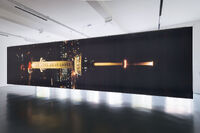 AS LONG AS IT LASTS
In 1993, artist Lawrence Weiner made a work on the 185 meter high Euromast in Rotterdam as part of a group exhibition on painting and architecture. He painted the text AS LONG AS IT LASTS – which also became the title of the exhibition – up the length of the tower, making it one of the largest works Weiner has realized to date. The first issue of Witte de With’s signature Cahier journal extensively documented the exhibition and featured a cover designed by Weiner. The Cahier also includes the two photographs of the work on the Euromast, now shown here on the light box, one taken by day, the other by night.
Conceived of as a recurring work, AS LONG AS IT LASTS reappeared in Rotterdam inside the pedestrian tunnel of the central station, as part of the citywide exhibition Melanchotopia in 2011.
Now, on the occasion of the 25th anniversary of Witte de With, Weiner’s words aptly articulate the ever-changing modus of operation of the institution. Each reiteration of the work prolongs the statement it embodies, resulting in a conceptual short-circuit which is forever finite.
AS LONG AS IT LASTS is a cautious slogan, not quite pessimistic, but rather a firm reminder that one should never make assumptions about the future.
Concept: Paul van Gennip
Photography: Bob Goedewaagen
In Light Of 25 Years
Presented as part of In Light Of 25 Years, this project celebrates Witte de With’s 25th anniversary. For In Light Of 25 Years, ten artists and curators each create an image-based work that analyzes certain sediments of contemporary art history, departing from Witte de With’s archive.
<div class="
-
Art In The Age Of…Planetary Computation
How would you draw a picture of the Internet; through the machines and ‘their’ language that broadcast and store ‘our’ messages, or through the affect and power relations that those messages and their movement produce?
Presented as part of the year-long Art In The Age Of… exhibition series, Art In The Age Of…Planetary Computation investigates how quantification, telecommunications, and our ever-expanding information apparati not only inform contemporary artistic production, but also how contemporary art can hold a mirror up to these processes and formations.
The participating artists explore the fissure between literal infrastructure—code, machines, wires and other like-vocabularies — and the subjective socio-political interactions fostered by using these devices. Guided not only by what can be seen on the computer screen, and the various other black mirrors we stare into day in and day out, this exhibition will also look at what happens behind these screens. Moving from objects to subjects, we ask, how do these positions impact daily life, or said in another way: what does it mean to be ‘screened’?
Aram Bartholl’s Greetings from the Internet repurposes those little scraps of paper on which Wi-Fi passwords are usually handed over into a set of complimentary postcards.
Rossella Biscotti’s monumental textiles show patterns inspired by demographic data from recent Brussels censuses, questioning how statistics and quantitative analysis represent our reality.
Nina Canell meditates upon transmission and resistance through her sculptural constellations comprising found cables originally used for telecommunication and electrical power.
Following his denial of access by Google Inc, John Gerrard hired a helicopter and produced a detailed photographic survey of a Google data server building in Oklahoma, also known as a ‘data farm’, resulting in Farm (Pryor Creek, Oklahoma, 2015), a simulated CGI ‘twin’ of the building.
Femke Herregraven examined countless investment bank brochures to track the names under which more than 60% of all financial securities are now traded via various computer algorithms.
The sculpture Solaris Panel by Antonia Hirsch features shapes cut from black Plexiglas resembling contemporary smartphones and notepads that, in sleep mode, resemble a Claude glass, an artist’s framing aid invented in the 17th century.
Two ‘hyperlinked’ sculptures by David Jablonowski question the impact of contemporary computation in relation to early technological improvements such as manual copying machines.
Navine G. Khan-Dossos creates two new murals under the title My TV Ain’t HD, That’s Too Real. These gouache paintings evolve throughout the exhibition in response to media reports on current events in the Middle East.
John Menick’s Biography of Anish Meta-Bhatt shows pages of a fictional biography of computer scientist Dr. Anish Meta–Bhatt, developer of the first artificially intelligent computer capable of writing novels.
With iknowwhereyourcatlives.com, Owen Mundy visualizes a sample of 1 million public pictures of cats on a world map, locating them by the latitude and longitude coordinates embedded in their metadata.
Trevor Paglen’s Autonomy Cube relays all of Witte de With’s Wi-Fi traffic over Tor, a global network of thousands of volunteer-run servers, relays, and services designed to help anonymize data.
Lucy Raven’s lenticular print Hand moving at a walking pace is made from a video Raven took in a post-production studio in Chennai (India), just one of many outsource centers where Hollywood films are converted from 2D to 3D at highly reduced wages.
Stephan Tillmans creates series of photographs taken at the very moment analog cathode ray televisions are switched off; as the picture raster breaks down, a final flicker abstracts the last image into electromagnetic geometrical waves.
For her work After, About, With, Julia Weist exploited her personal contacts, social media networks, and search engine optimization techniques to attempt to control the search results returned for the artist Haim Steinbach.
Alongside artist presentations, a dedicated research blog has been founded. This blog will track the development of Art in the Age of… exhibitions for 2015 and acts as a visual reader accompanying artists work: http://artintheageof15.tumblr.com.
Art In The Age Of…Planetary Computation is the second iteration of the Art In The Age Of…, a three-part presentation series that investigates future vectors of art production in the 21st century. Art In The Age Of… runs throughout 2015 starting with Art In The Age Of…Energy and Raw Material and continues in September with Art In The Age Of…Asymmetrical Warfare.
Participants
Aram Bartholl, Rossella Biscotti, Nina Canell, John Gerrard, Femke Herregraven, Antonia Hirsch, David Jablonowski, Navine G. Khan-Dossos, John Menick, Owen Mundy, Trevor Paglen, Lucy Raven, Stephan Tillmans
Curators
Defne Ayas, Adam Kleinman, Samuel Saelemakers
Supported By
The work of Antonia Hirsch is presented with the kind support of the Southern Alberta Art Gallery.
<div class="
-
NO HUMANS INVOLVED
Witte de With is pleased to host HOWDOYOUSAYYAMINAFRICAN?, a multi-disciplinary arts collective made up of 45 artists who have lived and worked together, in various iterations, for the past twenty years. The collective consists of visual artists, writers, poets, composers, academics, filmmakers and performers from around the world who collaborate across disciplines and cities. Projects conceived and created by this transnational collective ultimately function as laboratories for investigation, production and discourse.
Members of the collective recided in Rotterdam for two months to produce new work, including video and sculptural installations, printed matter, sonic scapes and film shorts. Many of these installations include algorithmically produced sounds, piezoelectric material interactions and visual material from social media, which are explored in relation to the body. By pushing the notion of technology in conjunction with socio-political questions into the physical, sensorial and hence affective realm the Collective is invested in aesthetically emphasizing what writer Sylvia Wynter called “sociogenic principle”. A concept that can be understood as a result of processes of social conditioning and culturally prescribed “sense of the self”, drawing from the work of the writer and activist Frantz Fanon.
The exhibition was organized around the central question: “What does it mean to be human in a world which is continually contesting ‘certain’ people’s humanity?” and explored different modes of perception as forms of aesthetic conceptual protest and disobedience to normative orders. The ‘new default’ position, which the collective aimed to initiate, opened up a conversation around the multiplicity of our identities. Is it possible to move outside of aesthetic strategies that art, through ideological and institutional framings, has for a long time been complicit with? Can art subvert and truly free the body outside the peripheries of myth and representation to open up a debate that might lead to an understanding of what it “feels to be human”?
Exhibition Readings
Exhibition readings were offered by experts throughout the summer:
5 June, 2015: Teana Boston-Mammah (Researcher, Rotterdam University of Applied Sciences)
3 July, 2015: Samir Bantal (Executive Manager, OMA)
Symposium
The symposium Between Nothingness and Infinity was held on Tuesday 14 July from 6pm.
Participants
HOWDOYOUSAYYAMINAFRICAN, Nana Adusei-Poku
Curators
Defne Ayas, Christa Bell, Natasha Hoare, Sienna Miller, Nana Adusei-Poku
Supported By
Embassy of the United States of America, The Hague.
<div class="
-
Özlem Altın — No story, no
When researching Witte de With’s exhibition history in preparation of her participation in the In Light Of 25 Years project, artist Özlem Altın was instantly drawn to Pas d’histoire, Pas d’histoire (No Story, No History), the first large scale solo exhibition by Belgian artist Joelle Tuerlinckx in 1994. She asks herself how to make Tuerlinckx’ work resonate in her own and whether this personal resonance and reflection could establish a platform that allows new perspectives or readings on how stories and histories are created and displayed?
Altın, whose practice also encompasses painting and photography, often combines images gathered from different sources and re-contextualises them, uprooting them from their origin. She shares with Tuerlinckx a great interest in what she calls suspended objects and gestures. Much like Pas d’histoire, Pas d’histoire (No Story, No History) in 1994, Altın’s work No story, no consists of an open ended constellation of image and text.
Just like the light box itself is suspended in the air, big like a wall yet light like a picture frame, the images on view depict hands, both human and artificial, in various stages of suspended movement, manipulating different objects. The point of these gestures remains unknown.
The notion of the gesture, a movement of the hands, is prominent in this work. French art historian Henri Focillon wrote in his essay “In Praise of Hands“ (1934): “Through his hands man establishes contact with the austerity of thought.” And indeed, Altın is working through her thoughts, drawing from multiple sources to create two enigmatic digital collages, shown in the light box along with a small painting by Altın and a print of an installation shot taken during Tuerlinckx’ exhibition in 1994.
Accompanying the work is a small publication titled Notes on notes, which combines Özlem’s own notes and images with selected notes written by Tuerlinckx and previously published in the Witte de With Cahier #3. This publication is available for sale at Witte de With and Printroom, Rotterdam.
Participants
Özlem Altın
Curators
Samuel Saelemakers
Supported By
SAHA Association
<div class="
-
Rotterdam Cultural Histories #5: Summer Carnival
Rotterdam Cultural Histories #5 features Robert De Hartogh’s photos of the first Rotterdam Zomercarnaval (Summer Carnival) in 1984. The pictures show the birth of a unique explosion of creativity in which the cultural, economic, social, and political ideas about the city come together. The Summer Carnival was held for the first time in 1984 and attracted more than 15,000 visitors. Now, more than thirty years later and with more than 750,000 visitors, the Summer Carnival’s parade is regarded as one of the biggest events in the Netherlands, and it has always remained true to its Caribbean roots. De Hartogh’s photos of the Summer Carnival’s early years show a new and colourful Rotterdam.
Rotterdam Cultural Histories is a collaborative project between TENT and Witte de With Center for Contemporary Art that explores our common roots in Rotterdam and articulates meeting points between both of our programs. Rotterdam Cultural Histories is conceived by Mariette Dölle (Artistic Director, TENT) and Defne Ayas (Director of Witte de With). This fifth edition is curated by Mariette Dölle in collaboration with Robert de Hartogh, in the context of the exhibitions On The Other Side Of Reality at TENT and NO HUMANS INVOLVED at Witte de With.
Network
TENT
Series
Rotterdam Cultural Histories
<div class="
-
Xu Zhen — One of Us Is On the Wrong Side of History!
For One of Us Is On the Wrong Side of History!, Xu Zhen (1977, China) focuses on the visual identity of Witte de With’s past exhibitions as well as its archive of posters. As such, this work brings to light not the artworks shown at Witte de With during the past twenty-five years, but rather the wording and design, which mediated them. The archive is read and revealed as a sprawling visual poem made up of fragments and traces of voices past. In the vein of his Metal Language series, Xu Zhen extracts fonts and layouts from their original contexts and reproduces them using metal chains.
On the floor, these chains sculpturally represent select titles and logos of Witte de With programs. Shimmering like jewels but weighing down on the physical foundation of the institution, the choice of metal shackles reflects the ambiguity of history itself: it is a treasure and a burden. The display, on the other hand, shows images taken from the Metal Language series (2012) and shows select sentences from political caricatures. The “bling” of the chains along with the many exclamation marks evoke the chaos of wall tagging and protest-graffiti, where many individual statements are embedded into one larger image.
In Light Of 25 Years
Presented as part of In Light Of 25 Years, this project celebrates Witte de With’s 25th anniversary. For In Light Of 25 Years, ten artists and curators each create an image-based work that analyzes certain sediments of contemporary art history, departing from Witte de With’s archive.
Participants
Xu Zhen
Curators
Samuel Saelemakers
<div class="
-
Zin Taylor — A Segment of Translation
Zin Taylor’s work A Segment of Translation (F. Kiesler’s Mind Form) stems from extensive research into the work and writing of architect, theoretician, set designer, and sculptor Frederick Kiesler (1890-1965). The first retrospective of this extraordinary artist in the Netherlands was held at Witte de With in 1996, and included original models, drawings, documents, photographs and writings by Kiesler.
Taylor approaches the light box as an architectural element conceived of in a way close to Kiesler’s thinking. Kiesler used the word “organic” to describe his aim for architecture where a form emerges from a creative consciousness and is translated into concrete existence. Taylor himself describes his practice in a similar way, as a process where thoughts about a subject are translated into forms about a subject, where abstraction and phenomenology participate as tools in a narrative development of form.
The two sides of the luminous display together form a permeable wall, a skin which touches both an interior and an exterior space. The wall builds a space for thoughts to exist within. It divides the private thought from the public form. The wall is the membrane that collects these two opposing elements.
The inner space, facing the entrance of the gallery, holds thoughts, and can be seen as a cave for contemplation. One of Kiesler’s most famous works is the Endless House (1950-61), the result of his lifelong scrutiny of the conventions of modern architecture. This house existed as an idea, materialized only into scale models and sketches, making it a house built from thought, rather than stones. The construction principle of the house was that of endless tension, as there was not a single column in the whole structure. As such, the entire house exists as one form, endlessly flowing, or as Kiesler wrote: “like the human body – there is no beginning and no end to it.” This side of Taylor’s work can be seen as a hypothetical rendering of the inside of the Endless House.
Both sides of the work are connected by holes which seemingly pierce the surface. By adding windows to his wall, Taylor opens a portal where dialogue can move through. The inside goes out, and the outside comes in. This dynamic is referenced in the dotted lines which run across both sides, exchanging white circular voids for black locational spots.
The street-side image, facing the Witte de Withstraat, witnesses the ever changing identity of the street through gentrification, a process that filters out difference and mess, replacing this with something approved and clean. This is a corporate idea, to remove the hand-made and the vernacular for the betterment of a select population. Kiesler’s work can be seen as a sort of counterculture architecture, built as the result of protest gestures, of dropping out, of building a personal system.
The structure of the Endless House in many ways resembles that of a yurt, a type of mobile housing unit originating from the Middle East and North Africa that was adopted by American west coast hippies and communes as a home for their ideological activities. This correlation brought Taylor to the idea that alternate ideas take on alternate forms, and alternate forms have the ability to generate alternate ideas. Of the many characters on the front of the wall, one, on the far right, is an illustrated rendition of Mr. Natural, a character by cartoonist Robert Crumb that satirically embodies the hippy movement and its eventual ideological demise.
Also on view is a small stool made by Taylor, carrying copies of poems by Kiesler. Taylor interprets these poems as the document of a hallucinogenic dream-episode Kiesler underwent in 1962, when upon waking he immediately put it to paper. The Endless House was already completed as an idea by then. Taylor then asks: could these poems have formed along with the space created by the organic house? He sees Kiesler’s poetry occurring as the result of the Endless House, that piece of strange architecture presenting a mental opportunity for an extended form of abstraction to take place. In other words, the narrative of the poems occurred within the space made for it by the thought of the Endless House. Thoughts within thoughts.
In Light Of 25 Years
Presented as part of In Light Of 25 Years, this project celebrates Witte de With’s 25th anniversary. For In Light Of 25 Years, ten artists and curators each create an image-based work that analyzes certain sediments of contemporary art history, departing from Witte de With’s archive.
Participants
Zin Taylor
Curators
Samuel Saelemakers
<div class="
-
Art In The Age Of…Asymmetrical Warfare
Just as World War II began with a charge on horseback, and ended with the atomic bomb, the technological escalation of killing machines continues today. Art In The Age Of…Asymmetrical Warfare, the third and final iteration of Witte de With’s year-long exhibition series Art In The Age Of…, considers the irregular, and often uneven nature of the hybrid battlefield. As always, war is ever-present, however, its theater has now extended from the so-called real to the virtual. While hard power is still asserted face-to-face and hand- to-hand, remotely controlled weaponry and other means of telecommunicated violence are broadcast and delivered digitally through cyber attacks, and via social media propaganda platforms. Not surprisingly, these new channels have created their own forms of representation in which morale and information have become equal to, or are greater than, traditional military superiority. Instead of simply producing images of war, a new war of images is being fought and sold. As such, Art In The Age Of…Asymmetrical Warfare asks the question: What role do artists play when they slip into these networks and try to reveal the engines and effects of contemporary conflict?
Valences between presentations develop various leitmotifs including subjects such as diplomacy, media, extra-judicial killing, computation and coding, military and guerrilla tactics, and of course, weaponry. In addition to the artworks, several artifacts will join the exhibition including a real-time global cyber attack monitor as well as an animated map of the international arms trade and nuclear detonations.
As the last iteration in the three part series, this exhibition carries forward three artistic positions from the preceding show, Art In The Age Of…Planetary Computation. Works by Trevor Paglen and Navine G. Khan-Dossos remain on view, whilst artist John Gerrard presents a new duo of simulations. This slippage recontextualises the works to explore the interrelation of computation and conflict.
Abbas Akhavan’s blue shield, cut from one of Witte de With’s gallery walls, marks the art center as a heritage, non-military site unfit for aerial bombardment. Sven Augustijnen charts the history and dispersal of the Belgian made FAL rifle through the gun’s appearance in Paris Match war dispatches from the 1970s. To highlight government censorship, James Bridle uses Fraunhofer lines—light spectrum graphs—to depict information recently withheld by the Dutch government concerning the downing of Malaysia Airlines Flight 17 over the currently embattled Ukraine. The process-based paintings of Navine G. Khan-Dossos are informed by actual reports of Daesh’s (aka Islamic State) executions, accounts of female jihadists, and related ‘War on Terror’ propaganda. John Gerrard’s simulations tackle the logistics and tactics of the United States military troop exercises by rendering an impossible drill set in an overseas Djibouti base through the use of motion capture animation. Like a cipher, the evolution of American embassy design (1967–85) is tracked by Terence Gower so as to decode the country’s developing foreign relations. Glenn Kaino picks up a related theme through a wall-mounted work in which steel panels replicate the façade of the American embassy in Syria, which bears the scars of several street protest assaults. Civil and military weaponry meet in Nida Sinnokrot’s Rubber-Coated Rock, All-Stars 02, which consists of handmade projectiles mimicking the rubber bullets used by the Isreali army. Trevor Paglen and Jacob Appelbaum’s Autonomy Cube creates a working relay within the Tor network, an encrypted online channel that facilitates anonymous communication so as to combat mass Internet surveillance by governments and other institutions. Likewise, Thomson & Craighead consider the spread of Internet-based citizen journalism and other forms of social-media reporting through a film essay which twins Flickr images of war zones spanning the entire globe with the metadata that reveals the origin of each image. The utility of war photo reportage is evoked and critiqued by Broomberg & Chanarin, who, while embedded in Afghanistan, exposed photographic paper on the one day in which no soldier was killed. To measure the physic toll of living under the constant threat of terror, the ominous sound of a General Atomics MQ-1 Predator drone is simulated overhead in Susan Schuppli and Tom Tlalim’s Uneasy Listening. Reflecting on the media coverage of perhaps the preeminent asymmetrical attack, Mohammad Salemy fragments TV broadcasts of 9/11 to demonstrate how a multilayered geopolitical event was channeled into a universal spectacle. Hijacking is also widened to encompass proxy and other acts of disinformation through Thatchergate, a faked conversation between Margret Thatcher and Ronald Reagan disseminated by the anarcho-punk band Crass in the aftermath of the Falklands War. Extending the definition of war further, José Antonio Vega Macotela’s Murmurs brings the viewer to her/his knees in order to decipher codes used by jailed Mexican drug runners to communicate in secret.
Alongside artist presentations, a dedicated research blog has been founded. This blog will track the development of Art in the Age of… exhibitions for 2015 and acts as a visual reader accompanying artists work: http://artintheageof15.tumblr.com.
Art In The Age Of…Asymmetrical Warfare is the third and last iteration of Art In The Age Of…, a three-part presentation series that investigates future vectors of art production in the 21st century. Art In The Age Of… runs throughout 2015; started with Art In The Age Of…Energy and Raw Material in January (23 January – 3 May 2015), and continued with Art In The Age Of…Planetary Computation in (22 May-16 August 2015).
Participants
Abbas Akhavan, Sven Augustijnen, James Bridle, Broomberg & Chanarin, Crass, Claire Evans, John Gerrard, Terence Gower, Glenn Kaino, Navine G. Khan-Dossos, Trevor Paglen, Mohammad Salemy, Susan Schuppli, Nida Sinnokrot, Thomson & Craighead, Tom Tlalim, José Antonio Vega Macotela
Curators
Defne Ayas, Natasha Hoare, Adam Kleinman
Supported By
Art In The Age Of…Asymmetrical Warfare is kindly supported by the vfonds.
<div class="
-
Douglas Coupland — Bit Rot
Witte de With Center for Contemporary Art is proud to present Bit Rot by artist and novelist Douglas Coupland. Bit Rot is Coupland’s very first large-scale solo exhibition in Europe and will be on view from 11 September 2015 until 3 January 2016. The exhibition presents Coupland’s ‘mindscape’, combining his own work with loans from his personal collection, as well as material stemming from his recent residency at the Google Cultural Institute in Paris. An eponymous paperback collection of new and existing short stories and essays written and compiled by the artist will accompany the exhibition.
Throughout the exhibition Coupland shares his thoughts on globalization, terror, the Internet, pop-culture, social media and the resulting accelerated image economy. Taking its title from the phenomenon in which digital data spontaneously and quickly decomposes, Bit Rot creates an associative and visually playful constellation in which memory, loss, fame, violence, destruction, and creation are subjects for contemplation.
For many years Douglas Coupland has been intuitively collecting art works, images and objects, creating a collection perhaps only fully legible to himself. Each of the exhibited strands of work began as impulsive purchases but ultimately led to forms of clarity in regard to deeply rooted needs and wants. Now, for the first time, Coupland exhibits these collected works together with his own.
Following his residency at the Google Cultural Institute, Paris in early 2015, Coupland also presents The Living Internet, a kinetic room-sized sculptural tableau visualizing what the Internet and online searching actually looks like.
Important to the framework of the exhibition is a piece of writing included in the Bit Rot publication, titled An app called: Yoo. This fictional app, conceived by Coupland, creates new and unique visual material based on all of the (meta-)data individuals generate throughout their lives. If the Yoo app, in essence a mind-mapping tool, were to produce an exhibition, Bit Rot is what that might look like.
Yoo brings previously unobserved life patterns to the surface.
Yoo allows you to reinterpret any day of your life in an infinite number of ways.
Yoo finds connections in your life that you didn’t know were happening and makes them for you, before your eyes.
Yoo, poetically, allows you to reincarnate while still living.
Yoo takes images, sounds and text from the course of your day (or week or year) and weaves them together so that they morph, jump-cut and dissolve.
Every new technology allows us new opportunities to explore our humanity. That’s what Yoo is all about.
— Excerpts from An app called: Yoo, published in Bit Rot, Douglas Coupland, 2015
The Cloud Is The New Infinity
With The Cloud Is The New Infinity (2017), renowned author and artist Douglas Coupland has developed for Witte de With an exclusive version of his famous Slogans for the Twenty-First Century series. His solo show Bit Rot was on view at Witte de With from 11 September 2015 – 3 January 2016. Proceeds generated from the sale of this edition partly go to the artist and partly to the institution.
More info
Publication
Published by Witte de With, Bit Rot is a paperback collection of short stories written for the exhibition, which functions as an accompanying work running parallel to the different clusters of art works in the exhibition. Emphasizing the importance of literature as an artistic medium, Coupland readdresses the issues at stake in the exhibition through the medium of writing. Bit Rot will be launched during the opening of the exhibition on 10 September 2015.
“My books have always, to some extent, contained ideas for installations and works […]. Pieces in the exhibition become materializations of words, and some of the words in this book are a dematerialization of objects in the exhibition.”
—Douglas Coupland, introduction to Bit Rot, 2015
The exhibition kicks off Futurosity, a project by Kunstblock that is part of Rotterdam celebrates the city! (check www.rotterdamcelebratesthecity.nl for the complete program) and is supported by The Art of Impact.
Participants
Douglas Coupland
Curators
Samuel Saelemakers
Supported By
Bit Rot is supported by Intracorp, Vancouver and AMMODO, Amsterdam. The work The Living Internet is a Douglas Coupland initiative supported by the Google Cultural Institute.
<div class="
-
Camille Henrot — The Beaver Moon
When faced with the large-scale light box which functions as the ongoing display module for the In Light Of 25 Years series, artist Camille Henrot was reminded of her training in animation. Although the production of animation has by now gone mainly digital, light box based animation remains an essential part of animation studies.
During her research into the exhibition history of Witte de With, Camille Henrot was drawn to the works of Michelangelo Pistoletto, who used mirrors and photography to create trompe l’oeils where the distinction between physical objects and representations is blurred. Also of inspiration were the video works by Ulrike Ottinger, who had a solo exhibition at Witte de With in 2004. In these videos, a universe of strange characters unfolds, inspired by countercultures and questioning norms and morals.
For her new work, titled The Beaver Moon, Henrot drew two human-like characters and staged them as if involved in domestic activities of maintenance and cleaning, reminding us that exhibition spaces are the homes of artworks, and sometimes of artists as well. The creatures are ambiguous, existing somewhere between the realms of male and female, human and bird. They are reminiscent of the Egyptian god Thoth, who has the body of a man and the head of an ibis and who was the god of writing, science and magic. Thoth was believed to be self-begotten, and was considered the care-keeper of the universe.
In Light Of 25 Years
Presented as part of In Light Of 25 Years, this project celebrates Witte de With’s 25th anniversary. For In Light Of 25 Years, ten artists and curators each create an image-based work that analyzes certain sediments of contemporary art history, departing from Witte de With’s archive.
Participants
Camille Henrot
Curators
Samuel Saelemakers
<div class="
-
Rotterdam Cultural Histories #6: Video at the Lijnbaancentrum
Rotterdam Cultural Histories #6 highlights a lesser known aspect of the Lijnbaancentrum, namely its video studio. The Lijnbaancentrum (1970 – 1984), led by head of Exhibitions Felix Valk, was an exhibition space of the Rotterdam Arts Foundation (RKS) in the center of Rotterdam. Here various exhibitions were presented on art, image and mass culture, in order to appeal to a large and diverse audience. Moving image was seen as an indispensable medium to do this; therefore, since its launch the Lijnbaancentrum was equipped with a special studio, with modern video equipment for the recording and editing of both monochrome and recently introduced color video.
The video studio did not just offer quality video equipment and expertise freely to international and Dutch artists such as Vito Acconci, Joan Jonas, Nan Hoover, Wim Gijzen, and Jan van Munster for the production of new video works, but also created recordings of performances, educational videos and produced a number of reports on the exhibitions held at the Lijnbaancentrum. A major exhibition in 1973, Video, brought these different applications of the medium together. Besides an overview of video initiatives in the Netherlands, the exhibition presented various forms of the educational application of video, alongside the work of artists such as Dennis Oppenheim and Henk Tas.
Over the years the core of the Lijnbaancentrum video team was formed by Henk Elenga, Frédéric Kappelhof, Wink van Kempen and Erik van Dieren. Rotterdam Cultural Histories #6 gives an impression of their efforts and experiments with the medium of video, based on archival material, photographs and a selection of five videos, which were created in, and thanks to, the video studio of the Lijnbaancentrum.
Rotterdam Cultural Histories is a collaborative project between TENT and Witte de With Center for Contemporary Art that explores our common roots in Rotterdam and articulates meeting points between both of our programs. Rotterdam Cultural Histories is conceived by Defne Ayas (Director of Witte de With) and Mariette Dölle (Artistic Director, TENT).
Network
TENT
Series
Rotterdam Cultural Histories
<div class="
-
Germaine Kruip – A Room, 4 Minutes
In her work, artist Germaine Kruip brings out tensions between formal abstraction and lyrical spiritualism. With a background in theatre set design, Kruip examines techniques of staging such as light, sound, duration, and isolation. With a predilection for ephemeral objects such as sound or fleeting experiences of time, she decided to use the fixed element of the light box, used throughout the In Light Of 25 Years program, not as a carrier for imagery and representation but to turn it into a performative agent.
Using time and space as her material, Kruip creates a choreography of light and sound which repeats itself endlessly. Outside of the exhibition space is a clock which counts down from four minutes to zero; inside, another clock counts upwards from zero to four. The counting up and down is activated by the sound of hands clapping. This single clap of two hands reminds us of the clapperboard used in cinema. Once the clap is heard, the action begins. The light goes on, then out again.
A Room, 4 Minutes not only hints towards Kruip’s previous work A Room, 24 Hours, but is also a tribute to the work of David Lamelas (Argentina, 1946) who in 1997 had his very first retrospective exhibition in Europe at Witte de With. Kruip’s new work is inspired by Lamelas’ pieces such as Time as Activity (1969) which showed four minutes of recorded city scenery, shot at three different locations but shown in one exhibition space; or Two Modified Spaces (1967) in which the artist modified the exhibition space, creating a stage within a stage by use of light and wooden cubical frames.
With A Room, 4 Minutes, Kruip, much like Lamelas, urges the spectator to become aware of the room they are in, the space they occupy, and the time they spend there.
In Light Of 25 Years
Presented as part of In Light Of 25 Years, this project celebrates Witte de With’s 25th anniversary. For In Light Of 25 Years, ten artists and curators each create an image-based work that analyzes certain sediments of contemporary art history, departing from Witte de With’s archive.
Participants
Germaine Kruip
Curators
Samuel Saelemakers
<div class="
-
Raimundas Malašauskas — What are we looking at tonight?
“All the children will go to sleep, adults will marvel at each other and at an invisible object in the future, asking each other “How do we know if we are still alive?”; the radio will be playing Marvin Gaye (he always sits on one of the shelves upstairs(1)) and a blown up paper toy by Viktorija Rybakova will swirl around Jef Geys’ writings(2); It is 1993(3) and 2016 at once, or perhaps twice, in the same room, in the split gaze; Like that film shot from the perspective of someone whose identity multiplies or changes half way. “How many times you’ve been dead?” one may ask.”
R. Malašauskas
1 On the first floor landing, gracing a window looking into Witte de With’s offices, stands a vinyl record of Marvin Gaye’s hit single What’s Going On (1971). The record has been standing there for over twenty years; the song is the on-hold music for Witte de With’s telephone line.
2 “The words I am writing are mirrored in the red balls on the imaginary Christmas tree which is not in my hotel room in Bredene aan Zee. They assume shapes which even I can barely recognize: “black” is powdered with artificial snow, and “valid” rotates slowly round the tree’s green tip. “Division of labor” is reflected by the stomach of the pink-and-white mannequin onto the pale yellow fake straw before the words fade away between the ox and the ass. Mary’s blue cloak swallows up “working week” and “condensation,” and “demo” glides from one imitation pearl to another.”
Jef Geys, What are we going to read tonight?, Cahier #2, Witte de With Publishers, 1994
3 The 1993 exhibition Wat eten wij vandaag? (What Are We Having for Dinner Tonight?) at Witte de With was associated with the fifth Architecture International Rotterdam manifestation, whose theme was the postwar residential areas built in Rotterdam’s Alexanderpolder neighborhood. Jef Geys’s project commented on the abstract way architects, urban planners and politicians tend to think about the urban environment.
By inviting nine families from Alexanderpolder to contribute to his exhibition, Geys let the residents have their own say about the area they inhabit. The project was realized with the cooperation of the families Bast, Battes and Risse, De Bruin, Diepstraten, Groot and Van Halem, Roodbeen and Boode, Van Schouwen, Sevenhuijsen, and Verkade.
In the exhibition, the families presented photographs of their living area. Each evening, throughout the entire exhibition period, one of the nine participating families was filmed having dinner and broadcasted by the local television station.
Sculpture by Viktorija Rybakova
Photograph by Bob Goedewaagen
In Light Of 25 Years
Presented as part of In Light Of 25 Years, this project celebrates Witte de With’s 25th anniversary. For In Light Of 25 Years, ten artists and curators each create an image-based work that analyzes certain sediments of contemporary art history, departing from Witte de With’s archive.
Participants
Raimundas Malašauskas
Curators
Samuel Saelemakers
<div class="
-
Calla Henkel & Max Pitegoff — Foreword
In Foreword, Berlin-based duo Calla Henkel and Max Pitegoff focus on shared fictions and the abstraction of community within entrepreneurial startups and models of creative labor. An excerpt from a novel-in-progress by New York-based writer Emily Segal (co-founder of the trend forecasting group and art collective K-HOLE and former creative director at Genius) will be released and installed in three parts over the course of the exhibition, framed by a configuration of colored benches and tables pulled from spaces run by Henkel and Pitegoff over the past five years in Berlin. These tables display Henkel and Pitegoff’s short story “Photography and Eating,” which explores the creative classes’ relationship to risk, profit, fantasy, and uselessness, drawing from their interviews and visits to startups in Berlin. The brightly coloured installation recalls both the aesthetics of the start-up offices they visited, and those of early 2000’s relational art practices, offering a non-work space in the ground floor gallery of Witte de With. Hosting two parallel semi-fictional narratives weaving in and out of truth in a nod to internet-era journalism and digitally circulated texts, Foreword sees Henkel and Pitegoff perversely position text as art object.
Para | Fictions
Foreword is presented as part of Para | Fictions, a cycle of sustained investigations taking as its focus the relationship between literature and visual art through the practice of ten artists; Daniel Dewar & Grégory Gicque, Calla Henkel & Max Pitegoff, Mark Geffriaud, Laure Prouvost, Oscar Santillan, Dineo Seshee Bopape, Lucy Skaer and Rayyane Tabet.
Each project on display presents a different artistic methodology, constituting a combination of each artist's visual interests and literary underpinnings, to seek the viability of repositioning ‘reference’ as ‘form’, ‘translation’ as ‘co-authorship’.
Participants
Calla Henkel, Max Pitegoff, Emily Segal
Curators
Defne Ayas, Natasha Hoare
Supported By
AMMODO
<div class="
-
Charlemagne Palestine — GesammttkkunnsttMeshuggahhLaandtttt
GesammttkkunnsttMeshuggahhLaandtttt, a solo exhibition with artist Charlemagne Palestine, who also spent several years living and working in Rotterdam, includes early video works, sculptures, paintings, installations, and sound scores. Charlemagne Palestine works form a highly personal universe of rituals, intoxication, and shamanism. In the last four decades, the artist has created an extensive body of experimental musical compositions, bodily performances, and, in later years, visual art works that are inhabited by stuffed animals. To Palestine, teddy bears figure as powerful shamanic totems, which he fondly calls Divinities.
Born in 1947, Brooklyn, in a Jewish family, Charlemagne Palestine gained recognition in the sixties with his experimental compositions and performances. A flamboyant part of the creative scene of New York, he collaborated with choreographer Simone Forti, artists Tony Conrad and Richard Serra, and performed alongside avant-garde artist La Monte Young and composers Terry Riley, Philip Glass, and Steve Reich. In spite of the art historical consensus about that era and his contemporaries, Palestine has always resisted being labeled a minimalist, opting instead for the term “maximalist”. In his later years he toured through Europe, settling briefly in the Netherlands, where he lived and worked in Rotterdam.
Central to his exhibition are a grand piano, as the sounding heart of the show, and a new large-scale version of the so-called God-Bear Museum Model, a proposal for a new kind of museum where music and performance find a home just as easily as a painting would. Also part of the exhibition are Palestine’s extraordinary music or sound annotations, a vast collection of works on paper, which aim to translate sound into image.
The exhibition kicks off with a performance by Palestine on the opening night, Thursday 28 January 2016, and will be accompanied by a new catalogue, co-published by Witte de With Publishers and Sternberg Press on behalf of Kunsthalle Wien.
Curator: Luca Lo Pinto (Kunsthalle Wien), together with Samuel Saelemakers (Witte de With)
The exhibition is co-commissioned by Kunsthalle Wien and Witte de With Center for Contemporary Art. An earlier iteration of the exhibition was on view from 18 September to 8 November 2015 at Kunsthalle Wien.
On 2-3 April 2016, Charlemagne Palestine and Simone Forti presents a new version of their performance Illuminations at Vleeshal Markt, organized by Vleeshal, Middelburg.
Participants
Charlemagne Palestine
Curators
Luca Lo Pinto
Network
Kunsthalle Wien
<div class="
-
Michael Portnoy — Relational Stalinism – The Musical
“Relational Stalinism”
In opposition to the strangling of museum spaces worldwide by rampant immaterial kudzu, (i.e. Post-French Post-Conceptual Dance, Dance-We-Can’t-Call-Dance, Po-Faced Minimalism, Feel-Good Participatory Glibbery, (a.k.a. Too Many Seagulls), and Performance with no qualities whatsoever aside from its leeching of court-approved historical referents, (a.k.a. Fancy Shoulder Piggybacking)), the breed of Relational Stalinism arose in a Theater Internment Facility in Preoccupied Benelux in the late Twenty-Teens. The primary tenets of Relational Stalinism are: Emboldening Confusion, Logocratic Exuberance, and Antic Behaviorism. Relational Stalinist works use a slippery iron fist to unbutton the viewer’s buggy of self and catapult her into a realm of truths only palpable through higher forms of irrationality.
This advanced breed of world-bending adopts the degree-zero performance palette as a constraint (performers, in a room, that's it), but pushes it out of monochrome and into a pubotany of deviously vibrant offshoots which stretch participants' language and behavior in the service of invention.
--
Running across six spaces at Witte de With, Relational Stalinism – The Musical is an ambitious assemblage of new performances created by artist Michael Portnoy, enacted and developed with a diverse troupe of dancers, actors, singers and improvisers. Many different registers of performance will simultaneously cohabit the institution, mixing inscrutable role-play scenarios, experimental sketch comedy, hyperactive spectatorship, melodramatic operatic interlude, prog-rock micro-dance and teary-eyed theoretical soliloquy. Combining futurology with satire, this exhibition transmutes the seeds of prevalent approaches to visual arts performance as a form of generative critique.
Relational Stalinism – The Musical is the latest branch of Portnoy’s Improvement League, initiated in the Taipei Biennial 2010, which seeks to “improve” existing breeds of art-making by pruning, grafting and hybridizing certain lines of thought in a kind of conceptual horticulture.
Relational Stalinism – The Musical is curated by Defne Ayas (Director, Witte de With) and Natasha Hoare (Curator, Witte de With) and is a co-production of Witte de With and A.P.E (art projects era).
Director: Michael Portnoy
Choreography: Michael Portnoy in collaboration with Mark Bellamy, Thomas Dudkiewicz, Jimmy Guacamole, Margo van de Linde, Keyna Nara, Evelyne Rossie, Loveday Smith, and Gerrie de Vries
Performers: Mark Bellamy, Thomas Dudkiewicz, Jimmy Guacamole, Margo van de Linde, Keyna Nara, Evelyne Rossie, Loveday Smith, and Gerrie de Vries
Curators: Defne Ayas and Natasha Hoare
Dramaturgy: Advisor Maaike Gouwenberg
Lighting: Andre Goos and Jorg Schellenkens
Music: Michael Portnoy
Costume: Nadia van Luijk, Marieke Pruis, Yoeri Guépin
Production Assistant: Sten Saarits
Public Program:
The project is accompanied by several events including Performance Taxonomies, a symposium on March 3, 2016, featuring a series of present and future taxonomies by key thinkers in the field of performance analysing current typologies from which speculative improvements can be structured; The Particiturbation Room, a conceptual nightclub at various locations in Rotterdam; and on a night of short films selected by Portnoy himself to draw out the absurdist streak in artist’s moving image.
Participants
Michael Portnoy, Mark Bellamy, Thomas Dudkiewicz, Margo van de Linde, Keyna Nara, Claudio Ritfeld, Evelyne Rossie, Loveday Smith, Gerrie de Vries
Curators
Defne Ayas, Natasha Hoare
Network
A.P.E (Art Projects Era)
Supported By
Fonds 21, the City of Rotterdam, and the American Embassy in the Netherlands.
<div class="
-
Rotterdam Cultural Histories #7: Perish festival
Rotterdam Cultural Histories #7 revolves around the performance festival Perish, organized on May 24 & 25, 1997, by artists’ initiative Duende in Rotterdam. For 28 years, 1984-2013, Duende offered studio spaces, residencies and exhibitions to Rotterdam-based and (inter)national artists. The Perish festival brought together videos of performances from the 60s and 70s – including works by Dan Graham, Hélio Oiticica, Bas Jan Ader, and Joseph Beuys – and (filmed) performances by contemporary artists such as Bik Van der Pol, Jeroen Eisinga, Alicia Framis, Charlemagne Palestine, Otto Berchem, Yael Davids, and Yvonne Trap. Perish explored the relationship between early performance art and performances from the late ‘90s, reflecting on the role video occupied as a medium and meditator within both contexts.
Rotterdam Cultural Histories is a collaborative project between TENT and Witte de With Center for Contemporary Art that explores our common roots in Rotterdam and articulates meeting points between both of our programs. Rotterdam Cultural Histories is conceived by Defne Ayas (Director of Witte de With) and Mariette Dölle (Artistic Director, TENT).
Concept and Research: Adelheid Smit and Wendy Bos (Witte de With)
Loans: Bik Van der Pol, Kamiel Verschuren and the municipal archive Rotterdam.
Graphic design: Rick Vermeulen, Via Vermeulen
Participants
Bik Van der Pol
Network
TENT
Series
Rotterdam Cultural Histories
<div class="
-
Oscar Santillan — Zaratán
“There is one story that has ranged the whole of geography and all epochs – the tale of mariners who land on an unknown island which then sinks into the sea and drowns them because it is a living creature.”
Jorge Luis Borges, Book of Imaginary Beings, 1957
Zaratán is a new commission by artist Oscar Santillan (1980, Ecuador) presented at Witte de With Center for Contemporary Art as part of Para | Fictions. The commission is fed by converging threads of research and literary reference, including the short stories and life of writer Jorge Luis Borges (1899-1986), travellers’ tales of imaginary islands from the era of colonial exploration, and an unfinished movie titled The Messenger whose filming was tragically cut short.
Titled after the name of a mythical creature recorded in Borges’ Book of Imaginary Beings (1957) – whose gargantuan shell is mistaken by sailors to be an island only to be lost once it submerges – the project traces how we shape the unknown using the forms and tropes at our disposal, and encapsulates Borges’ dizzying referential play between encyclopedic fact and apocryphal tale.
The presentation is the outcome of months of research that started in Russia and ended in the Dominican Republic. Creating parallel realities to Borges’ literary creations, Santillan animates and materializes the imaginary, eschewing empirical definitions of materiality and existence.
Collaborators
Gabriela Aleman (writer, Ecuador), Maritza Alvarez (photographer, Dominican Republic), Netherlands), Matteo Gatti (artist, Italy), Orlando Inoa (historian, Dominican Republic), Ludo Hellemans (biologist, Netherlands), Salomon Kroonenberg (geologist, Netherlands), Frans Snik (astronomer, Netherlands), Ana Pavlisova (translator, Russia), among others.
The Messenger:
Score and Performance - Raul Masu
Cinematography and Editing - Louis Henderson
Para | Fictions
29 January 2016 – 9 April 2017
Zaratán is part of Para | Fictions, a cycle of sustained investigations taking as its focus the relationship between literature and visual art through the practice of ten artists; Daniel Dewar & Grégory Gicque, Calla Henkel & Max Pitegoff, Mark Geffriaud, Laure Prouvost, Oscar Santillan, Dineo Seshee Bopape, Lucy Skaer and Rayyane Tabet.
Each project on display presents a different artistic methodology, constituting a combination of each artist’s visual interests and literary underpinnings, to seek the viability of repositioning ‘reference’ as ‘form’, ‘translation’ as ‘co-authorship’.
Participants
Oscar Santillan, Raul Masu, Louis Henderson
Curators
Natasha Hoare
Supported By
AMMODO
<div class="
-
Ahmed Bouanani — I want to possess in this world that which brings joy to the eyes…
After the collective trauma of the colonial occupation of Morocco, a vanguard of artists forged cultural practices that sought to establish a new vision of the country, appealing to its ancient traditions passed down through oral culture. Filmmaker, poet, and writer Ahmed Bouanani (1938 – 2011) was a towering presence in this landscape, pioneering a cinematic and poetic language that influenced a generation to come.
Bounani’s daughter artist Touda Bouanani and curator Omar Berrada work together to stage presentations drawing from his extensive archive. Here, the platform Witte de With provides is used to enable the translation and subtitling of his short films into English for the first time, providing a stepping stone to the wider distribution of Bouanani’s work and an accompanying recognition of the value and power of avant-garde film making in Morocco and the Maghreb.
Operating between the censoring hand of the monarchy and its organs, and an absence of native filmic tradition, Bouanani was keenly aware of the vital need to use cinema to protect and revive the fragile memories that linked Morocco to its pre-colonial past. In this his training and talent as a film editor were key. The archive is an explicit presence in his films and poetry. Tarfaya was made whilst working at the Moroccan Cinema Center through the permissible format of the regional documentary; Mémoire 14 consists of re-cut films shot by the French during the conquest and so-called pacification of Morocco. Both explicitly make use of archival footage to address the ethnographic distancing typical to the colonial cinematic vision, and to strive towards a more nuanced self-image.
With sad irony his legacy itself is threatened with erasure by a house fire devastating a portion of his collection, and his withdrawal from the public sphere and subsequent neglect as a figure. This presentation acts against erasure, activating networks of distribution through translation, and presenting archival documents to paint a picture of his formidable life long output.
The presentation includes Halakat Nord-Africaines (2014) a video installation by Moroccan artist Ali Essafi based on research around the practice of three radical North African filmmakers, Azzedine Meddour, Ahmed Bennys, and Ahmed Bouanani, each active from the 1960’s onwards, whose films Essafi has restored and resurrected. Halaqat refers to the circle of people gathering around a storyteller in North Africa’s public squares. This traditional oral form inspired the region’s cinema at its origins, as well as other modern narrative genres, and intersects in their work with archival footage assembled to represent contemporary history and engender new cultural forms of post-colonialisation.
Participants
Ahmed Bouanani, Touda Bouanani, Ali Essafi
Curators
Natasha Hoare, Omar Berrada, Touda Bouanani
Series
WDW25+
<div class="
-
Bik Van der Pol — WERE IT AS IF
What is hidden, forgotten, cast away, or overlooked in the day-to-day operations of a cultural institution? How does one make tangible the container of knowledge that envelops the factual succession of exhibitions and publications? Can artists become active and responsible co-creators of institutions, their politics, and representations?
Following Witte de With’s 25th year anniversary, Rotterdam-based artist duo Bik Van der Pol is invited by Witte de With Director Defne Ayas to highlight what might otherwise become lost in both the history of the institution as well as art’s history in the city of Rotterdam. Paying close attention to the socio-economic and political context in which the institution was created, and departing from the belief that cultural institutions and their legacies are as much made up of stories, ephemeral objects, and subtle traces, Bik Van der Pol’s process can be likened to a long term forensic investigation that examines, tests and actively exposes that which lies concealed in the folds of history.
Titled WERE IT AS IF, the collaboration between Bik Van der Pol and Witte de With, which commenced in June 2015, unfolds during the exhibition period, and is carried out in close dialogue with many agents (among them staff members and artists), who plunge into the institute’s rich exhibition history collaboratively, reenergizing the work of artists’ such as John Ahearn, Jef Geys, Ken Lum, Antoni Muntadas, Eugenio Dittborn, Eleanor Bond, John Knight, and Allan Sekula. Equating seemingly-in-the-fringes-material – leftovers, support structures, plans, notes, stories, and witness reports – to the level of artworks, and so exploring the viability of approaching ‘archival document’ as ‘art’, and ‘art’ as ‘source material’, the artists revive histories preserved in the documentation of exhibitions at Witte de With, such as L’oeuvre a-t-elle lieu? (1994), The Rotterdam Project (1998), Hortus Conclusus/Breeze of AIR (2001), Tracer (2004), and Melanchotopia (2011).
This particular search, however, does not stem from a seemingly omnipresent nostalgic desire to revisit the 1990s but is sparked instead by an understanding that much remains active yet unnoticed in the layers of the institute’s past. Stories and (un-)realized artistic and social projects are brought to light as Bik Van der Pol extend the premises of the investigation beyond the white walls of the institute itself, turning to the cities’ forgotten or disappeared crevices which have stood as departure points for artists working at Witte de With, such as the Perron Nul (Platform Zero) (1987 – 1994), a former methadone distribution center and safe haven for drug-users near Rotterdam train station, as well as the closed down ‘tippelzone’ (streetwalking area) at the Keileweg (1994 – 2005), where the divergent worlds of sex workers, protesting citizens, and artist initiatives – including Kaus Australis and Kunst & Complex – clashed repeatedly.
In Bik Van der Pol’s words,
“to resist memory loss and to avoid falling into the trap of repetition, conservatism or even fundamentalism, people’s activities (which after all make and determine history) must first be consumed and digested. In this way, progression and change can truly be generated and made possible.”
To this Director Defne Ayas adds,
“This examination is an attempt on our part to create a mental space for examining the potential of a cultural institution – to (re)perceive itself, to reclaim, reconstitute and recalibrate her connection to the context in which she was created. Our partnership with Bik Van der Pol insists on the rich history of Rotterdam not only as a hub of logistics and trade but also as an intellectual hub, while embracing the urgency to respond to the current momentum that brands Rotterdam as the “destination city” for art and architecture. It is our aim to make available our rich source material for new types of research and visual and textual production as to rewire possibilities through the informed eyes of artists.”
For the duration of the exhibition, Witte de With invites several guests to give readings into the methodologies and choices on display.
Participants
Bik Van der Pol
Curators
Defne Ayas, Samuel Saelemakers
Series
WDW25+
Supported By
Mondriaan Fund
<div class="
-
Marwa Arsanios — What representations?
Witte de With Center for Contemporary Art continues to examine its archive with WDW25+ Commissions running from Summer 2016 until January 2017. This commissioning series invites artists to respond to, and elaborate on, the exhibition history of the institution as a fertile ground for re-assessing and re-imagining contemporary art history.
The first commission sees Marwa Arsanios (artist and co-founder of 98Weeks Research Project) critically engage with Contemporary Arab Representations, a series initiated by former Director Catherine David at Witte de With from 2001 onwards to explore and present the activities of cultural and intellectual actors across the Arab world. Considering the series as one part of an ecology of artist, institution, market, and real estate in post-war Lebanon, Arsanios explores how the canon is formed and written into history; what informed this situation at the time (90s onward), why and how do artists get written out of certain histories? Arsanios excavates this particular period of knowledge production and validation through art historical, spatial, and revisionist feminist discourses, while mapping, re-staging, and inserting new voices in order to open up new readings.
What Representations? critically rethinks the Beirut / Lebanon program. A round-table conversation with academics, artists and writers creates a broader picture of political and social context from which the Beirut show emerged. Furthermore, Arsanios takes a cue from scripts of performances – a pre-eminent medium in the region at the time - found in the archive to create a theatrical set from which to ‘re-script’ the exhibition. This show within a show enacts the self-reflexivity of institutional archives. Lina Majdalanie’s performance “Biokhraphia”, in which she dialogues with herself in a mediation on interiority, is especially influential.
Participants
Marwa Arsanios
Curators
Natasha Hoare
Series
WDW25+
<div class="
-
Rotterdam Cultural Histories #8: Hard Werken
This summer Rotterdam Cultural Histories focuses on the magazine Hard Werken. Between 1979 and 1982, only ten editions of this cultural magazine were published, yet it had a significant influence on a whole generation of graphic designers in the Netherlands and beyond. The presentation is curated by Reyn van der Lugt and Marjolein van de Ven.
Hard Werken
The striking A3 format, its anarchic design contrary to typographic currents, the focus on photography, and its changing group of contributors for each edition – mainly from the visual arts and literature – immediately characterised this new initiative as a brash, elusive, and distinctly Rotterdam phenomenon.
Hard Werken regularly featured Rotterdam writers and poets – it once ran a prepublication of Jules Deelder’s book about the Rotterdam boxer Bep van Klaveren – and provided commentary on Rotterdam’s urban and architectural developments, in particular against the ‘nieuw truttigheid’ (new drabness). Hard Werken became the voice of a dynamic, metropolitan, and international culture. More distinctive than its content was the magazine’s remarkable design; contrasting the mostly black and white pages was an exuberantly coloured cover. Hard Werken featured drawings and collages, dozens of fonts for each issue, skewed texts and photographs; everything was put together in a unique design that evolved into a new ‘style’. The specific attention to photography meant images were often shown across double spreads. Many participating artists became part of what was known in the mid-eighties as the Rotterdam School for (staged) Photography. The magazine’s adverts were designed according to the same unorthodox principles.
At its core were Gerard Hadders, Rick Vermeulen, Tom van den Haspel, Henk Elenga, Kees de Gruiter, and Willem Karswho, who also ran the Rotterdam Art Foundation’s Grafische Werkplaats, which printed the magazine. In 1980, the magazine’s initiators founded the Hard Werken design studio. They mainly worked for cultural institutions in Rotterdam but soon took on clients nationally and internationally. They are renowned for their series of posters for the International Film Festival Rotterdam from 1984 to 1994.
Hard Werken was of great importance to Rotterdam’s cultural self-esteem. The many artists affiliated with the magazine gained national and international recognition. The magazine galvanised Rotterdam’s cultural momentum in the eighties and nineties, liberating the city from its image as a dull and culturally inferior harbour city.
Rotterdam Cultural Histories is a collaborative project between TENT and Witte de With Center for Contemporary Art that explores our common roots in Rotterdam and articulates meeting points between both of our programs. Rotterdam Cultural Histories is conceived by Defne Ayas (Director of Witte de With) and Mariette Dölle (Artistic Director, TENT).
Network
TENT
Series
Rotterdam Cultural Histories
<div class="
-
Maria Barnas — That Slow Nightfall
"The universe (which others call the Library) is composed of an indefinite and perhaps infinite number of hexagonal galleries... Like all men of the Library, I have travelled in my youth; I have wandered in search of a book..."
The Library of Babel, Julio Luis Borges.
During Poetry International, poet and artist Maria Barnas responds to the exhibition Zaratán by artist Oscar Santillan presented at Witte de With Center for Contemporary Art as part of Para | Fictions. Santillan’s project is fed by converging threads of research and literary reference, including the short stories and life of writer Jorge Luis Borges (1899-1986). Maria Barnas is particularly interested in the fact that Borges steadily lost his sight, but continued to visit the cinema until his death in 1986. In response to this, Barnas has written a poem in brail that is presented on a light box at Witte de With.
Borges (in a 1977 lecture): "In my case, that slow nightfall, that slow loss of sight, began when I began to see. It has continued since 1899 without dramatic moments, a slow nightfall that has lasted more than three-quarters of a century. In 1955 the pathetic moment came when I knew I had lost my sight, my readers and writer's sight."
That Slow Nightfall is commissioned by Witte de With Center for Contemporary Art and Poetry International Festival Rotterdam 2016.
Participants
Maria Barnas
Network
Poetry International Festival
<div class="
-
Lucy Skaer — One Remove
"‘Like' and ‘like’ and ‘like’–but what is the thing that lies beneath the semblance of the thing?...The players take the square and place it upon the oblong. They place it very accurately; they make a perfect dwelling-place. Very little is left outside. The structure is now visible; what is inchoate is here stated; we are not so various or so mean; we have made oblongs and stood them upon squares. This is our triumph; this is our consolation."
Virginia Woolf, The Waves, 1931
"I am not concerned with the single life but with lives together. I am trying to find in the folds of the past such fragments as time preserves…..there was a napkin, a flower pot and a book. I am telling the story of the world from the beginning, and in a small room, whose windows are open."
Virginia Woolf – marginalia from an early draft of The Waves
Two lines of oval tables dissect the space. The nearest is recognizably modernist, and shadowed by hanging ceramic lamps. The other, separated from us by the first, is made up of antique mahogany tables with a long curve of Lapis Lazuli making a continuous line down their length. Beneath these lies an elongated and irregular Moroccan rug whose woven shape echoes the carved curvilinear interlocking of the modernist tables. Here, domestic objects behave like sculpture, speaking specific stylistic languages that span different temporalities and geographies yet through insertion and adaption are defamiliarised, dividing the space into non-accessible areas.
Lucy Skaer's One Remove departs from Virginia Woolf's The Waves. The novel follows the self-narrated lives of six friends whose personalities, though defined, co-mingle and overlap much like waves themselves, performing an extraordinary map of human consciousness, each from a singular perspective. Throughout, the text vividly insists on its own materiality, pulling away from the form of the novel towards speech and image.
Can one invert this sentiment to make a small room from the telling of a story? In taking the sensibility of Woolf’s novel, Skaer uses the carte blanche afforded by fiction to make a room that is neither functional nor narrative, but it is specifically crafted to an unreasonable level. Each element has either been manufactured by an artisan or adapted, to fit. In Skaer's undoing of the 'thingness' of these familiar objects one senses in the artworks a dialectical steadying and loosening of the bounds of a grounding in space and time - so many oblongs stood upon squares.
Skaer draws from the novel's irreducibility, approach to pure abstraction, and tension of its relationship to, and status as, 'literature'. The novel itself barely works as such. The experience of the artworks translates, albeit obliquely, these qualities. Frustrating and blocking the viewer from approaching both the textiles and the delicately wrought mahogany, the installation withholds itself whilst emphasizing legibility through material. The tables overlap various moments - the now of the artwork, and contaminous pasts of geological and anthropocentric spans. In the novel a character, when faced with the annihilating abstraction of death, exclaims, "Let me touch the table–so–and thus recover my sense of the moment." No such moment of recovery is provided here.
"What should I describe first – the living half of the room, or the sleeping half? They must be described separately; yet they are always running together."
Virginia Woolf, A Sketch of the Past, 1940
Ceramics made by Gailan Ngan using her own glazes
Rug weaving by Khadija Hadid
Para | Fictions
One Remove is presented as part of Para | Fictions, a cycle of sustained investigations taking as its focus the relationship between literature and visual art through the practice of ten artists; Daniel Dewar & Grégory Gicque, Calla Henkel & Max Pitegoff, Mark Geffriaud, Laure Prouvost, Oscar Santillan, Dineo Seshee Bopape, Lucy Skaer and Rayyane Tabet.
Each project on display presents a different artistic methodology, constituting a combination of each artist's visual interests and literary underpinnings, to seek the viability of repositioning ‘reference’ as ‘form’, ‘translation’ as ‘co-authorship’.
Participants
Lucy Skaer
Curators
Natasha Hoare
Supported By
AMMODO
Peter Freeman, Inc
<div class="
-
In the Belly of the Whale
Drawing from the biblical story of Jonah and the Whale — in which the prophet’s resolve and message is galvanized whilst he meditates within the dark body of the great beast that has swallowed him whole — this group exhibition brings together artworks and objects to trace various transformations of meaning, reception, and use over time. In the Belly of the Whale plays content against its framing to question both how an artifact references a given historical moment and how different modes and moments of display affect signification. Or, to present these questions in another way: do images and artifacts indicate fixed meanings independent of their context, or are they inherently unstable, and tempered by situational and institutional inscription?
Foregrounding their conditions of presentation, ownership, reception, and provenance, artworks, artifacts, and their passage through time and narrative discourses are played off the figure of the cloud chamber — an early twentieth century device that used water vapor to mark the movement of subatomic particles, and which laid the ground for the study of particle physics by photographing the patterns these movements produced. Likewise, the works exhibited are positioned as ‘objects’ caught in motion, images whose trajectories operate to articulate power structures, disrupt official histories, colonial legacies, and other forms of epistemological violence.
Objects are not only molded by reality, they can actively produce new realities as well. A section of the exhibition seeks to address this ability, both through affect and scientific ideals of verifiability. Here the figure of Jean-Martin Charcot, a neuroscientist central to the pathologization of hysteria as a medical category, looms large —particularly through his use of photographic taxonomies as a form of evidence. His findings underpin contemporary facial recognition techniques and research into micro-histories of photography that undermine the medium’s claim to objectivity. Like fragments or links in a larger system, the works collected here offer perspectives with which to bounce aesthetic concerns against the political environment in which they were birthed or later received. Eschewing any neat synthesis, the show instead parallels the sense of investigation from within.
Throughout the Fall of 2016, public tours of In the Belly of the Whale will be given by: Aaron Peck (author, art critic), Nicoline van Harskamp (artist), Mohammad Salemy (critic and curator) and Aaron Schuster (philosopher).
Participants
Advancing American Art (1946-47), Minia Biabiany, Broomberg & Chanarin, Tania Bruguera, Mariana Castillo Deball, Jean-Martin Charcot, Paul Ekman, Hamza Halloubi, International Academy of Art Palestine (IAAP), Emily Jacir, Käthe Kollwitz, Susanne Kriemann, Britta Marakatt-Labba, Pratchaya Phinthong, Jeremy Shaw, Amie Siegel, Charles Thomson Rees Wilson, Van Abbemuseum
Curators
Natasha Hoare, Adam Kleinman
<div class="
-
Kasper Bosmans — Decorations
An intuitive researcher and playful gatherer of material, Kasper Bosmans (1990, BE) collects and transposes into his work formal elements and anthropological principles intrinsic to the studied phenomena, thus opening up a realm of meaning that both surpasses and celebrates them. Each strand of investigation is incorporated into Bosman’s unique visual language and translated into paintings and sculptural ensembles.
With Decorations, Kasper Bosmans reimagines past projects through a series of new works, including an artist publication, painterly interventions in select archival boxes, sculptures and large-scale murals. Bosmans engages with recurrent themes distilled from the archive, including migration, domesticity, sexuality, urban development, and ecology.
Prompted by the absence of folk art in Witte de With’s exhibition history, Decorations also features documents taken from artist Asger Jorn’s photographic archive 10,000 Years of Nordic Folk Art, a project part of his Scandinavian Institute for Comparative Vandalism, founded in 1961 as an interdisciplinary institute aimed at ‘vandalizing’ art history.
As a permanent yet discrete intervention into Witte de With's archive, Bosmans selected a number of archival boxes containing the documentation of projects he closely relates to on a formal, anecdotal, or conceptual level. Using the inside of the lids of these boxes as his canvas, Bosmans paints a visual encryption in which he symbolically translates the content of these archive boxes and the stories surrounding the project it houses. These small paintings are inserted in the very material structure of the archive as a silent presence, only to be revealed to future researchers.
Publication Decorations
Kasper Bosmans began his investigation of Witte de With’s history with a close reading of 20+ Years Witte de With, an anthology published by the institution in 2012 that lists all exhibitions and other projects at Witte de With between 1990 and 2011. Bosmans made numerous annotations and footnotes, scribbles and sketches in the margins across the 357 pages. Adding his own remarks and critical notes, and inserting photographs from Asger Jorn's 10,000 Years of Nordic Folk Art collection, he opens up this well-edited historiography to new interpretations.
Exhibition Reading
Friday 2 December 2016, 7 pm - Hilde de Bruijn (curator, Cobra Museum)
Participants
Kasper Bosmans
Curators
Samuel Saelemakers
Series
WDW25+
Supported By
Flanders State of the Art
<div class="
-
Rotterdam Cultural Histories #9: Manifesta 1 Revisited
Rotterdam Cultural Histories #9 revolves around the first edition of Manifesta, the travelling European biennial that had its very first edition in Rotterdam from June to August 1996. Manifesta 1 was held in 16 different museums and 36 public spaces in Rotterdam, including Witte de With. The biennial was developed by Hedwig Fijen (founding director) and Joop van Caldenborgh (first chair of Manifesta Foundation) and co-curated by Katalyn Neray (Hungary), Rosa Martinez (Spain), Viktor Misiano (Russia), Hans-Ulrich Obrist (Switzerland), and Andrew Renton (United Kingdom). All the works displayed at Manifesta 1 were specially made for this edition and many of the participating artists, now world-renown, were exhibiting outside their own countries for the first time in their career. Through archival and video material that was never shown before, this edition of Rotterdam Cultural Histories aims to shed light on the coming about of the first Manifesta biennial and on the contributions done by artists like Maria Eichhorn (Germany), Ayse Erkmen (Turkey), Vadim Fishkin (Russia), IRWIN (Slovenia), Oleg Kulik (Russia), Roman Ondak (Slovakia), and Huang Yong Ping (France/China).
Rotterdam Cultural Histories is a collaborative project between TENT and Witte de With Center for Contemporary Art that explores our common roots in Rotterdam and articulates meeting points between both of our programs. Rotterdam Cultural Histories is conceived by Defne Ayas (Director of Witte de With) and Mariette Dölle (former Artistic Director of TENT).
This edition is organized in close collaboration with and with support of Manifesta Foundation.
Curators
Adelheid Smit
Series
Rotterdam Cultural Histories
<div class="
-
Mark Geffriaud — two thousand fifteen
A voice comes to one in the dark. Imagine.
Thus starts Company (1977-1979), a novella by Samuel Beckett. With two thousand fifteen, artist Mark Geffriaud (FR, 1977) revisits some of the formal and narrative characteristics of this literary text – an anonymous, detached voice speaking in the second person; the closed-off, almost metaphysical space where the story unfolds – and deploys them to further his own research into the phenomenon of time in cinema. In writing, the author, and with them the reader, is able to seamlessly shift between different times and spaces, however in cinema the montage or cut is always a hard-edged tool which never passes unnoticed. Like the turning of a page, the blink of an eye, or the rotation of a revolving door (as installed here by Geffriaud, altering the entrance to the exhibition space), the cinematic cut is a mechanical gesture which interrupts or redirects the flow of a narrative, a space, or a beam of light.
Geffriaud shows multiple video projections of footage shot during his recent travels in South-America. In the Atacama Desert, Chile, on the top of Mount Armazones, he visited the construction site of what is to be the largest telescope in the world. From here, astrophysicists hope to travel back in time and witness the birth of the first galaxies. On the shores of Lake Titicaca, located between Peru and Bolivia, the artist witnessed the large building stones that were abandoned there for unknown reasons more than a thousand years ago. The various theories about the building for which they were intended are in fact speculations about the past, and construct various projections of a future that will forever remain fictitious.
Between these two sites of investigation lies the land of the Aymara, the only people on earth that have an inverted concept of time: the past lies ahead and the future behind. This unhinging of time is reflected in the exhibition itself. The projected imagery of the film is interrupted by automated shutters, while the voice-over runs independent from these projections allowing for chance correspondences and synchronicities to occur between image and sound.
Along the darkened windows of the exhibition space runs a strategically placed dotted line, a formal nod to the small holes that run along the sides of film strips. The cut-out circles are three millimeters in diameter, referencing the average width of the human pupil, the organ with which we decipher both images and text. Along with the cut-out technical description of the exhibited works placed on the side window, the dotted line allows for daylight to enter the space and for people on the street to look inside.
Para | Fictions
two thousand fifteen is presented as part of Para | Fictions, a cycle of sustained investigations taking as its focus the relationship between literature and visual art through the practice of ten artists; Daniel Dewar & Grégory Gicque, Calla Henkel & Max Pitegoff, Mark Geffriaud, Laure Prouvost, Oscar Santillan, Dineo Seshee Bopape, Lucy Skaer and Rayyane Tabet.
Each project on display presents a different artistic methodology, constituting a combination of each artist's visual interests and literary underpinnings, to seek the viability of repositioning ‘reference’ as ‘form’, ‘translation’ as ‘co-authorship’.
Participants
Mark Geffriaud
Curators
Samuel Saelemakers
Supported By
AMMODO, Institut français des Pays-Bas
<div class="
-
Fabian Bechtle and Adriana Ramić — Rome Was Built For A Day
Rome Was Built For A Day sees the archive through two commissions by Fabian Bechtle and Adriana Ramić. A proposal to bypass chronological investigations into history of art and exhibitions, Witte de With’s in-house materials are activated to yield various contributions on the third floor at the institute and in its digital channels.
Emerging from a relationship with an artificial neural network trained on Witte de With’s digital archive of the past ten years, Adriana Ramić presents a fictitious exhibition. Each piece responds to a text. The texts were composed by a crude version of an autonomous brain — a program which is informed by the institution’s data itself. Seeking to perplex anthropomorphism, Adriana Ramić’s exchange with machine learning employs a certain brutalism of bureaucracy: it is regarding the process of exhibition making as an administrative gesture through documents preserved on the institute’s working server since 2006. This project is part of a long-term research by Adriana Ramić on the question of materializing systems of cognition.
With an interest in the creation of memory Fabian Bechtle has frequently worked on archives. His contribution proposes an observant perspective on the archive of Witte de With. Entering it like a scene both the outward set-up as well as its inner transformations were scanned: in the video, the exhibition space resembles its appearance to date, but also seems to document a different time — in the future or the past. With this proposal of temporality as a possibility, the archive is read as a sculpture in process, a temporary topography or architecture of memory. In order to capture what is yet invisible but present, the camera pans down shelves, boxes and items. The signatures of all directors of the institute are to set into motion an artistic, discursive and administrative evolution of Witte de With. They are shown alongside inhouse materials, while the archival work on the third floor continues. Presented on the third floor, the exhibition also makes use of an earlier set-up. It was initially created by deputy director Paul van Gennip and artist Pierre Bismuth for his solo show in 1997: Special filters on the gallery windows retain transparency but allow for a view outside, while removing just enough light for a clear video projection inside.
Rome Was Built For A Day is the title of a song by Lawrence Weiner. It was released on a record Weiner produced with Ned Sublette in 1997. An mp3 version of this album is part of former curator Juan Gaitán’s research in Witte de With’s digital archive.
Participants
Adriana Ramić, Fabian Bechtle
Curators
Marie Egger
Series
WDW25+
Supported By
the Goethe Institut
<div class="
-
Eric Baudelaire — The Music of Ramón Raquello and his Orchestra
The Music of Ramón Raquello and his Orchestra is the largest monographic presentation of the work of Eric Baudelaire to date, including his latest feature length film Also Known As Jihadi (2017). Baudelaire’s oeuvre has ceaselessly and open-endedly engaged with histories of images, cinema, radical militancy, and violence by or against the state. Spanning over a decade of artistic production across installation, print, photography and film, the exhibition follows his sustained attempts to find a form that accommodates the catastrophic complexity of contemporary life. The exhibition draws on a reoccurring leitmotif in Baudelaire’s work, that of the ‘return’. Here, historical trajectories become looping re-visitations rendered both through the art works themselves and ghosted through their spatial realization.
The new film Also Known As Jihadi follows the progress of a young man’s journey from France to Syria, and back to France where he is currently incarcerated for allegedly joining Daesh. Based on real events, and drawn from thousands of pages of judicial documents, the work employs the so-called landscape theory (fukeiron in Japanese). The theory originated in the film AKA Serial Killer (1969) co-directed by Masao Adachi who was the subject of Baudelaire’s film The Anabasis of May and Fusako Shigenobu, Masao Adachi, and 27 Years without Images (2011), also featured in the exhibition.
Paths to radicalism are rendered purely through a series of landscape shots filmed at the locations traversed by the subject: a biography determined not by what the subject did, but by what the subject saw, questioning how these landscapes reflect the social and political structures that are the backdrop for a journey of alienation. With this starkly expansive approach, Baudelaire affirms the position of trying (not) to understand. Or, in the words of philosopher Pierre Zaoui, to make a film that “aims to understand and not to understand at the same time — to understand up to the point that one no longer understands — and also to show, refusing to understand or explain, so that with a dreadful feeling of confusion we are surprised to find ourselves understanding, discovering a subtle sympathy, telling ourselves that maybe monstrosity is our shared condition.”
Many of the works in the exhibition, titled after the perpetually interrupted fictional band leader in Orson Welles’ The War of the Worlds radio play, pursue Baudelaire’s interest in juxtaposing fictions that have documentary tendencies with documents that open fictional spaces. Research material fragments, chronologies, images and texts that have informed Baudelaire's work process (originating with his training as a social scientist) unfold in the exhibition space as a large scale “source book”. A series of conferences draw out key themes from the exhibition, including ‘fukeiron’ or landscape theory (28 January with International Film Festival Rotterdam), architecture and ‘assembly’ (22 April).
The film Also Known As Jihadi (101 minutes) starts: 11:30 am, 1:30 pm and 3:30 pm.
On Fridays, Witte de With closes at 9 pm. The final screening starts 6:30 pm.
The Music of Ramón Raquello and his Orchestra is co-commissioned by Tabakalera International Centre for Contemporary Culture, San Sebastian. The exhibition runs 23 June – 15 October 2017.
Participants
Eric Baudelaire
Curators
Defne Ayas, Natasha Hoare
Supported By
Institut français and Foundation Collection van Wijngaarden-Boot
<div class="
-
Laure Prouvost — the wet wet wanderer
"When I double speak, laughing and vomiting by the swing-bridge, then my language exits through a trapdoor."
the wet wet wanderer is a new work by Laure Prouvost developed from a sequence selected from the seven part feature-length film The Wanderer (2012). The latter mis-translates fellow artist Rory Macbeth’s mistranslation of a Kafka novella from German with no knowledge of the language or a dictionary. In the ‘wet sequence’ section of the film we follow the progress of Gregor, a tortured writer daubing paper with squid ink; a novel in the making, a mind unraveling, time stalled, distended, and looping.
Prouvost’s installation transforms the ground floor of Witte de With into a sodden sub-aqueous bar, laced with squid ink and dotted with vodka fountains. Plays of projected light cast over objects intensify intoxicatedly as day moves to night. Combining sculpture, video and sound, the form of a mundane high street commercial space is defamiliarized and shot through with a Kafkaesque narrative overlay that metamorphoses literature into space, film into sculpture. Here language is as slippery as a squid, function as deceitful as fiction.
the wet wet wanderer follows previous works in Prouvost’s oeuvre in building an immersive installation with which to frame audio and film works. These set an encompassing mood and wrong-foot interpretation, seducing and provoking the viewer to become an active part of the fictions she concocts. Here, wetness is the central theme in a melancholic and visceral space of rain, water, fish tanks and the body of the squid. In our protagonist Gregor the trope of the tortured alcoholic writer and doomed lover is absurdly magnified to melodramatic proportions. The figure of the squid, a primordial creature that simultaneously embodies both pulpy disgust and aquiline beauty; twin bodily affects engendered by the work. The squid has long been a fascination to Prouvost as a creature whose highly developed consciousness precedes our own by millions of years; here the sea as the birthplace of the mind cues the complexity of the act of creation.
Para | Fictions
the wet wet wanderer is presented as part of Para | Fictions, a cycle of sustained investigations taking as its focus the relationship between literature and visual art through the practice of ten artists; Daniel Dewar & Grégory Gicquel, Calla Henkel & Max Pitegoff, Mark Geffriaud, Laure Prouvost, Oscar Santillan, Dineo Seshee Bopape, Lucy Skaer and Rayyane Tabet.
Each project on display presents a different artistic methodology, constituting a combination of each artist's visual interests and literary underpinnings, to seek the viability of repositioning ‘reference’ as ‘form’, ‘translation’ as ‘co-authorship’.
Participants
Laure Prouvost
Curators
Natasha Hoare
Supported By
AMMODO, Institut français des Pays-Bas
<div class="
-
Rotterdam Cultural Histories #10: Naum Gabo
The untitled sculpture by Russian-American artist Naum Gabo (1890 – 1977) on the Coolsingel in Rotterdam is the largest constructivist artwork ever placed in a public space. At the time, ‘the thing’ or ‘the stylized flower’ as the 26 meter high, 40.000 kg work has come to be known, was a symbol of modernity.
In 2011, the Bijenkorf building and the artwork were declared national monuments of the post-war reconstruction period. In recent years, the sculpture has deteriorated and will be restored in 2017, alongside the long expected redevelopment of the Coolsingel. With the reclamation of public space in this nerve-center of the city it is hoped that Gabo’s sculpture will reclaim its rightful place as a landmark. In anticipation of this restoration, Rotterdam Cultural Histories #10 provides a history of the sculpture through preliminary drafts, film footage of the unveiling and documentation of various restorations that have occurred over the years.
The work was initially commissioned by Van der Wal, director of Bijenkorf department store, aided by Nelly van Doesburg, widow of Theo van Doesburg and an expert in abstract modern art. It was placed in front of Bijenkorf in 1957, itself an iconic building designed by Marcel Breuer.
This edition is organized in close cooperation with Sculpture International Rotterdam, the international program for art and public space of CBK Rotterdam. The Naum Gabo is included in the international sculpture collection of the city, Sculpture International Rotterdam, but is owned by IEF Capital.
Rotterdam Cultural Histories is a collaborative project between TENT and Witte de With that explores our common roots in Rotterdam and articulates meeting points between both of our programs. Rotterdam Cultural Histories is conceived by Defne Ayas (Director Witte de With) and Marielle Dölle (former Artistic Director TENT).
Curators
Wendy van Slagmaat-Bos, Sannetje van Haarst
Network
Sculpture International Rotterdam
Series
Rotterdam Cultural Histories
<div class="
-
Judy Radul — the king, the door, the thief, the window, the stranger, the camera
Media technologies such as CCTV, automation, and screens of all sorts have become the culturally and politically charged frames and filters through which we see reality, oftentimes obscuring or even replacing reality itself.
With the king, the door, the thief, the window, the stranger, the camera, Judy Radul transforms Witte de With’s exhibition spaces into a dynamic set for live image production. Radul sets out to explore the poetic and social agency of doors, windows, entrances, and exits by means of her multi-camera, live-feed “present system” – the backbone of the exhibition. Cameras become agents that steer the visitor’s behavior; architecture is performed through multiple points of view. the king, the door, the thief, the window, the stranger, the camera creates an architecture of the lens where the portals and vistas, the apertures of Witte de With’s exhibition floor, are brought to the fore as reality-producing media.
At the heart of the exhibition lies a publication edited and designed by Radul, in which she compiles visual references and other source material including art historical imagery, architectural sketches, and selected texts from poets and philosophers such as Francis Ponge and Georg Simmel. This book is presented on a custom automated page turner with a camera installed above it, panning and zooming, “reading” through the images and text, while playing back the live footage on screens in separate rooms. As such, both the content of the book and the exhibition as a whole unfold through lens-based representations and spacializations.
Participants
Judy Radul
Curators
Samuel Saelemakers
<div class="
-
Ari Benjamin Meyers — An exposition, not an exhibition
Can we imagine a space for music that exists outside of recordings, headphones and concerts? Taking this question as a departure, An exposition, not an exhibition by American composer and artist Ari Benjamin Meyers presents new works developed from ongoing research into dissolving the delineation between contemporary art and music.
Meyers sculpts elements—compositions, sites, performers and audience members—into a meta-score that challenges conventions around and perceptions of what we think of as music and musical performance. Specifically, and for the first time, the artist takes as his starting point the grey area of what is commonly referred to as “contemporary” or “new” music. As a trained composer who works in the field of contemporary art, Meyers is often confronted by a paradox: although there is a body of “new” music spanning back over one hundred years, it seems to have little or no place in our cultural consciousness, not even in the all-embracing contemporary art discourse of today. How does this music relate to us and what happens when this “contemporary” music is disrupted, deconstructed and unbound from its usual mode of “classical” presentation in the concert hall?
To amplify the spectrum of voices addressing this quandary, Meyers invited six leading Hong Kong composers Shane Aspegren, Steve Hui, Charles Kwong, Lam Lai, Vanissa Law, and GayBird Leung to write a set of intimate musical interventions that comprise Hong Kong Solos. Staff members at six contemporary arts organizations across the city—Asia Art Archive, Hong Kong Arts Centre, M+, Para Site, soundpocket, and Things that can happen—perform the works for visitors by appointment at their desks.
At Spring Workshop, Meyers presents Litany and Rapture, engaging the Hong Kong New Music Ensemble—who are in residence at Spring Workshop throughout 2017—in an arduous durational live performance of their entire repertoire, characterized by conditions set by Meyers and an embrace of contrived imperfection. Finally, there is a single moment at the opening when, under Meyers’ orchestration, the performers from the multiple segments of the exhibition come together with Spring’s staff to sing his composition Anthem, after which the choir disbands.
These new works do away with trappings of how music is consumed and disseminated today, providing live testing grounds where the dynamics of performer and listener are continuously unpacked and overturned. The works can only be experienced live, and so despite traces of exhibition activities recorded as chalkboard entries, what transpires each day is recorded only in the memories of those who were there.
Team: Natasha Hoare, Christina Li, Anja Lindner, Samuel Saelemakers, Rosa de Graaf.
An exposition, not an exhibition was developed during Ari Benjamin Meyers’ two residencies in the summer and fall of 2016 at Spring Workshop, which is in the final year of its five-year run. Stemming from his ongoing work on the essence of live musical performance and the questions surrounding its protocols for audiences, performers and institutions as well as its place within the context of contemporary art, the presentation showcases the first iteration of research and key themes for the Kunsthalle for Music and will be followed at Witte de With Center for Contemporary Art (Rotterdam) by a conference in May 2017 and the inaugural exhibition of the Kunsthalle for Music in January 2018. The Kunsthalle for Music is commissioned by Witte de With Center for Contemporary Art, together with Spring Workshop.
Participants
Ari Benjamin Meyers
Network
Spring Workshop
<div class="
-
Daniel Dewar & Grégory Gicquel — THE NUDE AND THE SAP
Let intelligence and body come together, let them understand one another, by means of the matter of my art! The stones and the powers, the profiles and the masses, the lights and the shadows, the artificial groupings, the illusions of perspective, and the reality of weight, these are the objects of their commerce of which the profit shall finally be this incorruptible richness I call Perfection.
– Eupalinos by word of Phaedrus, Eupalinos, or the Architect, Paul Valéry
The text Eupalinos, or the Architect by French poet Paul Valéry, commissioned as an introduction to the first edition of the review Architectures (1921), runs in parallel to Daniel Dewar and Grégory Gicquel’s THE NUDE AND THE SAP, an exhibition gathering existing and new works by the artist duo. Throughout the works on view runs an interest in the fluids (water, urine, sap, oil) that emerge from the materials used and the bodies that have had a hand in their shaping. Recurrent motifs such as vessels and containers –a vase, a pipe, a dresser– address the notion of negative space as a constructive element to all sculpture and pictorial surfaces.
Valéry’s fictive text plays out a conversation between Socrates and Phaedrus on the potential of immersive architecture and finished form, most especially the idea that through construction the maker and the object being made are indivisible; almost a phantom limb. Phaedrus speaks to Socrates in the afterlife, where the philosopher resides as a mind without a body. In this spiritual realm, they discuss the need for ideas to take on form and thus, potentially, embody beauty. In both architecture and sculpture, issues of sustainability and eternity inevitably arise, thus forcing us to take into consideration the means and processes of production. “There are no details in the execution,” the fictive (?) architect Eupalinos says, meaning that detail is precisely everything when creation is concerned. Mind and body meet in the act of making, defining the work as the “indissoluble knot of the difference between intelligence and body.”
Emphasizing the dialogic in creation and critique – a process inherent to the artist duo’s own sculptural practice – the text could be read as a manifesto of the pair’s sculptural process. Much like the architecture Valéry’s protagonists speak of is mirrored in the architecture of the text itself –a poiesis at work, a building that operates through thinking, speaking, and writing–, Dewar and Gicquel’s sculptures and murals embody their own making, oscillating between perfection and imperfection. The surrealist André Breton is known to have mockingly altered Valéry’s texts by replacing a given word by its opposite, revealing the supposed equivocal nature of the poet’s writing. For THE NUDE AND THE SAP, Dewar and Gicquel have undertaken a similar irreverent approach, replacing the word architecture with sculpture. The artists continuously dissect and reconstruct the medium of sculpture through their iconoclastic practice. With great wit and a bold visual language they traverse the aesthetic registers of sixteenth century pastoral and "brutalist rustic", to create a series of sculptures that explore the tensions and interrelations between nature and culture, material and form, animal and human.
Para | Fictions
THE NUDE AND THE SAP is presented as part of Para | Fictions, a cycle of sustained investigations taking as its focus the relationship between literature and visual art through the practice of ten artists; Daniel Dewar & Grégory Gicquel, Calla Henkel & Max Pitegoff, Mark Geffriaud, Laure Prouvost, Oscar Santillan, Dineo Seshee Bopape, Lucy Skaer and Rayyane Tabet. Each project on display presents a different artistic methodology, constituting a combination of each artist's visual interests and literary underpinnings, to seek the viability of repositioning ‘reference’ as ‘form’, ‘translation’ as ‘co-authorship’.
Participants
Daniel Dewar & Grégory Gicquel
Curators
Samuel Saelemakers
Supported By
AMMODO, Institut français des Pays-Bas
<div class="
-
Rotterdam Cultural Histories #11: Disclaim the street
In Rotterdam Cultural Histories #11: Disclaim the street Navin Thakoer presents an image of the history of hip hop culture in Rotterdam. For 40 years hip hop has been in motion: what it claims to be, what it takes as its domain, and which voices matter, all keep shifting. The same applies for hip hop’s history: there is not one story in which everyone involved would recognise themselves. Hip hop history is itself subject to different claims, and part of an ongoing vigorous debate.
Thakoer makes the discussion concerning hip hop and its legacies visible by appealing to social media and by asking: Who are the legendary Rotterdam hip-hoppers and why?
With his manifest Don’t believe the hype!, he puts hip hop in a historical perspective and in the context of current societal tensions. Time and again, hip hop offers room to create a temporary identity for a new generation of youngsters, and a way to reinvent themselves. Therefore, what hip hop actually means, or is supposed to stand for, in the specific social dynamics of today, is something different than 40 or 20 years ago.
The film Walkmen – The history of Roffadamn hip hop (2002, 70 min.) forms part of Disclaim the street. This documentary was created by the Rotterdam artist, producer and label owner Mike Redman, in cooperation with editor Victor Vroegindeweij. By using rare archive images and interviews with Rotterdam leading figures, Walkmen relates the Rotterdam hip hop scene of 1979-2001.
Navin Thakoer a.k.a. NaferLovesYou is a Rotterdam artist, who, using sample techniques, develops a variety of projects in which ‘glocal’ culture, identity and interaction form central stage. In 2017, he created the NaferLovesYou Supermarket on the Rotterdam Coolsingel, showing exhibitions and activities concerning the changeability of identity. He also formed part of Transformerz, a collective of artists, musicians and DJs that existed fromrom 1994-2003. During ground-breaking club evenings, this collective pioneered in linking together the influences from the various cultures present in the Netherlands, and thus created the basis for urban eclectic and a new Dutch urban discourse.
Disclaim the street has been developed as a counterpart of the exhibition BLUEPRINT in TENT, which has the relationship between street culture and architecture as its theme.
With thanks to Mike Redman and Siebe Thissen.
Rotterdam Cultural Histories is a collaborative project between TENT and Witte de With that explores our common roots in Rotterdam and articulates meeting points between both of our programs.
Network
TENT
Series
Rotterdam Cultural Histories
<div class="
-
Goshka Macuga & Ahmet Öğüt Episode 1
This exhibition is the result of Witte de With director Defne Ayas’ pairing of two critically engaged artists, Goshka Macuga and Ahmet Öğüt. Both artists’ interests are tied to political and historical contexts, distilled through a variety of media and strategies of representation that include performance, participatory event, sculpture, film, and installation. Macuga and Öğüt began a conversation, and through a series of coincidences identified parallel references drawn from their shared social concerns, personal stories, and the ideas driving their respective practices, such as their mutual investment in collaboration and interest in the representation of critical thinkers in the global imaginary. Such references mark the point of departure for a two-part exhibition – the first steered by Ahmet Öğüt (17 June – 20 August), with the second part to follow in Fall with Goshka Macuga (8 September – 31 December). Both artists examine each other’s practices, a process subject to misinformation and misunderstandings along the way, as much as a generosity of ideas, commitment of time, and peer-to-peer play.
Participants
Ahmet Ögüt, Goshka Macuga
Curators
Defne Ayas, Rosa de Graaf, Samuel Saelemakers
Supported By
Mondriaan Fund and SAHA Association
<div class="
-
Wendelien van Oldenborgh — Cinema Olanda: Platform
Witte de With transforms into an adaptable platform for groups and individuals who have informed Cinema Olanda, artist Wendelien van Oldenborgh and curator Lucy Cotter’s presentation in the Dutch pavilion of the 57th Venice Biennale 2017. A series of changing presentations and six weeks of public events will be programmed by Quinsy Gario (Artist, Poet), Charl Landvreugd (Artist, Curator, Writer), Patricia Pisters and Esther Peeren (ASCA, University of Amsterdam), New Urban Collective (Jessica de Abreu, Mitchell Esajas), and First Things First (Katayoun Arian; Curator, Researcher, Writer, Louise Autar; Activist, Organiser, Max de Ploeg, Activist, Cultural & Political Programmer).
Cinema Olanda: Platform is an ever-evolving exhibition incorporating a six-week long dedicated program of live events that extends Wendelien van Oldenborgh and curator Lucy Cotter’s presentation at the 57th Venice Biennale. It forms the most extensive manifestation of their wider collaborative project that ‘brings home’ the exhibition’s questions surrounding the Netherlands’ (inter)national image vis-à-vis current transformations in the Dutch cultural and political landscape. Cinema Olanda: Platform at Witte de With not only brings Van Oldenborgh and Cotter’s presentation in Venice to a full circle, it is also a homecoming for the Rotterdam-based artist.
Artists and activists who appear in Van Oldenborgh’s new films for Venice are among those invited to guest-program a six weeks series of events at Witte de With. Cinema Olanda: Platform includes special live broadcasts of ‘Roet in Het Eten’, Quinsy Gario’s talk show, film screenings and talks curated by the Amsterdam School for Cultural Analysis (ASCA), and an ongoing archive-making endeavor for The Black Archives by New Urban Collective, alongside contributions from Tessa Boerman (Film Director), and Wayne Modest (Head of the Research Center for Material Culture, Nationaal Museum van Wereldculturen). Participating groups and individuals are invited to use the institution as a further site of production for existing projects, which are presented together with film installations by Van Oldenborgh in an exhibition scenography designed to adapt and mutate dependent on the needs of each activity.
Timeline:
Opening Weekend (16th – 18th June)
An opening evening on Friday 16 June will host a performance by the band Addiction. Saturday 17 June, join us for talks, performances, and screenings, including of Wendelien van Oldenborgh’s Prologue: Squat / Anti-Squat (2016) and of archival footage by Cineclub Vrijheidfilms with discussions between van Oldenborgh, Andre Reeder (Film Maker) and Juanita Lalji (Educator, Activist), (in Dutch). Finally, a panel discussion on ‘conditions for criticality’ is moderated and introduced by curator Lucy Cotter, with Amandla Awethu! (writer, community organizer, associated with ‘First Things First’), Charl Landvreugd (Artist, Curator, Writer), David Dibosa (Writer, Curator), and a contribution by Patricia Kaersenhout (Artist). We end the weekend with an architectural bike tour on Sunday 18 June of Pendrecht by OMI and with van Oldenborgh.
The Black Archives on Tour: Hidden Stories of Black Resistance in the Netherlands (19th – 25th June)
A week of talks, screenings and dialogues programmed by New Urban Collective (Jessica de Abreu, Mitchell Esajas) including a sessions on the ‘Zwarte Piet’ issue (20 June), and hidden histories of black resistance and radical black intellectuals (24 June) with a talk by Dr Kehinde Andrews (Associate Professor in Sociology, Birmingham University), and exploration of Surinamese black emancipation movements such as LOSON/SAWO by Andre Reeder (Film Maker) and Ernestine Comvalius (Director, Bijlmerparktheater and Theater Crater). A live archiving of a major new acqui- sition will be included in the exhibition.
Roet in het Eten (26th June – 2nd July)
Through the format of the talkshow, Quinsy Gario (Artist, Poet) aims to provide insights and perspectives with which to enrich the public debate in the Netherlands. Initiated in 2012 as a show on the multicultural Amsterdam-based radio station MART Radio, two years later it became a television talkshow on the Caribbean and South American centered cable channel RTV-7 and YouTube. The talkshow has been recorded at the Hugo Olijfveldhuis, which is owned by the Society Our Suriname. For Cinema Olanda: Platform, Gario will record new episodes of Roet in het Eten on Tuesday 27 June and Saturday 1 July. Previous episodes will be screened in the exhibition.
Black Figures, Black Voices (3rd – 9th July)
Programmed by participants at the Amsterdam School for Cultural Analysis (ASCA), University of Amsterdam, chaired by Patricia Pisters and Esther Peeren. The first session (4 July) focuses on the documentary Zwart Belicht (2008) by Tessa Boerman, which zooms in on black figures in (pre) 17th century Dutch and Flemish paintings. In response to Zwart Belicht, Valika Smeulders (researcher at KITLV/Royal Netherlands Institute of Southeast Asian and Caribbean Studies) will discuss with Boerman issues of representation, colonial history and art historical canons. Performer Naomi Veldwijk will read from Robin Coste Lewis’ collection of poems, Voyage of the Sable Venus (2015). A second session (6 July) will focus on the work of the Surinam-Dutch poet and author Edgar Cairo, with a discussion led by Charl Landvreugd (Artist, Curator, Writer) on the importance of Cairo’s work, alongside the screening of parts of Cindy Kerseborn’s documentary Edgar Cairo: Ik ga dood om jullie hoofd (2011).
Decolonial Options; The futurity of decolonial practice with First Things First (10th – 16th July)
A week-long program by First Things First that aims to critically investigate and discuss the coloniality of Dutch Society and beyond. During this week, we will approach this vast subject through five stages of awareness, as formulated by the artists and writer Grada Kilomba in her book Plantation Memories (2008). Through her art and writing, Kilomba uses the concepts of Denial, Guilt, Shame, Recognition and Reparation as tools to understand and overcome the different, and simultaneously existing, dimensions of colonial power structures. By adopting these stages of awareness in our community-led program, we aspire to bridge the gap between different groups and communities for building solidarity, strength, empowerment and raising consciousness and awareness. Decolonial Options: The Futurity of Decolonial Practice operates as an invitation to consider the ways in which we can break out of the colonial mould of being, knowledge and power. The program will be concluded with the performance ILLUSIONS, by Grada Kilomba herself. First Things First consists of Katayoun Arian (Researcher, Independent Curator, Writer), Louise Autar (Activist, Organizer) and Max de Ploeg (Political and Cultural Programmer).
Holland Mijn Mars (17th – 23rd July)
An audiovisual installation based on four stories from Suriname, Haïti, Quebec and the Netherlands, along with a performance to review migration across the axis of sexuality, by Charl Landvreugd (Artist, Curator, Writer). The first story that makes up the basis for this installation and performance is Kon Hesi Baka (1976) by Henk Barnard, which deals with migra- tion from the perspective of a young girl in Suriname around the time of the country’s independence. The second is Koewatra Djodjo (1979) by Edgar Cairo, which gives an insight into a young man’s arrival in the city. How to make love to a negro without getting tired (1987) by Dany Laferrière speaks about trying to settle in the metropolis. Wan Pipel (1976) by Pim de la Parra delves into disillu- sionment, loyalty and belonging. The com- bined texts create a narrative of migration, and show the timelessness of the subject. The costume design for this performance is by Marga Weimans.
Exhibition
The exhibition also features previous filmic works by Van Oldenborgh, including The Basis for a Song (2005), Maurits Script (2006), Instruction (2009), and Supposing I love you. And you also love me (2011). Each variously explores the clashes, confrontations and histories of legitimated forms of social control such as colonialism and nationalism, and the interpersonal relationships between those grappling with and contesting these edifices.
The Black Archives
Cinema Olanda: Platform will temporarily house part of The Black Archives, sharing its process of archiving of a major new acquisition with a wider public. The Black Archives contains several collections of books, manuscripts and ephemera that collectively document black history and culture in and beyond the Netherlands. This archive formed a source of inspiration for Van Oldenborgh’s two new films for the pavilion: Cinema Olanda (2017), which was shot on location in the Rotterdam district of Pendrecht, and interweaves the story of Suriname-born political activist Otto Huiswoud, regarded as one of the first black members of the American Communist Movement, and Prologue: Squat/Anti-Squat (2016), which centers around a large squatting action in Amsterdam in the 1970s by a Dutch Caribbean group, and features people from various squatting movements ranging from the 1960s until now. Prologue: Squat/Anti-Squat (2016) will have a special screening at Witte de With during the course of the exhibition.
About Cinema Olanda
Cinema Olanda: Platform is conceived and co-organized by artist Wendelien van Oldenborgh and curator Lucy Cotter, together with Witte de With Director Defne Ayas, and Curator Natasha Hoare, as well as the Amsterdam School for Cultural Analysis (ASCA), University of Amsterdam. Cinema Olanda is the Dutch representation at the 57th Venice Biennale, commissioned and financed by the Mondriaan Fund, a publicly financed foundation for visual arts and cultural heritage. Cinema Olanda is partnered by the Amsterdam School for Cultural Analysis (ASCA), University of Amsterdam; Akademie van Kunsten (KNAW); Wilfried Lentz Gallery, Rotterdam; and Nuova Icona, Venice. De Groene Amsterdammer is the media partner for the Cinema Olanda public program. For further information about the Dutch entry please visit: www.venicebiennale.nl.
Participants
Amsterdam School for Cultural Analysis (ASCA), Tessa Boerman, Lucy Cotter, Quinsy Gario, Charl Landvreugd, New Urban Collective, Wendelien van Oldenborgh, First Things First
Curators
Lucy Cotter, Natasha Hoare, Defne Ayas, Wendelien van Oldenborgh
Supported By
Cinema Olanda: Platform is supported by Amsterdam School for Cultural Analysis (ASCA), Gemeente Rotterdam, Goethe Institut and Mondriaan Fund.
<div class="
-
Rayyane Tabet — Ah, my beautiful Venus!
I recall a visit we paid to Baron von Oppenheim in Berlin when he took us to the Museum of his finds. Max and he talked excitedly for (I think) five solid hours. There was nowhere to sit down. My interest, at first acute, flagged, and finally died down completely. With lack-lustre eyes I examined the various extremely ugly statues which had come from Tell Halaf, and which in the Baron's view were contemporary with the extremely interesting pottery. Max was endeavouring to differ politely on this point without contradicting him flatly. To my dazed glance all the statues seemed strangely alike. It was only after a little while that I made the discovery that they were alike, since all but one were plaster reproductions. Baron von Oppenheim stopped in his eager dissertation to say lovingly: "Ah, my beautiful Venus!" and stroke the figure affectionately. Then he plunged back into discussion and I wished sadly that I could, in the old nursery phrase, cut off my feet and turn up the ends!
Agatha Christie, Come, tell me how you live, Williams Collins, 1946
In this latest edition of the Para | Fictions series, and part of his wider project on Max von Oppenheim’s excavation in Syria, Rayyane Tabet draws together narrative threads to piece together an account of the “Tell Halaf Venus”, a commemorative grave figure from the Neo-Hittite period. His literary and associative research is extended in an installation that follows this one sculpture through cycles of unearthing, violence, and display, traced through literary sources of Agatha Christie, Max von Oppenheim and André Malraux. Here, truth is stranger than fiction; indeed the Tell Halaf Venus seems to fictionalise herself across millennia of creation, burial, excavation, destruction, replication and reconstruction.
In Come, tell me how you live (1946), novelist Agatha Christie records her experiences on the site of archaeological digs in Syria and Iraq, of which her husband was a part. In these memoires she notes an encounter with Max von Oppenheim, a German lawyer, diplomat, ancient historian, and rapacious archaeologist, and his ‘Venus’, excavated from the Tell Halaf dig on the border of Turkey and Syria. Christie’s textual account dovetails with Von Oppenheim’s own publication, Tell Halaf: A New Culture in Oldest Mesopotamia (1931), which documents his collection of archaeological finds. His ‘Venus’ is at the heart (and on the cover) of his positioning of the collection. Having made a plaster cast of the figure, he transported the original basalt form to Germany, where it was housed at his own Tell Halaf Museum. The museum was destroyed by a British phosphorus bomb during World War II. The Tell Halaf sculptures survived the initial fire due to the density of the basalt, but exploded into thousands of pieces when rapidly cooled by the firemen's water. It has been a recent decade-long project by the Pergamon Museum, Berlin, now the home of the sculptures, to bring some 27,000 fragments back together again.
Finally, a third publication is drawn in to this tissue of stories through Tabet’s appropriately detective-like investigation of the statue. In André Malraux’s famous Le Musée Imaginaire de la Sculpture Mondiale (The Imaginary Museum of World Sculpture) published in 1952, she appears again by way of a photograph of Oppenheim’s plaster cast, which now resides in the collection of The National Museum of Aleppo. In the Imagined Museum, the Tell Halaf sculpture enters the register of art history - albeit in replica form – as a page in the expansive vision of works from across global geographies and vast temporalities, brought into radical dialogue through the book. The status of the plaster cast in Aleppo is currently unknown, the museum was badly damaged in 2016; again the narrative of conflict determines the sculpture’s fate. The open archeological dig at Tell Halaf has recently been ‘re-covered’ by Kurdish forces for protection, a strange twist of fate for a site uncovered a century ago.
Para | Fictions
Ah, my beautiful Venus! is presented as part of Para | Fictions, a cycle of sustained investigations taking as its focus the relationship between literature and visual art through the practice of ten artists; Daniel Dewar & Grégory Gicquel, Calla Henkel & Max Pitegoff, Mark Geffriaud, Laure Prouvost, Oscar Santillan, Dineo Seshee Bopape, Lucy Skaer and Rayyane Tabet. Each project on display presents a different artistic methodology, constituting a combination of each artist's visual interests and literary underpinnings, to seek the viability of repositioning ‘reference’ as ‘form’, ‘translation’ as ‘co-authorship’.
Participants
Rayyane Tabet
Curators
Natasha Hoare
Supported By
AMMODO
<div class="
-
Goshka Macuga & Ahmet Öğüt Episode 2
To create future it’s often necessary to eradicate the past.
Man is the only living species that has the power to act as his own destroyer—and that is the way he has acted through most of his history.
– Ayn Rand, The Virtue of Selfishness: A New Concept of Egoism, 1964
The lust for aggression and destruction is certainly included; the innumerable cruelties of history and daily life confirm its prevalence and strength. The stimulation of these destructive impulses by appeals to idealism and the erotic instinct naturally facilitates their release. Musing on the atrocities recorded on history’s page, we feel that the ideal motive has often served as a camouflage for the lust of destruction; sometimes, as with the cruelties of the Inquisition, it seems that, while the ideal motives occupied the foreground of consciousness, they drew their strength from the destructive instincts submerged in the unconscious. Both interpretations are feasible.
– Why War? An exchange of letters between Freud and Einstein, 1933
Every man must decide whether he will walk in the light of creative altruism or in the darkness of destructive selfishness. Let us try to teach generosity and altruism, because we are born selfish.
– Martin Luther King
Destruction for social critique but also anarchic, pointless destruction; destruction for the pure pleasure of it.
– Russell Ferguson, ‘The Show is Over’ in Damage Control: Art and Destruction Since 1950, 2013
The passion for destruction is a creative passion, too!
– Mikhail Bakunin
The destructive character is young and cheerful. For destroying rejuvenates in clearing away the traces of our own age; it cheers because everything cleared away means to destroyer a complete reduction, indeed eradication, of his own condition. But what contributes most of all to this Apollonian image of the destroyer is the realization of how immensely the world is simplified when tested for its worthiness of destruction. This is the great bond embracing and unifying all that exists. It is a sight that affords the destructive character a spectacle of deepest harmony.
– Walter Benjamin, Destructive Character, 1931
Each visible fact absolutely expresses its reality.
Certain machine produced forms are the most perfect forms of our period.
In the evenings some of the finest works of art produced now are dumped on the streets of Soho.
Auto creative art is art of change, growth movement.
Auto-destructive art and auto creative art aim at the integration of art with the advances of science and technology. The immediate objective is the creation, with the aid of computers, of works of art whose movements are programmed and include "self-regulation". The spectator, by means of electronic devices can have a direct bearing on the action of these works.
Auto-destructive art is an attack on capitalist values and the drive to nuclear annihilation.
– Gustav Metzger, Auto-Destructive Art Machine Art Auto-Creative Art, 1961
The truth of the matter, as Marx sees it, is that everything that bourgeois society builds is built to be torn down. “All that is solid” – from the clothes on our backs to the looms and mills that weave them, to the men and women who work the machines, to the houses and neighborhoods the workers live in, to the firms and corporations that exploit the workers, to the towns and cities and whole regions and even nations that embrace them all – all these are made to be broken tomorrow, smashed or shredded or pulverized or dissolved, so they can be recycled or replaced next week, and the whole process can go on again and again, hopefully forever, in ever more profitable forms. The pathos of all bourgeois monuments is that their material strength and solidity actually count for nothing and carry no weight at all, that they are blown away like frail reeds by the very forces of capitalist development that they celebrate. Even the most beautiful and impressive bourgeois buildings and public works are disposable, capitalized for fast depreciation and planned to be obsolete, closer in their social functions to tents and encampments than to "Egyptian pyramids, Roman aqueducts, Gothic cathedrals”.
– Marshall Berman, All that is Solid melts into Air, 1982
Have you ever witnessed the anger of the good shopkeeper, James B., when his careless son happened to break a square of glass? If you have been present at such a scene, you will most assuredly bear witness to the fact, that every one of the spectators, were there even thirty of them, by common consent apparently, offered the unfortunate owner this invariable consolation — "It is an ill wind that blows nobody good. Everybody must live, and what would become of the glaziers if panes of glass were never broken?" [...]
– Frédéric Bastiat, The Broken Window, 1850
A changing list of links and thoughts from Goshka Macuga towards Episode 2: The Show is Over*
Öğüt & Macuga
This exhibition is the result of Witte de With director Defne Ayas’ pairing of two critically engaged artists, Goshka Macuga and Ahmet Öğüt. Both artists’ interests are tied to political and historical contexts, distilled through a variety of media and strategies of representation that include performance, participatory event, sculpture, film, and installation.
Macuga and Öğüt began a conversation, and through a series of coincidences identified parallel references drawn from their shared social concerns, personal stories, and the ideas driving their respective practices, such as their mutual investment in collaboration and interest in the representation of critical thinkers in the global imaginary. Such references mark the point of departure for a two-part exhibition – the first steered by Ahmet Öğüt (17 June – 20 August), with the second part to follow in Fall with Goshka Macuga (8 September – 31 December). Both artists examine each other’s practices, a process subject to misinformation and misunderstandings along the way, as much as a generosity of ideas, commitment of time, and peer-to-peer play.
Early on in their exchange, Macuga proposed to take up the notions of destruction and ‘sudden change’ to be played out upon the pair’s work using the exhibition space as test-site, as a means to explore processes of reconstruction. With The Show is Over, Macuga sets out to question how far destruction can work to critique, protest, and confront the present cultural predicament and builds on a rich heritage of artists that have engaged with the gesture of destruction both as subject, concept, and process over the years. In the face of the recent surge of culture wars as well as right-wing agendas that have come to dominate the political landscape, what can be gained by enlisting destruction for social critique but also anarchic, pointless destruction; destruction for the pure pleasure of it? - as posed by Russell Ferguson in his paper The Show is Over (2014), after which the exhibition is named. Further, how far may destruction be invoked to challenge the perceived stability of art and its institutions through transformative processes of shattering, hijacking, and undoing in order to engage in reinvention? In such an exercise, the pair’s work and working relationship is challenged, manifested as, and through, a gesture of drastic change.
Exhibition Concept: Defne Ayas
Team: Defne Ayas, Samuel Saelemakers, Rosa de Graaf
Participants
Goshka Macuga, Ahmet Ögüt
Curators
Defne Ayas, Rosa de Graaf
Supported By
Adam Mickiewicz Institute
<div class="
-
Rana Hamadeh — The Ten Murders of Josephine
The Ten Murders of Josephine is an Opera project by artist Rana Hamadeh structured through several evolving iterations. Preceded by a study group, the exhibition will be followed by a theatrical production premiering at Theater Rotterdam, Schouwburg (14-15 December, 2017), a publication, and a film.
Conceived as both the spatial realization of Hamadeh’s libretto, and the ‘factory’ and ‘assembly line’ for the Opera, the exhibition can be approached as a breathing, morphing sonic encampment at Witte de With. It is constituted of a system of interplaying sonic zones where several characters or events manifest as a dramaturgy across a forty-minute looping score. The spatial realization of the Opera’s initial score is continuously interrupted by the live processing of the audience’s speech; the live interpretations of machines; the daily migrations and displacements of objects across different rooms carried out by Witte de With’s staff-turned-actors; performers’ public rehearsal; and the ongoing production of props and scenographic objects for the consequent theatrical production, turning Witte de With itself into part of the Opera’s materiality.
Drawing broadly on historian Saidiya Hartman and poets NourbeSe Philip and Fred Moten’s writings, Hamadeh approaches the notion of the ‘testimonial’ as a violence not attended to, which materializes – phonically – as a monument to absent speech.
Operatic in both scale and form, the project comes at a pivotal moment in Hamadeh’s diverse and urgent practice, coalescing multiple strands of theoretical research in the largest project of her career to date. Loosely based on Kafka’s mouse songstress Josephine, it genuinely engenders new modalities of readership and spectatorship, and tests performative dynamics of exhibition making.
Team: Defne Ayas, Patrick C. Haas, Rosa de Graaf
Participants
Rana Hamadeh
Curators
Defne Ayas, Natasha Hoare
Supported By
the Arab Fund For Arts and Culture – AFAC, Fonds 21, Gemeente Rotterdam, Mondriaan Fund, Prins Bernhard Cultuurfonds
<div class="
-
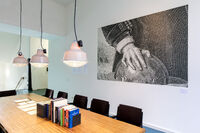 Rotterdam Cultural Histories #12: Witte de With; What’s in a name?
‘As long as the Dutch Imperial past does not form part of the common, general store of knowledge, which coming generations should have at their disposal, as long as general knowledge about the exclusionary processes involved in producing the Dutch nation does not circulate more widely, multiculturalism now cannot be realized...’
— Gloria Wekker, White Innocence
“Cultural memory and discourses on the past do not themselves constitute institutionalized agencies capable of redressing injustices. However, they can create arenas where injustices are recognized and new frameworks are imagined that are necessary, if not sufficient, for their redress.”
— Michael Rothberg, From Gaza to Warsaw: Mapping Multidirectional Memory
Witte de With Center for Contemporary Art was recently challenged, through the process of the Cinema Olanda: Platform project, to reconsider the legacies of its name. The question that was posed by the Platform’s programmers during preparations for the project, and later through an open letter addressed to the institution, was ‘What does it mean for a white institution to do “critical work” under the moniker Witte de With?’
This edition of Rotterdam Cultural Histories is devoted to a part of this question. It attempts to lay bare the activities of Witte Corneliszoon de With, the motivation behind street-naming in the nineteenth century, and the naming of the institution 27 years ago. It also aims to provide a space for public feedback on the question as to whether Witte de With Center for Contemporary Art should change its name.
The project has finite parameters, running from September – December 2017, and once staged it will be archived both within the institution’s public archive, and made permanently available online on our website, as a record and exposition of the colonial history the name Witte de With is a part of. The name has been long untroubled by this institution, a fact that is symptomatic of a wider national issue regarding the denial and sanitization of colonial histories. This is our first step towards recognition and acknowledgment.
This project has been developed through the input of a cross-departmental team of Witte de With staff members.
Rotterdam Cultural Histories is a collaborative project between TENT and Witte de With that explores our common roots in Rotterdam and articulates meeting points between both of our programs. Rotterdam Cultural Histories is conceived by Defne Ayas (Director Witte de With) and Marielle Dölle (former Artistic Director TENT).
Series
Rotterdam Cultural Histories
<div class="
-
Dineo Seshee Bopape — Lerole: footnotes (The struggle of memory against forgetting)
In her work, Southern African artist Dineo Seshee Bopape structures narratives through material and immaterial presences. For the eighth and final iteration of Para | Fictions, Bopape takes cues from author James Baldwin, who is known for his lyrical prose and writings on the complexity of social and psychological pressures of race, sexuality, and acceptance. Bopape presents an installation that meditates on pre-colonial recorded revolts and acts of resistance against European invasions in Africa.
It is commonly believed that the African continent was colonized without much fight or resistance from the people within its various locales, societies, and kingdoms. This is not the case; people fought, refused, rebelled and said ‘no’ – for hours, for days, for decades, and centuries. This work is a meditation on time, memory, spirit, and saying no.
The work is an ephemeral monument, a gesture made in commemoration of those acts and beings. It is comprised of bricks, gold leaf, and a sound composition comprised of collected recordings of a resplendent quetzal bird, mythologically known as the bird that commits suicide when held in captivity. The calls of the quetzal are mixed with sounds of the bodies of water that surround the African continent, as well as those that snake through its mass.
Bopape also draws from a story about Robert Sobukwe (1924-1978), a prominent South African political dissident, who founded the Pan Africanist Congress in opposition to apartheid. Upon the arrival of new prisoners at Robben Island, Subokwe – who was held in solitary confinement – had grabbed a hand full of soil, raised his fist, and saluted the new (political) prisoners. The final element within this work are the clay pieces, molded through a process of grabbing clay in one’s hand, forming it inside one’s fist - releasing it, letting it dry, and firing it till it’s hardened; these are tangible remnants of the exertion of energy, of agency, and the potential to ‘DO’.
Para | Fictions
Lerole: footnotes (The struggle of memory against forgetting) is presented as part of Para | Fictions, a cycle of sustained investigations taking as its focus the relationship between literature and visual art through the practice of ten artists: Daniel Dewar & Grégory Gicquel, Calla Henkel & Max Pitegoff, Mark Geffriaud, Laure Prouvost, Oscar Santillan, Dineo Seshee Bopape, Lucy Skaer and Rayyane Tabet. Each project on display presents a different artistic methodology, constituting a combination of each artist's visual interests and literary underpinnings, to seek the viability of repositioning ‘reference’ as ‘form’, ‘translation’ as ‘co-authorship’.
Participants
Dineo Seshee Bopape
Curators
Defne Ayas, Patrick Constantin Haas
Supported By
AMMODO
<div class="
-
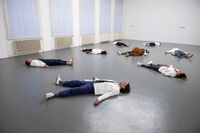 Kunsthalle for Music
 was a live exhibition composed by Ari Benjamin Meyers that ran from 25 January to 3 March 2018 at Witte de With Center for Contemporary Art. From 5 March until 8 April, traces of the project remain on-site. These traces include audio recordings, musical instruments, experimental scores, and the ensemble’s costumes. Alongside this, a selection of source material underpinning the exhibition is presented: the Kunsthalle for Music Reader, featuring texts that expand on the project’s foundational aims, and, the Kunsthalle for Music Songbook, comprising the scores of the 34 pieces enacted by the ensemble during the period of the exhibition.
At Kunsthalle for Music, an ensemble performed on-site a four-hour musical score of artworks drawn from a “repertoire” or collection, which included existing and newly commissioned solos, duets, and group pieces. While the artworks included in the score are signaled with wall object-labels throughout the galleries, there is no fixed timetable as to when one or the other will be activated. Composed by Ari Benjamin Meyers, the exhibition score is open to variations, and so offers a unique interpretation and experience every day. We encourage you to visit the Kunsthalle for Music more than once.
Even when the ensemble is not present or performing at all times, the Kunsthalle for Music keeps its doors open to the public. If you visit during these times, you may then encounter other kinds of activation of the gallery spaces. For example, ensemble members may be found using the space to rehearse or may have left a recorded trace in their absence. You may also find school groups learning and performing an especially commissioned score by Andre Heuvelman.
Ensemble
The Kunsthalle for Music ensemble forms the heart of the Kunsthalle for Music, consisting of eight musician-performers. An open-call for musicians of all types, backgrounds and skill-levels resulted in the following ensemble: Bergur Thomas Anderson (guitar), Billy Bultheel (piano), Sandhya Daemgen (violin and voice), Sara Hamadeh (violin), Alexander Iezzi (drums and percussion), Nanna Ikonen (saxophone and electronics), Jackson Moore (saxophone), and Pau Marquès i Oleo (cello).
Commissions
The ensemble performs newly commissioned works by Dominique Gonzalez-Foerster, Jonathan Bepler, Libia Castro & Ólafur Ólafsson, and The Residents. Over the course of the exhibition each of the commissioned artists work on-site, activating their scores directly with the ensemble in both rehearsals and performances open to the public. Each commission is incorporated as part of Kunsthalle for Music’s evolving repertoire. For secondary school groups, Andre Heuvelman develops a special education commission.
Repertoire
Kunsthalle for Music repertoire comprises a diverse range of existing and adapted pieces contributed by artists and composers including Bergur Thomas Anderson, Ei Arakawa & Christian Naujoks, Cory Arcangel, John Baldessari, Jonathan Bepler, Wojtek Blecharz, Billy Bultheel, Libia Castro & Ólafur Ólafsson, Sandhya Daemgen, David Michael DiGregorio & Sung Hwan Kim, Marcel Duchamp, Julius Eastman, Tim Etchells, Peter Fengler, Philip Glass, Dominique Gonzalez-Foerster, Andreas Greiner & Tyler Friedman, Sofia Gubaidulina, Charles E. Ives, Hassan Khan, Sora Kim, Lea Letzel, Ranjana Leyendecker, Christian Marclay, Jonathan Monk, Jackson Moore, Pauline Oliveros, Yoko Ono, Laure Prouvost, Steve Reich, The Residents, Terry Riley, Anri Sala with Franz Ferdinand, Erik Satie, Superflex, Andre Vida, Guido van der Werve. The exhibition also includes a number of Ari Benjamin Meyers’ performance-based music works.
Team
Artistic Director: Ari Benjamin Meyers
Co-Founders: Ari Benjamin Meyers and Defne Ayas in partnership with Mimi Brown
Key Production team: Sandhya Daemgen, Rosa de Graaf, Patrick C. Haas, Christina Li, Anja Lindner, Samuel Saelemakers
Founding of the Kunsthalle for Music
The Kunsthalle for Music is commissioned by Witte de With Center for Contemporary Art (Rotterdam) together with Spring Workshop (Hong Kong). An exposition, not an exhibition by Ari Benjamin Meyers unfolded the Kunsthalle’s foundational themes at Spring Workshop (11 March - 1 April 2017), taken up by Music is Not! A Symposium On and Around the Kunsthalle for Music at Witte de With (26-27 May 2017), with contributions by Peter Osborne (Professor of Modern European Philosophy), Armen Avanessian (Philosopher, Literary & Political Theorist), Victoria Ivanova (Writer and Curator), Jörn Schafaff (Art Historian), Marie-France Rafael (Art Historian), Francois Quintin (Director, Lafayette Anticipations), and Lisette Smits (Curator), amongst others, culminating with this inaugural take-over at Witte de With.
Supported By
Goethe-Institut, Institut français, Mondriaan Fund
<div class="
-
Rotterdam Cultural Histories #13: The Temporary Autonomous Bureau
Rotterdam Cultural Histories #13: The Temporary Autonomous Bureau is a space for researching and discussing interpretations of autonomy in cultural or social projects within Rotterdam. We are inhabitants of the Poortgebouw, a historic residential community located next to the Maas River, and students from the Experimental Publishing Master Programme at the Piet Zwart Institute in Rotterdam. We have converted a space at TENT into a temporary office. Following two projects from 2017 - the database 'The Autonomous Archive' and the publication 'A Bed, A Chair and A Table' - we shall use this space to carry on researching the Poortgebouw's history.
The Poortgebouw is a 37-year-old organisation that hosts cultural activities, as well as a community of 30 people. Over the years it has offered space for self-organised events and projects, provided residencies for guests, artists and musicians, and afforded living and work spaces for different generations of people from all over the world. The building was first squatted in 1980 and attained legal status four years later, which was made possible through renovating the building and making it habitable. The commitment of its first residents enabled the founding of the Poortgebouw Association.
During this presentation's three-month timeframe, we shall use this space to organise a series of events that will map the independent strategies of self-organisation in Rotterdam. At the same time, the public has access to the fragmented Poortgebouw archive. The Temporary Autonomous Bureau serves as meeting point where experiences with how to navigate between autonomy and institutionalisation can be shared.
How can independent organisations maintain agency in a city where the institutionalisation of cultural and residential spaces is the norm?
Is it possible to establish sustainable, non- hierarchical, socio-cultural projects through collaborative, bottom-up practices?
Can a degree of openness and autonomy be maintained in the management of a self-organised social and cultural project?
With thanks to past and present Poortgebouw occupants and all the people who have supported it over the years.
Rotterdam Cultural Histories is a collaborative project between TENT and Witte de With that explores our common roots in Rotterdam and articulates meeting points between both of our programmes.
Network
TENT
Series
Rotterdam Cultural Histories
<div class="
-
A new work by Teresa Margolles
Not too long ago, Colombians fled to Venezuela and elsewhere to avoid the escalating violence and insecurity associated to their country’s drug wars and guerillas groups. Today, it is Venezuelans that have been fleeing to Colombia. With an economic hyperinflation and a repressive government policy, Venezuela is facing a food shortage and health crisis, among many other challenges preventing social welfare and safety. On a daily basis, hundreds of Venezuelans cross the border of San Antonio de Táchira in Venezuela to the city of San José de Cúcuta, Colombia. They go there to look for work opportunities or simply to find safety. There, their work typically consists of carrying out odd-jobs or manual labor to purchase basic goods such as food and medicine.
Trayecto — Fase 1. La entrega. Fase 2. A través. Fase 3. Inclusión (Trajectory— Phase 1. The Remittance. Phase 2. Through. Phase 3. Inclusion), a new work by Teresa Margolles, is developed after the artist’s fieldwork in this border region. She has traveled there on three occasions, first, in 2017 at the invitation of Bienal Sur in Colombia. During her time in Cúcuta, Margolles engaged with the sites and subjects of forced migration. In one of several actions there, she hired Venezuelans to carry stones across the river, which geopolitically divides the border; in another action, she hired them to knit their narratives into fabrics stained with the local soil. During these exchanges, their manual labor was remunerated, and was always accompanied by conversations with, and documentation by, the artist.
At Witte de With, the exhibition A new work by Teresa Margolles consists of a simple action: the six large windows of the gallery space are smudged, rather than cleaned, using shirts stained by the soil and sweat of over one-hundred Venezuelan men that Margolles hired in Cúcuta. This performance at the gallery is staged for the first month of the exhibition; during this time period, the shirts used are each progressively encased in a series of cement blocks, made on site. The initials of the names of each hired worker are then engraved into each sculptural element. Together, these elements progressively form an installation in the space alluding to spatial dynamics set forth by the border-crossers in that region. Also included in the galleries is a portrait of one the participants of Margolles’ action in Cúcuta.
A new work by Teresa Margolles comes from the artist’s long-standing and profound engagement with victims of violent crimes in sites where, for the artist, mending a social fabric that is torn invokes attention and involves care. In earlier works by Margolles, such as her installation In the Air (2003) and her exhibition What Else Could We Talk About? (2009), the artist has used materials like cloths and water employed to cleanse the bodies of victims or sites of violence. In other artworks, such as Lote Bravo (2005), she draws soil from the ground where victims of feminicide were found to create her sculpture installations.
The latter is one of a number of works the artist has made in and about Ciudad Juarez in México, a city that borders the United States and that welcomed numerous migrants from the South of the country as the workforce to the new industries based there since the early 1990s. However, the city significantly suffered the effects of the war on drugs in the past decades. As with Lote Bravo, A new work by Teresa Margolles emerges from field-work in a geopolitical border region where social displacement and precarity is latent. These works also share the proposition of sculpture to encounter an occasion “of being” in the presence of absent testimony.
Performers: Pendar Nabipour, Víctor Santamarina
Participants
Teresa Margolles
Curators
Sofía Hernández Chong Cuy, Rosa de Graaf
<div class="
-
An exhibition with art installations by Susana Mejía, Pamela Rosenkranz, and Anicka Yi
This exhibition, bringing together work by Pamela Rosenkranz, Susana Mejia, and Anicka Yi, invites us to engage with a rarely visited part of the world: the Amazon. The largest tropical rainforest in the planet, Amazonia extends over nine different countries in South America, including Brazil and parts of Venezuela, Colombia, and Suriname. Scientists have likened its ecosystem to the lungs of our planet, like a larger-than-human organ taking in, but also producing, oxygen. Similarly, as an organism, art exhibitions operate as entities that make worldviews palpable. For, historically, artists have come to picture, and make visible, unknowns. In so doing, artists probe at what an image of a place, its experience and its mediations, may come to constitute or trigger; they explore the limits of an image, and what its ends could become.
The artworks in this exhibition are uncontained: they are neither solely documents nor finite pictures. Sensually spatializing empirical and intellectual findings, these projects distinguish themselves as aesthetic matter to attest to, and be tested through, senses other than sight and reason alone. The artists created these artworks after artistic and field-research, using a range of technologies drawn from scientific, digital, and indigenous knowledges. What results, are conceptually and materially multi-dimensional art installations.
Taking its name from a substance based on ancient and abundant natural properties found in the Amazon, Pamela Rosenkranz’s work is a light, water, and sound installation. Amazon (Container of the Substance Anemine) draws on the molecular structure of ‘chlorocruorin’, a green blood derived from ringed worms in the rainforest, known to enhance the intensity of human perception. A drip introduces saline water containing “Anemine”, the medical product containing the substance, into the gallery space, creating a reflective liquid on the ground that changes it’s shape over time. Based on her perceptual experience of the Amazon, Rosenkranz conceives the light installation as a translation of the aerial view of the rainforest’s green vegetation and the blue water of the Amazon river’s serpentine-like movements. Permeating throughout the gallery, are sampled sounds of the jungle, emanating from artificial intelligence speakers of the e-commerce company Amazon.
In stark material contrast to this installation, is the hand-made work by Susana Mejía. Together with other artists, anthropologists, botanists, photographers and filmmakers, Mejía has investigated the Colombian Amazon in search of color. Drawing on ancestral knowledge in conversation with Huitoto and Tikuna women, indigenous communities native to the Amazon, eleven botanical species were identified along with the alchemical processes for the use of their pigments on natural fibers such as fique, cotton, and paper. In the artist’s over decade-long project, titled Color Amazonia, of which a large component is showcased in the exhibition, Mejía presents the results of ethno-botanical research.
Anicka Yi’s The Flavor Genome is a techno-sensual journey through the unexplored potentialities of adaptation, mutation, and hybridization of living organisms. Structured as an episodic narrative, this 3D-film stems from the artist’s extensive field-research in the Amazon informed by science fiction, cultural ideas of taste, and the beliefs of indigenous Amazonians. Set in the rainforest and renegade laboratories, its narrative is told through a commercial flavorist who is on the hunt for a mythical orchid, which holds miraculous properties and resides in the jungles of the Amazon. By deploying both 3D video and 3D animation systems, the video takes reality as a matrix of perceived and so-called unique essences, which could enable the potential for bio-diverse intelligence sharing.
The artworks presented in this exhibition are explicitly contemporary: they result from all three women artists’ independent research in the Amazon. Not as a companion, say, to a male researcher, and neither as an emissary of an institution. Their mobility stands as a sign of class, gender, and intellectual emancipation, and the fostering of new imaginaries. Thanks to the histories experienced and the confidence gained through education, the three artists come to foster new imaginaries.
As a central component of this exhibition, a series of public programs will introduce the work by other artists who have also created work in the Amazon. In these programs, special attention is given to documentary practices, including a presentation on the work of Claudia Andujar by curator Agustin Pérez-Rubio, and a project on Thea Segall by the researchers Sagrario Berti and Aixa Sánchez.
Participants
Susana Mejía, Pamela Rosenkranz, Anicka Yi
Curators
Sofía Hernández Chong Cuy, Rosa de Graaf
Supported By
The Mondriaan Fund contributed to the artists fees through the experimental regulations.
<div class="
-
Angie Keefer —
OHRHUT
Angie Keefer’s OHRHUT is a signal-blocking mobile device case conceived by the artist as an antidote to both social media addiction and relentless data surveillance. Any device placed inside of an OHRHUT instantly disappears from the global grid of always-on networked communications, an effect both faster and more reliable than simply powering down, since even dormant phone batteries may be used to gather their owners' geolocation information. Though publicly proposed as a luxury commodity, OHRHUT aims to address systemic problems of political and economic inequity by way of a vertically-integrated, sustainable manufacturing program.
Participants
Angie Keefer
Curators
Sofía Hernández Chong Cuy, Samuel Saelemakers
<div class="
-
At home with Jef Geys
This vitrine display centers on the exhibition What Are We Having for Dinner Tonight? by Belgian artist Jef Geys (1934-2018). For this 1993 exhibition at Witte de With, the artist involved nine families from Alexanderpolder, a neighborhood in Rotterdam. On display are photographs and various other materials that document the exhibition and related projects. The conceptual thread knitting these ephemera together is the artist’s longstanding interest in the various expressions of “home,” from Geys' exploration of post-war housing projects in Rotterdam to his open-ended project in the Parque Guarani favela in Sao Paulo, Brazil.
Participants
Jef Geys
Curators
Samuel Saelemakers
<div class="
-
Federico Herrero
— Open Envelope
Federico Herrero began painting this work in the folds of the architecture—in the gallery corners, on the perimeters of its windows, at the meeting points between walls and floor. But his irregular block-like shapes and elongated color-fields slowly trickled elsewhere. Through the sprawling shapes of Open Envelope, the work painterly envelops the gallery. Color is approached by the artist as sound and volume. To create this work, as with his other compositions, Herrero considers the weight of color, as well as the different kinds of energy color can absorb or may come to express. Open Envelope will remain on view until Spring 2019.
Participants
Federico Herrero
Curators
Sofía Hernández Chong Cuy, Samuel Saelemakers
<div class="
-
Irene Kopelman, a solo exhibition
Irene Kopelman, a solo exhibition presents a selection of artworks from four different projects created by the artist between 2012 and 2016. Each of these projects was made during, or after, Kopelman engaged in fieldwork, travelling to comprehend and, ultimately, to render these environments. For nearly two decades, Kopelman analyzes with scientific rigor the landscapes and ecosystems of remote places, or, at least, sites that are not easily accessible, from the volcanic islands of Hawaii in the Pacific to the mountainous heartland of Borneo in Asia to the Peruvian rainforest in South America. At each location, she develops a specific method of observation.
Working on-site and spending significant time with her objects of study, whether these are tree lines or the colors of earth, Kopelman creates a system of representation that becomes the basis of her painterly work. She does this, first, through drawings and travelogues made during her expeditions, which later become the basis for this Argentinian artist’s studio-based practice in Amsterdam. Through these different stages of removal, or of distance from an original site of study, and through the inflections made by intuition, the artist represents interpretations of environmental phenomena. Her work is less a matter of document than an occasion to welcome sensuous imagery as imaginations of place.
The four large-scale paintings from her Tree Lines series capture the effect of avalanches on the mountainous landscape of the Swiss Alps. Also on display is one of her color-index works titled Sampling Greens. It was created after a scientific expedition that Kopelman was part of, and which was organized to sample animals and plants on Mount Kinabalu in Borneo, located in Eastern Malaysia. The results provided important information to conservation agencies concerned with the unique biodiversity of what is considered the Heart of Borneo—at only 1.5 million years old, a young region in geological terms. Kopelman’s objective during this expedition to Asia was to grasp the vast variations of greens in the jungle. Sampling Greens strikes a dialogue with Forest Windows, which is included in the exhibition and which was done after Kopelman undertook fieldwork in the Reserva Territorial Madre de Dios in Peru. A combination of drawings made on-site and of watercolors created after fieldtrips, manifest her feeling that “you don’t feel you are in a landscape, but rather surrounded by a continuum of elements.” At every stop during her expedition in the Peruvian jungle, Kopelman would sit and draw a section of the dense forest by establishing a perimeter of observation, an imagined window frame delineating the field she would draw.
She established a different method during and after her travels to study the dense yet dried and fractured lava landscapes of Hawaii, where she has been twice to date. Hawaii’s volcanic landscapes are represented in a massive sculpture and a series of paintings showcased in the exhibition, which are made after a rigorous study and indexing of black hues drawn from the island’s earth.
Whereas in past centuries, artists participated in scientific expeditions to map and picture landscapes that were (or aimed to be) colonized, Kopelman takes up the role—as a woman artist, a rare case given the historic gendered taboos existing for such a task—to manifest the places of intuition and subjectivity in representation, whether it be scientific or otherwise. Through her practice, which entails and ultimately depends on collaboration with experts in the territories she comes to investigate and visit, Kopelman’s work is also able to contribute to documenting, and hopefully lessening, the effects of global warming. A combination of aesthetic venture and scientific exploration, the work of Kopelman pictures the role visual arts has in making palpable conditions of our day.
Participants
Irene Kopelman
Curators
Sofía Hernández Chong Cuy, Samuel Saelemakers
Supported By
The Mondriaan Fund contributed to the artist fee through the experimentation regulation.
<div class="
-
Muebles Manuel
Untitled is furnished with various pieces made by Muebles Manuel, an extension of Manuel Raeder’s graphic design and publishing studio. Muebles Manuel’s line of furniture explores the connections and boundaries between exhibitions, books, archives, and typography. Working closely with Witte de With to furnish the space, and knowing these pieces would be integrated within Federico Herrero’s Open Envelope, Raeder has conceived areas for contemplating, socializing, and browsing. Some of the furniture pieces were designed especially for Untitled, while others come from its existing catalog and were slightly modified to fit the purpose of this exhibition space.
The furniture design combines manual labor and industrial design. For example, the Adrián Chair, that accompanies the rounded and oval-shaped tables in the space, consists of a hand-woven cover made of palmtree-thread by Oaxacan artisan Adrián López, a collaborator of Raeder, which are placed over an industrially-made monobloc plastic chair. The Z-bookshelves consist of several powder-coated steel ladders that are held together by plastic cable-ties. The premise of their design is drawn from the Roman letters A and Z. The metal elements placed over the shelves are called Buch Arms, and were originally created as a simple cataloguing tool for librarians and archivists.
Participants
Manuel Raeder
Curators
Sofía Hernández Chong Cuy, Samuel Saelemakers
<div class="
-
Rotterdam Cultural Histories #14: May 1968
Rotterdam Cultural Histories is a collaborative project between Witte de With Center for Contemporary Art and TENT. This long-term project, begun in 2014, articulates conceptual meeting points between the programs of these two institutions, both housed in this building, through the study of their common roots in Rotterdam.
The fourteenth edition of Rotterdam Cultural Histories focuses on how the city newspapers reported on international and local events during the revolutionary times and spirit of May 1968, considered then, and still today, a turning point of our times. This was just before television became a common household staple, and when printed newspapers, as well as radio, functioned as the main media channels for distributing information. At the time, seven different newspapers were published in Rotterdam, all represented in this exhibition: Algemeen Dagblad, De Rotterdammer, De Tijd–De Maasbode, Het Rotterdams Parool, Het Vrije Volk, Nieuwe Rotterdamse Courant, and Rotterdamsch Nieuwsblad.
The month of May 1968 is mostly associated to the student movements in Paris that shook the world. Fifty years ago, students from the Sorbonne University held a demonstration against social inequalities in France. They were soon joined by sympathizers from all walks of life and labor unions declaring a general strike in the country. Their call to action was not limited to France; it mobilized activists internationally. While the Paris events were mainly reported in the newspapers from May 1968, these also called attention to the Prague Spring in Czechoslovakia, begun in January that year, as to the Vietnam War and the civil rights movements in the United States.
This documentary- and event-based exhibition presents an installation of newspaper covers from Rotterdam dailies. The selection gives a feeling of the times, expressing topics and voices important in Rotterdam. For example, in the Netherlands, 1968 saw the arrival of the first color television broadcasts and the introduction of the birth control pill. Another important event taking place in Rotterdam during that time was the installation of the Rotterdam Council for Youth and Children, designed to address a growing need to give voice to the city’s youth. It was also when the groundbreaking publication of De Binnenstadsbeleving en Rotterdam (“The Inner-city Experience and Rotterdam”) by Prof. Dr. Rob Wentholt gave impetus to analyze the new urban culture and expectations of Rotterdammers after the War reconstruction.
These and various other stories in May 1968 newspapers, and the question of what other events took place here that weren’t reported, form the basis of a series of public programs organized in conjunction to Rotterdam Cultural Histories #14: May 1968. Consult our Calendar for details.
Special thanks to Algemeen Dagblad, De Rotterdammer, De Tijd–De Maasbode, Het Rotterdams Parool, Het Vrije Volk, Nieuwe Rotterdamse Courant, Rotterdamsch Nieuwsblad, and the Municipal Archive Rotterdam.
Curators
Sofía Hernández Chong Cuy, Wendy van Slagmaat-Bos
Series
Rotterdam Cultural Histories
<div class="
-
Untitled
In Untitled, curatorial and educational goals are intertwined. With art installations and events, as well as a bookstore and an initiative dedicated to collective learning, this long-term project continuously evolves. Inaugurated in May 2018, it is sited in our now freely accessible ground floor gallery. Untitled is conceptually conceived as a Matryoshka doll, where one work holds another work, which contains another work, and so forth, infinitely. To offer this multi-layered experience, there are a variety of display mechanisms and presentation formats in the gallery. Each of these involves different exhibition time-periods and engages with varying spans of attention in terms of how they’re rolled-out and experienced.
With this in mind, a site-specific work for the space has been commissioned, which is a room-size painting by Federico Herrero, as have been the furnishings of Untitled, commissioned to Muebles Manuel, which includes tables and chairs, bookshelves, and vitrine cases. The latter includes changing displays of new projects every exhibition season. Whereas one of these two vitrines features new artistic and curatorial projects, another is devoted to displays that draw from Witte de With’s rich exhibition history, and especially on those projects that involved community engagement.
For its part, new books are added every month to the bookshelves in Untitled and can be browsed through or purchased on site. This progressively growing inventory of the bookstore component of Untitled is made by the Witte de With team and guest participants, who select a theme and related bibliography. The bookstore also includes titles relating to artists participating in Witte de With’s exhibitions, and titles published by Witte de With over the years. Additionally, it features publications selected by TENT and CBK Rotterdam, which center on artists living here in Rotterdam and on local topics more broadly.
In Untitled, a series of events and public programs take place on a regular basis, especially on weekends. Please check the Calendar for event listings. We tend to serve refreshments at every program, and offer a casual atmosphere to engage with contemporary art and culture, to openly exchange ideas and hold conversations, and to make meaningful encounters with people.
Kicking-off in Autumn 2018, is a new initiative involving a work-study fellowship program for Rotterdam youth. Including courses ranging from art history to hospitality to business, the new initiative entails a hiring program that sees the participants collectively running the program and operations of Untitled in collaboration with the Witte de With team. Not just a gallery or classroom, not fully a bookstore or café, Untitled is designed to be both a site and an occasion for collective learning.
Participants
Jef Geys, Federico Herrero, Angie Keefer, Manuel Raeder
Curators
Sofía Hernández Chong Cuy, Samuel Saelemakers
Supported By
The Mondriaan Fund contributed to the artists fees through the experimentation regulation.
Goethe-Institut
<div class="
-
A group exhibition with work by Dora García, Sharon Hayes, Emily Jacir, Mahmoud Khaled, Carlos Motta, Wu Tsang, Akram Zaatari, and Quinn Latimer
At Witte de With, we have received some trailblazing letters as of late. Noted are missives that go from critiques of our institution’s name to suggestions for why and how we ought to be more inclusive or hospitable. We also receive letters stating how this or that project we’ve done has been influential. Indeed, in most art institutions, epistolary exchanges are part of the work culture. And this is likely to happen more often at institutions that engage people from different parts of the world, not solely from its immediate surroundings. Within this scenario, a time difference is accounted for in one instance or other, even within the most basic of epistolary exchanges. However objectively or subjectively it is experienced, and regardless of whether it is framed as a historical, chronological or technical measure, time is pointed, expressed, felt.
No less, these exchanges tend to draw on cultural or geographical divides between correspondents. In this kind of epistolarity, explanation of a spatial-temporal context seems compulsory, more than simply necessary. Consequently, an epistolary underlying expression “of the times” is articulated not only in a given latency or immediacy between sending and receiving dispatches—which, since the emergence of postal service has significantly shortened and changed in form due to communication technology—but also within and even between the very lines of a missive. The kind of epistolarity considered here lies beyond the bureaucracy a project entails and its associated correspondence; it also stands apart from mail art that centers, in principle, on using, and simultaneously exposing, the means and channels of distribution at hand.
Taking this into account, this group exhibition explores the ways in which visual artists are reflecting on the history and present articulations of the epistolary form. The selection of works considers key characteristics of early examples of epistolary writing, namely, the ways in which there was an unclear distinction made between a letter’s status as reality or fiction, because, in their time of publication, these appeared to be a compilation of private documents that were seemingly found or inexplicably sourced; and how the epistolary can be seen to expounds on cultural differences between people and places, in its form as correspondence between lovers separated by class or war, or both, dispatches from a fortunate traveler, or letters from a soldier, an exile, an immigrant or someone they left behind. Being or feeling in captivity, and the urge or desire to be rescued, loved or simply understood is thus central in epistolarity.
While letter writing has aimed to shorten distances between people, missives also mark the gaps that separate them apart, even if and when articulating beliefs and emotions through correspondence may be intended to bring people closer, or to come to terms with one another. Testimony, confession, anecdote; these forms of interiority, exteriority, and super-structures that describe a personal, and likewise present a grammar of a present-tense, are, at best, expressed in a literal and visual semiotic of a missive, however brief or developed an exchange may be.
This exhibition includes seven art installations that in different ways explore epistolarity, each micro-politically pointing to a different technology and social context. As part of the exhibition is a custom-made wallpaper, designed in-house and installed sparsely throughout the gallery space. Including images that range from seventeenth-century paintings to contemporary films, it intends to make visually palpable something along the lines of an epistolary visual culture. Additionally, a series of programs and live-events on epistolarity have been organized in parallel to the exhibition. This is considered another form of address, instances where and when artistic projects and curatorial research is publicly shared and experienced. Relatedly is the exhibition’s publication: a letter commissioned to the poet and editor Quinn Latimer, which will be distributed midway through the exhibition period through postal service.
More information to come.
Sofía Hernández Chong Cuy thanks Laura Braverman and Jovanna Venegas for assisting in the initial research stage of this project, years back, as well as Andrea Valencia, who assisted in its development during her curatorial internship at Witte de With in the summer of 2018.
Participants
Dora García, Sharon Hayes, Emily Jacir, Mahmoud Khaled, Quinn Latimer, Carlos Motta, Wu Tsang, Akram Zaatari
Curators
Sofía Hernández Chong Cuy, Samuel Saelemakers
Supported By
The artists’ fees are supported by the Mondriaan Fund (from the Experimental Regulations)
<div class="
-
Ana María Millán, a solo exhibition
This exhibition centers on Ana María Millán’s artistic research on the relations between digital cultures, gender and performativity. It premieres her animation Wanderlust (2017), commissioned by inSite/Casa Gallina and developed in Mexico City, as well as two other animations by Millán, one created in her native Colombia and another in Germany, where the artist currently lives and works. The exhibition also features a new series of watercolor paintings where Millán portrays the people and their invented gaming characters that were involved and are ultimately featured in her animations. Creating her work in close collaboration with video gamers and Live Action Role Play (LARP) communities, Millán approaches animation as a tool to invent, and at times simply claim, a meaningful space in this world. When taking on the medium of watercolor painting, she explores the fluid identity of these characters within the genre of fantasy, characteristic of gaming culture.
This is Ana María Millán’s first solo-exhibition in the Netherlands. More information to come.
Participants
Ana María Millán
Curators
Sofía Hernández Chong Cuy, Rosa de Graaf
Supported By
AMMODO, Embajada de Colombia en el Reino de los Países Bajos, The artist’ fee is supported by the Mondriaan Fund (from the Experimental Regulations)
<div class="
-
John Ahearn & Rigoberto Torres
In 1991, New York artists John Ahearn and Rigoberto Torres were commissioned to carry out a public art project in Rotterdam, to be presented in conjunction to their exhibition South Bronx Hall of Fame at Witte de With. To create it, they engaged eight residents of the city’s Cool district, which is also the neighborhood of this institution. In their effort to make art that portrays people in everyday life situations—rather than, say, heroes represented in public monuments or statues—the artists created bust portraits of each of the eight people and hung these sculptures in building facades throughout Cool. Some of the portrayed participants were young then; some older in age. Some of the sculptures figuring them remain in their original site; some were eventually removed.
Earlier this year, we reached out to the former participants to see where they were then in life, and where they are now. Not all continue living in Cool, but all are still based in Rotterdam, for the exception of one, who has passed away. We also went to seek out the remaining sculptures on-site, and brought along with us the photographer who originally documented the process and project in 1991. Untitled features a display of archival images and documentation, as well as newly commissioned photo portraits of the original participants and testimonies about their experience of Cool and of working with Ahearn and Torres. This presentation is in the one of two vitrines in Untitled especially devoted for displays that draw from Witte de With’s rich exhibition history.
Participants
John Ahearn, Rigoberto Torres
Curators
Sofía Hernández Chong Cuy, Jessy Koeiman
<div class="
-
Mauricio Marcín on Marcos Kurtycz
In the late 1960s, during his 30s, the artist and graphic designer Marcos Kurtycz left Poland and took refuge in Mexico, where he lived until his death in 1996. Kurtycz’s mail art “bombs” and metaphoric “bombings,” begun in 1981, are the focus of a display guest-curated by Mauricio Marcín for Untitled at Witte de With. Kurtycz’s Bombs consisted of packages sent by the artist to institutions internationally, and which included drawings, letters, and other printed matter critiquing the academicism of their time.
These missives were sent to institutions that, for Kurtycz, were imposing Eurocentric perspectives unto aesthetic production in Latin America. He called these institutions out for creating “aesthetic belts” and importing “imperialist tendencies” that were alien to, or simply unconcerned with, the histories and realities of the region. For Marcín, Kurtycz’s Bombs stand apart from the common understanding that mail is a communication tool that brings interlocutors closer; and that, instead, the artist uses mail art as a weapon that can set the art canon on fire.
This display of Kurtycz’s Bombs is sited in one of the two vitrines of Untitled at Witte de With, and this presentation marks the first occasion of their exhibition in the Netherlands.
Participants
Marcos Kurtycz
Curators
Mauricio Marcín
<div class="
-
Rosalind Nashashibi, a solo exhibition
In a new body of work, including paintings and a film in three parts, the first premiering in this exhibition, Rosalind Nashashibi explores affective relations and community building. These works follow a non-linear narrative that weaves various intimate settings, some within shared domestic spaces, others in outdoor environments. Shot in Lithuania, London, and Edinburgh, the film features the artist and her children, as well as close friends, which she considers extended family.
In the process of creating this new work, Nashashibi questions how a group’s sense of commonality is dissolved when there is an absence of communal experience and adherence to linear time. Through an open-ended discussion of space and time travel in the film, which is in part inspired by the creation and dissolution of group relationships in Ursula Le Guin’s The Shobies’ Story (1990), Nashashibi explores new modes of conviviality, considering the absence of having a nuclear family structure, without an imperative model in sight.
For years, Raimundas Malašauskas has collaborated with Nashashibi and is here the guest curator of the exhibition. He has remarked that Nashashibi’s work is the dip of an eye scrolling for a footnote while it reads. Writing about Nashashibi’s new work, Malašauskas points that “by exercising our freedom to belong in, or even peel away from, the multiple dimensions that make up the world, we can come to witness how predetermined our movements are, but also to imagine their possible irreversibility.”
More information to come.
Participants
Rosalind Nashashibi
Curators
Raimundas Malašauskas
Supported By
AMMODO, The artist' fee is supported by the Mondriaan Fund (from the Experimental Regulations)
<div class="
-
Rotterdam Cultural Histories #15: Orphaned sculptures and public favourite
‘Art is elitist’ is a common accusation levelled at art: a ‘taste terror’ that nobody wants, imposed by ‘so-called experts’. ‘Citizens are always obstructive when it comes to art’, is a common suspicion from the other side. It is for this reason that some call ‘art and public participation incompatible’. This edition of Rotterdam Cultural Histories offers a rather different story. Using three examples, TENT shows how the people of Rotterdam cherish their city’s sculptures, lobbying and campaign for them and, if necessary, adopting them. They focus on ‘Jan Gat’ (the popular name for Ossip Zadkine’s The Destroyed City), ‘Kabouter Buttplug’ (Paul McCarthy’s Santa Claus), and ‘De Witte Bollen’ (Hans van der Plas’s Cells). We have made a selection from the wealth of emotions, opinions, news reports, and campaigns concerning these sculptures. Rather than prioritising the perspective of artists or policymakers, this presentation is guided by the responses and views of fellow citizens.
Rotterdam Cultural Histories is a collaborative project between Witte de With Center for Contemporary Art and TENT. This long-term project, begun in 2014, articulates conceptual meeting points between the programs of these two institutions, both housed in this building, through the study of their common roots in Rotterdam.
This presentation was realised with input from:
Peter Buisman, Stichting De Witte Bollen
Jeanne Hoogendoorn, Vereniging de Binnenweg
Dees Linders and Sannetje van Haarst, SIR
Caro van der Pluijm and Siebe Thissen, BKOR
Network
TENT
Series
Rotterdam Cultural Histories
<div class="
-
An exhibition with an audio script by Sarah Demeuse and Wendy Tronrud, as well as a soundtrack by Mario García Torres in collaboration with Sol Oosel
What distinguishes dropping out from being or feeling pushed out, dropping out from burning out? Dropping out from the art world, for example, has been a recurring decision by artists and cultural workers who have little to no interest in engaging with mainstream modes of production, with dominant beliefs systems, or even with urban environments and lifestyles championed by metropolitan life or consumer societies.
This exhibition explores the phenomenon of dropping out. In a deserted gallery environment painted in different color scales inspired by solar time, two sound pieces are available: on the one hand is an audio recording that can be experienced through wireless headphones; on the other is ambient music throughout the gallery space, which is the exhibition’s music soundtrack. The gallery space is punctuated with words in vinyl lettering that speak to dropping out.
The recorded piece, a script written by Sarah Demeuse and Wendy Tronrud, poses several questions pertaining to economic, gender, racial, institutional, geographic aspects that inform an understanding of dropping out, including: What can be learned from the “dropout” about models of productivity and living? The recording specifically highlights women artists of the post-1968 moment. Three voices come together in a close reading, listening, and questioning of the terms and narratives that create "dropouts."
The exhibition’s soundtrack is created by Mario Garcia Torres, who collaborates with the musician Sol Oosel in its composition and production. Garcia Torres has conducted for over a decade significant artistic research on visual artists and musicians who have retreated from the mainstream or left urban contexts. He creates for the exhibition ambient music inspired by these cases of withdrawal, as well as from the environment of desert landscapes.
During the course of this exhibition, artists Grace Ellen Barkey, Andrea Éva Győri, and Johanna Tengan have been invited to punctuate the gallery space and these ideas with live performances. A series of public programs will also be held during the exhibition. Please consult the calendar for a schedule of these events.
Participants
Grace Ellen Barkey, Sarah Demeuse, Mario García Torres, Andrea Éva Győri, Sol Oosel, Johanna Tengan, Wendy Tronrud
Curators
Sofía Hernández Chong Cuy, Samuel Saelemakers
<div class="
-
Firelei Báez, new work
Firelei Báez was born in 1980 in Santiago de los Caballeros, Dominican Republic, and currently lives and works in New York. With a convergence of interests in anthropology, science fiction, black female subjectivity, and women’s work, Baéz is interested in how culture and identity are shaped by inherited histories. Approaching selfhood as malleable, her work serves as a defense against culturally predetermined ethnic stereotypes as maintained and perpetuated by dominant narratives. Drawing attention to the incomplete nature of our communal stories, Baéz creates alternate environments in which cultures, disparate or alike, can commune.
In this exhibition, a new body of work is presented featuring three paintings and an immersive installation manifest from the artist's research on the Haitian Revolution (1791-1804) and its enduring significance.
This will be the artist’s first solo exhibition in the Netherlands.
Participants
Firelei Báez
Curators
Sofía Hernández Chong Cuy, Rosa de Graaf
Supported By
AMMODO, James Cohan Gallery, New York, The artist’s fee is supported by the Mondriaan Fund (from the Experimental Regulations)
<div class="
-
Lawrence Abu Hamdan, a solo exhibition
Lawrence Abu Hamdan, a solo exhibition presents a new co-commission by the Beirut-based artist and ‘private ear’. Featuring three newly designed sound instruments, over ninety sourced objects and an audio work, Earwitness Theatre (2018) explores the political effects of listening through the hallucinatory world of the ear-witness. The new commission is presented alongside Abu Hamdan’s recent film Walled Unwalled (2018), which together develop the artist’s ear-witness investigation into the Syrian regime prison of Saydnaya, which the artist was invited to carry out in partnership with Amnesty International and Forensic Architecture, Goldsmiths University, London, as part of a broader enquiry.
Abu Hamdan’s exhibition is commissioned and produced by Witte de With Center for Contemporary Art in partnership with Chisenhale Gallery, London; Contemporary Art Museum St. Louis; and the Institute of Modern Art, Brisbane. It will be presented at the partner venues throughout 2019.
Participants
Lawrence Abu Hamdan
Curators
Sofía Hernández Chong Cuy, Rosa de Graaf
Network
Chisenhale Gallery, Contemporary Art Museum St. Louis
Supported By
AMMODO, The artist’s fee is supported by the Mondriaan Fund (from the Experimental Regulations)
<div class="
-
On Contemporary Arab Representations
Within the vitrines of the continuously evolving exhibition Untitled, sited at the institution’s ground-floor gallery, is an archival display focusing on Contemporary Arab Representations. This long-term project was developed in 2002-2003 by Catherine David, Witte de With’s director at the time. Contemporary Arab Representations included various “representations by authors,” and was organized in three chapters: Beirut, Cairo, and Iraq. The project was ahead of its time on various counts. It offered and debated locally-specific cultural perspectives, over falsely-unifying overviews of a region. David’s use of “Arab” over “Middle Eastern” is a case in point. At the time, the press reviewed this long-term project widely, noting that the featured authors—how David referred to visual artists and cultural makers at large—were largely unknown to general audiences within and outside of their context.
Curators
Sofía Hernández Chong Cuy, Wendy van Slagmaat-Bos
<div class="
-
An Exhibition of Posters
Inaugurating on 7 April 2019 at Witte de With’s ground-floor gallery space is An exhibition of posters by Maja Bekan, Kévin Bray, Chloë Delanghe, Baldvin Einarsson, Priscila Fernandes, Vera Gulikers, An Onghena, Kevin Osepa, Josie Perry, Rory Pilgrim, Tramaine de Senna and Edward Clydesdale Thomson.
The twelve visual artists, who live in the Netherlands and the surrounding region, were commissioned these posters as part of Witte de With Center for Contemporary Art’s collective learning initiative, with a focus on community building. This initiative entails many activities, including a work/study program designed for Rotterdam youth. The program includes art history courses as well as business workshops, and engages the program participants in skill-building activities to gain skills that range from hospitality to creating collaborative partnerships.
During the first edition nine participants enrolled: Gizem Adanur, Chloé Blansjaar, Tayler Calister , Mohamed Chajid, Sjoerd van Kampen, Stijn Kemper, Eva Langstraat, Joy Ravenswaaij and Sytze van der Wolk. They are either still enrolled in school or are already pursuing a career in the arts. For a period of six months, these young Rotterdammers met, discussed ideas, and organized public programs together with Witte de With’s Curator of Collective Learning, Jessy Koeiman.
The participants learned and worked in the ground floor gallery space of Witte de With from September 2018 until February 2019. This space has provisionally been called Untitled, and is designed as a site for art displays and public convening, as well as the primary location for the institution’s public programs. At the exhibition opening on Sunday, April 7, the collective learning participants will announce a new identity for Untitled, which they conceptualized and developed during their work/study program.
In an effort to make the ground-floor gallery space more readily accessible to the public, entrance is free of admission.
Participants
Maja Bekan, Kévin Bray, Chloë Delanghe, Baldvin Einarsson, Priscila Fernandes, Vera Gulikers, An Onghena, Kevin Osepa, Josie Perry, Rory Pilgrim, Tramaine de Senna, Edward Clydesdale Thomson
Curators
Sofía Hernández Chong Cuy, Samuel Saelemakers
Supported By
An Exhibition of Posters and the Initiative for Collective Learning are partly made possible by The Cultural Participation Fund.
<div class="
-
On Melly Shum
In its very first year of programming, 1990, Witte de With Center for Contemporary Art presented a solo-exhibition of the Canadian artist Ken Lum. This exhibition also included an off-site commission of the artist’s billboard “Melly Shum Hates Her Job.” An image of it wraps around the front and back cover of the accompanying exhibition catalog, presented in this vitrine. Displayed here are documents related to this exhibition and commission. As you may read there, “Melly Shum Hates Her Job” is originally part of a body of work that the artist’s called “Portrait-Logos.” Besides this billboard, a number of works in this series were exhibited within the galleries of Witte de With as part of his exhibition.
In the bottom row are a series of key documents that point to how the project first came about. These materials make evident a shared artistic and curatorial intent to address immigrant experience. This is expressed in the artist’s writings, as well as in dealings and contracts between institutions.
Throughout the exhibition planning process, Chris Dercon, the founding director of Witte de With, proposed Ken Lum to make one of his “Portrait-Logos” as a city billboard. The artist accepted and selected “Melly Shum Hates Her Job” for this. In the center row of this vitrine are photographs showing the billboard across 12 locations throughout Rotterdam. These were taken by the people who pasted the billboards throughout the city. The billboards were exhibited in the public space for a period of six weeks.
Apart from requesting public funding to finance Ken Lum’s exhibition at Witte de With, the institution required additional funding to finance the billboard project. To realize the latter, Witte de With sold editions of the billboard to museums, galleries, and individuals in the Netherlands and internationally. On the top row you can see one of several funding applications and grant evaluations associated to the exhibition. Also included is correspondence between the neighboring Museum Boijmans, who purchased an edition of “Melly Shum Hates Her Job.”
Curators
Sofía Hernández Chong Cuy, Stijn Kemper
<div class="
-
Rotterdam Cultural Histories #16: How does one get from Salvador Allende Street to the André van der Louw Bridge?
The exhibition focuses on a solidarity movement that emerged in Rotterdam following the coup d’état in Chile on September 11th 1973, which ousted President Salvador Allende and his cabinet. In the years that followed, thousands of Chileans would take exile in Rotterdam, leading to the advent of new initiatives, artworks, landmarks and events. The multi-faceted solidarity movement unfolded, for the most part, in the 1970s and the 1980s. A central figure in this movement was André van der Louw, mayor of Rotterdam from 1974 to 1981.
Taking the form of a photo-essay, this exhibition highlights a selection of key events from the period. This exhibition can also be seen as a conceptual cartography of the route between two locations in Rotterdam: the Salvador Allende Street in ‘s- Gravenland-Oost and the André van der Louw Bridge in Wijnhaven. The names of this existing street and bridge were given in 1990 and 2015, respectively, recognizing the contributions of these politicians. The route also acknowledges the active Chilean community in Rotterdam.
This exhibition is the sixteenth edition of Rotterdam Cultural Histories, a collaborative project between Witte de With Center for Contemporary Art and TENT, both housed in this building. Begun in 2014, this long-term research project focuses on studying of these institution's common roots in Rotterdam. Special thanks to Juan Heinsohn Huala, Jorge Kata Nuñez, BKOR (Siebe Thissen, Nienke Post, Caro van der Pluijm), Hans Abelman, Ricardo Cuadros, Martín la Roche, Jorge Arrate, Ana Maria Fernandez, Paul Goede, Karla Hinojosa, Wendy van Slagmaat-Bos, and the Embassy of Chile in the Hague.
Curators
Rosa de Graaf
Series
Rotterdam Cultural Histories
<div class="
-
Cecilia Vicuña, a retrospective exhibition
Cecilia Vicuña, a retrospective exhibition brings together over a hundred works by the poet, visual artist, and activist Cecilia Vicuña. Since the 1960s, the artist has constituted a radical perspective on the relationship between art and politics through her writing and art making. She has done so in different parts of the world, leaving her native Chile for London in 1973, before basing herself in the United States since 1980.
The 1973 military coup d’état in Chile shaped the structures of feeling in Vicuña’s formative years, as it did for an entire nation. In many ways, her work has been, and continues to be, triggered and inspired by political resistance. Feminist and sociological methods, as well as indigenous culture and natural materials imbue her art practice. For decades, she has developed a varied and multidisciplinary body of work, which at times relies on words, images, environments, and a combination of languages, mediums, and techniques.
For her exhibition retrospective organized by Witte de With and developed by guest curator Miguel A. López, a number of artworks, documents, and ephemera are presented for the first time. Most have been sourced from Vicuña’s personal archives at her home and studio. This material, which enables a more comprehensive understanding of the artist’s practice, is joined by a number of artworks on loan, which span several decades of production. Significant chapters within Vicuña’s multifaceted practice are delved into and showcased. From her long-term quipu, precarios [precarious objects], and palabrarmas series, through to her painterly works, her work made in solidarity with Vietnam and as part of the collectives Tribu No [No Tribe] and Artists for Democracy, as well as a number of her films, which in turn point to the artist’s extensive performance practice.
López, who is originally from Peru and who has collaborated closely with Vicuña over the years, has remarked that, “her flashes of inventive brilliance –whether literary, visual, performed, or audible– defy all conventional categories, through the weaving of word and seed, sound and thread, quipu and blood, body and dust, rubbish and cosmos.”
Accompanying the exhibition is the publication Cecilia Vicuna: Seehearing the Enlightened Failure edited by López and published by Witte de With. It brings together three new and two existing essays on Vicuña’s work, and an anthology of diverse texts authored by the artist. Included, too, is a plethora of artwork images and visual documentation organized in four thematic sections, which encompass the full range of mediums the artist has worked in over the years.
At Witte de With, the exhibition has been coordinated by Rosa de Graaf; its publication by Wendy van Slagmaat-Bos; its exhibition design by Sofía Hernández Chong Cuy and Paul van Gennip. Andrea Valencia and Karla Hinojosa assisted in the process as curatorial interns in 2018 and 2019, respectively.
El Paro (detalle) by Cecilia Vicuña
Witte de With is pleased to offer on sale a new silkscreen by Cecilia Vicuña. Proceeds generated from the sale of these works partly go to the artist; partly towards future exhibitions at Witte de With. Her exhibition retrospective was on view at Witte de With Center for Contemporary Art from 26 May until 24 November 2019. From 8 February to 2 August 2020, the exhibition is on view at Museo Universitario Arte Contemporaneo (MUAC) in Mexico City.
More info
Participants
Cecilia Vicuña
Curators
Miguel A. López
Network
The Institute for Studies on Latin American Art (ISLAA), Museo Universitario Arte Contemporáneo
Supported By
Institute for Studies on Latin American Art (ISLAA), Directorate of Cultural Affairs (DIRAC), Ministry of Foreign Affairs Chile, Embassy of Chile in The Hague – the Netherlands, The Henry Moore Foundation, Lehmann Maupin
<div class="
-
Mariana Castillo Deball, a solo exhibition
This solo exhibition presents three distinct kinds of work—and worlds—created by Castillo Deball in the past decade. They strike a balance between material folds and unfolding ideas, whereby multiple senses of time are experienced in the blank spaces of a drawing, in the negative space of sculpture, or in the wrinkles of a surface. For years, Castillo Deball’s work has consistently manifested the ways in which the passage of time is illustrated, organized, and expressed in nature as much as in artifice.
One body of work in the exhibition comes from her study into the description of indigenous culture, skills, and technology—including the development of natural pigments endemic to pre-Columbian Mexico, as indicated in the 16th century Florentine Codex. Another group of works point to the artist’s long-standing interest in the meeting points of indigenous knowledge and Western thought. In this case, her works investigate how such dialogues, which are often contentious, are expressed in different spheres of influence, from museum design practices to cultural theories inspired by anthropophagy, the act of eating human flesh.
The artist paints and sculpts, writes and publishes, and conducts artistic research into source materials drawn from antiquity, modernity, and our present. Like a line of thought, or an air plant, Castillo Deball’s work meanders through a physical space in imagined time. At times, sensually maneuvering us into another world, while at others, uncomfortably poking into ours, only to experience the wealth of knowledge there is to gain from a wider, deeper, and more global understanding of our ancient past.
Participants
Mariana Castillo Deball
Curators
Sofía Hernández Chong Cuy, Samuel Saelemakers
Supported By
AMMODO, kurimanzutto, Mendes Wood DM, Brussels, the artist’s fee is supported by the Mondriaan Fund (from the Experimental Regulations)
<div class="
-
Melike Kara, new work
Melike Kara creates her painterly work along with writing poetry, and most recently with making sculpture, video and other mediums. In her works on canvas, especially, she has developed a pictorial range of characters communicating with each other through what appears to be body language and whispers. These figures can often be characterized as ungendered, and of a nondescript time and place. Their dress, if at all, blends with their skin, which appears to be made of armor. Her primary medium for her works on canvas has been, for years, thick oil pastels. She regularly chooses one color and its hue variations to paint these figures, more recently, the palette of each of her paintings includes two to three more colors, but no more.
For her exhibition at Witte de With, Kara has created a new body of work, including a series of large works on canvas, as well as an installation of wooden sculptures intervened upon with paint and other materials. The group of paintings are indicative of the changes she has made in her recent body of work, for example, they barely present her more rigid humanoid figures that had previously populated her canvases, and introduce more organically shaped figures, including animals, after what is an evidently more free-flowing use of paint. The goat is a recurring figure in her new canvases, and it is connected to a longer investigation the artist has carried out regarding her Kurdish roots. This too, is more evidently explored in the artist’s new sculptures for the exhibition.
Melike Kara was born and raised in Cologne, Germany, where she currently lives. For years, she developed a conversation with her grandmother, who emigrated from Turkey to Germany. She kept a strong liaison with the Kurdish community residing in the native village of her grandmother. And their relationship inspired Kara’s work, addressing, in one way or other, her family history. This artistic exploration of her Kurdistan cultural background begins, ultimately, with an understanding that knowledge is produced through rituals and oral histories, and that these processes lend new meanings to objects and encounters. In her work, references to images like the goat, or the likening of the wooden sculptures to traveling cradles, are drawn from the nomadic and land-working culture of Kurdish communities.
Melike Kara, new work is the first exhibition of the artist in The Netherlands, and the most important commission she has had to date in Europe.
Participants
Melike Kara
Curators
Sofía Hernández Chong Cuy, Samuel Saelemakers
Supported By
AMMODO, the Goethe-Institut, PERES PROJECTS Berlin, Jan Kaps, Cologne, the artist’s fee is supported by the Mondriaan Fund (from the Experimental Regulations)
<div class="
-
Alejandro Cesarco, a solo exhibition
Over the past two decades, Alejandro Cesarco has been making art, publishing books, and curating exhibitions. His expanded practice centers on a close consideration of affect, or as Cesarco states it, “the way meaning is felt.” With a deep interest in conceptualism’s linguistic turn, he has investigated the meanings of measured expression, the emotional cadence of feelings (however sincere, contradictory, or uncomfortable these may be), and the common and varied languages that emerge from emotional ties and genealogies.
Encapsulating his artistic practice and these core themes is Cesarco’s Index series, begun in 2000. The series is exhibited entirely for the first time in the artist’s solo-exhibition at Witte de With.
The Index series is a central and ongoing project within the artist’s larger praxis. Each index references an imaginary book he “hasn’t written and most probably never will”. Each one addresses a specific theme or topic and hints at a possible narrative within it. To date, Cesarco has made six different indexes and is creating a new one for this exhibition; their subject-matter ranges from large ideas, such as writing’s relation to memory or the repetition of romantic archetypes, to very focused emotions, such as mourning or regret.
Indexing has become an idiosyncratic way of tracking the development of Cesarco’s interests, becoming “a form of self-portraiture that unfolds over time". “This ongoing series of indexes are a form of writing that constitutes an archive of my reading”, he says. The way information and knowledge is organized and presented, as well as a preference for para- texts has been an ongoing concern throughout his work. The entries listed in each index enable its navigation and use—they outline or promise a narrative—but, they simultaneously signal towards that which is excluded or silenced from it.
Participants
Alejandro Cesarco
Curators
Rosa de Graaf, Sofía Hernández Chong Cuy
Supported By
AMMODO, Tanya Leighton, the Embassy of Uruguay in The Hague, the artist’s fee is supported by the Mondriaan Fund (from the Experimental Regulations)
<div class="
-
Rossella Biscotti, new work
Rossella Biscotti’s work has dealt with an exploration of forgotten or untraced events that may come to reveal changing value systems, whether in their processes of production or consumption. The artist is interested in description, and in manifesting through sculpture and images, as well as through other genres and materials, the constitution of sentient beings as they are and not only as they may come to be perceived. She does so with an attentiveness towards revealing individual narratives, which she draws as much from oral histories, as she does from her technical, archival, and field research into sites that have been historically tapped by different forms of mining, exploitation, and confinement.
Her exhibition at Witte de With centers on the artist’s most recent research into the forced displacement and exploitation of bodies—human and animal—during the Dutch colonial period in Southeast Asia, and the exportation of plants at the wake of the twentieth century. This, she traces through real and fictional accounts.
An earlier work that also derives from this longstanding and ongoing investigation is Clara (2016). In that work, Biscotti’s protagonist is a famed eighteenth century female Indian rhinoceros called Clara, brought to the Netherlands by a captain of the Dutch East India Company (Vereenigde Oostindische Compagnie, VOC). By reason of its presumed exoticness in Europe, the rhinoceros was toured around Europe for seventeen years concluded by her passing. Biscotti’s work literally gave weight to the creature as subject, rather than to its spectacle. Clara is again a subject Biscotti comes to explore for her exhibition at Witte de With. This time, primarily through the artist’s research into the VOC archives, delving into its logbooks and noting the unregistered inventories that come with displacement.
The artist also takes other books as the basis for her new work. Among these, is the four-volume novel The Buru Quartet by acclaimed Indonesian author Pramoedya Ananta Toer. From this, she creates work inspired by five of its characters, one based on the life of Surati, who contracts smallpox voluntarily in her efforts to escape subjection as a concubine under Dutch colonialism. On par with this, Biscotti regards the exportation of the flowers rafflesia and amorphophallus titanium. As part of an experiment, toward the end of the 19th century the latter was planted at Bogor Botanical Gardens (then carrying a Dutch name, Buitenzorg) in Indonesia, for exportation to England, the Netherlands, and Italy; to this day, it may be found in the botanical garden of Leiden, the Netherlands, as well as other locations around the world.
Rossella Biscotti, new work at Witte de With presents a selection of these works. From the rhinoceros Clara, to the stories of five women and two breeds of corpse flower, the artist creates measured portraits—however uncontained, abstract and lyrical—of instances of forced migration. Moving between fiction and reality, Biscotti regards these narratives of displacement as forms of event.
Participants
Rossella Biscotti
Curators
Rosa de Graaf, Sofía Hernández Chong Cuy
Supported By
AMMODO, La Quadriennale di Roma, the artist’s fee is supported by the Mondriaan Fund (from the Experimental Regulations)
<div class="
-
Rotterdam Cultural Histories #17: Artists as city makers, the case Kaus Australis
Artists have long played a crucial role in Rotterdam’s cultural development as makers and as city makers. RCH #17 questions how that role can remain possible in the city.
Rotterdam’s current landscape of art institutions emerged in the 1990s. In contrast, artists have been shaping the city’s artistic milieu since the late 1970s. Artist initiatives provide workspace, presentation possibilities, local cooperation, international exchange, and inspiring models of self-organisation. Artists join forces, using their creativity not only to develop their work but also to create conditions for advancing art and culture. This attitude was always elementary – and possible – in Rotterdam.
Kaus Australis is a telling example of how artists literally create space for art. In 1993, the artists took the initiative to develop a DIY model and commissioned and partly built the facility themselves. The building became a place where artists have scope to make large-scale work, known for its international guest studios, exhibitions, and welcoming kitchen. In short, a place that gave substance to a neglected corner of the city. This presentation details how such a project was possible and the effort it entailed.
The booming real estate market is now putting Kaus Australis under pressure, and they have been ordered to dismantle the building. RCH#17 is an expression of support for them to find a new location and a call for broader discussion. The importance of ‘incubation sites’ and a sustainable cultural ‘ecosystem’ has been under discussion for decades. The International Advisory Board for Culture recently said Rotterdam’s strength is that it is a place where initiatives and grassroots organisations can develop. However, the city has reached a tipping point. What impact will current real estate policies have on Rotterdam as a home for makers? Is the Kaus Australis model feasible in 2020? Can artists still contribute to the making of the city?
Artists Sandro Setola and Chris van Mulligen compiled RCH #17.This archival presentation tells the story of Kaus Australis, while a growing timeline functions as an invitation to help visualise the long-standing debate about the importance of space for artists and their initiatives. If you want to contribute something to this timeline, please contact us via =(c=c.charCodeAt(0)+13)?c:c-26);});return false">aletta [at] tentrotterdam.nl.
In the coming months, we shall organise several events around RCH #17 and Kaus Australis. Announcements will follow via tentrotterdam.nl and kausaustralis.org.
This exhibition is the 17th edition of Rotterdam Cultural Histories, a collaborative project between Witte de With Center for Contemporary Art and TENT, both housed in the same building.
Network
TENT
Series
Rotterdam Cultural Histories
<div class="
-
Adriano Amaral, new work
While the internet, prosthetics, solar panels, and touch screens can each be seen as ways of ‘upgrading’ human experience, a more elemental and subjective tendency seems to be gaining value again. Intuition, emotion, and imagination have become central tenets and, akin to the movement of Romanticism that originated in Europe toward the end of the 18th century, Enlightenment’s emphasis on a purely rational outlook is being called into question. Adriano Amaral investigates the place of materiality by creating environments in which natural and synthetic elements merge, forming hybrids between technology and mysticism.
With an intuitive approach towards materials, combining industrial and discarded personal objects, Amaral creates site-sensitive installations that model the exhibition space as an encompassing experience. In his response to existing architectural qualities, Amaral both subverts and transforms them. Although discussions about the relationship between the human and the artificial have intensified in the last couple of years, this relationship is nothing new. Humans are, and always have been, reshaped by the objects and technologies they create. In his work, Amaral accentuates this relationship by combining found materials, trying to find “the most natural way to extend objects synthetically.” By doing so, he investigates and tests the social and environmental implications of materials and their interactions, suggesting a flow of energy and movement between them.
The exhibition is curated by guest curator Julia Mullié and is a collaboration with Pivô in São Paulo, where the exhibition will open 30 May 2020.
Participants
Adriano Amaral
Curators
Julia Mullié
Network
Pivô
Supported By
AMMODO, Embassy of Brazil in The Hague, Galeria Jaqueline Martins, São Paulo, Brazil, the artist’s fee is supported by the Mondriaan Fund (from the Experimental Regulations), technology is provided in partnership with Beam Systems
<div class="
-
Alia Farid, a solo exhibition
Alia Farid’s work explores contemporary urban life against the backdrop of colonial histories in Kuwait and Puerto Rico, where the artist lives and works. Farid has especially explored the correlations between the shaping of environment and perception. Her work has dealt with social displacement and migration, national identity and self-representation, as well as the enduring legacy and impact of Western imperialism. Farid interprets her research-based artistic practice through drawings, installations, public interventions, and, most recently, film.
Farid’s most recent artistic research centers on communities who, in one way or another, actively resist the assimilation of modern culture. This she draws out and articulates through various micro-narratives and actions enmeshed in daily life. Her subjects are located in the Global South, a descriptor the artist purposefully employs to both locate and complicate the degrees of separation between the Caribbean and the Middle East—the two regions where Farid grew-up, and which inspire much of her work.
Her exhibition at Witte de With presents a newly commissioned film installation, along with her earlier film At the Time of the Ebb, 2019. Her new work is shot in Haiti, and centers on the after-effects of the country’s historic revolution. Her earlier film was also shot on an island, in Qeshm, Iran; it is a melancholic meandering through the local rituals of Nowruz Sayadeen (Fisherman’s New Year). In both films, Farid delves into how group rituals, social ruptures, and individual acts of resistance may admit, escape, alter or reject definition.
The artist’s new work is commissioned by Witte de With Center for Contemporary Art in partnership with The Power Plant Contemporary Art Gallery, Toronto, Canada, and Contemporary Art Museum St. Louis, United States. This is the artist’s first exhibition in the Netherlands.
Participants
Alia Farid
Curators
Rosa de Graaf
Network
Contemporary Art Museum St. Louis, The Power Plant Contemporary Art Gallery
Supported By
AMMODO, the artist’s fee is supported by the Mondriaan Fund (from the Experimental Regulations), technology is provided in partnership with Beam Systems
<div class="
-
An exhibition with works by Athos Bulcão, Marcos Castro, Anna Franceschini, Ni Haifeng, Nicolás Lamas, Praneet Soi, Adriana Varejão, Ana Vaz, Bouke de Vries, Raed Yassin, Karlos Gil & Belén Zahera
This exhibition explores the immigration of form. It regards a cultural product that is as much the result of local traditions as it is a cosmopolitan artifact. Here, consider Delft Blue in the Netherlands. Now, consider a piece of Qinghua Porcelain in China, or Iznik Ceramic in Turkey, Azulejo in Portugal, China in Britain, or Talavera in Spain and Talavera Poblana in Mexico. These are all blue-and-white ceramics that can be traced back to global trade. This type of artifact signals a commercial approach—by and large through colonialism—that massively transformed civilizations. By focusing on an aesthetic manifestation of a world in movement, this exhibition invites you to consider a blue-and-white ceramic piece as both a vessel and a port. It gathers artworks in different media made by contemporary artists from the Americas, Asia, and Europe.
In the Netherlands, the rise in popularity of blue and white ceramics came by way of the Dutch East India Company (VOC) in the early seventeenth century. The esteem and value of these ceramics was not only because their provenance and designs were considered exotic. Their material composition was foreign, too. These imported pieces were made in porcelain, of which invention and related enterprise was protectively overseen by the Chinese Dynasty. In the fourteenth century, when porcelain was considered “white gold,” The Ottoman Empire was already commissioning custom-made Chinese porcelain for export. They are also credited for having provided the Chinese with cobalt, the blue color-producing mineral, which they sourced from the region known today as Iraq. But it was long-distance maritime trade that globally internationalized the style of blue and white ceramics.
Participants
Athos Bulcão, Marcos Castro, Anna Franceschini, Ni Haifeng, Nicolás Lamas, Praneet Soi, Adriana Varejão, Ana Vaz, Bouke de Vries, Raed Yassin, Karlos Gil, Belén Zahera
Curators
Sofía Hernández Chong Cuy, Bernardo José de Souza
Supported By
Fonds 21, Stichting Van Achterbergh - Domhof and made possible by the Athos Bulcão Foundation. Ana Vaz, Bernardo José de Souza, Karlos Gil & Belén Zahera's travel and stay is supported by the Embassy of Brazil, The Hague, and the Embassy of Spain, the Hague. The artists' fees are supported by the Mondriaan Fund (from the Experimental Regulations). The production of the work of Anna Franceschini is in part made possible by a contribution of PERUFFO Jewelry.
<div class="
-
A presentation with works by Jarmal Martis, Nelly Dos Reis, Enang Wattimena, and Tina Rahimy
For this presentation, we expand our MELLY’S Neighbours program with art commissions and displays that further connect our institution with our neighbouring communities. Here, we reflect upon Rotterdam’s transformation over the past three decades, as well as the changing relationships between these communities and our institution.
Late last year, we invited two visual artists and two narrators to work in pairs or individually and join us in reflection, capturing and questioning the developments in our neighborhood. They are photographer Jarmal Martis together with storyteller Nelly Dos Reis, as well as filmmaker Enang Wattimena and political philosopher Tina Rahimy.
Their research and conversations began at the start of 2020, and were guided by these kinds of questions: Who are our neighbors? Which neighbors have witnessed the development of this art institution? What is the relationship between us and them, if any? What will our institution look like in the future, considering our ongoing transformation that goes in par with our renaming process? And, how do our neighbors imagine the future of this street?
Over time, each of the projects and conversations in development took a turn. This first happened in the Spring, due to the pandemic lockdown; then, during the summer, in light of the Black Lives Matter movement in Rotterdam and internationally. Consequently, the direction of each commissioned project changed. While the key intentions remained the same, different routes were taken as a means to process a drastically altered set of circumstances. Presented in these vitrines, are the research results of Martis, Dos Reis, Wattimena, and Rahimy manifest through photography, video interviews, textile, and text.
This project is curated by Jessy Koeiman and is part of Anchored, a project series that explores our immediate environment in Rotterdam, including our building, our street, and our neighbors. It is part of our ongoing name change initiative. Experience other Anchored projects in the series on our 1st and 2nd floors.
The wall and floor graphics in MELLY are social distancing indicators; it is commissioned to Enchilada (Rotterdam). The furniture is designed by Manuel Raeder (Berlin).
Participants
Nelly Dos Reis, Jarmal Martis, Tina Rahimy, Enang Wattimena
Curators
Jessy Koeiman
<div class="
-
Christian Vinck, new work
Christian Vinck regards himself as an artist belonging to a long tradition of amateur painters. That is to say, what matters most to him is not his technique so much as his subjects. Likening his artistic process to the act of fishing, painting affords him invaluable space in which to process his vast and eclectic collection of references. His collections range from sticker books, album covers, and baseball cards, to newspaper cuttings, historical encyclopedias, and found photography. Drawing on such source materials and collecting habits, the bodies of work he comes to create unfold gradually through a daily ritual of painting. This is where personal narratives come to be interwoven with minor histories, micro-narratives, and fictional stories inspired by actual events, people, and non-human species.
For this exhibition, Vinck’s personal experience of migration—he was born in Maracaibo, Venezuela, and currently lives and works in Madrid, Spain—inspires a central theme: flight. The exhibition features more than 200 new paintings of oil on canvas. Together, they are ‘Album #8, Alt’, grouped into four series. In one, he maps and illustrates an unofficial history of aviation in Latin America. In another, he creates a series of clouds based on used sticker sheets. A further series sees him imitate two breeds of dog figured in a pair of ceramic tiles he found in Italy. Finally, he portrays Turpiales, the national bird of Venezuela and Curaçao, and Pinzones taking cue from his surname, which, in Dutch, means “finch.” (Vinck is both Dutch and Venezuelan.)
While creating these works, the artist began to address more profoundly the intersection of the Dutch and Spanish heritages that culturally inform the part of the Caribbean where he grew up. His fascination in picturing images is not only provoked by dominant histories and official archives, but is inspired, by and large, by oral histories and urban legends. His exhibition gives attention to the at first meaningless miscellanea that people surround themselves with; once gathered, this patchwork of visual fragments introduce more informal ways of creating legacies, and in representing cultural identity.
This is the artist’s first exhibition in the Netherlands.
Participants
Christian Vinck
Curators
Rosa de Graaf, Sofía Hernández Chong Cuy
Supported By
AMMODO, Acción Cultural Española (AC/E), the artist’s fee is supported by the Mondriaan Fund (from the Experimental Regulations)
<div class="
-
Kapwani Kiwanga, new work
The artist Kapwani Kiwanga has been in dialogue with curator and theorist iLiana Fokianaki, who was invited to organize this exhibition. They ask, “What is the role of plants in the histories of human struggle for liberation?” Here, the curator has written an introduction to the exhibition, as well as artwork labels.
This exhibition presents a new body of work by Kapwani Kiwanga, who lives and works in Paris. The work revolves around the epistemologies of botany, its histories and their relation to acts of resistance. The artist examines the role of plants in self-medication, subsistence, and self-protection, while considering plants as witnesses to human history. Kiwanga looks at how plants can metamorphose from pharmakon (medicine) to poison. For her, the tenuous balance between the two further highlights one other important concept: opacity, or, the visibility and invisibility of resistance. From seeds hidden in the hair of abducted people to flowers used as abortifacients, the relationship between botany and human defiance is key in this exhibition.
Scholars and theorists looking into the histories of racial inequality have proposed opacity as an expression of resistance. The Martinique-French theorist Édouard Glissant discusses opacity as the denial to be visible or to be understood and categorized. This line of thought was furthered by Afro-American writer Saidiya Hartman, who identifies opacity as obscurity and calls for “the right of obscurity to be respected.” Opacity/obscurity stands in stark contradiction to the hyper-visibility of the controlled body imposed by dominant narratives. It also runs against appropriating practices of exposure, demonstrated in the science of botany developed in the West from the 16th century onwards.
Kiwanga’s desire to unveil plants as protagonists of the “opacity of resistance,” links the histories of resistance from previous centuries to the modern histories of civil rights movements and the current anti-racist global movement. This Spring, Kiwanga and Fokianaki discussed creating an additional new work in response to current events. Their dialogue centered in bridging past and present acts of resistance, as well as bringing attention to racial violence and inequalities in the West and beyond. This new work draws inspiration from the seminal civil rights song, Mississippi Goddam (1964), written and performed by Nina Simone.
Participants
Kapwani Kiwanga
Curators
iLiana Fokianaki
Supported By
AMMODO, Institut Francais des Pays-Bas, the Canada Council for the Arts, the artist’s fee is supported by the Mondriaan Fund (from the Experimental Regulations)
<div class="
-
Michael Stevenson, a solo exhibition
For over three decades, the New Zealand-born artist Michael Stevenson, who lives and works in Berlin, has developed a practice that is at once research based and materially dedicated. His artworks operate at the confluence of economics, technology, belief, and the infrastructural systems that enable them. Known primarily for his large-scale art installations and ambitious sculptures, he has done so through numerous collaborations with scholars and engineers, as well as with individuals whose oral histories have yet to be widely communicated. Stevenson’s practice may draw conceptual threads connecting the Middle East to Central America, or an experimental learning environment in California with a community practice in Nuremberg or Geneva, where the artist works as an art professor. Creating artworks that have, over the years, dealt with a distinct range of infrastructural or macro-systems––from economic theories and pedagogical models to belief systems and the figures of higher beings––Stevenson’s artistic perspective suggests a geography that is unbounded. Yet at the same time, central to each project is an ethnographic bent for the micro-narratives and worlds that are decidedly discontinuous. The voices of the characters which he implicates or figures in his works are adherents, but are also skeptical and vulnerable both to ideas and to the consequences of proof versus belief.
This exhibition presents a first for Stevenson, comprising a selection of works drawn from key projects developed over the past decade, as well as new work. In the absence of their original assemblies of past art installations, the artist regards their parts and re-assemblage as if emerging from a “boneyard” of sorts. Akin to an aviation boneyard, this alludes to a storage area for furloughed parts and materials that may come to be reused and repurposed over time. A fitting analogy, considering it is sites of this particular kind that have long-inspired Stevenson’s work. For this exhibition, each of the artworks have come to be thought anew along new lines of inquiry. Together, they manifest rationalized ideas as much as emotional binds that people have with education, theology, and technology.
This exhibition is co-presented by KW Institute for Contemporary Art in Berlin, where a larger iteration of the exhibition will be staged in 2021.
This is the artist’s first exhibition in the Netherlands.
Participants
Michael Stevenson
Curators
Rosa de Graaf, Sofía Hernández Chong Cuy
Network
KW Institute for Contemporary Art
Supported By
AMMODO, Henry Moore Foundation, Institut für Auslandsbeziehungen, the artist’s fee is supported by the Mondriaan Fund (from the Experimental Regulations)
<div class="
-
Michiel Huijben, new work
Last year, we commissioned visual artist Michiel Huijben to conduct research into our building's design. Based in Rotterdam, Huijben’s artistic practice involves historical and archival research, as well as publishing, writing, and sketching alternative histories of architecture through live performance, installation, and video. For its part, our building was designed by municipal architect C.B. van der Tak. It was constructed in the 1870s as a female-only civic school.
Here, a live performance and this exhibition by Huijben place the institution’s architecture at the center of their investigation. With the late nineteenth century debate around an ‘official’ national style as a backdrop, this new work searches for traces of human decision-making across the histories of the school’s use, the building, and the wider city environment. This juncture is explored in two acts:
Act One departs from the specificities of the building’s exterior. Beginning with ornamental sculptures 3D-scanned from the institution’s façade, the story builds to pan outward into the surrounding city via other examples of nineteenth century architecture in Rotterdam. These ornaments could be considered characters, sculptures, or simply extras in the debate around a national architectural style. These pieces are handled by Huijben at different moments in a live performance; here, a video presents the artist’s rehearsal.
Act Two is formulated around a speculative interior floor plan depicting the original uses of the building. Here, through archival photographs and reinterpretations of spatial configurations and architectural plans, the story elaborates on the airy spaces, natural light, and occupancy standards of educational architecture at the turn of the twentieth century. The artist’s live performance takes the form of a lecture; a video of which will be presented here thereafter.
Huijben’s presentation also involves an architectural intervention that turns this room into an exhibition space; it was formerly used as an office. The performance schedule is listed in our website; these will take place considering social distancing measures.
This presentation is part of Anchored, a project series that explores this institution’s immediate environment, including its building, street, and neighbors. Experience other Anchored projects at MELLY and as part of Rotterdam Cultural Histories on the first floor.
Participants
Michiel Huijben
Curators
Sofía Hernández Chong Cuy
Supported By
Stichting Elise Mathilde Fonds, the artist’s fee is supported by the Mondriaan Fund (from the Experimental Regulations)
<div class="
-
Rotterdam Cultural Histories #18: The 1980s art scene on the Witte de Withstraat
This edition of Rotterdam Cultural Histories focuses on the art scene of the Witte de Withstraat in the 1980s. A documentary exhibition, it presents images and materials of the art initiative Het Veem, as well as three art galleries: Galerie Snoei, Galerie van Mourik, and Tudelu Galerie. Their spaces were all sited on the Witte de Withstraat during that decade. Also presented are photographs commissioned to Jannes Linders. These picture the current use of the original location of these art spaces. The aim of this exhibition is to examine the role these art spaces played in shaping the artistic climate of our street, and to acknowledge the ways in which they lay the ground for the founding of our institution here.
At the time, many new institutions were founded and sited in the vicinity. These include: CBK Rotterdam (1982); Maritime Museum (1986); Dutch Architecture Institute – NAi (1988), which eventually merged into The New Institute (2013); our institution, formerly known as Witte de With Center for Contemporary Art (1990); Kunsthal (1992); V2_Lab for the Unstable Media (1994); WORM (1994); Nederlands Fotoarchief (1990) and Nederlands Fotoinstituut (1994), which eventually merged into Nederlands Fotomuseum (2003); M.a.M.A. (1997); and, TENT Rotterdam (1999). Together, these institutions have greatly contributed to Rotterdam’s artistic climate.
This exhibition is one of several upcoming projects exploring histories in and of this street from 1871 onwards. That was the year it was named Witte de Withstraat. Since then, the street has been home to editorial offices and various newspapers; it was also an allegedly shady-night-life destination; it has been considered Rotterdam’s art quarter; more recently, it has become a central destination for cultural tourism, and is populated with hotels, restaurants, bars, and cafés. Since 2013, the organization Kunstblock (‘Art block’), promotes institutional collaboration and cross-promotion between neighboring institutions here: CBK, MAMA, TENT, V2, WORM, and our institution.
This exhibition is curated by Wendy van Slagmaat-Bos. It is part of Rotterdam Cultural Histories, a collaborative project between our institution and TENT Rotterdam, both housed in this building. Begun in 2014, this long-term research project focuses on studying these institution's common roots in Rotterdam. This presentation is also part of Anchored, a project series that explores this institution’s immediate environment, including its building, street, and neighbors. Experience other Anchored projects at MELLY and on our 2nd floor.
Curators
Wendy van Slagmaat-Bos
Series
Rotterdam Cultural Histories
<div class="
-
Usha Seejarim, a solo exhibition
For over a decade the artist Usha Seejarim has been in dialogue with the curator and writer Tumelo Mosaka, who was invited to organize this exhibition. Here, the curator has written an introduction, as well as gallery texts throughout the exhibition.
Usha Seejarim draws inspiration from the Latin term Vesica Piscis, which translated means, “vessel of fish”. It refers to the almond-shaped fish bladder, while also illustrated by the joining of two perfect circles to create a third lens in the center. This lens mirrors the profile of a fish, which is commonly associated with the Christian emblem. Historically, this image extends beyond Christianity to include ancient cultures such as the Greek and Syrian. An example is the word “fish” and “womb,” which exist interchangeably in these cultures. The meaning relies on various associations to reveal either concrete or metaphorical understanding. Seejarim is invested in multiple definitions of objects where symbolic meaning is not limited, but instead relies on the changing context. Most of her work focuses on the critique of gender and identity politics affecting women.
In the exhibition, the fish image stands as a sign of womanhood. It is evoked to address the historical bias of inequality and oppression that has contributed sexist ideologies against women. This symbol can also be understood as a bridge between ideas and identities where intersection allows for fluidity and transformation. For Seejarim, the female body is a register for confronting women’s lived experiences. While the representation of the physical body itself is absent, it is signified through anatomical fragmentation such as in the shape of a vagina and earlobe. Moreover, the material choice of household objects such as cloth pegs and wooden brooms also connects the body to socially constructed gender roles.
As a mother, wife, and artist, Seejarim brings into attention the unequal distribution of labor attributed to women as useful and controllable subjects. While the issue of female subjectivity is prevalent throughout her work, Seejarim explores the complex tensions surrounding everyday household rituals done by women and their desire and dilemma to escape such roles. The phenomenon of “escape” and “return” in everyday rituals is true to the artist’s life as a homemaker and creative producer. Seejarim negotiates between and against these polarizing positions by recasting ordinary materials into new forms that challenge the benefits of our patriarchal society.
This is the artist’s first exhibition in the Netherlands. The exhibition is coordinated by Wendy van Slagmaat-Bos.
Participants
Usha Seejarim
Curators
Tumelo Mosaka
Supported By
AMMODO, the artist’s fee is supported by the Mondriaan Fund (from the Experimental Regulations), the Robben Foundation
<div class="
-
84 STEPS
Inaugurated in 2021, 84 STEPS features projects conceived at the intersection of art and education. This page includes a general introduction to this long-term and evolving initiative; additional pages linked here provide information on each participating artist and commission; links to related public programs can be found here, too.
84 STEPS occupies an entire floor of Kunstinstituut Melly. It features a constellation of specially commissioned artworks and environments. The installations are regularly activated in different ways by the participating artists, as well as our institution's programming team and guest participants. The work and events within 84 STEPS give special attention to the relation between physical and mental architectures, as much as with interpretations of personal and social health. These relations have been actively explored through programs organized in seasonal thematic clusters.
The name 84 STEPS alludes to the number of steps that connect the building's ground floor to this third-floor gallery. This transformation of a white-cube gallery into a dynamic space for socializing art follows our 2018 makeover of the ground floor gallery, MELLY. This approach to exhibition-making emphasizes an ongoing interest in developing new forms of public engagement with art, and no less of articulating embodied knowledge and shared experiences with art.
To date, 84 STEPS has included works by Afra Eisma, The Feminist Health Care Research Group (Inga Zimprich), Alma Heikkilä, Maike Hemmers, Moosje M Goosen and Daily Practice (Suzanne Weenink), Domenico Mangano & Marieke van Rooy, Raja’a Khalid, Lisa Tan, Tromarama, RA Walden and Anna Witt. In June 2023, the art installation by Lisa Tan is exchanged with a culminating chapter of 84 STEPS: a documentary display surveying the numerous artistic installations, environments, and activity-based programs that have come to constitute this exhibition initiative over the past three years.
The artists in 84 STEPS have been commissioned by Sofía Hernández Chong Cuy and Rosa de Graaf, with Wendy van Slagmaat Bos and Julija Mockutė. The programs within 84 STEPS include Trainings organized by Aqueene Wilson and Veronika Babayan, as well as Forums, Workshops, and myriad events organized by Vivian Ziherl and Jessy Koeiman. These activities have involved a range of participants, from health experts and art historians to movement and wellness practitioners to healers and activists.
Participants
Afra Eisma, The Feminist Health Care Research Group (Inga Zimprich), Moosje M Goosen, Alma Heikkilä, Maike Hemmers, Raja’a Khalid, Domenico Mangano & Marieke van Rooy, Daily Practice (Suzanne Weenink), Lisa Tan, Tromarama, RA Walden, Anna Witt
Curators
Veronika Babayan, Rosa de Graaf, Sofía Hernández Chong Cuy, Jessy Koeiman, Julija Mockute, Aqueene Wilson, Vivian Ziherl
Series
84 STEPS, TRAININGS
Supported By
2021: OUTSET, Goethe Institut Rotterdam
2022: Frame Finland, ifa (Institut für Auslandsbeziehungen), Goethe Institut Rotterdam, Stokroos Foundation, and IASPIS
<div class="
-
Rotterdam Cultural Histories # 19: Homes for People, Not Profit
How do we want to live? What kind of place do we need to live and work? What are alternatives to the dominant forms of ownership and the market-driven housing policy at a time when space is becoming increasingly scarce and expensive, and citizens are being pushed out of their homes? What role can art play in this? FGA invites you to look back and ahead.
Rotterdam-based artist collective Fucking Good Art, together with several partners, is investigating the possibilities of cooperative and self-organized forms of housing in Rotterdam.
In the Shared Space of TENT and Kunstinstituut Melly, FGA presents an installation and key documents: plans, visions, the Housing Acts from 1901 and 2015, activism, and Jaap Bakema’s fantastic manifesto from 1971, with 64 points for "a wide range of spatial quality" and “joyful-dwelling associations”.
This presentation is part of ongoing field research by FGA in the city, which you can follow on their blog and through public space interventions. FGA broadcasts talks and reports on Radio WORM every Friday from 17.00 to 18:00. FGA and TENT are currently exploring possibilities to facilitate conversations for interested parties through city walks and an online mini-symposium.
Participants
Fucking Good Art
Series
Rotterdam Cultural Histories
<div class="
-
Sasha Huber, a solo exhibition
Swiss-Haitian-Finnish artist Sasha Huber uses performance, photography and film, among other media, to investigate colonial residues left in the environment. Her projects conceive of natural spaces—mountains, lakes, rock formations, glaciers, forests, and craters—as contested territories, highlighting the ways in which history is imprinted onto the landscape through acts of remembrance. Her artistic research especially draws her to investigate acts of memorialization through naming and the erection of monuments.
Marking the artist’s first solo in the Netherlands, this exhibition presents over a decade’s worth of work prompted by the cultural and political activist campaign Demounting Louis Agassiz. Founded in 2007 by Swiss historian Hans Fässler, the campaign seeks to make public the racist legacy of Swiss-born naturalist and glaciologist Louis Agassiz (1807–1873). His scientific contributions to the fields of glaciology, paleontology, and geology resulted in over 80 landmarks (and seven animals) bearing his name on Earth, Moon, and Mars. Less well known, however, is Agassiz’s legacy of ‘scientific’ racism, an ideology that includes miscegenation, or the suppression of interracial marriage, cohabitation and procreation, and the creation of racial hierarchies.
As a member of the Demounting Committee, Huber has staged numerous interventions at terrestrial and extraterrestrial sites bearing Agassiz’s name. The artist draws from both archival research and the embodied experience of moving through a world marked by the names of racist thinkers and policymakers, and in doing so seeks to make public the racist legacy of Louis Agassiz. On a practical level, this has entailed the artist’s involvement in local politics, lobbying, and petitioning for the renaming of these sites. On an aesthetic level, Huber explores art’s potential for engendering such sites’ symbolic rededication, affectively writing into being counter histories through movement, sound, and touch.
This exhibition is co-produced in collaboration with The Power Plant Contemporary Art Gallery, Toronto, Canada.
Participants
Sasha Huber
Curators
Rosa de Graaf, Justine Kohleal
Network
The Power Plant Contemporary Art Gallery
Series
SOLO DUETS
Supported By
AMMODO, Frame Finland, and Alfred Kordelin Foundation
<div class="
-
Simon Fujiwara, new work
Update 1 May 2022: Kunstinstituut Melly is pleased to offer on sale a new limited edition by Simon Fujiwara. Proceeds generated from the sale of these works partly go to the artist; partly towards future exhibitions at Kunstinstituut Melly.
For his first solo exhibition in the Netherlands, artist Simon Fujiwara presents a large body of works on paper centered around his creation of an original cartoon character, Who the Bær. Fujiwara began drawing and collaging versions of his bear during the first 2020 lockdown in Berlin, developing the concept of a contemporary subject that exists as a ‘total image searching for a self in the world of images’. Who the Bær since developed into a large-scale project manifesting in drawings, collages, sculptures, animations and animatronics. Taking a cartoon subject as a simplified lens to look at image culture, Fujiwara’s absurdist creations reflect on the complex mechanisms of defining a self in an image-dominated world. For this exhibition, the artist returns to the origins of his project presenting a personal archive of over 100 drawings and ‘thinking works.’ Together, they show the various ways the artist uses Who as a cartoon avatar through which to explore the pleasures and traumas, violence and joys of life in the mediated modern world. Who the Bær can also be followed via their Instagram account @whothebaer.
Participants
Simon Fujiwara
Curators
Rosa de Graaf
Series
SOLO DUETS
Supported By
AMMODO, Institut für Auslandsbeziehungen, and Goethe Institut Rotterdam
<div class="
-
Dan Zhu: Night into Nights
Dan Zhu is an artist based between The Hague and Shenyang and winner of the C.o.C.A Award 2020. In this exhibition, she presents several large-scale works, smaller drawings and murals. The most recent among these were developed during Zhu’s return visit to China this year. Zhu is fascinated by fiction and the subconscious in their intermingling with reality. Figured together with her paintings are a combination of familiar objects and phenomena drawn from everyday life, as well as ideas and feelings that she derives from her own daydreams.
In her earlier practice, Zhu commenced from a curiosity in invisible universal forces. More recently, her point of arrival lies with pigment itself. Tracing the origins of pigments to a variety of plant and earth matter drawn from a particular mountain, Zhu seeks to pivot towards imaginations of prior- and post- formations of the so-called ‘human’ body and spirit. She unravels the ‘human’ as being itself a composition of minerals more closely related to those we might imagine as inert or beyond human substance. Zhu approaches art making as a space in which to begin processing these relations.
Participants
Dan Zhu
Curators
Melchior Jaspers
Network
C.o.C.A.
Supported By
Mondriaan Fund
<div class="
-
Iris Kensmil: Some of My Souls
For more than seventeen years, Iris Kensmil's artistic practice is committed to positioning the experience, activism, and intellectual work of Black people in the Western World as a central pivot to modernity’s emancipatory aims, or, as it were its progressive claims. She does this through a practice that involves studying, archiving, and painting; through a quiet exercise of reading, listening and looking. Over the years, her work has more and more focused on depicting counter-narratives to modernity by Black thinkers and activists in the “West” from the twentieth century to date. Stylistically, she found a way to break with how Black people, and especially women, have been typically painted. Instead, Kensmil presents them, in her words, "as the intellectuals they are."
Raised in Suriname during her early childhood, Kensmil was born in Amsterdam, where she currently lives and works. Her solo exhibition at Kunstinstituut Melly consists of a new body of work about the Netherlands. This will be set in dialogue with a selection of paintings and drawings from 2007 to date regarding the artist’s longstanding interest in music—especially protest songs, from Blues to Soul and that inspired by African American emancipation struggles. In creating her work, Kensmil not only traces or captures personal and historic transnational experiences. She also portrays communities, events, and aesthetic forms that manifest what the scholar Paul Gilroy identifies as an “embattled cultural sensibility, which has also operated as a political and philosophical resource.”
This autumn, Kensmil participates in the program Beeldbepalers at De Balie in Amsterdam, for which she is curating a program taking place on 4 September 2021. Featuring artists and curator talks, this program will involve a performance by a young generation of feminists who voice, advocate and stimulate anti-racism, educational reform and social inclusivity in The Netherlands. These women figure in Kensmil’s new series of large portraits featured in her exhibition at Kunstinstituut Melly. This series follows Kensmil’s Six Woman (Understanding Futurity) and The New Utopia Begins Here. These two art installations from 2019 include portraits of women whose work had these aims, here or abroad, paving the road for creating, imagining and working towards a better present-day and future, both for Black people as much as society at large.
As part of Kensmil’s exhibition, Kunstinstituut Melly will host a special public program inspired by the artist’s 2015 art installation Dutch Nurses 2019 and her 2016 installation When I Dare to Be Powerful: May Ayim. This program will be set in dialogue with the institution’s long-term initiative 84 STEPS, focused on the intersection of art and education and including activities focused on health. These and other activities will be soon further detailed in our Engage section of this website.
Participants
Iris Kensmil
Curators
Sofía Hernández Chong Cuy
Network
De Balie
Series
SOLO DUETS
Supported By
AMMODO
<div class="
-
Jasmine Thomas-Girvan: Bathed in Sacred Fire
Jasmine Thomas-Girvan casts lyrical bronze and silver figures with dexterity and treats glass and metals as if these were delicate lines in an automatic drawing. These poetic assemblages often include anthropomorphised characters and depict or readily incorporate natural materials from Caribbean landscapes, including seeds and gourds, palm fronds and feathers, and detritus-turned-treasure washed up from the warming Atlantic. The artist’s interests lie in folklore and myth, as much as contested histories, orality and literature. Her inspirations range from Carnival processions and Junkanoo dances to the literary work of Jamaican Poet Laureate Olive Senior and the multitudinous stories of Anansi, a trickster archetype brought from West Africa to the Caribbean through oral histories by enslaved people.
Including newly commissioned work and recent sculptures, Thomas-Girvan’s solo exhibition at Kunstinstituut Melly will be her first in Europe. This exhibition by the Trinidad and Tobago-based artist is presented within the framework of Kunstinstituut Melly’s Solo Duets program, and as part of Gatherings and Passages, a new, multi-year collaboration with Sour Grass, the Barbados-based curatorial agency led by Annalee Davis and Iyawo (Holly Bynoe Young). Gatherings and Passages aims to foster a more comprehensive understanding of Caribbean contemporary art and culture. Its activities are also an opportunity to raise awareness about colonial histories, and experiences of post-colonialism and decolonisation.
Participants
Jasmine Thomas-Girvan
Curators
Holly Bynoe Young, Annalee Davis
Network
Sour Grass
Series
SOLO DUETS
Supported By
AMMODO, Henry Moore Foundation
<div class="
-
Joy Mariama Smith: Black Joy/White Fragility
Joy Mariama Smith is an Amsterdam-based movement artist and one of the 15 artists selected for the first edition of The Hartwig Art Production | Collection Fund, 2020-2021. Their work focuses on issues related to visibility, projected identities, and self-representation. Through their dance, performances, and installations, they are interested in investigating the interplay between the body and its cultural, social, and physical environment. Consent and agency are integral parts of their work.
Presented here, Black Joy/White Fragility (2021) is an ongoing performance installation that centers on QTBIPOC * experience in club culture and the embodied aesthetics of possibility. Using bass, collective joy, and consent praxis, the artist and performers collectively create a healing and transformative space for bodies of color. What would it mean to create a safer space where bodies of color, can celebrate, heal, perform, transform, and transcend? Who would be given access to that space, who would be allies?
Black Joy/White Fragility is a celebratory and excavational site-specific performance installation that provides a site for Black joy to be experienced and expressed. During the course of the exhibition, the club environment comes to be activated by performers, whose traces shape the installation through a process of accumulation. In extension of the work, a series of t-shirts designed by the artist can be seen and purchased on the ground floor in MELLY and online in our webshop, to transmit the sentiments of Black Joy/White Fragility beyond the walls of the institution.
All performances will be scheduled in our events calendar in due course, listed in the Engage section of our website. The work exhibited will be donated to the Dutch national art collection, the Rijkscollectie.
*(Queer, Trans, Black, Indigenous, People of Color)
More information about accessibility
Participants
Joy Mariama Smith, Pilar Mata Dupont
Curators
Rosa de Graaf, Jo-Lene Ong
Network
Hartwig Art Foundation
Series
Hartwig x Melly
<div class="
-
On Constant: New Babylon
In 1998, Kunstinstituut Melly (then named Witte de With Center for Contemporary Art) hosted an exhibition of the legendary Dutch artist Constant Nieuwenhuys (1920-2005), who was simply known as Constant. This comprehensive exhibition and accompanying publication focused on his decades-long project New Babylon (1959-1974). Constant blurred the lines between architecture and art, and his New Babylon crystallized this: it was an imaginary and certainly visionary future city given over to the pleasure principle.
The exhibition, Constant: New Babylon was curated by architectural historian Mark Wigley and Bartomeu Mari, director of our institution from 1996 to 2002, in close collaboration with Constant. The exhibition comprised a vast series of work, ranging from models and paintings, to books and manifestos. Taken together, the works laid bare Constant’s envisaging of a society of total automation in which the need to work is replaced with a nomadic life of creative play propelled by desire. By consequence, New Babylon introduces a fictional reality in which traditional architecture comes to disintegrate along with the social institutions that it propped up. While optimistic at the start, in the later years of his work on the project Constant began to embed a more critical reflection upon the downfalls of his Utopia, as described in a lengthy exhibition review in the New York Times: “He sketches an apocalypse in black and red: madness, slavery, dehumanization, the dystopian consequences of unquenchable desire.”
This autumn, Kunstinstituut Melly revisits this 1998 exhibition. On Constant: New Babylon presents a vitrine display with archival materials relating to Constant's exhibition, including correspondence, promotional materials and publications. One such document is the exhibition’s educational pamphlet, which prompted audience members to consider how New Babylon can be interpreted in light of the internet’s emergence of the internet, asking: As the world is more interconnected than ever, what does New Babylon say about society today? Is desire and play more important now than ever, and if so, what are the consequences?
On Constant: New Babylon is one of several small-scale displays activating our exhibition archive; these are presented at MELLY. The current presentation is planned in conjunction with a public program organized in collaboration with Het Nieuwe Instituut and Master Interior Architecture: Research + Design (MIARD) at the Piet Zwarte of the Willem de Kooning Academy, both in Rotterdam, on the occasion of the opening of Constant 101.
Participants
Sofía Hernández Chong Cuy, marjolijn kok, Julija Mockute, Constant Nieuwenhuys
Network
Constant 1 0 1, Nieuwe Instituut, MIARD
<div class="
-
Rotterdam Cultural Histories #20: The Museum of Education and Art
The twentieth edition of Rotterdam Cultural Histories is a documentary display about the Museum of Education and Art sited on Witte de Withstraat from 1880 to 1884. This short-lived museum in Rotterdam was located just a few steps away from Kunstinstituut Melly’s building, which, for its part, was constructed in the 1870s as an all-women civic school.
The Museum of Education and Art was founded by the Rotterdam publishers J. van der Hoeven and D. Buys. Their approach to the educational vocation of museums was peculiar, or certainly more entrepreneurial and less sacred than we deem so today: on the one hand, the museum's exhibitions presented artistic, scientific, and pedagogical materials; on the other hand, these exhibitions also functioned as commercial displays, since its many items were for sale. This two-fold purpose promoted art as tools, and that learning could be done in a newfound context.
Documentary, immersive, and small in scale, this exhibition presents materials of the Museum of Education and Art drawn from Stadsarchief Rotterdam, including an 1880s neighborhood map; the museum brochure, promotional materials, and floor-plan, as well as pages of the inventory for sale of the museum's collection. This presentation is part of this exhibition series Rotterdam Cultural Histories by Kunstinstituut Melly and TENT. Also inspiring the presentation is Melly's Anchored ongoing project series, investigating histories of our building, our street, and our neighbors.
Rotterdam Cultural Histories #20: The Museum of Education and Art is organized by a team at Kunstinstituut Melly: Sofía Hernández Chong Cuy, Julija Mockutė, Paul van Gennip, Wendy van Slagmaat-Bos, and Jeroen Lavèn. We thank Lonneke Visser, Lineke van den Bout, Maaike Heemskerk, Tim van der Post, Corinne Lampen, Martijn Verbon and Janneke Pierhagen and acknowledge the historical work done by Luca van Buren and Nationaal Onderwijsmuseum.
Participants
Sofía Hernández Chong Cuy, Jeroen Lavèn, Julija Mockute, Wendy van Slagmaat-Bos
Series
Rotterdam Cultural Histories, ANCHORED
Supported By
Stadsarchief Rotterdam
<div class="
-
Maria Pask: Zandra Rhodes’ Bedroom; A Room to Read Auden
Maria Pask is an Amsterdam-based artist and one of the 15 artists selected for the first edition of The Hartwig Art Production | Collection Fund, 2020-2021. The artist creates collaborative scenarios through which to examine themes of collective creativity, empowerment, and community service. Over the past two decades, central to her art-making has been the notion of reciprocity. Whether performance or installation, each of her works come to be shaped by shared experience, through which to foster an openness to difference and change.
Presented here, Zandra Rhodes’ Bedroom; A Room to Read Auden (2021) sees the artist further her exploration into the fashion and textile designer Zandra Rhodes. Specifically, her bedroom. Adorned head-to-toe in the designer’s own creations—from furniture and prints, to the cushions and wallpaper—Pask regards Rhodes’ bedroom as an ideal space of retreat. One conducive to reflecting on old loves and to dream of future relationships, processed and imagined through acts of drawing, painting, and print-making. In this exhibition, Pask emulates Rhodes by creation of her own retreat, complete with fabrics by the meter, flower displays, paintings, and a bed linen range. Further to works created by the artist, are the hand-made tapestry bookmarks and film-star tapestry cushions created by Paul Wilkinson, an adult who Pask parents.
Different to Rhodes, however, everything on view is for sale. The funds of which will be donated to St. Helena Cuckoo, a Netherlands-based organization run by the artist, providing living assistance to older adults. To acquire a work visit our webshop or consult the inventory available here. All purchases will be available for collection following the close of the exhibition.
Some of the work exhibited will be donated to the Dutch national art collection, the Rijkscollectie.
Participants
Maria Pask, Pilar Mata Dupont
Curators
Rosa de Graaf, Jo-Lene Ong
Network
Hartwig Art Foundation
Series
Hartwig x Melly
<div class="
-
Kent Chan: Warm Fronts
Kent Chan is an artist, filmmaker, and curator whose practice revolves around the tropical imaginary. Based between Amsterdam and Singapore, his artworks explore the different contexts, politics, and aesthetics of heat. The practices of other creatives often form the locus of his works, as is true of his latest installation presented here, Warm Fronts.
For this exhibition, Chan furthers his interest into the past and future relationships between heat and art. He especially focuses on music emanating from across the tropics, inviting music producers and DJs in India, Indonesia, Kenya, and Brazil to create a set. Tapping into electronic music’s long-held associations as forms of futurist statement, each is alike in its desire to evoke a musicality in which climate’s past and future come into sync.
These music sets shape Chan’s video installation, which, together with a series of posters by the artist designed by Jonathan Castro Alejos, imagines a radical tropical future to come. A sonic and solar alliance built not only upon their distanced shared histories, but the potentiality and connectivity of heat. For the artist, the tropics is already future; the future is heat.
The work exhibited will be donated to the Dutch national art collection, the Rijkscollectie.
Participants
Kent Chan, Pilar Mata Dupont
Curators
Rosa de Graaf, Jo-Lene Ong
Network
Hartwig Art Foundation
Series
Hartwig x Melly
<div class="
-
Home: An Unfinished Project
Performance times:
Friday 8 April, 7–8 pm: Open Rehearsal Part 1
Saturday 9 April, 3–4 pm: Open Rehearsal Part 2
Friday 15 April, 7–8 pm: Performance
Saturday 16 April, 3–4 pm: Performance
Friday 22 April, 7–8 pm: Performance Finissage
Saturday 23 April, 3–4 pm: Performance Finissage
“If the body is a home, who is our neighborhood?” This question was the starting point to develop Home: An Unfinished Project, a performance-based exhibition by the participants of this year’s edition of our program Collective Learning in Practice (CLIP). Home: An Unfinished Project is a motion reimagining gridded neighborhoods into dynamic rhizomes; reinventing familiar structures; creating different colored roots that support community development; encountering tensions, ideas of freedom, and the many different paces of others; of touching rough edges; of making connections.
A “live” exhibition, Home: An Unfinished Project opens to the public on 8 April, with new movements performed and physical elements added, removed, or transformed over two weeks. Staged in the second-floor galleries of Kunstinstituut Melly, the exhibition follows a choreographic score of movements and play. The project aims to foster reconnection; of being still while moving; as well as to express an array of feelings, from being pushed in-between things; of being pulled away from things; and of being eager to find air, roots, and balance. Read the curatorial statement on this page, below.
Home: An Unfinished Project is a project of the fourth annual edition of CLIP, a six-month work/study program for youth and emerging professionals in Rotterdam. Begun in 2018, the participants of this program have been crucial in Kunstinstituut Melly’s transformation, from inspiring its name change to developing new programming activities. Ten participants are enrolled in this year’s edition of CLIP: Alma Zijderveldt, Bianca Casaburi, Elisa De La Serna Gallego, Je-Anne Dirksz, Lara Silva Santos, Lola den Dunnen, Repelsteeltje, Seré, Simon Mensger, and Yoshi So.
These ten CLIP participants organize Home: An Unfinished Project under the guidance of Amsterdam-based artist and choreographer Karina Villafan and Kunstinstituut Melly’s curator of collective learning, Jessy Koeiman. Besides conceptualizing and performing the exhibition’s score, they have also commissioned the exhibition’s set design to Ludmila Rodrigues, sound/music to Hyunji Jung, and costumes to Eduardo Leon from Avoidstreet. Working closely with them as the producer of this live exhibition is Rotterdam artist Pilar Mata Dupont, who oversees other productions at Kunstinstituut Melly. Emilia Tapprest from nvisible will create the CLIP documentary for 2022.
Click here to learn more about CLIP.
What are we doing?
(Re)imagining the neighborhood into a Rhizome.
In this Rhizome, we have dancing bodies going through different experiences.
Some of these bodies are busy connecting.
Connecting with their own beings.
Some of these bodies are spontaneously becoming, ceaselessly multiplying underground.
These bundled-up bodies are forming a map through the making of movements.
This map serves as a “Home” base where people come together to roam present time and space.
We are creating our own reality by combining the different perspectives of what the word “Home” means to us individually.
How are we doing this?
We are moving.
Whilst being still.
We are shifting through spaces.
In circles. Screaming. Laughing. Running.
At times try to find a balance where we are.
As if we are in our own playground.
Reinventing familiar structures.
Structures with different levels. Levels with different colored roots.
Colors that support our Rhyzome’s growth.
Our huddled bodies are pulling out and towards each other.
This doesn’t stop.
Long ropes give you the chance to make a few knots in Time.
Now bodies are getting caught triggering a longing need for balance.
Seeking eye contact for stability through connection.
A desire to seek these connections can become destructive.
Imagine Crawling horizontally.
Moving through sandy boxes eyes shut.
Dragging baggy objects of nostalgia.
Looking back at these experiences from ending to start with the desire to encounter a new beginning.
Why are we doing this?
For the tension we encounter.
For the feeling of freedom to express at your own pace.
For the roughness between connections.
For the eye contacts in between, pulling away - desiring balance.
Our Rhizome is not the One that becomes Two or even directly three, four, five…
This Rhizome is us (re)imagining hierarchal structures to an anarchic structure through different connections.
With the hope to feel present in different spaces, in different phases in Time surrounded by different objects.
Objects which were left behind through constant movement are experiencing Love by newcomers.
These newcomers are learning how to live as if they already know how to die.
Welcome to the neighborhood, we call it “Home”
Participants
Bianca Casaburi, Lola den Dunnen, Je-Anne Dirksz, Simon Mensger, Seré, Elisa de la Serna Gallego, Lara Silva Santos, Repelsteeltje, Yoshi So, Alma Zijderveldt
Curators
Jessy Koeiman, Karina Villafan
Series
CLIP
Supported By
Stichting Verzameling van Wijngaarden-Boot
<div class="
-
Ane Graff: The Wound in Its Entanglements
Presented here is the first solo exhibition of Norwegian artist Ane Graff in the Netherlands. Over the past decade, she has created sculptural installations that question how ideas of human exceptionalism relate to the health and ecological disasters we face today. More recently, Graff has begun to extend her research into mental health, examining the environmental risk factors and environments that influence mental states, and the socioeconomic and physical environments shaping mental distress. Her solo exhibition pairs this more recent inquiry with earlier bodies of work, which explores related notions of inflammation, correlating the human body with the social and environmental injustices typifying our present.
As part of her artistic research, Graff investigates materials, situations, and historical events that have created bodily changes, even ‘epigenetic changes.’ Namely, changes that affect the way genes work in response to environmental and behavioral factors. Her interest in the materiality of bodies has led her to identify ingredients that have, in one way or another, been linked to the chronic diseases of our times. Ranging from radioactive molecules originating from Chernobyl, to glacial till-clay deposits, road dust, and artificial flavoring found in Skittles candies, to name a few. These she derives from present-day sites and substances, as well as historical landmarks dating back to Paleolithic times.
The artist regards her artworks as bodies in themselves, sites of discovery where entangled narratives and materials meet, change, and grow together, both conceptually and materially. Akin to the body, each artwork—comprising, in some cases, up to 50 ingredients—is engaged in ongoing processes of interaction, gradually shifting in composition material make-up, and appearance over time.
Participants
Ane Graff
Curators
Rosa de Graaf
Network
Jan van Eyck Academie
Series
SOLO DUETS
Supported By
AMMODO, Office for Contemporary Art Norway, OSL Contemporary, Norwegian Ministry of Foreign Affairs
<div class="
-
Ayesha Hameed: Brown Atlantis
Presented here is the first solo exhibition of London-based artist Ayesha Hameed in the Netherlands. Over the past decade, the artist has developed a long-term body of work titled Black Atlantis. In this, she explores the Black Atlantic—the fusion of Black cultures with other cultures from around the Atlantic—and its afterlives in contemporary illegalized migration at sea, oceanic environments, and outer space. More recently, Hameed has extended her attention to the Indian Ocean world: Brown Atlantis is a new project that explores the interwoven histories of enslavement with indentureship, looking at subaquatic worlds and oceanic ecologies.
Hameed’s solo exhibition presents a newly commissioned installation together with two recent textile-audio works that form part of Brown Atlantis. Her new work emerges from a recent research trip to Sri Lanka, investigating how coconuts—their origin myths, cellular structure, and circulation—can be seen to recapitulate histories of indigenous migration and colonial extraction across the Indian and Pacific Oceans. Her multi-channel sound and textile installations focus on historical events situated in subaquatic zones, highlighting the consequences of colonial occupation on both bodies and environments.
During the course of the exhibition, a new episode of her ongoing radio program Brown Atlantis, broadcast on Movement Radio and Radio alAhara, will be hosted in the galleries and made available online. For more information, visit the ENGAGE section on our website.
Participants
Ayesha Hameed
Curators
Rosa de Graaf
Series
SOLO DUETS
Supported By
AMMODO
<div class="
-
Nokukhanya Langa: A Downward Spiral Is A Loaded Spring
Nokukhanya Langa is the winner of the C.o.C.A Award 2021, and is currently based in Ghent, Belgium. In this exhibition, curated by Ellis Kat, the artist presents an installation that is about our overwhelmed inner worlds, depicting thoughts racing like a mosh pit. Through the different mediums of painting, sculpture and text, she seeks to visualize hallucinatory realities, through use of playful jargon and aesthetics.
Langa’s practice is characterized by her distinct and subversive visual language that is at once abstract, narrative and figurative. She is interested in exploring this versatility to create a sense of confusion and ambiguity. In her work, there are hidden meanings and political expressions proclaimed with a playful wink. Subtle and incendiary subtexts are hidden behind cheeky gestures, such as a cartoon magic wand capable of conjuring away our intrusive thoughts and grim phrases painted in the most cheerful colors imaginable.
The exhibition is developed with C.o.C.A. Foundation (Collectors of Contemporary Art). C.o.C.A. is composed of a group of collectors whose aim is to support the work of young and promising artists in the Netherlands via working grants. This is the second time a solo exhibition for the winner of the award is presented at Kunstinstituut Melly, in conjunction with Art Rotterdam. The exhibition was developed with Kunstinstinstituut Melly’s curatorial assistant Julija Mockutė.
Participants
Nokukhanya Langa
Curators
Ellis Kat
Network
C.o.C.A.
Supported By
Mondriaan Fund
<div class="
-
Rotterdam Cultural Histories #21: Gone Within 2 Years, The Studio Crisis
This edition of Rotterdam Cultural Histories draws attention to the working conditions for artists amidst the city’s rapidly shifting cultural landscape.
While a growing number of institutions have provided Rotterdam with space to present and enjoy contemporary art since the 1970s, it was the artists working and living in the city who formed the foundation for the city’s vibrant artistic milieu. The mix between established institutions and the many grassroots initiatives that spring from the artists’ communities themselves has received international recognition as the unique strength of Rotterdam’s culture. But what will happen if this city can no longer provide its rich multiplicity of artists with a working base?
This presentation on the studio situation in the city has been compiled by De Atelier Unie Rotterdam (Studio Union Rotterdam). Their poster collection visualizes their ongoing research into the urgent need for studio facilities in the city. De Atelier Unie Rotterdam was also the initiator of the Big Rotterdam Studio Survey.
Follow De Atelier Unie Rotterdam via: @atelierunierotterdam
Or join forces with them via: www.atelierunierotterdam.nl
Special thanks to:
Piet de Jonge, Tess Martin, Sandro Setola, Sander van Wettum, TimeWindow
About Rotterdam Cultural Histories
This exhibition is presented by TENT Rotterdam. It is part of Rotterdam Cultural Histories, a collaborative project between our institution and TENT Rotterdam, both housed in this building. Begun in 2014, this long-term research project focuses on studying these institutions' common roots in Rotterdam.
Network
TENT
Series
Rotterdam Cultural Histories
<div class="
-
Beatriz Santiago Muñoz: The Navel of the Dream
This exhibition marks Beatriz Santiago Muñoz’s first in the Netherlands and is presented as part of Gatherings and Passages, a multi-year collaboration with Sour Grass, the Barbados-based curatorial agency led by Annalee Davis and Iyawo (Holly Bynoe Young). The initiative aims to foster a more comprehensive understanding of Caribbean contemporary art and culture, as well as to raise awareness about colonial histories, and experiences of post-colonialism and decolonization. Here, Sour Grass has written an introduction to the exhibition.
—
Beatriz Santiago Muñoz is a Puerto Rican-based artist who works primarily with expanded moving images. She develops her films and videos through writing, as well as through chance encounters and structured improvisation with nonactors. Over the years, she has been investigating what she refers to as the “sensorial unconscious.” Using tools of ethnography, she mines popular culture, history, and indigenous mythologies placing stories within stories, universes within universes, creating rich and textural interventions juxtaposing documentary with fiction and storytelling.
Muñoz’s artworks highlight multiple voices and points of reference from her homeland and its complex colonial histories with Spain and the United States. More recently, she’s been exploring the intersection of the anti-colonial unconscious with a growing awareness of ecosystems and the environment and how each is informed by place. In the making of her work, the artist’s lens becomes a witness to familiar sites that are portrayed anew, provoking a sense of disorientation within the viewer through her use of non-linear filmic strategies.
Including newly commissioned and recent film works The Navel of the Dream develops the artist’s ideas around visual archeology, decolonized spaces, and alternative models of being. These works are exhibited in conjunction with a new series of drawings and objects through which she continues to question possible futures in the region.
Participants
Beatriz Santiago Muñoz
Curators
Holly Bynoe Young, Annalee Davis
Network
Sour Grass
Series
SOLO DUETS
Supported By
AMMODO
<div class="
-
Pablo Castañeda: Border Autofictions
Border Autofictions includes over forty paintings, from 2006 to date, by the Mexican artist Pablo Castañeda. It will also present a new mural painting created by the artist on-site. This is Castañeda’s first solo exhibition in Europe.
Urban micronarratives, absurd and surrealist scenes, and desert landscapes figure extensively in the artist’s work. He often inserts self-portraits of himself in these scenarios, most of the time depicted as a painter at work, as well as portraits of his friends who have served at one time or other as models for his paintings. Also, pictures of well-known artists or artworks—from a portrait of Dante to one of Cindy Sherman’s Film Stills—appear as framed pieces hung on walls or as city billboards in the backdrop. At times, his paintings are composed like misè-en-scene for film noir. Other times, these are composed as miniature panoramic narratives or appear as fragments of larger frieze paintings. In this exhibition, Castañeda’s work is grouped in different types of scenarios, rather than chronologically or by the artist’s painting series. This arrangement is to emphasize the source of the painting’s imagery and what these images narratively, and even cinematically, emulate within a composition.
An artist living in Mexicali in Baja California, Mexico, Castañeda has for decades focused on picturing his immediate environment and surrounding landscape, his friends, and the local arts community. Like many artists, his knowledge and trajectory in the art field has been shaped through a combination of curiosity and discipline, and not through professional or academic degree-granting programs. Instead, kinships formed through lived experiences, self-organized art workshops, and intellectual affinities have been his primary forms of schooling. And yet, Castañeda is not a so-called outsider or self-taught artist. He is well versed in art history. He has preferences. He resists certain definitions, too. He does not champion binary framing devices like life and work, nor being inside-out, nor pictorial dualities, such as surface and depth.
Castañeda is an avid arts reader and onlooker; he silently wanders about, day and night, which enables him to focus on what has been left behind—love, emptiness, desire—and yet is instilled everywhere—stories, fantasy, imagination. Castañeda is hearing impaired; this plus his incapacity to speak in a field where orality has been championed, intensifies the value images have for him and in his work. He has been able to convey a world where souls glow at twilight and where the contrast given by claro-oscuro elucidates not just borders but their liminalities.
The exhibition title, Border Autofictions, alludes both to the artist’s context, as much as to his milieu figured in this work. The artist’s hometown, Mexicali, borders Calexico in California, USA. These so-called twin cities are part of a desert valley. South of the border, Mexicali’s century-long development has been heavily influenced by a binational water treaty, first, and, decades later, by an international trade agreement. While the former allowed agronomy and agricultural development (its sustainability, questionable), the latter embedded an international manufacturing culture, which, while creating employment, has deepened economic inequality in the region. In any case, both kinds of development have been reasons for emigrants to settle in this arid land. Another reason for settling in Mexicali has been the impossibility of crossing the border into the ‘land of opportunities’ that the US has been considered by too many and for too long.
Kunstinstituut Melly’s director, Sofía Hernández Chong Cuy, is the curator of this exhibition. Like the artist, she is also from Mexicali in Baja California, Mexico. This exhibition is inspired by her conversations with Chris Kraus, who lives in Baja California, and by her writing, which has given focus to social art practice fostered by kinship. Hernández Chong Cuy’s work at Kunstinstituut Melly has continuously explored presenting work that is locally relevant and globally meaningful.
Participants
Pablo Castañeda
Curators
Sofía Hernández Chong Cuy
Series
SOLO DUETS
Supported By
AMMODO
<div class="
-
Rotterdam Cultural Histories #22: Hortus Botanicus
Our institution’s building — located on Witte de Withstraat 50 in Rotterdam — stands on what was the original location of the city’s nineteenth-century Hortus Botanicus. Sited on these grounds from 1826 to 1870, this botanical garden was established for educational purposes, especially used by the Clinical School (1828–1866). In 1870, the Hortus Botanicus was demolished to pave new roads, including Witte de Withstraat, and to build the surrounding area as envisioned in a city plan developed by William Nicolaas Roos.
For this twenty-second edition of Rotterdam Cultural Histories, newly recovered documents and maps of the Rotterdam Hortus Botanicus are presented here. Among the materials is a plant catalog kept by the Hortolanus Carsten Witte. This small book extensively documented the botanical garden plants according to stars and planetary markers, such as the Sun, Mars, Jupiter, and Saturn. It also includes dried leaves and flowers, which are purported specimens of that historic botanical garden.
The research for this presentation was done in collaboration with the Rotterdam Stadsarchief. It was developed in conjunction with an art commission to the painter Sam Samiee. Fascinated by both gardens and psychoanalysis, Samiee turns his focus on this building’s side street, Boomgaardsstraat, which intersects Witte de Withstraat today and which once marked the perimeter of the Hortus Botanicus. The artist’s exhibition, A Garden of Clouds, is sited in the gallery upstairs, and is on view until Saturday 31 December 2022.
This edition of Rotterdam Cultural Histories, as well as Sam Samiee’s A Garden of Clouds, are both part of our Anchored project series. Begun in 2020, Anchored explores the histories of our building, street, and neighbors. Rotterdam Cultural Histories #22: Hortus Botanicus is organized by a team at Kunstinstituut Melly: Paul van Gennip, Wendy van Slagmaat-Bos, Jeroen Lavèn and Vivian Ziherl.
Participants
Paul van Gennip, Sofía Hernández Chong Cuy, Jeroen Lavèn, Wendy van Slagmaat-Bos, Vivian Ziherl
Series
ANCHORED, Rotterdam Cultural Histories
Supported By
Stadsarchief Rotterdam
<div class="
-
Sam Samiee: A Garden of Clouds
The exhibition A Garden of Clouds by painter Sam Samiee explores processes of symbolic social ‘anchoring’ in different times — under different names — and amid a dream-scape of clouds.
A Garden of Clouds is inspired by a close engagement with the Rotterdam Stadsarchief, to look at the construction of our Cool neighborhood in the 1870s, following cholera and tuberculosis epidemics. During this time, the botanical garden and Clinical School (1828–1866) were transformed into a newly built environment including our former namesake the Witte de Withstraat. Today the botanical garden is known by the Boomgaardsstraat or ‘Orchard Street’, the smaller and quieter street that references the natural environment and gardens existing in this area of Rotterdam prior to its urban development. Together with Research and Programs Manager Vivian Ziherl, Samiee has consulted city maps, journals and a botanical catalog holding pressed botanical specimens.
For Samiee the Garden of Clouds is a site of day-dreaming and association. The artist draws upon his psychoanalytic training to contemplate the two personae of our name change — the seventeenth-century colonial Admiral Witte Corneliszoon de With after whom the Witte de Withstraat is named, and the former art student Melly Shum whose image appears on the Boomgaardstraat in a billboard by Canadian artist Ken Lum. Images of plant specimens, medical history, Persian gardens and Dutch maritime painting are brought together with portraits of de With and Shum as ‘floating signifiers’. Between layers of history, Samiee welcomes a collective renegotiation of the colonial patriarch as a symbolic father.
This exhibition takes place as part of our Anchored series, which explores the histories of our building, street, and neighborhood. The presentation takes place alongside Rotterdam Cultural Histories #22: Hortus Botanicus, presented in partnership with the Rotterdam Stadsarchief and presenting newly recovered nineteenth-century maps and a plant catalog. The exhibition A Garden of Clouds is developed with the support of Stichting Elise Mathilde Fonds.
On the occasion of the exhibition, the Rotterdam City Archive will launch a new page dedicated to the botanical garden and Clinical School — a new addition to their online documents of the city.
Participants
Sam Samiee
Curators
Vivian Ziherl
Series
ANCHORED
Supported By
Stichting Elise Mathilde Fonds
<div class="
-
Jennifer Tee: Still Shifting, Mother Field
The exhibition Still Shifting, Mother Field, by artist Jennifer Tee includes newly commissioned ceramic sculptures, textile installations, performances, and collages. Tee was born in Arnhem, the Netherlands in 1973. She lives and works in Amsterdam.
As part of the solo-exhibition Still Shifting, Mother Field at Kunstinstituut Melly, Dutch artist Jennifer Tee is staging a performance developed with Korean improvisation choreographer and dancer Miri Lee. Performances will take place at scheduled Fridays and Sundays throughout the exhibition period.
In Jennifer Tee’s work her interest in the in-between state of what she calls “the soul in limbo” is of central importance. The soul in limbo is restless and alive and caught in an unnamed place–a conceptual, mental, psychological, and physical space–on the border between the present and the possible. Tee also researches contemporary life, with its cross-cultural identity and narratives, its instability and complexity, and its potential for the loss of identity, language, and kinship with original cultures. In addition, Tee explores various forms of ideological concepts of life and their potential for creating a new and more beautiful and soulful world. With her work, she encourages the contemplation of life’s fragile connections, evoking spiritual realms with active material experimentation.
A central element of Jennifer Tee’s exhibition at Kunstinstituut Melly is her Tampan Tulip series. It’s a series of collages made from pressed tulip petals, with motifs taken from Tampan weavings. These textiles can be found in the Lampung region of southern Sumatra, a part of a crucial trade route for hundreds of years. The area has long been a crossroads of cultures and artistic traditions. The square-shaped woven Tampans were exchanged during important rites of passage. The motifs often include a ship with human souls, animals, and plant-like forms in motion to the afterlife: references that explore diasporic narratives, migration, and the tree of life in relation to genealogy and ancestry.
Commissioned and produced by Kunstinstituut Melly, Rotterdam and Vienna Secession, Vienna. The exhibition is on view in Vienna from 16 September to 6 November 2022, and in Rotterdam from 20 January to 21 May 2023.
Participants
Miri Lee, Jennifer Tee
Curators
Jennifer Tee
Network
Vienna Secession
Series
SOLO DUETS
Supported By
AMMODO, Henry Moore Foundation, Mondriaan Fund, Stichting Jaap Harten Fonds
<div class="
-
Rotterdam Cultural Histories #23: Under Six Meters of Sand: The Disappearance of the De Beer Nature Reserve
The port of Rotterdam, where the BP refinery and the ore and coal storage are now located, once was the site of a large nature reserve. The construction of the Nieuwe Waterweg shipping route in the 1860s produced a sand bank which grew into a 1300 hectare jagged dune area. Known as De Beer, the area was a 1300-hectare avian paradise.
The nature reserve ended with the development of The Europort in the late 1950s and early 1960s. During the 1964 breeding season, the site was scorched away with car tyres and burning oil. The villages of Blankenburg and Nieuwesluis were also flattened and buried under the sand to make way for industry.
There was little resistance at the time, and any critical voices were ignored. The port’s economic growth was the undisputed priority. It was understood that increased prosperity would naturally lead to greater general well-being. Though authorities made a promise to ‘compensate’ for the De Beer’s disappearance, it was never honoured.
In their documentary ‘Under Six Meters of Sand’ artists Nöelle Ingeveldt and Juriaan van Berkel (Studio Berkveldt) investigate the rationale of the Port Authority and the Municipality of Rotterdam and the consequences of De Beer’s destruction.
Historian Ed Buijsman shares documents about this period, which he collected while researching the history of De Beer nature reserve.
Rotterdam Cultural Histories is a collaboration between TENT and Kunstinstituut Melly that explores our common roots in Rotterdam. TENT curated this edition.
Curators
Nöelle Ingeveldt, Juriaan van Berkel
Network
TENT
Series
Rotterdam Cultural Histories
<div class="
-
A new artistic environment in MELLY by Loes van Esch and Simone Trum from the graphic-design studio known as Team Thursday, architect Tomas Dirrix, and artist Koen Taselaar
An interdisciplinary group of Rotterdam makers—including Tomas Dirrix, Loes van Esch, Koen Taselaar and Simone Trum—create a new artistic environment for MELLY. MELLY is admission-free, and open to the general public during Kunstinstituut Melly’s regular gallery hours: Wednesdays through Sundays from 11 am to 6 pm, and Fridays until 9 pm, as part of Kunstavond.
Developed in 2018 as a curatorial project at the intersection of art and education, MELLY is Kunstinstituut Melly’s ground-floor gallery turned multipurpose space. Here, numerous artists have created new work, whether hung on the walls, displayed in vitrines, presented live, or a combination of all the above. Here, too, numerous activities and public programs take place year-round. MELLY’s creation came together with the institution’s work-learn project, called Collective Learning in Practice a.k.a. CLIP, which is now in its fifth annual edition. The space also includes a cafe plus a bookshop, which carries publications related to Kunstinstituut Melly’s exhibitions and programs, as well as CBK’s selection of titles, with a special focus on books made by Rotterdam artists.
Working collaboratively, Dirrix, Van Esch, Taselaar, and Trum, reflected on MELLY as not just a place to experience art; it is often a space used to rehearse ideas and to perform publicly. Considering this, they envisioned that the various elements they would create for MELLY could be conceived of as a dance troupe. The shared trait of their design pieces is that these can be easily re-arranged to serve as either a bookshop and cafe lounge, as well as to conduct a workshop, accommodate a lecture, or convene a meeting or even a dance itself. (Speakers and a disco ball already hung in MELLY; removing these was the only thing they were not allowed to do.) In this sense, the environment can host different scores and perform various kinds of functions.
Among the new elements for the space designed by the Rotterdam makers is a rectangular aluminum frame, which is three-meter-tall and sits on wheels. This mobile piece can glide through the space, and be used in different manners: at times, as a floor lamp; at other times, as a lightbox for an artwork or signage; sometimes, perhaps as a room divider, as a structure to hold a backdrop, or in any other imaginable way.
The environment by Dirrix, Van Esch, Taselaar, and Trum also includes textile and silkscreened paper designs. The latter is pasted on most walls within MELLY. In both their form and content, these are partly inspired by a sense of interconnectivity communicated by bodies and their shadows in movement, specifically by a choreographic score of Anne Teresa de Keersmaeker. These silkscreens also appear to bring the bustle of public space inside. The entire space—and whenever there’s programming, its activities, attendance, and spirit—can be seen through the large windows on MELLY’s main perimeter walls, which are lined to the street.
A distinctive element in the new environment created by the Rotterdam makers is a trio of cone-shaped bookshelves, a design that could well refer to pompous crinolines, a Bauhaus stage costume, or the architectural centerpiece in Pieter Bruegel’s Tower of Babel. With a ludic approach, these bookshelves, co-designed with Phil Proctor, are equipped with wheels and topped with plants. So are some layered tables and seating they’ve made for MELLY. And while not all their chairs for the space include a set of wheels, their lightness, and slanted shapes do inspire movement. Or play? Or drunkenness?
These pieces also recall archival photography showing the uses of Kunstinstituut Melly during the late nineteenth and early-twentieth centuries. Those images picture a group of women in different modalities, from studying to dancing to posing with geometric models (including a prominent cone) in what appears to be a drawing class. Built in the 1870s, Kunstinstituut Melly’s building was originally designed as a school; at present, this institution devoted to the art and theory of our present insists it is a site of learning.
Since MELLY has focused on the art of our present and in public engagement, the space and its various elements had to be versatile. For this reason, ensuring collaborative work and a sense of dynamism was a guiding principle for this artistic commission. MELLY’s new environment created by Dirrix, Van Esch, Taselaar, and Trum is part of the institution’s initiative Tools for Conviviality, promoting the creation of brave and safe art spaces that are functional, experimental, and inspiring. An earlier iteration of this initiative is the long-term and slowly-evolving group exhibition 84 STEPS, begun in 2021 and sited in Kunstinstituut Melly’s third-floor gallery; the title itself refers to the number of steps in the stairwell connecting MELLY on the ground-floor to Kunstinstituut Melly’s top-floor gallery.
This summer, Kunstinstituut Melly also convenes at its venue her network partners in Tools for Demodernizing, a program to develop a toolbox for making meaningful transformations in the arts sector. This program, as well as the exhibition-oriented strategy Tools for Conviviality and the recent publication Tools for Collective Learning, have been developed by Kunstinstituut Melly as part of its Name Change Initiative. Such a multifaceted initiative came with the promises to rename the institution (it was formerly known as Witte de With Center for Contemporary Art), as well as to make structural change. Without a doubt, these initiatives, including the co-creation modus operandi of CLIP, have been instrumental in diversifying the institution’s personnel, public, and program over the past five years.
The new artistic environment by Dirrix, Van Esch, Taselaar, and Trum is the first commission for MELLY since the summer of 2020. It replaces a floor- and wallpaper design featuring monochromes and color-gradient shapes, their hue inspired by the light signage at Kruiskade, a local street lined by cafes and shops reflective of Rotterdam’s cultural diversity. That design was created in Spring 2020 by Enchilada, a Rotterdam communication firm, and it indicated the social-distancing measure required during the Covid pandemic. Beforehand, MELLY’s space featured a group exhibition involving poster commissions to 12 artists from the region, celebrating the renaming of that gallery space, which was once called Untitled. During the year-long Untitled name period, the space featured a room-size painting commissioned to artist Federico Herrero. The core furniture used in the space since 2018, which was made by graphic designer Manuel Raeder, is replaced June 2023 with pieces designed as part of Dirrix, Van Esch, Taselaar, and Trum’s new environment for MELLY.
Following the collaboration for MELLY, Koen Taselaar has created a special limited edition commissioned by Kunstinstituut Melly. See here for more information.
Participants
Team Thursday, Koen Taselaar, Atelier Tomas Dirrix
Curators
Sofía Hernández Chong Cuy
Series
MELLY Bookshop & Café
<div class="
-
Falke Pisano: not to be governed like that by that
For her project-based exhibition at Kunstinstituut Melly, artist Falke Pisano presents a new work that stems from her year-long research into the first savings bank in Rotterdam. Established in the early nineteenth century, the Savings Bank in Rotterdam (Spaarbank te Rotterdam) was created by a group of affluent residents and an emerging local bourgeoisie. Some of the people involved in this bank’s foundation were related to the Society for Public Welfare (Maatschappij tot Nut van ‘t Algemeen), which, for its part, had been established a few decades earlier, in 1784. The purpose of this foundation was to stimulate personal growth and self-discipline amongst working-class citizens and those who were financially underprivileged. The foundation saw the dissemination of “virtue” as a way to mend a divided society. The opening of Spaarbank championed this belief, too.
At the Rotterdam City Archive (Rotterdam Stadsarchief), Pisano had access to board-meeting minutes, reports, and correspondence pertaining to these institutions. She also regularly visited the Engelfriet family's website, which shares various kinds of histories about Rotterdam. These findings, along with further reading, introduced her to the advent of a “civil society” in The Netherlands at the turn of the eighteenth and nineteenth centuries. The artist explains that, through her research, she came across the so-called bourgeois “civilizing offensive” of the 19th Century, and that she was able to place the history of the Savings Bank in context. “I focused largely on the way common values and worldviews of the upper classes were conveyed through administrative language,” she says, “which I found future-oriented and patronizing, and, as such, disruptive and transformative of social relations and institutions.”
In her new work, not / to be / governed like that / by that, Pisano straddles the legacy and contemporary currency of such viewpoints and language around poverty prevention. The centerpiece of Pisano’s installation is shaped after a typical boardroom table. The tabletop is made up of seven separate panels, each with unique screen-printed illustrations underneath. These illustrations show actions, spaces, and moments of exchange, crisis, and control. While at first concealed, the illustrations are revealed during scheduled performances by Pisano, where she will use them to deliver different narrations. This also means that, formally, the artist’s performance involves overturning the sculpture’s main surface, and thus the purported function of a table connoting decision-making power.
The artist's performance consists of a three-part monologue; each part is performed once a month by Pisano between September and November. The first part of the performance focuses on the establishment of the Rotterdam Savings Bank in 1818. It speaks to forms of resistance and positions against notions of virtue, both then and now. The second part revolves around the national financial crisis of 1844, which sparked a public debate, eventually leading to the creation of new policy and a modern approach to personal and societal responsibilities. A key topic of conversation at the time was the bill proposed by Finance Minister Van Hall for an extra tax levy – avoidable if wealthy Dutch people provided a loan of 127 million guilders to the state by purchasing government bonds at 3% interest. The third part of Pisano's performance focuses on 1899, when the Savings Bank began to take steps towards expansion. The bank office was reorganized: teller counters were introduced to improve customer flow; banking services were no longer carried out by board members but by trained officials; opening hours were extended to eight hours a day. Optimization also began to appear in other institutions at the time. Whether it was the development of living rooms in homes or social welfare programs, spatial and legal arrangements in society were shaping institutions into managers.
On Sunday, 11 June 2023, as part of the exhibition-opening weekend programs, Pisano will give a brief introduction to not / to be / governed like that / by that. Then, during the summer, she will meet with different people experienced in matters and policies pertaining to savings, debt, and social welfare. These meetings will be held within her exhibition, lending another use to her sculpture and art installation. The artist anticipates that the conversations held there will have meaningful repercussions for her work. These exchanges will shape not just the script’s narrative, but likewise the artist’s overall performance. For example, they may sway the viewpoints and voices she takes on, her body movement, and her uses and displays of the image panels.
The composition of Pisano’s not / to be / governed like that / by that will thus take different arrangements over the course of its five-month exhibition period. Her installation also includes a series of posters displaying, among other things, historical announcements from the Savings Bank and the Society for Public Welfare, plus an audio piece by the artist. The latter serves as a voice-over to the mise-en-scène of changing value systems that Pisano’s work comes to picture. Her attention to the current financial inequality experienced in Rotterdam motivates and informs her new work. So does her long-standing artistic interest in changing value systems that support, transform, and upend common language and social relations, as much as civic institutions.
Pisano’s exhibition is titled after a fragment of a longer line in a text on “critique” authored by Michel Foucault. The artist splits the cited words with line breaks, encouraging interpretations in the breaths marked by the pronunciation of each segment: not / to be / governed like that / by that. With this new work, her critique is directed towards economic “autonomy” and financial “independence” as guiding principles, terms common in the arts sector and no less in conservative discourses on wellbeing. These are ideologically-charged terms, often promoting blank statements on “freedom” to romantics, as much as to the working class of an ever-precarious society. The work of Pisano, whose artistic practice has engaged with language for nearly two decades, is thus an invitation to meaningfully probe: who comes to use these terms as guiding values; when, and to what ends; at what cost?
For the artist, “making and presenting art is a way to publicly think about enduring ideas, customs, and institutions.” Pisano’s artistic practice persistently engages with institutions so as to address and challenge their roles in society. With not / to be / governed like that / by that, she inaugurates a new body of work exploring historic and contemporary forms and domains of governance; what has unsettled these in the past, what could unsettle these today?
Falke Pisano not / to be / governed like that / by that is curated by Sofía Hernández Chong Cuy, and organized by Julija Mockute. Her performance-based exhibition is presented in the project space of Kunstinstituut Melly’s second-floor galleries. This space was created in 2020; before then, it was the director’s office and a meeting room. Pisano was commissioned to realize this new work as part of Anchored, an exhibition series focused on the institution’s building, its street, and its neighbors and vicinity. This series promotes the understanding that making meaningful transformation requires historical awareness as much as an understanding of the present. Two earlier projects of this exhibition series, which were also presented in this project space, were created by artist Sam Samiee and artist Michel Huijben, and curated by Vivian Ziherl and Sofía Hernández Chong Cuy, respectively. In recent years, other projects of Anchored have included documentary displays about other nineteenth-century developments in Kunstinstituut Melly’s street. These were developed through research at the Rotterdam Stadsarchief, conducted by Wendy van Slagmaat-Bos, and have featured a defunct museum and a demolished botanical garden.
Thanks to Peter Graafland / Mesh Print Club for silkscreen production
Participants
Falke Pisano
Curators
Sofía Hernández Chong Cuy
Series
ANCHORED
Supported By
Stichting Elise Mathilde Fonds
<div class="
-
Kelly Sinnapah Mary: The Fables of Sanbras
Kelly Sinnapah Mary lives and works in the island of Guadeloupe, an overseas territory of France. Through her work, she engages natural, historical, folkloric, and ancestral materialities of this archipelago in the Caribbean. Her paintings, tapestries, sculpture, and artistic interventions draw from her personal background, her direct environment, and the springs and waters of history. Sinnapah Mary is a descendant of indentured workers, who, originally based in the South Indian state of Tamil Nadu, were relocated with force, deceit, and/or some degree of choice to Guadeloupe following the abolition of slavery in the nineteenth century. Storytelling and archetype inform her inquiry into her island, exploring its abundant ecologies of mangroves, ravines, volcanoes, pastures, and promontories, as much as its contested histories and revolutions.
For the artist, it has been relevant to ground her work through the lens of philosopher, poet, and writer Aime Césaire, especially his notion of ‘the return’. For Césarie, one of the founders of the Négritude movement in Francophone literature, this meant advocating for human dignity and cultural equality while resisting colonial values and celebrating African culture. Also influential to her is the work of poet Khal Torabully, the novelist Maryse Condé, and other Caribbean intellectuals who wrestle with experiences and the impact of colonialism and diaspora. Sinnapah Mary has a keen interest in interweaving human and non-human expressions of kinship. The artist says this interest is partly inspired by her grandmother, Violette. In different ways, Sinnapah Mary’s work acknowledges the care this elder mentor gave to her garden and the orphaned animals she nurtured.
Showcasing existing and newly commissioned artworks, this exhibition is Sinnapah Mary’s first in The Netherlands. In creating these works, the artist considers daily rituals—such as feeding hens and watering plants every morning—and the flora and fauna surrounding her home and art studio. She works with a repository of memories, existing mythologies, and common superstitions, which together wrestle with certain ideological constructs that have been imposed by the West. Her paintings reference rituals, as well as encounters between native and invasive creatures from land and sea.
The main character featured throughout the artist’s work is called ‘Sanbras’. Part child, part woman, the Black body of Sanbras is regularly pictured intertwined with flora and fauna. Her long braid is at times a nest for blue-speckled duck eggs. Her musings through the forest involve medicine findings as much as mischievous play. Also often featured in Sinnapah Mary’s visual fables is a mongoose. She pictures this small carnivorous mammal transforming from a dangerous pest to an adored pet. These kinds of entanglements picture the dawning of a new era, where a human and more-than-human world find alliance and kinship. A caring relation to the environment here is also to contest empires and colonialist projects that have sought to determine and control the role of the natural world.
Kelly Sinnapah Mary: The Fables of Sanbras is curated by Sour Grass as part of Gatherings and Passages, a multi-year initiative at Kunstinstituut Melly focused on the Caribbean contemporary art and culture. Sour Grass is the Barbados-based curatorial agency of Annalee Davis and Holly Bynoe. Begun in 2021, Gathering and Passages programming has touched upon histories of enslavement and Diaspora, post-colonial experience, and ecological crisis.
Participants
Kelly Sinnapah Mary
Curators
Annalee Davis, Holly Bynoe Young
Network
Sour Grass
Series
SOLO DUETS
Supported By
Ammodo, Institut français NL, Mondriaan Fund has contributed to these exhibition through the Artists' Fee Compensation Scheme.
<div class="
-
Lucy Beech: Ooze
While much attention is paid at present to how society creates waste, Lucy Beech is preoccupied with how waste shapes society. The latest works by the visual artist and filmmaker consider ways in which the uses of waste, for example in the context of science and fiction, have come to “blur boundaries between social constructs and biological realities.” They probe both real-life and imaginary experiences that expand on understandings of gender, desire, and at times, crisis. The artist’s solo exhibition, Ooze, presents their new film Flush, commissioned by Kunstinstituut Melly. It also includes the Dutch premiere of Beech’s Warm Decembers (2022), as well as their earlier work, Reproductive Exile (2018).
To create these films, Beech corresponded with historians, poets, and doctors as well as shadowing specialists in waste management and reproductive science. They focus in particular on waste matter that does not easily fit into a single category nor field of research and production. A common thread throughout the moving images presented in Ooze is the probing of ideas about waste, value, gender, and productivity, as much as the reproductive links between them.
However differently, each of the films also conveys—or may perhaps trigger—a form of resistance. This is evident in the sheer density of scientific research that Beech has succinctly elucidated in their moving images; by an impending sense of rejection in the storylines, images, or characters these films present; and, no less, by the abject and visually palpable viscosity of fluids featured throughout. Beech explains that, “A focus on viscosity offers a lens through which to consider the forces and stresses involved in the de/formation of waste materials, language, and ideas about the body.”
The fluids in the works range from gluts of piss and wastewater to drops of blood and injection spills. Liquid organisms twirl through microscopes, and endoscopes capture unsettled fluids. There is rain and mud, runny feces and teary eyes. Colored substances fill buckets, pipes, and hoses, vials, syringes, and catheters. Water is kept in basins for cleansing bodies, and floors are made reflective by floods. Beech melds this kind of imagery with close-up takes of animal and human skins, of eyes meeting, of eavesdropping.
In Beech’s films, animals seem to copulate in the wild, while subject to testing in both farms and labs. Whenever this is the case, the footage shows real events shot by the artist at different locations. In their films, people, too, happen to fall upon or willingly submit themselves to altered inner states and experiment rooms. These shots are staged and recorded by Beech. Ultimately, the films show biological matter moving between characters and across borders, which are marked by governing ethical mores, the limits of laboratories, national boundaries, or, ultimately, by some combination of these.
Each film displayed in Ooze presents a unique scenario. Experiments in endocrinology are a point of contention in the newest film Flush (2023), the protagonist of which is the freemartin: an intersex calf born from twin-pregnancy. From birth, these cows are neither deemed total waste nor fully used in industry, be that food or science. Beech visits a research lab, where human placentas are studied for information on hormonal flows and reactions, a process which was created in the study of freemartins. In Flush, which was largely shot in the Netherlands, Beech maps fluids flowing in and out of these experiments, which can be traced to urine donation centers and the pharmaceutical world.
Urine from horses and from people experiencing menopause are among the fluids that seep throughout Reproductive Exile. In this film, the main location is a fertility-assistance medical center of the Future Life Group, where Anne, the protagonist, comes to meet and correspond with Eve, who is a stainless-steel reproduction of Anne’s own reproductive system. In Warm Decembers, Beech weaves together experiences of crisis, love, and gender in psychological and biological transitions. There are recurring expressions of tending and tenderness in this film. Shot in a variety of landscapes, and in dreamscapes and stage sets created by Beech, the work is inspired by words that didn’t quite make it into a prose poem by Eve Kosofsky Sedgwick; Beech draws on Sedgwick’s “wasted” notes.
In Ooze, a particular time period cannot easily be discerned. It is most likely our present, possibly a near future. Geographical location is left unspecified, too, though it's presumably in Europe. Regardless, the storylines unfold in familiar spaces; grass plains, forests, farms, labs, spas, and medical clinics. The intentional looping of each film leaves any origin undefined, any linear narrative unable to accumulate. The scenes propose no clear-cut conclusion to the scientific experiments, nor resolutions to poetic musings.
The opacity of the storylines is thus counterposed with the clarity of images, the crispness of surround sound, and the lucidity of thought voiced in these films. Epistolary monologues, demonstrative speaking, character dialogues, poetic recitals, and group conversations; these are the various types of verbal expression that Beech beautifully couples with their moving images. While some lines appear as voice-overs in places, commanding essayistic narrations are largely avoided.
To create the scripts, Beech worked with writers, scholars, and scientists. One of their collaborators is science historian Tamar Novick. The author of the forthcoming book Milk and Honey: Technologies of Plenty in the Making of a Holy Land, expected July 2023, Novick’s work delves into waste and reproduction along the human-animal divide. Beech and Novick co-authored The Sex Panic and The Productive Infertility of The Freemartin (2023), from which the poetic film script for Flush was developed. For Warm Decembers, Beech collaborated with poet Cassie Westwood, who is featured reading parts of her work The Use of the Poem in Transition (2022) at the start and end of the film. The film’s title comes from an earlier text by Eve Kosofsky Sedgwick, The Warm Decembers (1978 –1987). These are among many other collaborators listed in a fourth film projection playing at the start of the exhibition, designed as a rolling credits film intertitle.
Beech, who was born and raised in the UK, has just completed a two-year fellowship at the Max Planck Institute for the History of Science. Located in Berlin, where Beech lives and works, the focus of this research institute is on “scientific thinking and practice as historical phenomenon.” There, the artist’s research gave special attention to the relationship between bodily waste and reproduction processes. Beech also created the research group Working with Waste, composed of artists, scientists, and other practitioners. But while Beech conducts rigorous research, and while some of the experiments featured in their films are real, the work of their artistic practice falls decidedly into the category of speculative fiction. The artist champions the hypothetical and generative “what if?” that art, creativity, and science share.
The films presented in Ooze were shot by Beech in 4K and include surround sound. The duration of each is between 15 and 30 minutes. At Kunstinstituut Melly, the experience of these films’ lush images and sound is heightened by insulated, darkened galleries. Ooze is presented in the institution’s second-floor galleries. To realize this exhibition, Kunstinstituut Melly collaborated with two institutions in Germany: Edith-Russ-Haus für Medienkunst in Oldenburg and Kunstverein Harburger Bahnhof in Hamburg.
Lucy Beech: Ooze is curated by Sofía Hernández Chong Cuy, with curatorial assistance by Julija Mockutė. Flush was commissioned by Kunstinstituut Melly, thanks to the support of Ammodo. The exhibition is additionally supported by ifa: Institut für Auslandsbeziehungen and Mondriaan Fonds. Warm Decembers was made possible thanks to the support of Kunstverein Gartenhaus in Vienna, Edith-Russ-Haus für Medienkunst in Oldenburg, Stiftung Niedersachsen, and Max Planck Institute for the History of Science in Berlin. Reproductive Exile was commissioned by Lafayette Anticipations in Paris.
Participants
Lucy Beech
Curators
Sofía Hernández Chong Cuy, Julija Mockute
Series
SOLO DUETS
Supported By
Ammodo, ifa (Institut für Auslandsbeziehungen), Mondriaan Fund has contributed to these exhibition through the Artists' Fee Compensation Scheme
<div class="
-
Rotterdam Cultural Histories #24: Mama Aisa
Kunstinstituut Melly invites Boris van Berkum and Marian Markelo in light of the 150th commemoration of the abolition of slavery in Suriname which is celebrated during Keti Koti on the 1st of July, and the 24th edition of our Rotterdam Cultural Histories exhibition. Marian Markelo opened the ceremony in Amsterdam on the 1st of July by performing a libation, accompanied by dancer Vanessa Felter, who wore a Kabra-ancestor mask made by Van Berkum. Markelo and Felter have worked together since 2013.
Van Berkum made a sculpture in collaboration with Markelo, of the Winti goddess Mama Aisa, who represents love, compassion, and inclusivity. With the work forming the focal point of this exhibition, we aim to center care, understanding, and connection with each other. Part of Keti Koti’s 150th commemoration, the Rotterdam Cultural Histories exhibition, entitled Mama Aisa, focuses on Winti culture. By presenting the work of Van Berkum and Markelo, we want to contribute to the representation of Surinamese diaspora, culture, and beliefs. People of Surinamese descent make up the largest minority group in Rotterdam, where Kunstinstituut Melly is based, and we recognize the importance of giving voice to stories and histories that are institutionally underrepresented.
Winti developed in Suriname. During Dutch colonization, enslaved people brought West-African beliefs and perspectives to Suriname, where these concepts formed the basis of Winti. People living in Suriname, as well as the country’s diaspora, continue to practice Winti today. Winti rituals and traditions are about being with others and taking time for each other, both with the living and the deceased ancestors. The Winti god of creation is Anana Keduaman Keduampon, who created a number of Winti gods and goddesses, sent to help humans. Winti, another word for these deities, is often connected to the forces of nature: air, earth, water, and the forest. The highest Winti is Mama Aisa (Mother Earth), also known as Wanaisa or Maisa. The creator of life and death, Mama Aisa is the goddess of flora and fauna; protector of the arts, medicine, and commerce.
In making their work, Van Berkum and Markelo celebrate the power of connection, diversity, and cultural exchange, inviting audiences to engage with Winti beliefs and traditions. Central to this exhibition is the representation of one of the most important Winti, Mama Aisa, Mother Earth. The sculpture, created by Boris van Berkum, was modeled on Marian Markelo, for whom Mama Aisa plays an important role in Winti culture and practices. In his designs, Van Berkum incorporates West-African art objects that he and Markelo select from the collections of Dutch ethnographic museums. He makes 3D scans of these artworks and assembles them into new designs. Before the selected pieces are scanned, Markelo performs a libation to the ancestors, inviting the object’s makers to participate in the project. Namely for Van Berkum and Markelo, the African ancestors are important collaborators.
For more information and updates on the Mama Aisa sculptures, also visit: mamaaisa.nl.
Participants
Boris van Berkum, Marian Markelo
Curators
Sofía Hernández Chong Cuy, Jessy Koeiman, Wendy van Slagmaat-Bos
Series
ANCHORED, Rotterdam Cultural Histories
Supported By
CBK Rotterdam, Mondriaan Fund, Kayden Stone & Ceramics
<div class="
-
Rotterdam Cultural Histories #25: 25 Years of Tubelight — Critical Art Critique
This edition of Rotterdam Cultural Histories celebrates the 25th anniversary of Tubelight with an anniversary exhibition. The roots of Tubelight can be found at number 53 Witte de Withstraat, directly across from TENT and Kunstinstituut Melly. Once upon a time, MK Galerie was located here. The gallery owners, Emmo Grofsmid and Karmin Kartowikromo, along with co-initiator Antoine Achten, started an experimental review magazine back in 1998. This small initiative grew over the years into a launching pad for emerging writers, editors, and designers.
In the exhibition space, you can explore the physical edition of Tubelight #126: a magazine in the form of an exhibition. In this space, you can discover all previously published editions of Tubelight, view artworks, and read accompanying reviews and texts about Tubelight. The texts are available on loose sheets in the space, and you are welcome to take them with you. New contributions will be added throughout the exhibition, gradually expanding the issue. Tubelight #126 is designed by Kai Udema, who also created the sanctuary in this space.
The Rotterdam Cultural Histories series is a collaboration between TENT and Kunstinstituut Melly, in which we take turns highlighting subjects from the history of art and culture in Rotterdam. This edition is a production of TENT and was curated by the Tubelight editorial team.
Network
TENT, Tubelight
Series
Rotterdam Cultural Histories
<div class="
-
Music for My Oma
A line-up of concerts and sound performances organized by Kunstinstituut Melly in partnership with the Amarte Foundation, as part of the 'Melly X Amarte' sound art and music program. The program was initiated in September 2023 with an open call for existing or newly proposed music or sound pieces inspired by grandmothers or ancestral knowledge. This is the line-up of performances, taking place throughout the galleries and spaces at Kunstinstituut Melly from 8-10 December 2023.
Friday 8 December 5 – 9 pm
6 PM
Channa Boon, Khachapuri
Channa Boon will play a 20-minute sound piece using 64 ceramics, each in the shape of Khachapuri, a traditional Georgian bread. Boon co-creates with the ‘Acoustic Body’, a term she coined that speaks to an experience of presence and energy in the inanimate and inaudible. Although her family restricts any conversations about the dead, Boon has always felt her grandmother as a presence, one that is strong, loving, and supportive; in that sense, this piece is performed for her as well.
7 PM
Elsa van der Linden, In binnen in
Elsa van der Linden performs a solo set that embarks on a search for polyphony within the self. Wondering whether she might resemble the younger version of her grandmother, or if her mother might share features with her great-grandmother, or whether her mother might be represented in a future generation.. As a saxophonist, Van der Linden can only play one tone at a time, but through improvisation, graphic scores, and performative objects, she questions how to make consonance with herself.
7:30 PM
Cosmic Bride, A performance in _____
Natalia Kharetskaya: voice, body, sensors
Tomas Valečka: sound engineer
Raz van Isac: visual artist
Cosmic Bride, the artistic act of Natalia Kharetskaya, presents A performance in _____, a 30-minute immersive experience. Described as ‘3D audio,’ the piece foregrounds its setting to welcome the audience into the music itself, conceived as a piece of sonic architecture. The audience can wander around and hear and feel the music spatially, as it travels above their heads and behind their backs. Through wearable sensor technology, Cosmic Bride alters the sounds of both her own voice and the accompanying string quartet.
8 PM
Het Duo Leve: Jasperina Verheij and Mathilde Lettinga
Performing compositions by:
J. Dowland (1563-1626) / J. van Eyck (1589-1657) - Flow my Tears
L. Malossi (1996) - RUZIE (2023)
E. Beunk (1999) - Vacuüm (2023)
G. Jacob (1895-1984) - Flow my Tears
Jasperina Verheij and Mathilde Lettinga perform a series of compositions spanning between the 1500s and today, sharing songs that build on each other through improvisation and re-interpretation. A primary component of the work is a poem that used to hang in the bathroom of Mathilde’s grandmother’s house; poetry now permeates the music both artists play. Central to the piece is an intergenerational conflict born from misunderstanding, that becomes ultimately resolved in an emotional and connected manner.
8:30 PM
12 Tribes of Mars, Past Times
Andrius Dereviancenko - saxophone/fx
James McClure - trumpet/fx
Azubike Onwuk- - bass guitar
Franky Douglas - guitar
Dario Trapani - guitar
Onno Govaert - drums
Performing their original music at Kunstinstituut Melly, Tribes of Mars will share a set made for dancing. Originating from diverse age groups and cultural, musical, and geographical backgrounds – from improvisation to pop to funk, from Africa to the Caribbean – the group will combine their sounds into a seamless composition. In between songs, they will explore the acoustics of the gallery space, blending and processing them live with effects. Challenging both the spatial dynamics and the rhythm of the listeners, they will incorporate quick mood changes and surprising extensions to keep listeners on their toes.
Saturday 9 December, 2 – 6 pm
5 pm
Melvin Moti, Rootless
Melvin Moti extends the idea of ‘rootless voicing’ – a term closely associated with the piano style of jazz pianist Bill Evans – to the idea of the rootless self. Generations of (im)migration in Moti’s family have created a certain rootlessness. But like in jazz, where there are no wrong notes on a piano, so every chord, no matter how rootless, has a home, the artist sees familial rootlessness also as a good thing. Having to adapt to new environments and figure things out for oneself encourages a familiarity with change. For My Oma, Moti performs a piece beginning with noise and chaos, from which musical ideas will appear. The electronic music, ranging from aggressive to minimal, will reflect a feeling of rootlessness.
5:30 pm
Peter Scherrebeck / Misty Superdeluxe, Hide my Face
Choreography/Composition/Performance: Peter Scherrebeck / Misty Superdeluxe
Performance:
Paca Faraus
Ceramics / Counseling:
Christin Johansson
Peter Scherrebeck / Misty Superdeluxe with Paca Faraus present Hide My Face, a work based on a praxis they developed called ‘Mouth Singing.’ Performing a song written by Scherrebeck en route to Portugal, on a journey through the maternal line and intergenerational trauma, two figures take up various positions as they sing into each other’s mouths. As they sing, their bodies use one another as a resonance chamber, and they become vessels through which the past, present, and future flow. Accompanying the performers is a video installation inside a ceramic vase, displaying another iteration of the performance.
Sunday 10 December, 2 – 6 pm
3:30 pm
Maria Magdalena Kozłowska, COMMUNE
For My Oma, Maria Magdalena Kozłowska along with Teresa Costa (flute), Beatrice Miniaci (flute) and Bjørk Delcroix Semey (double bass) will perform a selection of songs written for her opera COMMUNE, conceived as a tribute to her own grandmother, who appears in the piece as a hybrid between herself and Rosa Luxemburg. In the work, the ghost of a communist grandmother teaches young musicians how opera can be used as a form of resistance.
4 pm
Eveline Ypma, 10
Eveline Ypma shares a new ambient work that commemorates her grandmother, who passed away in February this year. Wanting to find places where her grandmother had felt happiness, Ypma was drawn to the beach campsite where her family had holidayed every summer for ten years. Made along the route from the campsite’s entrance to the sea – a journey her grandmother would often make – Ypma’s piece, 10, combines local environmental sounds, instrumental compositions, and voice, lasting the same 17 minutes of the walk’s duration.
4:30 pm
Gabriel de Oliveira, Where Dona Nina Saw The Fire
Gabriel de Oliveira: 8-string guitar, electronics, vocals
River Adomeit: double bass, vocals
Zenzele Mthembu-Salter: electric bass, vocals
Sberna: vocals
Gabriel de Oliveira presents a new commission that reveals how the musicality embedded in his grandmother Nina’s life, struggle, and surroundings has paved the way for his own creativity, aiming to make a bridge between their timelines. The series of new compositions collects songs, spoken word, instrumental scores, and samples of Nina’s speech, performed and arranged by a small mostly acoustic ensemble. Much of the material is translated from a spontaneous audio recording of an interview with Nina, made by the artist in 2021 upon a visit to his father’s hometown of Guarulhos, Brazil. The recording captures not only Nina’s stories, but the organic and day-to-day sounds of her household. Departing from this sonic information, de Oliveira’s work incorporates songwriting, regional Brazilian rhythms, and choral singing. The series imagines the spaces of his grandmother’s stories, sonically mapping the geographies of her life.
5:30 pm
Mallet Collective, Mallet Collective plays Keiko Abe, grandmother of marimba
Mallet Collective play works composed by Keiko Abe, the ‘grandmother of the marimba.’ Abe, a Japanese marimba player and composer, who invented the marimba as we know it today, makes music that always has a connection with nature and rituals. Her music is a big inspiration for Mallet Collective, who have worked and performed with her in Japan. The collective also draws on the work of other composers who build on Abe’s unique style. Responding to Abe’s wish to expand her audience and preserve her work, Mallet Collective, as ‘grandsons of Abe,’ are happy to make music in conversation with her legacy.
Participants
Channa Boon, Het Duo Leve: Jasperina Verheij and Mathilde Lettinga, Eveline Ypma, Peter Scherrebeck / Misty Superdeluxe, Melvin Moti, Elsa van der Linden, Mallet Collective, Cosmic Bride, Gabriel de Oliveira, 12 Tribes of Mars, Maria Magdalena Kozłowska
Network
Amarte Fund
Series
My Oma
Supported By
Amarte Foundation
<div class="
-
My Oma
My Oma is a curatorial project focusing on the figure of the grandmother.
The project overall explores personal and cultural legacies mobilized by affection as much as by conflict. It convenes artists and narratives, as well as artworks and theory that articulate central issues of our time: experiences of immigration, dissonant heritage, and changing gender roles.
My Oma gives special attention to embodied knowledge and micro narratives. In the light of increasing political polarization, My Oma promotes historical learning, strengthened intergenerational bonds and celebrates knowledges held among diaspora communities. The bilingual title—with the English my and the Dutch oma for grandmother—is meant to communicate this personal approach. As such, we address grandmothers as plural protagonist imbued with agency as well as being the subject of social projections. The figure of the grandmother thereby allows for various approaches to histories, traditions, and ancestry. It also welcomes the reconsideration of gendered and ageist determinations surrounding cultural and material legacy.
Organized by Kunstinstituut Melly, My Oma involves a large group exhibition of contemporary art including new commissions, existing work, performances, and events. Participating artists are: A Maior (Portugal), Funda Baysal (Turkey), Yto Barrada (France), Meriem Bennani (Morocco), Nurul Ain Binti Nor Halim (Thailand), Lia Dostlieva and Andrii Dostliev (Ukraine), Shardenia Felicia (Curaçao), Susanne Khalil Yusef (Germany), Charlie Koolhaas (The Netherlands), Liedeke Kruk (the Netherlands), Marcos Kueh (Malaysia), Berette S Macaulay (Sierra Leone), Silvia Martes (Curaçao), Hana Miletić (Croatia), Jota Mombaça (Brazil), Sheelasha Rajbhandari (Nepal), Anri Sala (Albania), Stacii Samidin (the Netherlands), Kateřina Šedá (Czech Republic), Julia Scher (United States), Buhlebezwe Siwani (South Africa), Judy Watson (Australia), and Sawangwongse Yawnghwe (Shan State, Burma).
During the opening weekend, from December 8th to 10th, a number of performances and presentations will take place at Kunstinstituut Melly under the name of Show and Tell: Ola Hassanain (Sudan), Yoeri Guépin (The Netherlands), Melike Kara (Germany), Raimundas Malašauskas (Lithuania), Amanda Moström (Sweden), Maria Pask (Wales), Laure Prouvost (France), Sara Sallam (Egypt), and Asa Seresin (United Kingdom). A complete list of participants and program schedule will be published here in November. Additionally we present a new collaboration with Amarte Fund, Music for My Oma. In this program musicians and sound artists perform at Kunstinstituut Melly as part of the opening-weekend festivities: 12 Tribes of Mars (Amsterdam), Channa Boon (Amsterdam), Cosmic Bride (Rotterdam), Elsa van der Linden (Utrecht), Eveline Ypma (Amsterdam), Gabriel de Oliveira (Amsterdam), Het Duo Leve: Jesperina Verheij and Mathilde Lettinga (Den Haag), Mallet Collective (Nieuwegein/Rotterdam), Maria Magdalena Kozłowska (Amsterdam), Melvin Moti (Rotterdam), and Peter Scherrebeck / Misty Superdeluxe (Amsterdam).
My Oma is the closing exhibition and public-engagement project of Sofía Hernández Chong Cuy’s tenure as the director of Kunstinstituut Melly. It marks her six years of transformational institutional work here. The exhibition and its parallel projects result from curatorial research and public outreach conducted by her and her team—including curators Rosa de Graaf, Jessy Koeiman, Julija Mockutė, and Vivian Ziherl—during this span of time. Curatorial advisors to My Oma include: Diana Campbell (chief curator Dhaka Art Summit, Bangladesh), Edward Gillman (director Auto Italia, London, UK), Sun A Moon (director Space AfroAsia, Dongducheon, South Korea), and Manuela Moscoso (director CARA, New York, USA).
During the My Oma exhibition opening weekend, Hernández Chong Cuy will present a report of her tenure that began in 2018 and is concluding at the end of 2023. This event will be organized in the format of a Town Hall, a public forum that will welcome questions and encourage discussion. Throughout the exhibition period of My Oma special programs will also take place; please stay tuned for a calendar of events published here.
*
Sensory Map
Our exhibitions may be overly stimulating for neurodiverse visitors. To address this, we’ve developed a sensory map of our galleries. This map serves as a preparation guide for your visit and aids in navigating the exhibitions. It includes all current sensory stimuli present in the exhibition. The map is available on location and digitally via this link.
Participants
Yto Barrada, Funda Baysal, Maria Pask, Meriem Bennani, Nurul Ain Binti Nor Halim, Lia Dostlieva, Andrii Dostliev, Shardenia Felicia, Yoeri Guépin, Ola Hassanain, Melike Kara, Susanne Khalil Yusef, Charlie Koolhaas, Liedeke Kruk, Marcos Kueh, Berette S Macaulay, Raimundas Malašauskas, Hana Miletić, Jota Mombaça, Amanda Möstrom, Anri Sala, Asa Seresin, Julia Scher, Kateřina Šedá, Buhlebezwe Siwani, Judy Watson, Sawangwongse Yawnghwe, Bruno Zhu, A Maior, Stacii Samidin, Sara Sallam, Silvia Martes, Sheelasha Rajbhandari, Laure Prouvost
Curators
Rosa de Graaf, Sofía Hernández Chong Cuy, Jessy Koeiman, Julija Mockute, Vivian Ziherl, Diana Campbell, Sun A Moon, Edward Gillman, Manuela Moscoso
Network
Amarte Fund
Series
My Oma
Supported By
Amarte Foundation, AMMODO, Czech Centre Rotterdam, Creative Australia, Hartwig Foundation, Fonds 21, Mondriaan Fund, SAHA Association (Supporting Contemporary Art from Turkey provided support for Funda Baysal), Teiger Foundation, VriendenLoterij Fonds.
<div class="
-
My Oma: Show and Tell
Artist’s talks, lectures, and performances take place inspired by personal grandmother stories, as well as by ideas, objects, or traditions inherited by their grandmothers or passed on through generations.
Friday 8 December 2023, 5 – 9 pm
5 pm
Laure Prouvost, Here Her Heart Hovers, 2023
GRANDMA, soft feminine.
Hidden but with strong vision,
carries with her the past of the
past of her past,
made of so many experiences
crossing through a century,
almost.
Likes making teapots and tapestry
to tell stories and her point of view
on things,
loved by many.
Known for her immersive and mixed-media installations that combine film and installation in humorous and idiosyncratic ways, the work of French artist Laure Prouvost addresses miscommunication, and ideas becoming lost in translation. Playing with language as a tool for the imagination, Prouvost is interested in confounding linear narratives and expected associations among words, images, and meaning. She combines existing and imagined personal memories with artistic and literary references to create complex film installations that muddy the distinction between fiction and reality.
For My Oma’s Show & Tell, Prouvost explores ideas of the grandmother as both a real and imagined social matriarch by gathering and exchanging stories of grandmothers of all kinds around a campfire at Kunstinstituut Melly. This work can be read as an extension of the body of work around the figure of the oma, the nana, the grandma, that the artist has developed recently.
6:30 pm
Ola Hassanain, Watching Debris, 2023
Grandmother always told us to watch the cracks.
Watching Debris is the latest work in a cycle of installation, photography, and research for the Sudanese artist Ola Hassanain. The piece connects the mass-modernization of the agricultural Gezira Scheme in 1920s Sudan with the disintegration of the artists’ grandmother’s house this year, due to cracks produced by the draining of water tables. The work reflects on the cyclical nature of catastrophe through waves of modernization and colonization across the world, and how this contradicts ideas of linear growth. The work is a punctuation in Hassanain’s ongoing investigation into forms and mechanisms of the physical and ecological “emptying” of the spaces we inhabit, namely through urbanization and globalization. How can we take back our claim to “built form” in order to resist or even rebel against these systemic removals?
In her presentation for My Oma’s Show & Tell, the artist’s research references the architectural forms for water control through canals of irrigation in the Gezira Scheme of Khartoum. This work captures and thinks through the impact of water-flow deviations and traces left behind on clay soil – mainly in her grandmother's house, located inside the Scheme. The house is currently exhibiting irreparable cracks due to the jeopardized state of the soil. Watching Debris, through photographs and a live presentation, Hassanain conjures her grandmother’s house as a resonant site, amid cyclical patterns of emptying and evacuation.
Saturday 9 December, 2 – 6 pm
2 pm
Maria Pask with her daughter Liv Kluiters, her twin sister Helena Maitland, and Paul Wilkinson, an adult she parents, milde vänner/gentle friends, 2023
Mormor’s swear word was “milde vänner” which means “gentle friends”
Maria Pask is an Amsterdam-based artist whose performance and installation works interpret the nature of collective creativity, empowerment, and the live moment. Working with open formats and social structures, her works take the form of drawings, paintings, performances, and textiles that often come together in installations.
For My Oma’s Show & Tell, Pask is joined by family members – her daughter, Liv, her sister, Helena, and an adult she parents, Paul – in a performance reflecting on the legacy of preparing for death in Sweden. This custom, Dödstädning (in English, ‘cleaning up death’) is something that greatly preoccupied Pask’s Swedish grandmother, Thora Stork. She dedicated herself with great enthusiasm to bequeathing everything she possibly could, from her prized recipes, core values, and cautionary tales, to her tea towels, and a wooden spoon.
Pask became especially interested in how, in the absence of monetary wealth, her grandmother’s primary offering was her ethos of service. Inspired by this, together the family host a fika (a Swedish concept and state of mind that refers to making time for friends and colleagues to share a cup of tea, coffee, and a little something to eat). Maria and her twin sister, Helena, serve a selection of their grandmother’s Swedish cookies, baked by their mother, Gunilla Pask, while Paul, inspired by Thora Stork’s love of ghost stories, reads gory extracts from his book The Mosquito Could Not Suck Blood.
2:30 pm
Yoeri Guépin with Fung K. Leung Wong, Gardens, 2023
I find oma in many people.
Yoeri Guépin is a visual artist, researcher, and passionate gardener based in Rotterdam. His projects are long- term and collaboratively oriented, involving experimental forms of care, working with embodied knowledge, storytelling, and ecosystems at the margins. His experience of being brought up at a biodynamic farm, and helping his parents in the fields from a young age, led to an interest in (agri)cultural histories. Mrs. Wong is a fellow gardener and Chinese herbal medicine expert. After moving to Rotterdam in the 1970s from Shenzhen, China, she started a garden in the city, where she continued growing and preserving medicinal plants that had been local to her in Shenzhen. She has been sharing a garden with Guépin for the last three years.
For My Oma’s Show & Tell, Guépin and Mrs. Wong will have a conversation about their shared passion for gardening. Their exchange will be facilitated, for the first time, by a Cantonese/Dutch translator. With language barriers making it difficult to engage in conversation, this is the first time their exchanges will be aided by a translator. Throughout the years they have known each other, Mrs. Wong has been teaching Guépin about different Chinese medicinal plants and their uses through notes in their shared garden, passing down her knowledge to the next generation. As Guépin’s late grandmother also grew medicinal plants, the exchange, and care they show for each embodies the caring relationship between grandparents and their grandchildren. During their conversation, they will reflect on the garden throughout the years, and invite participants to try one of Mrs. Wong’s recipes.
3 pm
Asa Seresin, Your Arms in His Sink, 2023
My grandmother was my grandfather’s cleaner – that is how they met.
Writer, researcher, and critic Asa Seresin remarks that his grandparents ended up more divorced than they had ever been married. They met in their line of work; Seresin’s grandmother had been her grandfather’s cleaner and, as such, a labor contract preexisted their romantic relationship, which never crystallized into a legal marriage. A marriage relationship, Marxist-feminist critics of romance have argued, shrouds what is usually an exploitative labor relation under a veil of obscurity. As the 1970s feminist slogan proclaimed: “It starts when you sink into his arms, and ends with your arms in his sink.” Seresin’s grandparents’ love story moved the other way around. It started with her arms in his sink and ended with other arms, other sinks.
For My Oma’s Show & Tell, Seresin presents Your Arms in His Sink. Beginning with the story of his grandparents, the artist explores the ongoing relevance of the Marxist-feminist critique of romance, while also probing its limits. Marital ceremonies involve vows to care for and support one another, but such promises are both nonspecific and unenforceable – that is, until the moment of divorce. Looking from the perspective of divorce allows a new insight by stripping away the idealizing and mystifying operations of romantic love. What can be determined about the ethics of labor and love when we start with this compromised object?
3:30 pm
Amanda Moström with Ruby Wroe, Greta and Enid, 2023, courtesy the artist.
Mormor and many friends
Amanda Moström is an artist living and working between London, UK and Ålbo, Sweden, whose practice lies at the intersection of object making, photography, and creating sites of interaction. Her work takes a strong interest in interdisciplinary exchanges and playfully engages with family archives.
In this work produced for My Oma’s Show & Tell, she has collaborated with fellow artist Ruby Wroe. The work consists of a newly written text and a collection of quotes by Wroe that are directly informed by conversations between her and her Moström. In response, Moström has created an eclectic collection from her grandmother Greta’s archives of photographs and handwritten letters, as well as mobile phone footage of Greta. Together, this tactile and performative presentation seeks to locate the unique relationship that grandmothers have with their grandchildren.
4 pm
Sara Sallam, When Her Lighthouse Was Shining, 2023
Nena also talked to plants. I wonder if, in my walk, I came across a tree that she spoke to in her youth.
Sara Sallam is an Egyptian multidisciplinary artist, publisher, and educator based in the Netherlands. Her research-based practice includes photography, film, writing, voice narration, archival interventions, and self-publishing handmade books. Her work focuses on the retelling of history by imagining counter-narratives and exploring fiction as ways to reclaim and decolonize her ancient Egyptian heritage.
For My Oma’s Show & Tell, Sallam retraces her grandmother’s childhood in Port Said, Egypt. When her grandmother was growing up there, the city was a melting pot for a multinational community, prospering in the trade and tourism that resulted from the passing of ships. Sallam remembers her grandmother telling her about watching sunsets at the lively port, eating ice cream at the Swiss restaurant, dancing in casinos, and spending time at the family’s beach house. Her grandmother never talked, however, about the British troops stationed at the canal, the French, and Italian engineers who segregated the residents in designated neighborhoods, and what it was like to live under the control of the French and British colonial empires. In her artistic reading of postcards of the city, Sallam seeks to unearth the remnants of the city’s so-called golden era, while forming a more profound understanding of the youth of the girl who later became her beloved grandmother.
4:30 pm
Raimundas Malašauskas, The Dowery, 2023, courtesy the artist.
Baba spills the grid.
Raimundas Malašauskas is a curator and writer who lives and works in Brussels. He has a distinctively reflexive approach to writing and curating, drawing from various modes of communication. His questioning of the exhibition concept often results in unpredictable, playful projects. For My Oma’s Show & Tell, Malašauskas invites audiences to spend time with the multiple dimensions of a piece of linen cloth woven by his grandmother in 1936. The cloth has an intricate geometric grid and was prepared by Malašauskas’ grandmother from raw flax all the way through to the weaving of white thread.
The presentation is conceived in three parts. The first and second comprise a recorded conversation between Malašauskas’ mother Aldona and her long-time best friend, Zna, starting with the question; “how is linen produced?” The conversation evolves in two layers; one that brings to life the hand-making of linen, and the other which recalls a childhood amidst wartime, marked by memories of soldiers, looting, and death. These two realities cannot quite become one story, but coexist in a dreamlike shared reality. Here, Malašauskas revisits the linen together with a video projection made by Ona Julija Lukas Steponaityte for My Oma’s Show & Tell.
Sunday 10 December, 2 – 6 pm
2 pm
Melike Kara with Jeannel, Die Straße führt zu dir, 2023
Dêka
Melike Kara is a visual artist who lives and works in Cologne. She works across various mediums, including painting, sculpture, and photography. Her artistic practice revolves around themes of displacement, marginalization, and exclusion, with a particular focus on amplifying the voices of those often overlooked and unheard. In 2019, Kara presented a solo exhibition of new work here on the second floor of Kunstinstituut Melly that was , in part, inspired, in part, by her relationship with her grandmother. Having emigrated from Turkey to Cologne, her grandmother kept their family’s Kurdish roots alive, imparting oral histories, rituals, and lullabies.
For My Oma’s Show & Tell, Kara returns to source material that had been central to her exhibition here at Kunstinstituut Melly – a recording of her grandmother singing a Kurdish lullaby. On this occasion, the artist has invited her life-long friend and musician, Jeannel, to create a new musical piece based on both the lullaby and Kara’s grandmother’s recording of it. The result is an exploration into the commonalities of two seemingly non-related ancestral lineages, layering the songs of both their grandmothers into a piece of its own. Die Straße führt zu dir (‘The road leads towards you’) was deliberately created as a vocal piece to honor the voices, songs, and stories of both grandmothers, paying tribute to what connects them: womanhood, sisterhood, resilience, strength, solidarity, friendship, and a longing for home; attributes mirrored in Jeanne’s and Kara’s bond. Commissioned specially for My Oma, the piece will be performed for the first time, accompanied by a video created by the artist.
3 pm
Charlie Koolhaas, Harriët Freezerstraat, 2023
I'm looking for my grandmother in every woman.
Charlie Koolhaas uses photography, architecture, and writing 'to create landscapes that tell stories', especially in and about places she dwells and visits. The artist grew up in London, and is based in Rotterdam. She is one of three Dutch artists especially commissioned to realize a photo-based project for My Oma; the other two artists are Liedeke Kruk and Stacii Samedin. For this exhibition, Koolhaas creates a body of work about her late grandmother, Wilhelmina Eybergen, better known in The Netherlands by her pseudonym Harriët Freezer.
Freezer passed away just before Koolhaas was born. For the past year, the artist has been learning about her grandmother’s life and work, her career and influence. In the process, she has gathered scrapbooks made by Freezer, as well as related materials, memorabilia, and oral histories gathered through interviews. Koolhaas has also been visiting cities and towns throughout the Netherlands that have streets named after her grandmother’s pseudonym. From the 1990s to date, sixteen different streets go after this namesake. Koolhaas visited all of these, and took portraits of women at each of the streets; at times they pose accompanied by a partner, friend or colleague.
Participants
Yoeri Guépin, Ola Hassanain, Melike Kara, Raimundas Malašauskas, Amanda Möstrom, Maria Pask, Asa Seresin, Sara Sallam, Laure Prouvost, Charlie Koolhaas
Series
My Oma
<div class="
-
Sijben Rosa: Bewaard
Sijben Rosa (they/them) is a Dutch artist interested in how creating objects and choreographing situations around them can foster social connection. Bewaard (Kept) is the outcome of Sijben’s months-long, community-oriented commission. For this, they collaborated with four people in The Netherlands whose sense of mortality is heightened due to aging or illness. Through conversations each collaborator, together with Sijben, set out to identify meaningful objects from their personal surroundings. These ranged from a pinball machine and a BDSM knife, to a nettle leaf and fur coat. However idiosyncratic, these objects speak to their life stories, encapsulating the lasting, personal values identified by each.
Inspired by these objects as conversation pieces in themselves, Bewaard consists of an installation of biodegradable sculptures created by Sijben. Warped in both scale and form, the artist uses color as a means to further portray their collaborators. For example, charcoal-like tones echo the black ink of tattoos, and reddish hues are borrowed from a cherished painting of Jesus Christ. For Sijben, a crucial component of these artworks is their respective afterlives – whether bequeathed to the collaborators’ close communities; incorporated into their own burials; held onto within their homes; or destined to disintegrate. Contingent in nature, objects may come and go over the course of the exhibition, in unison with the chosen bewaarder (in English, “keeper”).
An exploration of how objects attain significance and value through lived experience, Bewaard by Sijben Rosa is curated by Rosa de Graaf. This presentation marks the last iteration of Kunstinstituut Melly's Solo Duets exhibition series. Begun in 2018, Solo Duets involved commissioning artists to create work, which was then presented with existing artworks by the same artist, contextualizing this with their artistic research and trajectory.
*
Sensory Map
Our exhibitions may be overly stimulating for neurodiverse visitors. To address this, we’ve developed a sensory map of our galleries. This map serves as a preparation guide for your visit and aids in navigating the exhibitions. It includes all current sensory stimuli present in the exhibition. The map is available on location and digitally via this link.
Participants
Sijben Rosa
Curators
Rosa de Graaf
Series
SOLO DUETS
Supported By
AMMODO
<div class="
-
KIJK
“Kijk” (Look), says Paul, as he takes out the pencil from his pocket. Just like that, the unsolvable problem you brought to him is figured out, with a drawing, a call, or a thing he has seemingly held onto for this exact moment. Paul van Gennip has worked for over 34 years at Kunstinstituut Melly as Deputy Director. As he retires, the book PAUL delves into his legacy, focusing on the everyday aspects that reflect his determination to make art happen.
Paul’s long-time colleagues, line kramer and marjolijn kok, who together form THE KOKRA FAMILY, were commissioned for the book to document the vast collection of objects Paul has accumulated at the institution over the years. They spent over a year developing the project, selecting and documenting more than 500 objects. A selection of this photographic series, accompanied by descriptions authored by Paul, is displayed in the exhibition. A few items from his collection are presented in their original form: as ‘things’. From a charred fuse to a chair from the (1995) exhibition of Paul Thek, these objects symbolize the institution's exhibition history
The exhibition is curated by Julija Mockutė in collaboration with THE KOKRA FAMILY and Paul van Gennip, with the assistance of Alexis Medina Trejo. Special thanks to 75B, Wendy van Slagmaat-Bos, Tubelight, and Jordy Walker.
Curators
Paul van Gennip, THE KOKRA FAMILY, Julija Mockute
PUBLICATIONS
↳ PAUL, an unofficial institutional history through the hands of Paul van Gennip
<div class="
-
Cihad Caner: (Re)membering the riots in Afrikaanderwijk in 1972 or guest, host, ghos-ti
Cihad Caner is an artist whose work explores the politics of image-making and how images influence and are influenced by socio-political realities. Originally from Turkey and based in Rotterdam for the past decade, Cihad works in video, photography, music, motion capture, and CGI. His art challenges the linear and often one-dimensional narratives that dominate popular media, focusing on issues of representation, language, marginalization, and the processes of image production and circulation. His works frequently feature fictional characters in nonlinear, multilingual narratives that use humor, absurdity, and poetry to offer alternative perspectives on how we understand the world around us.
In his solo exhibition, Cihad examines a largely forgotten event in Dutch history: the 1972 riots in Rotterdam’s Afrikaanderwijk neighborhood, where guest workers were targeted. With the riots as a focal point, Cihad expands his exploration to include how the neighborhood was named in commemoration of the Anglo-Boer War in South Africa, as well as the particular challenges of gentrification it faces today. This project explores the nature of memory—how we remember, how subjective experiences shape collective memory, and the role of reenactment in bringing the past into the present. Featuring film, sculptural installations, a space for public activations and tours of Afrikaanderwijk conducted in languages widely spoken in the neighborhood, Cihad delves into the fluidity of memory, recognizing it as an ever-changing phenomenon. By revisiting the Afrikaanderwijk riots through individual recollections, the artist draws out varying perspectives within these memories. He uses reenactment not just to recreate events but to activate archives and recuperate forgotten narratives. Through this process, Cihad forms a multifaceted understanding of this pivotal event, addressing the complexities around how history is remembered and retold, and the implications this poses for the community.
First Double 1 & 2
Cihad’s exhibition is part of the series First Double 1 & 2, which takes its title from a collaborative album by South African musicians Madala Kunene, Baba Mokoena, and Sibusiso Mndaweni. The album’s lyrics connect seemingly unrelated activities—such as a mother going to the marketplace, a father attending a racecourse, and anti-colonial resistance chants—to reflect deeper connections between everyday life and broader socio-political themes. Similarly, the five solo exhibitions in First Double 1 & 2 explore diverse yet interconnected topics, including spiritual technologies, mineral extraction, land-related issues, queer cosmologies, and the recollection of historical events. Also included within the series are solo exhibitions by Jabu Arnell, Luana Vitra, Nolan Oswald Dennis, and Sara Sejin Chang (Sara van der Heide).
Participants
Cihad Caner
Curators
Gabi Ngcobo, Rosa de Graaf
Series
FIRST DOUBLE 1 & 2
<div class="
-
Jabu Arnell: Turn off the Lights: Disco Ball #13 A Kind of Black
For his upcoming solo exhibition at Kunstinstituut Melly, Jabu will create a new installation entitled, Turn off the Lights, Disco Ball #13: A Kind of Black, 2024. This sculpture will grow from built, ready-made, and stumbled-upon materials during the exhibition period. With Disco Ball #13 the artist digs deeper into Disco as a cultural and historical pillar for queer communities and as a pillar in his own artistic practice. Furthermore, the work questions the intuitive and etymological definitions and implications of its related forms. For the exhibition opening, Arnell will also present the accompanying work, Portrait of [Disco] [Ball] #13 in which he experiments with assumptions and responses to the idea of disco, the form of a ball, and the conceptualization and physicality of the disco ball.
In 1979, Comiskey Park, a baseball stadium in Chicago, planned a promotional event to increase ticket sales. Baseball fans were given a discounted entry ticket to the stadium if they brought a disco record with them to the game. At the end of the evening a massive crate of disco records were destroyed in a theatrical explosion which was returned with the cheers of more than 45,000 people in the stadium. As a herald of Queer, Black, and Hispanic/Latin joy, the music and culture of disco was viewed as a threat to the status quo and pursued with a mixture of fear, excitement, violence, and celebration. For Arnell, the disco ball behaves as a gateway to exploring various phenomena such as vulnerability, beauty, cringe, and glamor.
Jabu Arnell’s artistics practice is made up of often temporary works which are made using a processed-based method which he describes as “conceptuitive”. His work is created through a practice of spontaneous but intentional explorations of themes such as performativity, vulnerability, and impermanence. These themes are explored through the intuitive use of found objects, sculpture, music, light, and collage. Through engagement with such objects Jabu uncovers relationships of push and pull, cause and effect, beauty and ugliness.
The work Turn off the Lights, Disco Ball #13: A Kind of Black was selected by the Commissioning Committee of Hartwig Art Foundation and acquired through the Hartwig Art Production | Collection Fund. It will subsequently be donated to the Dutch state, becoming an integral part of the national art collection (‘Rijkscollectie’), available for institutions in the Netherlands and abroad.
First Double 1 & 2
Jabu's exhibition is part of the series First Double 1 & 2, which takes its title from a collaborative album by South African musicians Madala Kunene, Baba Mokoena, and Sibusiso Mndaweni. The album’s lyrics connect seemingly unrelated activities—such as a mother going to the marketplace, a father attending a racecourse, and anti-colonial resistance chants—to reflect deeper connections between everyday life and broader socio-political themes. Similarly, the five solo exhibitions in First Double 1 & 2 explore diverse yet interconnected topics, including spiritual technologies, mineral extraction, land-related issues, queer cosmologies, and the recollection of historical events. Also included within the series are solo exhibitions by Cihad Caner, Luana Vitra, Nolan Oswald Dennis, and Sara Sejin Chang (Sara van der Heide).
Participants
Jabu Arnell
Curators
Gabi Ngcobo
Series
Call & Response
Supported By
AMMODO
<div class="
-
Luana Vitra: The beads of my rosary are artillery bullets
Since the beginning of her artistic career, Luana Vitra has dedicated herself to understanding the mineral realm. Drawing from the geography of the Brazilian mining region of Minas Gerais, where she comes from, Luana feels deep kinship with matter that makes up the ground of the earth.
Recently, her interest in the physical, chemical and spiritual aspirations of matter led her to pursue a six-month long self-directed residency in eThekwini (Durban), South Africa. In this region, popularly known as the Kingdom of the Zulus, she immersed herself in learning traditional wire weaving and beading techniques typical to the area. Luana’s interest in these two techniques is connected to her understanding of stitch, line and repetition as the cradle of spirituality.
For her solo presentation at Kunstinstituut Melly, Luana reflects on the relationship between manual work and prayer. She grew up observing the hands of prayers traversing the beads of the rosary, repeating the same prayer over and over again. In her perception, spirituality is also a journey that the hands make over the beads, as if these points were leading the body into the invisible, fostering protection and a sense of purpose. This aspect transcends various cultures, connecting to the energetic properties of different metals and the patterns formed by beads and metals through history.
Inspired by complex geometric forms and patterns connected to the spiritual abilities used as communicative objects to express affection, such as Zulu love letters, Luana transformed these shapes to her own understanding of the spiritual world. The arrows and spears are elements that create the vectors of the energies present in the works, and within the mythology of the Orixás these instruments are related with the hunt, the forest, abundance, war and the energy of metals. Her installations are made with a wide variety of materials that raise political questions linked to the ongoing spiritual and historical warfare perpetuated in Brazil and other countries.
Luana Vitra was selected by the Commissioning Committee of the Hartwig Art Production | Collection Fund to research and learn new techniques in order to produce a new work to be included in the collection. The piece will subsequently be donated to the Dutch state, becoming an integral part of the national art collection (‘Rijkscollectie’), available for institutions in the Netherlands and abroad.
First Double 1 & 2
Luana's exhibition is part of the series First Double 1 & 2, which takes its title from a collaborative album by South African musicians Madala Kunene, Baba Mokoena, and Sibusiso Mndaweni. The album’s lyrics connect seemingly unrelated activities—such as a mother going to the marketplace, a father attending a racecourse, and anti-colonial resistance chants—to reflect deeper connections between everyday life and broader socio-political themes. Similarly, the five solo exhibitions in First Double 1 & 2 explore diverse yet interconnected topics, including spiritual technologies, mineral extraction, land-related issues, queer cosmologies, and the recollection of historical events. Also included within the series are solo exhibitions by Cihad Caner, Jabu Arnell, Nolan Oswald Dennis, and Sara Sejin Chang (Sara van der Heide).
Participants
Luana Vitra
Curators
Gabi Ngcobo
Series
FIRST DOUBLE 1 & 2
Supported By
AMMODO
<div class="
-
MELLY: Tools for Conviviality
The second edition of Tools for Conviviality continues our ongoing work to transform the bookstore, café, and event space into a lively environment that invites people to gather, read, listen, dance, talk, and share food, among other things. Developed in collaboration with our new neighbors, Hiphophuis, this edition focuses on creating ‘common ground.’
An expression of this common ground is our shared interest in the sonic. The space includes a collection of 5,000 vinyl records, housed in custom furniture designed by Amsterdam-based artist Dimitri Madimin. This collection, cared for by Dimitri along with Rotterdam-based programmer Philip Powell, serves as the basis for storytelling, DJ-led sonic lectures, and community gatherings, integrating sound into the daily rhythm of the space.
With a joint wish to create a more welcoming, lived-in atmosphere, the space is transformed by carefully selected second-hand furniture as opposed to newly made pieces; all elements arriving to MELLY with their own histories and stories to tell. Amsterdam-based artist Thato Toeba is leading this effort, selecting furniture and objects as part of their artistic contribution. Their approach re-imagines Melly as a living-room environment, inviting hosts to change the displays as they choose over time. Alongside these sourced items, Thato is creating a custom-built console for the curated vinyl selections, which they approach as a three-dimensional collage.
Curators
Dimitri Madimin, Lara Silva Santos, Thato Toeba
Network
Hiphophuis
Series
MELLY Bookshop & Café
<div class="
-
Nolan Oswald Dennis: geo-logics
Nolan Oswald Dennis’ solo presentation geo-logics comprises of two major recent works, Specifications for a Reverse Archaeology and Isivivane/Superpositions, both 2022-23
Nolan is concerned with the hidden structures that condition our social and political imagination, which move across multiple realms (technical, spiritual, economic, psychological, etc) and works to produce alternative-diagrams and systems, which sometimes oppose and sometimes compliment each other. geo-logics engages with current discussions around remediating the contentious colonial heritage of technical and science museums – asking whether a non-imperial and healing approach to these types of museum collections unearth other dispositions, lines of possibility and potential histories. Nolan complicates these concerns by posing questions around the discipline of archaeology and its techno-political bonds with other histories of extraction as conventions of colonial practices.
Specifications for a Reverse Archaeology, 2022-23
In Specifications for a Reverse Archaeology Nolan enacts a reverse archaeology of the Mapungubwe collection housed at the University of Pretoria, South Africa. Reverse archaeology refers to the artist’s critical counter-approach to the discipline of archaeology. Instead this work performs a series of alterations to the instruments, structures and technologies of archaeological practice in order to prepare them for more radical paths. Reverse archaeology is a refusal to treat the past as a resource to be extracted (from the earth). It is rather a tool to unearth the violences against memory and soil that produces knowledge as a rehearsal for a practice that will happen at another, unspecified, time.
The installation comprises of a speculative film, time-map lightboxes, a set of viewing rocks and seating responding to the botched excavations, gold artefacts, surveys, misinterpretations, metallurgic symbolism, mythologies, material and spiritual histories surrounding the sacred hill and ancient capital of the precolonial Mapungubwe state.
Specifications for a Reverse Archaeology was selected by the Commissioning Committee 2021/23 and acquired through the Hartwig Art Production | Collection Fund. It will subsequently be donated to the Dutch state, becoming an integral part of the national art collection (‘Rijkscollectie’), available for institutions in the Netherlands and abroad.
Isivivane/Superpositions, 2022/23
Isivivane/Superpositions, explores the political and spiritual history of the land in South Africa as a necessary framework for how we encounter, understand, and transform our planet. The work is an installation of geopoetic gestures that takes inspiration from the artist’s ongoing conversations with geologists and geology museum curators. For Nolan, dispossession, racialization and restitution are important parts of how we may think about the world on a geological scale: a planetary science also known as reparation. Working with digital and physical simulations of geological objects this work offers itself as a platform for collectively learning a way back to another world.
'Superposition' is the term used by geologists to describe a vertical conception of time. In geological terms depth is a measure of duration, going down is a movement through space and into time. A superposition is also the act of placing one thing on top of another. The accumulation of rocks and other material is therefore also an accumulation time (and other immaterial).
'Isivivane' is the isiZulu word meaning a cairn, a pile of stones marking a significant point in the landscape. It is also the word for making a contribution or working together.
Isivivane/Superpositions forms part of a commission made possible by INSITE through COMMONPLACE, a project taking place between Mexico, South Africa and Peru.
iduku [01]: A Limited Edition by Nolan Oswald Dennis
Developed from Isivivane/Superpositions: iduku[01]—currently on view at Kunstinstituut Melly—this edition expands Nolan’s ongoing inquiry into land, memory, and cyclical systems of reproductive labor. The 3D-printed rocks which this installation produces over the course of the exhibition are modelled after geological specimens from South African museums, reinforcing the work’s exploration of land, displacement, and planetary time. Produced in an edition of 200.
Link to the limited edition: iduku[01]
First Double 1 & 2
Nolan's exhibition is part of the series First Double 1 & 2, which takes its title from a collaborative album by South African musicians Madala Kunene, Baba Mokoena, and Sibusiso Mndaweni. The album’s lyrics connect seemingly unrelated activities—such as a mother going to the marketplace, a father attending a racecourse, and anti-colonial resistance chants—to reflect deeper connections between everyday life and broader socio-political themes. Similarly, the five solo exhibitions in First Double 1 & 2 explore diverse yet interconnected topics, including spiritual technologies, mineral extraction, land-related issues, queer cosmologies, and the recollection of historical events. Also included within the series are solo exhibitions by Jabu Arnell, Luana Vitra, Cihad Caner, and Sara Sejin Chang (Sara van der Heide).
Participants
Nolan Oswald Dennis
Curators
Gabi Ngcobo
Network
Insite (Commonplaces)
Series
FIRST DOUBLE 1 & 2
<div class="
-
Pickup Notes: Liz Johnson Artur, Madiha Sikander, and Zara Julius
Pickup Notes is a group exhibition that features work by Liz Johnson Artur, Madiha Sikander and Zara Julius. The title refers to notes that occur before the first downbeat of a piece of music. Pickup Notes create a sense of motion and anticipation and are used to establish a tone delivered in rhythmic waves in a musical piece.
Liz will show a series of cyanotype prints drawn from her Black Balloon Archive developed over 30 years. Liz’s intimate images taken at PDA (Public Display of Affection), a cult South London club, are developed from negatives using the cyanotype printing formulation. The images suggest tensions between invisibility and hypervisibility of bodies and their relationship to photographic agency.
Madiha Sikander’s Majmuā, a ‘curtain’ assembled using cloves, beads and monofilaments makes its first appearance through windows facing Witte de Withstraat, it releases a scent before it can be seen in space, first in its totality, then in detail.
In Zara’s Maroon Time, a man (Vusi) dances to South African jazz pianist Andile Yenana’s 2002 composition Tembisa (The People). Vusi’s captivating, improvised dance moves simultaneously flow with and against the music. Music here stands for Time (past, present, future) whilst the reference to the maroons* helps us think about escape, or fugitivity as a way of performing possibility in the context of ongoing oppression faced by people in the ‘global south’.
*A Maroon is a member or descendent of formerly enslaved Africans who ran away from captivity to form communities in the mountains and forests.
Participants
Liz Johnson Artur, Madiha Sikander, Zara Julius
Curators
Gabi Ngcobo, Rosa de Graaf
Series
PICKUP NOTES
<div class="
-
Sara Sejin Chang (Sara van der Heide): Dismemberment
Sara Sejin Chang’s (Sara van der Heide) artistic practice is dedicated to spiritual evocations, historical research, decentering eurocentrism, and unraveling colonial narratives to create works that act as historical repair and healing.
In her newly created film installation Dismemberment (2024), she presents a political and shamanistic allegory where a gallerist, embodying Enlightenment ideals, undergoes a ‘dismemberment gut,’ a ritual inspired by the traditional Korean healing practice Ssitgim gut.* The gallerist, the colonial and patriarchal figure of Europa, is portrayed by actress Susanne Sachsse in an all female cast. Through this character, Sara examines the colonial condition of Europe, intertwining ritual objects and artworks to challenge the boundaries imposed by colonial narratives that separate art from spiritual practice.
The installation invites viewers into a space where the film and objects reflect on the deep entanglements of colonialism within Western systems of categorization and racialization. It also reflects on the historical experiences of Asian women, their mothers, and grandmothers in Europe, acknowledging the cycles of violence they have faced and calling for change. Through visions and song-making, Sara reimagines the gallery space as a site of ancestral convergence, situated in the present and honoring the spiritual world, with which the ‘European Enlightenment project’ severed ties.
*During the ssitimgut ritual one is taken apart by the gods, and that which no longer serves the person – whether that be greed, arrogance, abusiveness or sickness, for example – will be removed leading to one's rebirth, assembled anew.
First Double 1 & 2
Sara’s exhibition is part of the series First Double 1 & 2, which takes its title from a collaborative album by South African musicians Madala Kunene, Baba Mokoena, and Sibusiso Mndaweni. The album’s lyrics connect seemingly unrelated activities—such as a mother going to the marketplace, a father attending a racecourse, and anti-colonial resistance chants—to reflect deeper connections between everyday life and broader socio-political themes. Similarly, the five solo exhibitions in First Double 1 & 2 explore diverse yet interconnected topics, including spiritual technologies, mineral extraction, land-related issues, queer cosmologies, and the recollection of historical events. Also included within the series are solo exhibitions by Cihad Caner, Jabu Arnell, Luana Vitra, and Nolan Oswald Dennis.
Participants
Sara Sejin Chang (Sara van der Heide)
Curators
Rosa de Graaf
Series
FIRST DOUBLE 1 & 2
Supported By
MONDRIAAN FUND
<div class="
-
Ola Hassanain: The Watcher
Ola Hassanain is an artist whose work moves through architecture, film, and spatial strategies to reflect on how power becomes visible—and felt—through built environments. Her practice engages with places shaped by climate instability, postcolonial legacies, and displacement, thinking through the politics of inhabiting and how ecological and social systems shape one another across time. As she notes, “observation summons a form of power”.
In The Watcher, her solo exhibition at Kunstinstituut Melly, Ola reflects on the act of watching as a form of responsibility—of bearing witness to both environmental and political catastrophe. Central to the project is the figure of the watcher, drawn from Sudan’s Gezira irrigation scheme: a community caretaker who monitors water levels and signals early signs of floor. Rooted in communities facing environmental precarity, including Ola’s own, the role becomes a lens for considering how people respond to the slow unfolding of catastrophe—whether natural or engineered.
The exhibition’s central film installation moves between two roles inhabited by the same performer. One watches within an agricultural landscape, observing for signs of ecological crisis—mud, storm surges, rising water—alerting others to the slow violence of uninhabitability. In a temporal fold, this same figure inhabits his “historic future” in Waterloopbos, a former hydraulic testing site in the Netherlands where technologies of water control were developed and later exported to colonial contexts such as the Gezira scheme. The second watcher appears in the urban margins, surveilling the displaced—those now framed as “debris” while also acting as a double informant: warning residents ahead of their forced removal, resisting the machinery of state control. As Ola describes, “they watch for the catastrophe of modernity, which brings a continuous cycle of removal and arrival.”
Debris, in Ola’s work, is both material and metaphor. It stands in for the residue of systems, cycles, and histories that displace and erode. Watching becomes a way to read this residue—a mode of resistance, of staying with what remains. “Our bodies are also fragments of modernity,” she notes. “We shore up different spaces but we also shore up different ideas and aspirations for a different political ecology.”
Across the exhibition, Ola reflects on how spatial technologies—retaining walls, thresholds, irrigation networks—are implicated in broader questions of control and erasure. These built forms, designed to manage movement and resources, also manage bodies and histories. Her work asks how we witness what has been lost, and how we remain attentive to what is still unfolding. Watching, in this sense, becomes a mode of resistance: a way to stay with the trouble of living within unstable ground.
The film The Watcher (edition I of III) is commissioned by BAK, basis voor actuele kunst, Utrecht, and presented at Kunstinstituut Melly in its current iteration. The project was made possible with the support of artist Oded Rimon; videography by Juan Arturo Garcia; performance by Hammo Salhein; calligraphy by Tewa Barnosa; and production by Shantell Palmer. Special thanks to Marianne Peijnenburg, Benedetta Pompili, Asbeter, and Orlando Maaike Gouwenberg, Carly Rose Bedford, and Jeanne van Heeswijk.
Participants
Ola Hassanain
Curators
Rosa de Graaf, Gabi Ngcobo
Network
BAK, institute for the contemporary, Ammodo
Series
Call & Response
<div class="
-
Paulo Nimer Pjota: A Lua e Eu (The Moon and I)
Paulo Nimer Pjota is an artist whose large-scale works combine painting on metal sheets and raw canvas. His compositions bring together imagery from archaeology, street culture, comic books, advertising, music, and mythology through a process of visual sampling—a method he likens to that of a hip-hop producer: “If you think of the composition, you can imagine a producer, sampling and repeating to produce the beat. I do it with my pieces: I cut a part of the history and rearrange it, cut another part and rearrange it further.” These visual elements are not simply juxtaposed but held in loose, associative constellations, allowing relationships to emerge between disparate histories, images, and ideas.
Until now, Paulo’s visual language has been one of accumulation and drift. Forms appear suspended or loosely arranged across open surfaces, resisting central focus. Symbols take on a mutable presence: a moon becomes a bowl, a mask becomes a moon, a domestic object turns mythic. “I remix images out of context—images from the old world are layered with the contemporary world,” he notes. Rather than constructing fixed meanings, his works remain open and associative, responding to context and imagination alike.
His solo exhibition A Lua e Eu (The Moon and I) brings together an entirely new series of paintings, shown alongside a selection of recent works that anchor the installation in the artist’s earlier visual language. These are arranged within a large-scale mural painted directly onto the gallery walls. Just as forms in his canvases drift and cluster in loose constellations, here too the works are held in suspension, inhabiting a shared pictorial space without settling into a single narrative or centre.
The exhibition marks a subtle shift in Paulo’s work—from the urban iconography of earlier pieces to a more introspective mode of reflection. Drawing on memories of his childhood in São José do Rio Preto, a small inland city in Brazil, the new paintings explore rural and domestic interiors, plants, animals, and mysterious figures that hover between recollection and imagination. “It takes on a character of dreamlike intoxication,” he says, “where the perspectives of the paintings and their elements, like flowers and beings, blend in the pictorial plane, expressing a fantastical and spiritual thought drawn from fables and myths.”
Some compositions are constructed from earlier studies and sketchbook drawings, tracing a line back to the artist’s earliest experiences of mark-making as a child—when drawing was a way of understanding the world through curiosity and intuition. The exhibition’s title, A Lua e Eu, is borrowed from a song by Brazilian musician Cassiano, a long-standing point of reference for Paulo and a guiding note for the mood of introspection and resonance that infuses this latest body of works.
A Lua e Eu is Paulo Nimer Pjota’s first institutional solo exhibition, and his debut in the Netherlands. This project is supported by Ammodo, and by the artist’s three galleries, Mendes Wood, Maureen Paley, and Francois Ghebaly.
Publication: A Lua e Eu (The Moon and I) — Paulo Nimer Pjota
This new monograph accompanies Paulo Nimer Pjota’s first institutional solo exhibition A Lua e Eu (The Moon and I) at Kunstinstituut Melly, Rotterdam (17 May – 21 September 2025).
Bringing together works from the past five years, the book illustrates Pjota’s distinctive montage practice, in which painting on raw canvas and metal sheets merges with imagery from archaeology, street culture, music, and mythology. His latest works mark a shift from urban iconography toward more introspective explorations of memory, rural life, plants, animals, and dreamlike figures.
The publication includes contributions by writer Mateus Nunes and Gabi Ngcobo, Director of Kunstinstituut Melly, as well as a conversation between Paulo Nimer Pjota and curator Hans Ulrich Obrist. Together, they provide insight into the artist’s evolving visual language and the resonant poetics of his imagery.
Step into Paulo Nimer Pjota’s world of memory, myth, and imagination: buy the book today!
BUY THE BOOK
Participants
Paulo Nimer Pjota
Curators
Gabi Ngcobo, Rosa de Graaf
Network
Ammodo
Series
Call & Response
<div class="
-
Simnikiwe Buhlungu: hygrosummons (iter.02)
Simnikiwe Buhlungu’s exhibition hygrosummons (iter.02) transforms the building of Kunstinstituut Melly into a porous, responsive site. Comprising installation, sculpture, drawing, and sound, Simnikiwe’s new commission unfolds as a sensing hygrometer that conspires with the conditions of the building—summoning water to reveal the ways knowledge, history, and ecology circulate and pool. Puddles are not treated as a minor detail but as a site of accumulation. As Simnikiwe puts it, “The show expands our day-to-day understanding of how water circulates through humidity, moisture, and puddles, by encouraging us to look again at their complexity, and what they might tell us about how knowledge is produced and accessed."
Spanning multiple floors—from basement to rooftop—the installation brings together water samples collected from puddles in Rotterdam, Italy, and South Africa. These are joined by sculptural instruments—zithers—tuned to humidity and materials that shift, leak, or settle over time. Sound, too, is shaped by the moisture in the air—absorbed and altered by the building’s atmosphere. Throughout the exhibition, the artist intervenes in and alongside the architecture: puddles echo the slant of the uneven roof; hand-sculpted clay vents—made using clay sampled from Rotterdam and subterranean puddles from Salse di Nirano, Italy—intervene within the building’s ventilation system; and improvised schematics drawn by the building’s former manager reappear in the form of specially designed merchandise. Simnikiwe, as she says, “thinks with the building,” treating its idiosyncrasies as openings for attunement. Unfolding during a moment of architectural transition at Kunstinstituut Melly, hygrosummons participates in sensing the conditions of the building ahead of the structural renovation of its roof.
Simnikiwe’s practice looks at how knowledge is produced and felt. Through installations that bring together sound, sculpture, and publishing, she traces inquiry or invisible systems—working with water, language, and time as open-ended forms of questioning. “We experience universal phenomena across disparate places and their conditions,” she reflects. “Things that happen in one place might also happen in another, but they look different, mean different, or are encountered differently. What can those shifts tell us?”
This project was co-commissioned with Chisenhale Gallery, London, who presented the first iteration of the exhibition in 2024. The exhibition is accompanied by a new publication, besides Puleng; dontsa-ring and roving preoccupations (2024), co-published with Chisenhale Gallery and Mousse Publishing and available for purchase online and in the ground-floor bookshop.
BESIDES PULENG; DONSTA-RING AND ROVING PREOCCUPATIONS: A PUBLICATION BY SIMNIKIWE BUHLUNGU
With contributions from musicians, artists, curators, and scientists from around the world, the publication draws upon research related to hygrosummons (iter.01) – commissioned by Kunstinstituut Melly, Rotterdam, together with Chisenhale Gallery in London – and gathers an intertextual conversation around the literal and metaphorical possibilities of the water cycle. The artist’s original writing uses the footnote as an editorial style to trace personal anecdotes and literary references that have informed her commission. Situated amongst original drawings, texts, song lyrics, posters and correspondences, a series of research images reveal geographical sites and experimental processes that have shaped the development of a new body of work.
BUY THE BOOK
BESIDES PULENG T-SHIRT: LIMITED EDITION BY SIMNIKIWE BUHLUNGU
Marking the launch of the publication, the artist created a limited edition T-shirt. The design features graphics inspired by Simnikiwe’s research into puddles as poetic and ecological sites, reflecting her interest in how knowledge circulates through everyday life.
BUY THE LIMITED EDITION T-SHIRT
Participants
Simnikiwe Buhlungu
Curators
Rosa de Graaf, Gabi Ngcobo
Network
Chisenhale Gallery, Mousse Magazine Publishing
<div class="
-
TOOLSHED #1 : Pungwe Listening
TOOLSHED is Kunstinstituut Melly’s new residency and research initiative dedicated to exploring the tools we use to build, question, and transform cultural institutions today.
Located on the second floor of Melly, TOOLSHED is a dynamic experimental space for reflection, discussion, experimentation, and action. Building on our programs: Tools for Collective Learning, Tools for Demodernizing, and Tools for Conviviality, TOOLSHED extends our commitment to institutional practices rooted in accessibility, criticality, and care.
At TOOLSHED, tooling is approached as both a practical and symbolic process. It invites artists, cultural practitioners, researchers, and collectives to engage with artistic, theoretical, and material tools that shape how we institute. TOOLSHED is a space to reflect on and challenge conventional institutional frameworks, while exploring interdisciplinary practices that expand the potential of art spaces to engage meaningfully with their surroundings.
For its pilot edition, TOOLSHED welcomes Listening at Pungwe, the collective comprising artist and historian Memory Biwa and music and sound researcher Robert Machiri. Working between Windhoek, Berlin, and Johannesburg, Listening at Pungwe engages with historical and contemporary sound collections and archives to create spaces where people can hear, feel, and activate new knowledge systems that challenge dominant ways of interacting with the world.
Over the course of five months, Memory and Robert approach the TOOLSHED space as a site to cut, play, rewind, splice and dice different materials, whether they were books, sounds or photographs. While the collective slowly reworked these fragments, they also built a radio studio and a record library, enabling them to host The Pungwe Listening Rotations. These open radio sessions draw from the call-and-response tactics of the pungwe: a term used in Zimbabwe to describe all-night social gatherings. Founded in 2017, Listening at Pungwe began as a jam session of ideas centred on sonic memories and the archives of southern African histories. The Rotterdam radio rotations extend this lineage, offering listening as a way of accessing alternative archives: living, communal, and spiritual, beyond material taxonomy.
The residency culminates with a public jam session: a cypher of text cuts, imaginaries, sounds, dance, and other methodologies of living, anchored in Katherine McKittrick’s text Dear Science and Other Stories, and developed in collaboration with Lynnée Denise and Eiliyas.
TOOLSHED is designed as an open, publicly accessible space. Visitors are invited to engage directly with the processes and research unfolding within TOOLSHED, witnessing and participating in new modes of collective learning, institutional questioning, and artistic experimentation.
After the end of Listening at Pungwe’s residency, TOOLSHED remains open to the general public. Visitors were invited to listen to a recording by Princess Constance Magogo, activate the sonic sensors placed on the plants that had lived and breathed alongside the collective and their collaborators for the duration of the program, and browse through a curated selection of LPs. Photographic fragments cut and sequenced by Memory Biwa and drawings on wood by Robert Machiri, also referred to as markings, punctuated the walls.
As a residency initiative, TOOLSHED hosts two collectives per year, each developing their projects over a four-month period. For residents based outside the Netherlands, the program collaborates with Casa Chris, which offers residential studio apartments, supporting immersive research embedded within Rotterdam’s cultural landscape.
Participants
Memory Biwa, Robert Machiri
Network
Listening at Pungwe
Series
TOOLSHED
<div class="
-
35 Years of Minds and Matter: From the Archive of Kunstinstituut Melly
In 2025 Kunstinstituut Melly celebrates its 35 year anniversary, and in the past 10 years, the archive in its current form has come into existence. The archive was created in connection with the exhibition Were it as If of Bik Van de Pol. Their need for archival information on the institute’s relationship with Rotterdam highlighted the necessity of accessible archival resources. 35 Years of Minds and Matter is curated by Melly’s archivist marjolijn kok.
The wealth of material and stories about the artistic practices of over 1400 artists who have come through our doors cannot be grasped in one exhibition, and we should not even attempt to give a complete overview. Instead, a thematic approach is taken.
This exhibition will take as its starting point artists who have exhibited at Kunstinstituut Melly and have engaged with the concept of the archive. Their combined insights will form a thread that shapes the core of the exhibition. Education has always been a strong pillar of Kunstinstituut Melly, and deserves a space where the integral role of our educational programs can be highlighted.We have a large collection of audio tapes, particularly from the events in the early years, capturing discussions that are still relevant today. Events often have a more ephemeral character than exhibitions but have shaped the institute in their own way. Video and film have been important from the start, which is reflected in our collaborations with the International Film Festival Rotterdam and through the many television productions we have made.
We invite the public to participate in the continued development of our archive by scanning our publications, and uploading them directly to our new online archive, where photographs from the first 10 years are already available.
You may also encounter our old name at several locations, which reflects our commitment to preserving documents as they were, rather than how we might wish them to be.
Exhibition Guide: 35 Years of Minds and Matter
To accompany 35 Years of Minds and Matter, we have created an exhibition guide offering further context on the themes, archival materials, and artists featured in the show. Explore the guide to learn more about how our archive came into being, the role of education at Kunstinstituut Melly, and the many voices that have shaped our institution over the past 35 years.
DOWNLOAD THE GUIDE
ONLINE ARCHIVE: MELLY X ARCHIVAL CONSCIOUSNESS
It has always been our goal to make the archive as accessible as possible. While online accessibility is a key objective for Kunstinstituut Melly, it remains a long-term project. In collaboration with Archival Consciousness, we have taken the first step by joining their web archive, Biblio*Graph.
Photographs from our first decade (1990–2000) are now available online, and we are currently digitizing a selection of our publications. On the website, you can explore the archive through three viewing modes:
Timeline: shows scanned publications,
Grid: displays our photographs,
Graph: illustrates the relationships between exhibitions, artists, curators, and years.
All information provided on the website can be used for research and personal enjoyment; commercial use is not permitted.
Click here to discover the online archive.
For more information, please contact our archivist marjolijn kok at [email protected].
Curators
marjolijn kok
<div class="
-
donna Kukama: I Breathe, You Breathe
I Breathe, You Breathe brings together donna Kukama’s sound, videos, paintings, drawings, sculptures, and performance documentation spanning two decades of her artistic practice, along with a newly commissioned mural and performances that will take place throughout the exhibition period. Approaching history as a living and breathing body, donna invites us to breathe in the company of lesser-known stories, reimagine what it means to write a historical text, and to fluidly inhabit spaces of contradiction, plurality, and becoming, reflecting and mirroring the messiness of history.
donna is an interdisciplinary artist and creative researcher whose practice is grounded in breath as a grammar for storytelling and memory work. Known for her performance practice, her continued engagement with the medium, alongside its translations and transmutations into other forms, remains a tool to invent and reimagine the conventions and institutions of art, historical writing, and monument-making.
Aligning with donna’s approach to engaging with history, the exhibition is intentionally unchronological and layered, echoing her multiplicity and non-linear storytelling methods that weave and intertwine histories, rumors, gossip, and poetic ruptures into socio-political contexts. In her drawings and paintings, she rhythmically and repetitively renders written language obsolete, leaning instead toward gestural and invisibilized forms of knowledge-making “go kgapha” from her maternal lineage. Her sculptural works, which document moments in her performances, become miniature monuments drawn from the earth and rendered in clay, copper, and steel. In her sound works, the presence of breath, the human voice, the wind, and oceans transform the exhibition into a living archive of survival, resistance, and reclamation.
I Breathe, You Breathe is donna Kukama’s first solo exhibition in the Netherlands. The exhibition is supported by Ammodo. With thanks to blank projects, Galerie Tschudi, and private collectors across Europe.
Participants
donna Kukama
Curators
Honey Kraiwee, Gabi Ngcobo
Network
Ammodo
<div class="
-
Marilyn Nance: Spirit Faith Grace Rage
Marilyn Nance started making photographs of daily life in New York City at the age of eighteen. At age twenty-three, Marilyn joined the FESTAC ‘77 United States delegation as technical support for the Second World Black and African Festival of Arts and Culture in Lagos, Nigeria, where she created one of the most vibrant visual records of the Pan-African gathering. She continued making images with an equal attention to historical events, family moments, community gatherings, trips abroad, and quiet moments.
While studying and taking care of her photographs, she began using the title Spirit Faith Grace Rage to tie together her work made across different times and geographies. For Marilyn, Spirit is the underlying energy of an event; Faith lies in the belief that everything works towards the greater good; Grace acknowledges the spiral of time and the beauty, love and joy that lives in the everyday; Rage is that built up energy that finds expression and moves us forward.
As Marilyn parses through her images and files with her team, she makes stops along the way to send them to the people she recognizes, or to scholars and artists who can help gather context. From the very beginning of the Internet, Marilyn has set a visionary example for how to disperse archives online to preserve them and put them in relation with others: her website soulsista.com, active since 1995, acts as a partial container, and her social media @marilyn.nance and @festac77archive contemporize her archive.
For this exhibition, the meticulously selected photographs bring together reunions, communions, hugs, dance trains, stages, street or church scenes, demonstrations and living rooms in an interconnected constellation of timeless gestures. Sonic fragments collected by Marilyn over the years and arranged by artist and technologist Ali Santana imbue the space in the social and intimate contexts from which the images emerge.
Across five decades, Marilyn’s works bring forward the importance of seeing oneself historically instead of waiting for history to decide what is worth documenting. The message in her practice remains clear: keep your records, take many photographs, make notes often, back up your files, share them with others. From the multiplication and connection of personal archives, collective memory can be traced and kept safe.
The artist and the Kunstinstituut Melly team would like to thank Ashlyn Diaz (Archive Fellow), Ali Santana (Exhibition Technologist), and RaFia Santana (Exhibition Technologist) for their essential contributions to the making of this exhibition, and to the daily upkeep of the Marilyn Nance Archive.
Photographs ©️ Marilyn Nance c/o Pictoright Amsterdam 2025.
Spirit Faith Grace Rage was made possible thanks to the support of Hartwig Foundation and the Netherlands-America Foundation.
Participants
Marilyn Nance
Curators
Gabi Ngcobo, Aïda Sidhoum
Network
Stichting Hartwig Foundation, The Netherland-America Foundation (NAF)
<div class="
-
TOOLSHED #2 : The Imaginary Stage
Act III
Dear Puppet, sorry to burden you with existence. PS. Please speak for me.
Act III of The Imaginary Stage is a collaborative project by Andrea Celeste La Forgia and Kerem Akar, developed within the TOOLSHED residency at Kunstinstituut Melly. The project understands The Imaginary Stage as the capacity to imagine otherwise: not as fantasy or escape, but as a shared social practice through which new characters, relationships, ideas, and possibilities can be rehearsed collectively through play and experimentation.
Over the course of several months, the artists worked with participants from neighbourhood centres across Rotterdam to explore creativity in relation to labour, migration, social class, collective learning, and making. Through workshops, participants created puppets and developed their characters intuitively through conversation, improvisation, storytelling, and theatre exercises. The puppets became agents of imagination and collective inquiry, redistributing voice and agency while creating space for participants to explore personal and collective stories, memories, desires, and impossible ideas through the voice of another.
The puppets presented in this exhibition were made in collaboration with participants from Dokhuis, Gemaal op Zuid, Het Wijkpaleis, and SOL (Samen Ondernemend Leren). Rather than remaining in the places where they were created, the puppets travelled between neighbourhood centres, becoming vessels for stories, encounters, and the traces of new relationships. This presentation reconnects those journeys and offers a glimpse into the conversations, exchanges, and collective processes that shaped the project.
The Imaginary Stage is part of TOOLSHED, a residency and research initiative at Kunstinstituut Melly. This edition is supported by Amarte Fonds and developed in collaboration with Dokhuis, Het Wijkpaleis, Gemaal op Zuid, SOL (Samen Ondernemend Leren), and Singing Club Rotterdam (Tara Reece).
Exhibition Locations
The puppets created through The Imaginary Stage are presented across five locations in Rotterdam.
Kunstinstituut Melly
20 June – 31 July 2026
Dokhuis
23 June – 25 July 2026
Gemaal op Zuid
23 June – 30 August 2026
Het Wijkpaleis
23 June – 30 August 2026
SOL 't Steiger
23 June – 30 August 2026
TOOLSHED
TOOLSHED is a residency and research initiative by Kunstinstituut Melly that explores the tools we use today to build, question, and transform cultural institutions. The programme invites artists, cultural practitioners, researchers, and collectives to critically reflect on conventional institutional frameworks while developing interdisciplinary practices that expand the capacity of art spaces to engage meaningfully with their surroundings.
Located on the second floor of Melly, TOOLSHED is a dynamic experimental space for reflection, discussion, experimentation, and action. Building on our programs: Tools for Collective Learning, Tools for Demodernizing, and Tools for Conviviality, TOOLSHED extends our commitment to institutional practices rooted in accessibility, criticality, and care. For its pilot edition, TOOLSHED welcomed Listening at Pungwe, the collective comprising artist and historian Memory Biwa and music and sound researcher Robert Machiri.
For its second edition, TOOLSHED welcomes artists Andrea Celeste La Forgia and Kerem Akar, whose joint residency focuses on the relationship between labour, social class, migration, and collective forms of learning and making. Working from distinct yet complementary practices, they approach art and performance as tools to question existing structures and to explore alternative ways of gathering, sharing knowledge, and imagining together.
During their TOOLSHED residency, Andrea Celeste La Forgia and Kerem Akar explore how artistic and pedagogical practices can function as tools for emancipation, solidarity, and institutional imagination. Through performance, collaboration, and research, they develop situations in which labour, knowledge, and creativity are collectively rethought and activated.
Public Performance: Dear Puppet, sorry to burden you with existence. PS. Please speak for me.
On Saturday 20 June, artists and theatre makers Andrea Celeste La Forgia and Kerem Akar invite you to the Public Performance: Dear Puppet, sorry to burden you with existence. PS. Please speak for me. at Kunstinstituut Melly. The performance marks the opening of Act III of their residency project TOOLSHED #2: The Imaginary Stage.
Call for Puppeteers: Join the Puppet Choir!
Artists and theatre makers Andrea Celeste La Forgia and Kerem Akar invite you to join the Puppet Choir at Kunstinstituut Melly, part of the final phase of their residency project TOOLSHED #2: The Imaginary Stage. Over the past months, workshops across Rotterdam have brought a growing community of strange, tender, chaotic, and impossible puppets into being. Now, these travelling characters gather at Kunstinstituut Melly alongside their makers, puppeteers, friends, neighbours, and fellow performers for a collective rehearsal. Led by Tara Reece from the Singing Club Rotterdam, the Puppet Choir temporarily transforms Melly into a shared stage for collective play, rehearsal, and imagination.
Collective Puppetry-Making Workshop
Join artists and theatre makers Andrea Celeste La Forgia and Kerem Akar for a two-session workshop exploring puppetry, storytelling, and collective creation. Using plaster, fabric, and found materials, participants will design and build their own puppets, then bring them to life through simple theatre exercises involving voice, movement, and character development.
Meet the TOOLSHED residents
Andrea Celeste La Forgia
Andrea Celeste La Forgia is an artist based in Rotterdam whose work moves across archival research, painting, prop making, and theatrical performance. Her practice interweaves family experience with broader histories of class struggle and labour, examining how social class is lived, embodied, and reproduced through contemporary forms of work. Central to her practice is an ongoing collaboration with her mother, a lifelong factory worker in Italy, through which lived working class knowledge, tools, and imagination become artistic methods and critical frameworks.
Kerem Akar
Kerem Akar is an artist, theatre maker, educator, and DJ based in Amsterdam. His practice emerges from everyday diasporic migration experiences and is grounded in questioning existing norms. Through collective making processes, often working with children, young people, and non professional performers, he dismantles traditional hierarchies within theatre. Vulnerability, play, and shared learning form the basis for collective and transformative experiences.
This second iteration of TOOLSHED is in collaboration with Amarte.
Participants
Andrea Celeste La Forgia, Kerem Akar
Network
Amarte Fund, Gemaal op Zuid, SOL, Wijkpaleis, Dokhuis
Series
TOOLSHED
<div class="
-
CLiP #7: The end is both near and already here; prepping for collective beginnings
CLiP #7: The Garage School of Prepping Otherwise
Collective Learning in Practice (CLiP) is the successor to Kunstinstituut Melly’s successful Work-Learn Project (2018) and has run six editions to date. CLiP gives participants the opportunity to study contemporary art issues and work with our team to make the institution more publicly accessible. Each edition supports 10–14 young participants with the tools, skills, and inspiration to grow as individuals, decision-makers, and professionals through a six-month study period.
This year, CLiP returns with its seventh edition: The Garage School of Prepping Otherwise. Over six months (October 2025 – March 2026), a group of Rotterdam-based participants aged 17–24 explored what it means to survive together in times of global crises, militarisation, and social inequity.
Monthly Open CLiP Sessions
During CLiP #7, monthly public sessions were held, giving everyone the opportunity to engage with the concepts and practices explored in the program. These sessions took place on the last Friday of each month and were open to the public.
CLiP #7: The end is both near and already here; prepping for collective beginnings
Presented as the exhibition The end is both near and already here: prepping for collective beginnings, CLiP #7 shares the outcomes of this collective learning process. At its core are the participants’ letters to the future(s) we are preparing (for): multimedia reflections on the skills, knowledge, and positions developed over the six-month programme, each responding to the question: What can it mean to survive together?
Taking over the Space for Education and Participation on the ground floor, the exhibition brings together these works alongside a small info market with publications and materials from the CLiP #7 library.
CLiP #7: the Garage School of Prepping Otherwise is curated by the Garage School and is made up of Janey Roana, Nik van der Meulen, Urvee Kulkarni, Pavlos Theodoru, Hooi-Ying Zhang, Aden Mete, Camilla Yakupova, Sol Munoz, August Sturlyte, Sophia Wirth, Leo Rij and Anarcha.
Meet the CLiPers
Discover the young participants shaping CLiP #7 and the ideas emerging from The Garage School of Prepping Otherwise.
Meet the Curators of CLiP #7: The Garage School
For this edition of Collective Learning in Practice (CLiP), Kunstinstituut Melly has invited The Garage School: a nomadic art and education collective led by Santiago Pinyol and Kari Robertson. Together, they reimagine “prepping” as a collective, creative, and hopeful practice.
Curators
The Garage School
Network
Fonds 21, Fonds voor Cultuurparticipatie, Stichting Mostert-Van der Meijden
Series
CLIP, Collective Learning, Monthly Open CLiP Sessions
<div class="
-
Hajra Waheed: There Is a Fountain Even If Pale That Flows Beneath Us All
Spring 2026 at Kunstinstituut Melly
This spring, Kunstinstituut Melly presents a new season of exhibitions opening across April and May 2026. On 18 April, two solo exhibitions open as part of the ongoing series Call & Response. A group exhibition, Draw Redraw Withdraw, will follow on 23 May.
Call & Response
Call & Response brings artists into proximity whose practices resonate with one another. The series reflects Kunstinstituut Melly’s commitment to supporting artists whose work engages with geopolitical demands while imagining new possibilities. This season presents exhibitions by Hajra Waheed and by Basel Abbas and Ruanne Abou-Rahme. In both, the artists situate viewers within ongoing conditions that call for sustained attention and attunement, attesting to sound as both a political and liberatory force.
There Is a Fountain Even If Pale That Flows Beneath Us All
Opening 18 April 2026
Guest curated by Hera Chan
Hajra Waheed is a multidisciplinary artist working across drawing, painting, sound, sculpture, video, and installation. Her practice explores the nature of power, the human impact of displacement and incarceration, and the transformative possibilities of liberation struggles.
There Is a Fountain Even If Pale That Flows Beneath Us All brings together newly commissioned and recent works that approach listening as an embodied, collective, and political practice. The title invokes an undercurrent that persists beneath regimes of repression, where expression defiantly circulates despite attempts to silence it.
At the center is Hum (2020), the first volume in Waheed’s trilogy of multichannel sound installations, which foregrounds political prisoners as leaders of liberation struggles and traces voice under conditions of incarceration. The singers and songwriters featured in the work have all been imprisoned—their work censored, with many forced into exile for mobilizing collective voice. The songs are drawn from a period, as today, marked by state violence and genocide, mass uprisings, and crackdowns. From this shared condition of silencing, the work turns to humming as both a compositional method and a language of resistance.
In parallel to Hum, the exhibition presents a series of sound studies; drawings, paintings, handbound artist books, and leporellos—many shown for the first time. Created over the years alongside sound chamber designs for Hum, these works extend Waheed’s sonic practice across mediums, where line, mark, and landscape become shared fields of attunement.
Participants
Hajra Waheed
Curators
Hera Chan, Rosa de Graaf, Aïda Sidhoum
Network
Ammodo
Series
Call & Response
<div class="
-
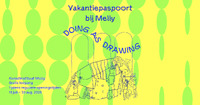 Holiday Passport 2026 - Doing as Drawing
Holiday Passport 2026 runs from 18 July to 30 August inclusive. The programme can be visited during our regular opening hours: Wednesday to Sunday, from 11:00 to 18:00.
Doing as Drawing
Join us this summer at Kunstinstituut Melly and discover the many possibilities of thinking through drawing. From 18 July to 30 August, children aged 4 to 12 can take part, free of charge, alongside their parents or carers, in an adventurous art programme full of play, imagination and discovery.
Be inspired by the exhibition Draw Withdraw Redraw, where drawing is so much more than just a pencil line on paper. Pick a card, follow a trail, build a story or discover how small choices can spark new ideas.
A world full of surprises awaits in the Space for Education and Participation. Help build a giant tent where you can explore, play and withdraw for a while. Create a secret garden for yourself or for someone else. Bring your drawings to life, invent new stories and discover what’s hidden in the many drawers, cupboards and secret nooks of the space. Behind every drawer lies a new task, question or surprise.
There’s no set route and no right or wrong answer. Follow your curiosity, try things out and respond to what others have left behind. Our art mediators will help you get started and invite you to explore the exhibition too.
WORKSHOP SERIES – DISTORTING IMPROVEMENT | JULY 2026
In July, Conform Cox will host a series of three free Saturday workshops where we’ll draw, imagine, and rethink the world around us, taking inspiration from the exhibition Draw Withdraw Redraw. Each workshop explores a question related to improving our everyday lives. In the first workshop, we’ll reimagine the human form; in the second, we’ll rethink our own living spaces; and in the third, we’ll turn our attention to Rotterdam.
The first workshop will be during the Festive Opening: Holiday Passport.
Workshop Programme July 2026
Workshop #1 — Distorting Improvement with Conform Cox: 18 July 2026
In this workshop, participants are invited to imagine how changing the human form could improve the world. Through drawing, posing, and playful experimentation, they will create unique characters that give shape to qualities, traits, and possibilities that are often difficult to see, but easy to imagine.
Workshop #2 — Distorting Improvement with Conform Cox: 25 July 2026
Participants are invited to rethink their living spaces by imagining what would make their room feel better, more exciting, or more inspiring. Through drawing and collage, they will transform familiar interiors into spaces that reflect their wishes, needs, and imagination.
Workshop #3 — Distorting Improvement with Conform Cox: 1 August 2026
How would you change Rotterdam to make it an even more beautiful place? Participants will transform parts of the city through drawing and imagination, creating new perspectives on familiar places and sharing their ideas for the future.
WORKSHOP SERIES – EMOTIONAL TREES IN A COLLECTIVE FOREST | AUGUST 2026
The second Free Saturday Workshop series of Holiday Passport 2026 – Doing as Drawing – will be hosted by Carmen José this August. In Emotional Trees in a Collective Forest, we will explore drawing beyond the academic canons of control and violence over the course of two Saturdays. Together, we will create a vibrant forest on large textiles, culminating in a collective installation hanging from the ceiling.
Workshop Programme August 2026
Workshop #1 — Emotional Trees in a Collective Forest with Carmen José: 8 August 2026
You are invited to draw a large, imaginary tree on textile—inspired by a tree from your window, a childhood memory, or your dreams. What is its name, and how is it feeling today? Together, we will build it from the ground up: starting with deep, entangled roots, moving up to a sturdy trunk, and expanding into branches and leaves that reach out and cross paths with others.
Workshop #2 — Emotional Trees in a Collective Forest with Carmen José: 15 August 2026
Next to the tree, you are invited to draw an imaginary person on textile, rooted in your memories or surroundings. Who are they, and what is their story? We will guide you from the feet up to the body, arms, and head. Are they barefoot or dressed for the cold? How do they move, and what expression do they wear on their face?
WORKSHOP SERIES - CULTIVATING ACTS OF COURAGE | AUGUST
The final free Saturday workshops as part of Holiday Passport 2026 – Doing as Drawing will be led by Elina Charinti. Cultivating Acts of Courage is a series that explores courage as a way to move forward, to refuse to conform and to find new paths. Using felt, drawings and natural materials, participants reflect on memories, values and communities, and create tangible objects that embody courage, resilience, care and hope. Courage becomes something that can be made, seen and touched!
WORKSHOP PROGRAMME AUGUST 2026
Workshop #1 — Cultivating Acts of Courage with Elina Charinti: 22 August 2026
In the first workshop, we will work with felt, natural materials, and drawing to reflect on the people, ideas, values, memories, smells, and flavours that sustain us. We will explore through making what keeps us moving and helps us navigate uncertainty and change, creating tactile pieces that celebrate the things that help us keep going and find our way through challenges.
Workshop #2 — Cultivating Acts of Courage with Elina Charinti: 29 August 2026
What helps us feel trust, safe enough to take a chance, try something new, or face uncertainty? In this workshop, we will create small "safety blankets" using needle-felting techniques. Inspired by the people, places, objects, and memories that offer comfort and support, these pieces will become personal reminders of trust, strength, and resilience.
Curators
Camille de Bruin
Series
Workshops and Collective Learning
<div class="